

On this page
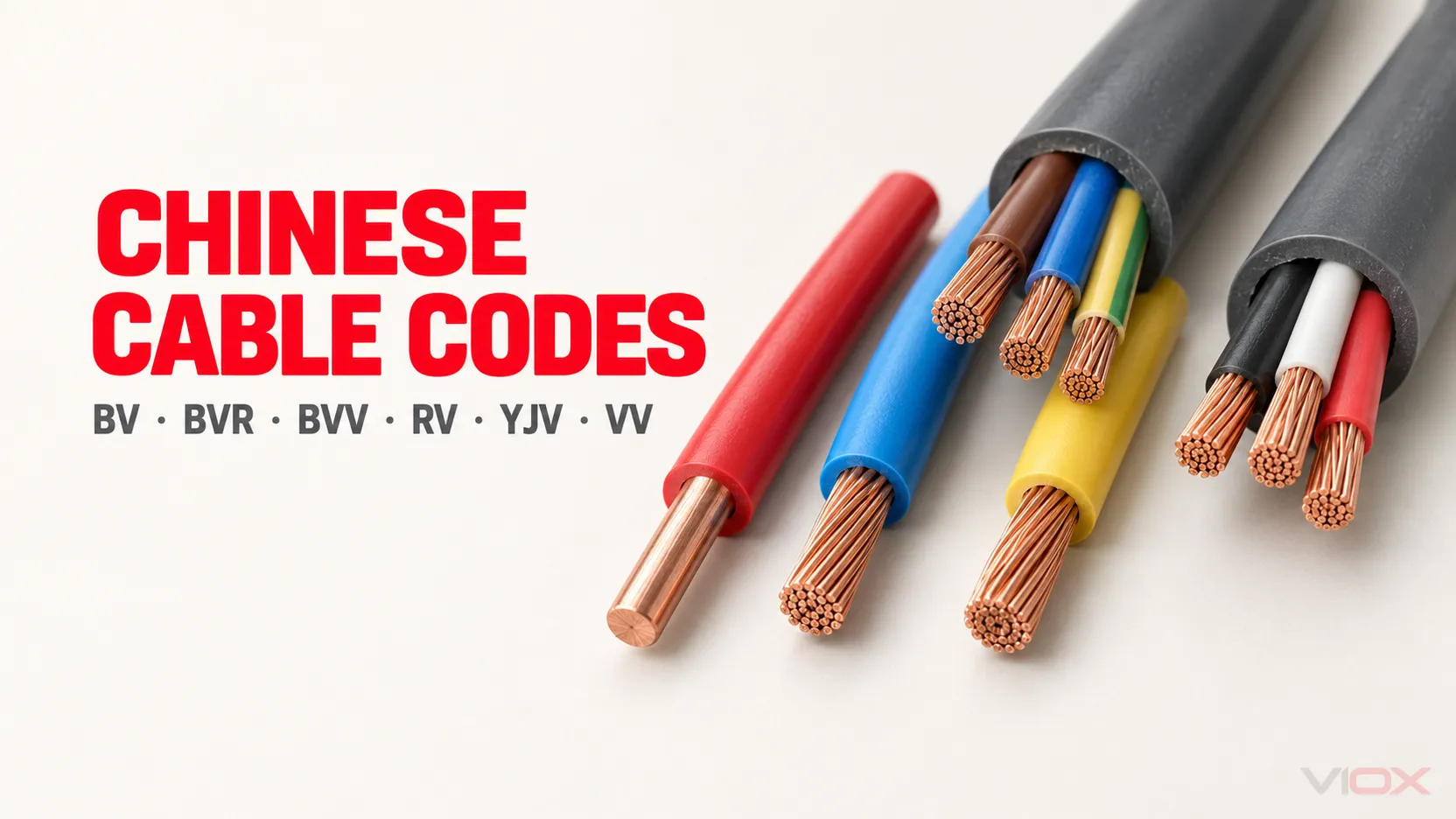
BV, BVR and RV identify PVC-insulated, non-sheathed wire families. BVV adds a PVC outer sheath. VV and YJV are power-cable designations: VV uses PVC insulation, while YJV uses cross-linked polyethylene (XLPE) insulation; both have PVC sheaths. Their differences involve conductor construction, insulation, sheath and product standard—not a single ranking from “basic” to “best.”
These codes commonly appear in Chinese cable schedules and export quotations. Use them to identify a product family, then read the complete designation, rated voltage, conductor specification and governing standard before approving a cable.
BV, BVR, BVV, RV, YJV and VV: Quick Comparison
| Code | Product family | Insulation / outer sheath | Main distinction to verify |
|---|---|---|---|
| BV | Non-sheathed copper wiring cable | PVC / no outer sheath | Rigid conductor construction; check whether the specified type is solid or stranded |
| BVR | Non-sheathed copper wiring cable of soft construction | PVC / no outer sheath | Stranded construction under its product specification; not automatically interchangeable with RV |
| RV | Single-core flexible-conductor wiring cable | PVC / no outer sheath | Complete type identifies general-purpose or internal-wiring requirements |
| BVV | PVC-sheathed wiring cable | PVC / PVC | Additional sheath and a different product family from non-sheathed wire |
| YJV | Copper-conductor power cable | XLPE / PVC | XLPE conductor insulation; voltage, cores and installation duty remain separate fields |
| VV | Copper-conductor power cable | PVC / PVC | PVC conductor insulation; do not confuse it with BVV solely because both use PVC |
The table describes base families, not every size or variant. The Beijing market regulator’s model list records the material names; CNCA’s certification-unit table distinguishes the complete model and standard routes for the wiring products.
Read the Layers Before Comparing the Letters
Conductor insulation surrounds an individual conductor. An outer sheath surrounds the cable assembly and contributes to its protection in the declared environment. A PVC-insulated wire without a sheath and a PVC-insulated, PVC-sheathed cable therefore have different constructions even when their copper areas match.
In the designations discussed here, V denotes PVC in the relevant insulation or sheath position, YJ denotes XLPE insulation, and R indicates a flexible or soft-conductor construction within its product family. Read the whole code: a repeated V identifies two material positions, while a B-family wiring cable and a power cable can still fall under different standards.
An outer sheath is not an armor layer. Neither BVV nor a base YJV/VV designation alone establishes resistance to crushing, direct burial suitability or a particular outdoor exposure. Obtain the actual construction and installation declaration.
BV vs BVR vs RV: Conductor Construction and Product Type
BV: “Rigid” is not always “solid”
BV is often illustrated as one solid copper conductor. That is a useful example, but an incomplete definition. Rigid conductors can be solid or stranded; the actual construction depends on the complete type and size. IEC 60228:2023 treats conductor cross-sectional area and construction requirements as related but distinct characteristics.
For a specification, record the conductor class or permitted construction as well as the nominal area. “BV, 10 mm²” does not answer every question about the conductor that must fit the terminal.
BVR: check the construction instead of assigning a class from the name
BVR identifies soft-construction PVC-insulated copper wiring cable. Its designation is listed under the JB/T 8734.2 route, whereas the 60227 IEC RV types follow a different product route. A quote for BVR should state the conductor construction, voltage and standard explicitly.
Do not approve BVR as RV—or assign it IEC Class 5—solely because it contains multiple copper strands. The specification must establish the relevant construction and resistance requirements.
RV: flexible conductor does not mean continuous-flex cable
RV appears in complete types such as 60227 IEC 02, 06 and 08, with different general-purpose or internal-wiring definitions. Flexibility helps handling and routing, but it does not by itself establish suitability for repeated movement, drag chains or a portable appliance cord.
It also does not automatically prohibit fixed wiring. IEC 60227-3:2024 covers single-core, non-sheathed PVC cables for fixed wiring. Identify the complete RV type and then check the applicable installation requirements.
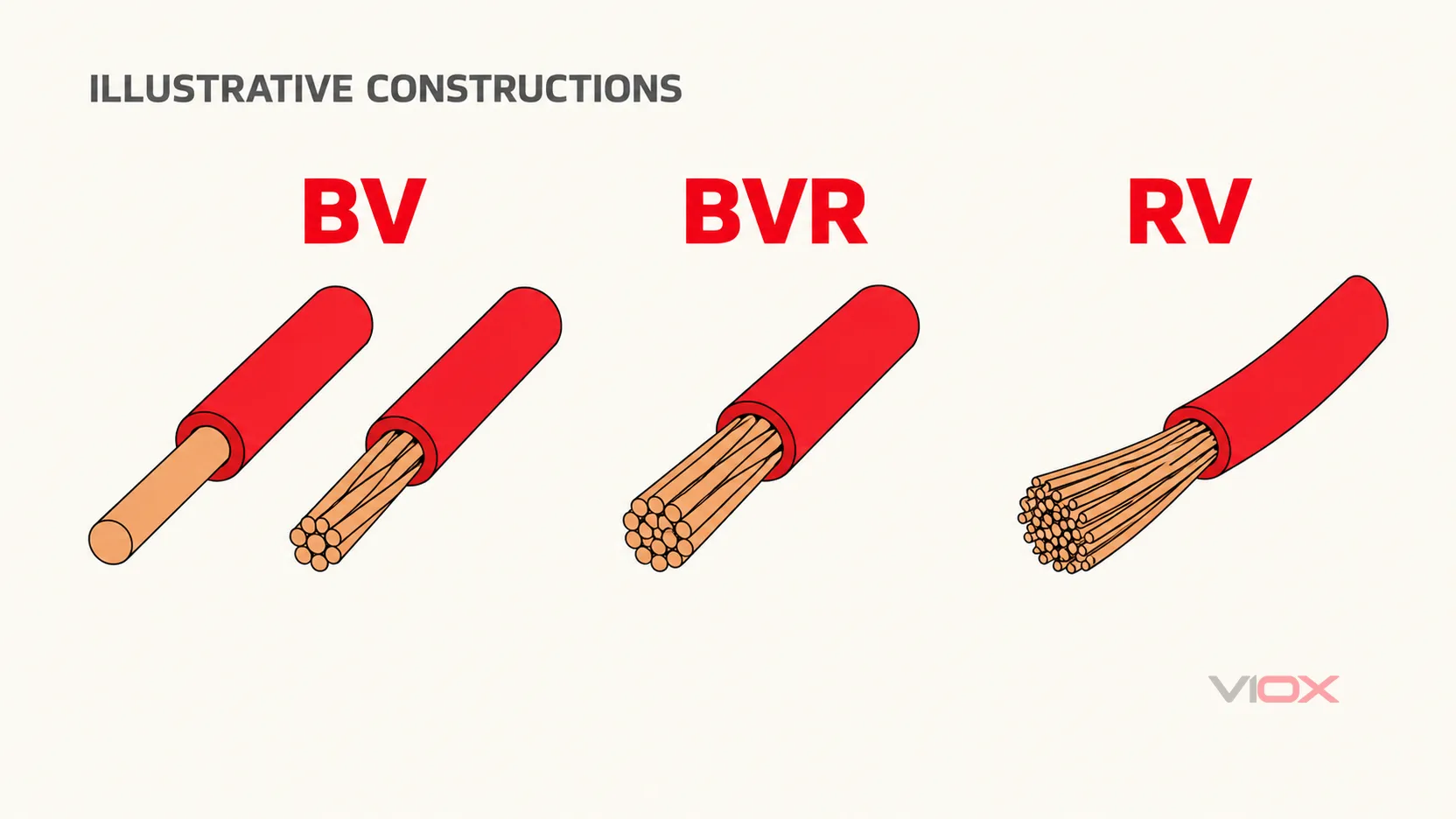
Illustrative samples only. BV can also have a stranded rigid conductor. The drawn strand counts and dimensions are not specifications or an IEC class assignment.
BVV vs VV: Similar Materials, Different Product Families
BVV and VV both use PVC insulation and PVC sheathing, but their matching material names do not make them interchangeable.
BVV is a sheathed wiring-cable family. Its complete designation may follow the GB/T 5023.4 route or the applicable JB/T route. IEC 60227-4:2024, the international sheathed fixed-wiring part, specifically covers light PVC-sheathed cables rated 300/500 V. Do not turn the broader series title into a claim that every BVV cable is rated 450/750 V.
VV is a power-cable designation. Compare its voltage grade, construction and product standard with the circuit duty. Material descriptions alone do not establish insulation thickness, test requirements, environmental suitability or an acceptable replacement.
YJV vs VV: XLPE Insulation vs PVC Insulation
The principal material difference is the conductor insulation: YJV uses XLPE; VV uses PVC. Both base designations have PVC outer sheaths.
That insulation choice can affect thermal performance and cable sizing, but it does not produce one universal ampacity or a guaranteed “safer” cable. The actual rating depends on the specified cable, installation method, ambient conditions, grouping and connected equipment. The allowed terminal temperature may also constrain the circuit.
For the relevant low-voltage power-cable scope, GB/T 12706.1-2020 remains the current Chinese standard for its declared 1 kV and 3 kV categories, as checked on 8 October 2026. The letters YJV alone do not fix one voltage grade.
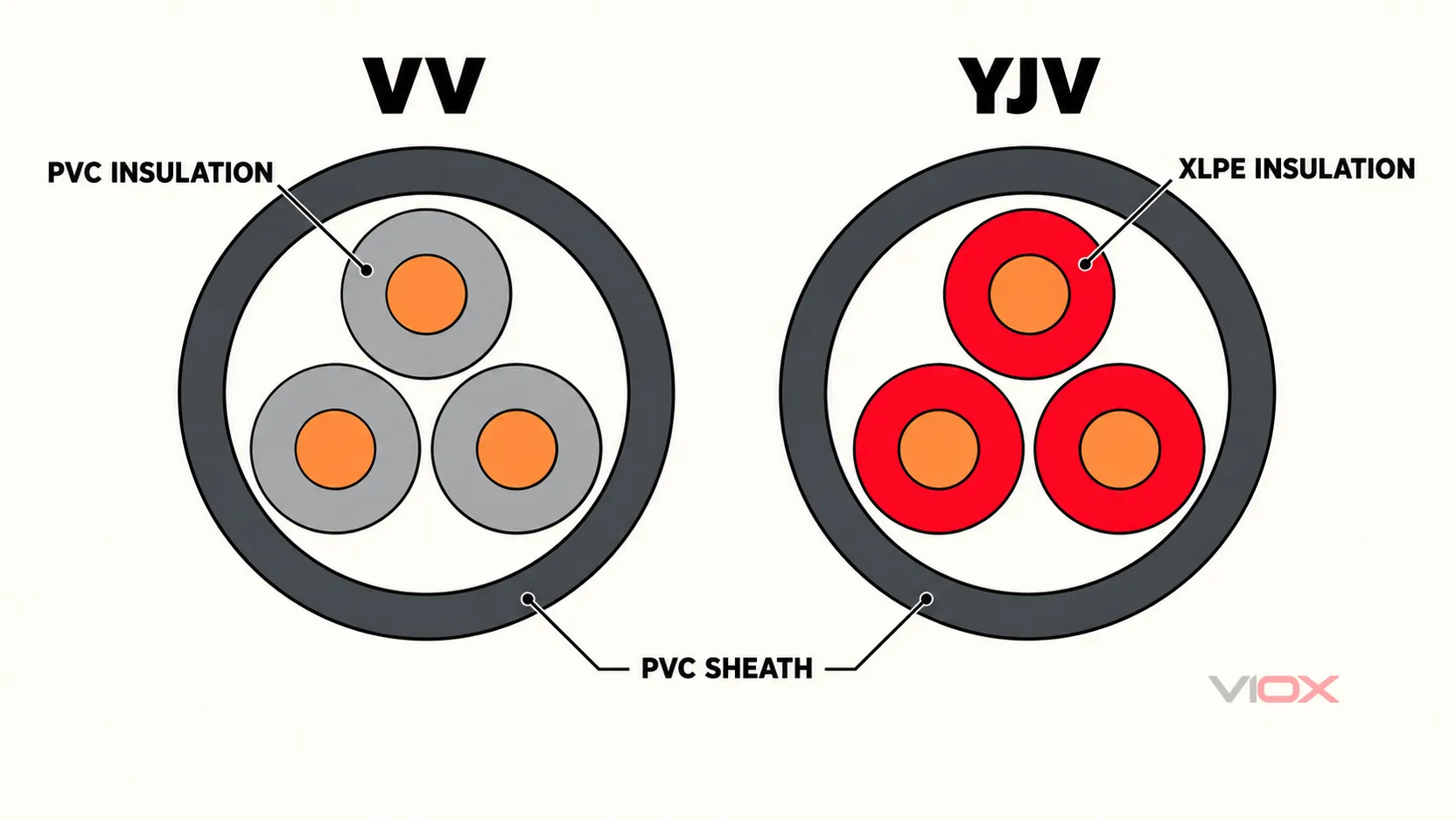
Conceptual layer comparison for otherwise similar samples. Colors identify insulation materials; they are not prescribed conductor colors. Core counts, fillers and layer thicknesses vary by product.
XLPE insulation does not make YJV a low-smoke, halogen-free cable
The PVC sheath still matters. A cable with XLPE conductor insulation and a PVC jacket cannot be assumed to be low-smoke, zero-halogen (LSZH). UL’s cable-material guidance identifies PVC as a potential halogen source.
Flame retardance, fire resistance/circuit integrity, smoke emission and halogen content describe different performance requirements. Ask for the required designation and test evidence rather than infer all four from “YJV” or “VV.” UL’s HF and LSHF guidance also distinguishes halogen and smoke assessments.
The Complete Designation Determines the Standard Route
Use this crosswalk when reviewing a cable quotation:
| Marking or family | Chinese product-standard route to check | Interpretation limit |
|---|---|---|
| 60227 IEC 01/05/07 with BV or BV-90 | GB/T 5023.3 | The full number distinguishes the type; BV alone is incomplete |
| 60227 IEC 02/06/08 with RV or RV-90 | GB/T 5023.3 | General-purpose and internal-wiring variants must not be collapsed into one use |
| BV or BVR under the national industry route | JB/T 8734.2 | Verify the actual product definition and construction |
| 60227 IEC 10 (BVV), or BVV under the industry route | GB/T 5023.4 or JB/T 8734.2, as declared | The same short name is not proof of identical construction |
| YJV or VV power cable | Applicable GB/T 12706 part and voltage grade | Confirm the full specification rather than assume all power cables have the same rating |
The wiring-product routes are identified in the CNCA table linked above. A current IEC publication and a Chinese national adoption can have different edition dates; record the exact standard and edition used for the offered product.
China Compulsory Certification (CCC) should be checked where the product falls within the applicable certification catalogue. Do not extrapolate the wiring-product table into a claim that every YJV/VV power cable carries, or must carry, the same CCC certification.
Which Type Should Be Used in a Home?
For a residential project in China, start with the approved wiring design and installation method. If it specifies insulated singles in conduit, evaluate the permitted non-sheathed wiring types and their complete ratings. If it specifies a sheathed cable or a distribution feeder, evaluate that product family instead. Conductor flexibility can help routing, but terminal compatibility and the permitted installation still govern.
For a home in another country, specify the cable type accepted by that country’s rules. These Chinese codes are useful for interpreting a supplier’s offer; they do not establish permission to install it locally. A six-code comparison cannot determine circuit size, protective-device rating or the required fire performance without the project conditions.
Overseas Equivalents and Terminal Compatibility
Do not write a substitution schedule based only on rules such as “BV = THHN,” “RV = H07V-K” or “BVV = NYM.” A candidate may resemble another cable in insulation or use while differing in its standard, construction, testing, marking or installation permissions. The UL Wire and Cable Application Guide illustrates why cable type markings and use conditions must be read together for the North American market.
Check the connection as well as the cable. A terminal’s accepted area range may differ for solid, stranded, fine-stranded and ferruled conductors. Use the VIOX terminal block selection guide to review the clamp and preparation requirements. A ferrule is appropriate only where the terminal instructions support that conductor and ferrule combination.
Nominal copper area is also different from cable outside diameter. Use the actual overall diameter for enclosure entries and glands. For mixed-unit documents, the AWG to mm² conversion reference helps compare area without implying cable equivalence.
Worked Example: What a Cable Marking Tells You
Consider this illustrative procurement line:
YJV — 0.6/1 kV — 4 × 16 mm² — GB/T 12706.1-2020It identifies an XLPE-insulated, PVC-sheathed power-cable family, a stated voltage grade, four cores with 16 mm² nominal conductor area each, and a declared product standard. It does not tell you the circuit’s allowable current, whether a core is neutral or protective earth, the installation method, the termination arrangement or a fire-performance classification.
Complete the procurement record before approving the offer:
| Required field | Evidence to record |
|---|---|
| Complete designation and standard | Full model, product standard and edition; any fire-performance requirement |
| Conductor | Material, construction/class, nominal area and resistance compliance |
| Electrical and thermal ratings | Declared voltage and temperature limits for the offered type |
| Cable construction | Core count, identification, insulation, sheath and any armor/screen |
| Installation conditions | Permitted route, environment, bending limits and mechanical protection |
| Circuit calculation | Load, derating, voltage drop, fault withstand and protective-device coordination |
| Connection | Terminal/lug compatibility, preparation instructions and cable outside diameter |
| Market acceptance | Applicable certificate or test evidence for the destination and exact offered product |
For a machine-control-panel circuit, continue with the IEC cable-sizing guide. A residential circuit needs the applicable building-installation rules instead of a machine-panel sizing assumption.
Technical References
- SAMR/CNCA — Compulsory Certification Implementation Rules for Electric Wires and Cables, CNCA-C01-01:2024
- IEC 60227-3:2024 — Non-sheathed cables for fixed wiring
- IEC 60227-4:2024 — Sheathed cables for fixed wiring
- IEC 60228:2023 — Conductors of insulated cables
- SAMR — GB/T 12706.1-2020 official standard record