


Residual Current Breakers with Overcurrent Protection (RCBO)
Compare VIOX RCBO series by rated current, pole configuration, breaking capacity and rated residual operating current for combined circuit protection.
Combined protectionLeakage and overcurrent
Pole optionsConfirm by series
Breaking capacityMatch the fault level
SensitivityConfirm IΔn by model
What is an RCBO?
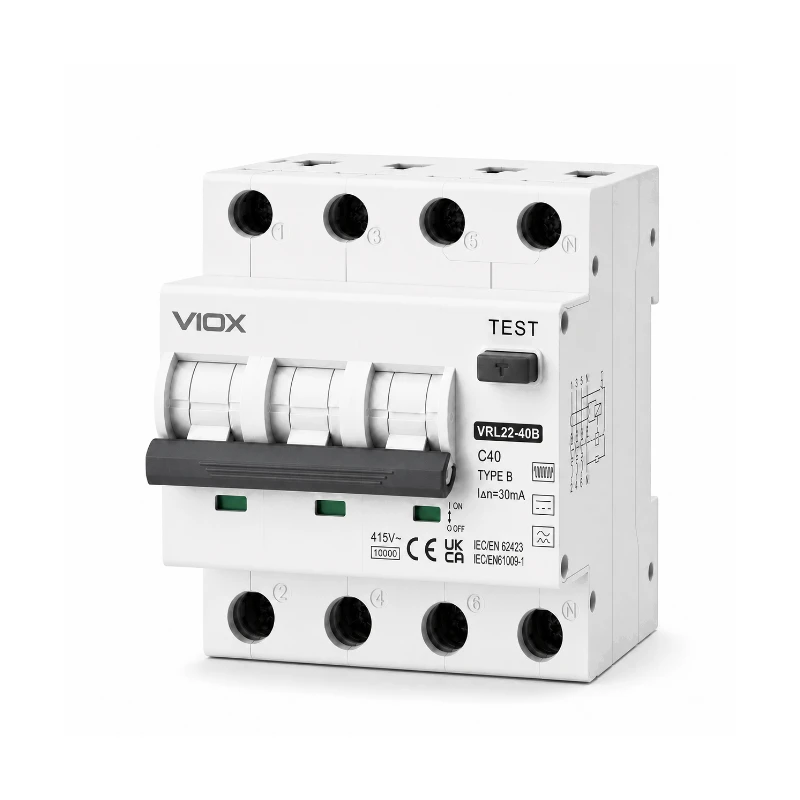
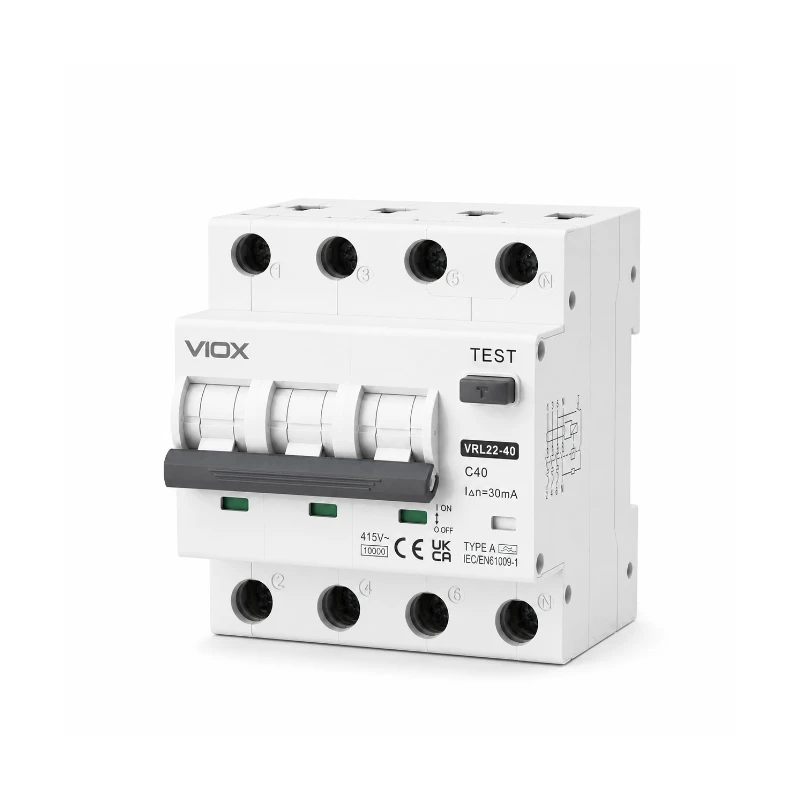
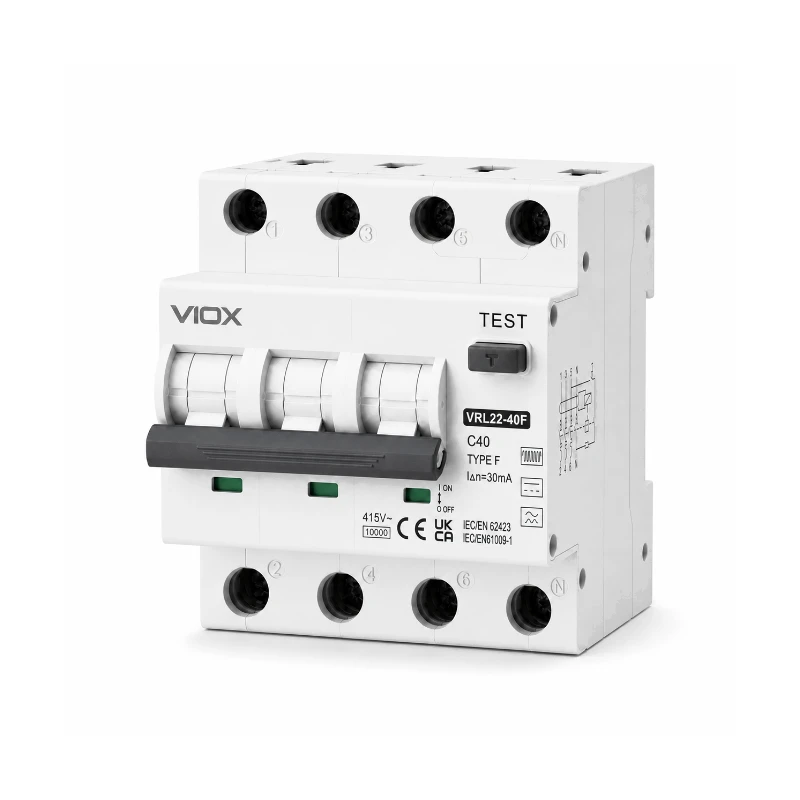
An RCBO combines residual-current detection with overload and short-circuit protection in one device. It can disconnect the circuit when earth leakage or an overcurrent fault exceeds the device operating characteristics.
Selection must consider both protection functions. Rated current, breaking capacity, pole arrangement, trip curve, rated residual operating current and residual-current type must match the circuit and connected load.
RCBO Series Overview
Compare ratings, pole configurations and residual-current types.
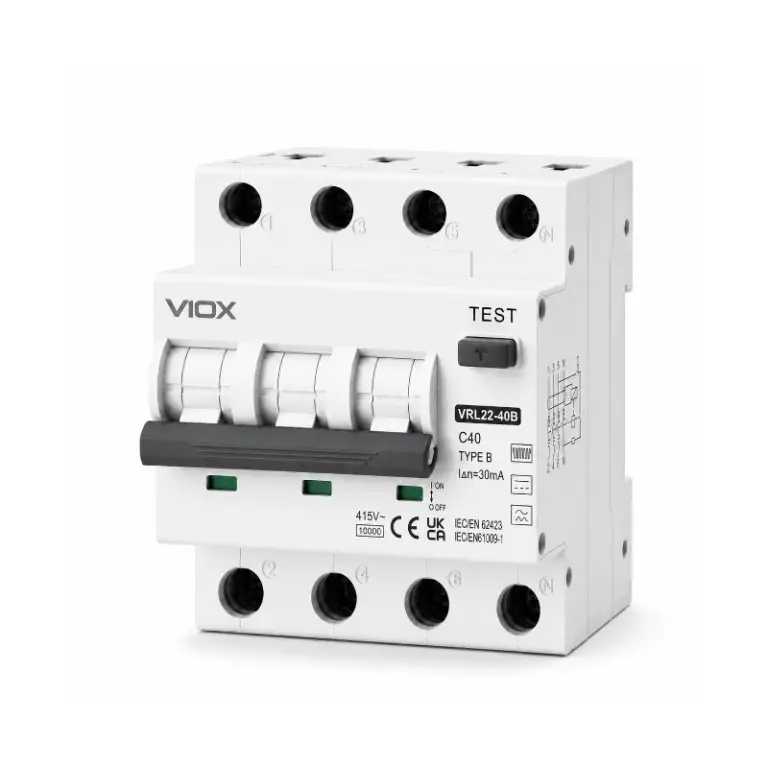
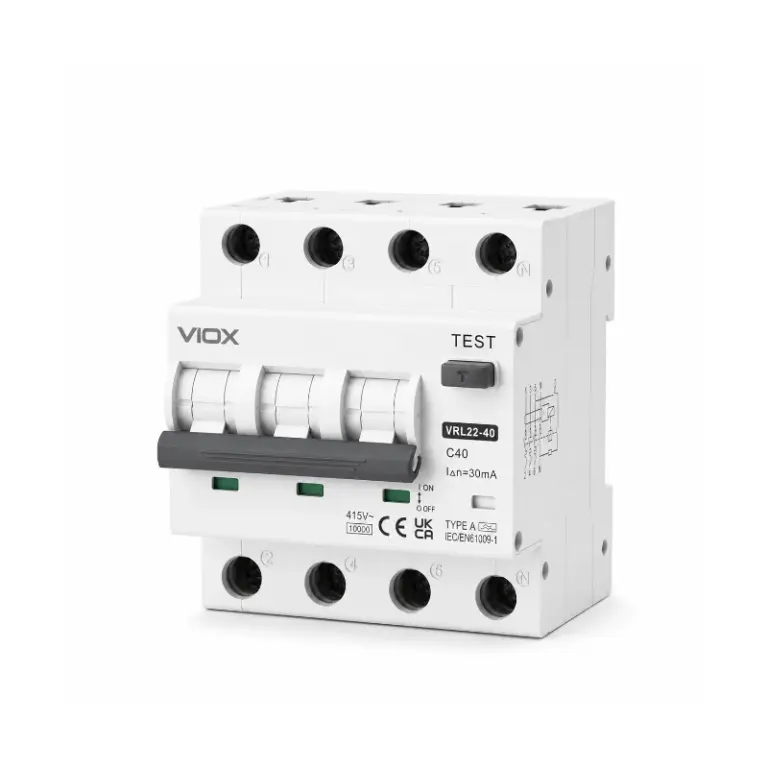
VIOX VRL22B
Residual current breaker with overcurrent protection- Rated Current
- 6-63 A
- Residual Current
- 30-500 mA
- Pole Configuration
- 2P, 4P
- Short-Circuit Rating
- 6 kA or 10 kA
VIOX VRL22
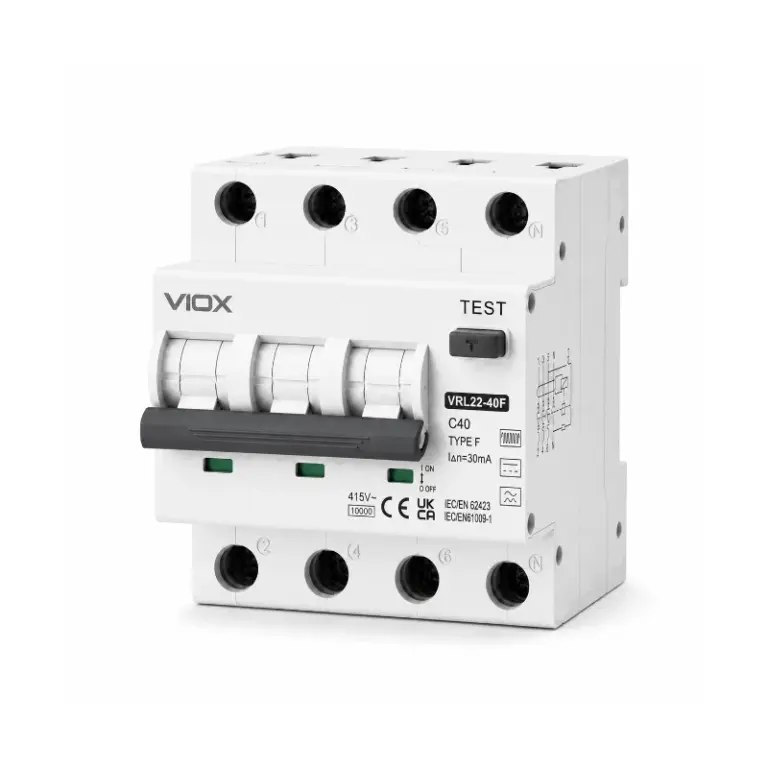
Residual current breaker with overcurrent protection- Rated Current
- 2-63 A
- Residual Current
- 10-500 mA
- Pole Configuration
- 1P+N, 3P+N
- Breaking Capacity
- 6 kA or 10 kA
VIOX VRL22F
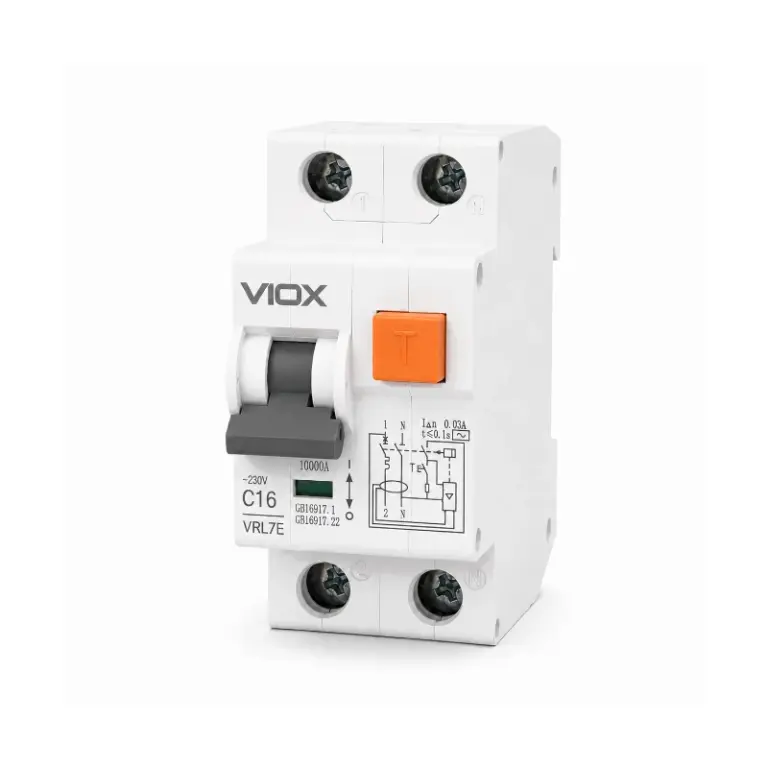
Residual current breaker with overcurrent protection- Rated Current
- 2-63 A
- Residual Current
- 10-300 mA
- Pole Configuration
- 2P, 4P
- Short-Circuit Rating
- 6 kA or 10 kA
VIOX VRL7E
Residual current breaker with overcurrent protection- Rated Current
- 2-40 A
- Residual Current
- 10, 30, 100 mA
- Pole Configuration
- 1P+N
- Breaking Capacity
- 4.5 kA
Compare the four RCBO series
Start with the required residual-current type, then check the current rating, poles and short-circuit specification for your circuit.
| Selection factor | VRL7E | VRL22 | VRL22F | VRL22B |
|---|---|---|---|---|
| Residual-current type | Type AC | Type AC / A / ASi | Type F | Type B / B+ |
| Rated current | 2–40 A | 2–63 A | 2–63 A | 6–63 A |
| Sensitivity IΔn | 10 / 30 / 100 mA | 10–500 mA | 10–300 mA | 30–500 mA |
| Pole configuration | 1P+N | 1P+N / 3P+N | 2P / 4P | 2P / 4P |
| Rated voltage | 230 V AC | 230/240 V; 400/415 V AC | 230/240 V; 400/415 V AC | 230/240 V; 400/415 V AC |
| Short-circuit specification | 4.5 kA breaking capacity | 6 kA or 10 kA breaking capacity | 6 kA or 10 kA conditional short-circuit current | 6 kA or 10 kA conditional short-circuit current |
| Model specifications | View VRL7E | View VRL22 | View VRL22F | View VRL22B |
The 10 mA option is limited to VRL22 1P+N and VRL22F 2P models rated up to 32 A. Ranges cover different variants, not every combination. Conditional short-circuit current is not interchangeable with breaking capacity: confirm the rating definition and any required backup protection for the ordered model.
RCBO applications
Match the residual-current response to your equipment, from conventional AC circuits to inverter-controlled loads.
VRL22B Type B protection for power-conversion equipment
Consider VRL22B where the installation requires detection of smooth DC as well as AC and pulsating DC residual currents. Select the B or B+ variant against the equipment’s frequency requirements.
For AC EV charging, confirm the charger’s built-in DC detection first. A suitable Type A device with compliant 6 mA RDC-DD protection may be an alternative to Type B, subject to the charger instructions and local rules.
View VRL22B Type B RCBOVRL7EConventional AC final circuits
For 230 V lighting and distribution circuits where Type AC is permitted and suitable for the connected load. Confirm the 4.5 kA breaking capacity against the circuit fault level.
View VRL7EVRL22Residential & commercial distribution
Choose AC, A or ASi according to the connected equipment. Confirm the required neutral arrangement and any short-time-delay or selectivity requirement.
View VRL22VRL22FSingle-phase inverter-controlled equipment
Consider Type F for suitable inverter-controlled air conditioning or pump circuits with mixed-frequency residual currents. Type F does not detect smooth DC fault current.
View VRL22FApplication examples, not wiring diagrams. Final selection depends on the equipment instructions, circuit design and applicable rules. Type B residual-current detection does not make VRL22B suitable for a DC fast charger’s DC output circuit.
Not sure which RCBO fits your circuit?
Find candidate series and prepare your specification.
Enable JavaScript to use the selector, or compare the models and catalogs on this page.
Candidate series
Preliminary matching only. Unknown parameters and installation coordination still require verification.
Checks before ordering
Why other series were excluded
View full specification
RCBO catalogs & technical details
Open the series catalog to review dimensions, operating characteristics and available configurations.
VRL7E
Type AC
2–40 A · 1P+N
VRL22
Type AC / A / ASi
2–63 A · 1P+N / 3P+N
VRL22F
Type F
2–63 A · 2P / 4P
VRL22B
Type B / B+
6–63 A · 2P / 4P
RCBO Selection Questions
Quick answers for preliminary product-family comparison before detailed circuit verification.
What protection does an RCBO provide?
An RCBO combines residual-current protection with overload and short-circuit protection. The exact ratings and residual-current characteristics vary by model.
How is an RCBO different from an RCCB?
An RCCB is selected for residual-current protection and normally requires separate overcurrent protection. An RCBO combines residual-current and overcurrent protection in one device.
Which RCBO ratings should be checked?
Confirm rated current, poles, circuit voltage, breaking capacity, trip curve, rated residual operating current and residual-current type.
Can every RCBO be used on a DC circuit?
No. Use only a model whose voltage, polarity, poles and AC or DC ratings are explicitly suitable for the circuit.
Does RCBO type matter with electronic loads?
Yes. Connected electronic equipment can affect the residual-current waveform, so the correct device type must be selected from the product documentation and applicable installation rules.
Need the Right RCBO?
Let’s Confirm It Together.
Send the circuit voltage, rated current, poles, breaking capacity, sensitivity, connected loads, quantity and target market. VIOX will help identify a suitable series for your project.
Request RCBO Support