On this page
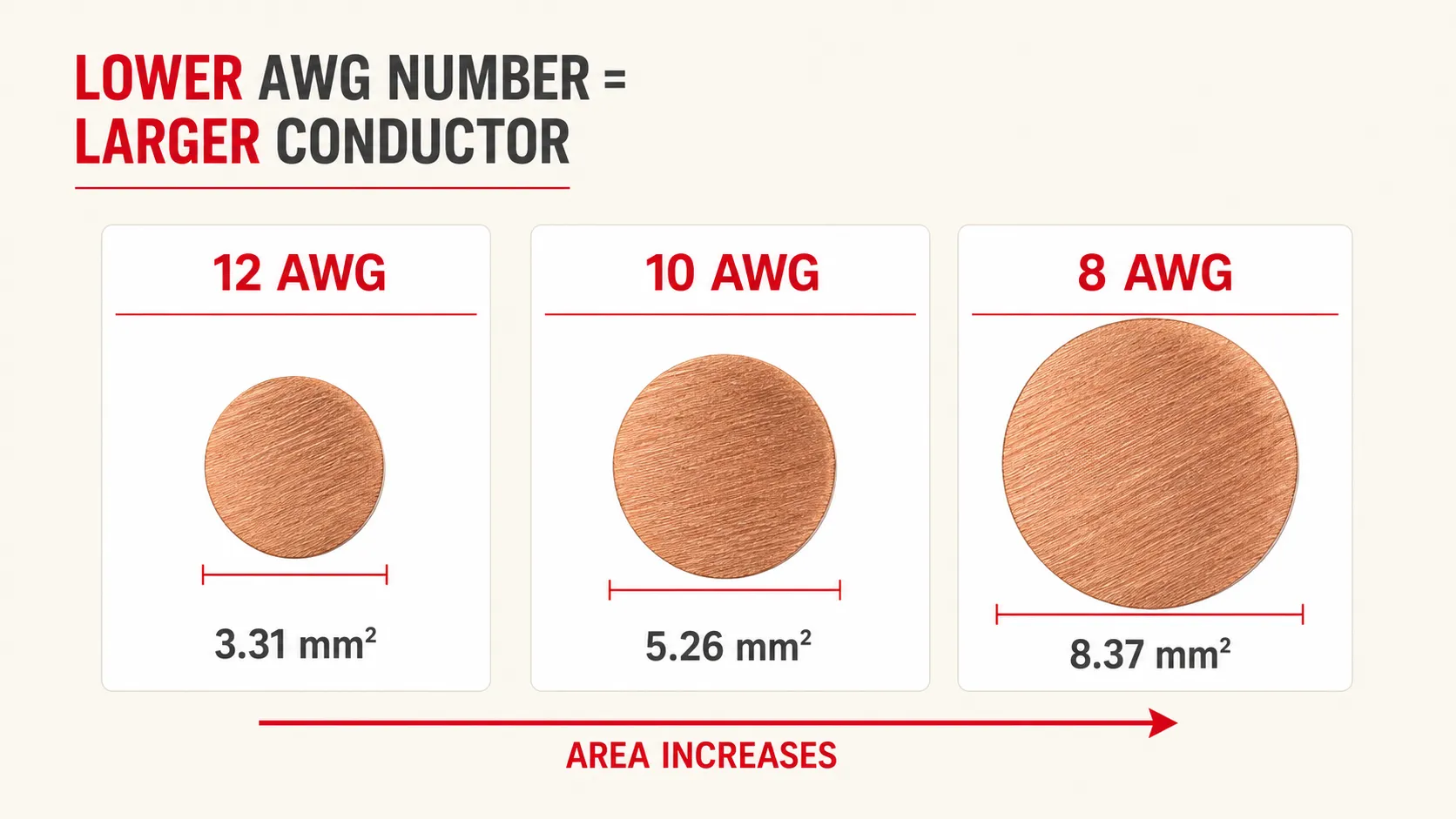
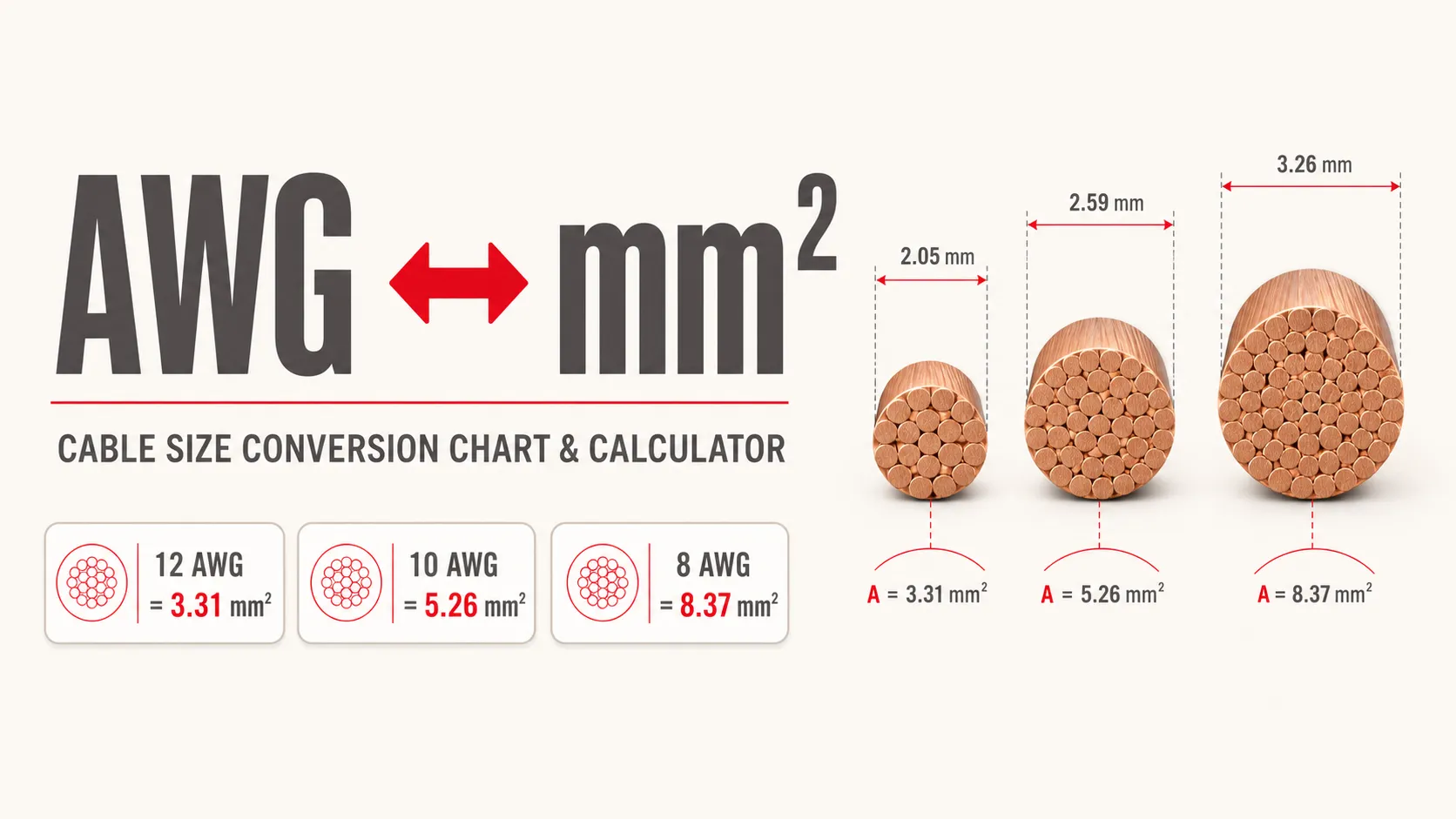
To convert AWG to mm², use the conductor's actual cross-sectional area rather than treating AWG and metric sizes as interchangeable labels. For example, 12 AWG is 3.31 mm², 10 AWG is 5.26 mm², and 8 AWG is 8.37 mm². In the opposite direction, 2.5 mm² is closest to 13 AWG, while 14 AWG is only 2.08 mm².
Use the VIOX converter below to obtain the theoretical gauge, nearest standard AWG size, and the next AWG size that is not smaller than the entered metric area.
Important: A mathematical conversion is not automatically an ampacity, code, terminal, or cable replacement approval. Conductor material, insulation temperature, installation method, ambient temperature, grouping, voltage drop, and local electrical rules must still be checked.
Quick AWG to mm² Answers
| Search query | Exact or nearest result | Engineering note |
|---|---|---|
| 1.5 mm² to AWG | 15 AWG is 1.65 mm² | 16 AWG is only 1.31 mm² and is smaller by area |
| 2.5 mm² to AWG | 13 AWG is 2.62 mm² | 14 AWG is 2.08 mm² and is smaller by area |
| 4 mm² to AWG | 11 AWG is 4.17 mm² | 12 AWG is 3.31 mm² |
| 6 mm² to AWG | 9 AWG is 6.63 mm² | 10 AWG is 5.26 mm² |
| 10 mm² to AWG | 7 AWG is 10.5 mm² | 8 AWG is 8.37 mm² |
| 8 AWG to mm² | 8.37 mm² | Nominal area, not cable outside diameter |
| 10 AWG to mm² | 5.26 mm² | Nominal solid conductor diameter: 2.588 mm |
| 12 AWG to mm² | 3.31 mm² | Nominal solid conductor diameter: 2.053 mm |
| 14 AWG to mm² | 2.08 mm² | Nominal solid conductor diameter: 1.628 mm |
| 16 AWG to mm² | 1.31 mm² | Nominal solid conductor diameter: 1.291 mm |
Odd-numbered sizes such as 13, 11, 9, and 7 AWG are mathematically valid but may be less readily available than even-numbered building-wire sizes. Availability does not change the conversion; it changes which commercially available cable must be evaluated for the installation.
Complete AWG to mm² Conversion Chart
The table below gives the nominal cross-sectional area and nominal diameter of a solid round conductor. For stranded cable, the total conductive area may correspond to the AWG size, but the finished conductor and cable outside diameters will be larger.
| AWG size | Area (mm²) | Solid conductor diameter (mm) |
|---|---|---|
| 40 | 0.00501 | 0.0799 |
| 39 | 0.00632 | 0.0897 |
| 38 | 0.00797 | 0.1007 |
| 37 | 0.0100 | 0.1131 |
| 36 | 0.0127 | 0.1270 |
| 35 | 0.0160 | 0.1426 |
| 34 | 0.0201 | 0.1601 |
| 33 | 0.0254 | 0.1798 |
| 32 | 0.0320 | 0.2019 |
| 31 | 0.0404 | 0.2268 |
| 30 | 0.0509 | 0.2546 |
| 29 | 0.0642 | 0.2859 |
| 28 | 0.0810 | 0.3211 |
| 27 | 0.102 | 0.3606 |
| 26 | 0.129 | 0.4049 |
| 25 | 0.162 | 0.4547 |
| 24 | 0.205 | 0.5106 |
| 23 | 0.258 | 0.5733 |
| 22 | 0.326 | 0.6438 |
| 21 | 0.410 | 0.7229 |
| 20 | 0.518 | 0.8118 |
| 19 | 0.653 | 0.9116 |
| 18 | 0.823 | 1.024 |
| 17 | 1.04 | 1.150 |
| 16 | 1.31 | 1.291 |
| 15 | 1.65 | 1.450 |
| 14 | 2.08 | 1.628 |
| 13 | 2.62 | 1.828 |
| 12 | 3.31 | 2.053 |
| 11 | 4.17 | 2.305 |
| 10 | 5.26 | 2.588 |
| 9 | 6.63 | 2.906 |
| 8 | 8.37 | 3.264 |
| 7 | 10.5 | 3.665 |
| 6 | 13.3 | 4.115 |
| 5 | 16.8 | 4.621 |
| 4 | 21.2 | 5.189 |
| 3 | 26.7 | 5.827 |
| 2 | 33.6 | 6.544 |
| 1 | 42.4 | 7.348 |
| 1/0 | 53.5 | 8.251 |
| 2/0 | 67.4 | 9.266 |
| 3/0 | 85.0 | 10.405 |
| 4/0 | 107.2 | 11.684 |
In AWG notation, a smaller gauge number means a larger conductor. After 1 AWG, sizes progress through 1/0, 2/0, 3/0, and 4/0. The term 4/0 is commonly pronounced “four aught.”
Common mm² to AWG Conversion Chart
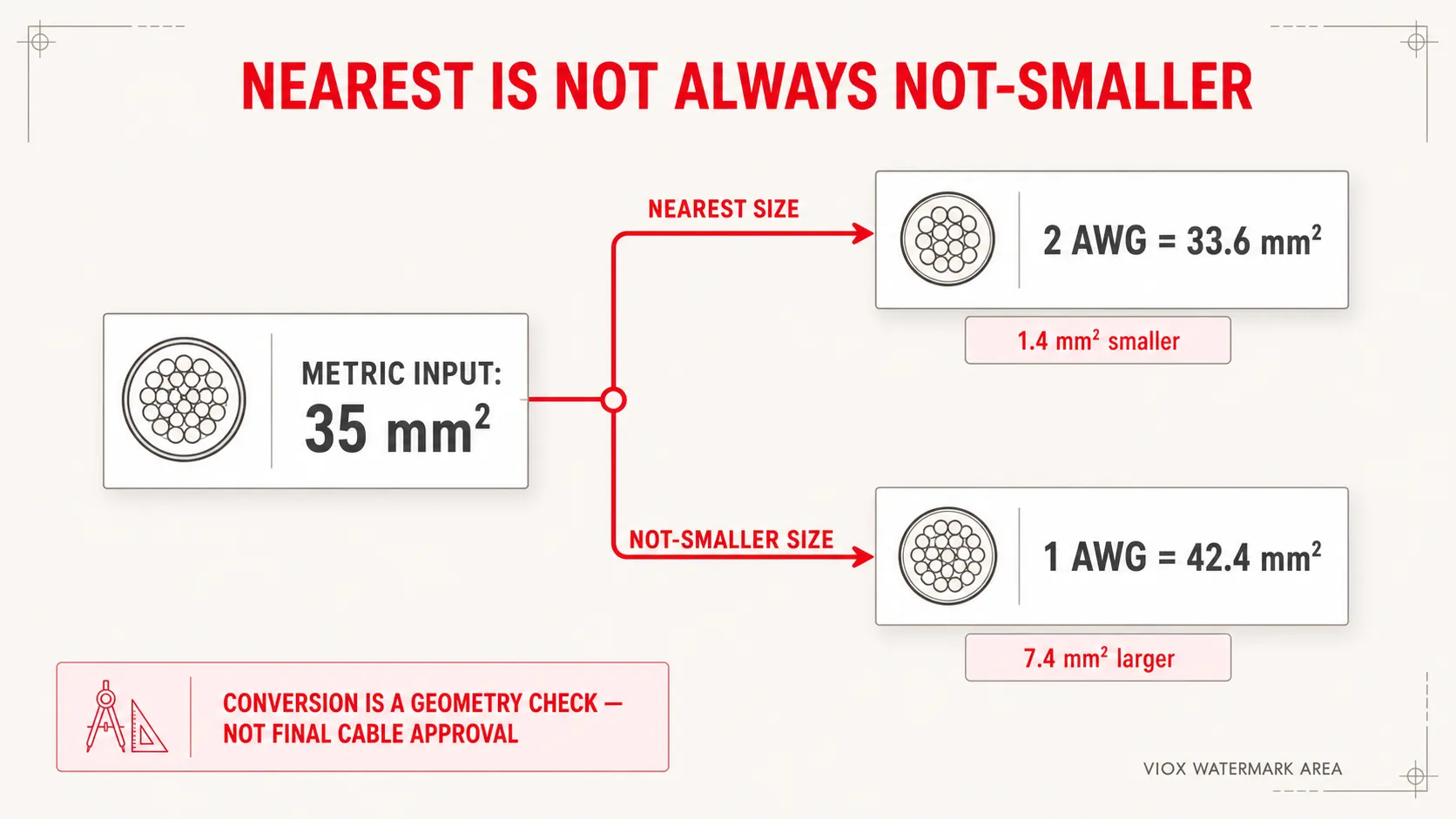
There are two useful answers when converting a metric conductor size:
- Nearest AWG minimizes the mathematical difference in cross-sectional area.
- Not-smaller AWG has an area equal to or greater than the metric input.
These answers can differ. The not-smaller result is a useful screening reference, but it still does not establish electrical-code equivalence.
| Metric size (mm²) | Nearest AWG | Nearest AWG area (mm²) | Not-smaller AWG | Not-smaller area (mm²) |
|---|---|---|---|---|
| 0.5 | 20 | 0.518 | 20 | 0.518 |
| 0.75 | 18 | 0.823 | 18 | 0.823 |
| 1.0 | 17 | 1.04 | 17 | 1.04 |
| 1.5 | 15 | 1.65 | 15 | 1.65 |
| 2.5 | 13 | 2.62 | 13 | 2.62 |
| 4 | 11 | 4.17 | 11 | 4.17 |
| 6 | 9 | 6.63 | 9 | 6.63 |
| 10 | 7 | 10.5 | 7 | 10.5 |
| 16 | 5 | 16.8 | 5 | 16.8 |
| 25 | 3 | 26.7 | 3 | 26.7 |
| 35 | 2 | 33.6 | 1 | 42.4 |
| 50 | 1/0 | 53.5 | 1/0 | 53.5 |
| 70 | 2/0 | 67.4 | 3/0 | 85.0 |
| 95 | 3/0 | 85.0 | 4/0 | 107.2 |
For metric areas above 107.2 mm², 4/0 AWG is smaller than the entered area. Large North American conductors are normally specified in circular mils, such as 250 kcmil, rather than continuing the AWG series indefinitely.
How AWG to mm² Conversion Works
American Wire Gauge is a logarithmic system. For gauge number n, the nominal solid-wire diameter is:
d(inches) = 0.005 × 92^((36 − n) / 39)
After converting the diameter to millimeters, conductor area is calculated from the area of a circle:
A(mm²) = π × d² / 4
The combined area equation is approximately:
A(mm²) = 0.012668 × 92^((36 − n) / 19.5)
For 1/0, 2/0, 3/0, and 4/0, use gauge numbers 0, −1, −2, and −3 respectively in the formula.
Example: Convert 12 AWG to mm²
The nominal diameter of 12 AWG solid wire is approximately 2.053 mm.
A = π × 2.053² / 4
A ≈ 3.31 mm²
Therefore, 12 AWG equals approximately 3.31 mm².
Example: Convert 2.5 mm² to AWG
The theoretical result lies close to 13 AWG. Comparing standard areas:
- 14 AWG = 2.08 mm², which is 16.8% smaller than 2.5 mm².
- 13 AWG = 2.62 mm², which is 4.8% larger than 2.5 mm².
Therefore, 13 AWG is the nearest standard AWG by conductor area. If only commonly stocked even-numbered sizes are available, do not automatically substitute 12 or 14 AWG. Recheck the circuit using the applicable ampacity, terminal, cable, and installation requirements.
Why AWG and Metric Cable Sizes Are Not Exact Equivalents
AWG and IEC metric sizes come from different standardization systems. ASTM B258 specifies nominal diameters and cross-sectional areas for AWG solid round electrical conductors. IEC 60228:2023 specifies nominal metric cross-sectional areas and conductor requirements for insulated power cables and cords.
The metric series includes sizes such as 1.5, 2.5, 4, 6, 10, and 16 mm². The AWG series follows a fixed logarithmic progression. Their values therefore fall near one another at some points but almost never match exactly.
For example:
| Comparison | Area difference |
|---|---|
| 14 AWG vs 2.5 mm² | 14 AWG is approximately 16.8% smaller |
| 12 AWG vs 4 mm² | 12 AWG is approximately 17.3% smaller |
| 10 AWG vs 6 mm² | 10 AWG is approximately 12.3% smaller |
| 8 AWG vs 10 mm² | 8 AWG is approximately 16.3% smaller |
This is why a conversion chart should be used to compare conductor geometry, not to bypass the sizing rules of the destination market.
Nearest Size vs Not-Smaller Size: Which Should You Use?
Use the nearest size when you are:
- comparing datasheets from different markets;
- identifying the approximate conductor range of a lug or terminal;
- translating a drawing or bill of materials;
- checking whether two catalog descriptions refer to similar conductor areas.
Use the not-smaller size only as an initial area-preserving reference when you are:
- replacing a conductor specified in another unit system;
- screening candidate conductor sizes before a full electrical calculation;
- checking whether a candidate conductor has at least the original nominal copper area.
Neither method replaces final selection. A conductor with a slightly larger copper area may still have a different permitted ampacity because its insulation system, cable construction, number of current-carrying conductors, installation method, ambient temperature, and governing standard differ.
AWG, B&S, SWG, and mm²: What Is the Difference?
AWG and B&S
AWG means American Wire Gauge. B&S gauge, short for Brown & Sharpe gauge, is the historical name associated with the same gauge progression. In electrical conductor specifications, B&S and AWG generally refer to the same size system.
SWG Is a Different System
SWG means Standard Wire Gauge. It is a separate British-origin gauge system with different diameters. The same numeric designation does not necessarily mean the same conductor diameter in AWG and SWG. Do not use an AWG table to convert an SWG value.
mm² Measures Conductive Area
Metric conductor sizes are stated in square millimeters. This is the nominal cross-sectional area of the conducting material, not the cable's measured outside diameter.
Conductor Area Is Not Cable Diameter
Three measurements are often confused:
- Conductor area in mm² describes the amount of conductive material.
- Solid conductor diameter is the diameter calculated from that area for one round wire.
- Cable outside diameter includes strand geometry, conductor insulation, fillers, screens, armor, and the outer sheath.
A 10 mm² flexible cable is not 10 mm in diameter. Its conductor contains many strands whose combined nominal area is 10 mm², and its finished outside diameter depends on the cable construction. For gland, conduit, enclosure-entry, or bend-radius selection, use the cable manufacturer's stated overall diameter rather than an AWG conversion table.
Do Not Use This Chart Alone to Select Ampacity
The same AWG or mm² conductor can have different allowable currents in different installations. Final cable sizing should include:
- load current and continuous-load rules;
- copper or aluminum conductor material;
- insulation temperature rating;
- ambient-temperature correction;
- grouping or bundling correction;
- cable installation method;
- voltage drop;
- short-circuit thermal withstand;
- protective-device coordination;
- terminal temperature and conductor-range limitations;
- applicable national electrical code or project specification.
Use the VIOX wire gauge and circuit breaker sizing chart for the next sizing step, and verify voltage drop with the VIOX Voltage Drop Calculator.
Using AWG/mm² Values for Lugs and Terminals
Cable lugs, ferrules, distribution blocks, and equipment terminals are usually marked with an accepted conductor range. A converted geometric area can help identify a candidate connection, but the connection must be approved for the actual conductor construction.
Before selecting a lug or terminal, confirm:
- conductor material: copper, aluminum, or bimetallic;
- solid, stranded, compacted, fine-stranded, or flexible conductor class;
- accepted AWG or mm² range marked by the manufacturer;
- strip length and crimp die;
- terminal screw or stud dimensions;
- tightening or crimping instructions;
- equipment and certification requirements.
For component selection, use the VIOX Cable Lug Selector and review the VIOX cable lug range.
A Practical Conversion Workflow
- Enter the known AWG or mm² value in the VIOX AWG ↔ mm² Converter.
- Record the exact area, nearest listed size, not-smaller size, and conversion error.
- Check whether the candidate size is commercially available in the destination market.
- Recalculate ampacity under the applicable code and installation conditions.
- Check voltage drop at the actual circuit length and load current.
- Verify cable outside diameter, bending radius, gland, conduit, and enclosure space.
- Confirm that every terminal, lug, breaker, isolator, and distribution block accepts the selected conductor type and size.
- Document the final standard and cable designation instead of showing only an approximate conversion.
Common Conversion Mistakes
Treating 2.5 mm² and 14 AWG as Equal
They are commonly compared, but they are not equal. A 2.5 mm² conductor has about 20% more conductive area than 14 AWG at 2.08 mm².
Selecting by Diameter Instead of Area
The measured diameter of a finished insulated cable cannot be entered as conductor diameter. Remove insulation dimensions from the comparison and use the manufacturer's stated conductor size.
Assuming a Larger Area Guarantees Compliance
A larger geometric area does not confirm the correct insulation, temperature rating, conductor class, listing, or terminal compatibility.
Confusing SWG with AWG
SWG and AWG use different dimensional sequences. Always identify the gauge system before converting.
Ignoring Voltage Drop
A conductor may satisfy an ampacity table but still produce excessive voltage drop on a long run. Check voltage drop separately, especially for motors, DC systems, PV circuits, EV charging, and low-voltage control circuits.
Frequently Asked Questions
What is the formula for converting AWG to mm²?
For AWG number n, use A(mm²) = 0.012668 × 92^((36 − n) / 19.5). For 1/0 through 4/0, use n values of 0 through −3.
What AWG is 1.5 mm²?
15 AWG is the nearest standard size by area at approximately 1.65 mm². 16 AWG is approximately 1.31 mm² and is smaller than 1.5 mm².
What AWG is 2.5 mm²?
13 AWG is the nearest standard AWG by area at approximately 2.62 mm². 14 AWG is approximately 2.08 mm², so it is not an equal-area replacement.
How many mm² is 8 AWG?
8 AWG has a nominal cross-sectional area of approximately 8.37 mm² and a nominal solid-conductor diameter of 3.264 mm.
How many mm² is 10 AWG?
10 AWG is approximately 5.26 mm².
How many mm² is 12 AWG?
12 AWG is approximately 3.31 mm².
How many mm² is 14 AWG?
14 AWG is approximately 2.08 mm².
Are B&S gauge and AWG the same?
In electrical conductor sizing, B&S gauge generally refers to the Brown & Sharpe system that became AWG. SWG is a different gauge system and should not be treated as equivalent.
Can I use the nearest AWG as a direct replacement for a metric cable?
Not without checking the installation. The chart compares nominal conductor area only. Ampacity, insulation, installation method, voltage drop, terminal compatibility, and local rules determine whether a replacement is acceptable.
Does mm² mean the cable diameter?
No. mm² is the conductor's nominal cross-sectional area. The finished cable diameter is larger and depends on strand construction, insulation, screens, armor, and sheath.
Final Selection Note
AWG-to-mm² conversion is precise as a geometry calculation but approximate as an engineering substitution. Use the chart and calculator to translate conductor sizes, then complete the electrical, mechanical, and compliance checks for the actual installation.
For fast results, open the VIOX AWG to mm² and mm² to AWG Converter. It reports the exact AWG area, theoretical gauge, nearest listed size, not-smaller size, nominal solid-wire diameter, and conversion error from 40 AWG through 4/0.