When searching for RCB Full Form in Electrical, you’re looking for a clear answer: RCB stands for Residual Current Breaker. This life-saving electrical safety device is designed to protect against electric shock and fire by detecting leakage current—current that escapes the intended circuit path, such as through a person’s body or damaged insulation.
But understanding the RCB Full Form is just the beginning. In real-world electrical installations, the term RCB is often used interchangeably with RCD (Residual Current Device) and RCCB (Residual Current Circuit Breaker), which creates confusion for many electricians, engineers, and homeowners.
This comprehensive 2026 guide explains not only what RCB Full Form means, but also how Residual Current Breakers work, the critical differences between RCB, RCCB, RCD, and RCBO, when to use each type of residual current protection device, and real-world applications that can save lives.
What Is the RCB Full Form in Electrical?
In electrical systems, RCB Full Form stands for Residual Current Breaker.
An RCB is a protective device associated with detecting leakage current or residual current. In simple terms, it continuously monitors the balance between current flowing out through the live conductor and current returning through the neutral conductor. If part of that current leaks away—such as through damaged insulation, faulty equipment, or through a person touching live parts—the device detects this imbalance and instantly trips to disconnect the circuit.
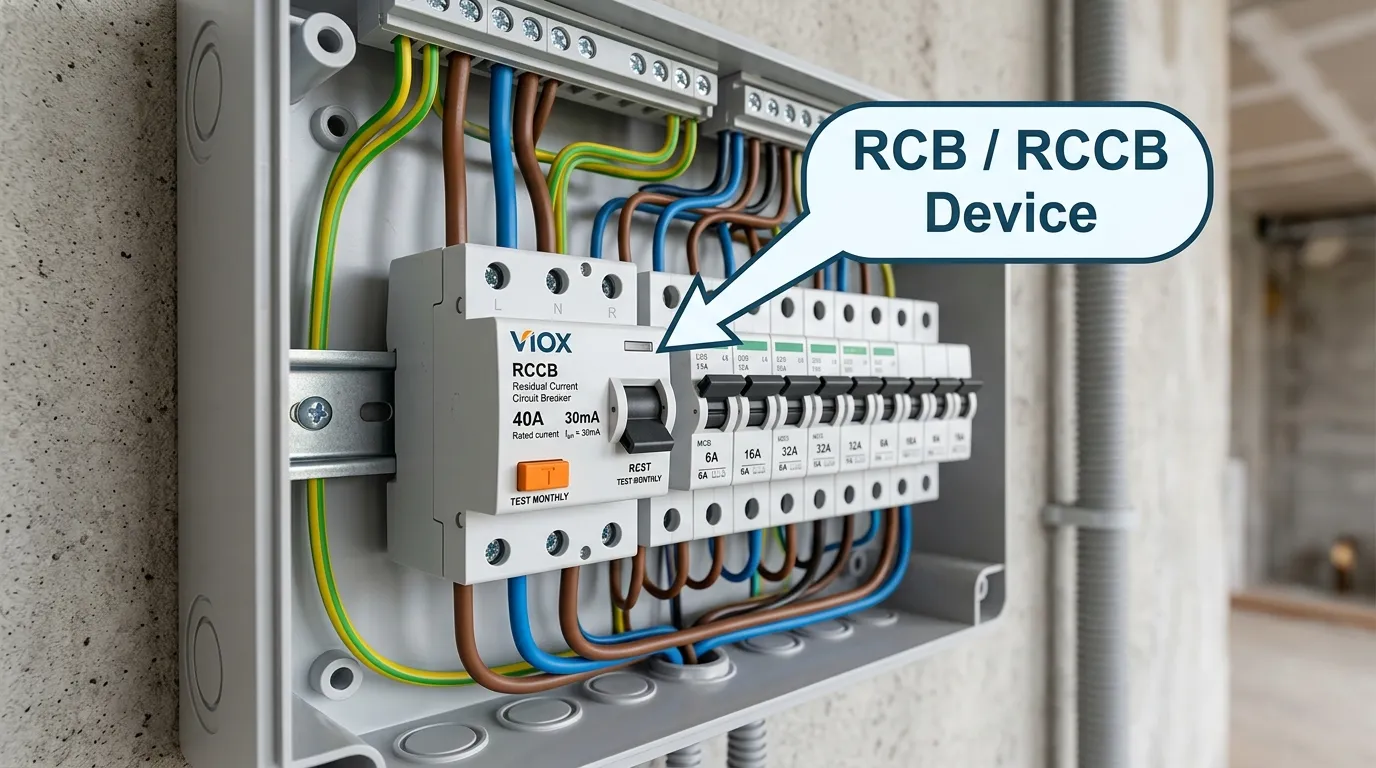
Quick Reference Table
| Term | Full Meaning |
|---|---|
| RCB Full Form | Residual Current Breaker |
| Main Purpose | Detect residual current or earth leakage and disconnect the circuit |
| Primary Safety Value | Reduce electric-shock risk and prevent electrical fires from earth faults |
| Commonly Confused With | RCD, RCCB, RCBO, and MCB |
So if your only goal is to answer what is RCB Full Form, the answer is straightforward: Residual Current Breaker. But if you want to truly understand electrical safety and make informed decisions about circuit protection, you need to grasp how the term is used in practice and how it differs from related devices.
What Does an RCB Do?
An RCB (Residual Current Breaker) is specifically designed to disconnect a circuit when it detects a difference between the outgoing current and the returning current. Under normal, healthy operating conditions, the current leaving through the live conductor should precisely match the current returning through the neutral conductor.
When there’s an imbalance—meaning some current is taking an unintended path to ground—the RCB interprets this as a dangerous leakage or fault condition and trips within milliseconds, typically 25-40 milliseconds. This rapid response is crucial because it occurs before the electric shock can cause ventricular fibrillation, the most common cause of death from electrocution.
This is why RCB-type devices are essential for:
- Electric shock protection – Detecting current flowing through a person’s body to ground
- Earth leakage protection – Identifying insulation breakdown or ground faults before they cause fires
- Fire risk reduction – Preventing electrical fires caused by persistent leakage currents that generate heat
- Enhanced safety in wet environments – Critical protection in bathrooms, kitchens, outdoor areas, and other moisture-prone locations
- Equipment protection – Safeguarding sensitive electronics from ground fault damage
That fundamental difference explains why an RCB is not the same as a purely overcurrent device like an MCB (Miniature Circuit Breaker). While MCBs protect against overloads and short circuits, they cannot detect the small leakage currents that pose electrocution risks.
How Does an RCB Work? The Operating Principle
To truly understand the RCB Full Form and its importance, you need to grasp the basic operating principle behind residual current detection.
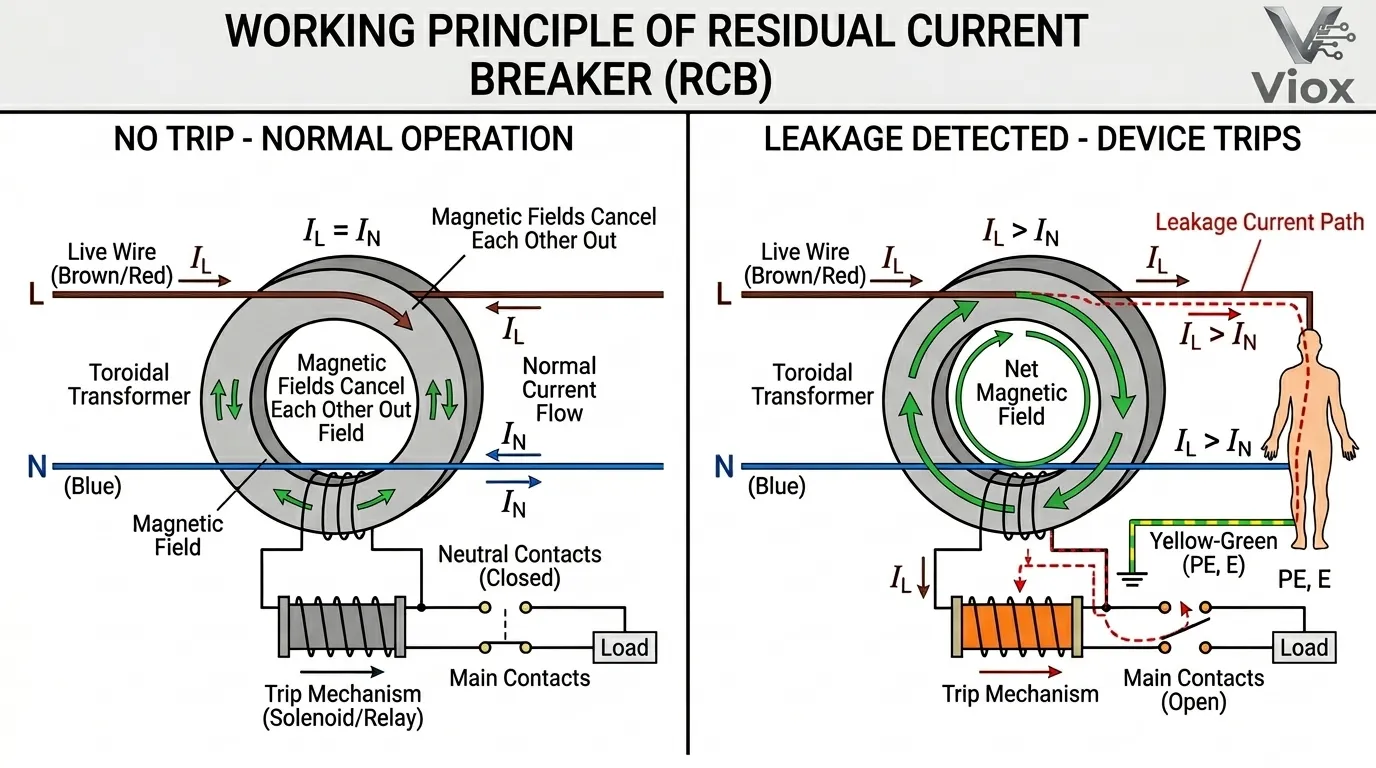
An RCB uses a differential current transformer (also called a toroidal transformer or core balance transformer) that encircles both the live and neutral conductors. In a healthy circuit, the magnetic fields generated by the outgoing and returning currents cancel each other out perfectly, resulting in zero net magnetic flux in the transformer core.
However, when leakage occurs—whether through damaged insulation, moisture ingress, or a person touching live parts—some current returns to the source via an alternative path (typically through the protective earth or ground). This creates an imbalance in the magnetic fields, inducing a voltage in the secondary winding of the transformer. When this voltage exceeds a predetermined threshold (corresponding to the device’s rated residual operating current, typically 10mA, 30mA, 100mA, or 300mA), it triggers a relay mechanism that mechanically trips the breaker contacts open.
Basic Operating Logic
| Circuit Condition | What the RCB Detects | Typical Result |
|---|---|---|
| Normal operation | Outgoing current equals returning current exactly | No trip – circuit remains energized |
| Earth leakage fault | Outgoing current exceeds returning current | Trip if leakage exceeds device sensitivity (e.g., 30mA) |
| Person contacts faulty equipment | Part of current flows through person’s body to ground | Immediate trip within 25-40ms, preventing fatal shock |
| Insulation breakdown | Gradual or sudden current leakage to earth | Trip when cumulative leakage reaches threshold |
This principle is why residual-current protection is so critical in circuits where human contact risk is meaningful, and why it’s mandated by electrical codes like the NEC (National Electrical Code) and IEC standards for specific applications.
RCB Technical Specifications You Should Know
Understanding the RCB Full Form also means knowing the key technical parameters that define device performance:
| Parameter | Typical Values | Purpose |
|---|---|---|
| Rated residual current (IΔn) | 10mA, 30mA, 100mA, 300mA, 500mA | Trip sensitivity threshold – lower values provide better shock protection |
| Operating time | 25-40 milliseconds (at rated IΔn) | Speed of disconnection – critical for preventing fatal shocks |
| Rated voltage (Ue) | 230V AC (single phase), 400V AC (three phase) | Maximum continuous operating voltage |
| Rated current (In) | 16A, 25A, 32A, 40A, 63A, 80A, 100A, 125A | Maximum load current the device can carry continuously |
| Number of poles | 2-pole (1P+N), 4-pole (3P+N) | Circuit configuration – single-phase or three-phase |
| Type | Type AC, Type A, Type B, Type F | Waveform sensitivity – determines what types of leakage currents can be detected |
| Breaking capacity | 6kA, 10kA (typical for RCCBs) | Ability to interrupt fault currents safely |
For detailed guidance on selecting the right sensitivity, see our article on how to choose the right RCCB sensitivity.
Is RCB the Same as RCCB or RCD? Clearing Up the Confusion
This is the section many competing pages fail to explain adequately, yet it’s crucial for understanding the RCB Full Form in context.
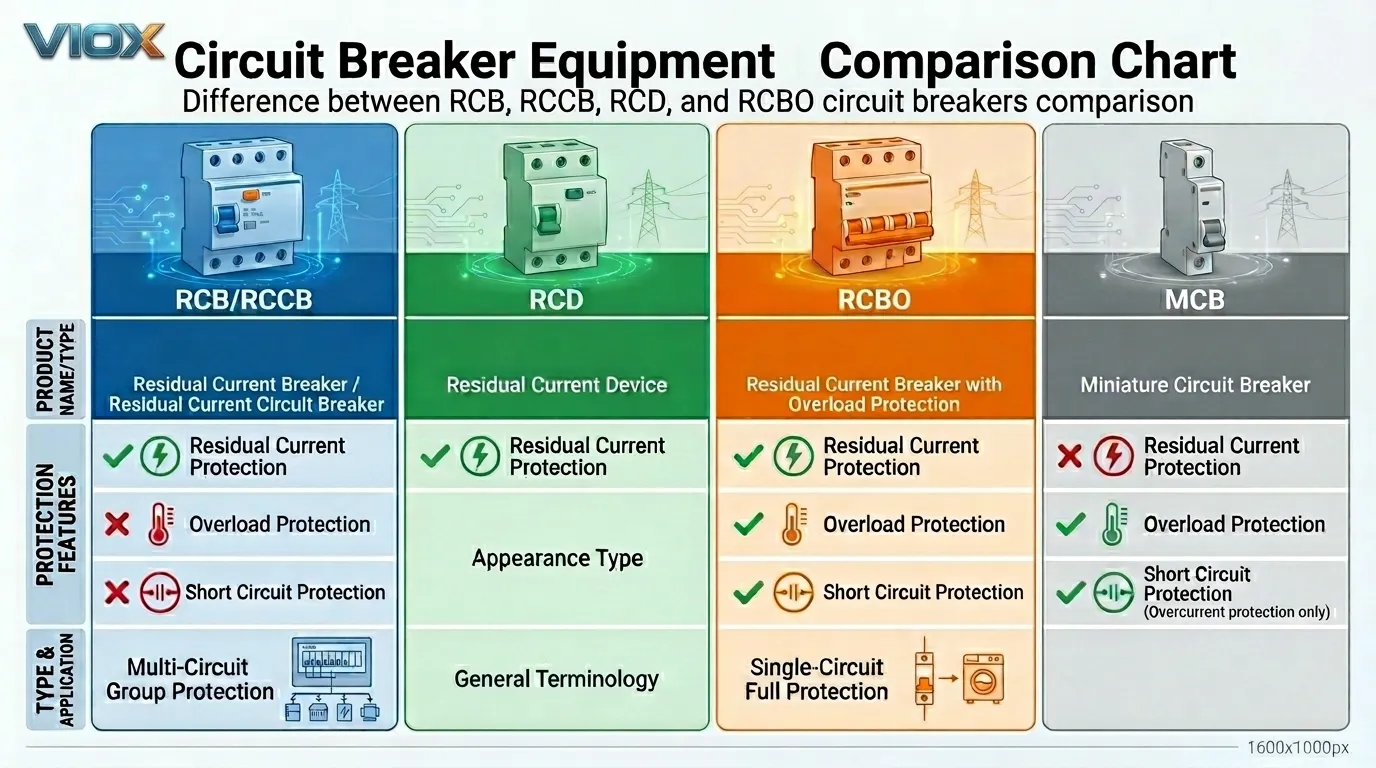
RCB as a Broad or Simplified Term
In some markets and everyday conversations, RCB is used as a broad or simplified term for any breaker that responds to residual current. It’s often used informally by electricians and in regions where precise terminology isn’t strictly enforced. However, this lack of precision can lead to confusion when specifying equipment or interpreting technical documentation.
RCD as the Broader Category Term
RCD typically means Residual Current Device. It’s the umbrella term used in IEC standards and many international markets for the entire family of devices that provide protection against residual current. An RCD can refer to:
- Residual Current Circuit Breakers (RCCBs)
- Residual Current Breakers with Overcurrent protection (RCBOs)
- Residual Current Monitors (RCMs)
- Portable RCDs (socket-outlet RCDs)
For a detailed comparison, see our comprehensive guide on RCD vs MCB differences.
RCCB as the More Specific Device Name
RCCB stands for Residual Current Circuit Breaker. In most modern product catalogs, technical standards (like IEC 61008), and professional electrical discussions, this is the precise device name for a circuit breaker that:
- Trips on residual current (earth leakage)
- Does NOT provide overcurrent protection (no built-in MCB function)
- Requires a separate MCB or fuse for overload and short-circuit protection
Learn more in our detailed RCCB full form guide.
Why This Terminology Matters for SEO and Equipment Buyers
Many users search for RCB Full Form, but what they actually need to understand is the relationship and differences between these related terms:
- RCB – Informal or simplified term
- RCD – Broad category encompassing all residual current devices
- RCCB – Specific product designation for residual current protection only
- RCBO – Combined residual current AND overcurrent protection in one device
Understanding these distinctions is critical when:
- Reading electrical drawings and specifications
- Ordering equipment from suppliers
- Ensuring code compliance
- Troubleshooting protection coordination issues
- Communicating with international partners
Comprehensive Comparison Table: RCB vs RCD vs RCCB vs RCBO
| Term | Full Form | How It’s Commonly Used | Overcurrent Protection | Residual Current Protection | Key Application Note |
|---|---|---|---|---|---|
| RCB | Residual Current Breaker | Informal/generic term in everyday usage | Depends on context | Yes | Can be ambiguous – clarify which specific device type is meant |
| RCD | Residual Current Device | Broad IEC category term covering all residual current protection devices | Varies by type | Yes | Umbrella term – not a specific product designation |
| RCCB | Residual Current Circuit Breaker | Precise product term in modern catalogs and IEC 61008 standard | No – requires separate MCB | Yes | Dedicated earth leakage protection – most common in residential/commercial |
| RCBO | Residual Current Breaker with Overcurrent protection | Combined protection device per IEC 61009 | Yes – integrated MCB function | Yes | Space-saving all-in-one solution – ideal for individual circuit protection |
For deeper technical comparison and selection guidance, consult our article on RCBO vs RCCB and MCB comparison.
RCB vs MCB: Understanding the Critical Difference
Another common reason people search for RCB Full Form is confusion about whether an RCB is simply another type of breaker like an MCB. The answer is definitively no—they serve fundamentally different protection functions.
Protection Focus Comparison
An MCB (Miniature Circuit Breaker) primarily protects against:
- Overload conditions – When connected load exceeds the circuit’s rated capacity
- Short circuit faults – When live and neutral conductors make direct contact, causing extremely high fault currents
- Thermal damage – Preventing conductor overheating and insulation degradation from sustained overcurrent
An RCB-type device (RCCB/RCD) primarily protects against:
- Residual current – Current leaking to earth through unintended paths
- Earth leakage faults – Insulation breakdown allowing current to flow to ground
- Electric shock risk – Current flowing through a person’s body to earth
- Electrical fire from earth faults – Persistent leakage currents that can ignite surrounding materials
Why You Need Both Types of Protection
This fundamental difference means that neither device can fully replace the other:
- An MCB alone will NOT protect you from electrocution if you touch a live part, because the current flowing through your body (typically 50-100mA for a fatal shock) is far below the MCB’s trip threshold (typically 6-32A for residential circuits)
- An RCCB alone will NOT protect your wiring from overload or short-circuit damage, because it only responds to current imbalance, not total current magnitude
For a detailed explanation of why circuit breakers alone don’t prevent electrocution, read why circuit breakers don’t protect people.
RCB vs MCB Quick Reference Table
| Device Type | Primary Protection Focus | What It Detects | Typical Trip Current | Response Time |
|---|---|---|---|---|
| RCB/RCCB | Leakage current and electric shock | Current imbalance between live and neutral | 10mA – 300mA | 25-40 milliseconds |
| MCB | Overload and short circuit | Total current magnitude in the circuit | 6A – 125A (residential/light commercial) | Seconds (overload) to milliseconds (short circuit) |
For comprehensive guidance on when to use each device type, see why use RCCB instead of MCB.
RCB vs RCCB vs RCBO: Choosing the Right Device
If you’ve searched for RCB Full Form, you’re likely at the beginning of your journey to understand electrical protection. The next critical step is deciding which specific device type you actually need for your application.
RCB / RCCB: Dedicated Residual Current Protection
In practical discussions, when readers search for RCB Full Form, they’re often actually asking about RCCB because that’s the precise product label they’ll encounter on:
- Manufacturer datasheets and catalogs
- Electrical panel schedules and drawings
- Product certifications (UL, CE, IEC)
- Supplier quotations and invoices
An RCCB provides residual current protection only. It must be installed in series with an MCB or fuse to provide complete circuit protection. This is the traditional approach used in most residential and commercial installations.
Typical RCCB installation configuration:
Main Supply → RCCB (e.g., 40A, 30mA) → Multiple MCBs → Individual CircuitsRCBO: Combined Protection in a Single Device
An RCBO (Residual Current Breaker with Overcurrent protection) combines both residual-current protection AND overcurrent protection (MCB functionality) in a single compact device. This means it covers:
- Earth leakage protection (like an RCCB)
- Overload protection (like an MCB thermal element)
- Short-circuit protection (like an MCB magnetic element)
Typical RCBO installation configuration:
Main Supply → Individual RCBOs → Individual CircuitsFor detailed technical comparison including space requirements, cost analysis, and selectivity considerations, see RCBO vs RCCB and MCB comparison.
Device Comparison: Protection Coverage
| Device Term | Residual Current Protection | Overload Protection | Short Circuit Protection | Typical Use Case |
|---|---|---|---|---|
| RCB/RCCB | ✓ Yes | ✗ No | ✗ No | Group protection for multiple circuits – requires separate MCBs downstream |
| RCBO | ✓ Yes | ✓ Yes | ✓ Yes | Individual circuit protection – all-in-one solution, no separate MCB needed |
| MCB | ✗ No | ✓ Yes | ✓ Yes | Overcurrent protection only – requires separate RCCB upstream for shock protection |
When to Choose RCCB vs RCBO
Choose RCCB + MCB configuration when:
- Protecting multiple circuits with one residual current device (cost-effective for groups)
- Working with existing installations that already have MCBs
- Panel space is not severely constrained
- You want simplified troubleshooting (one RCCB trip indicates leakage somewhere in the group)
Choose RCBO configuration when:
- Individual circuit protection is required (better selectivity – only the faulty circuit trips)
- Panel space is limited (RCBOs are more compact than RCCB + MCB combination)
- You want to minimize nuisance tripping (fault on one circuit doesn’t affect others)
- Code requires dedicated protection for specific circuits (e.g., EV charger circuits)
For practical selection guidance, see how to select the right RCBO.
Where Are RCB-Type Devices Required and Used?
Understanding RCB Full Form becomes more meaningful when you know where these life-saving devices are actually required and installed.
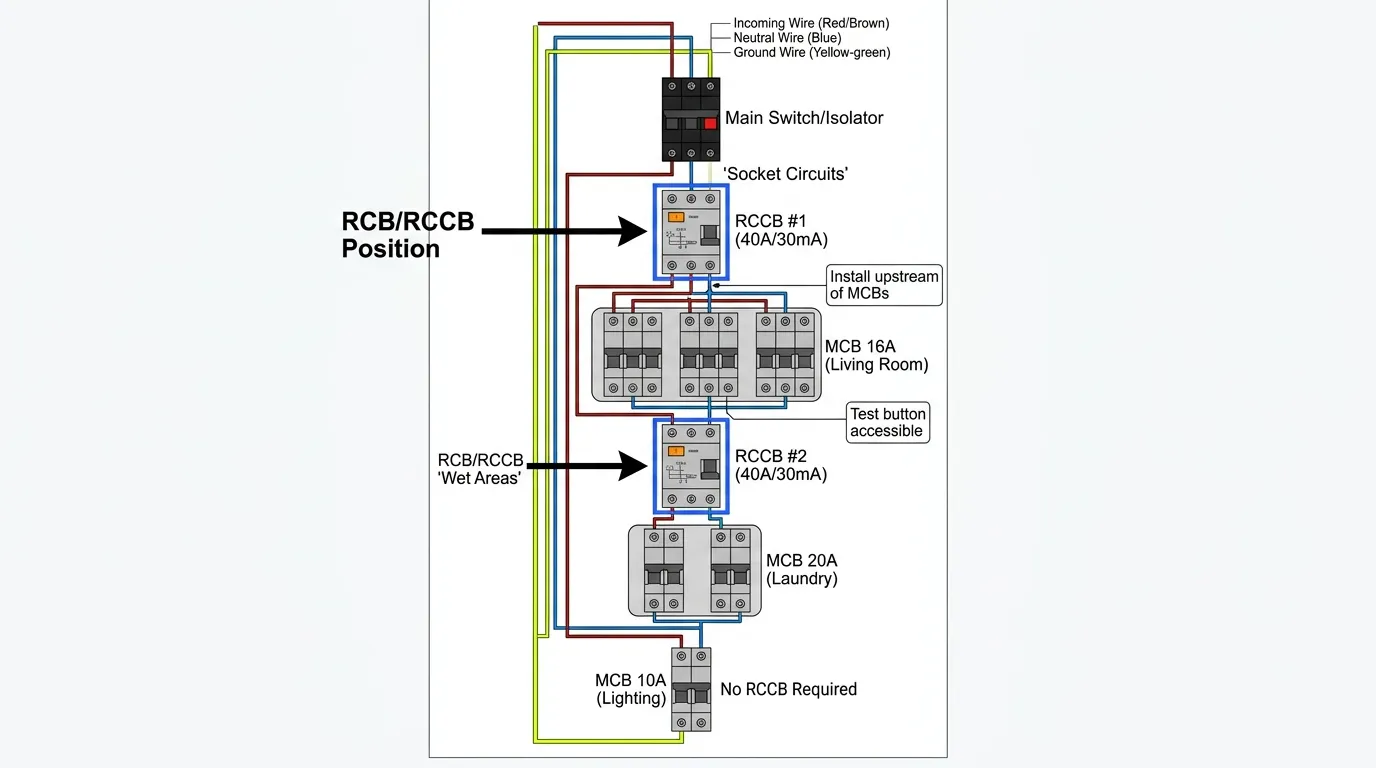
Code-Mandated Locations (NEC and IEC Requirements)
Modern electrical codes increasingly mandate residual current protection in high-risk areas:
Residential installations:
- Bathroom circuits (all outlets and lighting near water sources)
- Kitchen countertop receptacles (within 6 feet of sinks)
- Outdoor receptacles and lighting circuits
- Garage and unfinished basement outlets
- Laundry room circuits
- Pool, spa, and hot tub equipment
- EV charging stations
Commercial and industrial installations:
- Portable tool and equipment outlets on construction sites
- Outdoor and wet location circuits
- Healthcare facilities (patient care areas)
- Agricultural buildings (livestock confinement areas)
- Marinas and boat docks
- Temporary power distribution
- Solar PV systems (where applicable)
For comprehensive NEC code requirements, see NEC code for junction boxes and related protection requirements.
High-Priority Installation Locations
Even where not explicitly mandated, RCB/RCCB protection is strongly recommended for:
- All socket outlets in TT earthing systems (common in rural areas)
- Circuits supplying Class I equipment (metal-encased appliances with exposed conductive parts)
- Portable equipment used outdoors or in damp locations
- Circuits in older buildings with aging insulation
- Any circuit where enhanced safety is desired
Real-World Application Examples
Residential example:
A typical modern home might have:
- One 40A/30mA RCCB protecting all socket outlet circuits (living areas, bedrooms)
- One 40A/30mA RCCB protecting wet area circuits (bathrooms, kitchen, laundry)
- One 63A/100mA RCCB protecting outdoor and garage circuits
- Lighting circuits may be on MCBs only (though some codes now require RCD protection for all circuits)
Commercial example:
An office building might use:
- Individual 20A/30mA RCBOs for each office area socket circuit
- 30mA RCCBs for all general-use outlets
- 100mA or 300mA RCCBs for fire alarm and emergency lighting (to prevent nuisance tripping)
For detailed guidance on panel layout and protection coordination, see circuit protection selection framework.
Why RCB Protection Matters: The Life-Saving Difference
An ordinary overcurrent breaker (MCB or MCCB) cannot detect every dangerous leakage condition. That’s why residual-current protection remains critically important and increasingly mandated by electrical safety codes worldwide.
The Electrocution Risk Without RCB Protection
Consider this scenario: You’re using a power tool with damaged insulation. The metal housing becomes live at 230V, but the fault current flowing to ground through the tool’s protective earth conductor is only 200mA—far below the 16A MCB’s trip threshold. The MCB sees this as normal operation and doesn’t trip.
Now you touch the metal housing. Current flows through your body to ground. As little as 30mA across the heart can cause ventricular fibrillation and death. The MCB still won’t trip because 30mA is insignificant compared to its 16A rating.
With an RCB/RCCB (30mA sensitivity):
The moment the fault occurs (before you even touch the tool), the RCCB detects the 200mA leakage and trips within 40 milliseconds, de-energizing the circuit and preventing the electrocution scenario entirely.
This is why circuit breakers alone don’t protect people and why RCB-type devices are essential for shock protection.
Fire Prevention Through Earth Fault Detection
Persistent earth leakage currents, even as low as 300-500mA, can generate sufficient heat at poor connections or through carbonized insulation paths to ignite surrounding combustible materials. Traditional overcurrent devices won’t detect these fault currents because they’re below the overload threshold.
RCB/RCCB devices rated at 100mA or 300mA provide fire protection by detecting these dangerous leakage currents before they can cause ignition. This is particularly important in:
- Older buildings with deteriorating wiring insulation
- Agricultural buildings with rodent damage to cables
- Outdoor installations exposed to moisture and UV degradation
- Industrial environments with harsh conditions
For related fire protection strategies, see electrical cabinet fire protection guide.
Common RCB Tripping Problems and Solutions
Understanding RCB Full Form also means knowing how to troubleshoot common issues with residual current devices:
| Problem | Possible Cause | Solution |
|---|---|---|
| Frequent nuisance tripping | Accumulated leakage from multiple appliances; sensitivity too high for circuit length | Use higher sensitivity rating (e.g., 100mA instead of 30mA) for long circuits; split circuits to reduce cumulative leakage; check for moisture ingress |
| Won’t reset after tripping | Persistent earth fault in connected equipment or wiring | Disconnect loads one by one to identify faulty equipment; use insulation resistance tester to check wiring |
| Doesn’t trip when test button pressed | Device failure; mechanical jam; loss of spring tension | Replace immediately—device is not providing protection; never rely on a failed RCD |
| Trips immediately upon energization | High inrush current from capacitive loads; N-E fault downstream | Check for neutral-earth faults; use time-delayed or Type B RCD for circuits with variable speed drives or electronic loads |
| Random tripping during storms | Surge currents from nearby lightning strikes | Install surge protection devices (SPDs) upstream of RCCBs; ensure proper grounding |
For detailed troubleshooting procedures, see how to check RCCB functionality.
How to Choose the Right Device After Learning the RCB Full Form
If you began with the question “what is RCB Full Form?”, you’re now equipped to make informed decisions. But the useful next step is determining which specific device name or product you actually need for your application.
Selection Decision Matrix
| If Your Real Need Is… | You Should Specify… | Key Considerations |
|---|---|---|
| Understanding the acronym only | RCB Full Form / RCD family explanation | Educational purpose – no procurement needed |
| Leakage protection only (with existing MCBs) | RCCB (specific sensitivity: 30mA, 100mA, etc.) | Most cost-effective for protecting multiple circuits; requires separate MCBs |
| Leakage PLUS overload protection in one device | RCBO (specify both In and IΔn ratings) | Space-saving; better selectivity; higher cost per circuit |
| Overload or short-circuit protection only | MCB (no residual current protection) | Does NOT provide shock protection – must be combined with upstream RCCB |
| Portable shock protection | Portable RCD / GFCI adapter | Temporary protection for power tools and equipment |
Critical Selection Parameters
When specifying an RCB/RCCB/RCBO, you must define:
- Rated residual operating current (IΔn): 10mA, 30mA, 100mA, 300mA
- 10mA: Enhanced protection (medical, special applications)
- 30mA: Standard personal protection (required for socket outlets)
- 100mA: Fire protection / reduced nuisance tripping
- 300mA: Fire protection only (not for shock protection)
- Rated current (In): Must exceed the maximum expected load current
- Common values: 25A, 40A, 63A, 80A, 100A
- Type (waveform sensitivity):
- Type AC: Detects AC sinusoidal residual currents only (being phased out)
- Type A: Detects AC + pulsating DC residual currents (minimum for modern appliances)
- Type B: Detects AC + pulsating DC + smooth DC (required for EV chargers, VFDs, solar inverters)
- Type F: Enhanced Type A with immunity to high-frequency components
- Number of poles: 2-pole (1P+N) for single-phase, 4-pole (3P+N) for three-phase
For comprehensive selection guidance, see how to choose the right RCCB sensitivity.
Installation and Maintenance Best Practices
Understanding RCB Full Form is incomplete without knowing proper installation and maintenance procedures:
Installation Guidelines
- Install RCCBs on the load side of the main isolator but upstream of circuit MCBs
- Ensure proper neutral-earth separation downstream of the RCCB (no N-E bonds)
- Verify correct phase and neutral connections (reversed connections can cause malfunction)
- Maintain adequate clearances per NEC 110.26 requirements
- Label circuits clearly to facilitate troubleshooting
- Test operation using the built-in test button before energizing loads
For detailed panel installation guidance, see how to ground an electrical panel.
Maintenance and Testing Schedule
| Test/Inspection | Frequency | Procedure |
|---|---|---|
| Test button operation | Monthly (residential), Weekly (commercial/industrial) | Press test button – device should trip immediately; reset and verify normal operation |
| Insulation resistance testing | Annually or after any electrical work | Disconnect loads; measure insulation resistance of protected circuits; should exceed 1MΩ |
| Trip time verification | Every 2-3 years or per manufacturer recommendation | Use RCD tester to verify trip time at 1× IΔn (should be <300ms) and 5× IΔn (should be <40ms) |
| Visual inspection | Annually | Check for signs of overheating, damage, corrosion; verify tight connections; inspect for moisture ingress |
For detailed maintenance procedures, see how to check RCCB functionality maintenance guide.
Understanding Related Electrical Protection Devices
Now that you understand RCB Full Form, it’s helpful to see how residual current protection fits into the broader electrical safety ecosystem:
Complete Protection Device Family
- MCB (Miniature Circuit Breaker) – Overcurrent protection for circuits up to 125A
- MCCB (Molded Case Circuit Breaker) – Overcurrent protection for circuits 100A-1600A
- RCCB (Residual Current Circuit Breaker) – Earth leakage protection only
- RCBO – Combined residual current and overcurrent protection
- AFCI (Arc Fault Circuit Interrupter) – Detects dangerous arcing conditions
- AFDD (Arc Fault Detection Device) – IEC equivalent of AFCI
- SPD (Surge Protection Device) – Protects against voltage transients and lightning surges
For a comprehensive comparison of all these devices, see difference between MCB, MCCB, RCB, RCD, RCCB, and RCBO.
Protection Coordination Strategy
A properly designed electrical installation uses multiple layers of protection:
- Surge protection – SPDs at service entrance and sensitive equipment
- Overcurrent protection – MCBs or MCCBs for all circuits
- Residual current protection – RCCBs or RCBOs for shock and fire protection
- Arc fault protection – AFCIs/AFDDs where required by code
- Equipment protection – Motor protection circuit breakers, thermal overload relays
For detailed coordination strategies, see circuit protection selection framework.
Standards and Certifications for RCB/RCCB Devices
When specifying or purchasing devices based on your understanding of RCB Full Form, ensure they meet relevant standards:
International Standards
- IEC 61008-1 – Residual current operated circuit-breakers without integral overcurrent protection (RCCBs)
- IEC 61009-1 – Residual current operated circuit-breakers with integral overcurrent protection (RCBOs)
- IEC 60755 – General requirements for residual current protective devices
- IEC 62606 – General requirements for arc fault detection devices (AFDDs)
For detailed standard requirements, see IEC 61008-1 standard RCCB requirements explained.
North American Standards
- UL 943 – Ground-Fault Circuit Interrupters (GFCIs)
- UL 1053 – Ground-Fault Sensing and Relaying Equipment
- NFPA 70 (NEC) – National Electrical Code requirements for GFCI protection
For terminology correspondence between systems, see NEC vs IEC terminology correspondence.
Regional Variations
- GFCI (Ground Fault Circuit Interrupter) – North American term, essentially equivalent to RCD/RCCB
- RCD (Residual Current Device) – UK, Australia, IEC countries
- RCCB/RCBO – Precise IEC product designations
- Earth Leakage Circuit Breaker (ELCB) – Older term, largely obsolete
For detailed comparison, see RCD vs GFCI breaker difference and difference between RCCB and ELCB.
Frequently Asked Questions About RCB Full Form
What is the RCB Full Form?
The RCB Full Form is Residual Current Breaker. It’s an electrical safety device designed to protect against electric shock and electrical fires by detecting leakage current (residual current) and disconnecting the circuit when dangerous levels are detected.
What is RCB Full Form in Electrical?
In electrical systems, RCB Full Form in Electrical means Residual Current Breaker—a device term associated with residual-current or earth-leakage protection. It monitors the balance between outgoing and returning current, tripping when an imbalance indicates a potentially dangerous leakage condition.
Is RCB the same as RCCB?
Not always in strict terminology. In everyday use, some people use RCB loosely as a generic term, but RCCB (Residual Current Circuit Breaker) is the more precise product term in modern catalogs, technical specifications, and IEC standards. When specifying equipment, always use RCCB for clarity.
Is RCB the same as RCD?
Not exactly. RCD (Residual Current Device) is usually the broader IEC category term that encompasses all types of residual current protection devices, while RCB is a more specific (though sometimes informal) acronym used in some contexts for residual-current breaker protection. RCD is the preferred umbrella term in technical standards.
What is the difference between RCB and MCB?
An RCB/RCCB focuses on detecting leakage or residual current (typically 10-300mA) to prevent electric shock and earth fault fires, while an MCB (Miniature Circuit Breaker) focuses on overcurrent protection (overload and short circuit, typically 6-125A). They serve different protection functions and are typically used together for complete circuit protection.
Is RCBO better than RCB/RCCB?
It depends on the application. An RCBO combines residual-current protection with overcurrent protection in one device, making it more convenient and space-efficient. However, RCCBs are more cost-effective when protecting multiple circuits with one device. The correct choice depends on protection objectives, panel space, cost constraints, and selectivity requirements.
What sensitivity rating should I choose for an RCB/RCCB?
- 10mA – Enhanced protection for medical locations and special applications
- 30mA – Standard for personal shock protection (required for socket outlets and wet areas)
- 100mA – Fire protection with reduced nuisance tripping (suitable for long circuits)
- 300mA – Fire protection only, not suitable for direct shock protection
For detailed selection guidance, see how to choose the right RCCB sensitivity.
Can I use a 3-phase RCCB for single-phase circuits?
Yes, but it’s not cost-effective. A 4-pole (3P+N) RCCB can protect single-phase circuits, but you’re paying for unused poles. It’s better to use a 2-pole (1P+N) RCCB for single-phase applications. For related questions, see can you use a 3-phase MCCB for single phase.
How often should I test my RCB/RCCB?
Press the test button monthly for residential installations and weekly for commercial/industrial installations. Professional trip time testing should be performed every 2-3 years or per manufacturer recommendations. For detailed procedures, see how to check RCCB functionality.
Why does my RCB/RCCB keep tripping?
Common causes include:
- Faulty appliance with earth leakage
- Damaged cable insulation
- Moisture ingress in outdoor circuits
- Accumulated leakage from multiple appliances
- Incorrect neutral-earth connections
- Device sensitivity too high for circuit characteristics
For troubleshooting guidance, see 40A vs 63A RCD nuisance tripping guide.
What’s the difference between Type A, Type B, and Type AC RCCBs?
- Type AC – Detects AC sinusoidal residual currents only (minimum standard, being phased out)
- Type A – Detects AC + pulsating DC residual currents (minimum for modern appliances with electronic controls)
- Type B – Detects AC + pulsating DC + smooth DC residual currents (required for EV chargers, VFDs, solar inverters)
- Type F – Enhanced Type A with high-frequency immunity
For EV charging applications, see RCCB EV charging Type B vs Type F vs Type EV.
Conclusion: Beyond the RCB Full Form
Understanding that RCB Full Form means Residual Current Breaker is just the starting point. The real value comes from understanding:
- How RCBs work – Detecting current imbalance to prevent electric shock and fires
- Terminology differences – RCB vs RCD vs RCCB vs RCBO and when to use each term
- Protection principles – Why RCBs complement but don’t replace MCBs
- Selection criteria – Choosing the right sensitivity, type, and configuration for your application
- Installation requirements – Proper placement, wiring, and testing procedures
- Maintenance practices – Regular testing and inspection to ensure continued protection
Residual current protection is not optional—it’s a critical life-safety system that prevents electrocution and electrical fires. Whether you’re an electrician, engineer, facility manager, or homeowner, understanding the RCB Full Form and its practical implications empowers you to make informed decisions about electrical safety.
For ongoing education and detailed technical guidance on electrical protection devices, explore our comprehensive library of articles on circuit breakers, protection coordination, and electrical safety systems.
About VIOX Electric
VIOX is a leading manufacturer of low-voltage electrical protection devices, including MCBs, MCCBs, RCCBs, RCBOs, and complete distribution solutions. With over 12 years of industry experience, we provide high-quality, certified electrical components for residential, commercial, and industrial applications worldwide.
Related Resources: