On this page
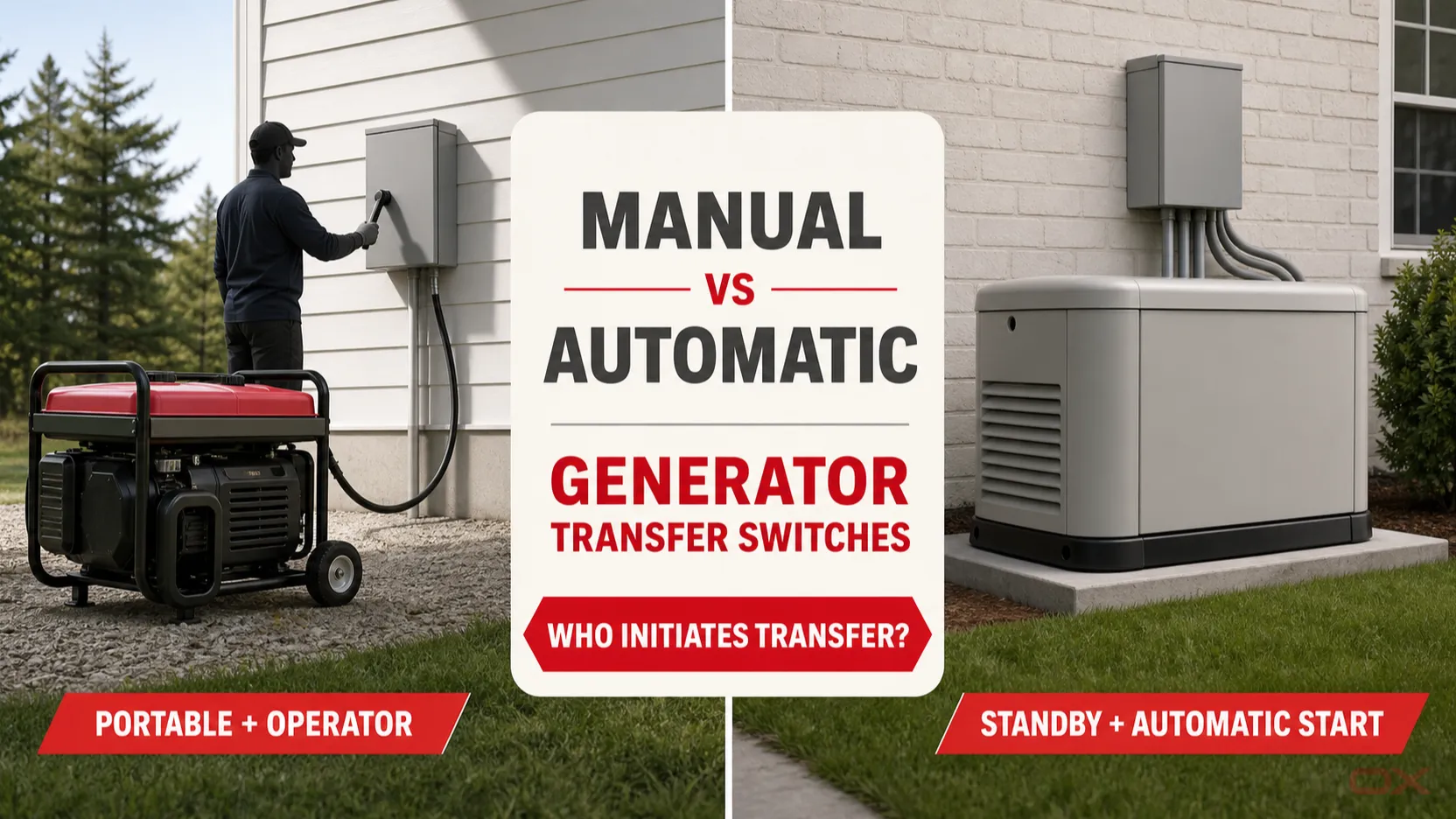
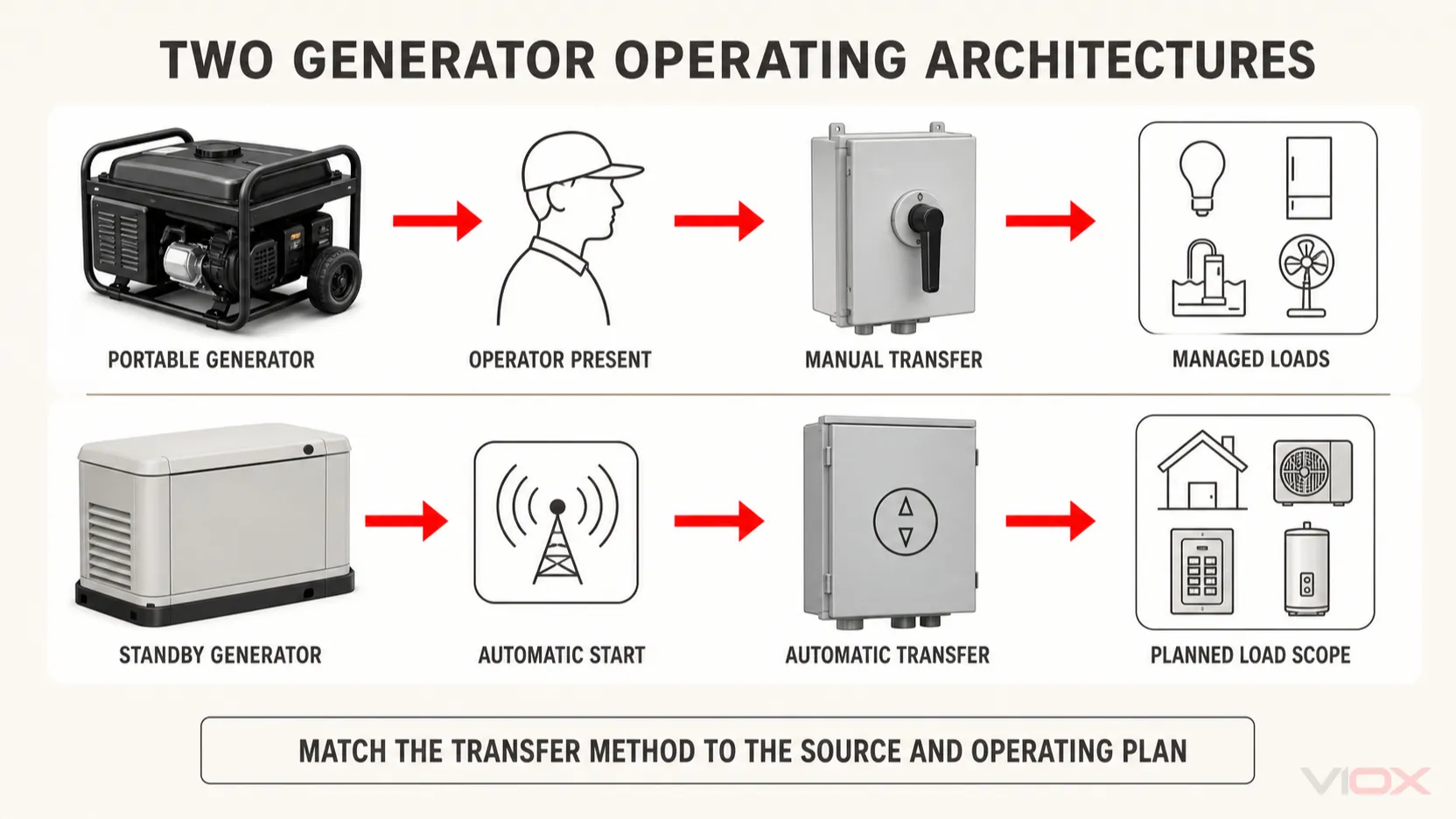
For most generator systems, the starting choice is clear: a portable generator normally pairs with an approved manual transfer switch (MTS) or another approved manual transfer arrangement, while a permanently installed, automatic-start standby generator normally uses an automatic transfer switch (ATS).
Choose an ATS when the site may be unattended, the load is continuity-sensitive, or the transfer cannot depend on a person. Choose an MTS when outages are infrequent, a trained operator will be present, the loads can tolerate the delay, and lower system cost matters. Neither choice removes the need to verify load scope, generator capability, system voltage and phase, neutral treatment, current and fault ratings, overcurrent protection, and local installation requirements.
| Generator or operating scenario | Better starting point | Why |
|---|---|---|
| Portable generator brought out and connected during an outage | Manual transfer switch | The operator is already present to position, connect, start and manage the generator. |
| Permanently installed standby generator with automatic start | Automatic transfer switch | The generator and switch can complete the start–verify–transfer sequence without waiting for an operator. |
| Remote, vacant or unattended site | Automatic transfer switch | Backup operation cannot reliably depend on someone reaching the switch. |
| Critical or continuity-sensitive loads | Automatic transfer switch, subject to the required system design | The consequence of delayed transfer usually outweighs the benefit of lower first cost. |
| Infrequent outages with non-critical selected loads | Manual transfer switch | Operator-dependent transfer may be an acceptable and economical design. |
| Portable generator with remote/electric start or an unusual control scheme | Project-specific review | “Electric start” alone does not prove compatibility with an ATS or safe unattended operation. |
The important distinction is not simply “cheap versus convenient.” It is whether the source, controls, load and operating plan form one coherent backup-power system.
Manual vs Automatic Transfer Switch: The Practical Difference
A manual transfer switch and an automatic transfer switch perform the same fundamental source-selection job: connect the load to the normal source or the alternate source while preventing an unintended connection between them. The difference is who—or what—decides that the alternate source is ready and initiates the transfer.
With an MTS, an operator confirms the outage, prepares and starts the generator, checks that it is operating normally, and moves the switch according to the equipment instructions. With an ATS, sensing and control logic monitors the normal source, calls for the generator when the system is designed to do so, verifies that the alternate source is acceptable, and operates the transfer mechanism. For a closer look at that sequence, see how an automatic transfer switch works.
| Decision factor | Manual transfer switch (MTS) | Automatic transfer switch (ATS) |
|---|---|---|
| Transfer command | Given by an operator | Given by sensing and control logic |
| Generator start | Normally manual in portable-generator systems | Normally coordinated with an automatic-start standby generator |
| Operator presence | Required | Not normally required for an automatic outage response |
| Outage delay | Depends on availability and actions of the operator | Depends on source sensing, programmed delays, generator starting and source-acceptance logic |
| Control complexity | Lower | Higher; requires compatible sensing, control power and generator-start functions |
| Typical generator pairing | Portable generator | Permanently installed standby generator |
| Typical load strategy | Often selected circuits or a deliberately managed load | Selected circuits or whole-building service, depending on generator and system design |
| First cost | Usually lower | Usually higher because the switch, controls and integration are more complex |
| Best fit | Attended, delay-tolerant backup | Unattended or continuity-sensitive backup |
“Automatic” does not mean uninterrupted power. A generator must still start and reach acceptable voltage and frequency before the load can be transferred. The actual interruption depends on the complete system and its programmed sequence, not on the letters ATS alone.
Portable Generator or Standby Generator?
Portable generators usually point to manual transfer
A portable generator normally requires a person to move it outdoors to an approved operating location, connect it through the intended inlet or connection system, start it, manage available fuel and control which loads are energized. In that operating model, a manual transfer switch is a natural match.
Eaton describes its residential manual transfer switches as equipment used with portable backup generators to supply selected circuits, with mechanical interlocking that prevents the normal and emergency sources from being connected together. Generac likewise describes an MTS as a portable-generator connection that prevents backfeeding and lets the user stagger loads to avoid overloading the generator.
This does not mean every portable generator works with every MTS. Compatibility depends on the generator outlet, voltage, current, grounding and neutral configuration, the inlet/cord system, the circuits being supplied, and the transfer equipment instructions.
Automatic standby generators usually point to ATS
A permanently installed standby generator is built around a different operating promise: it remains connected to the building system and can start when utility power fails. An ATS completes that automatic architecture by detecting the source condition, initiating or coordinating generator start, confirming the alternate source and transferring the load according to its control logic.
If a project pays for an automatic-start generator but still depends on someone manually transferring the load, it has not achieved unattended backup. Conversely, installing an ATS does not make a manually deployed portable generator into a complete automatic standby system.
The Five-Question ATS vs MTS Decision
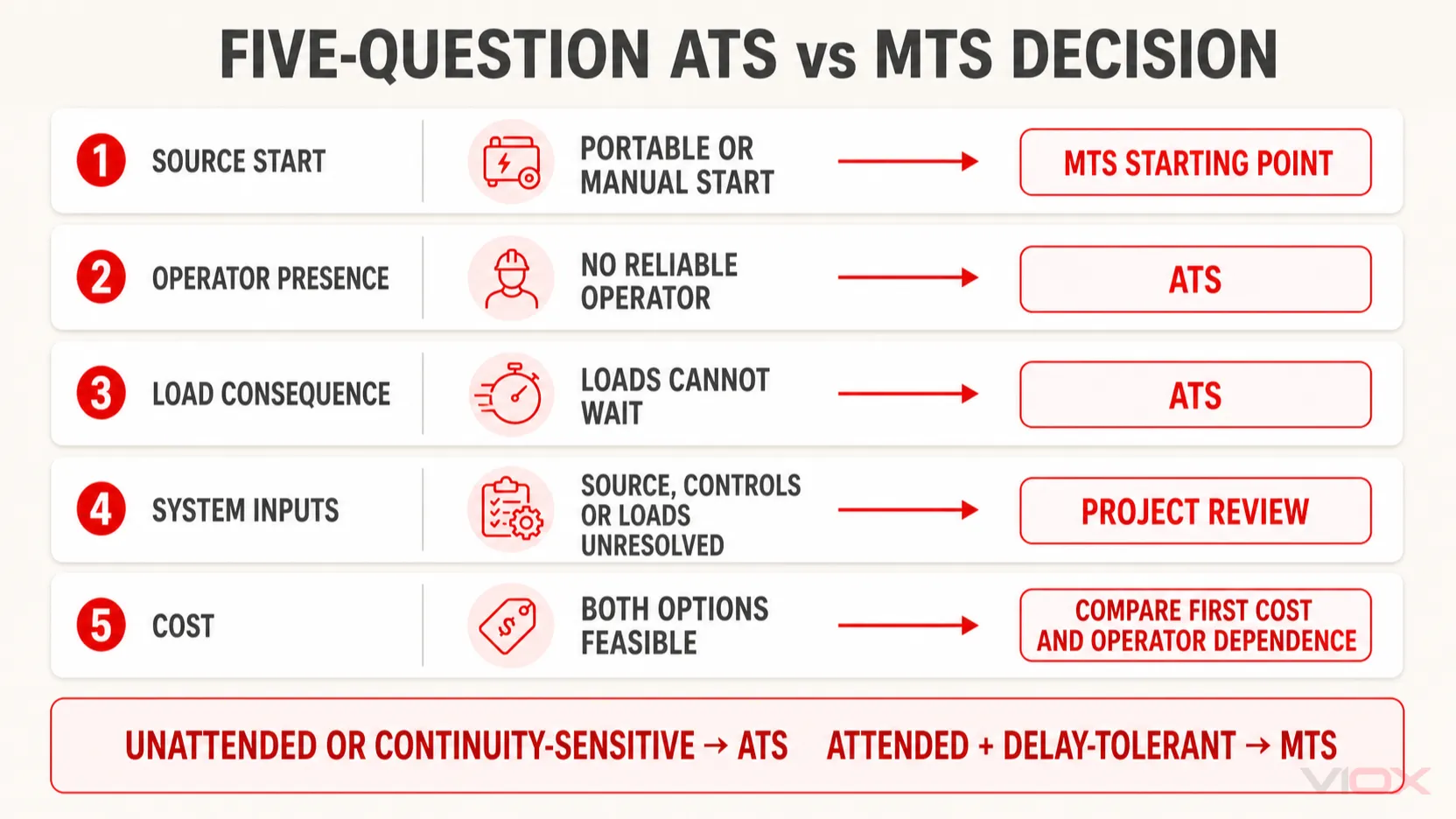
Use these questions in order. They intentionally decide only manual versus automatic operation; they do not replace the later equipment specification.
1. Can the generator start and remain available without an operator?
If no, begin with a manual transfer arrangement. An ATS can move contacts automatically, but it cannot make an incompatible generator deploy itself, obtain fuel, connect a cord or become safe for unattended operation.
If yes, continue to the next question. Confirm the exact generator-start interface and transfer-switch compatibility rather than assuming all two-wire, electric-start or remote-start functions are interchangeable.
2. Will a qualified operator reliably be present?
If the property is routinely vacant, remote or inaccessible during storms, manual transfer has a fundamental operating gap. Choose ATS unless a different supervised backup plan closes that gap.
If an operator will be present, both options remain possible. The operator must be able to follow the manufacturer’s procedure and determine that the alternate source is suitable before transferring the load. ASCO’s application guidance emphasizes that manual and non-automatic switching places this judgment on trained, authorized personnel.
3. What happens while the load waits?
Separate inconvenience from consequence. Lighting and ordinary convenience loads may tolerate the time needed to prepare a portable generator. Refrigeration, pumps, communications, process controls, environmental systems or other priority loads may not.
If waiting for a person creates an unacceptable safety, operational or property risk, ATS is the better starting point. The system may still require additional continuity measures; an ATS with an engine generator does not provide zero-interruption power.
4. Are you backing up selected circuits or a broader load?
Manual residential systems often supply a selected-circuit transfer panel because a portable generator cannot carry every connected load. Standby systems may supply selected circuits or a broader distribution section, but the generator and transfer equipment still have to be selected for the intended load and load-management strategy.
Do not use “whole house” as a shortcut for switch rating. The service rating, generator output, continuous load, motor starting, load shedding and protective-device arrangement are separate design inputs.
5. Is lower first cost worth operator dependence?
If the first four questions leave both options acceptable, cost can decide. If they reveal that the site must respond while unattended or that delayed transfer has unacceptable consequences, choosing manual solely because it is cheaper does not complete the required user job.
Manual Transfer Switch Cost
Manual transfer switches usually cost less than ATS installations because they omit automatic sensing, generator-start controls and associated integration. The installed price still depends on amperage, number of circuits, enclosure/location, inlet and cord requirements, panel or subpanel work, conductor routing, permits and local labor.
As a dated U.S. planning reference, Angi’s July 2026 cost guide reports $400–$1,300 installed for a manual generator transfer switch and $600–$2,500 for an automatic transfer switch. It also reports a broader $1,200–$1,600 range for professional transfer-switch projects across types. These figures are not equipment specifications or universal quotes; regional labor, service-equipment work and the actual system scope can move a project outside them.
| Cost driver | Why it changes the project price |
|---|---|
| Selected circuits versus broader distribution | More circuits or a larger load scope can require more equipment and field work. |
| Switch current and system configuration | Higher ratings and additional poles generally change equipment size and cost. |
| Existing panel condition | Panel, subpanel or breaker changes can exceed the cost of the transfer device itself. |
| Generator inlet, cord and location | Portable-generator systems need a compatible connection path and suitable physical placement. |
| ATS control integration | Sensing, control power, start contacts, communications or load management add design and commissioning work. |
| Permit and inspection requirements | These vary by jurisdiction and project classification. |
Compare quotations on the same scope. A low MTS price for a few selected circuits is not directly comparable with a service-rated ATS package supplying a much broader load.
Safety and Engineering Requirements Both Options Share
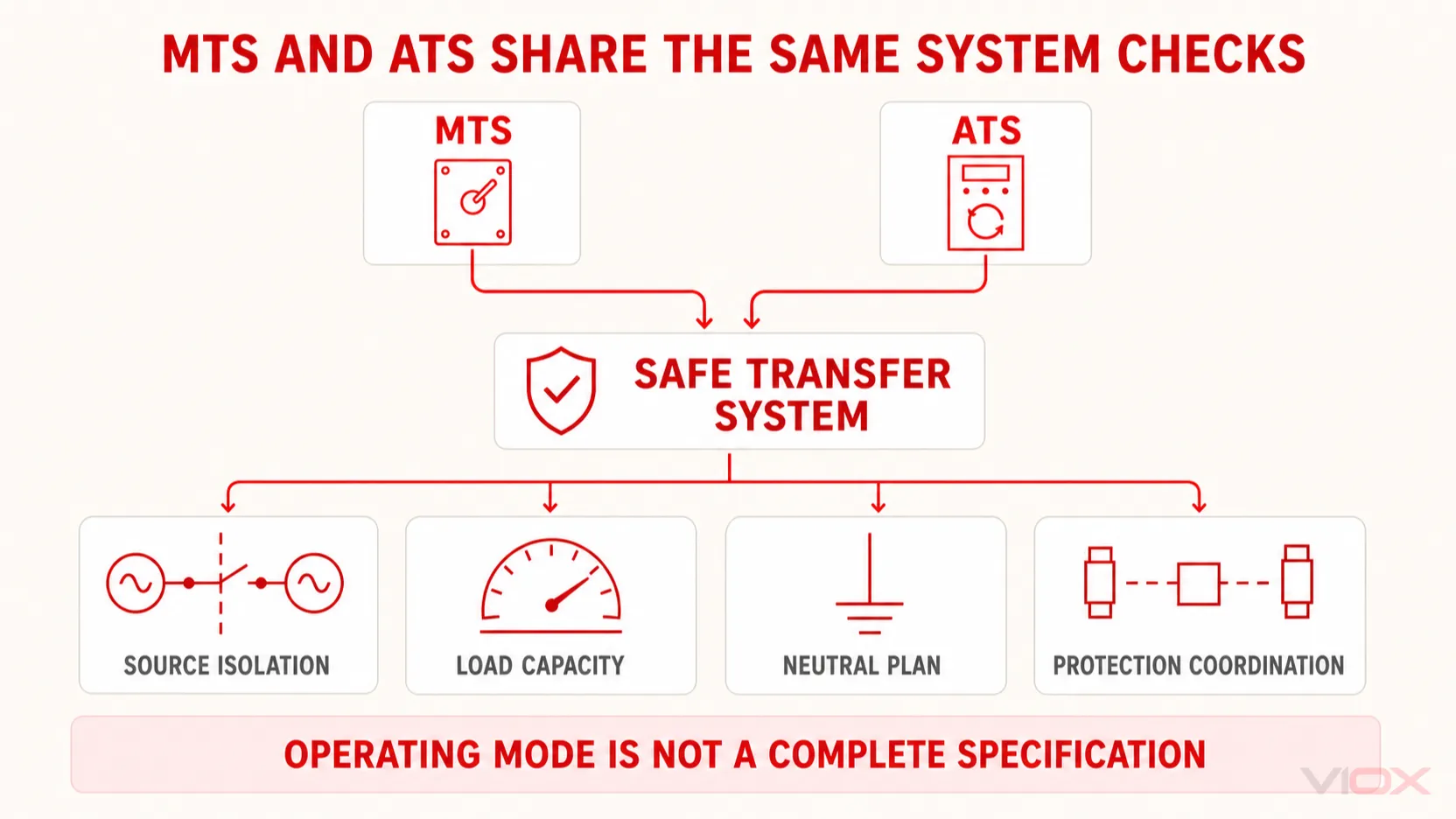
Choosing MTS or ATS answers only the operating question. Both systems still need a safe source-transfer architecture and equipment suitable for the installation.
Prevent unintended source connection and backfeed
The transfer arrangement must prevent the normal and generator sources from being connected together in an unintended way. This is the core safety function behind a properly applied transfer switch or approved interlocked arrangement. Never energize building wiring through an improvised backfeed connection.
IEC 60947-6-1:2021 covers transfer switching equipment for transferring loads between sources within its stated low-voltage scope and includes requirements related to interlocks, transfer sequences and short-time withstand performance. In North American product evaluation, UL Solutions lists both automatic and nonautomatic transfer switches under UL 1008 categories. The applicable installation code, product listing/certification and authority requirements still depend on the market and project.
Match the load—not only the generator nameplate
The switch must be suitable for the system voltage, frequency, phase, number of poles, continuous current and intended utilization. The generator must be able to support the loads that will actually be transferred, including relevant starting or inrush demands. A switch with a high ampere marking does not make an undersized generator capable of carrying the connected load.
Resolve the neutral arrangement
Neutral treatment depends on the source grounding/bonding arrangement, whether the neutral is switched, the transfer equipment design and the applicable installation rules. Do not choose a two-, three- or four-pole device from a generic rule alone. Verify the generator manual, transfer-switch documentation and project grounding design together.
Coordinate fault and overcurrent protection
A transfer switch is not automatically the overcurrent protective device for every source and load condition. Confirm the available fault current, the switch’s applicable withstand/closing or short-circuit rating, the specified upstream protective devices, conductor protection and downstream coordination. When the switch incorporates breakers, confirm their exact function and ratings rather than treating “breaker type” as a universal substitute for system coordination.
Confirm the operating and maintenance plan
An MTS needs an accessible switch and a trained person who can perform the approved procedure. An ATS needs compatible control logic, periodic functional verification and a generator that is ready to start. In both cases, the equipment instructions and locally required inspection or maintenance program control; generic internet intervals should not override model-specific documentation.
When the Usual Rule Has Exceptions
The portable/manual and standby/automatic pairing is a strong starting rule, not an absolute law.
- A portable or towable generator may be used with electrically operated or specialized transfer equipment in a supervised engineered system, but automatic transfer is justified only when source availability, starting, connection, fuel, controls and operating safety are all resolved.
- A permanently installed generator may use manual or non-automatic transfer at an attended facility where authorized personnel deliberately control source acceptance and load transfer.
- Some manual transfer products are designed for a future conversion or upgrade path, but compatibility is product-specific. Do not assume an existing MTS can be turned into an ATS by adding a controller.
- An interlock kit is an adjacent manual architecture, not another name for an MTS. If that is the actual decision, see the separate automatic transfer switch versus interlock kit comparison.
These exceptions are a reason for project-specific review, not a reason to ignore the default generator pairing.
Final Selection Checklist
Choose manual transfer as the starting architecture when all of the following are true:
- The generator is normally deployed, connected or started by a person.
- A trained operator will reliably be present.
- The intended loads can tolerate the response delay.
- Selected loads can be kept within generator capacity.
- The approved connection, neutral and protection design is defined.
- Lower first cost is valuable after the operating requirements are satisfied.
Choose automatic transfer as the starting architecture when one or more of the following is true:
- The standby generator is permanently installed and supports automatic start.
- The property may be unattended when utility power fails.
- The outage response must not depend on human availability.
- Delayed transfer creates an unacceptable operational consequence.
- The generator, ATS and any load-management controls can be integrated and commissioned as one system.
Before buying either type, give the supplier or engineer the source voltage and phase, generator model and output, load list and priority, selected-circuit or broader-service scope, neutral/grounding arrangement, available fault-current and protective-device information, installation environment, and applicable market requirements. If you have already determined that automatic operation is required, review the VIOX automatic transfer switch range against the project specifications or send the application details to [email protected].
Frequently Asked Questions
Can I use an automatic transfer switch with a portable generator?
Only when the complete system is designed for it. The generator must be safely available and connected, capable of the required automatic or supervised start sequence, compatible with the ATS controls, and suitable for the intended unattended or attended operation. An electric-start button by itself is not enough.
Does a standby generator have to use an ATS?
Not in every engineered application, but an ATS is normally required to deliver the unattended automatic-backup function buyers expect from an automatic-start standby generator. An attended facility may deliberately use manual or non-automatic transfer under an approved operating plan.
Is an ATS safer than an MTS?
Automation does not make a poorly selected or installed system safe. Both types can provide safe source isolation when correctly specified and applied. ATS reduces dependence on human action during an outage; MTS reduces control complexity but places more responsibility on the operator.
Can I replace an MTS with an ATS later?
Sometimes, but treat it as a system change rather than a control-only upgrade. The generator-start interface, conductors, load scope, neutral arrangement, ratings, protective devices, enclosure and product compatibility all need review. Some manufacturers offer explicitly upgradeable manual products; that does not make every MTS field-convertible.
Sources
- Eaton: Residential Manual Transfer Switches
- Generac: What Is a Manual Transfer Switch?
- Generac: Portable vs. Automatic Home Standby Power
- ASCO: Non-Automatic and Manual Transfer Switches for Backup Power Applications
- IEC 60947-6-1:2021: Transfer Switching Equipment
- UL Solutions: Switch Certification and Evaluation Services
- Angi: Generator Transfer Switch Installation Cost, July 2026