

On this page
Quick Answer: Main Types of Circuit Breakers
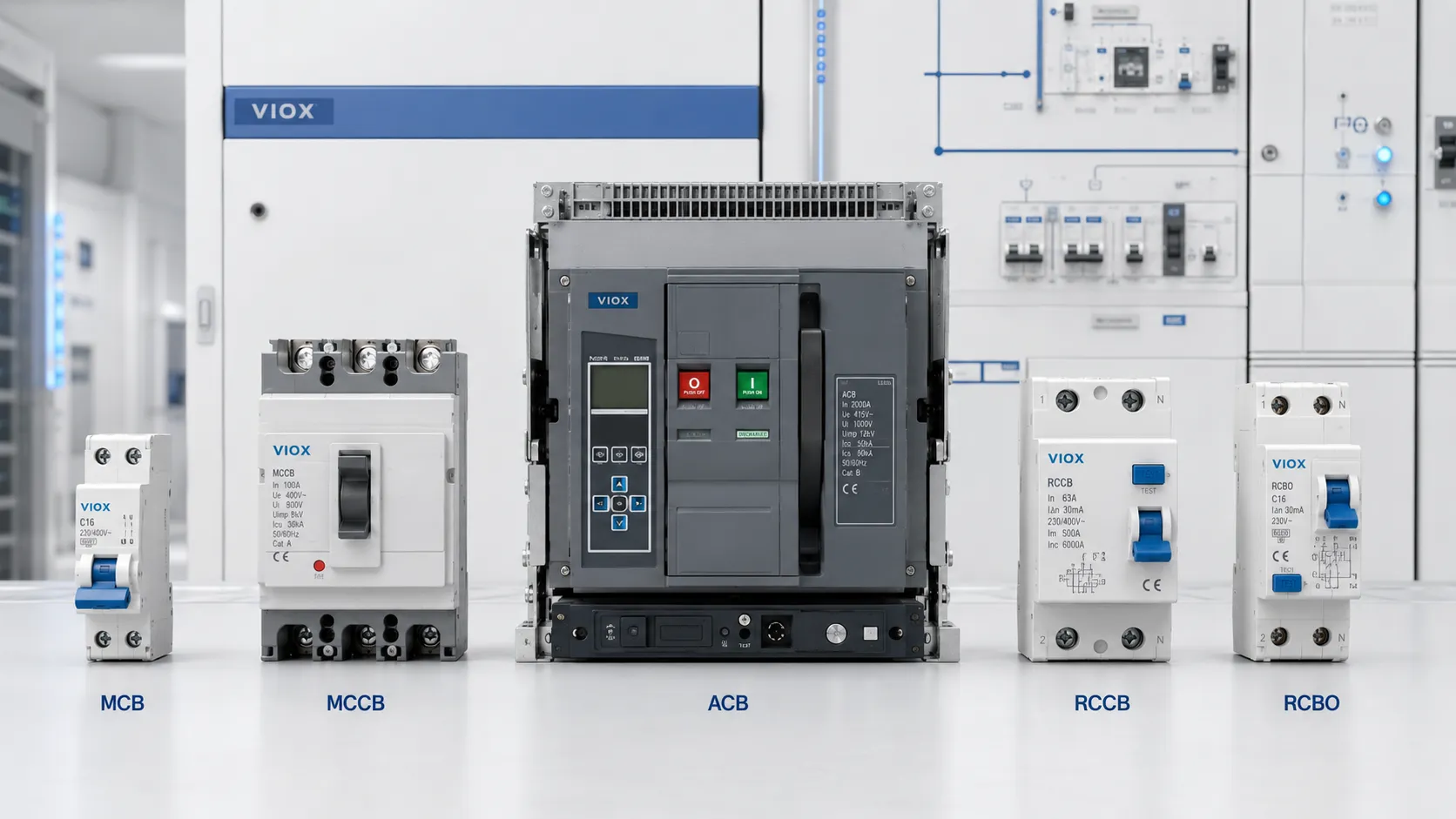
The main types of circuit breakers include MCB, MCCB, ACB, RCCB/RCD, and RCBO for low-voltage electrical protection. Depending on the application, engineers may also classify breakers by voltage level, arc-quenching method, mounting style, current rating, breaking capacity, and AC or DC use.
For most residential, commercial, and light industrial panels:
- MCB protects final circuits against overload and short circuit.
- MCCB protects higher-current feeders, machinery, and distribution circuits.
- ACB protects large low-voltage main incomers and switchboards.
- RCCB/RCD detects leakage current for shock protection.
- RCBO combines residual current protection with overcurrent protection.
- DC circuit breakers are used for solar, battery, and DC power systems.
For medium-voltage and utility applications, vacuum circuit breakers (VCB), SF6 circuit breakers, and oil circuit breakers are also used, but they belong to a different classification level than low-voltage MCBs and MCCBs.
Circuit Breaker Types at a Glance
| Circuit Breaker Type | Main Function | Typical Application | Best Next Step |
|---|---|---|---|
| MCB | Overload and short-circuit protection | Final circuits, lighting, socket circuits, small control panels | Read the MCB guide |
| MCCB | Higher-current overcurrent and short-circuit protection | Feeders, machinery, distribution boards | Read the MCCB guide |
| ACB | Main low-voltage circuit protection | Main incomers, switchboards, large distribution systems | Read the ACB guide |
| RCCB/RCD | Residual current or leakage protection | Shock protection, earth-leakage protection | Compare RCD vs MCB |
| RCBO | Residual current plus overcurrent protection | Individual final circuits where both functions are needed | Read RCBO vs RCCB + MCB |
| DC Circuit Breaker | DC fault interruption | Solar PV, battery systems, DC control circuits | Read the DC circuit breaker guide |
| VCB | Vacuum arc interruption | Medium-voltage distribution | Utility and industrial MV switchgear context |
| SF6 Circuit Breaker | Gas-insulated arc interruption | Medium/high-voltage substations | Utility and high-voltage system context |
Types by Protection Function
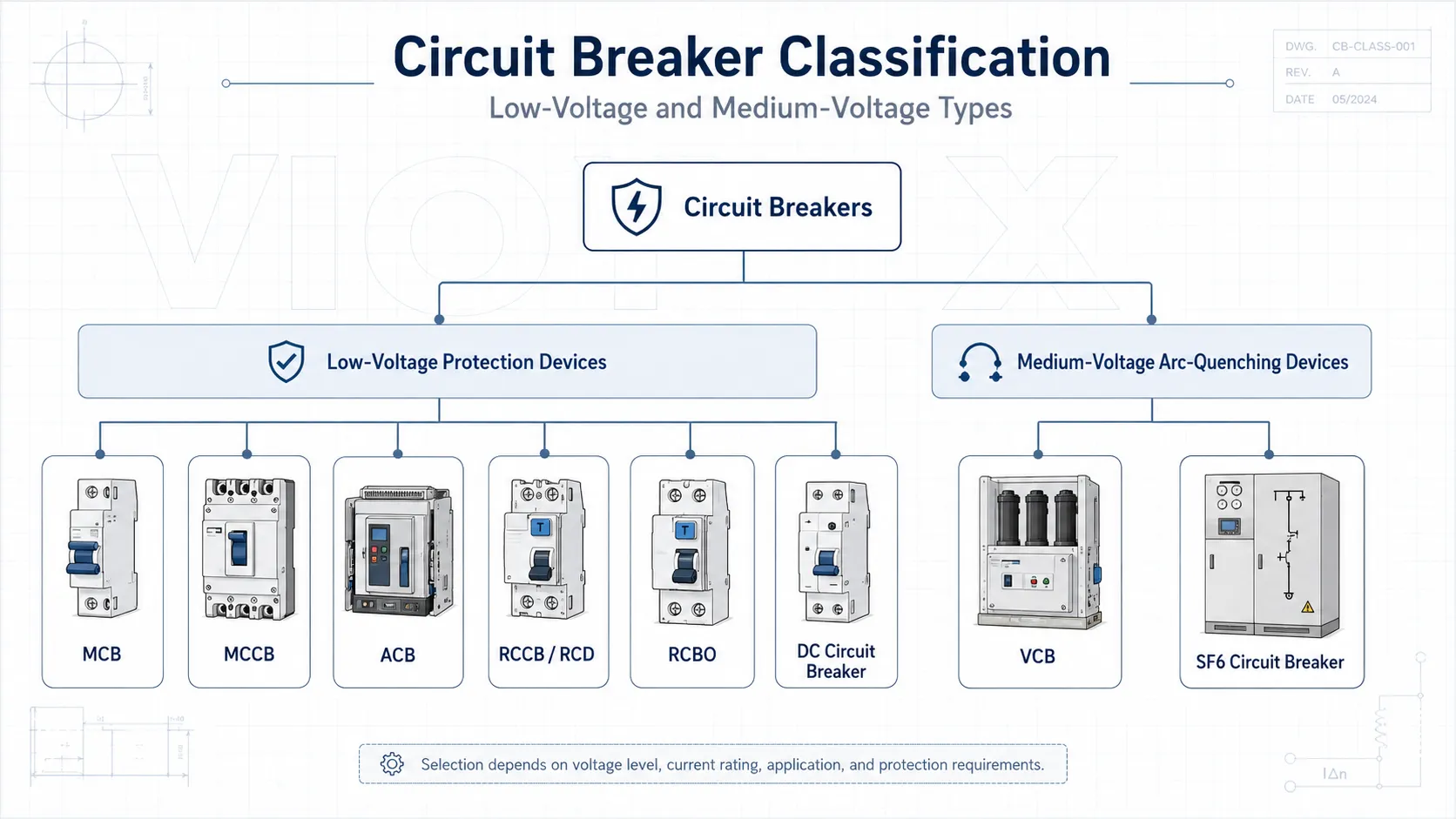
The most useful way to classify low-voltage circuit breakers is by the protection function they provide.
MCB: Miniature Circuit Breaker
An MCB protects final circuits from overload and short circuit. It is common in distribution boards, lighting circuits, socket circuits, small machinery, and control panels. MCBs are compact, modular, and commonly mounted on DIN rail.
MCBs are often selected by:
- rated current, such as 6A, 10A, 16A, 20A, or 32A
- trip curve, such as B, C, or D
- breaking capacity, such as 6kA or 10kA depending on the product and market
- number of poles
- AC or DC rating
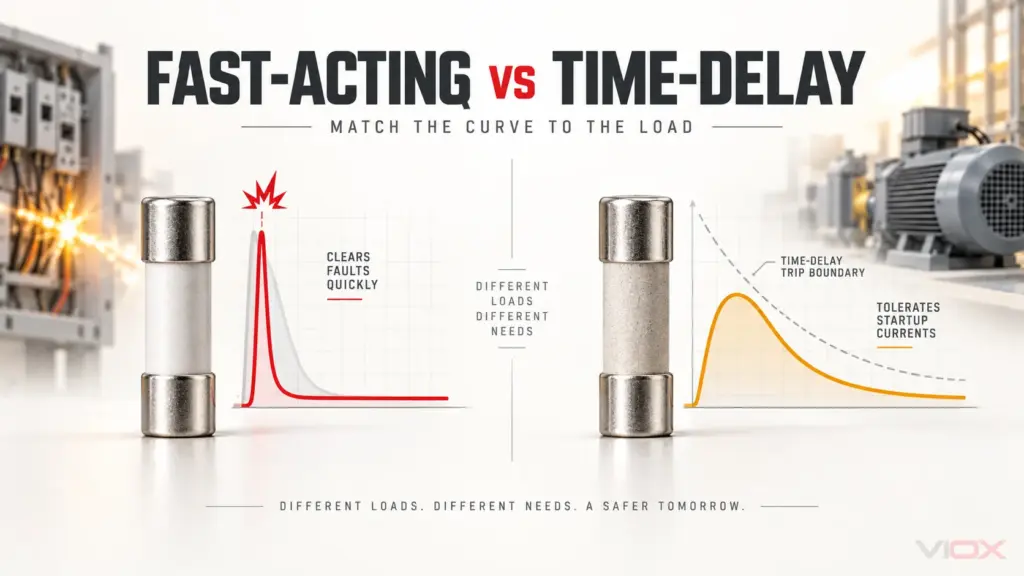
Trip curves deserve separate attention because a B16, C16, and D16 breaker may share the same 16A current rating but respond differently to inrush and fault current. For detailed curve selection, use VIOX’s trip curve explanation or the types of miniature circuit breakers article.
MCCB: Molded Case Circuit Breaker
An MCCB is used for higher-current circuits than typical final-circuit MCBs. MCCBs are common in commercial distribution, industrial panels, machine feeders, motor circuits, and sub-main protection.
MCCBs are often selected when the project needs:
- higher current rating
- higher breaking capacity
- adjustable trip settings
- better selectivity with downstream protection
- accessories such as auxiliary contacts, shunt trip, or undervoltage release
For a direct comparison, see VIOX’s MCCB vs MCB guide.
ACB: Air Circuit Breaker
An ACB is a low-voltage breaker used for large main incomers, switchboards, bus couplers, and critical distribution systems. ACBs are often used where high current, selective coordination, draw-out construction, metering, or communication features are required.
Do not choose an ACB only because the load is large. ACB selection depends on rated current, short-circuit capacity, short-time withstand, trip unit functions, installation type, and switchboard design.
RCCB/RCD: Residual Current Protection
RCCB and RCD devices detect imbalance between live conductors and the return path. They are used for residual current or earth-leakage protection, mainly to reduce shock risk and, in some cases, fire risk from leakage current.
An RCCB does not replace an MCB for overcurrent protection unless it is combined with overcurrent protection in an RCBO. This distinction is important in distribution board design.
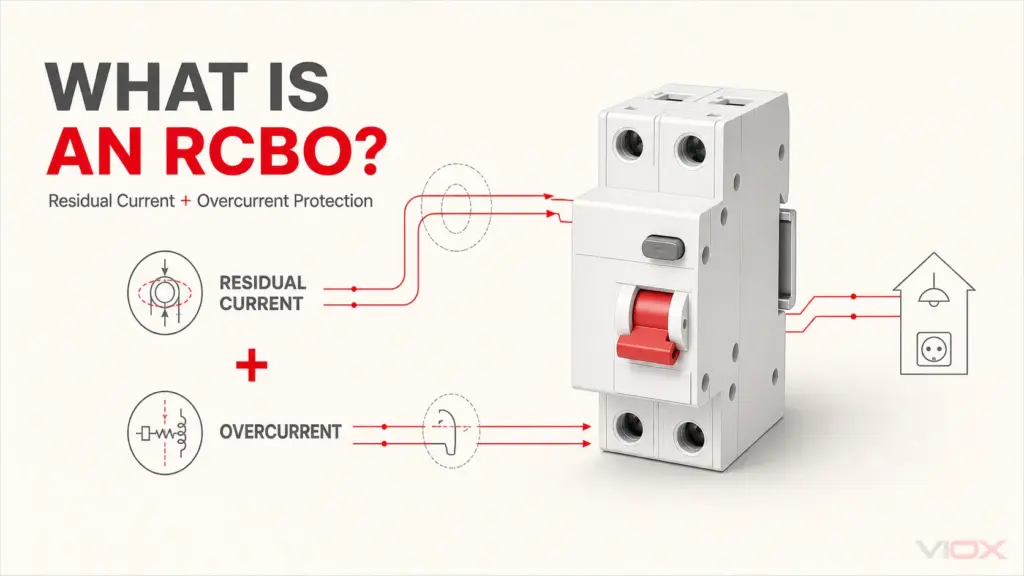
RCBO: Combined Residual Current and Overcurrent Protection
An RCBO combines MCB-like overcurrent protection with RCCB/RCD-like residual current protection. It is used when individual circuits need both functions in one device.
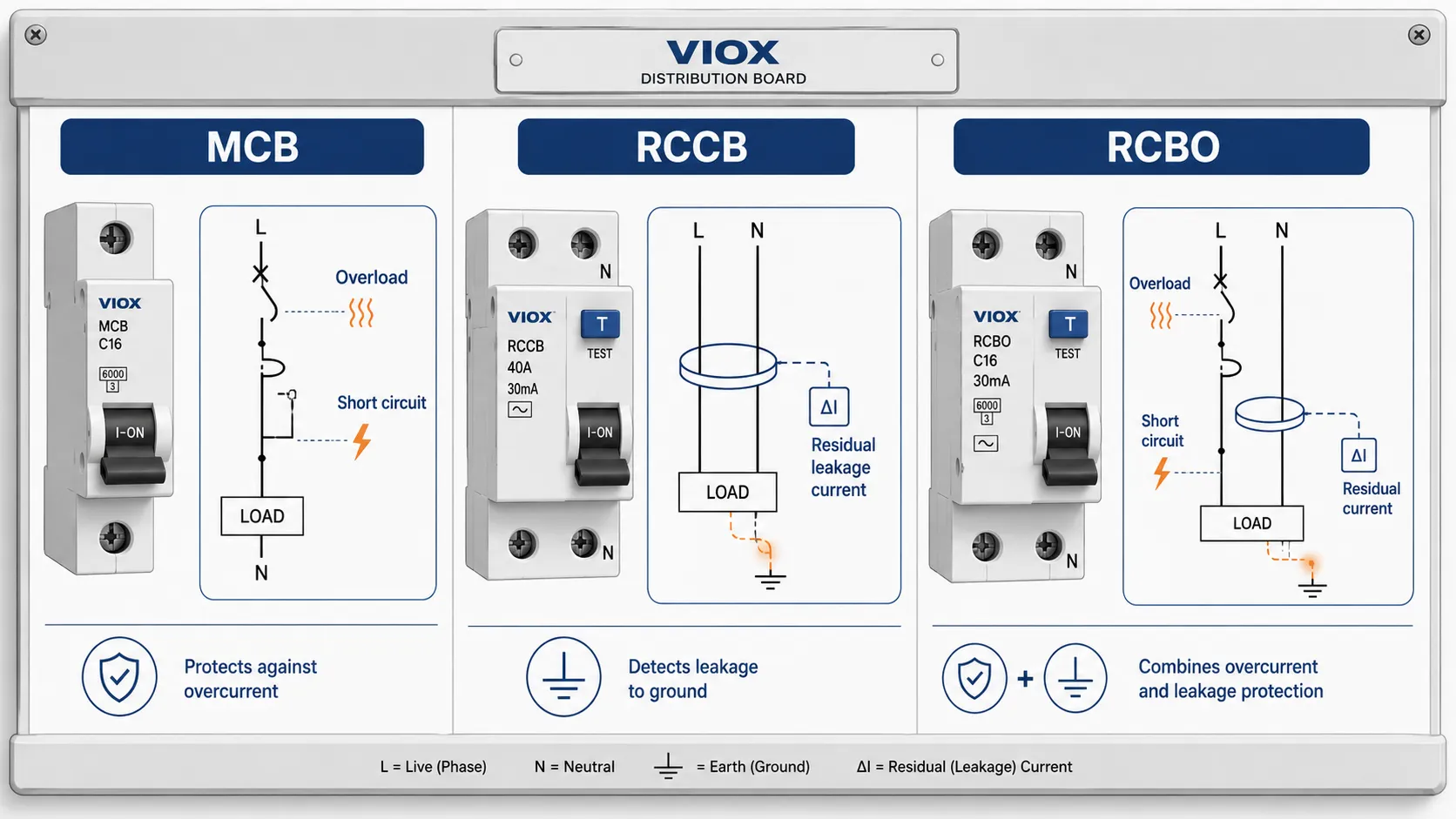
RCBOs are common where fault isolation matters. Instead of one RCCB protecting many MCB circuits, each RCBO can isolate only the affected branch circuit.
For acronym-heavy comparisons, use VIOX’s MCB, MCCB, RCD, RCCB, and RCBO difference guide.
Types by Current Range and Application
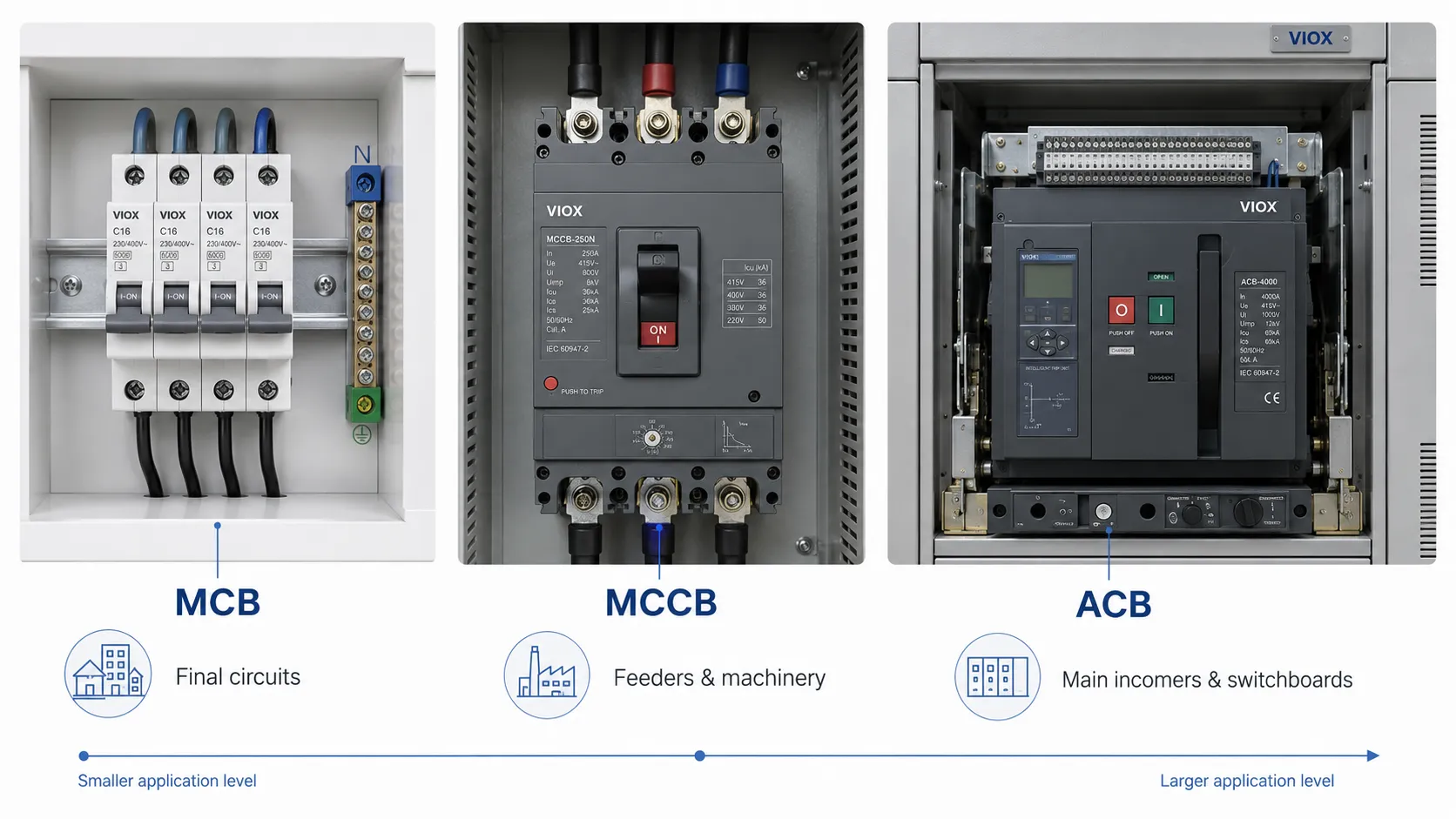
Another practical classification is current range and application level.
| Type | Common Role | Typical Application Level |
|---|---|---|
| MCB | Final circuit protection | Residential, light commercial, control panels |
| MCCB | Feeder and equipment protection | Commercial and industrial distribution |
| ACB | Main low-voltage protection | Main switchboards, large facilities |
This classification is useful because it prevents a common mistake: choosing a breaker only by amp rating. A 100A modular breaker and a 100A MCCB do not necessarily serve the same role. The correct device depends on fault level, coordination, installation type, accessories, thermal performance, and panel construction.
For MCB current ratings, use VIOX’s standard MCB sizes guide. For MCCB ratings, use standard breaker sizes for MCCBs.
Types by Voltage and Arc-Quenching Medium
Circuit breakers can also be classified by the method used to extinguish the arc when the contacts open.
| Arc-Quenching Method | Typical Voltage Context | Notes |
|---|---|---|
| Air | Low-voltage systems and some switchgear | Used in MCBs, MCCBs, and ACBs depending on design |
| Vacuum | Medium-voltage distribution | Common in VCBs for industrial and utility systems |
| SF6 gas | Medium/high-voltage systems | Used in gas-insulated and high-voltage equipment |
| Oil | Legacy medium/high-voltage systems | Older technology, less common in modern new installations |
This is a different classification from MCB/MCCB/RCCB/RCBO. For example, an ACB is named by its air arc-interruption method and low-voltage switchgear role. An RCCB is named by its residual current function. Mixing these categories without explanation can confuse readers.
For VIOX’s low-voltage circuit protection cluster, the key types are MCB, MCCB, ACB, RCCB, and RCBO. VCB and SF6 breakers belong mainly to medium- and high-voltage system discussions, so they are best treated as adjacent context rather than the main focus of a low-voltage breaker selection page.
AC vs DC Circuit Breakers
AC and DC circuit breakers may look similar, but their interruption requirements are different. AC current naturally crosses zero during each cycle, which helps arc extinction. DC current does not naturally cross zero, so DC breakers require suitable arc-chute design, voltage rating, polarity rules where applicable, and wiring instructions.
Do not use an AC breaker in a DC circuit unless the manufacturer clearly rates it for that DC application.
Common DC breaker applications include:
- solar PV strings and combiner boxes
- battery energy storage systems
- DC control circuits
- EV-related DC auxiliary systems
- telecom and UPS DC distribution
Circuit Breaker Mounting Types
Mounting style is another practical way to classify circuit breakers, especially when comparing residential panels, modular DIN rail boards, industrial control panels, and large switchboards.
| Mounting Type | Typical Use | Common Devices |
|---|---|---|
| DIN rail mount | Modular distribution boards and control panels | MCB, RCCB, RCBO, modular devices |
| Panel mount / fixed mount | Industrial panels and distribution boards | MCCB, some isolators and protection devices |
| Plug-in mount | Specific panelboard systems | Residential/commercial breaker systems in some markets |
| Draw-out mount | Large switchboards where maintenance access matters | ACB, large industrial breakers |
Mounting type is not just a mechanical detail. It affects panel design, replacement compatibility, wiring access, maintenance, and safety interlocking.
Circuit Breaker Sizes and Ratings
The phrase “circuit breaker size” can mean three different things:
- Amp rating: 16A, 20A, 32A, 63A, 100A, etc.
- Physical frame size: modular width, MCCB frame, ACB frame, panel cutout size
- Breaking capacity: 6kA, 10kA, 25kA, 50kA, etc.
Do not treat breaker size as only amperes. A correct breaker must match:
- rated current
- rated voltage
- breaking capacity
- trip curve or trip unit settings
- pole count
- installation standard
- cable size and load type
- panel compatibility
For IEC-style low-voltage products, the standard context also matters. IEC 60898-1 is commonly associated with circuit breakers for household and similar installations, while IEC 60947-2 is used for low-voltage circuit breakers in industrial applications. The same amp rating may appear in both contexts, but the short-circuit markings and test assumptions can differ.
For industrial breakers under IEC 60947-2, two key short-circuit terms are:
- Icu: rated ultimate short-circuit breaking capacity, the maximum fault current the breaker can interrupt under specified test conditions.
- Ics: rated service short-circuit breaking capacity, usually expressed as a percentage of Icu, indicating the fault current level at which the breaker is expected to remain suitable for continued service after the test sequence.
In practical procurement, a breaker marked 25kA Icu is not always equivalent to a breaker with 25kA Ics. For critical distribution systems, panel builders often pay close attention to the Ics/Icu ratio, not only the largest kA number on the label.
How to Identify Circuit Breaker Type
To identify a circuit breaker type, check the markings and physical construction. Do not rely only on appearance.
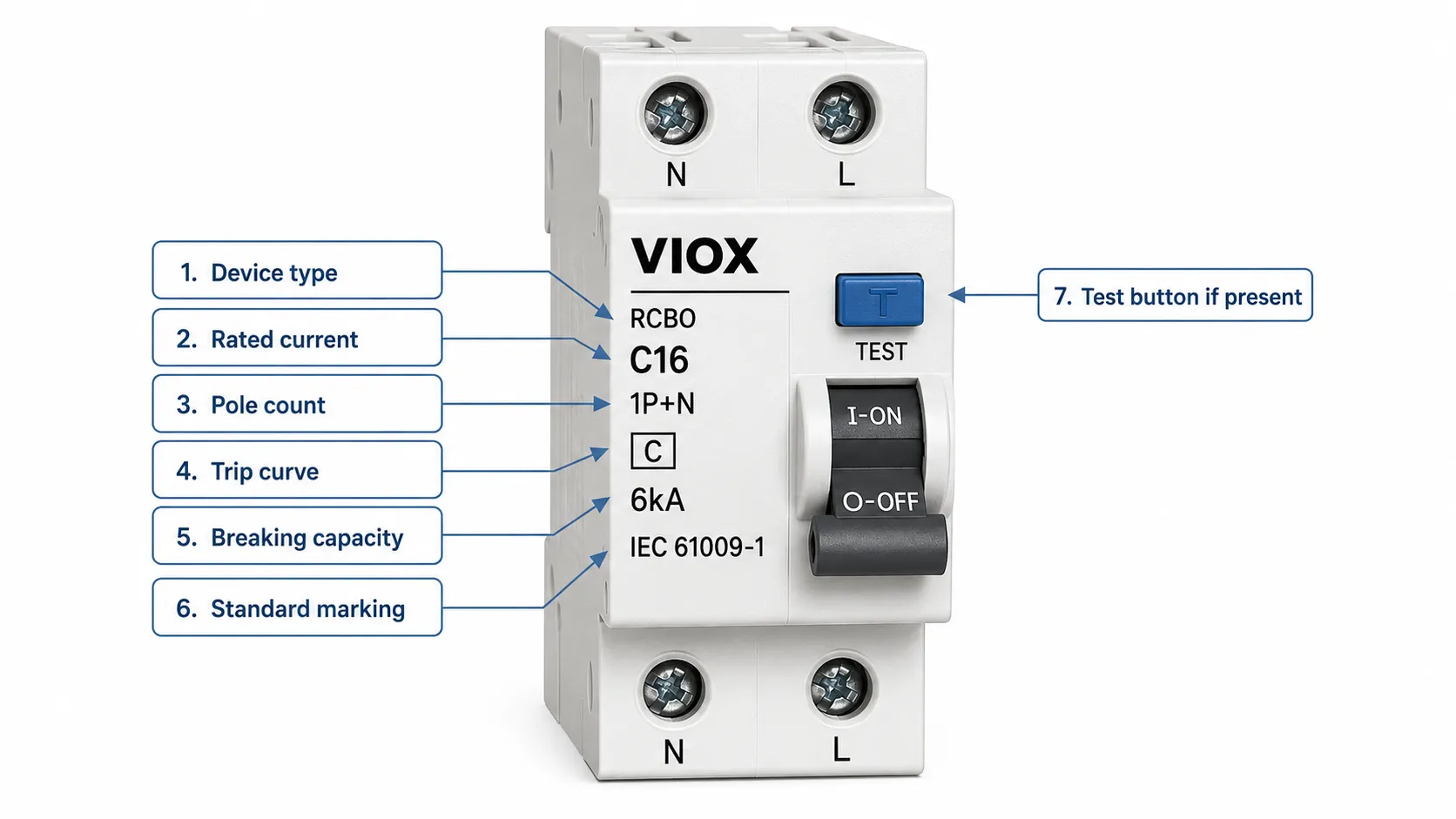
| What to Check | What It Tells You |
|---|---|
| Device label | MCB, MCCB, RCCB, RCBO, ACB, or manufacturer series |
| Rated current | Normal current rating, such as 16A or 250A |
| Trip curve or trip unit | B/C/D curve for many MCBs, adjustable settings for MCCBs/ACBs |
| Breaking capacity | Fault interruption capability in kA |
| Pole count | 1P, 2P, 3P, 4P, 1P+N, 3P+N |
| Test button | Often indicates RCCB, RCBO, GFCI, or AFCI-type functionality |
| Standard marking | IEC 60898-1, IEC 60947-2, UL 489, or other relevant context |
| Mounting style | DIN rail, fixed, plug-in, draw-out |
If the device has only overcurrent markings and no residual current test button, it is probably not an RCCB or RCBO. If it has residual current sensitivity such as 30mA, it belongs to the residual-current protection family.
Circuit Breaker Types for Home
Home circuit breaker types vary by country and electrical code. A useful general explanation is:
- MCB or standard breaker: protects against overload and short circuit.
- RCCB/RCD or GFCI: protects against leakage current and shock risk.
- RCBO: combines leakage protection and overcurrent protection.
- AFCI: detects dangerous arc-fault signatures in markets where arc-fault protection is required.
In North America, users often discuss standard breakers, GFCI breakers, AFCI breakers, and dual-function AFCI/GFCI breakers. In many IEC markets, users more often discuss MCB, RCCB/RCD, and RCBO. This terminology difference matters because the same protection concept may be described with different device names in different regions.
For GFCI/AFCI comparison, use VIOX’s GFCI vs AFCI guide.
How to Choose the Right Type
Use this decision table as a starting point.
| Application Need | Likely Breaker Type |
|---|---|
| Final circuit overload and short-circuit protection | MCB |
| Higher-current feeder or machinery protection | MCCB |
| Main low-voltage switchboard protection | ACB |
| Leakage current or shock protection | RCCB/RCD |
| Leakage plus overcurrent protection in one device | RCBO |
| Solar, battery, or DC distribution protection | DC-rated circuit breaker |
| Medium-voltage distribution | VCB or SF6 breaker depending on system design |
| Arc-fault protection in residential branch circuits | AFCI or equivalent local device |
After choosing the general type, verify current rating, voltage, breaking capacity, trip behavior, pole count, standard, accessories, and panel compatibility. A breaker type name is only the first step.
Common Mistakes
Mistake 1: Treating All Breakers as the Same Device
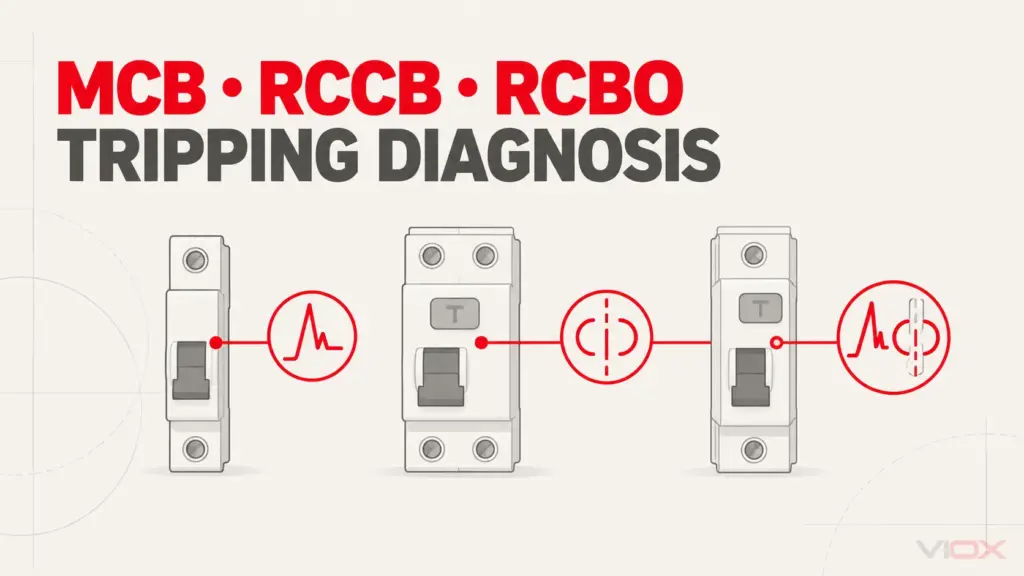
An MCB, RCCB, and RCBO may all fit on DIN rail, but they do not perform the same function. Physical similarity does not mean functional equivalence.
Mistake 2: Using RCCB Instead of Overcurrent Protection
An RCCB detects residual current. It does not replace an MCB or fuse for overload and short-circuit protection unless the device is an RCBO or combined protection system.
Mistake 3: Choosing Only by Amp Rating
A 32A breaker is not automatically correct for a 32A load. Cable size, inrush current, ambient temperature, trip curve, and breaking capacity must be checked.
Mistake 4: Ignoring AC/DC Rating
DC breakers need specific DC ratings and arc-interruption capability. AC-only breakers should not be used in DC circuits without manufacturer approval.
Mistake 5: Ignoring the Role of Specialized Breakers
A type name is only the first layer of selection. A project may also need a specific trip curve, residual-current type, DC rating, breaking capacity, mounting style, or communication accessory. Choose the breaker family first, then verify the detailed specification.
FAQ
What are the main types of circuit breakers?
The main low-voltage types are MCB, MCCB, ACB, RCCB/RCD, and RCBO. Other classifications include DC circuit breakers, AFCI/GFCI devices, VCBs, SF6 breakers, and oil circuit breakers depending on voltage level and application.
What type of circuit breaker is used in homes?
It depends on the country. Many IEC-style homes use MCBs with RCCB/RCD or RCBO protection. North American homes commonly use standard breakers, GFCI breakers, AFCI breakers, and dual-function breakers.
What is the difference between MCB and MCCB?
MCBs are typically used for final circuits and modular distribution. MCCBs are used for higher-current feeders, machinery, and distribution circuits where higher breaking capacity or adjustable trip settings may be needed.
What is the difference between RCCB and RCBO?
An RCCB detects residual current but does not provide overcurrent protection by itself. An RCBO combines residual current protection with overload and short-circuit protection.
What are circuit breaker mounting types?
Common mounting types include DIN rail mount, panel/fixed mount, plug-in mount, and draw-out mount. Mounting style affects panel compatibility, replacement, and maintenance.
How do I identify my circuit breaker type?
Check the label, rated current, pole count, trip curve or trip unit, breaking capacity, test button, standard marking, and mounting style. The product series and wiring diagram are often more reliable than appearance.
Is SF6 a type of circuit breaker?
Yes, SF6 circuit breakers are a type of breaker classified by arc-quenching medium, mainly used in medium- and high-voltage systems. They are not in the same classification group as MCB, RCCB, or RCBO, which are low-voltage function-based device names.
Which circuit breaker type should I choose?
Start with the application: final circuit, feeder, main incomer, leakage protection, DC circuit, or medium-voltage system. Then verify current rating, voltage, breaking capacity, trip behavior, pole count, and applicable standard.
Conclusion
Circuit breakers can be classified in several ways: by protection function, current range, voltage level, arc-quenching medium, mounting style, and application. For low-voltage panels, the most important families are MCB, MCCB, ACB, RCCB/RCD, and RCBO.
Use this guide to identify the correct breaker family first, then verify the detailed specification for sizing, trip curves, breaking capacity, residual current protection, or DC circuit protection.