


On this page
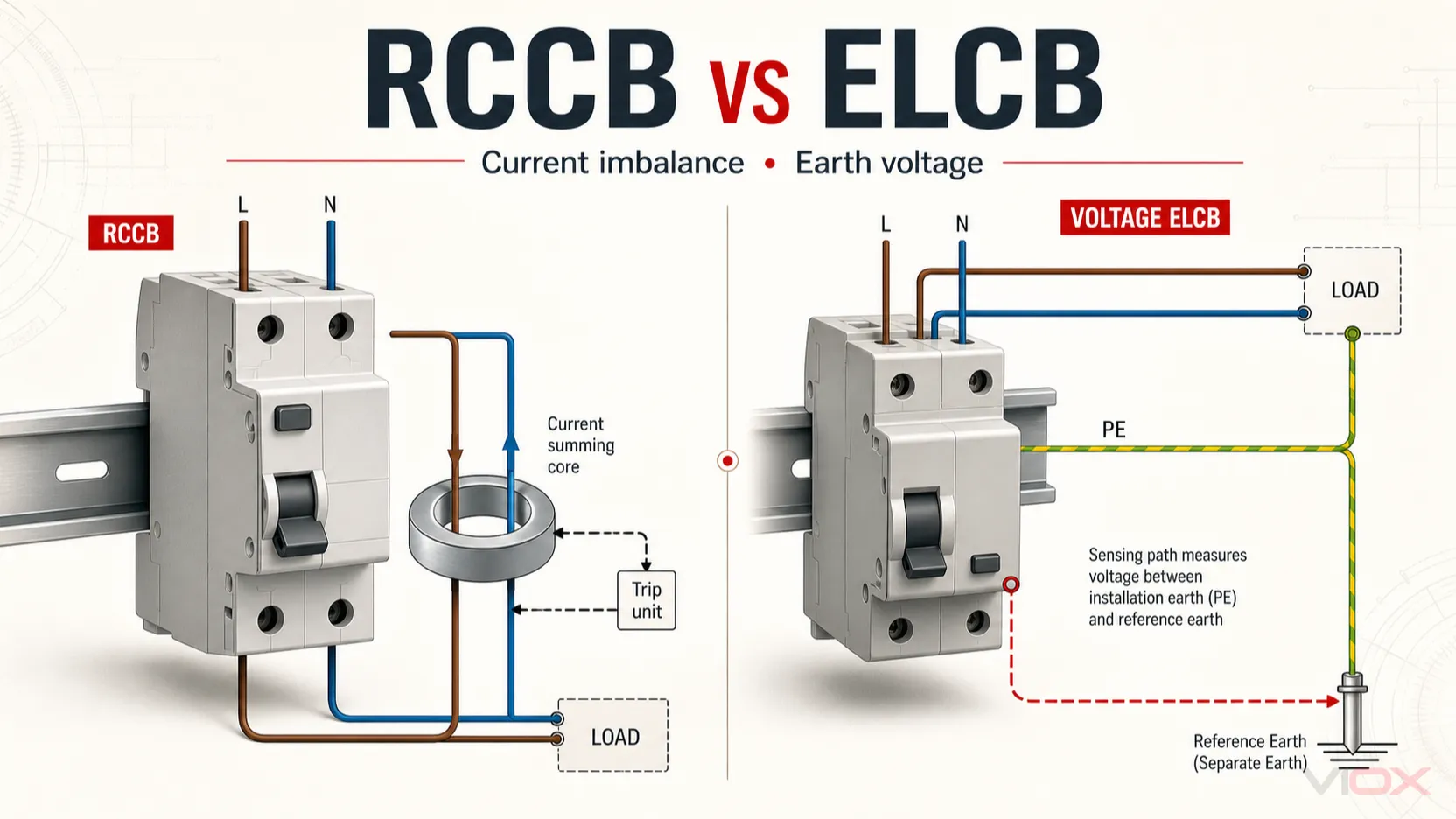
An RCCB (Residual Current Circuit Breaker) detects residual-current imbalance through all live conductors passing through its sensing core. A traditional voltage-operated ELCB (Earth Leakage Circuit Breaker) monitors voltage between protected earth and reference earth. They are not equivalent devices.
There is one important complication: in some markets, sellers and electricians still use “ELCB” as a general name for a current-operated RCD or RCCB. Therefore, do not identify a device by the word ELCB alone. Check its declared standard, front diagram, terminal arrangement, and manufacturer documentation before deciding whether it is a legacy device or whether it needs replacement.
RCCB vs ELCB: Quick Comparison
| Comparison point | RCCB | Traditional voltage-operated ELCB |
|---|---|---|
| Measured quantity | Vector sum of current through all live conductors in the sensing core | Voltage between protected earth and a reference-earth point |
| Typical sensing path | Line and neutral in single-phase circuits; all live conductors in multiphase circuits | Protected earth conductor and reference-earth connection |
| Trip condition | Residual current reaches the device’s operating threshold under its declared conditions | Voltage on the monitored earth path reaches the device’s operating threshold |
| Dependence on the monitored earth path | The sensing principle does not use the protective conductor as a measured current path | Correct operation depends on the intended earth connections and monitored path |
| Parallel earth path | An imbalance can still be detected if current returns outside the sensing core | Fault current that bypasses the monitored earth path may not create the required trip voltage |
| Overload and short-circuit protection | Not provided by an RCCB under IEC 61008-1 | Not an inherent function of a traditional voltage-operated ELCB |
| Present-day identification | Current-operated residual-current device with a declared RCD/RCCB standard | Legacy voltage-operated device; the market term ELCB alone is not conclusive |
| Direct interchangeability | Do not decide from ratings or appearance alone | Replacement may require earthing and conductor-routing changes |
The practical rule is simple:
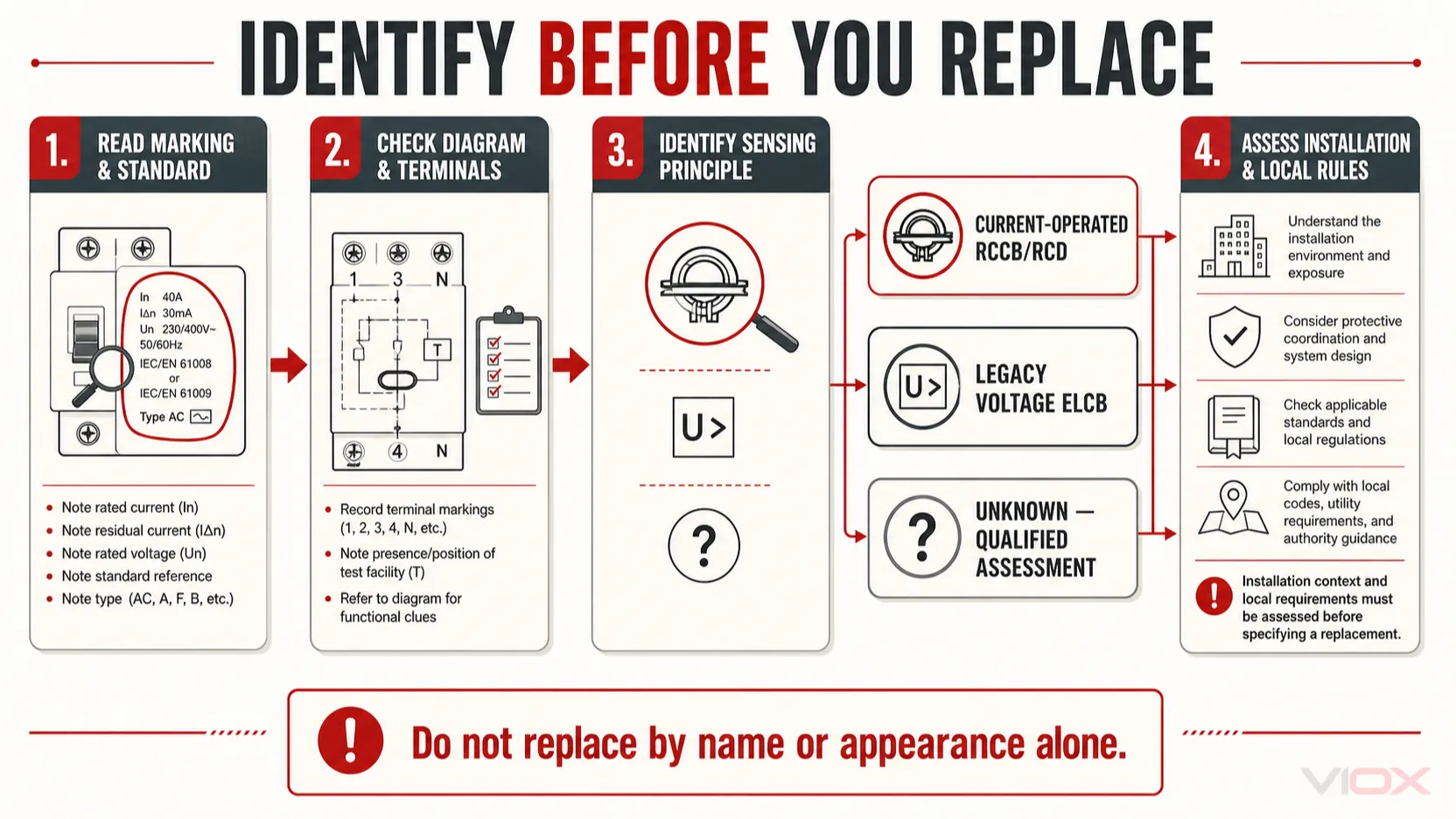
Identify the sensing mechanism first. Then verify the installation and the device standard. Do not make a retain-or-replace decision from the words RCCB or ELCB alone.
Are RCCB and ELCB the Same? Why the Name Causes Confusion
Historically, ELCB referred to a voltage-operated device. It sensed a rise in voltage on protected metalwork or the protective-earth path relative to reference earth. That technology is different from the current-summing principle used by an RCCB.
However, “earth leakage circuit breaker” became a familiar commercial term. Some markets subsequently used ELCB for current-operated leakage devices as well. A product advertised as an ELCB might therefore be:
- a traditional voltage-operated ELCB;
- a current-operated RCD or RCCB sold under regional terminology;
- a combined device whose protective functions cannot be determined from the sales name;
- an unidentified legacy product with incomplete documentation.
This is why a label such as “ELCB 63 A” is insufficient for replacement selection. The rated current does not reveal what the device measures, its residual-current characteristics, whether it includes overcurrent protection, or the standard against which it was evaluated.
For a focused explanation of modern current-operated devices, see What Is an RCCB?.
The underlying current terms are separated in Leakage Current vs Residual Current vs Ground Current.
How an RCCB Detects Residual Current
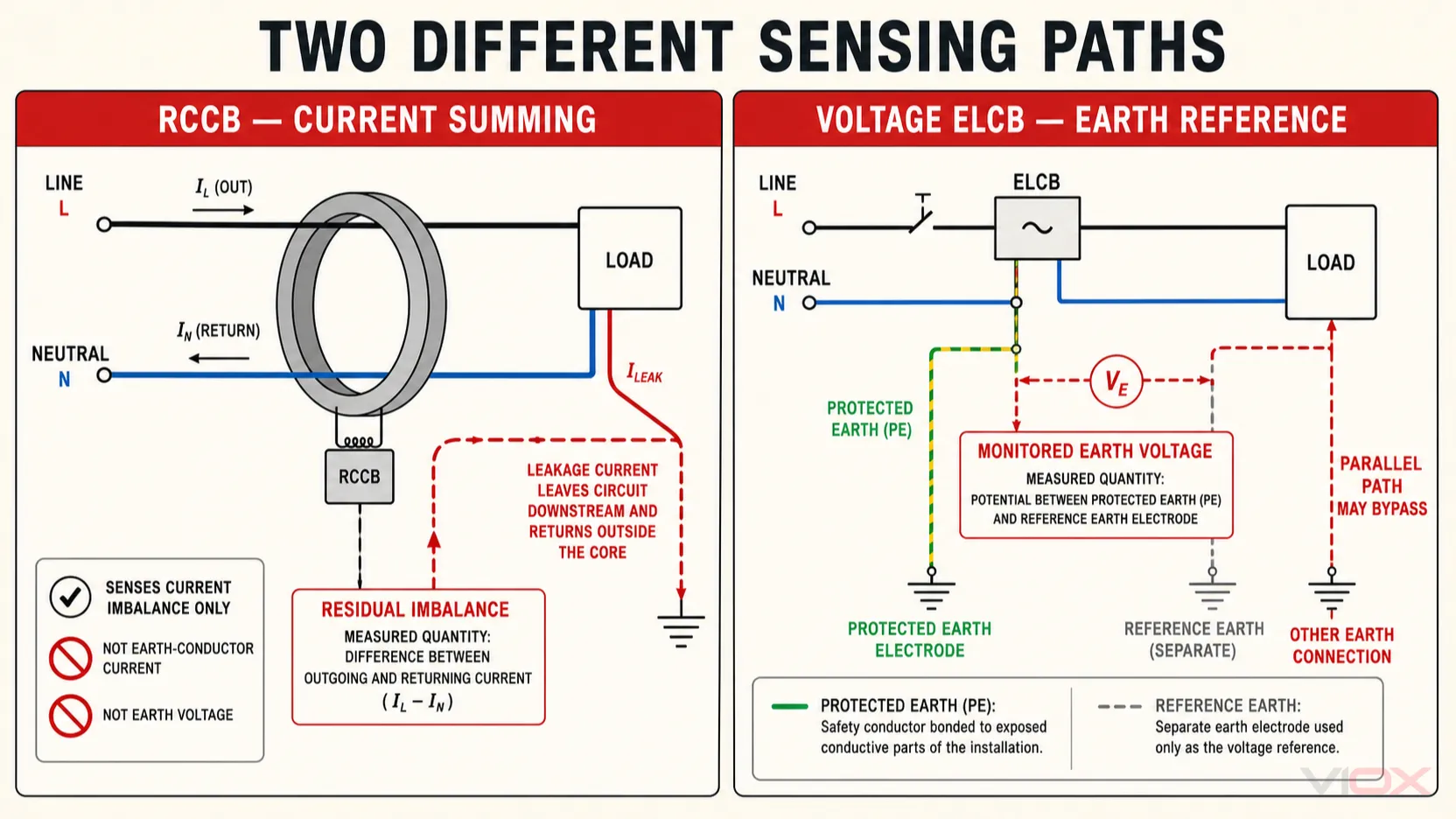
In a healthy circuit, the instantaneous vector sum of current through all live conductors passing through the RCCB’s summation transformer is approximately zero. In a single-phase circuit, current leaving on the line conductor should return through the neutral conductor. In a multiphase circuit, all live conductors—including neutral where used—must be included in the sensing arrangement.
If some current returns by another path, the vector sum is no longer zero. The resulting residual current, commonly expressed as IΔ, produces a signal in the sensing system. The RCCB opens when the operating conditions defined for that device are satisfied.
This principle has two important limits:
- It detects imbalance, not every dangerous current condition.
- It does not prove that the installation’s protective earthing is adequate.
For example, a current path that leaves through line and returns completely through neutral may create no residual imbalance, even though another protective function may need to operate. An RCCB must therefore be part of a coordinated protection system, not treated as a universal circuit breaker.
How a Traditional Voltage-Operated ELCB Works
A traditional voltage-operated ELCB monitors the potential difference between the protected-earth system and a reference-earth point. If a fault raises the monitored earth potential to the device’s operating level, the trip mechanism disconnects the supply.
Its limitation is the sensing path. The device can only respond correctly when the fault produces sufficient voltage across the monitored earth circuit. Parallel bonding, pipework, structural metal, an alternative electrode, incorrect conductor routing, or a damaged reference connection can change or bypass that path.
That does not mean every old ELCB is automatically defective. It means the installation cannot be assessed from the front label alone. The protected-earth arrangement and the device’s actual circuit must be examined by a qualified electrical professional.
Which Faults Can Each Device Detect?
| Condition | RCCB response | Traditional voltage-operated ELCB response | What else must be verified |
|---|---|---|---|
| Current leaves a live conductor and returns to earth outside the RCCB sensing core | Residual-current imbalance can be detected | May operate if the fault raises voltage on the monitored protected-earth path | Earthing, disconnection time, device type and sensitivity under local rules |
| Fault current flows through the ELCB’s intended protected-earth path | RCCB can detect the resulting live-conductor imbalance | Can operate when its monitored voltage reaches the trip condition | Integrity of both the protected and reference-earth connections |
| Fault current returns through a parallel earth or bonding path that bypasses the ELCB sensing circuit | RCCB can still detect imbalance through its live conductors | May fail to see the required monitored-earth voltage | Full bonding and earth-path survey |
| Current flows from line to neutral and returns through both conductors inside the RCCB core | No residual imbalance is created solely by that path | No protected-earth voltage is necessarily created | Overcurrent protection and other required protective measures |
| Sustained overload | An RCCB alone does not provide overload protection | Not an inherent ELCB function | MCB, fuse, MCCB, or another correctly coordinated overcurrent device |
| Short circuit | An RCCB alone is not the circuit’s short-circuit protective device | Not an inherent ELCB function | Required breaking capacity, backup protection and coordination |
No table can determine whether a real installation is safe without its earthing arrangement, fault level, wiring, device documentation, and test results.
Does an RCCB Work Without an Earth Connection?
The RCCB sensing mechanism does not need the protective-earth conductor to pass through its summation transformer. This is often shortened to “an RCCB works without earth,” but that phrase is unsafe when applied to the whole installation.
A compliant installation may still require protective conductors, equipotential bonding, automatic disconnection, and other measures under its adopted wiring rules. A broken or missing protective-earth connection can remain dangerous even if an RCCB is installed. The correct statement is:
Residual-current sensing is not the same as protective earthing. An RCCB does not make protective earthing optional.
Do RCCBs Protect Against Overload and Short Circuit?
An RCCB covered by IEC 61008-1 is a residual current operated circuit-breaker without integral overcurrent protection. Its rated current, In, describes the current it can carry under its declared conditions; it is not an adjustable overload trip setting.
For the scope and evidence fields of the product standard, see the VIOX guide to IEC 61008-1 RCCB requirements.
The circuit still needs correctly selected overcurrent and short-circuit protection. Depending on the design, that may be an upstream or associated MCB, fuse, or another protective device. An RCBO combines residual-current and overcurrent functions in one device, but its ratings and standard must still be verified.
For the functional boundary, see RCCB vs MCB: Why Use RCCB Instead of MCB?. Detailed sensitivity selection belongs in the separate RCCB sensitivity guide.
Which Is Better: RCCB or ELCB?
For a new installation that requires residual-current protection, the relevant modern solution is normally a current-operated RCD such as an RCCB or RCBO selected under the adopted code and application requirements. A traditional voltage-operated ELCB should not be treated as an equivalent alternative simply because it also responds to an earth-related fault.
That is not a universal instruction to remove every device called an ELCB. Existing-device policy varies by jurisdiction, and some current-operated devices are still called ELCBs locally. The decision should follow this sequence:
- Determine whether the device is voltage-operated or current-operated.
- Identify the declared product standard and protective functions.
- Assess the existing earthing, bonding, neutral, and protective-conductor arrangement.
- Verify residual-current characteristics and required overcurrent coordination.
- Follow the locally adopted rules, authority requirements, and manufacturer instructions.
How to Identify an Existing Device Safely
Do not remove covers or investigate energized equipment unless you are qualified and authorized. For a de-energized inspection and document review, collect the following evidence:
| Evidence | What to look for | Why it matters |
|---|---|---|
| Front marking | RCCB, RCD, ELCB, RCBO, standard number, model and ratings | The name is only the starting point; the standard and model narrow the device identity |
| Printed circuit diagram | Live conductors through a residual-current sensing arrangement, or a protected-earth/reference-earth circuit | Reveals the declared sensing principle more reliably than appearance |
| Terminal functions | Line/neutral or multiphase terminals; any dedicated earth/reference terminals | Helps distinguish current-operated and traditional voltage-operated architectures |
| Manufacturer datasheet | Residual-current type, rated residual operating current, rated current, poles and protective functions | Prevents assumptions based on a reseller description |
| Upstream protection | Protective-device type, rating and documented coordination | An RCCB does not independently establish overload or short-circuit protection |
| Earthing and bonding | System arrangement, continuity, parallel paths and conductor routing | Essential when assessing a legacy voltage-operated ELCB and overall installation safety |
| Test documentation | Required installation tests and device-specific test results | A working test button alone does not verify the complete protective system |
If the model cannot be identified or the earth arrangement is undocumented, treat the status as needs qualified assessment, not as proof that the device is safe or obsolete.
Can an ELCB Be Replaced Directly with an RCCB?
Not as a universal like-for-like replacement. A legacy voltage-operated ELCB may have protected-earth and reference-earth connections that are not used in the same way by an RCCB. Changing the device without reviewing those conductors can leave incorrect routing, hidden parallel paths, or an incomplete protective arrangement.
The replacement design should verify at least:
- supply and earthing arrangement;
- protective conductor and bonding continuity;
- line and neutral routing through the new device;
- number of poles and neutral switching requirements;
- rated current and upstream overcurrent protection;
- required residual-current type and sensitivity;
- prospective fault current and short-circuit coordination;
- applicable product standard and local approval requirements;
- inspection and verification after installation.
For terminal and pole arrangements, use the dedicated RCCB wiring diagram guide as educational context, then follow the selected manufacturer’s instructions and local wiring rules.
Technical References
- IEC 61008-1:2024 — RCCBs without integral overcurrent protection
- IEC 62423:2009 — Type F and Type B residual-current devices
- Indian Railways RDSO — Safety in Low Voltage Installations, Volume 2
- Singapore Energy Market Authority — Existing ELCB and RCCB guidance
If a new current-operated residual-current device is required, review the VIOX RCCB product range and request the model-specific datasheet, declared standard and certification evidence needed for the project.
Electrical protection selection and replacement must follow the locally adopted rules, manufacturer instructions, project calculations and qualified inspection. This article does not authorize work on energized equipment.