

On this page
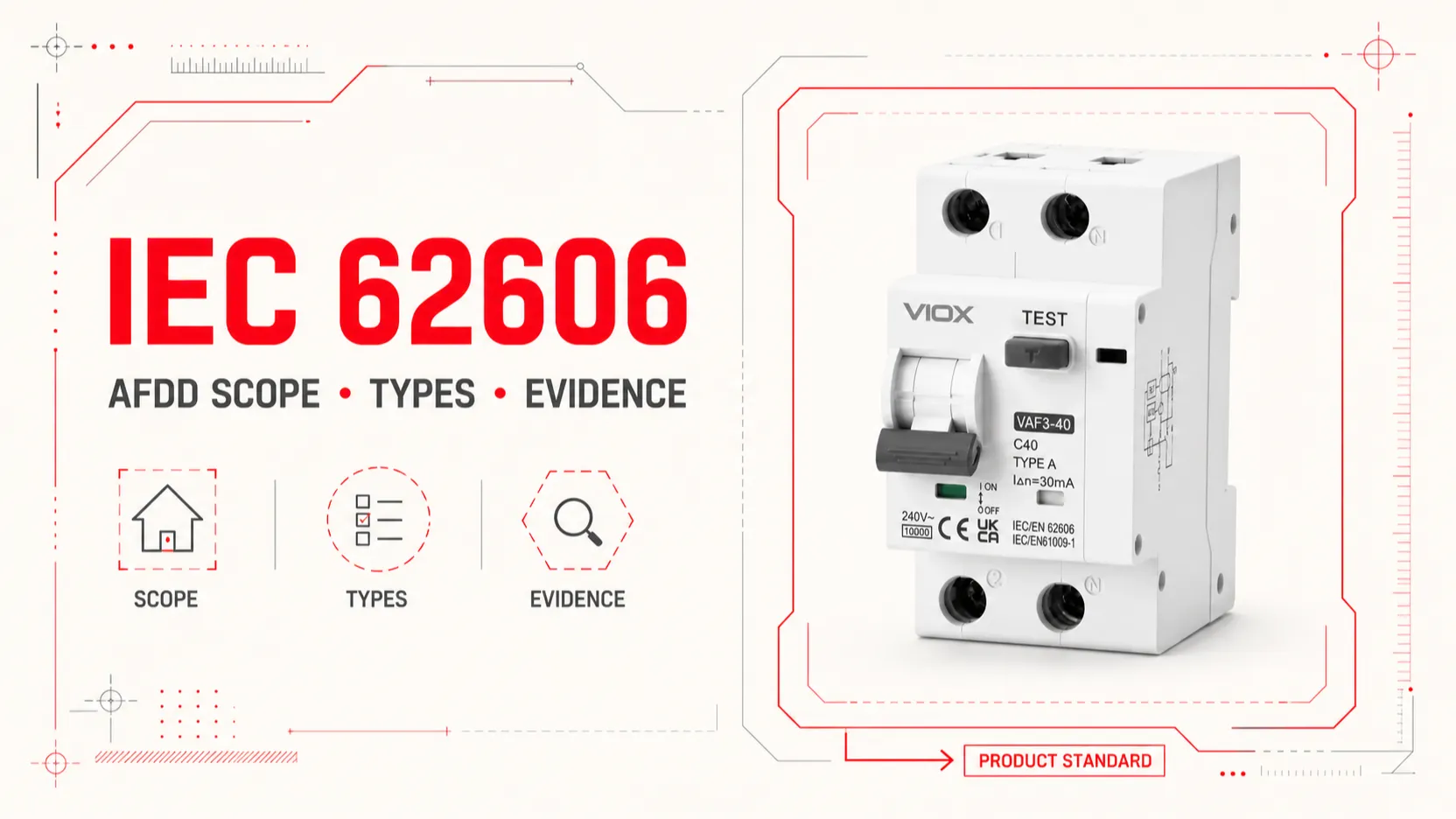
IEC 62606 is the product standard for Arc Fault Detection Devices (AFDDs) intended for household and similar uses in alternating-current (AC) circuits. It defines construction and performance requirements for the AFDD function, but it does not by itself prove that a particular model is certified, compatible with a specific distribution board, or required by the installation rules of every country.
For specifiers and buyers, the practical task is to separate four questions: what the standard covers, how the AFDD is constructed, which other protective functions are integrated, and what model-level evidence is available.
IEC 62606 Scope at a Glance
| Question | What IEC 62606 establishes | What must be verified elsewhere |
|---|---|---|
| Product category | General requirements for AFDDs for household and similar uses in AC circuits | Whether the intended application falls inside that scope |
| Construction | Permitted routes for supplying the arc-fault detection (AFD) function and opening means | Exact model architecture and associated protective functions |
| Arc-fault performance | Standardized product requirements and tests within the publication | The model’s valid report, certificate, declaration, and edition references |
| Installation need | Nothing universal for every country or circuit | National wiring rules, project specification, authority requirements, and risk assessment |
| Board integration | Does not make every device compatible with every assembly | Manufacturer-declared combination, busbar fit, thermal limits, orientation, and instructions |
| Additional protection | May be integrated depending on product design | Overcurrent, residual-current, isolation, and switching functions actually declared for the model |
The official IEC 62606 publication page identifies the base publication as IEC 62606:2013 and offers a consolidated version incorporating Amendment 1:2017 and Amendment 2:2022. Procurement documents should name the exact edition or consolidated reference required by the project instead of writing only “IEC 62606 compliant.”
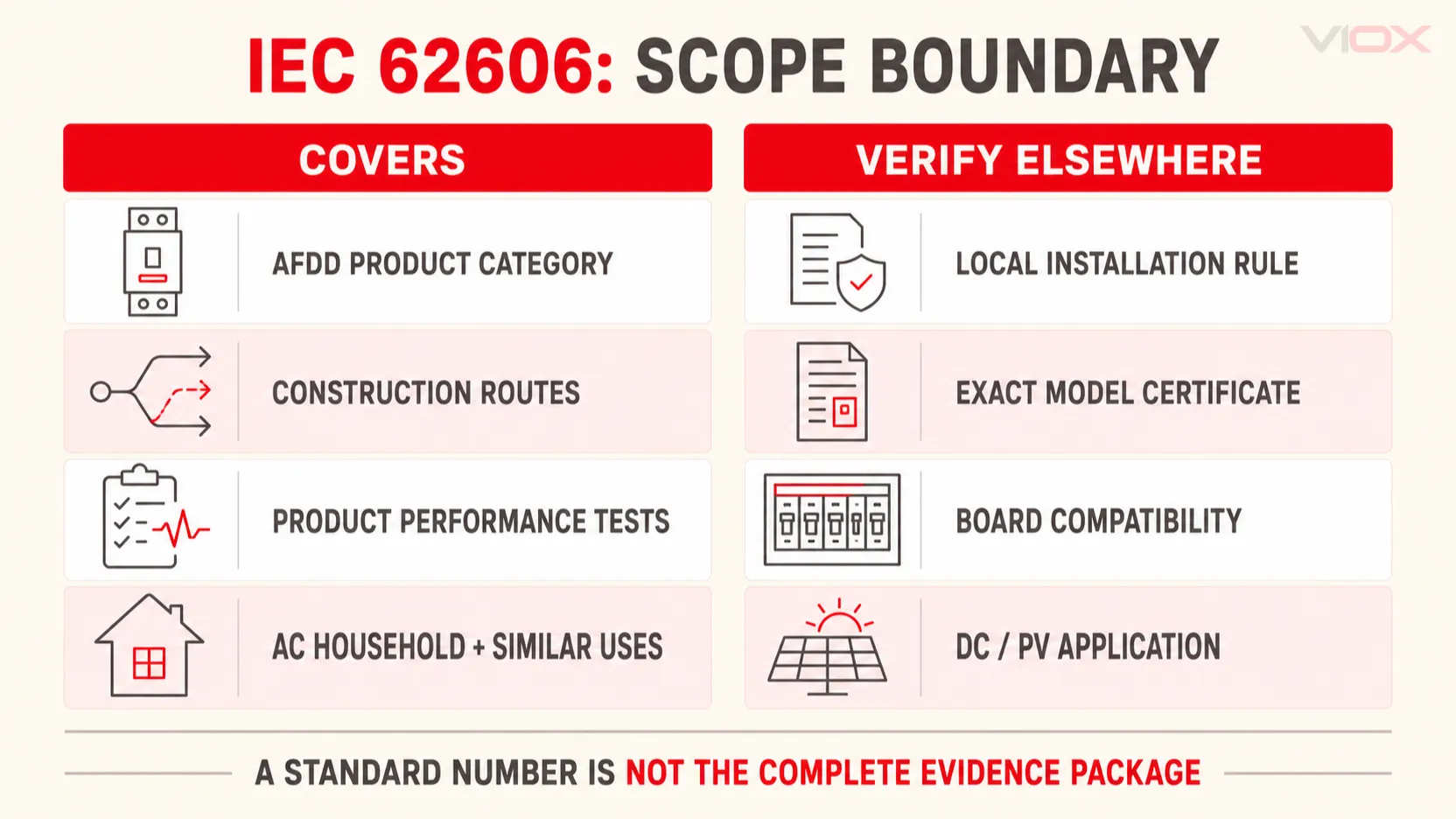
What IEC 62606 Does Not Prove
An IEC standard number printed in a catalogue, photograph, or product title is not the complete compliance record. It does not independently establish:
- that a named model has current third-party certification;
- that every rating or configuration in a product family is covered by the same report;
- that the device is compatible with another manufacturer’s board, busbar, or protective device;
- that an integrated product provides every protection function assumed by the designer;
- that the device is mandatory for the project location;
- that an AC AFDD is suitable for a direct-current (DC) or photovoltaic circuit.
A product photograph can identify a model and visible markings, but it cannot establish certificate validity or the complete protection architecture. Use the exact datasheet, declaration, certificate where required, and installation instructions for those decisions.
The Three AFDD Construction Routes
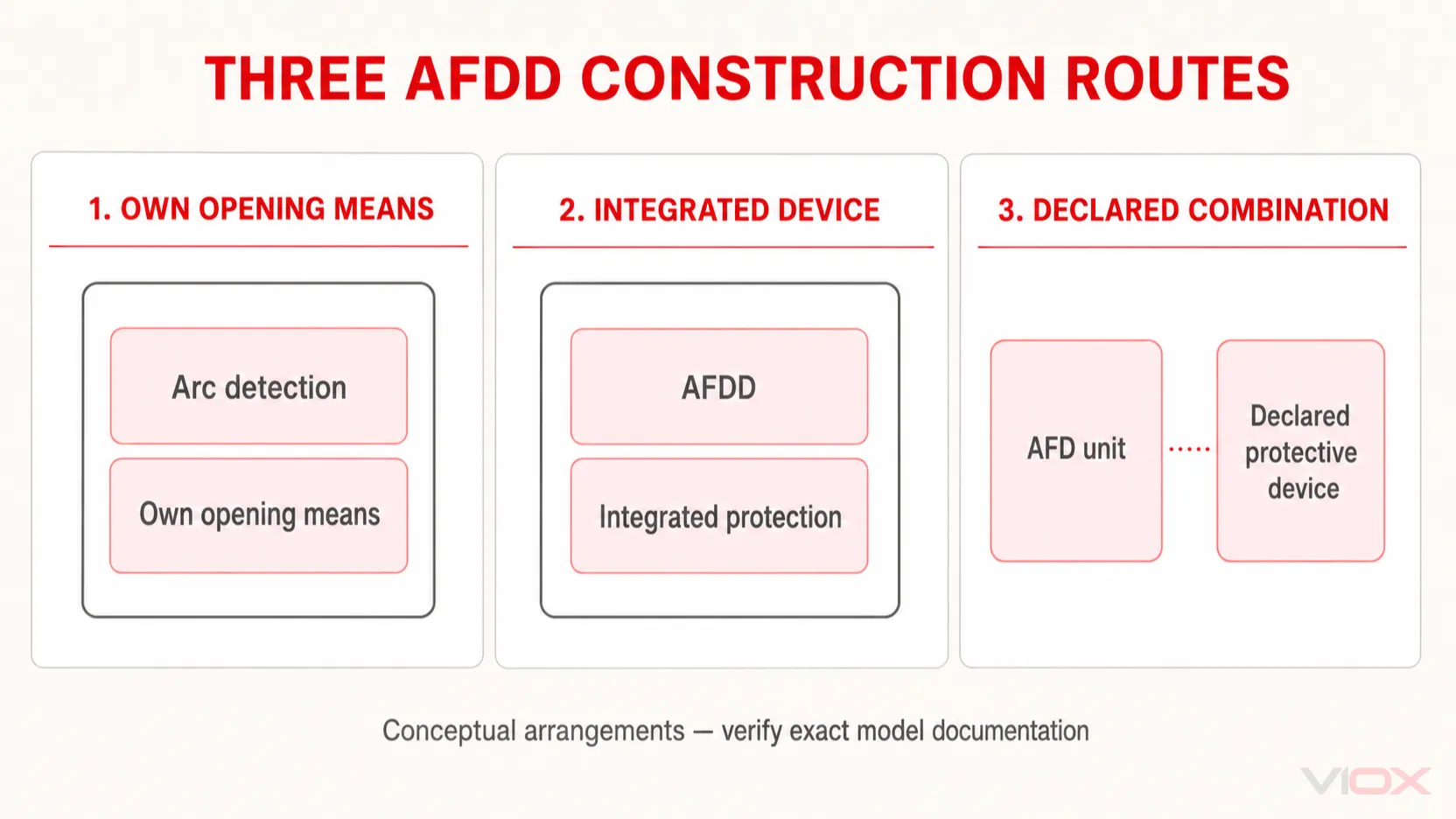
IEC’s public scope description recognizes three construction routes.
1. AFDD with opening means
The device contains the arc-fault detection function and a means to open the protected circuit. The designer must still determine what associated overcurrent and residual-current protection is required and how the devices are coordinated.
2. Single device integrating a protective device
The AFDD function is integrated with another protective device. Depending on the design, that may include overcurrent, residual-current, or combined functions. The product description must identify what is actually integrated; “AFDD” alone does not answer that question.
3. Separate AFD unit assembled with a declared protective device
The AFD unit is intended to be assembled on site with a protective device in a combination declared by the manufacturer. Mechanical fit is not enough. The declared pairing, electrical compatibility, orientation, accessories, and assembly instructions matter.
| Construction route | Arc detection | Opening means | Other protection | Essential evidence |
|---|---|---|---|---|
| AFDD with opening means | Yes | Included | May require associated devices | AFDD documentation plus system design evidence |
| Integrated product | Yes | Included | Defined by the integrated device | Exact model datasheet and all applicable product-standard evidence |
| Declared add-on combination | Yes | Supplied by the declared arrangement | Defined by the associated device | Manufacturer-declared pairing and assembly instructions |
IEC 62606 and Other Product Standards
When AFDD functionality is combined with circuit-breaker or residual-current functions, other product standards may also be relevant. The exact combination depends on product architecture and market adoption.
Electrical Safety First’s guidance on recording protective devices gives examples such as a circuit breaker combined with AFDD functionality and a residual-current circuit breaker with overcurrent protection (RCBO) combined with AFDD functionality. It identifies BS EN 62606 for the AFDD function alongside the relevant circuit-breaker or RCBO standard for the other function.
Use the following evidence logic:
| Claimed function | Evidence question |
|---|---|
| Arc-fault detection | Which IEC/EN 62606 edition is declared, and which exact model is covered? |
| Overload and short-circuit protection | Which circuit-breaker product standard, ratings, and trip characteristics apply? |
| Residual-current protection | Which residual-current device (RCD) or RCBO product standard, residual-current type, and rated residual operating current apply? |
| Isolation or switching | Is the function explicitly marked and documented for the intended use? |
| Combined assembly | Is the combination tested or declared as supplied, rather than assumed from physical fit? |
Do not transfer a certificate or rating from one product variant to another without a document that clearly covers both.
Product Standard Versus Installation Standard
This distinction prevents many incorrect compliance claims.
- IEC 62606 addresses the AFDD product within its scope.
- IEC 60364-4-42:2024 addresses protection against thermal effects in low-voltage electrical installations.
- National rules, such as BS 7671 in the UK, translate installation-safety principles into market-specific requirements and recommendations.
- Project specifications and authorities may add conditions beyond the general code baseline.
A compliant product can still be misapplied. Conversely, an installation rule that calls for arc-fault protection does not prove that any device carrying the letters AFDD is suitable for the exact circuit or assembly.
For a broader explanation of the protection function and links to testing and comparison guides, start with What Is an AFDD?.
UK Edition Control: A Current Example
Regional statements must include an edition and date. As of September 2026, the IET’s edition checker states that BS 7671:2018+A4:2026 is published and that Amendment 3:2024 remains valid during a transition ending on 15 October 2026.
That transition illustrates why a global AFDD page should not state that AFDDs are simply “mandatory” or “optional” without naming the jurisdiction, edition, circuit type, premises, and any relevant exception. The project team should verify the adopted edition and read the actual requirement rather than relying on an older summary.
Model-Level Compliance Evidence Checklist
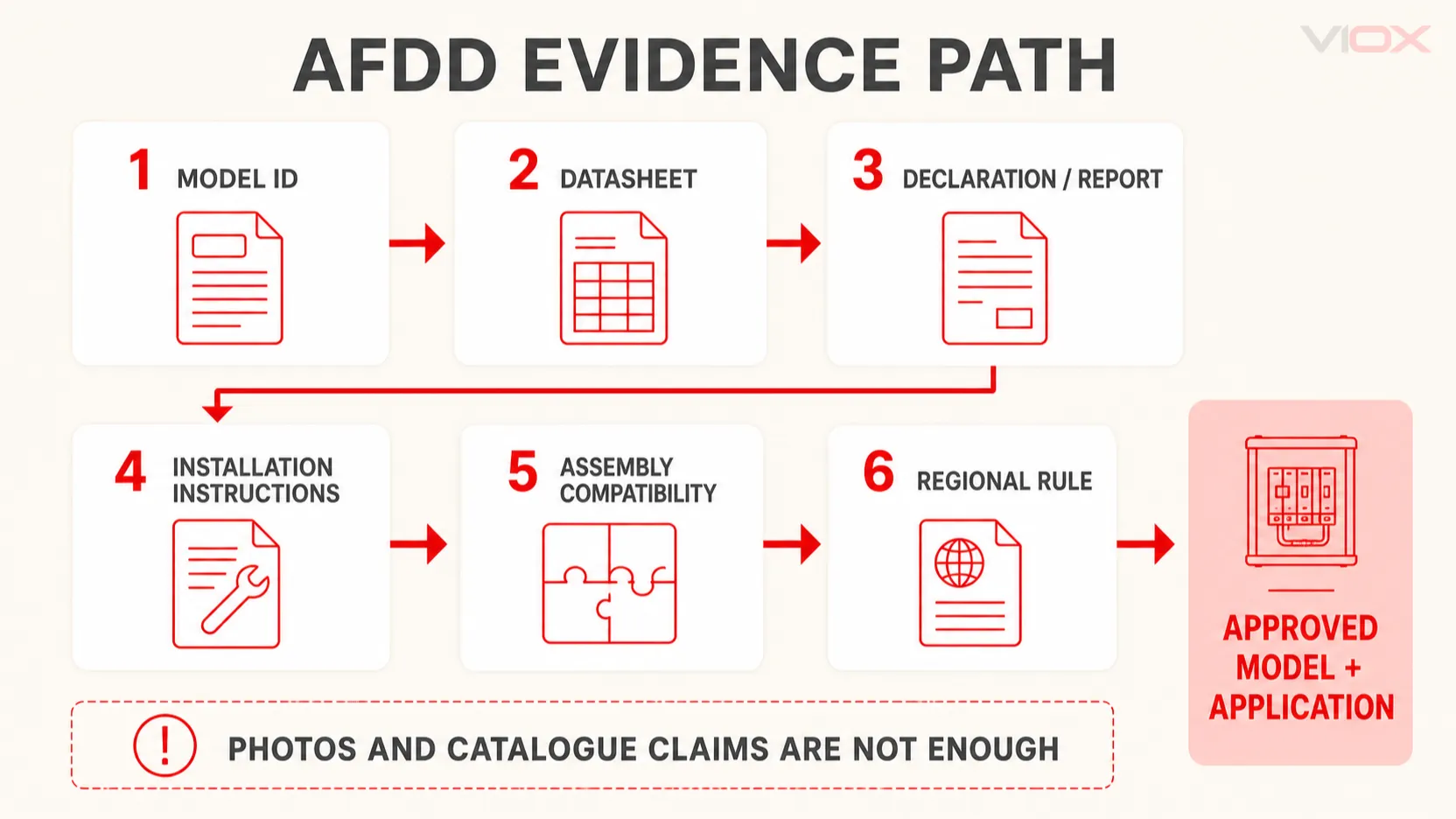
Before approving an AFDD or AFDD/RCBO for a bill of materials, request and align the following:
- Exact model identifier: including poles, current rating, curve where applicable, residual-current characteristics where integrated, and supply/load orientation.
- Current datasheet: with rated voltage, frequency, breaking capacity, environmental conditions, terminals, dimensions, and compatible accessories.
- Declaration and certificate: exact standard edition, issuing or testing body where relevant, document number, validity, and model coverage.
- Test-report scope: confirmation that the selected variant—not merely the product-family name—is included.
- Installation instructions: conductor limits, torque values, orientation, functional-earth or neutral requirements where applicable, test-button procedure, and diagnostic indications.
- Assembly compatibility: written confirmation for the distribution board, busbar, associated protective device, and accessories.
- Regional installation decision: the applicable wiring rules, edition, circuit conditions, project specification, and authority interpretation.
- Change control: confirmation that the supplied production revision matches the approved documentation.
Reading the Product Marking Correctly
A front label can help identify the next document, but it is not the whole specification. Read each marking as a prompt for verification:
| Visible marking category | Follow-up evidence |
|---|---|
| Model code | Datasheet and certificate that name the exact code |
| Rated current or trip curve | Circuit design and the applicable breaker standard |
| Residual-current type or value | RCD/RCBO standard and the project’s residual-current requirements |
| Breaking-capacity value | Test standard, voltage context, and exact model coverage |
| IEC/EN standard number | Declaration, report, certificate, edition, and issuing scope |
| Line/load or directional marking | Manufacturer installation instructions and supply-system compatibility |
Never infer an internal circuit, terminal function, or permissible installation arrangement from appearance alone.
Panel Integration and Compatibility
An AFDD installed in a consumer unit or distribution board becomes part of an assembly. Confirm clearances, busbar geometry, thermal behavior, conductor routing, neutral arrangement, accessories, and the manufacturer’s declared combinations.
A device that fits on the mounting rail is not automatically a verified assembly combination. Request documented compatibility rather than assuming that matching module width or terminal position is sufficient.
For operational verification after installation, follow the exact manufacturer’s procedure and interval. The AFDD testing overview is supplementary reading, not a replacement for those instructions. Installation and fault investigation require a qualified electrical professional; never create a live arc to test a device.
Frequently Asked Questions
Does a new standard edition automatically invalidate an older certificate?
Do not infer certificate status from the publication date alone. Check the certification scheme’s transition rules, the certificate’s current status, the exact covered model, and the edition required by the project or market. A standards catalogue and a certification record answer different questions.
Can an IEC 62606 AFDD be used for solar photovoltaic (PV) DC arc protection?
IEC’s published scope is for household and similar uses in AC circuits. Use a DC/PV-specific protection framework and equipment for PV applications; see the separate PV DC arc-fault protection guide.
Sources
- IEC 62606 — General requirements for arc fault detection devices
- IEC 60364-4-42:2024 — Protection against thermal effects
- IET — Current BS 7671 edition and transition status
- Electrical Safety First — Wiring Regulations guidance and product-standard recording examples
Review the VIOX AFDD product range, then send the exact model and application requirements to [email protected] to request declarations, certificates where required, and distribution-board compatibility documentation.