

On this page
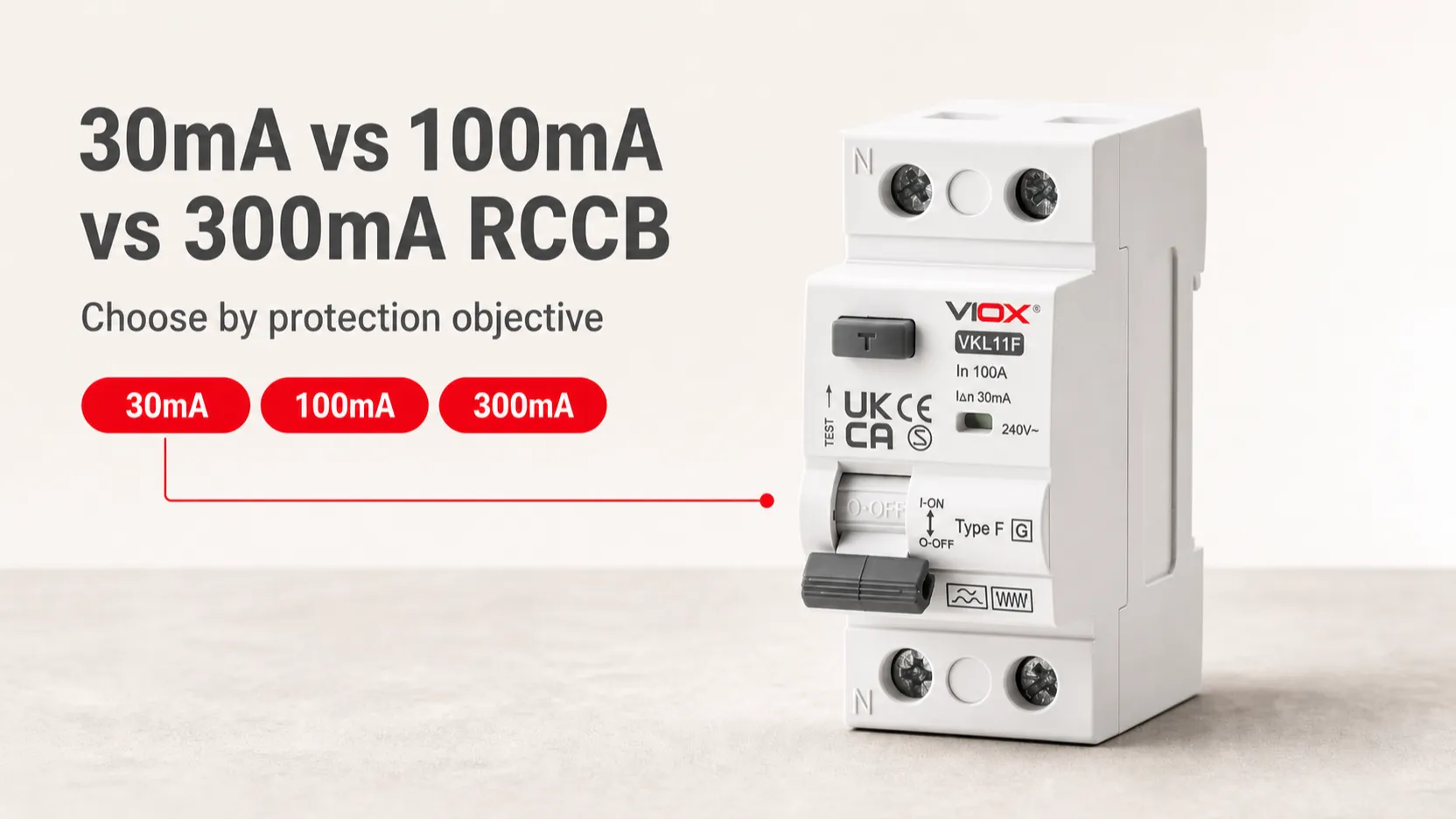
The difference between a 30mA, 100mA, and 300mA Residual Current Circuit Breaker (RCCB) is its rated residual operating current, written as IΔn. This value helps define the residual-current level at which the device operates under its product-standard test conditions.
The correct choice is not simply “30mA for homes, 100mA for commercial buildings, and 300mA for industry.” Start with the required protection function:
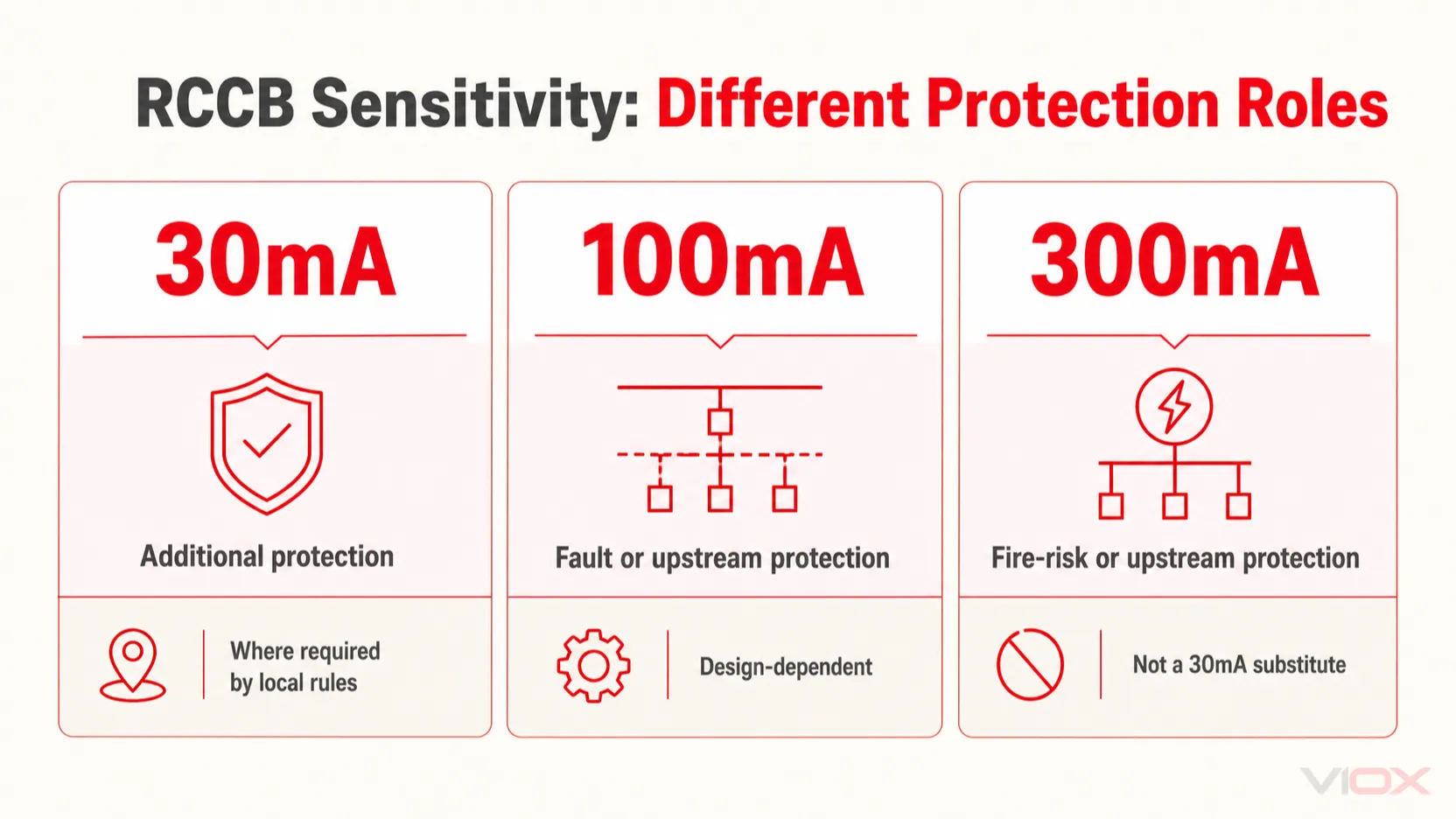
- 30mA is commonly associated with additional protection against electric shock where installation rules require an RCD not exceeding 30mA.
- 100mA may be used for fault protection or upstream coordination in some designs, subject to the earthing system, disconnection requirements, and local rules.
- 300mA may be used for specified fire-risk protection or selective upstream protection, but it is not a substitute for required 30mA additional protection.
An RCCB does not provide integral overload or short-circuit protection. It must be coordinated with a suitable overcurrent protective device. If one device must provide residual-current and overcurrent protection, evaluate an RCBO instead.
Key Takeaways
- Select RCCB sensitivity by protection objective and installation design, not by premises type alone.
- Do not replace a required 30mA device with 100mA or 300mA merely to stop unwanted tripping.
- Sensitivity, residual-current waveform type, time delay, rated current, poles, and short-circuit coordination are separate decisions.
- A higher upstream IΔn does not by itself guarantee selectivity; time coordination and manufacturer data also matter.
- Product standards define the RCCB, while local installation rules determine where and how residual-current protection is required.
30mA vs 100mA vs 300mA RCCB Comparison
| RCCB sensitivity | General protection role | Common installation position | Critical boundary |
|---|---|---|---|
| 30mA | Additional protection where required; may also contribute to fault protection | Final circuits and individually protected loads | Does not make electric shock harmless and does not replace basic protection, earthing, or bonding |
| 100mA | Fault protection or upstream residual-current protection in some designs | Distribution circuits or selected equipment circuits | Cannot replace 30mA where additional protection not exceeding 30mA is required |
| 300mA | Fire-risk protection where specified, or selective upstream protection | Main or sub-distribution level | Not intended to provide 30mA additional protection; selectivity requires more than a higher IΔn |
This table is a starting point, not a universal installation rule. The final selection depends on the applicable national code, earthing arrangement, circuit purpose, disconnection time, connected equipment, and manufacturer instructions.
What Does RCCB Sensitivity Mean?
RCCB sensitivity is the rated residual operating current, IΔn. An RCCB compares the current flowing through all live conductors that pass through its sensing core. If the vector sum is no longer approximately zero because current is flowing through an unintended path, the device can operate.
Do not confuse these two markings:
| Marking | Meaning | Example |
|---|---|---|
| In | Rated current the RCCB can carry under specified conditions | 40A, 63A, 100A |
| IΔn | Rated residual operating current | 30mA, 100mA, 300mA |
A 63A, 30mA RCCB is therefore rated to carry 63A under its declared conditions and has a residual-current rating of 30mA. The 63A marking is not an overload trip setting. Because an RCCB has no integral overcurrent protection, its rated current and conditional short-circuit capability must be coordinated with an appropriate MCB, fuse, or other protective device.
For a wider marking and standards explanation, see the IEC 61008-1 RCCB requirements guide.
When Is a 30mA RCCB Used?
A 30mA RCCB is commonly selected where installation rules call for additional protection by an RCD with IΔn not exceeding 30mA. Depending on the jurisdiction, examples may include specified socket-outlet circuits, outdoor mobile equipment, bathrooms, domestic lighting, concealed wiring, EV charging points, or other special locations.
These requirements are not identical in every country. Verify the circuit against the applicable installation standard rather than applying one global list.
What 30mA protection does—and does not—mean
A 30mA RCCB can reduce risk by disconnecting when it detects a qualifying residual-current fault. It does not guarantee that every electric shock will be prevented, and 30mA must not be described as a harmless or universally safe body current.
An RCCB may not operate for a line-to-neutral contact if the outgoing and returning currents remain balanced. It also does not replace insulation, enclosures, protective earthing, bonding, correct circuit design, or safe working practices.
When May a 100mA RCCB Be Used?
A 100mA RCCB may be considered when the design requires residual-current fault protection, distribution-level protection, or coordination with downstream devices and the applicable rules permit it.
For example, in some TT-system designs an RCD may be needed to achieve automatic disconnection because the earth-fault path does not allow the overcurrent protective device to operate within the required time. The allowable IΔn then depends on the earthing arrangement, earth-electrode resistance, touch-voltage criterion, disconnection time, and local installation rules.
A 100mA RCCB is not automatically the correct choice for offices, lighting, HVAC, servers, or long cables. If a final circuit requires 30mA additional protection, normal equipment leakage does not remove that requirement. The design may instead need circuit subdivision, individual RCBOs, leakage measurement, correct RCD waveform type, or investigation of faulty equipment.
When May a 300mA RCCB Be Used?
A 300mA RCCB may be used for fire-risk protection where specifically required or permitted, or as an upstream device in a coordinated residual-current protection system.
A common arrangement is a selective or time-delayed upstream RCCB combined with faster, lower-IΔn devices downstream. However, “300mA upstream and 30mA downstream” is not automatically selective. Coordination depends on:
- the upstream and downstream IΔn values;
- the upstream time-delay characteristic;
- the downstream operating characteristic;
- the prospective residual fault current;
- the earthing system and required disconnection time; and
- manufacturer selectivity or coordination data.
Do not use a 300mA RCCB alone where a final circuit requires additional protection by a device not exceeding 30mA.
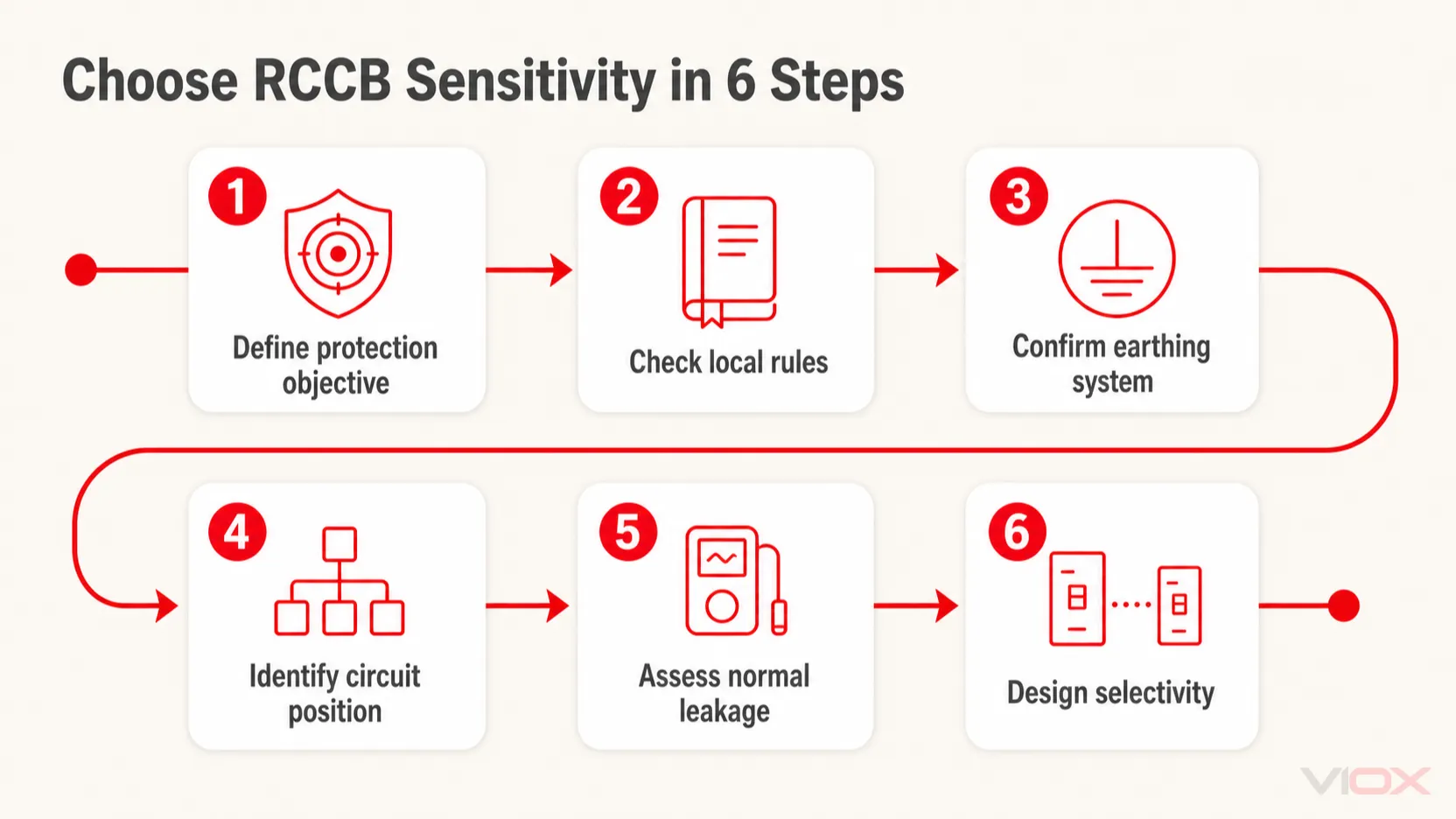
Choose RCCB Sensitivity in Six Steps
1. Define the protection objective
Decide whether the RCCB is intended to provide additional protection, fault protection, fire-risk protection, upstream isolation following a residual fault, or a combination permitted by the applicable rules.
Do not begin with the available product rating. Begin with the protection function required by the installation.
2. Check the applicable installation rules
IEC 61008-1 is a product standard for RCCBs without integral overcurrent protection. It does not tell a designer that every circuit worldwide must use the same sensitivity.
Check the national adoption of IEC 60364, BS 7671, or the relevant local code, together with any special-location requirements. Also verify the connected equipment manufacturer’s instructions.
3. Confirm the earthing system and disconnection conditions
TT, TN, and IT systems do not use identical protection logic. Where an RCCB is used for fault protection, its IΔn must be coordinated with the earth-fault path and required disconnection time.
This calculation belongs to the installation design. A generic application table cannot replace it.
4. Identify the circuit position
Ask whether the RCCB protects:
- one final circuit;
- a group of final circuits;
- a sub-distribution feeder; or
- the installation at the origin.
Final circuits often have different additional-protection requirements from upstream distribution circuits. Grouping many circuits under one RCCB also increases cumulative leakage and the consequences of one trip.
5. Assess normal leakage and unwanted-tripping risk
Electronic power supplies, electromagnetic-compatibility filters, variable-frequency drives, long cables, surge protective devices, and other equipment can contribute normal protective-conductor current.
Measure or estimate expected leakage using equipment data and installation guidance. Keep it sufficiently below the RCCB’s possible operating range. Because an RCCB may operate below its marked IΔn, designing normal leakage close to the nominal value creates an unreliable installation.
If a required 30mA device trips repeatedly, do not automatically increase the sensitivity. First:
- test for insulation faults, moisture, wiring errors, and shared neutrals;
- measure circuit and equipment leakage;
- split cumulative loads across additional circuits or RCBOs;
- verify the RCD waveform type; and
- check transient immunity and manufacturer recommendations.
6. Design upstream/downstream selectivity
Two instantaneous 30mA devices in series do not provide predictable selectivity. Either device may operate for a downstream fault.
Where upstream residual-current protection is required, use a coordinated arrangement based on both current and time. A selective Type S device is not appropriate for a function that specifically requires fast additional protection.
Application Matrix
| Application question | Starting point | What must still be verified |
|---|---|---|
| Final circuit requiring additional protection | RCD not exceeding 30mA | Local rule, circuit type, RCD waveform type, normal leakage, overcurrent protection |
| Group of electronic final circuits | Do not simply increase IΔn | Circuit subdivision, individual RCBOs, measured leakage, continuity requirements |
| TT distribution or origin protection | Design-dependent 100mA or 300mA may be considered | Electrode resistance, touch-voltage criterion, disconnection time, downstream protection |
| Upstream protection above 30mA final circuits | Higher-IΔn selective device may be appropriate | Time delay, manufacturer coordination data, local rules |
| Fire-risk location | Up to 300mA may be specified in some codes | Exact location requirement, wiring system, exclusions, selectivity |
| EV charging | Commonly requires protection not exceeding 30mA at the charging point in IEC/BS contexts | Type A/F/B, 6mA DC detection arrangement, EVSE instructions, local rules |
| VFD, UPS, or inverter load | Sensitivity alone is insufficient | Residual-current waveform, DC components, frequency content, leakage, manufacturer instructions |
This matrix intentionally avoids assigning one sensitivity to every residential, commercial, or industrial installation. The same building can contain final circuits requiring 30mA protection and upstream circuits using a different coordinated value.
RCCB Sensitivity Is Not the Same as RCD Type
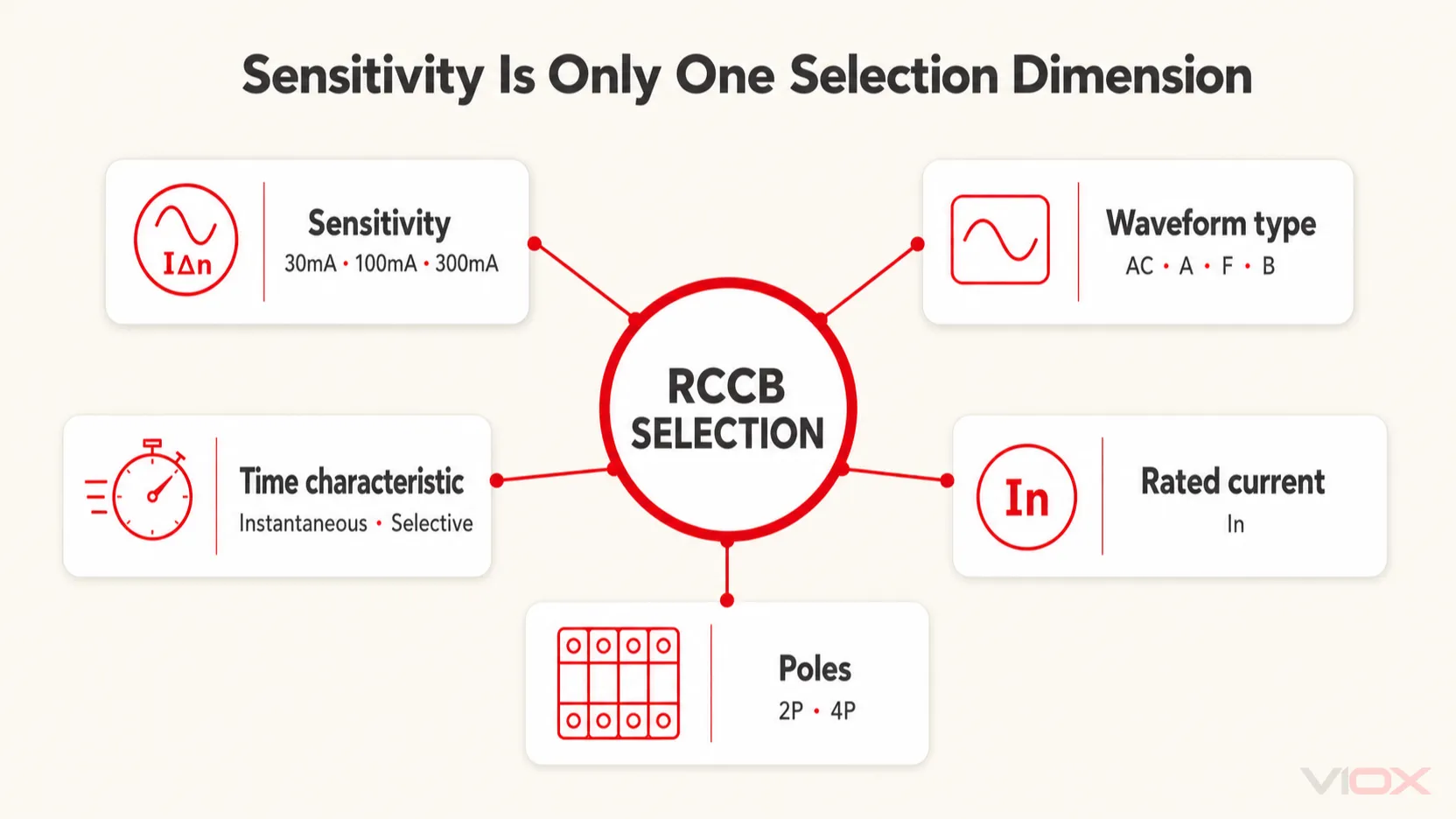
Sensitivity answers how much rated residual current is involved. RCD type answers which residual-current waveforms the device is designed to detect.
| Selection dimension | Examples | Main question |
|---|---|---|
| Sensitivity | 30mA, 100mA, 300mA | What IΔn is required for the protection objective? |
| Residual-current type | AC, A, F, B | What waveform can the load produce? |
| Time characteristic | Instantaneous, selective Type S | Is upstream/downstream time coordination required? |
| Rated current | 25A, 40A, 63A, 100A | Can the RCCB carry the design current with suitable overcurrent coordination? |
| Poles | 2P, 4P | Which live conductors must be switched and monitored? |
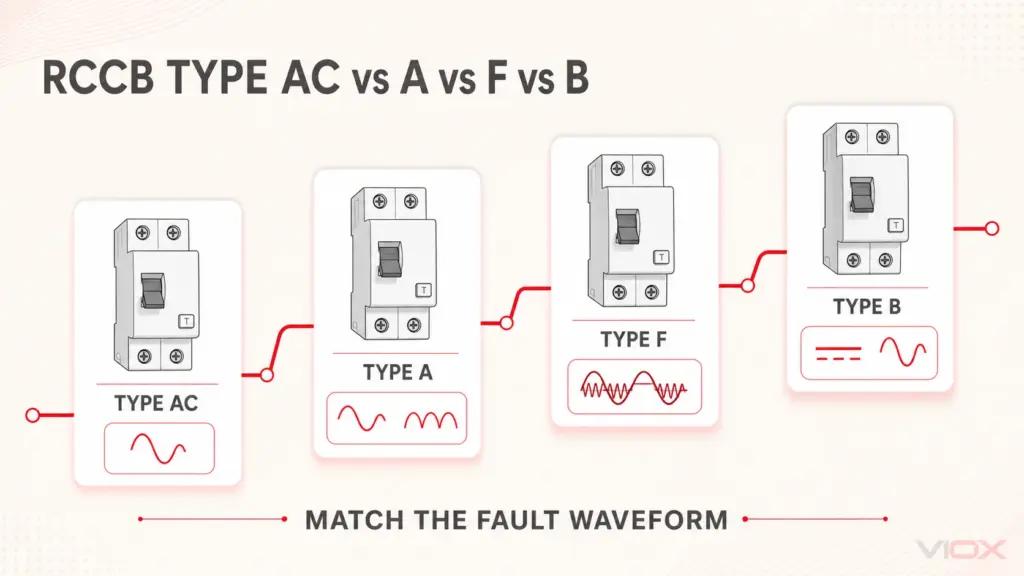
Modern electronic loads can produce residual currents that a basic Type AC device is not intended to detect. Select Type AC, A, F, or B from the load characteristics, applicable rules, and equipment instructions—not from IΔn alone.
For a detailed waveform comparison, see RCBO Type AC vs Type A vs Type F vs Type B. The type principles are relevant to residual-current protection, but the exact product standard and device data must still be checked.
RCCB vs RCBO: Do Not Forget Overcurrent Protection
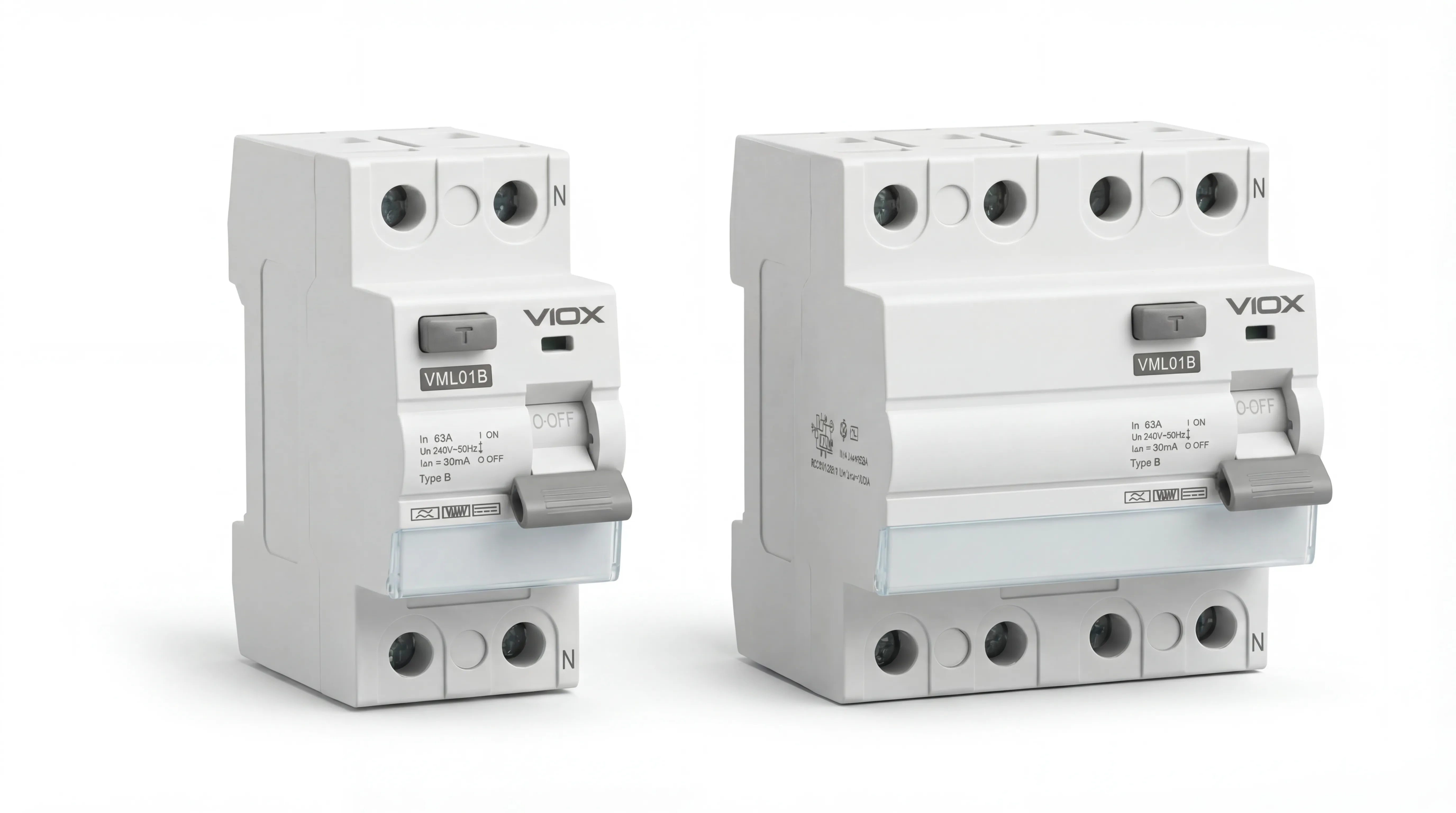
An RCCB under IEC 61008-1 provides residual-current protection without integral overcurrent protection. It therefore needs suitable overload and short-circuit protection in the installation.
An RCBO combines residual-current protection with integral overcurrent protection. If each outgoing circuit needs independent fault isolation and combined protection, an RCBO may be more appropriate than one RCCB feeding several MCBs.
Use the RCBO selection guide to check waveform type, sensitivity, rated current, trip curve, poles, breaking capacity, and application together. For architecture decisions, see RCBO vs RCCB + MCB.
Common RCCB Sensitivity Selection Mistakes
Treating 30mA as a harmless current
The 30mA rating identifies the RCD sensitivity class used for additional protection in many installation rules. It does not define a universally safe current through the human body.
Replacing 30mA with 100mA to stop tripping
If 30mA additional protection is required, increasing IΔn can remove the required protection function. Diagnose faults and cumulative leakage, then redesign circuit grouping if necessary.
Assigning one value to an entire building type
A factory, office, farm, or home may contain multiple protection objectives. Select by circuit and installation level, not by the label attached to the premises.
Assuming 300mA automatically provides selectivity
A higher upstream threshold helps with current discrimination, but reliable selectivity may also require a selective time delay and verified coordination data.
Ignoring RCD waveform type
A correct IΔn with the wrong Type AC, A, F, or B device may still be an incorrect design for the connected load.
Forgetting that an RCCB is not an MCB
The RCCB’s rated current does not provide integral overload protection. Verify the external short-circuit protective device and conditional short-circuit rating.
RCCB Selection Checklist
Before specifying a 30mA, 100mA, or 300mA RCCB, confirm:
- required protection objective;
- applicable national installation rules;
- earthing system and disconnection conditions;
- final-circuit, group, feeder, or origin position;
- expected normal leakage current;
- residual-current waveform type;
- instantaneous or selective time characteristic;
- rated current, voltage, frequency, and poles;
- external overload and short-circuit protection;
- upstream/downstream coordination data;
- exact product-standard reference and model documentation; and
- connected equipment manufacturer’s instructions.
When these requirements are known, review the available VIOX RCCB product range against the project specification.
Frequently Asked Questions
What is the difference between a 30mA and 100mA RCCB?
A 30mA RCCB is commonly used where additional protection by an RCD not exceeding 30mA is required. A 100mA RCCB may be used for fault protection or upstream protection in some designs, but it cannot replace required 30mA additional protection.
What is the difference between a 30mA and 300mA RCCB?
A 30mA RCCB is associated with additional protection on specified circuits. A 300mA RCCB may be used for fire-risk or selective upstream protection where permitted. They serve different protection objectives and are not interchangeable.
Can a 100mA RCCB protect people from electric shock?
An RCCB can disconnect some residual-current faults, but a 100mA device does not provide the additional-protection function defined by rules that require an RCD not exceeding 30mA. Do not present 100mA as a substitute for required 30mA protection.
Is 30mA dangerous?
Yes. Current through the body can be dangerous, and the outcome depends on magnitude, duration, path, frequency, and individual conditions. A 30mA RCCB is a protective measure that reduces risk; it does not make contact with live conductors safe.
Why does a 30mA RCCB trip when there is no obvious fault?
Possible causes include insulation deterioration, moisture, damaged equipment, shared or mixed neutrals, cumulative equipment leakage, cable capacitance, filter leakage, transient events, or an unsuitable RCD type. Test the installation rather than immediately substituting a higher-IΔn device.
Does a 300mA RCCB always go upstream of a 30mA device?
No. An upstream 300mA selective RCCB is one possible coordinated arrangement, but its suitability depends on whether upstream residual-current protection is required, the earthing system, local rules, time-delay characteristic, and manufacturer coordination data.
Is RCCB sensitivity the same as tripping time?
No. IΔn is the rated residual operating current. Operating time is a separate characteristic determined by device class, residual-current magnitude, waveform, product standard, and whether the device is instantaneous or selective. Do not infer a universal trip time from 30mA, 100mA, or 300mA alone.
Should I choose an RCCB or RCBO?
Choose an RCCB when residual-current protection will be coordinated with separate overcurrent protection. Choose an RCBO when the same device must provide residual-current, overload, and short-circuit protection for the circuit, subject to all required ratings and standards.
Conclusion
Choosing between a 30mA, 100mA, and 300mA RCCB is a protection-design decision, not a simple building-category lookup.
Use 30mA where the applicable rules require additional protection not exceeding 30mA. Consider 100mA or 300mA only when the fault-protection, fire-risk, or upstream-selectivity design supports those values. Then verify normal leakage, residual-current type, time characteristic, rated current, poles, overcurrent coordination, and local requirements.
If the circuit requirements are not yet known, do not select the RCCB from a product table alone. Complete the protection design first, then match the documented ratings to the exact product.