

On this page
Quick Answer
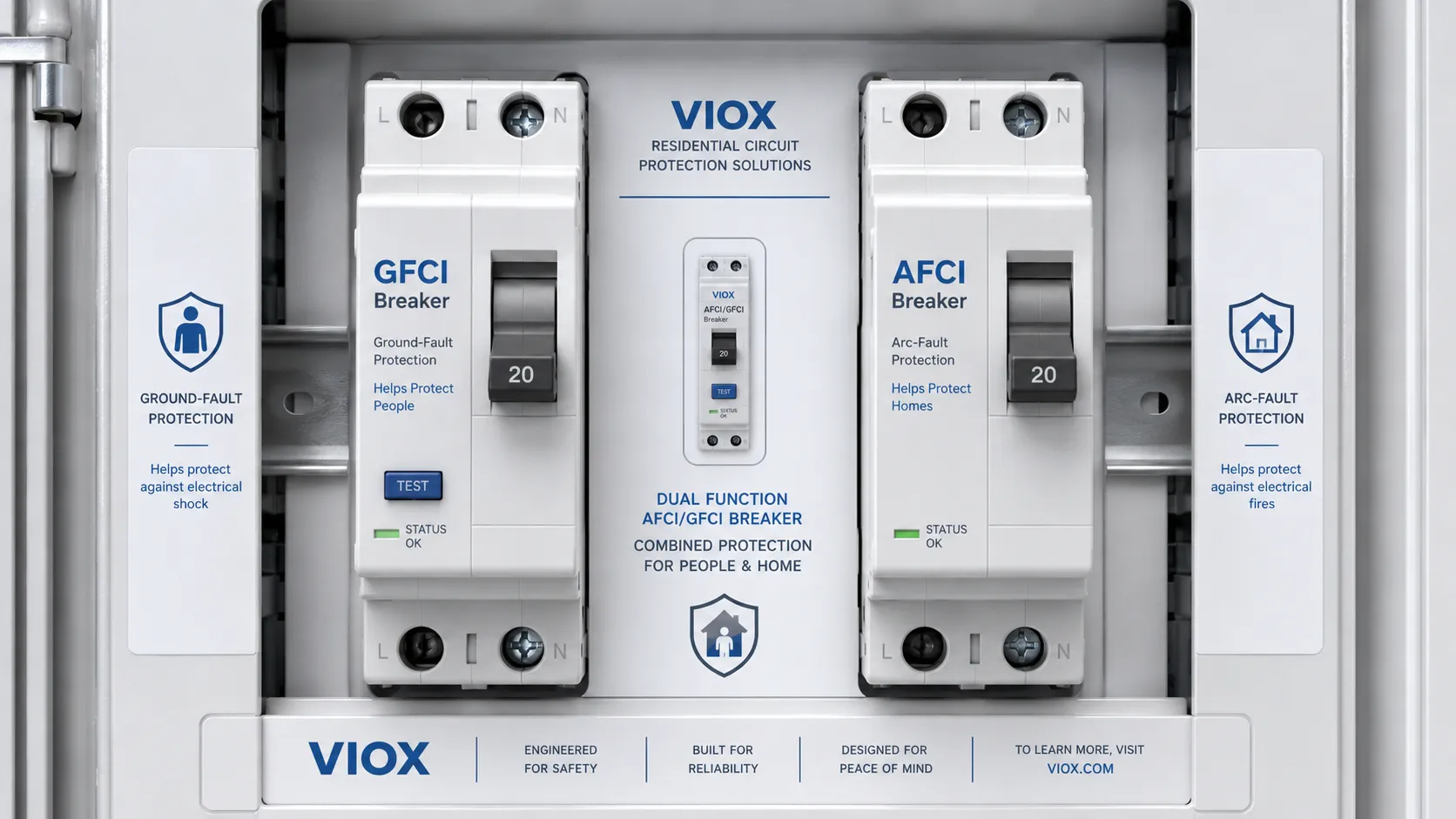
A GFCI breaker protects people from electric shock by detecting ground-fault current leakage. An AFCI breaker helps prevent electrical fires by detecting dangerous arcing conditions in a branch circuit.
The easiest way to remember the difference is:
- GFCI = shock protection
- AFCI = fire protection
- Dual-function AFCI/GFCI breaker = shock and fire protection in one breaker
If the problem is current leaking to ground, use ground-fault protection. If the problem is damaged wiring, loose connections, or dangerous arcing signatures, use arc-fault protection. In some modern residential circuits, both protections may be required by code or project specification.
GFCI vs AFCI Breaker Comparison Table
| Device | Detects | Main Protection | Typical Use |
|---|---|---|---|
| GFCI breaker | Ground-fault or leakage current | Shock protection | Wet or damp locations, receptacle circuits requiring ground-fault protection |
| AFCI breaker | Dangerous arc-fault signatures | Fire prevention | Bedroom, living area, and other branch circuits requiring arc-fault protection |
| CAFCI breaker | Series and parallel arc faults | Broader arc-fault protection | Modern arc-fault protected branch circuits |
| Dual-function AFCI/GFCI breaker | Ground faults and arc faults | Shock and fire protection | Circuits where both protection types are required |
GFCI and AFCI breakers are not interchangeable. They detect different electrical hazards. A standard GFCI breaker does not provide arc-fault protection, and a standard AFCI breaker does not provide personnel-level ground-fault protection unless it is specifically a dual-function device.
Ground Fault vs Arc Fault: What Is the Difference?
A ground fault occurs when current leaves its intended path and flows to ground through an unintended route. That route may be a wet surface, damaged insulation, a metal appliance housing, or a person. This is why ground-fault protection is closely associated with shock prevention.
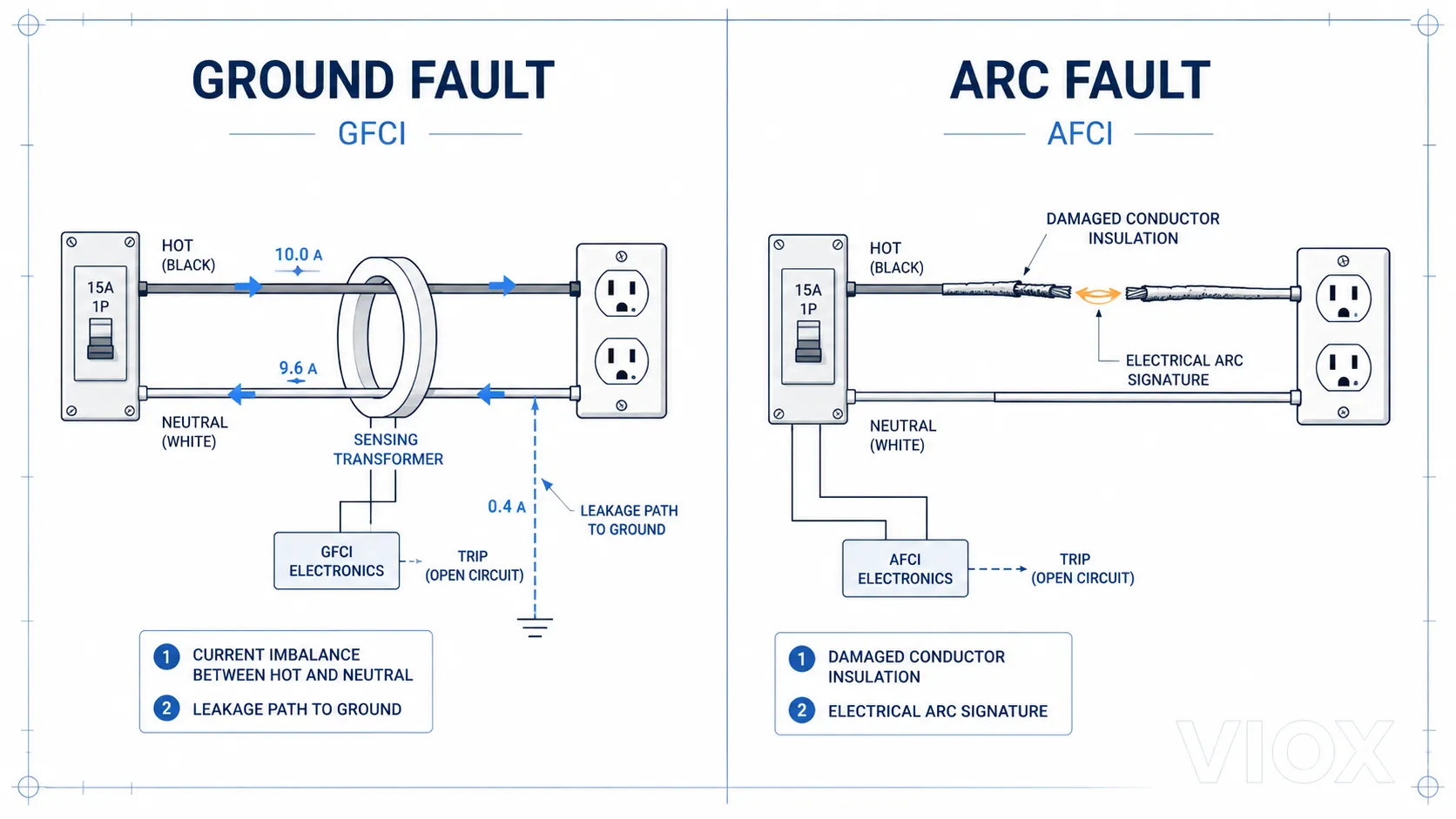
An arc fault occurs when electricity jumps across a gap or damaged conductor path. Arcing can be caused by loose terminals, damaged insulation, crushed cables, worn cords, or poor connections. Dangerous arcing can generate high heat and ignite surrounding materials.
| Fault Type | What Happens | Main Risk | Protective Device |
|---|---|---|---|
| Ground fault | Current leaks from hot to ground or another unintended path | Electric shock | GFCI breaker or GFCI receptacle |
| Arc fault | Current arcs across a damaged or loose conductor path | Electrical fire | AFCI or CAFCI breaker |
| Overload | Load current exceeds circuit capacity for too long | Heating and insulation damage | Circuit breaker thermal trip |
| Short circuit | Low-impedance fault causes very high current | Arc blast, fire, equipment damage | Breaker or fuse with suitable interrupting rating |
For a wider fault comparison, see VIOX’s guide to overload, overcurrent, and short circuit differences.
What Is a GFCI Breaker?
GFCI stands for Ground Fault Circuit Interrupter. A GFCI breaker monitors the current leaving and returning on a circuit. If the returning current is lower than the outgoing current by a small amount, the device interprets that imbalance as leakage and trips.
This imbalance may happen when current flows through water, a grounded metal surface, a damaged appliance, or a person. That is why GFCI protection is commonly associated with bathrooms, kitchens, garages, outdoor receptacles, basements, laundry areas, and other locations where shock risk is higher.
A GFCI breaker protects the entire circuit from the panel. A GFCI receptacle protects the receptacle itself and, when wired correctly, may protect downstream receptacles. The correct option depends on the panel design, local code requirements, and whether whole-circuit or point-of-use protection is needed.
What Is an AFCI Breaker?
AFCI stands for Arc Fault Circuit Interrupter. An AFCI breaker monitors the electrical waveform of a circuit and trips when it identifies patterns associated with dangerous arcing.
Arc faults are different from simple overloads. A damaged conductor, loose terminal, or crushed cord may create intermittent arcing without drawing enough current to trip a standard breaker immediately. AFCI protection is designed to identify those hazardous arc signatures before they become a fire.
AFCI protection is commonly required or specified in living areas and branch circuits where hidden wiring damage could create a fire hazard. The exact locations depend on the applicable electrical code, edition, and local amendments.
AFCI vs CAFCI: What Is the Difference?
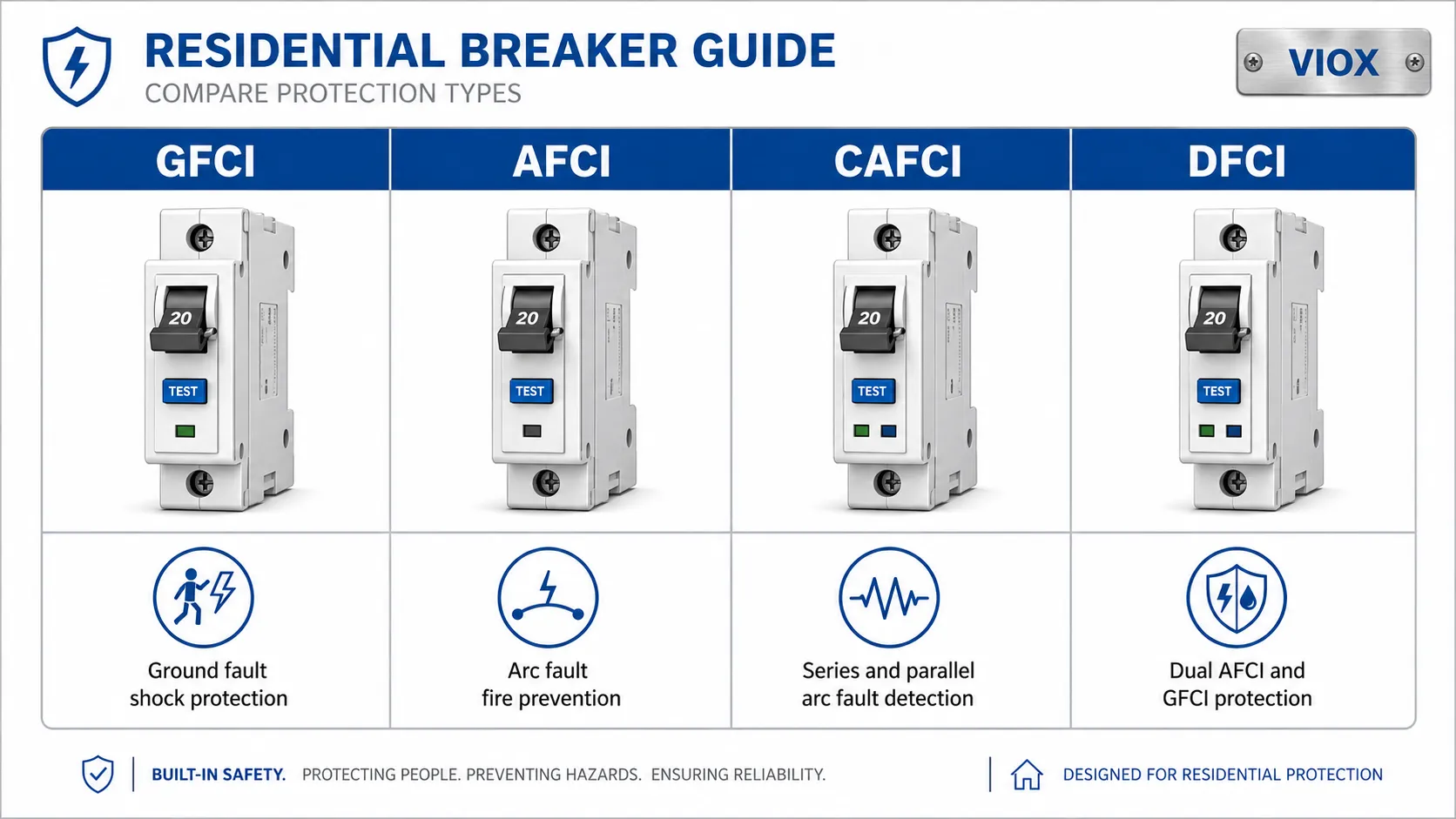
CAFCI stands for Combination Arc Fault Circuit Interrupter. The word “combination” is often misunderstood. It does not mean AFCI plus GFCI. It means the device is designed to detect more than one type of arc fault, typically including both series and parallel arc faults.
| Term | Meaning | Does It Include GFCI Protection? |
|---|---|---|
| AFCI | Arc fault circuit interrupter | Not necessarily |
| CAFCI | Combination arc fault circuit interrupter for broader arc-fault detection | No, not by that name alone |
| Dual-function AFCI/GFCI | Device providing both arc-fault and ground-fault protection | Yes |
If a breaker is labeled AFCI or CAFCI, do not assume it provides GFCI protection. Look for language such as dual function, AFCI/GFCI, or the specific manufacturer marking that confirms both protection types.
AFCI/GFCI Dual-Function Breaker Explained
A dual-function breaker combines AFCI and GFCI protection in one device. It is used where a branch circuit needs both arc-fault protection and ground-fault protection.
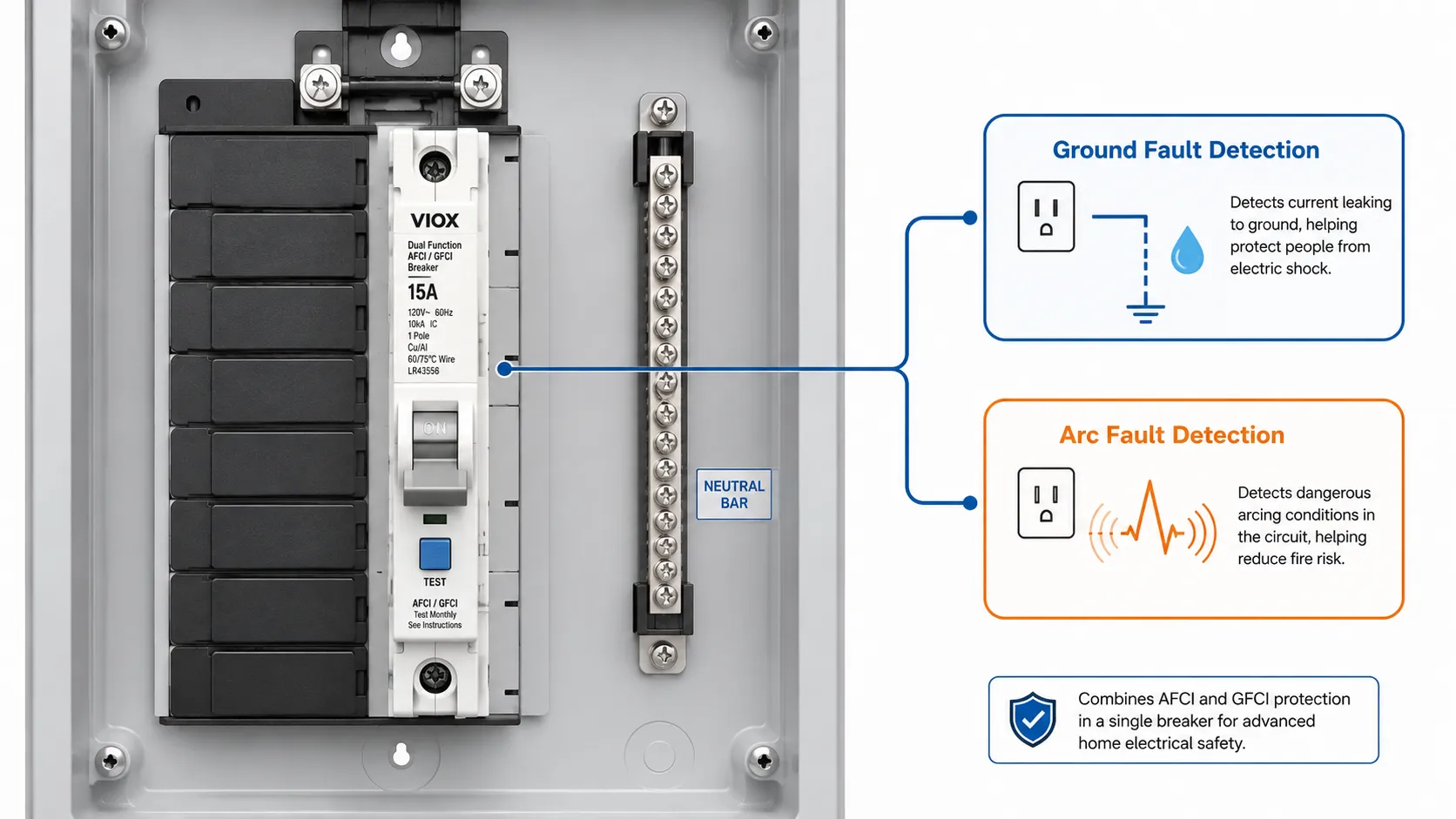
This can simplify panel design because one breaker provides both functions. It can also make troubleshooting clearer because the protection is located at the panel. However, dual-function breakers must be compatible with the panel, circuit wiring, and neutral arrangement.
Dual-function breakers are especially relevant when a circuit has both fire-risk and shock-risk protection requirements. The exact requirement depends on local electrical code and the circuit location.
GFCI Outlet vs GFCI Breaker vs AFCI Breaker
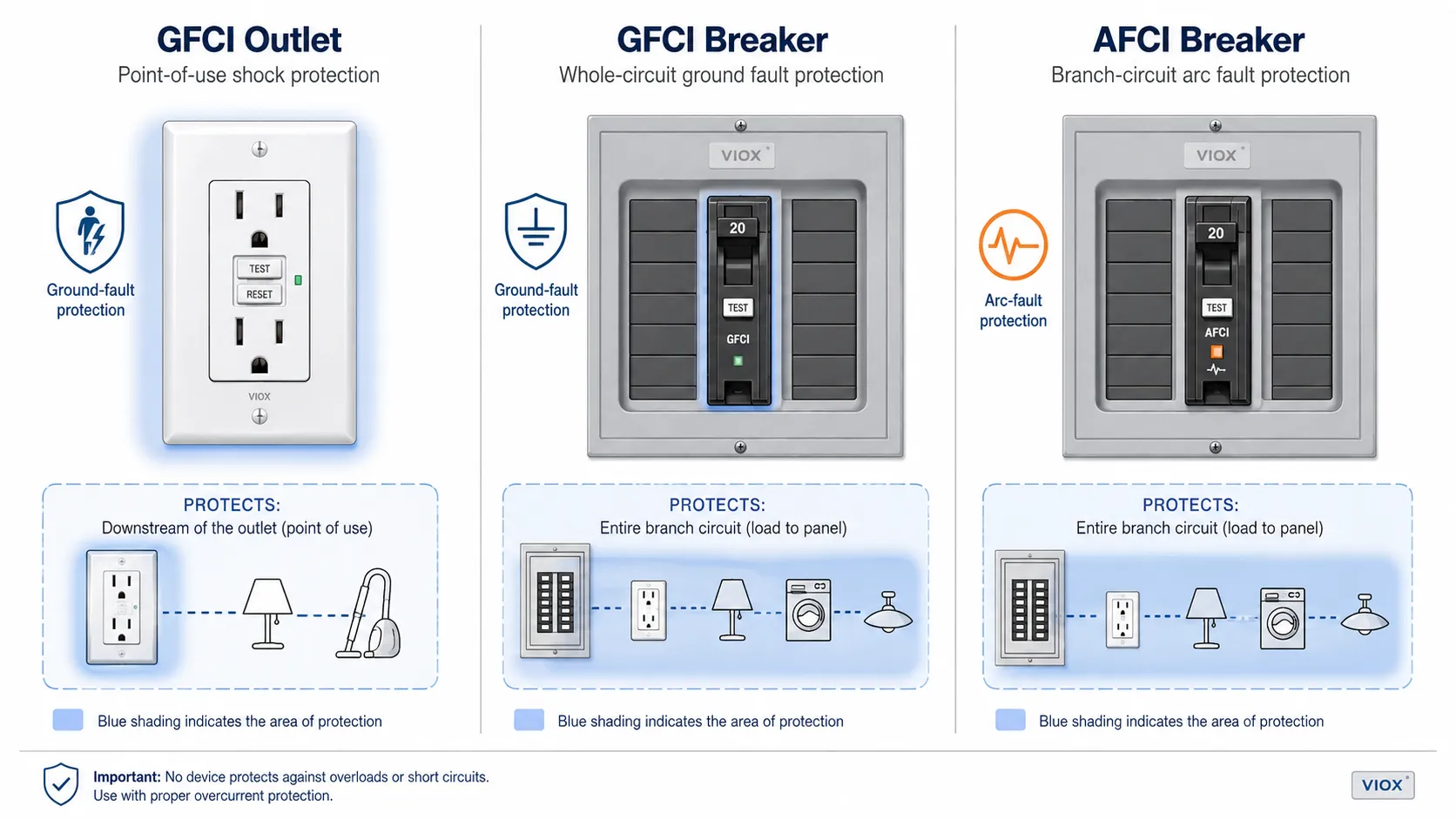
These devices are often confused because they may protect similar branch circuits, but their roles are different.
| Device | Installed At | Main Role | Key Point |
|---|---|---|---|
| GFCI outlet | Receptacle box | Local or downstream shock protection | Correct line/load wiring matters |
| GFCI breaker | Electrical panel | Whole-circuit shock protection | Protects the entire branch circuit |
| AFCI breaker | Electrical panel | Arc-fault fire protection | Detects dangerous arcing signatures |
| Dual-function breaker | Electrical panel | Shock and arc-fault protection | Combines GFCI and AFCI functions |
If the user asks “GFCI outlet vs AFCI outlet,” the practical answer is that GFCI outlets are common point-of-use protection devices, while AFCI protection is more commonly provided by breakers or specific outlet branch-circuit AFCI devices depending on the system and code context.
Where GFCI, AFCI, or Both Are Commonly Used
Requirements vary by country, code edition, and local amendments. The following table is a practical guide, not a substitute for the local electrical code.
| Area or Circuit Type | Common Protection Direction | Why |
|---|---|---|
| Bathroom receptacles | GFCI | Shock risk from water and grounded surfaces |
| Kitchen receptacles | GFCI, and sometimes AFCI depending on code | Shock risk and branch-circuit fire prevention |
| Outdoor receptacles | GFCI | Wet location shock risk |
| Garage receptacles | GFCI, and sometimes AFCI depending on code | Shock risk and branch-circuit protection |
| Bedrooms and living areas | AFCI | Hidden wiring and arc-fault fire prevention |
| Laundry areas | Often both, depending on local requirements | Damp-location shock risk and branch-circuit fire prevention |
| Basement receptacles | Often GFCI, sometimes both | Damp-location and habitable-space considerations |
For U.S. residential projects, National Electrical Code (NEC) rules are commonly referenced, including GFCI requirements in NEC 210.8 and AFCI requirements in NEC 210.12. Always verify the adopted edition and local amendments before specifying or installing devices.
Common Tripping Causes
GFCI and AFCI breakers trip for different reasons, so troubleshooting should begin by identifying the protection type.
| Symptom | Likely Device | Possible Cause |
|---|---|---|
| Trips when using outdoor or wet-area equipment | GFCI | Moisture, damaged cord, leakage current |
| Trips when plugging in an appliance | GFCI or AFCI | Leakage current, appliance fault, arc signature, or wiring issue |
| Trips randomly on a lighting or receptacle circuit | AFCI | Loose connection, damaged cable, incompatible device, or nuisance condition |
| Trips immediately after installation | GFCI/AFCI | Incorrect neutral wiring, shared neutral issue, line/load error, or device mismatch |
| TEST button does not trip | GFCI/AFCI | Device failure or incorrect wiring |
Do not repeatedly reset a breaker that continues to trip. A recurring trip is a diagnostic signal, not an inconvenience to bypass.
Common Selection Mistakes
Mistake 1: Assuming GFCI and AFCI Do the Same Job
They do not. GFCI protects against shock from ground faults. AFCI protects against fire risk from dangerous arcing.
Mistake 2: Confusing CAFCI With Dual-Function AFCI/GFCI
CAFCI means combination arc-fault detection. It does not automatically mean the breaker also provides GFCI protection.
Mistake 3: Choosing an AFCI Breaker Without Checking Panel Compatibility
Breakers are not universal. The breaker must be listed or approved for the panelboard, and the neutral connection method must be correct.
Mistake 4: Using a GFCI Outlet When Whole-Circuit Protection Is Required
A GFCI receptacle may protect downstream outlets only if wired correctly. A GFCI breaker protects the entire branch circuit. The right choice depends on the required protection scope.
Mistake 5: Ignoring Shared Neutrals
Shared neutral or multi-wire branch circuits require special attention. Incorrect neutral routing can cause immediate tripping or unsafe operation.
FAQ
What is the main difference between a GFCI breaker and an AFCI breaker?
A GFCI breaker detects ground-fault current leakage to reduce shock risk. An AFCI breaker detects dangerous arcing signatures to reduce electrical fire risk.
Do I need GFCI or AFCI protection?
It depends on the circuit location, load type, code edition, and local requirements. Wet or damp locations commonly need GFCI protection. Many living-area branch circuits commonly need AFCI protection. Some circuits may need both.
Is AFCI the same as CAFCI?
Not exactly. CAFCI is a type of AFCI designed to detect multiple arc-fault types, usually series and parallel arcs. CAFCI does not automatically mean the device includes GFCI protection.
Is AFCI/GFCI the same as dual function?
In common breaker terminology, a dual-function breaker provides both AFCI and GFCI protection. Always confirm the exact marking on the device.
Can I replace a GFCI breaker with an AFCI breaker?
Not if the circuit requires GFCI protection. AFCI and GFCI protect against different hazards. Use the protection type required for the circuit, or a dual-function breaker if both are required and the panel supports it.
Can I use a GFCI outlet on an AFCI breaker?
In some installations, yes, but compatibility and wiring must be correct. A dual-function breaker may be simpler where both protections are required, but the correct approach depends on the panel, circuit, and local code.
Why does my AFCI breaker keep tripping?
Possible causes include loose wiring, damaged cords, deteriorated insulation, incompatible equipment, shared neutral issues, or a real arc fault. Do not bypass the breaker; identify the cause.
Why does my GFCI breaker keep tripping?
Common causes include moisture, leakage current from equipment, damaged insulation, incorrect neutral wiring, or a faulty device. The circuit should be inspected if the trip repeats.
Conclusion
GFCI and AFCI breakers are both safety devices, but they are designed for different hazards. GFCI protection focuses on electric shock caused by ground faults. AFCI protection focuses on electrical fires caused by dangerous arcing.
For modern branch circuits, the question is not simply “GFCI or AFCI?” The better question is: does the circuit need shock protection, arc-fault protection, or both? Once the hazard and code requirement are clear, the correct breaker type becomes much easier to select.