

On this page
Quick Answer: NEC Junction Box Requirements
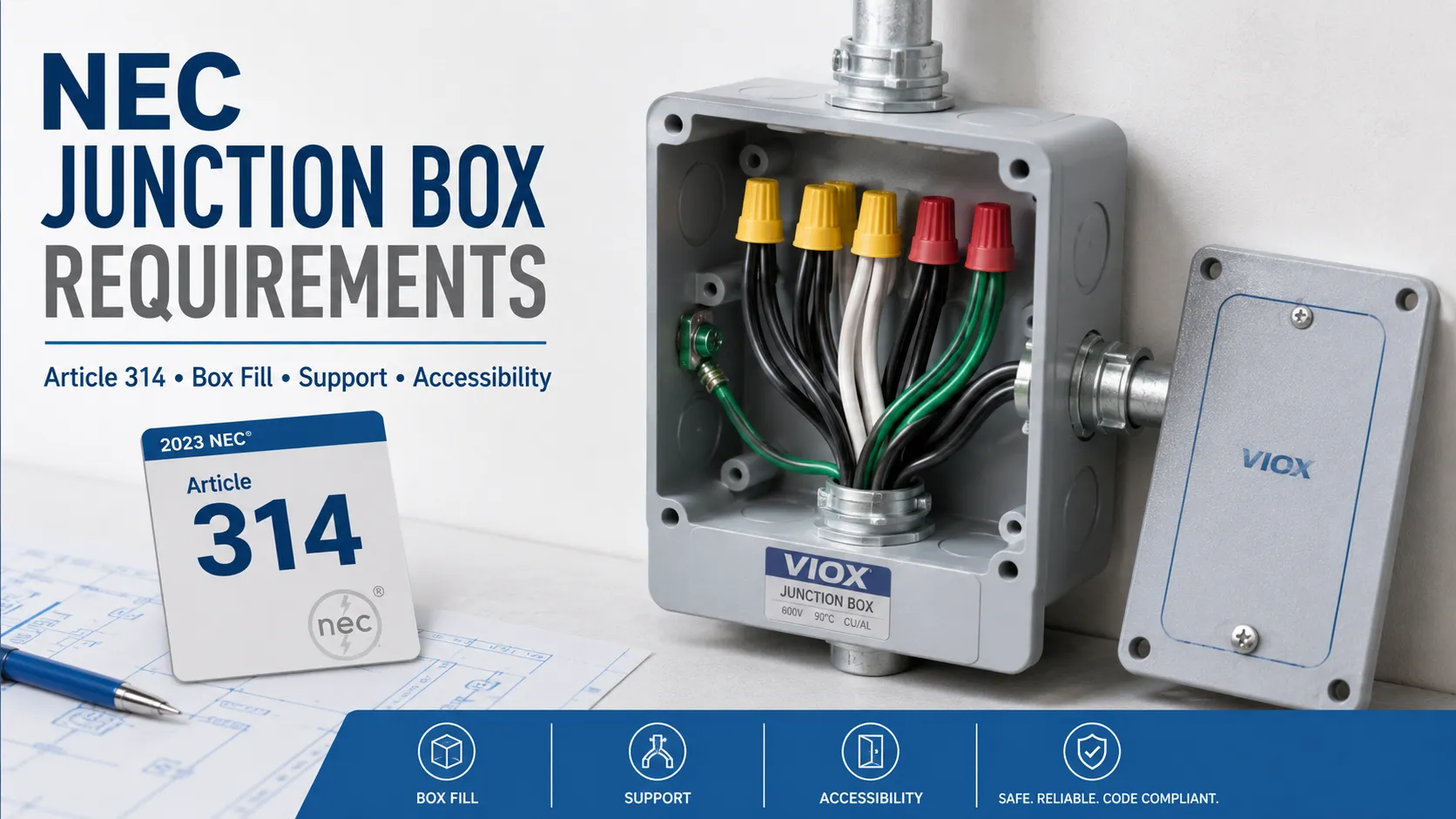
The main NEC requirements for junction boxes are found in NEC Article 314, which covers outlet boxes, device boxes, pull boxes, junction boxes, conduit bodies, and handhole enclosures. For most junction box installations, the most important rules are:
- NEC 314.16: the box must have enough internal volume for the number and size of conductors, devices, clamps, and grounding conductors.
- NEC 314.23: the box must be securely supported by the building structure or by an approved support method.
- NEC 314.29: the box must remain accessible after installation and cannot be buried behind permanent building finish.
- NEC 314.17: conductors and cables must enter the box through approved openings, fittings, bushings, or clamps.
- NEC 314.40: metal boxes must be properly grounded and bonded.
A compliant junction box must be large enough, securely mounted, covered, accessible, and wired with approved connectors and cable entries. Local amendments and the authority having jurisdiction (AHJ) can add requirements, so always verify the NEC edition adopted in your project location.
NEC Edition Note: 2017 vs 2020/2023 Rules Can Differ
NEC requirements evolve. A calculation or installation habit learned from an older code cycle may not match the NEC edition currently adopted by your AHJ. This is especially important for box fill calculations under NEC 314.16, where the treatment of equipment grounding conductors changed in the 2020 NEC and remains important in 2023 NEC-based work.
Use this article as a practical guide to the major NEC concepts, not as a substitute for the adopted code book, project specifications, or local inspection requirements.
NEC Article 314 Quick Reference Table
| NEC Section | Main Topic | What It Means in the Field |
|---|---|---|
| Article 314 | Boxes and enclosures | Main NEC article for junction boxes, pull boxes, outlet boxes, device boxes, conduit bodies, and handhole enclosures |
| 314.16 | Box fill | The box must provide enough cubic-inch volume for conductors, devices, grounding conductors, and internal fittings |
| 314.17 | Conductors entering boxes | Cables and raceways must enter through suitable openings, fittings, clamps, or bushings |
| 314.23 | Support | The box must be securely supported by framing, structure, or an approved support system |
| 314.25 | Covers and canopies | Boxes generally need covers, faceplates, or fixtures to enclose wiring and splices |
| 314.28 | Pull and junction boxes for larger conductors | Larger conductors and raceway pulls require minimum dimensions based on pull type |
| 314.29 | Accessibility | Boxes must remain accessible and cannot be concealed behind permanent finish |
| 314.40 | Metal boxes | Metal boxes must be grounded and bonded as part of the equipment grounding path |
This table is a practical guide, not a replacement for the NEC text. For code inspection, design, and permitting, use the currently adopted NEC edition and any local amendments.
NEC 314.29: Junction Box Accessibility Requirements
A common inspection question around junction boxes is simple: do junction boxes need to be accessible?
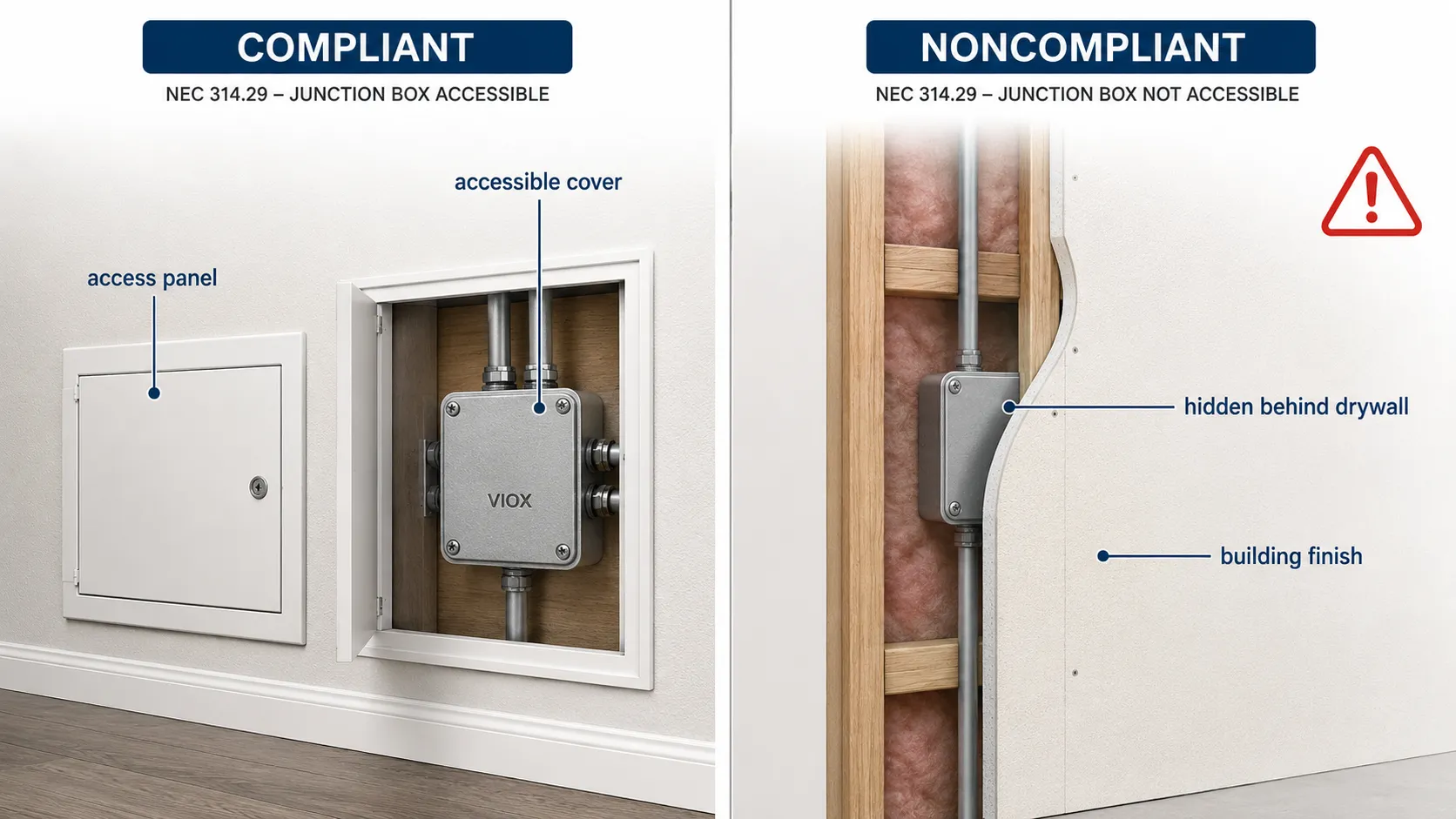
Yes. Under NEC 314.29, junction boxes, pull boxes, and similar enclosures must be installed so the wiring inside can be accessed after installation. The key point is that a splice or termination cannot be permanently hidden where an electrician or inspector cannot reach it later.
What “Accessible” Means for Junction Boxes
For a junction box, accessible generally means the box can be reached without damaging or removing permanent building finish. The cover can be removed for inspection and service, but the box should not be buried behind drywall, plaster, tile, fixed paneling, or other permanent surfaces.
Compliant examples often include:
- visible surface-mounted boxes
- boxes above a removable suspended ceiling
- boxes in an attic or crawlspace with practical access
- boxes behind an access panel
- boxes inside accessible equipment or cabinet spaces where allowed by the installation
Noncompliant or high-risk examples include:
- a box hidden behind drywall
- a box plastered into a wall cavity with no access cover
- a splice abandoned inside a finished ceiling
- a junction box covered by fixed cabinets with no removable access
- a box buried under flooring or behind permanent wall finish
For a deeper discussion of this exact issue, see VIOX’s guide on whether junction boxes can be behind drywall.
Accessible Is Not Always the Same as Readily Accessible
One common mistake is treating accessible and readily accessible as the same rule. They are related, but not identical.
In practical terms:
| Term | Practical Meaning |
|---|---|
| Accessible | Can be reached for inspection, maintenance, or wiring access without removing permanent building finish |
| Readily accessible | Can be reached quickly without needing tools, ladders, obstacles removal, or special access procedures |
Junction box rules often focus on accessibility, not necessarily everyday user access. A junction box above a removable ceiling tile may be accessible, while a box buried behind drywall is not. The exact judgment can depend on installation details and the AHJ.
Can Junction Boxes Be Behind Drywall, Cabinets, or Ceiling Panels?
Many failed inspections start with this exact issue.
| Location | Usually Acceptable? | Reason |
|---|---|---|
| Behind drywall with no access panel | No | The box is concealed behind building finish |
| Above removable ceiling tiles | Often yes | The ceiling tile can usually be displaced for access |
| Behind a removable access panel | Often yes | The box remains serviceable |
| Inside a fixed cabinet with no access path | Usually no | Access may be blocked by permanent installation |
| Inside an accessible attic | Often yes | The box can be reached for inspection and service |
| Buried underground without a listed handhole or enclosure method | No | Wiring access and environmental protection are not adequate |
If the box contains a splice, it is not a place to hide and forget. The purpose of the box cover is not only insulation; it also preserves future serviceability.
NEC 314.16: Box Fill Calculation Requirements
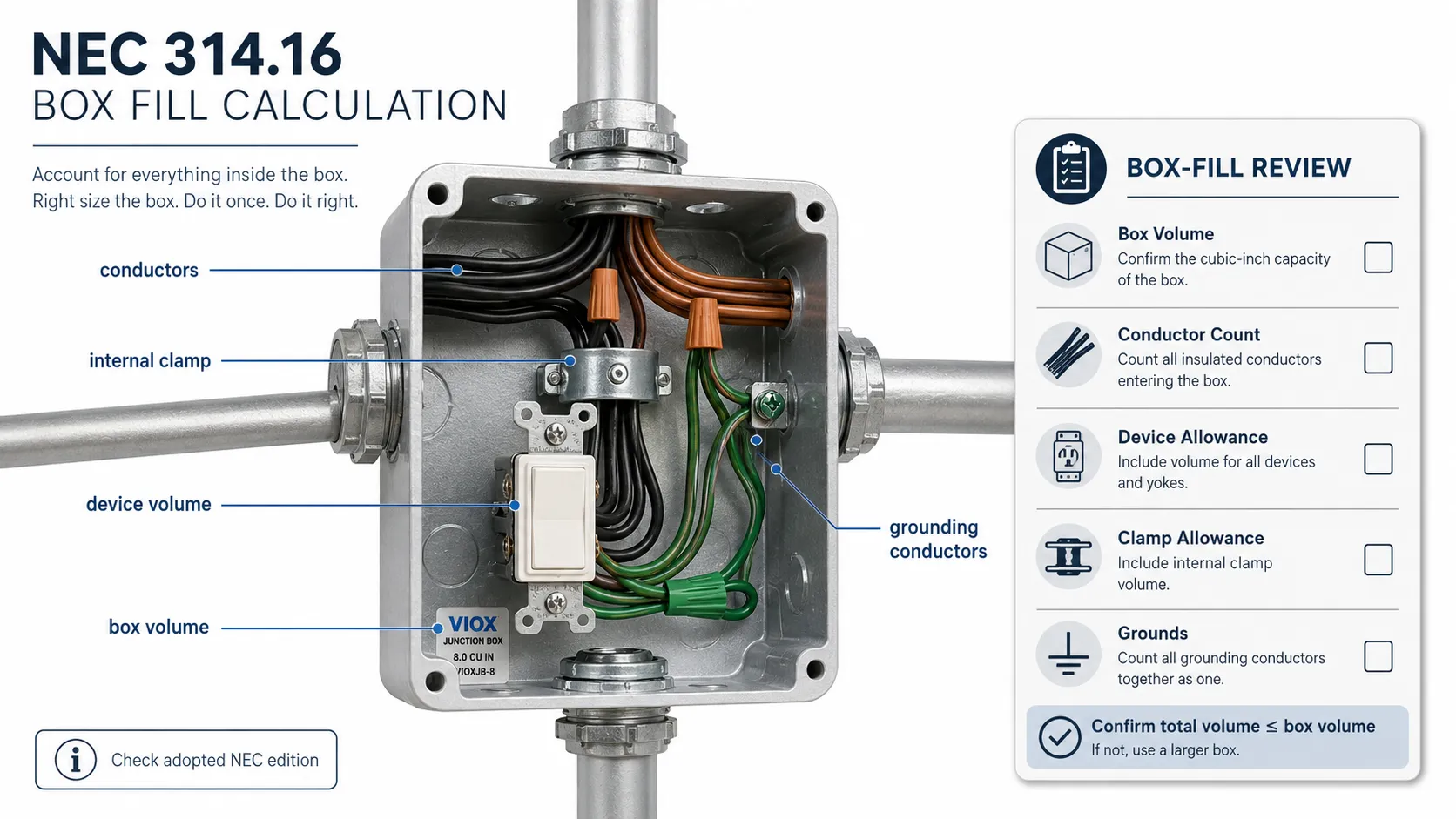
NEC 314.16 is the key section for box fill. It prevents installers from stuffing too many conductors, devices, clamps, or splices into a small enclosure.
An overcrowded junction box creates several problems:
- conductor insulation can be damaged during folding
- wire connectors may loosen
- heat dissipation becomes worse
- troubleshooting becomes difficult
- the installation may fail inspection
What Counts in Box Fill?
For typical box fill calculations, the following items must be considered:
| Item | General Box Fill Treatment |
|---|---|
| Current-carrying conductors entering the box | Counted based on conductor size and quantity |
| Conductors spliced or terminated in the box | Counted according to NEC box fill rules |
| Equipment grounding conductors | Edition-sensitive. Under 2020/2023 NEC-style rules, up to four equipment grounding conductors or bonding jumpers are generally counted as one volume allowance based on the largest conductor, with additional grounding conductors adding partial volume allowance |
| Internal cable clamps | Counted if they are inside the box |
| Device yokes such as switches or receptacles | Counted based on the largest conductor connected to the device |
| Pigtails that do not leave the box | Often not counted the same as conductors entering from outside, but verify the exact NEC rule |
| Wire connectors alone | Usually not counted as separate volume items, but the conductors they join are counted |
The old habit of saying “this box is fine because the wires fit” is not a code calculation. Box fill must be calculated from conductor size, count, and box volume.
Equipment Grounding Conductors: Check the NEC Edition
Grounding conductor volume is one place where old rules and current rules can be confused. In older NEC editions, installers often treated the equipment grounding conductors together as one volume allowance based on the largest equipment grounding conductor in the box.
Under the 2020 and 2023 NEC approach, the rule is more detailed: up to four equipment grounding conductors or equipment bonding jumpers are generally counted as one volume allowance based on the largest grounding conductor, and each additional grounding conductor or bonding jumper adds one-quarter of that largest conductor volume allowance.
That detail matters in crowded junction boxes. A box with many branch-circuit grounding conductors can require more volume than an older quick estimate would suggest. When in doubt, calculate from the NEC edition adopted by the AHJ rather than relying on memory.
Common Conductor Volume Allowances
The NEC provides conductor volume allowances by conductor size. Common values used in many residential and light-commercial calculations include:
| Conductor Size | Volume Allowance per Conductor |
|---|---|
| 18 AWG | 1.50 cubic inches |
| 16 AWG | 1.75 cubic inches |
| 14 AWG | 2.00 cubic inches |
| 12 AWG | 2.25 cubic inches |
| 10 AWG | 2.50 cubic inches |
| 8 AWG | 3.00 cubic inches |
| 6 AWG | 5.00 cubic inches |
These values are useful for common branch-circuit boxes. Always verify the applicable table in the NEC edition adopted by your jurisdiction.
Simple Box Fill Example
Suppose a junction box contains:
- two 12 AWG conductors entering
- two 12 AWG conductors leaving
- up to four equipment grounding conductors or bonding jumpers, depending on the adopted NEC edition
- internal clamps
A simplified 2020/2023-style calculation may count the current-carrying conductors, the applicable grounding conductor volume allowance, and one volume allowance for internal clamps if they are inside the box. Because 12 AWG conductors use 2.25 cubic inches per counted conductor volume, the final required box volume can quickly exceed what a shallow box provides. If more than four equipment grounding conductors or bonding jumpers are present, do not use the older one-volume shortcut.
The safest design habit is to choose the box after the conductor count is known, not before. If future splices are likely, select a larger enclosure.
For more detail on physical selection and sizing, route readers to a dedicated junction box sizing guide.
NEC 314.23: Junction Box Support and Mounting Rules
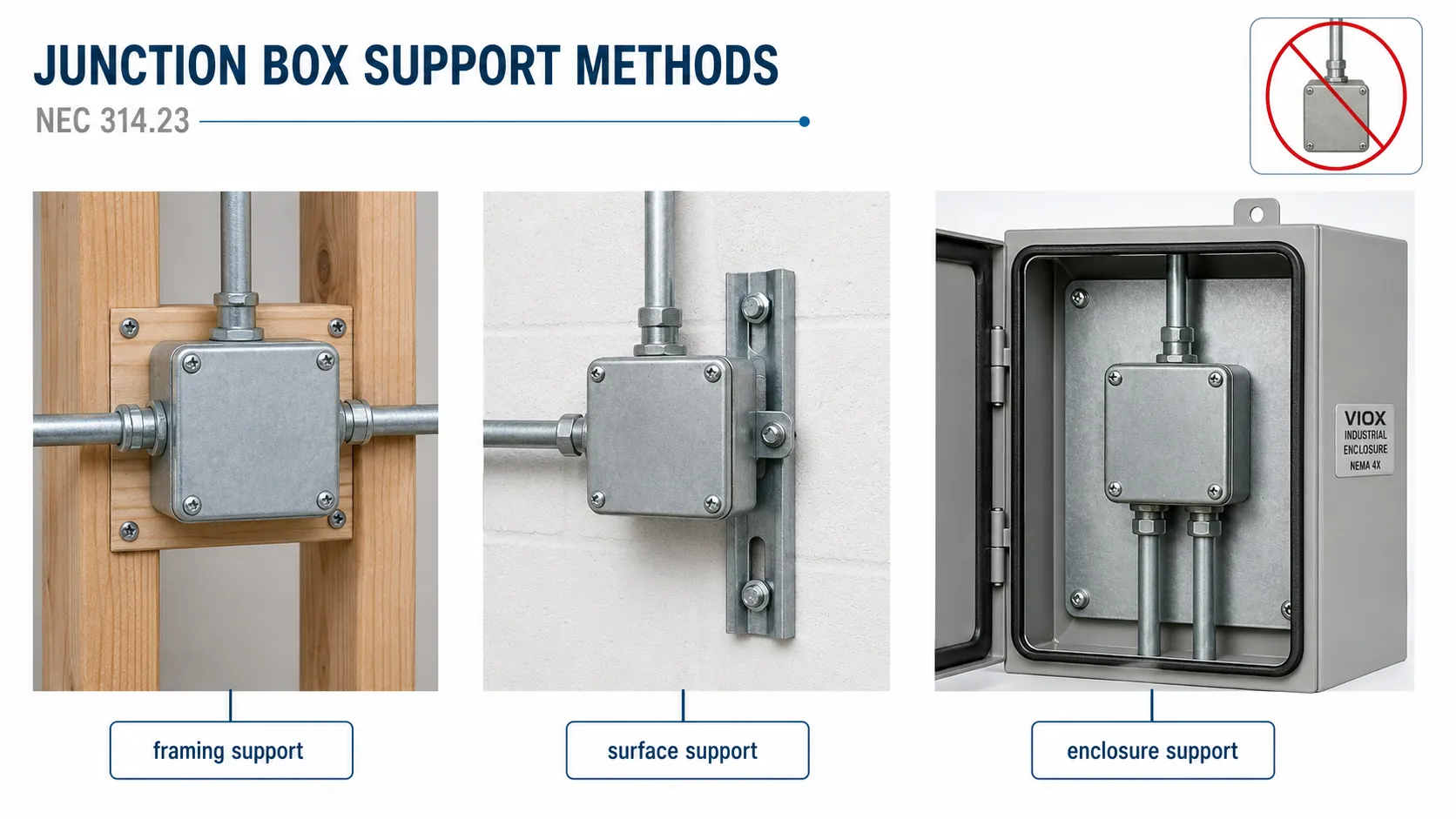
NEC 314.23 covers box support. The basic rule is that boxes must be securely supported by the building structure or by an approved support method. A junction box should not depend on loose cable tension, drywall alone, or unsupported conduit movement.
Common Support Methods
| Installation Type | Typical Support Method | Field Note |
|---|---|---|
| New-work box on framing | Fastened directly to stud, joist, or framing member | Common in residential walls and ceilings |
| Old-work box | Secured with listed clamps or wings for the wall material | Must match the wall type and box rating |
| Surface-mounted box | Fastened to wall, structure, strut, or backplate | Common in industrial and utility spaces |
| Ceiling box | Supported for the expected load | Fan or fixture loads may require special box ratings |
| Raceway-supported box | Allowed only under specific conditions | Do not assume conduit support is acceptable in every case |
| Panel or enclosure interior | Mounted to backplate, DIN rail, bracket, or listed support | Common in control cabinets and industrial assemblies |
The mistake to avoid is using the wiring method as the support system without verifying the rule. A cable, flexible conduit, or raceway connection is not automatically a structural support.
Why Support Matters
Poor support can lead to:
- loosened cable entries
- damaged insulation
- stressed splices
- broken grounding continuity
- cover misalignment
- failed inspection
In industrial and outdoor installations, vibration and thermal cycling make mechanical support even more important. The box should remain stable after repeated cable movement, maintenance, and environmental exposure.
Industrial Junction Boxes and Control Panels
Many NEC junction box questions come from residential and commercial construction, but VIOX’s B2B customers often deal with machinery, control cabinets, terminal junction boxes, and industrial enclosures. The compliance logic is similar, but the design priorities change.
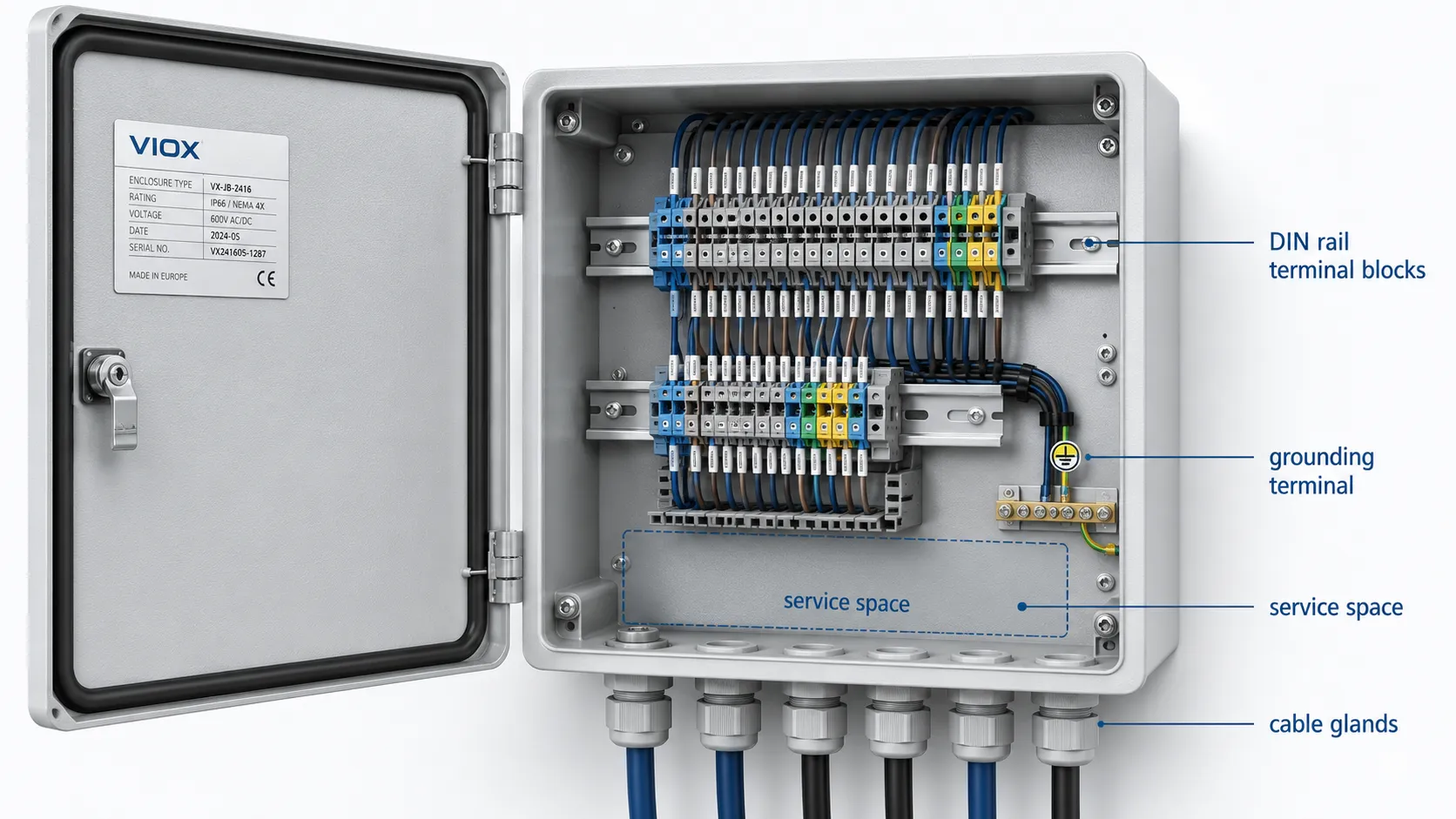
In an industrial enclosure, the problem is often not drywall access. It is serviceability, wire identification, vibration resistance, heat, gland sealing, and future maintenance. A box filled with loose splices may pass a basic wiring check but still be difficult for a panel builder or maintenance technician to troubleshoot.
For control panels and machinery wiring, engineers often prefer:
- DIN rail terminal blocks instead of loose splices
- labeled conductors and terminal markers
- larger enclosures with wiring duct space
- cable glands or strain relief fittings matched to the cable
- separate power and control wiring zones
- grounding terminals bonded to the enclosure or mounting system
At that point, a simple junction box becomes an engineered wiring enclosure. If the wiring must be inspected, labeled, expanded, or serviced repeatedly, terminal blocks and a larger industrial enclosure are usually better than trying to fit more wire connectors into a small box. VIOX terminal blocks and junction box products can be selected together for organized industrial wiring layouts.
NEC 314.17: Conductors Entering Junction Boxes
Conductors must enter a junction box through suitable openings and fittings. Sharp edges, missing bushings, loose clamps, and unsealed unused openings can all create safety and inspection problems.
Important checks include:
- cable clamps are suitable for the cable type
- raceway fittings are tight and listed for the box
- nonmetallic cable is secured as required
- conductor insulation is protected from abrasion
- unused knockouts are closed with suitable plugs
- wet-location entries use fittings rated for the environment
For outdoor or wet-location installations, the enclosure, cover, gasket, cable gland, and drainage strategy matter together. A weatherproof box can still fail if the cable entries are wrong.
NEC 314.25: Junction Box Covers
A junction box containing splices or terminations generally needs a cover, faceplate, fixture canopy, or equipment cover suitable for the box. The cover protects the wiring, keeps fingers and objects away from live parts, and keeps the box accessible for future service.
Common cover mistakes include:
- leaving an open junction box above a ceiling
- using a damaged or missing cover screw
- installing the wrong cover size
- using an indoor cover outdoors
- covering a box with drywall instead of a removable cover
For product-level cover differences, see VIOX’s guide to junction box cover types.
NEC 314.40: Grounding and Bonding for Metal Junction Boxes
Metal junction boxes must be grounded and bonded correctly. If a live conductor contacts the box, the equipment grounding path must help clear the fault through the overcurrent protective device.
Common grounding methods include:
- grounding screw
- listed grounding clip
- bonding jumper
- metal raceway path where permitted
- equipment grounding conductor connected to the box
Plastic boxes do not need the box body grounded, but the equipment grounding conductors in the circuit still need to be connected correctly. Do not confuse “plastic box” with “no grounding required.”
Pull Boxes vs Junction Boxes Under NEC Article 314
A junction box is usually used for splices, taps, or wire connections. A pull box is often used to make conductor pulling easier through a raceway system. One enclosure can sometimes serve both functions, but NEC sizing rules can differ depending on conductor size, raceway arrangement, and whether the box is used for straight pulls, angle pulls, or U-pulls.
For larger conductors and raceway systems, NEC 314.28 becomes especially important. The dimensions of the box may be governed by the raceway size and pull direction, not just conductor count.
| Box Type | Main Purpose | Key NEC Concern |
|---|---|---|
| Junction box | Splices, taps, branch connections | Box fill, accessibility, cover, support |
| Pull box | Pulling conductors through raceway | Pull length, raceway size, bending space |
| Device box | Switches, receptacles, controls | Box fill, device yoke volume, accessibility |
| Conduit body | Raceway access and pulling point | Fill limits, cover access, conductor bending |
For a deeper comparison, see pull box vs junction box.
Metallic vs Nonmetallic Junction Boxes
Both metallic and nonmetallic boxes can be code-compliant when used correctly. The selection depends on wiring method, grounding strategy, environment, mechanical exposure, and product rating.
| Box Type | Common Strength | Common Limitation |
|---|---|---|
| Metal junction box | Strong, suitable for many raceway systems, supports grounding continuity | Requires proper bonding and corrosion consideration |
| Plastic or nonmetallic box | Lightweight, corrosion-resistant, common with NM cable | Not suitable for every raceway, heat, or mechanical exposure condition |
| Weatherproof box | Outdoor and damp/wet applications when properly rated | Must be paired with correct cover and fittings |
| Industrial enclosure | Better for machinery, panels, and terminal wiring | Requires correct IP/NEMA rating, glands, terminals, and mounting |
For more comparison detail, see VIOX’s guide on metal vs plastic junction boxes.
NEC Rules for Pull and Junction Boxes: Metallic and Nonmetallic Examples
Many training and exam-style questions ask for NEC regulations governing pull and junction boxes and examples of metallic and nonmetallic boxes. The practical answer is:
NEC Article 314 governs the installation of boxes and similar enclosures. Pull and junction boxes must be properly sized, accessible, supported, covered, and suitable for the wiring method and environment. Metallic boxes are common with metal raceways, commercial wiring, and locations requiring durable mechanical protection. Nonmetallic boxes are common in residential cable wiring, corrosion-prone environments, and low-voltage or light-duty installations where the box is listed for the use.
Examples:
- Metal square junction box: branch-circuit splices in EMT conduit systems.
- Plastic old-work box: retrofit residential switch or receptacle location with NM cable.
- Weatherproof outdoor box: exterior lighting or receptacle junction with wet-location cover and fittings.
- Large pull box: raceway conductor pulling point for long conduit runs.
- Industrial terminal junction box: machinery or control wiring where terminal blocks improve labeling and service access.
For industrial wiring where splices need organization, labeling, and repeatable maintenance, a terminal block inside a suitable enclosure may be better than loose splices.
Common Junction Box Code Violations
1. Hidden Box Behind Drywall
The box may be electrically functional, but it fails the serviceability requirement. If a splice exists, the box must remain accessible.
2. Overfilled Box
If conductors are forced into the box, box fill may be too small. Overfilled boxes are especially common when adding smart switches, dimmers, pigtails, or extra branch-circuit splices to older boxes.
3. Missing Cover
An open box exposes wiring and creates a service hazard. Every junction box should have the correct cover or enclosure closure.
4. Unsupported Box
A box hanging from cable, flexible conduit, or loose drywall is not a reliable installation. The support method must match the box type and wiring method.
5. Wrong Box for Wet Locations
Indoor boxes, covers, and connectors can fail outdoors. Wet and damp locations require the correct enclosure rating, cover, gaskets, fittings, and cable entry method.
6. Poor Cable Entry
Missing clamps, sharp knockouts, or loose fittings can damage conductor insulation. Cable entry is part of the safety system, not a cosmetic detail.
7. Improper Grounding of Metal Boxes
Metal boxes need a reliable equipment grounding path. A loose or missing bonding connection can make the box dangerous during a fault.
Field Inspection Checklist
Use this checklist before closing a wall, ceiling, cabinet, or enclosure:
| Check Item | Pass Condition |
|---|---|
| Accessibility | Box cover can be reached without removing permanent finish |
| Box fill | Internal volume matches conductor count and device volume |
| Support | Box is secured to framing, structure, or approved support |
| Cover | Correct cover, plate, canopy, or enclosure closure installed |
| Cable entry | Clamps, fittings, bushings, and knockout closures are suitable |
| Grounding | Metal box bonded; grounding conductors connected correctly |
| Environment | Box and fittings rated for dry, damp, wet, corrosive, or hazardous location as applicable |
| Wiring method | Box type matches cable, raceway, or enclosure system |
| Future service | Splices can be inspected and repaired without demolition |
When to Use a Larger Junction Box
Use a larger box when:
- conductor count is close to the box fill limit
- multiple cable assemblies enter the same box
- devices or dimmers add volume
- large wire connectors make folding difficult
- future expansion is likely
- wiring must be labeled or serviced frequently
- the installation is industrial or high-vibration
In field work, a box that is technically just large enough can still be unpleasant to wire and difficult to service. For clean installations, leave working room.
FAQ
Do junction boxes need to be accessible?
Yes. Junction boxes containing wiring splices or terminations must remain accessible for inspection, maintenance, and repair. They should not be buried behind drywall, plaster, tile, fixed paneling, or other permanent finish.
What does NEC 314.29 require?
NEC 314.29 covers accessibility for boxes, conduit bodies, and handhole enclosures. In practice, it means the box must be installed so the wiring inside can be accessed without removing permanent building finish.
Can a junction box be hidden behind drywall?
No. A junction box with splices should not be hidden behind drywall. If the box must be in that area, use a suitable access panel or relocate the splice to an accessible location.
Can a junction box be above a drop ceiling?
Often yes, if the ceiling panels are removable and the box remains accessible. However, the installation must still meet support, cover, box fill, and local code requirements.
Does a junction box need a cover?
Yes, a junction box containing splices or terminations generally needs a suitable cover, faceplate, canopy, or enclosure closure. The box should not be left open.
What does NEC 314.23 require?
NEC 314.23 covers support. A junction box must be securely supported by the building structure or an approved support method. It should not hang loosely from cables or depend on unsupported wiring.
What does NEC 314.16 require?
NEC 314.16 covers box fill. The box must have enough internal volume for the conductors, grounding conductors, internal clamps, device yokes, and fittings that count under the box fill rules.
Where in the NEC are pull and junction boxes covered?
Pull boxes and junction boxes are mainly covered in NEC Article 314. Larger pull boxes and raceway pull calculations may also involve NEC 314.28.
What is the difference between a pull box and a junction box?
A junction box is mainly used for splices, taps, or wire connections. A pull box is mainly used to provide access for pulling conductors through raceway. Some boxes can serve both functions if sized and installed correctly.
Can I use wire nuts in a junction box?
Yes, if the wire connectors are listed, correctly sized for the conductor combination, and installed inside a box with enough fill volume. For industrial panels, terminal blocks may provide better organization and serviceability.
Do plastic junction boxes need to be grounded?
The plastic box body itself does not need bonding like a metal box. However, equipment grounding conductors in the circuit still must be connected correctly.
Can a junction box be inside a cabinet?
It depends on access. If the cabinet or panel allows the box cover to be reached and removed without damaging permanent finish, it may be acceptable. If the box is blocked or permanently enclosed, it can become a code problem.
Conclusion
The NEC rules for junction boxes are not only about choosing a box and making a splice. A compliant junction box must be accessible, properly sized, securely supported, covered, grounded when metallic, and suitable for the wiring method and environment.
For field clarity, remember the three most important code points:
- NEC 314.29: keep junction boxes accessible.
- NEC 314.16: calculate box fill correctly.
- NEC 314.23: support boxes securely.
If those three rules are handled correctly, most junction box installations are already on a stronger path toward inspection approval. For product selection, VIOX offers junction box and electrical connection solutions for residential, commercial, industrial, and enclosure applications. See the VIOX junction box product range for enclosure options.