

On this page
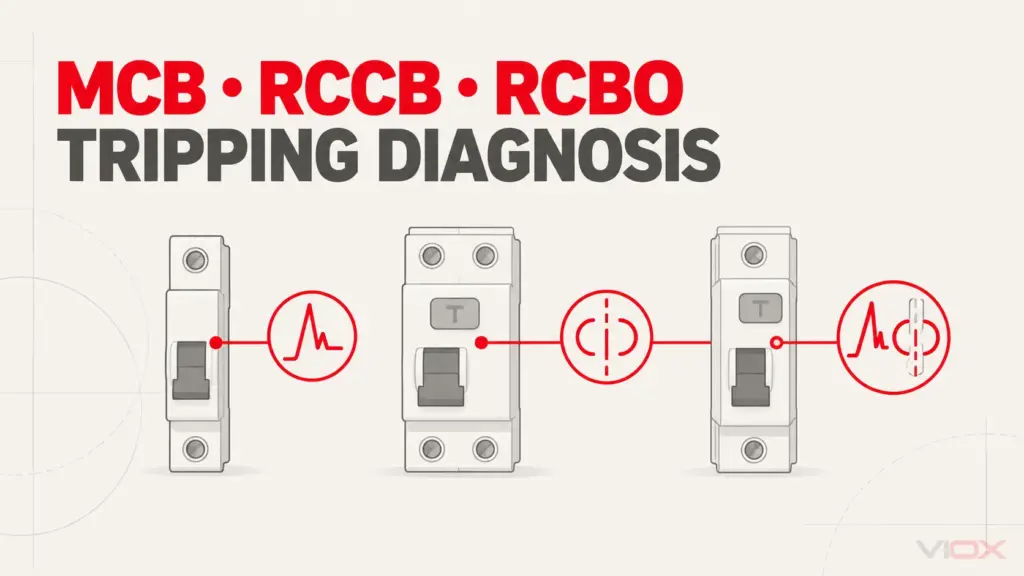
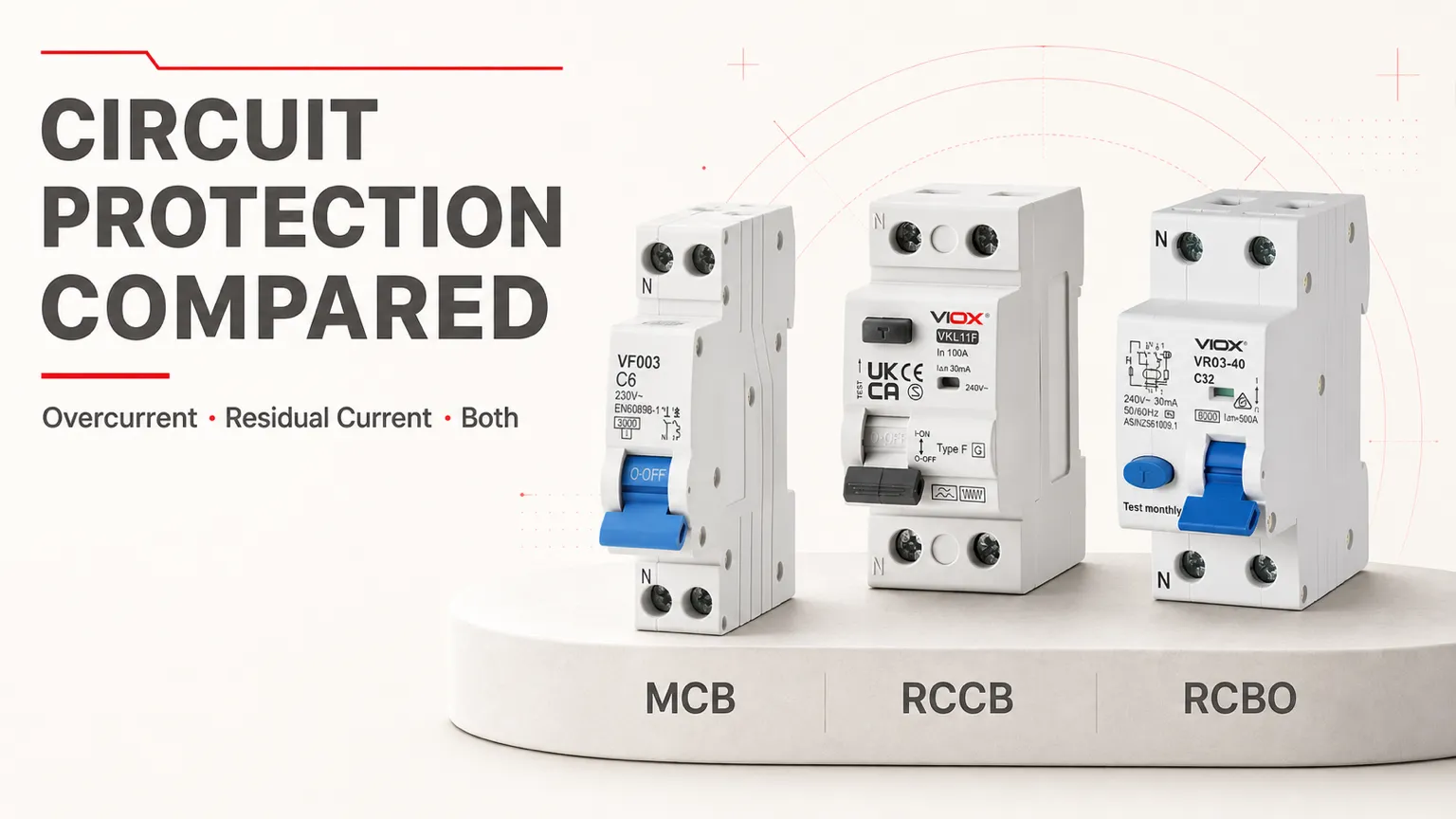
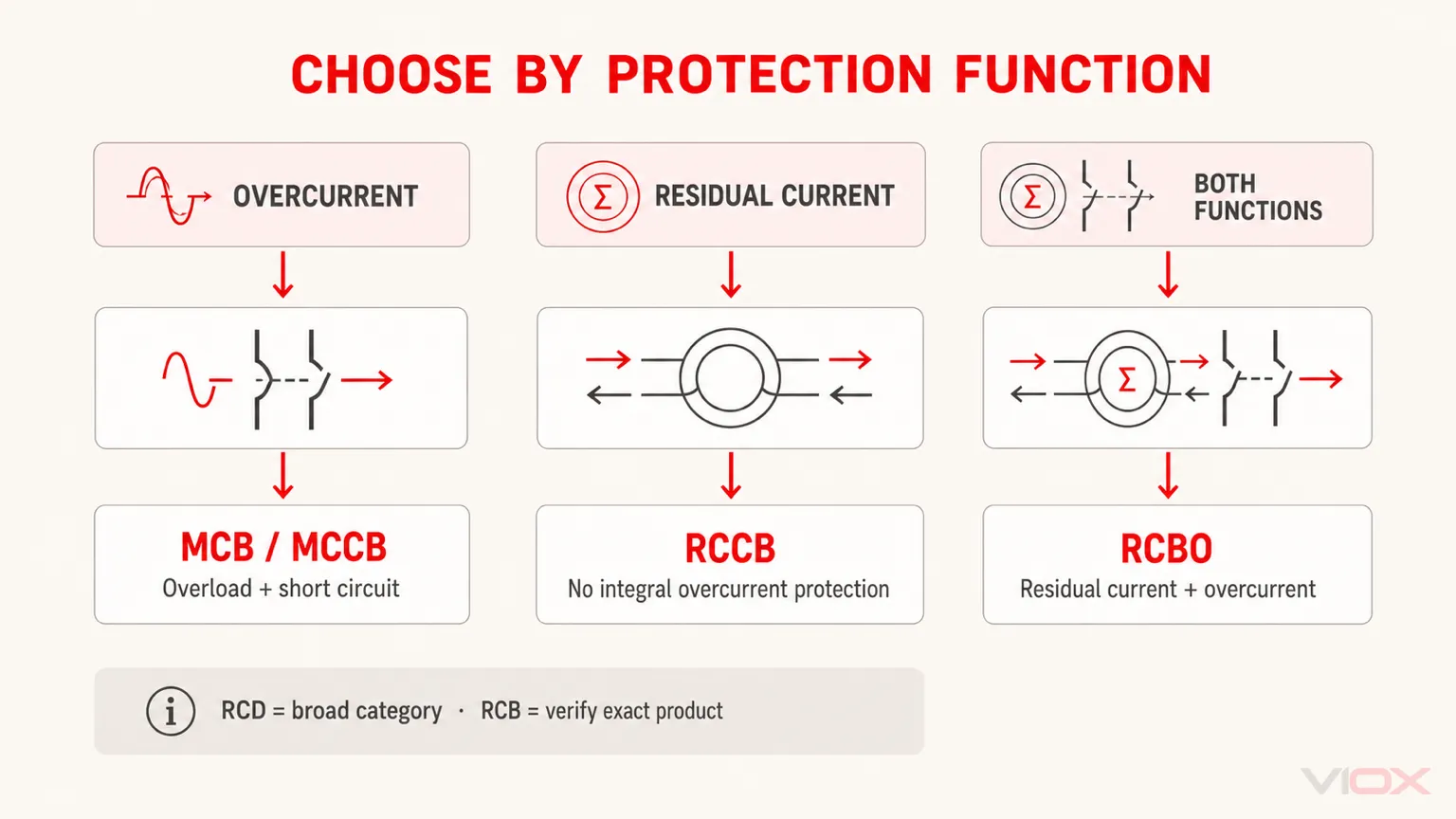
An MCB protects primarily against overcurrent, while RCD, RCCB, and the less precise term RCB relate to residual-current protection. An MCCB also provides overcurrent protection but is generally used for higher-duty distribution applications. An RCBO combines residual-current, overload, and short-circuit protection in one device.
The most important distinction in MCB vs RCB is therefore the fault being detected: an MCB responds to overcurrent; a residual-current device responds to an imbalance between outgoing and returning current. These functions are complementary, not interchangeable.
MCB, MCCB, RCB, RCD, RCCB, and RCBO at a Glance
| Term | Full form or technical meaning | Main function | Integral overcurrent protection? | Important boundary |
|---|---|---|---|---|
| MCB | Miniature Circuit Breaker | Protects circuit conductors against overload and short circuit | Yes | A standard MCB is not a residual-current device |
| MCCB | Molded Case Circuit Breaker | Overcurrent protection for distribution circuits and higher-duty applications | Yes | Ratings, trip functions, and adjustability depend on the product |
| RCB | Commonly expanded as Residual Current Breaker | Usually refers to residual-current protection | Unclear from the term alone | Regional or informal usage; verify the exact product type |
| RCD | Residual Current Device | Broad category of devices that respond to residual current | Not necessarily | It may refer to an RCCB, RCBO, or another RCD type |
| RCCB | Residual Current Operated Circuit-Breaker without Integral Overcurrent Protection | Residual-current protection | No | Requires suitable overcurrent protection in the circuit architecture |
| RCBO | Residual Current Operated Circuit-Breaker with Integral Overcurrent Protection | Residual-current, overload, and short-circuit protection | Yes | Must still be selected for current, curve, breaking capacity, RCD type, and residual operating current |
The table gives the basic answer, but it does not make similarly rated devices interchangeable. A 40 A MCB, a 40 A RCCB, and a 40 A RCBO perform different protection functions.
For device-specific definitions, see the VIOX guides to MCB full form, MCCB full form, RCB full form, RCCB full form, and RCBO full form.
RCB vs MCB: What Is the Main Difference?
An MCB and an RCB do not identify the same protection function. MCB is a defined circuit-breaker class for overcurrent protection. RCB is commonly used for a device that responds to residual current, but the abbreviation alone may not identify whether the product is an RCCB, RCBO, or another type of RCD.
| Question | MCB | RCB / residual-current device |
|---|---|---|
| What does it monitor? | Current flowing through the protected circuit | Difference between outgoing and returning current |
| Trips on sustained overload? | Yes, according to its time-current characteristic | Only if the exact device also incorporates overcurrent protection |
| Trips on high short-circuit current? | Yes, within its rated performance | Only if the exact device also incorporates overcurrent protection |
| Provides residual-current protection? | No | Yes, when RCB refers to an appropriate residual-current device |
| Can replace the other? | No | No |
A standard MCB is not an RCD and does not provide additional protection based on residual current. It may disconnect some earth faults when the resulting overcurrent reaches its trip threshold, but it must not be treated as a substitute for an RCCB or RCBO where residual-current protection is required.
Conversely, an RCCB detects residual current but does not incorporate overload or short-circuit protection. The installation therefore needs suitable overcurrent protection, such as an MCB, MCCB, or fuse, arranged according to the applicable design and manufacturer instructions.
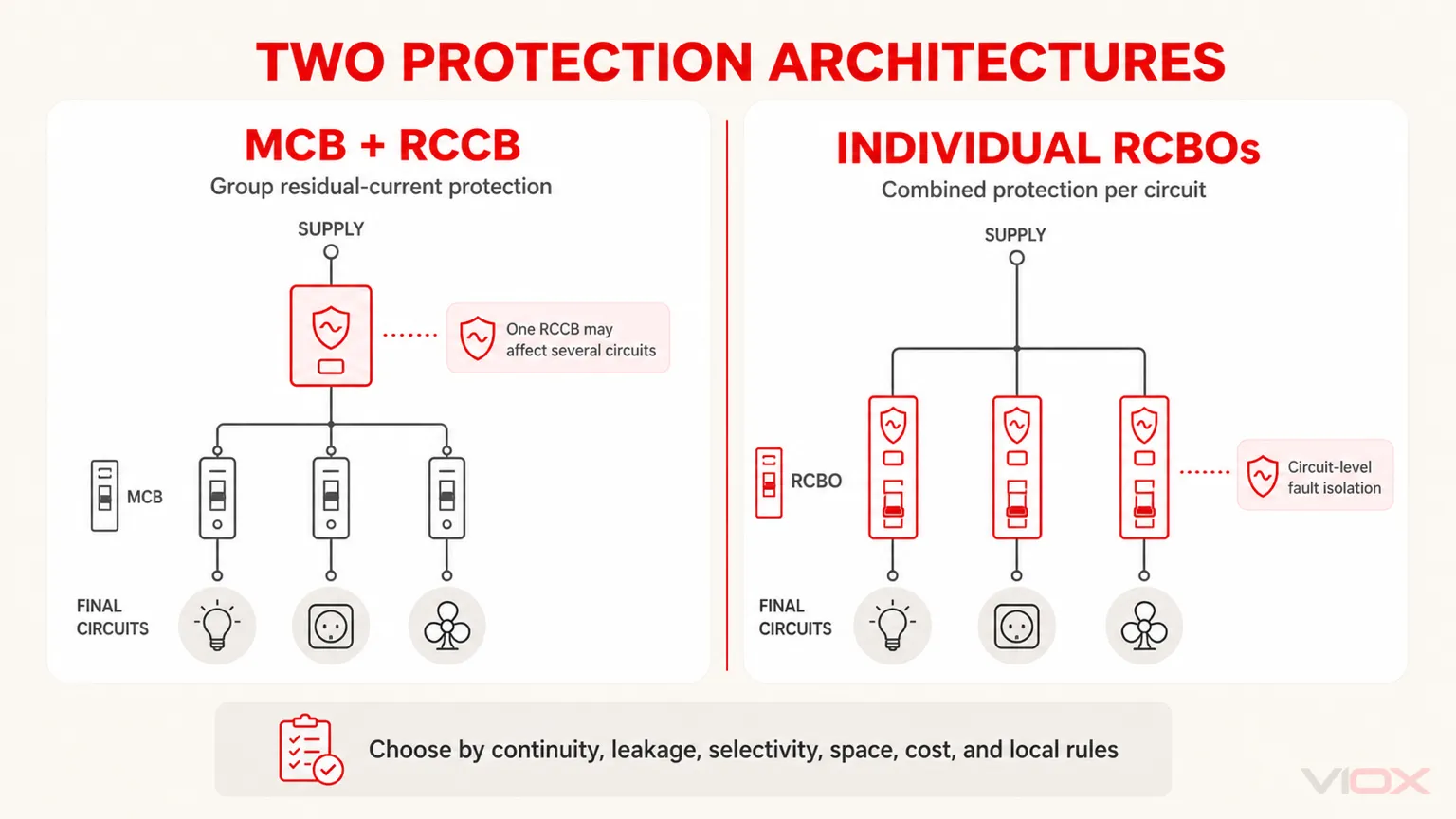
This leads to two common architectures:
- MCB + RCCB: separate overcurrent protection for individual circuits, with residual-current protection provided by an RCCB.
- RCBO: residual-current and overcurrent protection combined for the protected circuit.
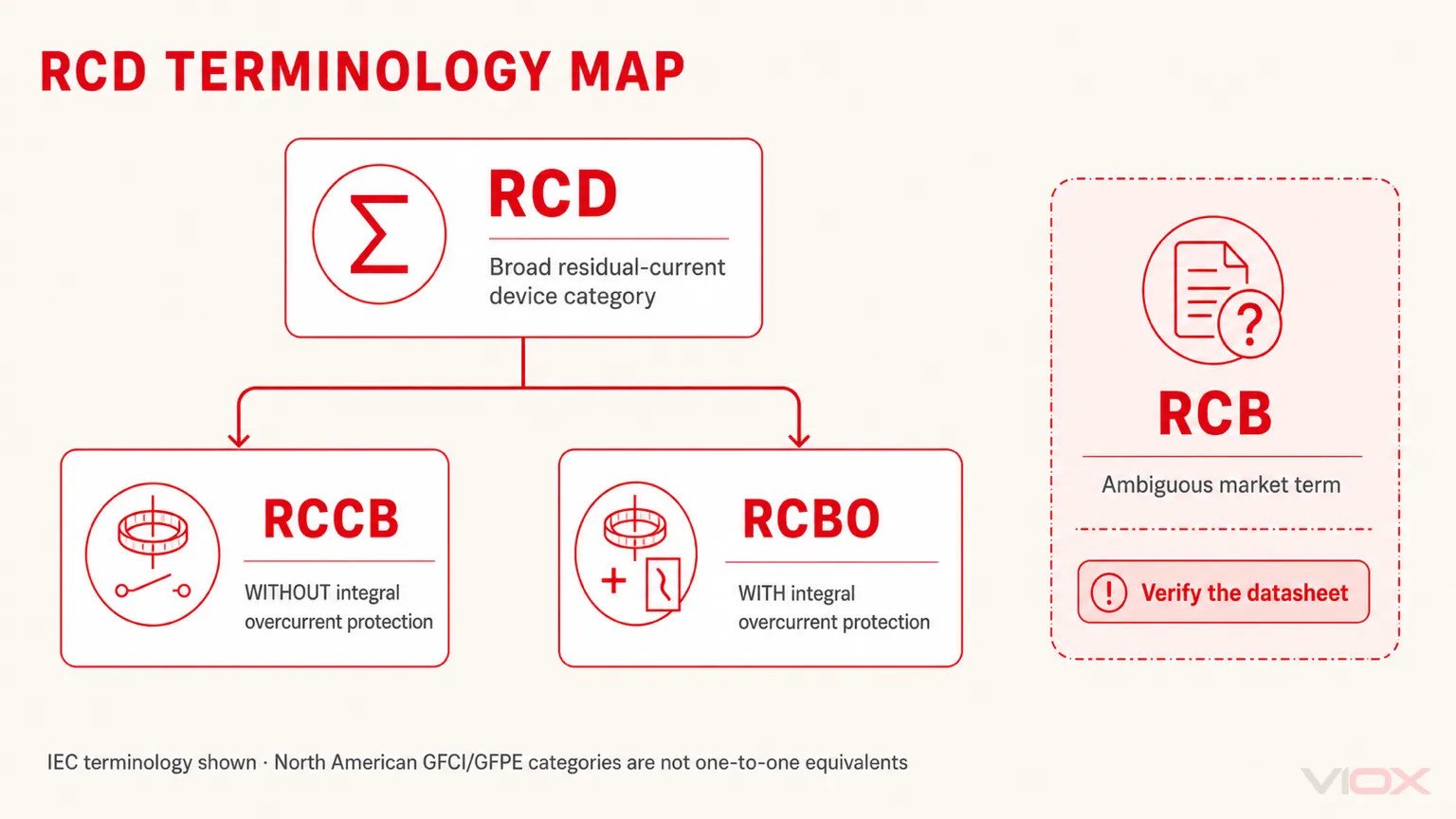
RCB, RCD, RCCB, and RCBO: Terminology That Prevents Specification Errors
The residual-current terms are related, but they are not exact synonyms.
RCD Is the Broad Category
RCD means Residual Current Device. It describes the wider family of devices that respond to residual current. It does not, by itself, state whether the device includes overcurrent protection.
When a drawing or specification calls only for an “RCD,” the next question should be: which RCD type and which product standard?
RCCB Has No Integral Overcurrent Protection
An RCCB is a Residual Current Operated Circuit-Breaker without Integral Overcurrent Protection. It monitors residual current and opens the circuit when the operating conditions reach its trip criteria.
An RCCB can provide residual-current-based fault protection and, where required by the applicable installation rules, additional protection. It should not be described as absolute protection against electric shock: effectiveness depends on the selected residual operating current, device type, circuit arrangement, installation condition, and applicable rules.
RCBO Combines Both Protection Families
An RCBO is a Residual Current Operated Circuit-Breaker with Integral Overcurrent Protection. It combines:
- residual-current detection;
- overload protection; and
- short-circuit protection.
That functional combination does not make every RCBO suitable for every circuit. The selected product must still match the system voltage, rated current, time-current characteristic, breaking capacity, residual operating current, residual-current type, pole configuration, and applicable standard.
RCB Is an Ambiguous Market Term
RCB is often expanded as Residual Current Breaker, but its use varies by market, supplier, and document. It may be used casually for an RCCB, an RCD, or residual-current protection in general.
For engineering and procurement, do not approve a device from the letters “RCB” alone. Confirm:
- the full product designation;
- whether integral overcurrent protection is included;
- the declared product standard;
- the rated residual operating current and RCD type; and
- the manufacturer wiring and application instructions.
Market note: This article uses IEC terminology. North American GFCI and GFPE terminology, product standards, trip thresholds, and application requirements are not direct one-to-one equivalents of IEC RCCB and RCBO categories. Always select devices according to the standards and installation rules applicable to the project market.
RCCB vs RCBO: Residual-Current Only or Combined Protection
The central difference between RCCB and RCBO is integral overcurrent protection.
| Selection factor | RCCB | RCBO |
|---|---|---|
| Residual-current protection | Yes | Yes |
| Integral overload protection | No | Yes |
| Integral short-circuit protection | No | Yes |
| Protection architecture | Used with suitable separate overcurrent protection | Combines residual-current and overcurrent functions for the circuit |
| Fault isolation | A shared RCCB may disconnect several downstream circuits | A circuit-level RCBO can isolate the affected circuit |
| Design tradeoff | Can support economical group protection | Can improve circuit-level separation and simplify functional coordination within one device |
An RCCB is not an inferior RCBO. It serves a different architecture. A shared RCCB with downstream MCBs may be appropriate where group residual-current protection is acceptable. Individual RCBOs may be preferred where a fault on one final circuit should not disconnect unrelated circuits.
The actual decision also depends on required selectivity, cumulative leakage current, panel layout, continuity requirements, local installation rules, and product compatibility. See the dedicated RCBO vs RCCB + MCB comparison for that design decision.
MCB vs RCCB vs RCBO
These three devices are easiest to compare by the function needed on a final circuit.
| Required function | MCB | RCCB | RCBO |
|---|---|---|---|
| Overload protection | Yes | No | Yes |
| Short-circuit protection | Yes | No | Yes |
| Residual-current protection | No | Yes | Yes |
| Works as the sole device for all three functions | No | No | Yes, within its ratings and application scope |
Use an MCB when the required function is overcurrent protection and residual-current protection is either not required or is provided elsewhere. Use an RCCB when residual-current protection is required and suitable overcurrent protection is already included in the architecture. Consider an RCBO when one circuit needs both functions in one device.
This is a functional starting point, not a complete design approval. Final selection must follow the applicable installation rules and verified product data.
MCB vs MCCB: Same Fault Family, Different Application Scope
MCBs and MCCBs both protect against overcurrent. Their difference is not “which one protects against short circuit”; both can do so within their rated performance. The practical distinction is product scope and system duty.
| Factor | MCB | MCCB |
|---|---|---|
| Common role | Final circuits and branch circuits | Feeders, distribution circuits, and higher-duty applications |
| Product scope | Compact devices, commonly within household and similar or light distribution contexts | Wider industrial distribution range |
| Trip arrangement | Commonly fixed thermal-magnetic characteristics | May offer adjustable thermal-magnetic or electronic trip functions, depending on model |
| Breaking performance | Must exceed the prospective short-circuit current at its installation point | Higher breaking-capacity options are commonly available, depending on series |
| Selection evidence | Product standard, curve, rated current, breaking capacity, poles | Product standard, trip unit, settings, breaking ratings, utilization category, coordination data |
Do not select an MCCB merely because its ampere rating is higher, and do not select an MCB where the prospective short-circuit current or application duty exceeds its declared capability. For the detailed decision, use the dedicated MCB vs MCCB comparison.
How the Protection Principles Differ
MCB and MCCB: Overcurrent Releases
Many MCBs use a thermal release for sustained overload and a magnetic release for rapid operation when overcurrent reaches the instantaneous pickup range, typically during a short circuit. MCCBs may use thermal-magnetic or electronic trip units, depending on the product.
Their operating time is determined by the time-current characteristic, the magnitude of overcurrent, device condition, and the declared product performance. A magnetic release is therefore better described as responding to high overcurrent within its instantaneous pickup range, not as a sensor that recognizes the physical cause of a short circuit.
RCCB and Other RCDs: Residual-Current Detection
An RCCB compares the current flowing through the live conductors with the returning current. Under normal conditions, the vector sum is close to zero. Current flowing through an unintended path creates residual current; when the device’s operating criteria are met, it opens the circuit.
Residual-current protection does not measure conductor overload in the same way as an overcurrent release. That is why an RCCB without integral overcurrent protection cannot replace an MCB or other suitable overcurrent protective device.
RCBO: Residual-Current and Overcurrent Operation
An RCBO incorporates both protection functions. Its datasheet and markings must therefore be checked for both sets of parameters rather than only the rated current or residual operating current.
Relevant IEC Product Standards
The product standard helps identify the device category and test framework. It does not by itself prove that a particular product is suitable for a particular installation.
| Standard | Relevant scope in this comparison | Selection implication |
|---|---|---|
| IEC 60898-1:2015 + AMD1:2019 | AC circuit-breakers for overcurrent protection in household and similar installations, within the standard’s stated limits | Common reference for IEC-style MCBs; verify ratings and curve markings on the product |
| IEC 60947-2:2024 | Low-voltage circuit-breakers intended for use by instructed or skilled persons within its scope | Common industrial reference for MCCBs and other circuit-breakers covered by the standard |
| IEC 62873-1:2017 + AMD1:2020 | Common blocks and modules for the RCD standards family, including RCCB and RCBO standards | Supports the category relationship between RCDs, RCCBs, and RCBOs |
| IEC 61008-1:2024 | RCCBs without integral overcurrent protection for household and similar uses | Confirms that the RCCB function does not include integral overcurrent protection |
| IEC 61009-1:2024 | RCBOs with integral overcurrent protection for household and similar uses | Confirms the combined residual-current and overcurrent function |
Standards may be adopted, modified, or supplemented by national requirements. Always verify the edition and rules applicable to the project location.
Protection Function and Selection Matrix
Start with the fault and circuit duty rather than the acronym.
| Design requirement | Device family to evaluate first | What must still be verified |
|---|---|---|
| Overcurrent protection for a final or branch circuit | MCB | Rated current, curve, breaking capacity, poles, voltage, conductor protection, standard |
| Overcurrent protection for a feeder or higher-duty distribution circuit | MCCB | Trip unit and settings, breaking ratings, selectivity/backup data, voltage, poles, standard |
| Residual-current protection with overcurrent protection provided separately | RCCB | Rated current, residual operating current, RCD type, poles, conditional short-circuit requirements, upstream/downstream coordination |
| Combined protection for an individual final circuit | RCBO | All MCB-side and RCD-side parameters, wiring arrangement, standard |
| Specification uses only “RCD” | Identify the required function before selecting | Whether the required device is RCCB, RCBO, or another RCD type |
| Quotation uses only “RCB” | Request the datasheet and exact designation | Integral overcurrent protection, standard, ratings, wiring, RCD type |
Before approving a device, answer these questions:
- Is the required protection against overcurrent, residual current, or both?
- Is the protected circuit a final circuit, branch circuit, feeder, or distribution incomer?
- What prospective short-circuit current must the device safely interrupt?
- Which rated current and time-current characteristic protect the conductors and coordinate with the load?
- If residual-current protection is required, what residual operating current and RCD type are specified?
- Is individual circuit fault isolation required, or is group protection acceptable?
- Which product standard, local installation rules, and manufacturer instructions apply?
For residual-current waveform selection, see Type AC vs Type A vs Type F vs Type B RCBOs.
FAQ
What is the difference between RCB and MCB?
An MCB protects primarily against overload and short circuit. RCB commonly refers to residual-current protection, but it is an imprecise term and may not identify the exact device. They are complementary functions and cannot be treated as substitutes.
Is RCB the same as RCCB?
Not necessarily. RCB is used inconsistently across markets. RCCB has a specific technical meaning: a residual current operated circuit-breaker without integral overcurrent protection. Check the product designation and standard rather than relying on “RCB.”
What is the difference between RCD and RCCB?
RCD is the broad category of residual-current devices. RCCB is a specific RCD type without integral overcurrent protection. An RCBO is another RCD type, but it includes integral overcurrent protection.
What is the difference between RCCB and RCBO?
Both respond to residual current. An RCCB does not include integral overload and short-circuit protection; an RCBO does. An RCCB therefore operates within an architecture that provides suitable overcurrent protection separately.
Do I need an MCB with an RCCB?
An RCCB requires suitable overcurrent protection because it does not incorporate that function. The overcurrent protective device may be an MCB, MCCB, or fuse, depending on the circuit design. The exact arrangement must follow applicable rules and manufacturer coordination requirements.
Does an MCB protect against electric shock or earth leakage?
A standard MCB is not a residual-current device and does not provide additional protection based on residual current. It may disconnect an earth fault if the resulting overcurrent reaches its trip threshold, but it is not a substitute for an RCCB or RCBO where residual-current protection is required.
Is an RCBO better than an MCB?
An RCBO provides an additional residual-current function, but “better” depends on the required protection architecture. If residual-current protection is required for the circuit, an MCB alone is insufficient. If that protection is provided elsewhere, the design may use an MCB instead.
Which is better: MCB + RCCB or RCBO?
Neither architecture is universally better. MCB + RCCB can provide group residual-current protection, while individual RCBOs can improve circuit-level fault isolation. The decision depends on continuity, cumulative leakage, panel layout, selectivity, cost, local rules, and verified product coordination.
Final Selection Rule
Choose by protection function, circuit duty, and verified product data—not by abbreviation alone:
- MCB and MCCB: overcurrent protection;
- RCD: the broad residual-current device category;
- RCCB: residual-current protection without integral overcurrent protection;
- RCBO: residual-current protection with integral overcurrent protection; and
- RCB: an ambiguous term that requires product-level confirmation.
For product evaluation, compare the relevant VIOX MCB, RCCB, and RCBO families against the circuit requirements and applicable standards.