

On this page
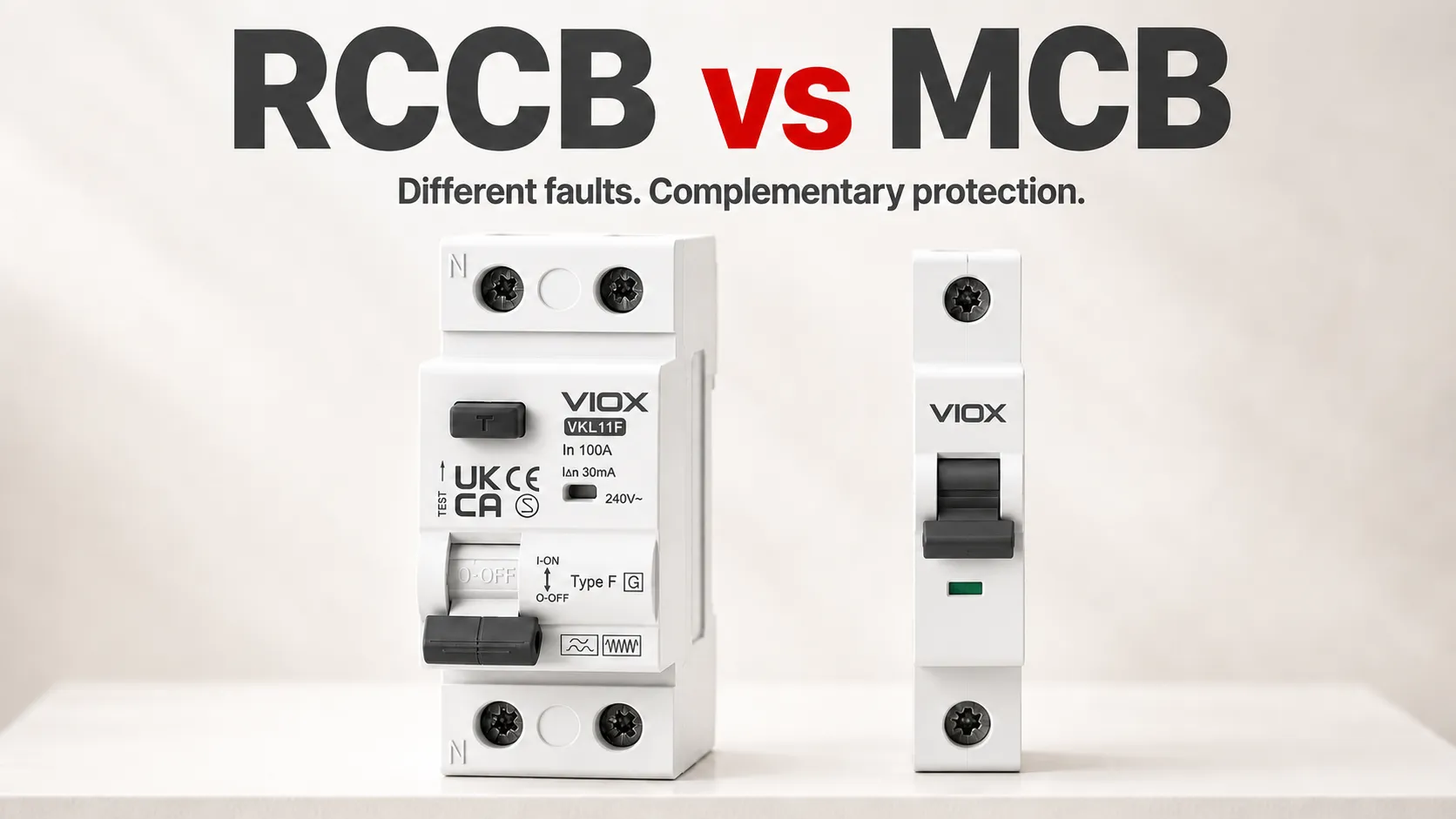
An RCCB detects residual-current imbalance; an MCB protects against overload and short circuit. They are not substitutes. When a circuit needs both functions, use an RCCB with correctly coordinated overcurrent protection, such as MCBs, or a suitable RCBO that combines the functions in one device.
“Why you need both” means both protection functions—not necessarily two separate devices. An RCCB’s contribution to shock protection depends on its sensitivity, the fault-current path, device type and correct installation. Neither device makes every electrical contact safe.
RCCB vs MCB: The Core Difference
The clearest comparison is the fault each device is designed to detect.
| Protection function or arrangement | RCCB | MCB | RCCB + MCB | RCBO |
|---|---|---|---|---|
| Residual-current detection | Yes | No | Yes | Yes |
| Overload protection | No | Yes | Yes, through the MCB | Yes |
| Short-circuit overcurrent protection | No | Yes | Yes, through the MCB | Yes |
| Additional shock protection | With suitable sensitivity/type and installation conditions | Not a substitute for high-sensitivity residual-current protection | With suitable residual-current protection and coordination | With suitable sensitivity/type and installation conditions |
| Typical role | Residual-current protection with separate overcurrent protection | Branch-circuit overcurrent protection | Separate devices providing complementary functions | Combined protection for a circuit |
“Yes” identifies an available function, not proof that a particular device is suitable for every circuit. Ratings, fault level, earthing arrangement and manufacturer requirements still control selection. Schneider’s RCCB and RCBO explanation confirms the key boundary: an RCCB needs external overcurrent protection, while an RCBO integrates it.
What Is the Function of an RCCB?
An RCCB—Residual Current Circuit Breaker—monitors the sum of the currents in the live conductors passing through its sensing system. In a single-phase circuit, this is commonly described as comparing outgoing line current with returning neutral current. Current taking an unintended path outside that monitored circuit creates an imbalance; the device operates according to its residual-current characteristics.
An MCB—Miniature Circuit Breaker—responds to overcurrent instead. A conventional thermal-magnetic MCB uses a thermal response for overload and a magnetic response for high short-circuit current. These are different detection tasks, which is why swapping one device for the other leaves a protection function missing.
For the detailed operating principle, types and limitations, see What Is an RCCB? This comparison focuses on which functions your circuit needs.
Why an MCB Does Not Replace RCCB Shock Protection
A dangerous current through a person may be too small to operate an ordinary branch MCB. The absence of an MCB trip therefore does not show that a contact or earth-leakage condition is safe.
However, “MCBs never protect people” is too broad. In a suitable TN earthing system, an overcurrent protective device can provide automatic disconnection for an earth fault when the fault-loop conditions produce enough current to meet the required disconnection time. That is different from high-sensitivity additional protection against contact with live parts. Electrical Installation Guide: TN protection principle.
An RCCB’s shock-protection role also needs limits:
- Sensitivity: RCDs rated at 30 mA or less are used for additional protection in applicable IEC-based arrangements. RCCBs with a higher rated residual operating current, such as 100 mA or 300 mA, are not equivalent for this purpose.
- Fault path: the device must detect a residual imbalance. A line-to-neutral contact that returns all current through the monitored conductors may not create one.
- Installation: correct protective measures, earthing and bonding where required, wiring and verification remain necessary. An RCCB does not replace them.
- Device suitability: waveform type and operating characteristics must match the load and applicable installation requirements.
High-sensitivity RCD protection is an additional measure, not a guarantee against injury or a replacement for basic protection. Electrical Installation Guide: additional protection.
When Should You Use RCCB Instead of MCB?
The wording needs one correction: add the missing residual-current protection function; do not remove necessary overcurrent protection.
| Circuit situation | Practical decision |
|---|---|
| Overcurrent protection is present, but required residual-current protection is missing | Evaluate adding a coordinated RCCB arrangement or using an appropriate RCBO |
| RCCB is present, but overload/short-circuit protection has not been established | Verify and provide the necessary overcurrent protection; the RCCB alone is not enough |
| Both functions are required for an individual final circuit | Consider an appropriate RCBO or a coordinated RCCB + MCB arrangement |
| Several circuits share an RCCB | Assess the consequences of losing the whole group during a residual-current trip |
Bathrooms, outdoor circuits and other locations with increased shock exposure often require particular protective measures. The exact circuit coverage and device requirements come from the applicable local rules—not a universal room-by-room rule in this article.
RCCB + MCB vs RCBO in Real Installations
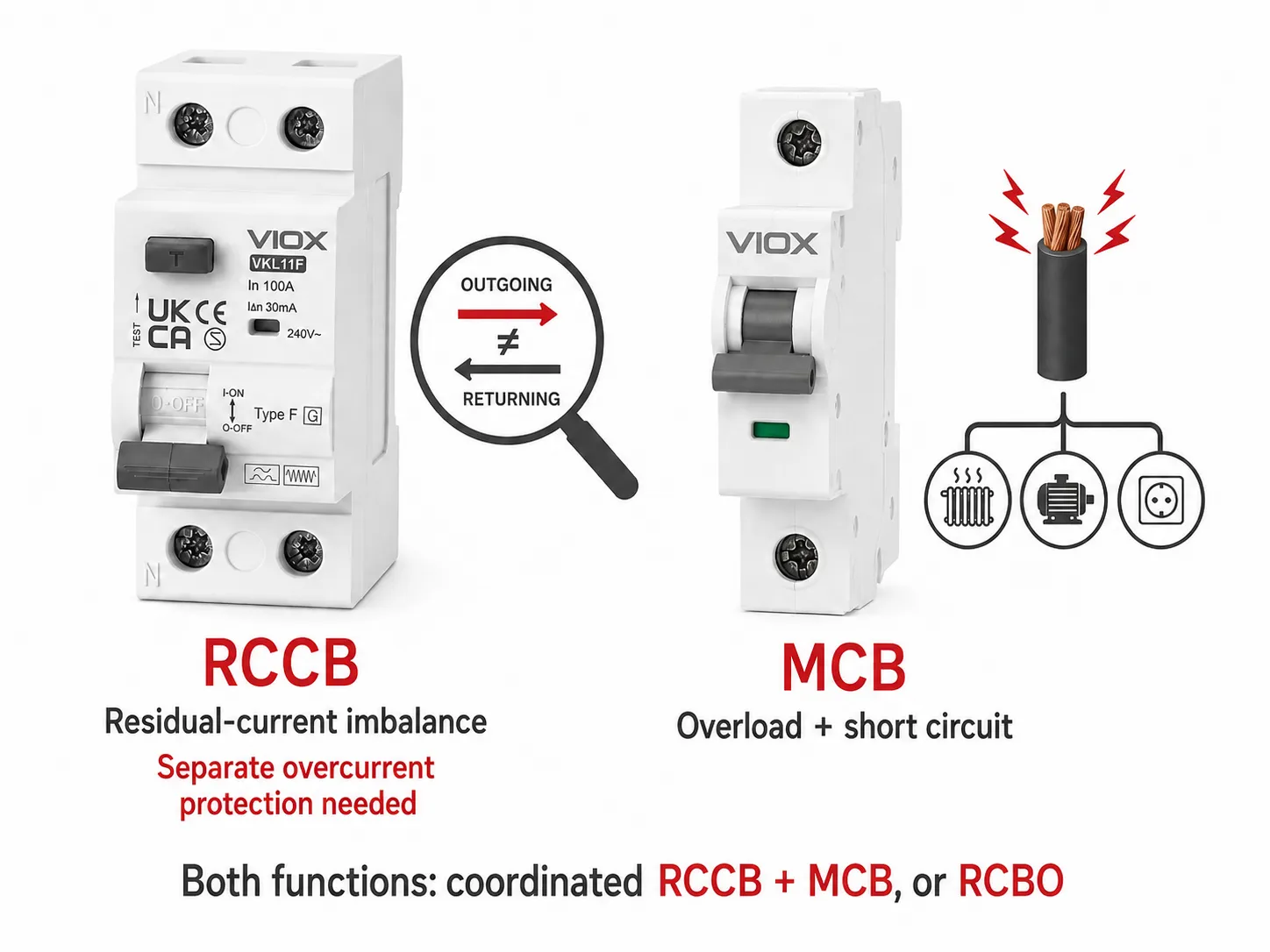
The figure uses simplified product exteriors to compare functions; it is not a wiring diagram, a specification sheet or a statement that any two selected devices form an approved combination.
With a shared RCCB and separate branch MCBs, the MCBs provide branch overcurrent protection while the RCCB provides residual-current protection for the group. A residual-current trip can disconnect multiple circuits. Separate per-circuit RCBOs can limit that shared-tripping impact, although upstream coordination still matters.
Neither arrangement wins automatically on cost, space or selectivity. For those design tradeoffs, see RCBO vs RCCB + MCB: Space, Cost and Selectivity.
Breaking Capacity and Backup Protection Still Matter
Do not stop at the labels “RCCB + MCB.” Check:
- the prospective short-circuit current at the installation point;
- the breaking capacity of the overcurrent protective device;
- the RCCB manufacturer’s permitted backup-protection combination and conditional short-circuit rating;
- overload protection for the RCCB itself, considering the actual arrangement and loading.
An RCCB’s ampere rating describes its rated current; it is not an overload trip setting. Its conditional short-circuit rating must not be treated as the same thing as an MCB’s standalone breaking capacity. Manufacturer coordination data determine the supported combination. ABB RCD technical guide.
RCCB Selection Basics: What to Check Next
Once the required functions are clear, selection becomes a specification task. Confirm rated current In, rated residual operating current IΔn, waveform type, pole count, voltage, time characteristics and overcurrent coordination. A 63 A marking and a 30 mA marking answer different questions; neither alone completes the selection.
Modern electronic loads can affect the required residual-current type. Do not select Type AC, A, F or B solely by price or assume one type is a universal upgrade. Use the connected equipment instructions and applicable installation rules.
Follow the complete How to Choose an RCCB workflow, then compare the VIOX RCCB product range against that specification. Installation or replacement should be carried out by a qualified electrical professional.
Frequently Asked Questions
Can an RCCB Replace an MCB?
Not by itself. An RCCB does not provide the MCB’s overload and short-circuit functions. A suitable RCBO can combine residual-current and overcurrent protection, but replacement still requires checking the circuit and device specifications.
Is an RCCB Better Than an MCB?
Not overall. The RCCB detects residual-current imbalance; the MCB handles overcurrent. Choose the functions required by the circuit rather than treating either device as a universal winner.
Why Does My RCCB Trip but the MCB Does Not?
A residual-current imbalance can operate the RCCB without enough overcurrent to operate the MCB. That does not identify the fault location by itself. For investigation, see Why Does an RCCB Keep Tripping? Do not bypass protection or repeatedly reset an unresolved fault.
What Is the Difference Between MCB and RCB?
MCB identifies a miniature overcurrent circuit breaker. RCB is used less precisely in some markets for residual-current protection. For procurement, confirm whether the specified product is an RCCB without integral overcurrent protection or an RCBO with it.
Do I Need Both RCCB and MCB If I Have an RCBO?
An appropriate RCBO already provides both functions for its protected circuit. That does not automatically remove requirements for upstream isolation, backup protection or other system protection. Check the complete arrangement rather than duplicating devices merely because their names differ.
Recommended Protection Strategy
Use MCB protection for overload and short circuit, and provide suitable residual-current protection where required. When both functions are needed, choose a coordinated RCCB + MCB arrangement or an appropriate RCBO. The decision is not which name is “safer,” but whether the complete circuit has the required protection and verified coordination.