

On this page
IEC 61008-1:2024 gives the general requirements and tests for residual current operated circuit-breakers without integral overcurrent protection, commonly called RCCBs, for household and similar uses. Within the standard’s scope, rated operational voltage does not exceed 440 V AC, rated frequency is 50 Hz, 60 Hz, or 50/60 Hz, and rated current does not exceed 125 A.
The critical boundary is contained in the product name: an IEC 61008 RCCB provides residual-current protection but does not incorporate overload or short-circuit protection. It therefore requires correctly coordinated overcurrent protection unless that function is provided elsewhere in the installation.
IEC 61008-1 is also only Part 1 of the applicable product-standard structure. The relevant IEC 61008 Part 2 depends on the RCCB classification and design. A standard reference on a label or datasheet is not, by itself, proof that every model in a product family is certified or suitable for a particular installation.
For a broader introduction to the device, begin with what an RCCB is and how it works. This article focuses specifically on the IEC 61008-1 standard and the evidence needed to evaluate a compliance claim.
IEC 61008-1 Scope at a Glance
The current IEC publication is IEC 61008-1:2024, Edition 4.0, published on November 21, 2024. It replaced the 2010 edition and its amendments.
| Scope question | IEC 61008-1:2024 answer |
|---|---|
| Product covered | RCCB without integral overcurrent protection |
| Intended environment | Household and similar uses |
| Principal purpose | Protection against shock hazard through residual-current operation |
| Rated operational voltage | Up to 440 V AC |
| Rated frequency | 50 Hz, 60 Hz, or 50/60 Hz |
| Rated current | Up to 125 A |
| Overload protection | Not incorporated in the RCCB |
| Short-circuit protection | Not incorporated; coordination with a specified SCPD may be required |
| Standard structure | Part 1 general rules plus the applicable Part 2 |
The official IEC 61008-1:2024 publication page is the authoritative source for the edition, scope, lifecycle, and published change summary. This article explains the standard’s practical meaning; it does not reproduce or replace the standard.
What IEC 61008-1 Covers—and What It Does Not Prove
IEC 61008-1 is a product standard. It defines how an RCCB within its scope is classified, constructed, marked, tested, and declared. That is different from proving that a complete distribution board or electrical installation complies with local wiring rules.
| IEC 61008-1 addresses | IEC 61008-1 alone does not prove |
|---|---|
| General requirements and tests for an RCCB | Compliance of the complete electrical installation |
| Residual-current operating characteristics | Overload or short-circuit protection for the final circuit |
| Product construction, operation, marking, and information | Suitability for every load, earthing system, or application |
| Conditional short-circuit performance under specified conditions | Compatibility with any MCB, fuse, or upstream protective device |
| Requirements associated with the stated RCCB classification | Certification of every pole count, current rating, or variant in a series |
| A basis for product testing and conformity assessment | Approval by IEC itself—IEC publishes standards but does not certify products |
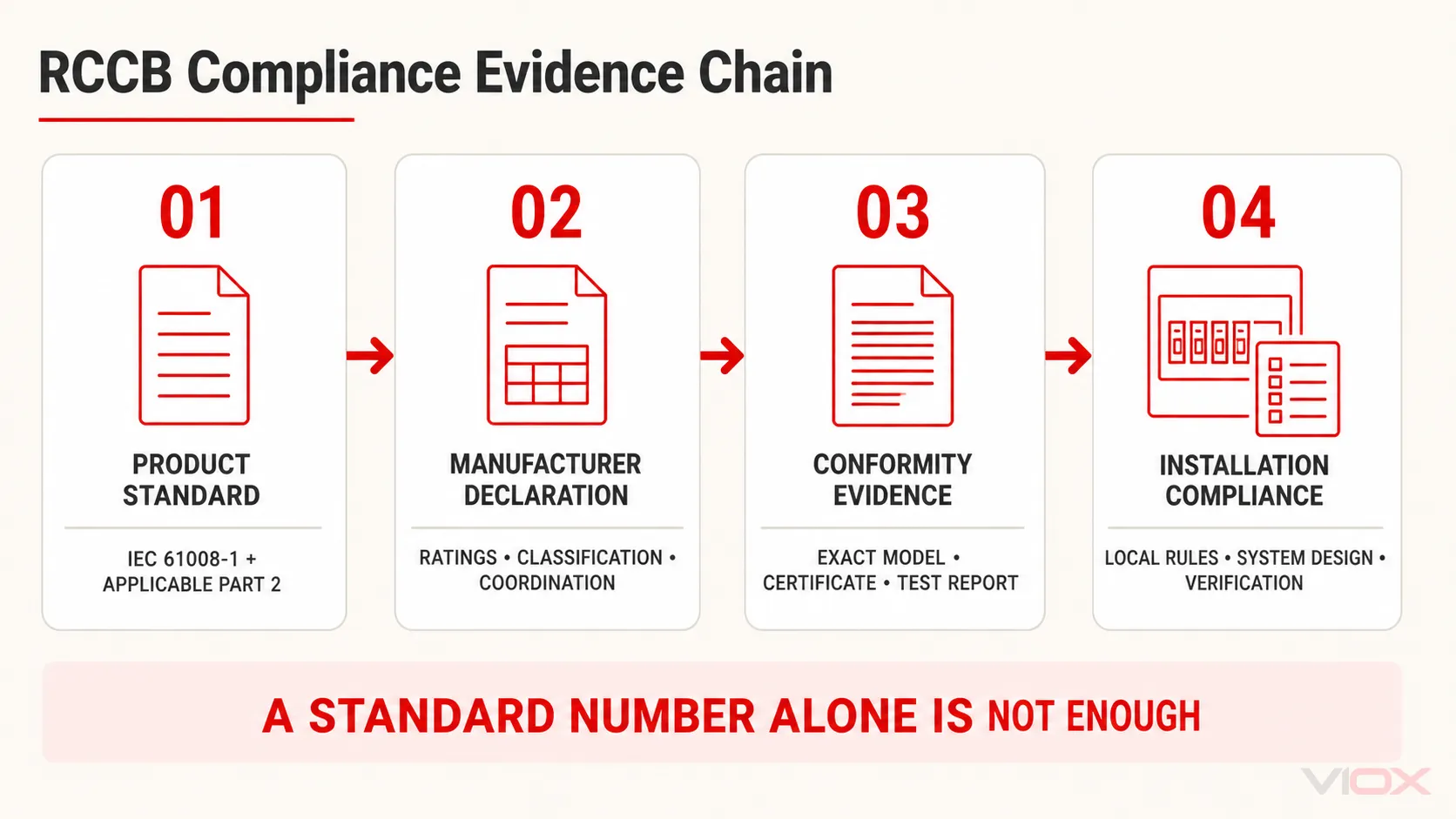
Four evidence layers should therefore be kept separate:
- Product-standard scope: what IEC 61008-1 and the applicable Part 2 require.
- Manufacturer declaration: the ratings, classification, and coordination conditions assigned to the product.
- Conformity evidence: a certificate or test report covering the exact model and relevant variants.
- Installation compliance: the local wiring rules, system design, and inspection requirements applying to the completed installation.
A product can be designed or tested with reference to IEC 61008 without automatically being suitable for every country or project. Conversely, the installation designer still has to verify conductor protection, fault levels, residual-current type, selectivity, earthing arrangement, and local requirements.
How IEC 61008 Part 1 and Part 2 Work Together
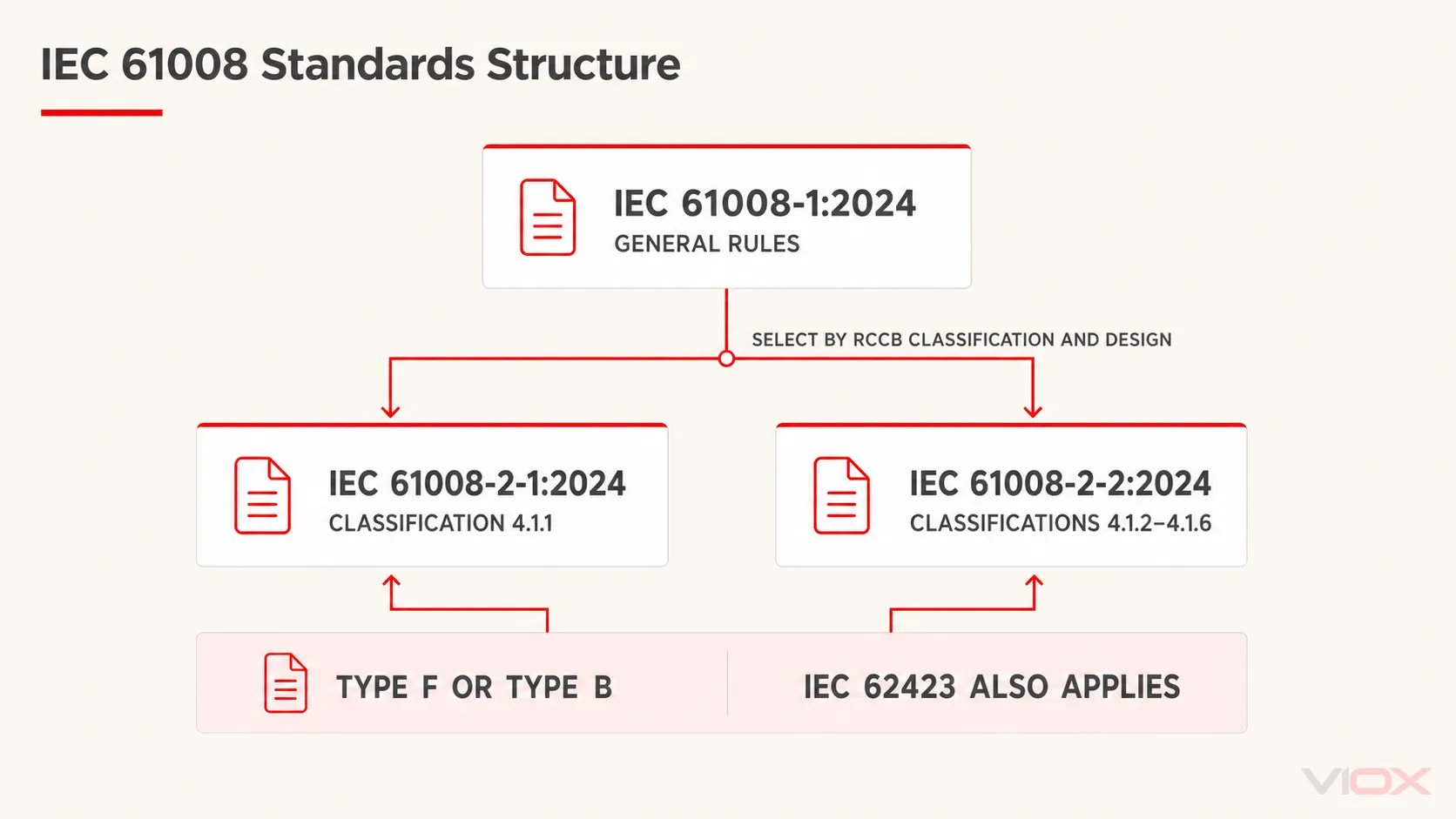
IEC 61008-1:2024 contains the general rules. A complete evaluation also uses the product standard corresponding to the device’s classification under Clause 4.1.
| IEC document | Role in the standard structure |
|---|---|
| IEC 61008-1:2024 | General requirements and tests for RCCBs within scope |
| IEC 61008-2-1:2024 | Requirements for RCCBs classified according to IEC 61008-1:2024, 4.1.1 |
| IEC 61008-2-2:2024 | Requirements for RCCBs classified according to 4.1.2 through 4.1.6 |
The two current Part 2 publications are IEC 61008-2-1:2024 and IEC 61008-2-2:2024. Their classification-based titles matter: older summaries that describe the parts only as “line-voltage independent” or “line-voltage dependent” do not fully communicate the 2024 classification structure.
For Type F and Type B residual current devices, IEC 62423 applies in addition to the IEC 61008 series. IEC 62423 defines additional requirements and tests for those types; it should not be treated as a replacement for IEC 61008. See the official IEC 62423 publication.
The practical rule for a buyer or panel builder is:
Verify IEC 61008-1, the applicable IEC 61008 Part 2, and any additional product standard required by the RCCB type and design.
IEC 61008-1 vs IEC 61009-1 vs IEC 60898-1
The three standards correspond to different protective functions. Their numbers are not interchangeable.
| Standard | Product | Residual-current protection | Integral overload and short-circuit protection |
|---|---|---|---|
| IEC 61008-1 | RCCB | Yes | No |
| IEC 61009-1 | RCBO | Yes | Yes |
| IEC 60898-1 | MCB | No | Yes |
IEC 61009-1:2024 covers residual current operated circuit-breakers with integral overcurrent protection—RCBOs. IEC 60898-1 covers circuit-breakers for overcurrent protection in household and similar installations. The standards describe different products even when the devices have a similar modular appearance.
If residual-current and overcurrent protection must be combined in one device, review the IEC 61009-1 RCBO standard. If the design uses a separate RCCB and MCB, compare the two architectures in RCBO vs RCCB plus MCB.
Key Requirements Addressed by IEC 61008-1
IEC 61008-1 is not merely a list of preferred ratings. It covers the product characteristics and tests required to establish predictable operation within its defined conditions. The major requirement groups include:
- classification and product characteristics;
- markings and manufacturer-supplied information;
- mechanical design and operating mechanism;
- electrical clearances, insulation, and dielectric properties;
- terminals and connection requirements;
- temperature-rise performance;
- residual-current operating characteristics;
- making, breaking, and short-circuit coordination tests;
- resistance to mechanical and electrical endurance stresses;
- behavior under surge, electromagnetic, ageing, and other specified influences;
- test-device operation, trip-free behavior, and isolation-related requirements;
- temporary overvoltage requirements introduced into the 2024 structure.
Passing one isolated test does not demonstrate conformity with the complete applicable standard set. A credible conformity claim must identify the edition, applicable Part 2, product classification, model coverage, and evidence used.
IEC 61008-1 RCCB Ratings and Markings
The ratings on an RCCB describe different aspects of the product. They should be read together rather than reduced to one ampere value.
| Marking or parameter | Meaning | What to verify |
|---|---|---|
| Ue | Rated operational voltage | Matches the supply and pole configuration |
| In | Rated current | The current the RCCB is designed to carry under its stated conditions; not an overload trip setting |
| IΔn | Rated residual operating current | Matches the protection objective, equipment instructions, and local rules |
| IΔno | Rated residual non-operating current | Used in the standard operating-characteristic framework |
| Im | Rated making and breaking capacity | The manufacturer’s declared switching capability under specified conditions |
| IΔm | Rated residual making and breaking capacity | Declared making and breaking capability under residual-current conditions |
| Inc | Rated conditional short-circuit current | Valid only with the specified short-circuit protective device and conditions |
| IΔc | Rated conditional residual short-circuit current | Conditional residual short-circuit withstand information |
| RCCB type symbol | Residual-current waveform classification | Must match the relevant product requirements and application constraints |
| S symbol, when present | Time-delay/selective classification | Coordination still requires a system-level check |
| Pole and neutral markings | Connection and switching arrangement | Must match the circuit and manufacturer wiring information |
| T or test-device marking | Identifies the integral test control | Follow the manufacturer’s instructions; it is not a substitute for all installation tests |
| Product-standard reference | Applicable IEC 61008 Part 2 reference | Confirm the edition and document scope in the technical file |
For example, In 63 A does not mean that an RCCB will trip like a 63 A MCB during an overload. It states a product current rating. Cable and circuit overcurrent protection must still be provided by the correctly selected protective device.
Likewise, IΔn 30 mA identifies the rated residual operating current; it does not, by itself, establish that the device is appropriate for every final circuit. Selection depends on the required protective measure, accumulated leakage, equipment instructions, local rules, and coordination with other residual-current devices. See the dedicated guide to 30 mA vs 100 mA vs 300 mA RCCB sensitivity for that separate selection task.
Conditional Short-Circuit Ratings: Inc, IΔc, and the SCPD
An RCCB is not an overcurrent protective device, but it may be required to withstand short-circuit stresses while a separate device interrupts the fault. IEC 61008 therefore includes conditional short-circuit concepts.
SCPD means short-circuit protective device. Depending on the manufacturer’s declared coordination, it may be an MCB, fuse, or another specified protective device.
| Claim being reviewed | Evidence required |
|---|---|
| RCCB has a stated Inc | Datasheet or marking showing the value and applicable conditions |
| RCCB is protected at the prospective fault level | Specified SCPD and its relevant rating are identified |
| RCCB and SCPD are coordinated | Manufacturer coordination table, test evidence, or other approved documentation covers the combination |
| Selected combination fits the installation | Prospective short-circuit current and local design rules have been checked |
The number Inc should never be read as if it were the RCCB’s independent short-circuit breaking capacity. It is a conditional rating. Changing the upstream protective device, its rating, or another declared condition can invalidate the conclusion.
Product Compliance, Certification, and Installation Approval Are Different
Compliance language is often used too loosely in quotations and datasheets. The following matrix shows what each statement should mean in a technical review.
| Supplier statement | What it may establish | What the buyer should request |
|---|---|---|
| “Designed to IEC 61008” | Design target or internal specification | Exact edition, Part 2, classification, and technical declaration |
| “Tested to IEC 61008” | Tests may have been performed | Test report, laboratory identity, model list, and tested variants |
| “Certified to IEC 61008” | Third-party conformity may be documented | Verifiable certificate number, issuing body, edition, and product scope |
| “IEC 61008 compliant series” | A product family claim | Evidence that the exact current rating, pole count, type, and model are included |
| “Suitable for this project” | Application assessment may have been performed | System parameters, local rules, coordination data, and approval basis |
IEC publishes the standard; it does not issue product certificates. Certification, where required, comes through the relevant conformity-assessment body or national scheme. A logo or standard number on marketing material should therefore be checked against an independently verifiable document.
How to Verify an IEC 61008-1 RCCB
Use the following sequence before approving a product for a bill of materials or project submittal.
1. Confirm the product category
The technical documentation should identify the device as an RCCB without integral overcurrent protection. If the device includes overload and short-circuit protection, IEC 61009-1 is the relevant RCBO family standard instead.
2. Match the exact model
Compare the product label, catalogue number, datasheet, certificate, and test report. A certificate for a related series does not automatically cover every derivative.
3. Check the full rating set
Verify rated voltage, frequency, rated current, residual operating current, pole arrangement, residual-current type, time-delay classification if applicable, and environmental or installation restrictions stated by the manufacturer.
4. Verify Part 1, Part 2, and additional standards
Record the IEC 61008-1 edition and applicable Part 2. For Type F or Type B products, also check the applicable IEC 62423 evidence. Do not infer the standard set from the product’s appearance.
5. Review short-circuit coordination
Identify Inc, IΔc, the specified SCPD, and every declared condition attached to the rating. Compare them with the prospective fault level and the actual upstream protection.
6. Separate product approval from installation approval
Confirm that local wiring rules, earthing-system requirements, conductor protection, isolation, residual-current coordination, and equipment-specific instructions have been addressed by the responsible designer or installer.
7. Check document validity
Confirm the issuing organization, document number, status, edition, amendments, certificate holder, manufacturing location where relevant, and model appendix. If a claim cannot be traced to the supplied model, treat it as unverified.
For physical installation details after the product has been correctly specified, use the separate 2-pole and 4-pole RCCB wiring diagrams. Wiring instructions do not replace the compliance checks above.
IEC 61008-1 vs EN or BS EN 61008-1
IEC 61008-1 is the international publication. EN and national versions such as BS EN adopt the standard within regional or national standardization systems. The number may look similar, but the applicable document can differ by publication year, amendment status, national conditions, or transition arrangements.
For an export project, compare the complete reference rather than matching only “61008-1”:
- issuing standards organization;
- full standard designation;
- edition or publication year;
- amendments and corrigenda;
- certificate or test-report reference;
- local regulatory or installation requirements.
An IEC 61008-1:2024 claim should not automatically be rewritten as an EN or BS EN claim. Verify whether the relevant regional adoption has been published and whether the project or certification scheme accepts that edition.
What Changed in IEC 61008-1:2024?
IEC identifies the 2024 publication as Edition 4.0 and a technical revision of the 2010 edition with its amendments. Its published summary highlights these major changes:
- harmonization of clauses across the IEC 61008, IEC 61009, and IEC 60755 series using a blocks-and-modules approach;
- harmonization of tables and figures across those series;
- referral of terms and definitions to IEC 62873-2;
- modification of the classification according to supply conditions;
- new requirements and tests for resistance to temporary overvoltages;
- improvement of dielectric-property testing;
- referral of tests for screwless terminals, flat quick-connect terminations, and aluminium conductors to the IEC 62873-3 series.
This is a summary of the changes IEC publishes on its catalogue page, not a clause-by-clause transition assessment. Manufacturers, laboratories, and certification holders should compare the complete editions and the applicable Part 2 before changing a test plan or conformity declaration.
IEC 61008-1 Compliance Evidence Checklist
Before accepting an RCCB compliance claim, verify all of the following:
- Exact manufacturer and model number
- RCCB product category rather than RCBO or MCB
- Rated operational voltage, frequency, and rated current
- Rated residual operating current
- Pole and neutral configuration
- Residual-current type and time-delay classification, where applicable
- IEC 61008-1 edition
- Applicable IEC 61008 Part 2
- Additional IEC 62423 evidence for Type F or Type B, when applicable
- Certificate or test-report scope covering the exact variant
- Declared
Inc,IΔc, specified SCPD, and coordination conditions - Regional standard adoption and local installation requirements
VIOX can provide model-specific technical and conformity documents for review where available. Evaluate the document set against the exact product being supplied rather than relying on a generic series statement. You can also review the current VIOX RCCB product range when preparing a specification.
Frequently Asked Questions
What is IEC 61008-1?
IEC 61008-1 is the Part 1 general-rules standard for residual current operated circuit-breakers without integral overcurrent protection—RCCBs—for household and similar uses within its stated voltage, frequency, and current limits. The current IEC edition is IEC 61008-1:2024.
Is IEC 61008-1 for RCCBs or RCBOs?
IEC 61008-1 applies to RCCBs without integral overcurrent protection. IEC 61009-1 applies to RCBOs with integral overcurrent protection.
Does an IEC 61008-1 RCCB provide overload or short-circuit protection?
No integral overcurrent protection is included. The RCCB must be used within a protection design that provides the required overload and short-circuit protection, including the manufacturer’s specified short-circuit coordination conditions.
What is the difference between IEC 61008 and IEC 61009?
The IEC 61008 series covers RCCBs without integral overcurrent protection. The IEC 61009 series covers RCBOs that combine residual-current and overcurrent protection. The correct standard follows the protective functions built into the device.
Which IEC 61008 Part 2 applies to an RCCB?
It depends on the product’s classification and design. IEC 61008-2-1:2024 applies to devices classified under IEC 61008-1 Clause 4.1.1, while IEC 61008-2-2:2024 applies to classifications 4.1.2 through 4.1.6. Check the product marking and technical documentation rather than assuming the applicable part.