

On this page
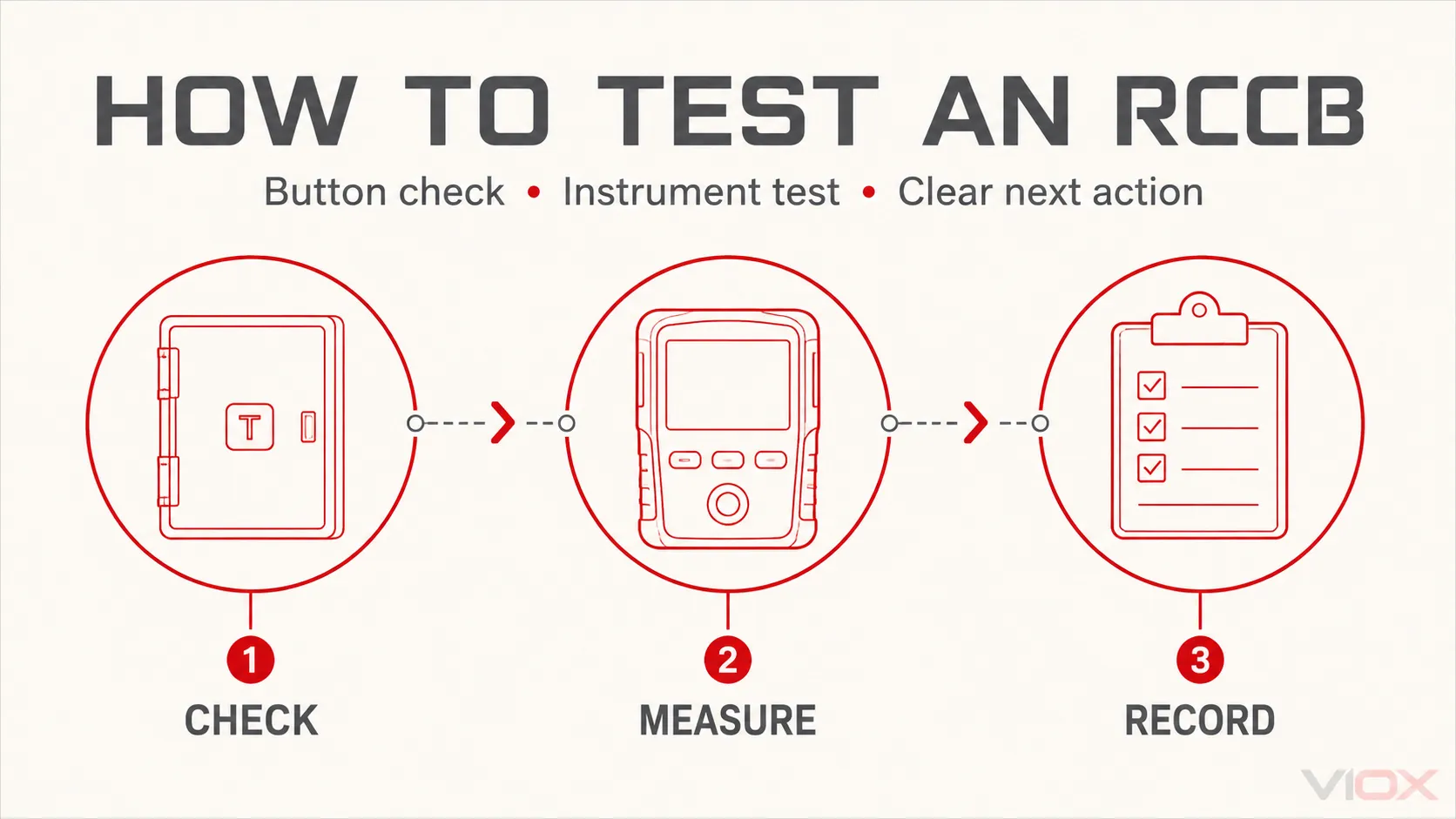
To check whether an RCCB is working, use its test button for a functional check. For measured verification, a qualified electrician uses a suitable RCD tester and the acceptance criteria applicable to the device and installation. A successful button test does not measure trip time or prove that the entire installation is safe.
This guide explains what each check establishes, how to respond to an unexpected result, and what to record. For the device’s operating principle, see What Is an RCCB?
Which RCCB Test Do You Need?
| Your question | Appropriate check | What the result does not establish |
|---|---|---|
| Does the device respond to its built-in test? | Test button, following its instructions | Measured trip time, trip threshold or installation condition |
| Does it operate within the required measured limits? | Compatible RCD tester used by a qualified electrician | Every aspect of installation safety or full product certification |
| Why does it trip during normal operation? | Fault investigation, including suitable leakage measurements where relevant | A button test alone cannot identify the faulty circuit or appliance |
| Is the installation safe to return to service? | Applicable installation verification and documented corrective work | One successful RCCB test is not a substitute for the wider checks |
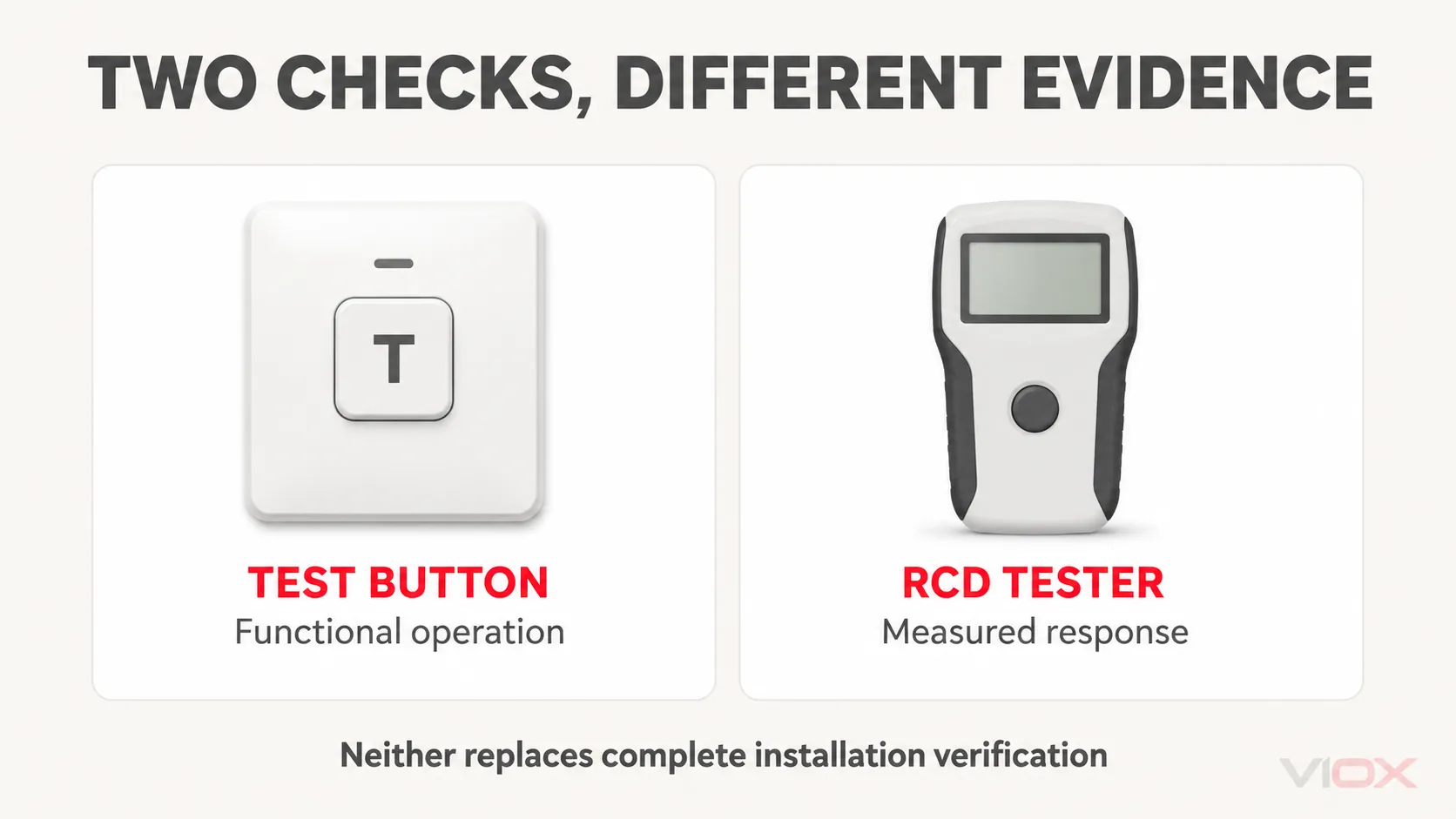
The practical distinction is between response, measurement and installation verification. Record which one you actually completed; do not label a button check as a full electrical inspection.
Before Testing: Identify the Device and Plan the Interruption
Do not remove covers or touch terminals to perform an ordinary button check. If there is visible damage, scorching, unusual heat, water ingress or an exposed live part, stop and arrange qualified assessment.
Before a planned test:
- Identify the circuits and equipment that will lose power. Arrange a safe shutdown for critical loads, controls and equipment that could restart automatically.
- Locate the exact manufacturer instructions, including the test-button conditions and reset procedure.
- Read or photograph accessible device markings without opening an enclosure.
- Know who will investigate a failure and how affected equipment will be kept safe if power cannot be restored.
For instrument testing, the electrician should identify these settings before connecting equipment:
| Device information | Why it matters |
|---|---|
| Manufacturer and exact model | Determines which instructions and limitations apply |
| Rated current, In | Must not be confused with residual operating current |
| Rated residual operating current, IΔn | Provides the sensitivity reference for the selected test |
| Type AC, A, F or B | Helps determine suitable instrument capabilities and waveform settings |
| Instantaneous or time-delayed characteristic | Affects the applicable assessment criteria |
| Pole count and rated voltage | Helps establish the correct circuit and test arrangement |
For example, “63 A / 30 mA” contains two different ratings. Do not enter 63 A as the residual-current test setting. If the device type is unclear, consult its documentation rather than guessing from the enclosure. See our RCCB type comparison for the selection background.
How to Check an RCCB with the Test Button
Follow the device instructions; the sequence below is a planning checklist, not a substitute for them.
- Prepare the affected equipment. Notify occupants or operators and complete the planned shutdown.
- Confirm the specified operating conditions. The device must be supplied and set as required for its test circuit to work. Do not investigate supply conditions by probing terminals yourself.
- Press the marked test button as instructed. It is commonly marked “T” or “TEST.” Do not hold it indefinitely or repeatedly operate a device that fails to respond.
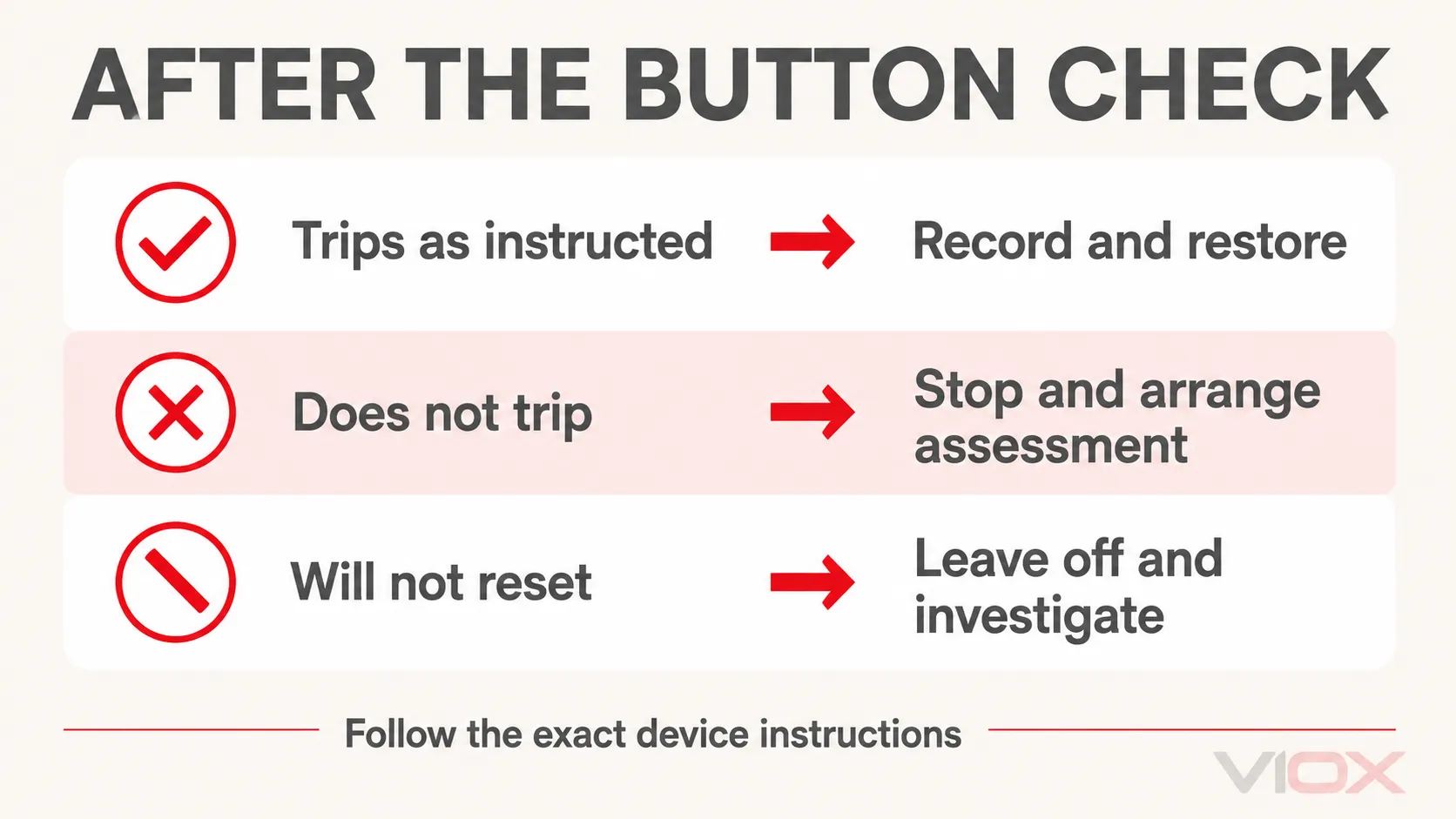
- Observe the response. Check the manufacturer’s specified trip indication. If the response is absent or uncertain, record a failed or inconclusive check and arrange investigation.
- Restore only when appropriate. If the check is satisfactory and there is no indication of a fault, reset according to the instructions, then restore equipment in a controlled sequence.
- Record the result. Include the date, device identity, response and any unusual behavior. If it will not reset or trips again, stop repeated attempts.
Do not use a lamp going out as proof that every conductor is isolated. A functional test is not a safe-isolation procedure.
What If the Test Button Does Not Trip the RCCB?
Treat the check as unsuccessful, but do not assume that it proves the mechanism alone is defective. The test circuit’s supply and connection conditions also need assessment. Schneider documents examples where insufficient voltage prevents its specified products’ test buttons from operating; those terminal references and voltage limits must not be transferred to another model. Schneider Electric: test-button failure.
A qualified electrician should check the exact product instructions and installation conditions, then decide whether repair, replacement or further verification is required. Until resolved, do not rely on the device as having passed its functional check. Never bypass it to keep the circuit running.
How an Electrician Tests an RCCB with an RCD Tester
An RCD tester applies a controlled test and reports a result such as operating time; some instruments also provide ramp testing. Capabilities differ even within one product family, so a meter’s general “RCD” label is not sufficient evidence that it supports the required test. Megger LRCD200 instrument specifications.
Use this verification sequence to make the test traceable:
- Define the purpose. Is this commissioning, periodic verification, a post-replacement check or fault investigation?
- Select the applicable procedure and criteria. Record the relevant installation rules, device instructions and edition or revision used.
- Confirm instrument suitability. Check the supported device types, test settings, leads, condition and calibration status required by the work procedure.
- Prepare the circuit safely. Assess connected equipment and possible supply interruption. Establish the test arrangement from the instrument and device instructions. Isolate and prove dead before altering connections where required; energized testing belongs to qualified personnel using appropriate precautions.
- Run the prescribed tests. Record the actual waveform or mode, current setting, time characteristic and other required conditions alongside the readings.
- Assess, restore and document. Compare results with the identified criteria, investigate discrepancies, and record whether the circuit was returned to service or left isolated.
This is not a universal terminal-hookup diagram. Test-point selection depends on the installation and instrument. Use the RCCB wiring guide for circuit-layout background, not as a replacement for tester instructions.
Is “Under 300 ms” Always a Pass?
No. A trip-time value without its test conditions and acceptance reference is incomplete. Time-delayed devices must not be judged against an instantaneous-device rule, and installed verification is not the same as the manufacturer’s full product tests. The IET’s explanation of the UK’s 2022 testing changes illustrates why a test sequence must be tied to a specific regulatory context rather than copied globally. IET: RCD testing changes in BS 7671:2018+A2:2022.
Likewise, do not automatically prescribe every available 0.5×, 1×, 5× or ramp test. Use the sequence required for the verification or diagnostic task. For product-standard scope, see IEC 61008-1 requirements.
RCCB Test Results: What Should You Do Next?
| Observation | Interpretation | Next action |
|---|---|---|
| Test button trips the device normally | Functional response observed | Record the check; retain any scheduled instrument verification |
| Test button does not trip | Functional check unsuccessful | Arrange assessment of supply, instructions, connections and device condition |
| Instrument result is outside the selected limit | Result needs investigation, not dismissal | Verify criteria and settings; investigate the circuit and device before accepting it |
| RCCB will not reset or trips again | A continuing fault or unresolved condition may exist | Stop repeated resets; have the affected circuit investigated |
| Result is inconsistent or instrument reports an error | Verification is incomplete | Record the error and conditions; resolve the cause before declaring a pass |
Background leakage and connected equipment can influence measurements. A leakage clamp can assist investigation, but it does not certify RCCB operating time. For residual leakage measurement, the appropriate live conductors are enclosed together while the protective conductor remains outside the clamp; this is work for someone competent to access and assess the circuit safely. Fluke: leakage-current measurement basics.
If normal operation keeps triggering the device, continue with Why Does an RCCB Keep Tripping? Do not substitute a higher IΔn device or bypass protection simply to make the symptom disappear.
How Often Should You Test an RCCB?
Use the exact manufacturer instructions, applicable local requirements and the site maintenance plan. Keep the test-button interval separate from the schedule for professional installation verification. There is no single interval in this guide that applies to every product, environment and jurisdiction.
Schneider’s guidance, for example, distinguishes recommendations by product and operating conditions. It supports checking the relevant instructions—not imposing its schedule on every VIOX or other-brand RCCB. Schneider Electric: recommended test intervals.
For a maintenance plan, name the responsible person, define the next due date and specify the response to a missed or failed test. After damage, water ingress, a significant fault or replacement, obtain an assessment of the required checks rather than waiting for the next routine date.
Copyable RCCB Maintenance Record
| Record field | Entry |
|---|---|
| Site / board / circuit / device ID | __________ |
| Manufacturer / model / pole count | __________ |
| In / IΔn / type / time characteristic | __________ |
| Date / person performing check | __________ |
| Check performed | Button / instrument verification / investigation |
| Procedure and acceptance reference | __________ |
| Instrument model / ID / calibration status, if applicable | __________ |
| Test settings and actual results, if applicable | __________ |
| Button response / observations | __________ |
| Corrective action and responsible person | __________ |
| Final status | Returned to service / left isolated / assessment pending |
| Next check due and interval basis | __________ |
Do not fill in a trip time for a button-only check. Write “not measured” so the record accurately describes the work.
Frequently Asked Questions
Can I Test an RCCB with a Multimeter?
A standard multimeter does not replace a suitable RCD tester for controlled trip testing. Do not improvise a fault using wires, resistors or a connection to earth. Arrange the appropriate test with a qualified electrician.
Does the Test Button Prove the Earth Wire Is Good?
No. A successful button response is not an earth-continuity test. The protective conductor and other installation conditions require their own applicable verification.
Is a 4-Pole RCCB Tested Like a 2-Pole RCCB?
Both need the correct device instructions and test conditions, but the connection arrangement must not be assumed identical. Identify the exact model, supply arrangement and supported instrument procedure; do not copy a two-pole terminal arrangement onto a four-pole device.
Must an RCCB Be Replaced After One Failed Button Check?
An unsuccessful check requires prompt investigation. It does not by itself distinguish a device fault from an incorrect supply or test condition. Let a qualified electrician establish the cause and verify the corrective action before relying on the protection.
Keep the Result Specific
A useful RCCB maintenance record says what was tested, under which conditions, what happened and what action followed. Start with the prescribed button check, use instrument verification when required, and investigate failures without bypassing protection.
For VIOX equipment, identify the exact model from our RCCB product range and request the matching instructions before setting the test procedure or maintenance schedule.