

On this page
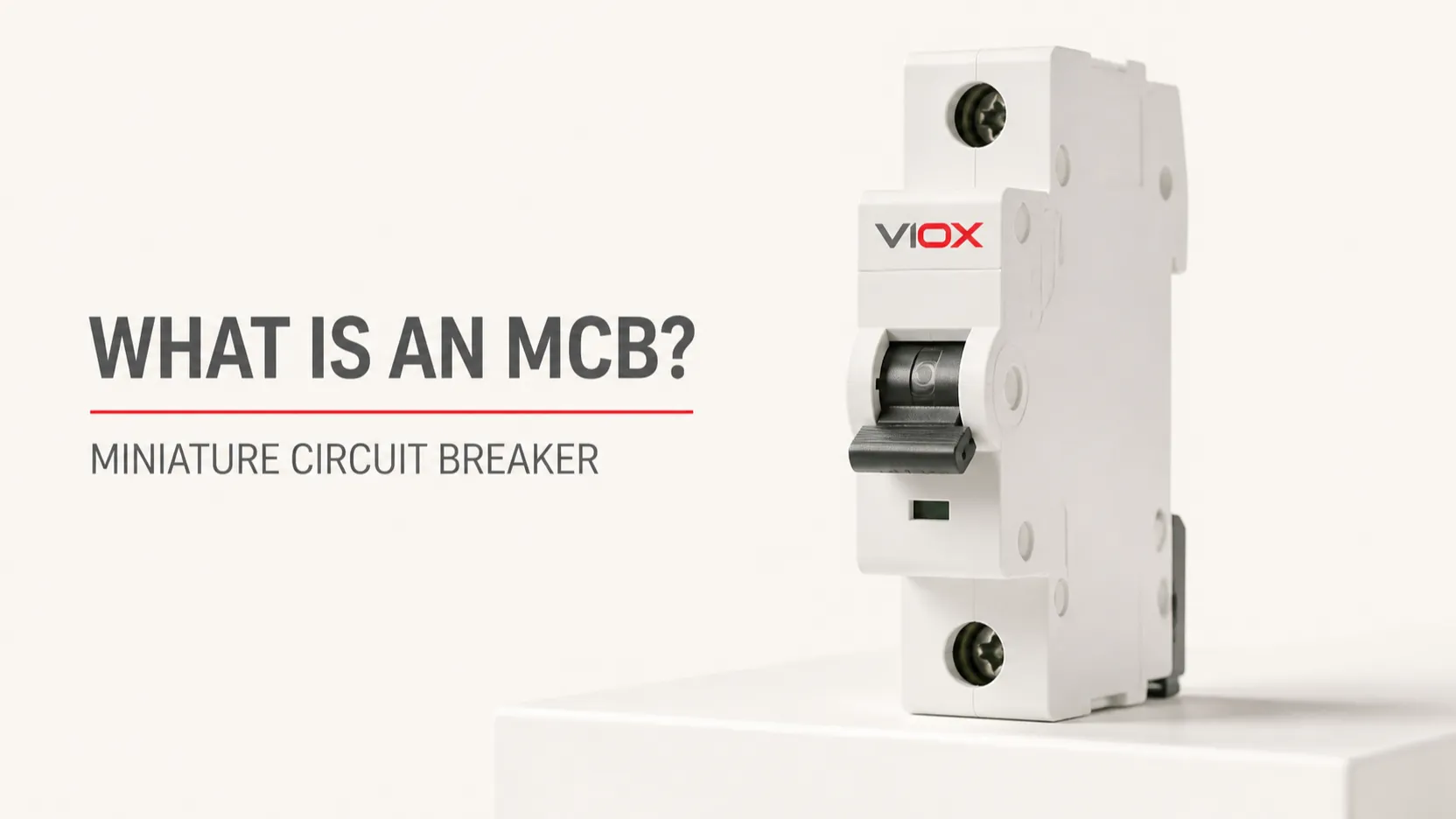
An MCB, or Miniature Circuit Breaker, is an automatic low-voltage protective device that opens a circuit when an overload or short circuit causes excessive current. It is selected primarily to protect circuit conductors and wiring and may also protect connected equipment when its characteristics are properly coordinated with the load.
Most MCBs used in distribution boards combine a time-delayed thermal trip for overload protection with an instantaneous magnetic release. The magnetic release responds rapidly when overcurrent reaches its pickup range, typically during a short circuit. After the fault has been found and cleared, the breaker can normally be reset instead of replaced.
This page explains the meaning, function, internal operation, and protection boundaries of an MCB. For model sizing and specification decisions, use the dedicated MCB Selection Guide.
MCB at a Glance
| Question | Direct answer |
|---|---|
| What does MCB stand for? | Miniature Circuit Breaker |
| What does an MCB protect against? | Overload and short-circuit overcurrent |
| What is its primary protection objective? | Protecting circuit conductors and wiring from excessive current |
| How does it trip? | A thermal element responds to sustained overloads; a magnetic release responds rapidly when overcurrent reaches its instantaneous pickup range |
| Can it be reset? | Normally yes, after the fault has been cleared and the installation is safe to re-energize |
| Does it detect residual current? | A standard MCB does not detect residual current and is not a substitute for an RCCB, RCD, or RCBO |
| Where is it used? | Final circuits, distribution boards, control circuits, and OEM equipment panels |
What Does MCB Stand For?
MCB stands for Miniature Circuit Breaker.
“Miniature” describes its compact construction relative to larger breaker families; “breaker” describes its automatic interruption function. For an acronym-focused answer, see MCB Full Form in Electrical. This article focuses on function and operation.
What Does an MCB Protect Against?
An MCB responds to two forms of overcurrent:
- Overload current: Current exceeds the circuit’s intended carrying capacity for long enough to create unacceptable heating.
- Short-circuit current: A low-impedance fault typically produces a much larger current that reaches the instantaneous trip range and requires rapid interruption.
The MCB should be coordinated with conductor ampacity, installation conditions, load current, inrush current, available fault current, and any upstream or downstream protective device. Choosing a higher ampere rating is not automatically safer: a breaker that is too large may fail to protect the conductor as intended.
An MCB does not normally provide residual-current protection. It therefore must not be treated as a replacement for an RCCB, RCD, or RCBO where residual-current protection is required.
How Does an MCB Work?
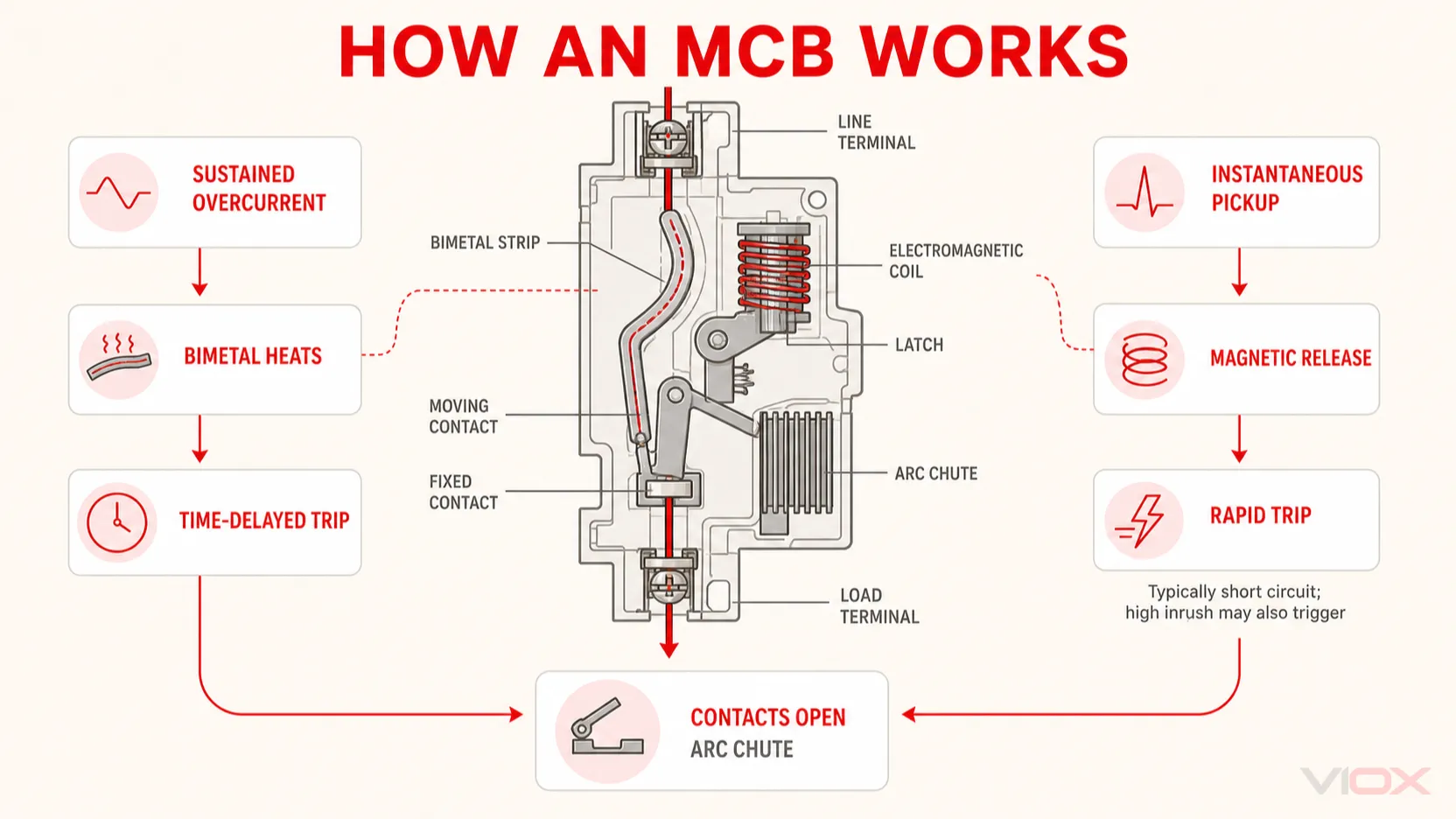
A typical thermal-magnetic MCB combines four actions:
- The current passes through the internal current path and closed contacts.
- A bimetal element responds to sustained overload current.
- An electromagnetic release responds rapidly when overcurrent reaches its instantaneous pickup range.
- When the contacts open, an arc chute divides, cools, and extinguishes the electrical arc within the breaker’s rated interruption capability.
Thermal overload trip
The thermal trip uses a bimetal strip. Current heats the strip, and a sustained overload causes it to bend until it releases the trip mechanism and opens the contacts.
This response is intentionally time-dependent. A modest overload generally takes longer to trip than a larger overload. The behavior helps the MCB tolerate short, non-damaging current peaks while limiting prolonged conductor heating.
Instantaneous magnetic release
The magnetic release uses an electromagnetic coil or solenoid. Normal current does not create enough magnetic force to operate the mechanism. When overcurrent reaches the instantaneous pickup range, the stronger magnetic field releases the latch rapidly. This usually occurs during a short circuit, but motor-starting or transformer-inrush current can also operate the release if it exceeds the threshold.
The instantaneous operating range is related to the trip characteristic. In IEC-style products, B, C, and D curves represent different magnetic pickup ranges; they are application characteristics, not quality grades.
Arc extinction
Opening contacts under fault current creates an arc. The arc chute draws the arc into metal splitter plates, where it is divided and cooled until current interruption is completed.
This is why an MCB is more than a manual switch. Its contact system, mechanism, insulation, and arc-control structure must operate together within the device’s declared voltage and breaking-capacity ratings.
Main Parts of a Miniature Circuit Breaker
| Part | Function |
|---|---|
| Toggle handle | Provides manual ON/OFF operation and position indication |
| Operating mechanism | Opens the contacts manually or automatically and provides trip-free operation |
| Fixed and moving contacts | Carry normal current and separate during interruption |
| Bimetal strip | Provides time-delayed thermal overload tripping |
| Magnetic coil or solenoid | Provides rapid tripping when overcurrent reaches the instantaneous pickup range |
| Arc chute | Divides and cools the arc during interruption |
| Terminals | Connect approved conductors or compatible busbars |
| DIN-rail clip and housing | Support modular mounting, containment, and insulation |
MCB Ratings and Markings
Two MCBs with the same ampere rating may behave differently. Read the complete marking set and the manufacturer’s technical documentation.
| Marking | Application check |
|---|---|
| Rated current, In | Coordinate with design current, conductor ampacity, ambient conditions, and installation method |
| Rated voltage | Match the system voltage and current type; do not assume an AC rating also applies to DC |
| Trip characteristic | Match load inrush and available fault current |
| Breaking capacity | Verify it is adequate for the prospective short-circuit current at the installation point |
| Pole configuration | Match the wiring system and required disconnection arrangement |
| Product standard | Use the rating terminology and application scope of the declared standard |
| Terminal capacity | Follow the product instructions for conductor, busbar, preparation, and tightening |
For a marking-by-marking explanation, see How to Read the Nameplate of a Miniature Circuit Breaker.
What do 6kA and 10kA mean?
On many MCBs, 6kA or 10kA identifies a declared short-circuit breaking capacity under a specified product standard and test sequence. The exact symbol may be Icn, Icu, or Ics, depending on the applicable standard and device category, so the number must be interpreted together with the standard reference and manufacturer documentation.
A 10kA device is not automatically the correct choice for every circuit, and a 6kA device is not automatically adequate. The rating must be checked against the prospective short-circuit current and the protection arrangement. See MCB Breaking Capacity: 6kA vs 10kA for the dedicated selection discussion.
Standards Context: IEC 60898-1, IEC 60947-2, and UL 489
The word “MCB” is used across markets, but the application context and rating language are not identical.
| Standard context | General scope relevant to this article | Practical implication |
|---|---|---|
| IEC 60898-1 | AC circuit breakers for overcurrent protection in household and similar installations, within the standard’s voltage, current, and short-circuit-capacity limits | Common context for modular B, C, and D curve MCBs in final distribution |
| IEC 60947-2:2024 | Circuit breakers for low-voltage switchgear and controlgear applications operated by instructed or skilled persons, within its stated voltage scope | Industrial application and rating terminology may differ from IEC 60898-1 |
| UL 489 | Molded-case circuit breakers, molded-case switches, and circuit-breaker enclosures for the relevant North American product context | Do not apply IEC curve markings or rating assumptions automatically to UL products |
A standard reference printed on a device is not, by itself, proof that every version or model has a particular third-party certification. Verify the exact model documentation required for the target market.
Common MCB Types
Trip curves
| Curve | Common instantaneous range in IEC 60898-1 applications | Typical load behavior |
|---|---|---|
| B | 3–5 × In | Low inrush, including many resistive and lighting circuits |
| C | 5–10 × In | Moderate inrush and mixed commercial loads |
| D | 10–20 × In | Higher inrush, subject to adequate fault current and coordination |
| K or Z | Product- and manufacturer-dependent | Use only where the declared time-current curve matches the application |
Curve availability and exact thresholds must be checked against the applicable standard and manufacturer data. For detailed curve selection, see Types of MCB: Curves, Ratings, Poles, and Applications.
Pole configurations
| Configuration | General role |
|---|---|
| 1P | One protected phase pole |
| 1P+N | Protected phase plus switched neutral, subject to the specific product design |
| 2P | Two mechanically linked poles; protection arrangement must be confirmed from product data |
| 3P | Three-pole operation for three-phase circuits |
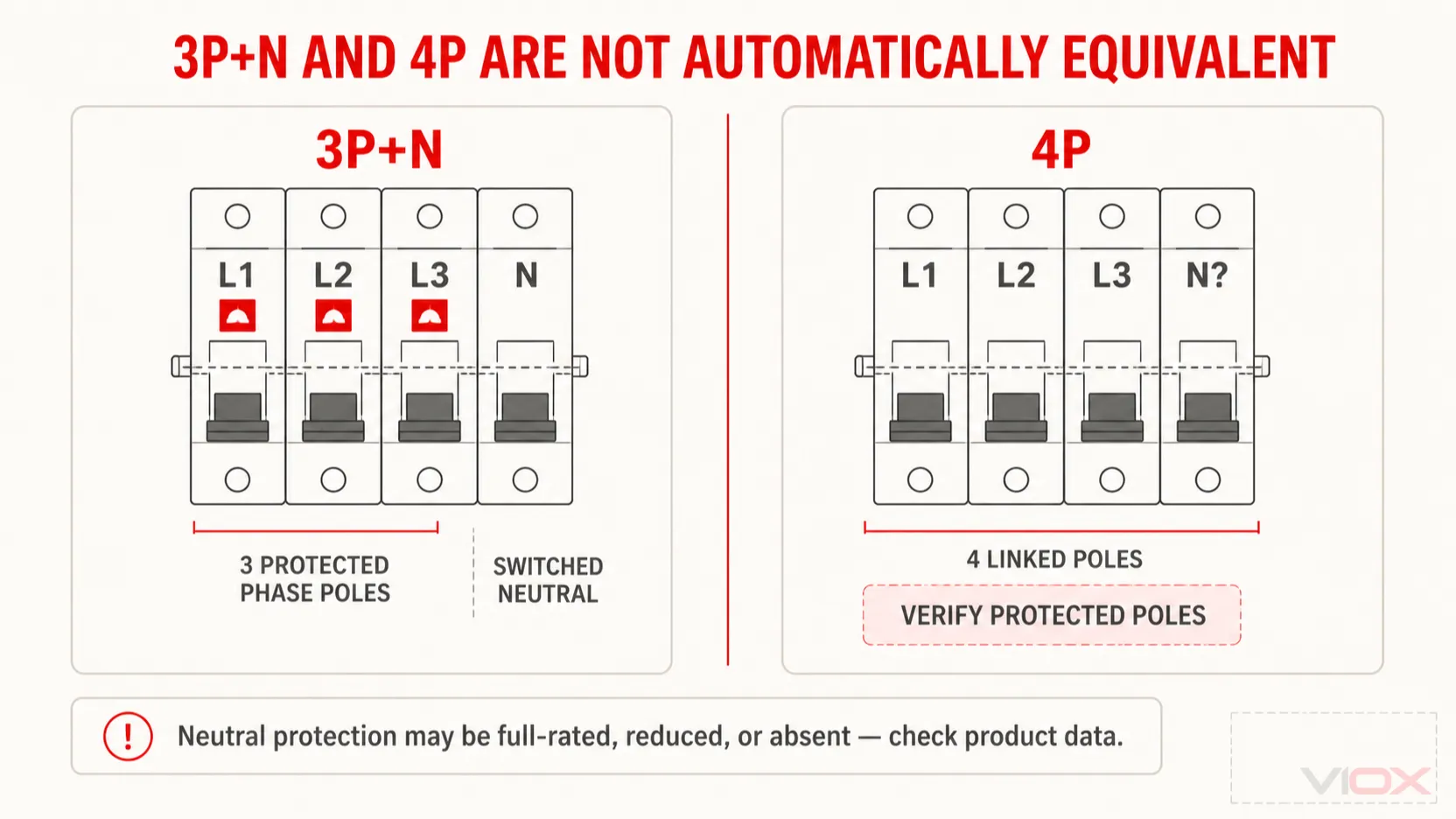
| 3P+N | Three phase poles plus a mechanically linked neutral pole. The phase poles are generally protected; confirm whether the neutral pole is switched only and how it operates from the product documentation |
| 4P | Four mechanically linked poles. Confirm how many poles include overcurrent releases and whether neutral protection is full-rated, reduced, or absent |
Pole selection depends on the wiring system, earthing arrangement, local rules, product construction, and required isolation or disconnection function.
MCB vs Fuse, MCCB, RCCB, and RCBO
| Device | Main protection function | Resettable? | Important boundary |
|---|---|---|---|
| MCB | Overload and short-circuit protection | Yes | Does not normally detect residual current |
| Fuse | Overcurrent protection using a replaceable element | No | Selection depends on utilization category, fault duty, and coordination objective |
| MCCB | Overcurrent protection over broader current, interruption, and adjustment ranges | Yes | Commonly used for feeders and larger distribution duties |
| RCCB / RCD | Residual-current protection | Usually yes | An RCCB without integral overcurrent protection still needs appropriate overcurrent protection |
| RCBO | Residual-current protection with integral overcurrent protection | Yes | Combines the relevant functions of an RCD/RCCB and an overcurrent protective device |
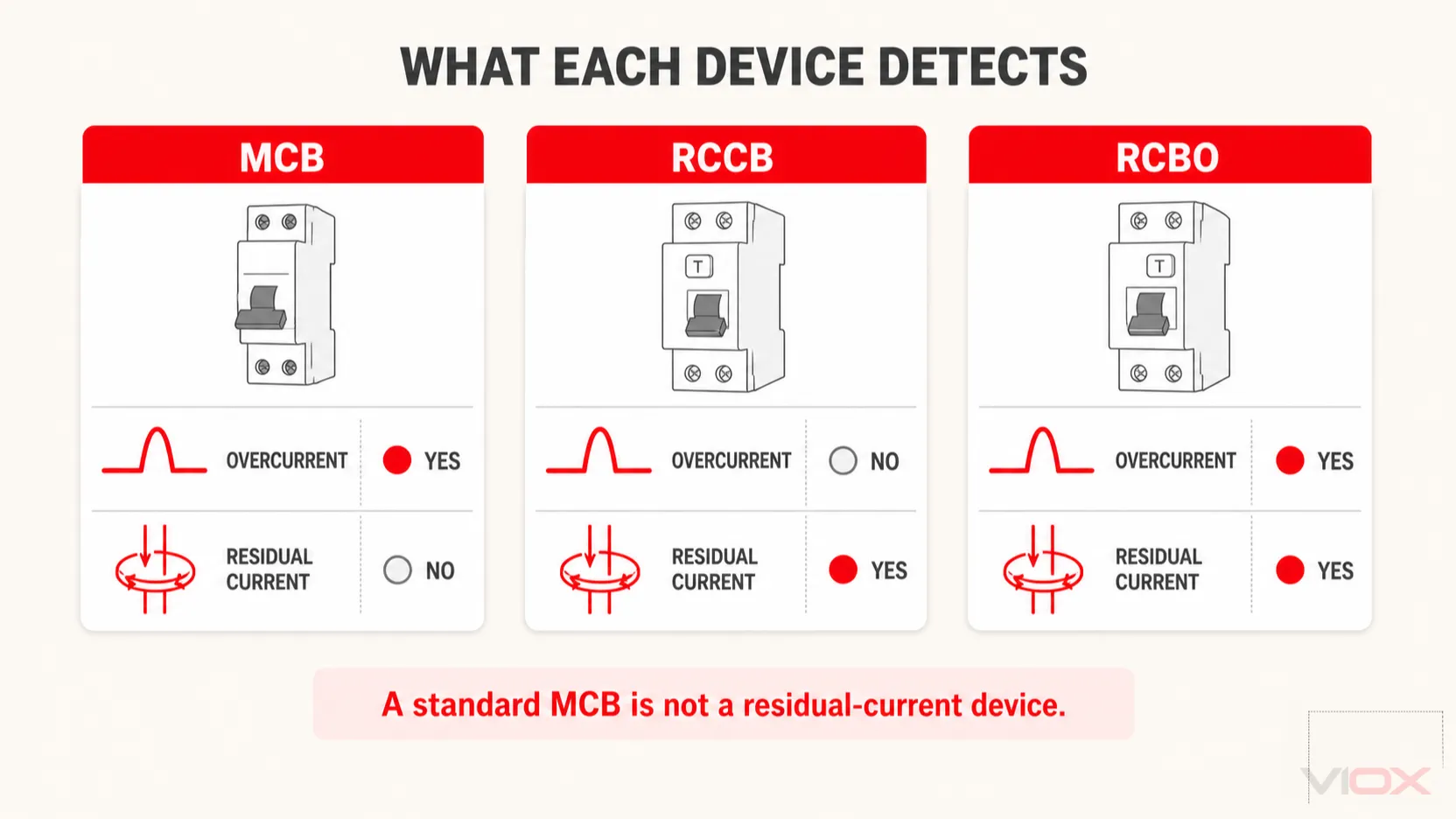
In IEC terminology, RCCB may be expanded more precisely as Residual Current Operated Circuit-Breaker without Integral Overcurrent Protection. RCBO means Residual Current Operated Circuit-Breaker with Integral Overcurrent Protection.
For adjacent device decisions, see Circuit Breakers vs Miniature Circuit Breakers, the MCCB guide, and RCBO vs RCCB + MCB.
Where Are MCBs Used?
MCBs are commonly found in:
- residential final-distribution boards for lighting, socket, and dedicated appliance circuits;
- commercial distribution panels and small branch circuits;
- industrial control panels for control transformers, power supplies, PLC circuits, solenoids, and auxiliary circuits;
- OEM machines that require compact, repeatable DIN-rail circuit protection; and
- appropriately rated DC systems, including some solar, battery, telecom, and control applications.
DC use requires a specifically declared DC rating. Do not assume that an AC MCB can interrupt a DC circuit safely. Voltage, polarity, number of series poles, and breaking capability must follow the exact device instructions. For the separate DC topic, see the DC Circuit Breaker Guide.
What Must Be Checked Before Selecting an MCB?
This article explains the device rather than replacing an engineering selection process. At minimum, selection requires checking:
- circuit design current and conductor ampacity;
- system voltage and AC or DC application;
- prospective short-circuit current;
- declared breaking capacity under the applicable standard;
- load inrush and time-current characteristic;
- pole configuration and disconnection requirements;
- ambient and enclosure conditions;
- conductor, terminal, and busbar compatibility; and
- coordination with upstream and downstream protection.
Use the MCB Selection Guide for the complete decision process. When the application requirements are known, the VIOX MCB product page provides the available product families for evaluation.
Frequently Asked Questions
What is the main function of an MCB?
The main function of an MCB is to interrupt overload and short-circuit overcurrent so that circuit conductors are protected within the intended design and coordination conditions.
How does an MCB work?
A typical MCB uses a thermal element for time-delayed overload tripping and a magnetic release that operates rapidly when overcurrent reaches its instantaneous pickup range, typically during a short circuit. High starting or inrush current can also operate the magnetic release if it exceeds that range. When the contacts open, an arc chute helps control and extinguish the arc.
Does an MCB protect against electric shock?
A standard MCB is not a residual-current device and does not provide additional protection based on residual current. It may disconnect some earth faults when the resulting overcurrent reaches its trip threshold, but it must not be treated as a substitute for an RCCB, RCD, or RCBO where residual-current protection is required.
What is the difference between an MCB and an RCBO?
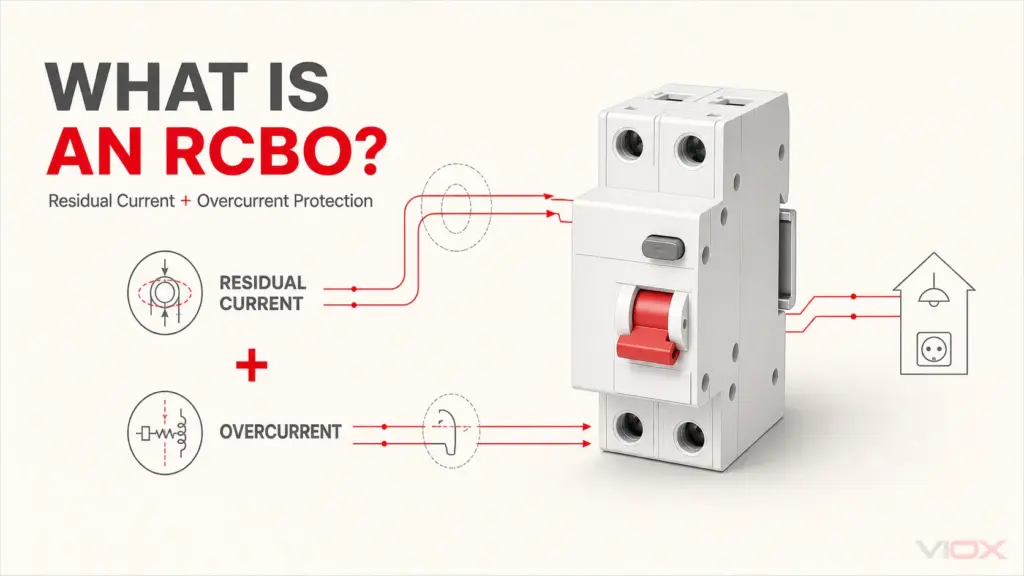
An MCB provides overcurrent protection. An RCBO combines residual-current protection with integral overcurrent protection, allowing it to respond to the relevant leakage faults as well as overloads and short circuits.
What is the difference between an MCB and an MCCB?
An MCB is generally a compact modular breaker used for final and smaller branch circuits. An MCCB covers broader current, breaking-capacity, trip-unit, and accessory requirements and is commonly used for feeders and larger distribution duties. Exact application boundaries depend on the product standard and manufacturer range.
What does C16 mean on an MCB?
On an MCB using IEC-style B, C, or D curve markings, C16 normally identifies a C trip characteristic and a rated current of 16 A. The remaining markings must still be checked for voltage, breaking capacity, standard, pole arrangement, and application limits.
Does a higher ampere rating make an MCB safer?
No. The rating must coordinate with the conductor and circuit design. Increasing it without confirming conductor ampacity and protection requirements may leave the wiring inadequately protected.
Can an MCB be used as an ON/OFF switch?
An MCB can be operated manually, but it is primarily an overcurrent protective device. Its suitability for isolation, operational switching, switching frequency, and the specific load must be confirmed from the applicable standard and manufacturer documentation. A suitably rated switch or contactor may be more appropriate for routine control.
Conclusion
An MCB is a resettable circuit breaker that primarily protects circuit conductors against overload and short-circuit overcurrent. Its operation combines a thermal overload release, a magnetic short-circuit release, a trip mechanism, contacts, and an arc chute.
Correct application depends on more than the ampere number printed on the front. The circuit designer must also verify the voltage, trip characteristic, breaking capacity, poles, product standard, installation conditions, and coordination with residual-current and upstream protection.
For model selection, continue to the MCB Selection Guide. For product evaluation, review the VIOX MCB range.
Sources Reviewed
- IEC 60898-1:2015+A1:2019 — Circuit-breakers for overcurrent protection for household and similar installations
- IEC 60947-2:2024 — Low-voltage switchgear and controlgear: Circuit-breakers
- UL Solutions — Molded Case Circuit Breaker: Marking and Application Guide
- UL Solutions — Circuit Breaker and Supplementary Protector Services
- VIOX — MCB Selection Guide
- VIOX — How to Read the Nameplate of a Miniature Circuit Breaker