

On this page
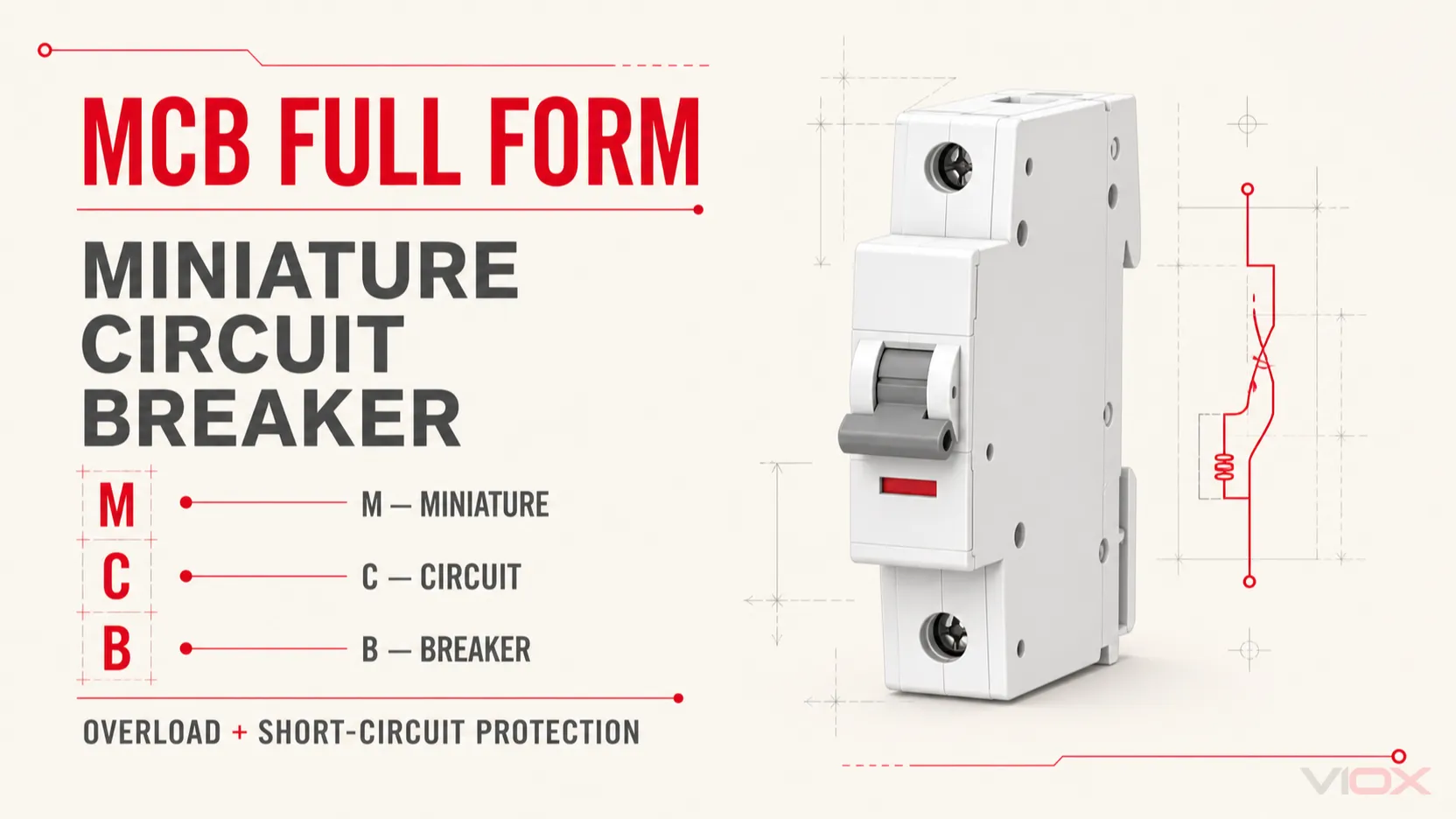
MCB stands for Miniature Circuit Breaker. It is a resettable protective device that automatically opens an electrical circuit during an overload or short circuit. MCBs are commonly used to protect circuit wiring against excessive current and may also protect connected equipment when the breaker characteristics are properly coordinated with the load.
MCB Full Form: Quick Answer
| Item | Answer |
|---|---|
| MCB full form | Miniature Circuit Breaker |
| Main function | Overload and short-circuit protection |
| Primary protection target | Circuit conductors and wiring |
| Resettable after tripping | Normally yes, after the fault is identified and cleared |
| Residual-current protection | Not provided by a standard MCB |
An MCB is often described as a resettable alternative to a fuse, but the two are not interchangeable in every application. Selection depends on the circuit design, fault level, required protection functions, and applicable standards.
What Does MCB Stand For?
MCB stands for Miniature Circuit Breaker:
- Miniature: A compact form commonly used in low-voltage distribution boards and final circuits.
- Circuit: The device is selected primarily to protect circuit conductors against overcurrent and, where properly coordinated, connected equipment.
- Breaker: It automatically interrupts current when its trip conditions are reached.
During normal operation, the MCB carries current without opening. During a sustained overload or short circuit, its trip mechanism releases and separates the contacts. After the fault has been found and corrected, the device can normally be reset instead of replaced.
For a more detailed explanation of construction and operating principles, read What Is a Miniature Circuit Breaker (MCB)?.
What Does an MCB Protect Against?
The primary function of an MCB is overcurrent protection.
Overload Protection
An overload occurs when a circuit carries more current than intended for a period of time. If the condition continues, conductors and insulation may overheat. The thermal element inside a typical thermal-magnetic MCB responds to this sustained overcurrent.
Short-Circuit Protection
A short circuit produces a rapid rise in current. The magnetic element responds quickly when the current reaches its operating threshold and releases the trip mechanism.
A standard MCB is not a residual-current device. Where residual-current protection is required, the installation may use a Residual Current Operated Circuit-Breaker without Integral Overcurrent Protection (RCCB) or a Residual Current Operated Circuit-Breaker with Integral Overcurrent Protection (RCBO), depending on the required functions and circuit arrangement. The shorter terms “Residual Current Circuit Breaker” and “RCBO” are commonly used in general discussion.
How Does an MCB Work?
Most thermal-magnetic MCBs combine three functions:
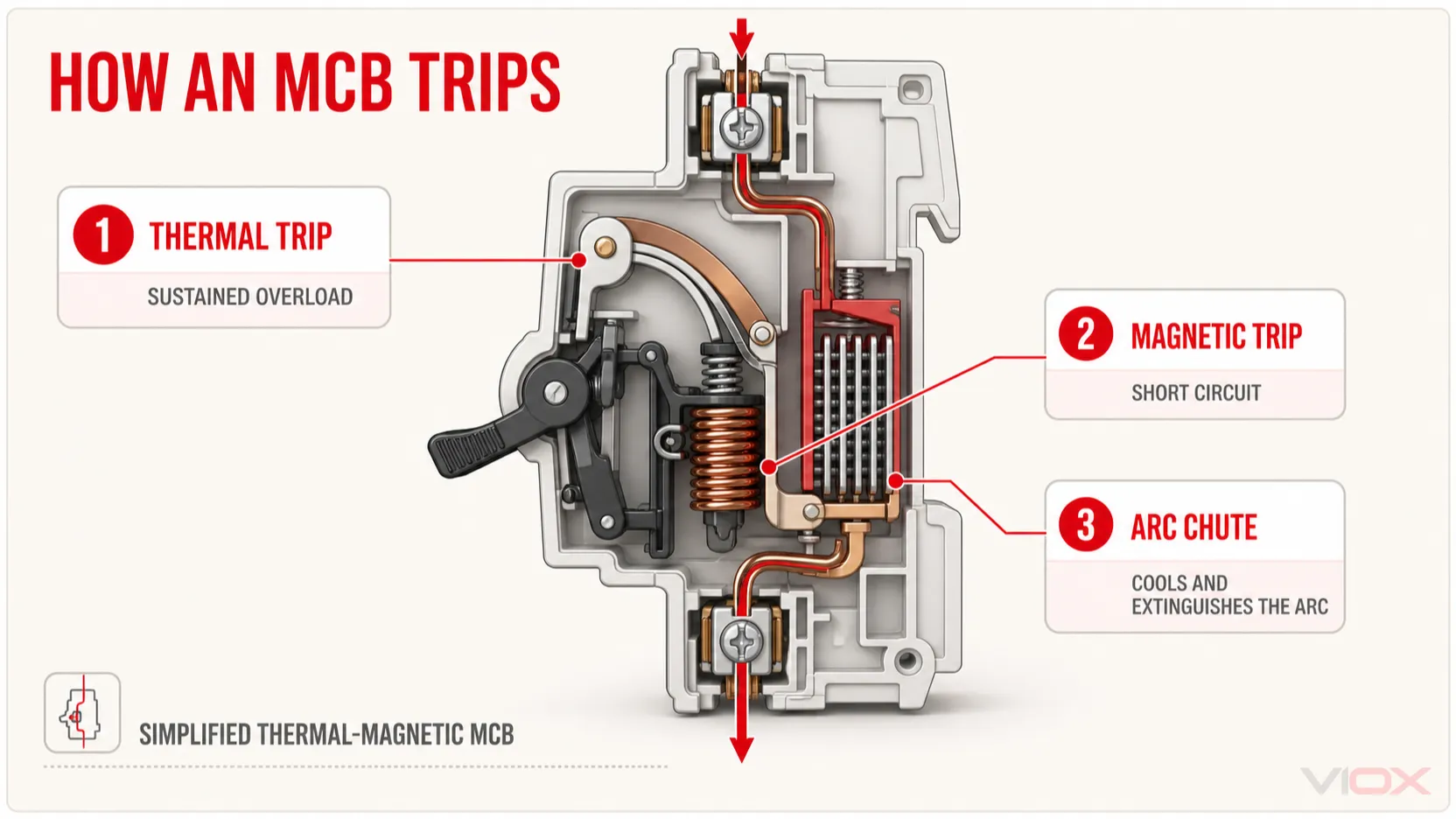
- Thermal tripping: A bimetallic element heats and bends during a sustained overload until it releases the mechanism.
- Magnetic tripping: A magnetic element operates much faster when a high fault current reaches its threshold.
- Arc interruption: When the contacts open, the arc is directed into an arc chute, where it is divided, cooled, and extinguished.
The thermal response is time-dependent: a smaller overload generally takes longer to trip than a larger overload. The magnetic operating range depends on the MCB’s trip characteristic. For detailed time-current behavior, see Circuit Breaker Trip Curve Explained.
The MCB’s breaking capacity must also be suitable for the prospective short-circuit current at the installation point. Rated current alone is not enough for correct selection.
Where Are MCBs Used?
MCBs are used in residential distribution boards, commercial lighting and socket circuits, final distribution circuits, control circuits, and auxiliary circuits in equipment panels.
IEC 60898-1 is a common reference for AC circuit breakers used for overcurrent protection in household and similar installations. Other applications and markets may use different standards. Always verify the markings and documentation for the specific device; this general description does not establish that a particular model is certified for a particular market.
Common MCB Types
MCBs are often classified by trip curve and pole configuration.
B, C, and D Trip Curves
| Curve | General characteristic | Application tendency |
|---|---|---|
| B | Lower tolerance for inrush current | Circuits with relatively low starting current |
| C | Moderate tolerance for inrush current | General loads with moderate starting current |
| D | Higher tolerance for inrush current | Loads with higher startup current, where system conditions support its use |
Curve selection must consider normal inrush current, fault-loop conditions, disconnection requirements, and conductor protection. For B, C, D, K, and Z characteristics, ratings, poles, and applications, see Types of MCB.
MCB Pole Configurations
MCBs are available in single-pole, double-pole, three-pole, and four-pole configurations. The correct arrangement depends on the electrical system, the conductors that must be switched or protected, and applicable installation rules.
How to Read Common MCB Markings
| Marking | Meaning |
|---|---|
| B, C, or D | Trip-curve characteristic |
| 6A, 16A, 20A, etc. | Rated current |
| Voltage value | Rated operational voltage or range |
| 6kA, 10kA, or another value | Declared short-circuit breaking capacity under the stated standard and conditions |
| 1P, 2P, 3P, or 4P | Number of poles |
| Standard reference | Product standard associated with the declared ratings |
On an MCB using IEC-style B, C, or D curve markings, C16 normally indicates a C-curve characteristic and a rated current of 16 amperes. It does not by itself confirm the voltage rating, breaking capacity, pole arrangement, certification status, or suitability for an application.
MCB vs MCCB vs Fuse vs RCCB vs RCBO
| Device | Full form | Main function | Resettable? |
|---|---|---|---|
| MCB | Miniature Circuit Breaker | Overload and short-circuit protection | Normally yes |
| MCCB | Molded Case Circuit Breaker | Overcurrent protection, often with broader ratings or adjustment options | Normally yes |
| Fuse | Not an acronym | Overcurrent protection through a sacrificial element | No |
| RCCB | Residual Current Operated Circuit-Breaker without Integral Overcurrent Protection | Residual-current protection; separate overcurrent protection is normally required | Normally yes |
| RCBO | Residual Current Operated Circuit-Breaker with Integral Overcurrent Protection | Residual-current, overload, and short-circuit protection | Normally yes |
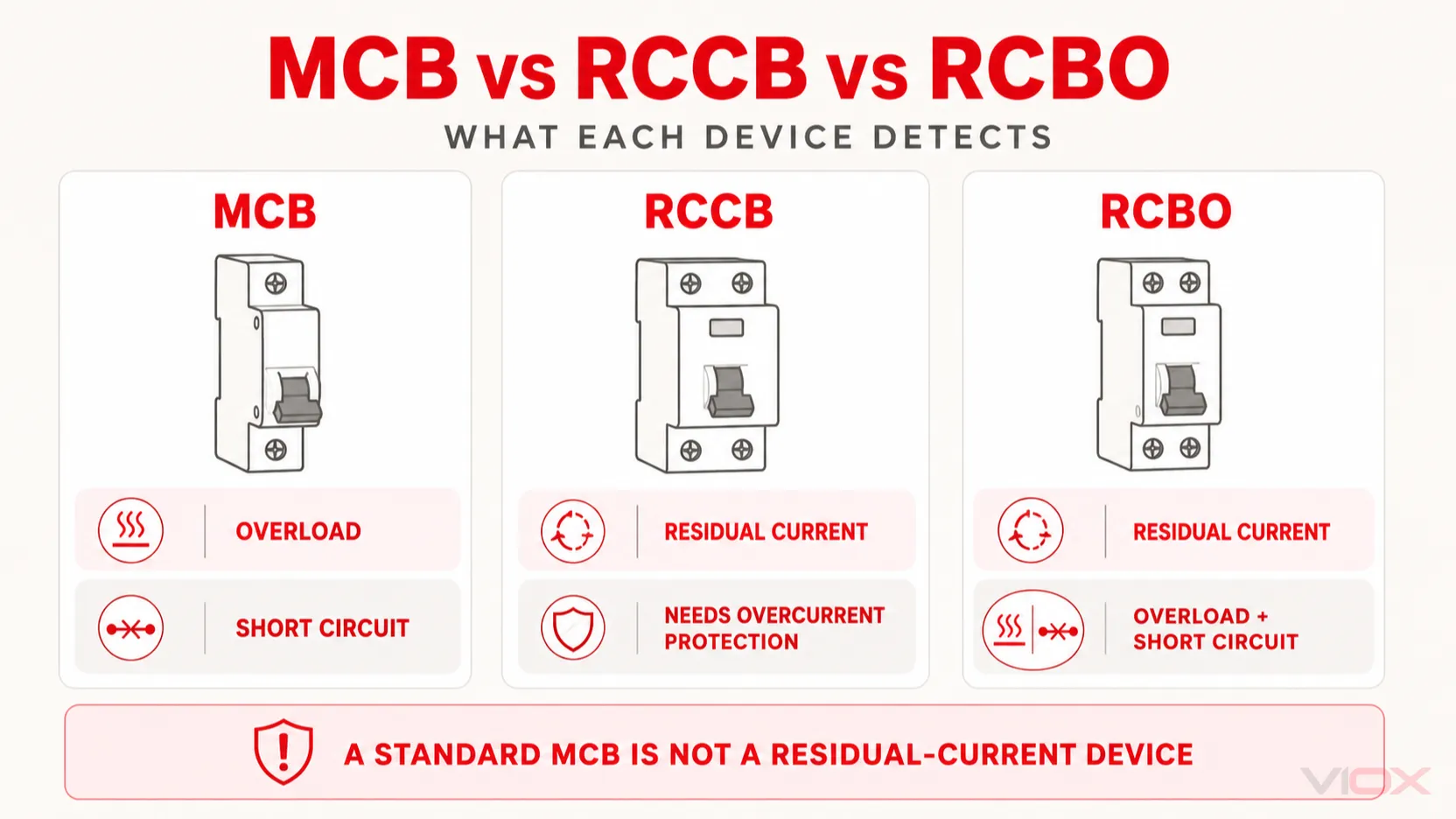
MCB vs MCCB
An MCB is commonly used for final circuits and compact distribution boards. A Molded Case Circuit Breaker (MCCB) is generally used where the system requires higher ratings, a larger frame, or broader trip-adjustment options. Product family and applicable standards determine the practical boundary. See MCCB vs MCB for a detailed comparison.
MCB vs Fuse
An MCB can normally be reset, while a fuse must be replaced after its element operates. Neither is universally better: they have different operating characteristics, breaking capabilities, coordination behavior, and application constraints.
MCB vs RCCB and RCBO
An MCB responds to overcurrent. An RCCB responds to residual current and normally requires separate overcurrent protection. An RCBO combines residual-current and overcurrent protection in one device.
What Should Be Checked When Selecting an MCB?
Knowing the MCB full form is not enough to select a device. Check at least:
- rated current
- trip curve
- breaking capacity
- number of poles
- system voltage and frequency
- applicable product and installation standards
- ambient and enclosure conditions
Use the MCB Selection Guide for a more complete decision process.
Frequently Asked Questions
What is the full form of MCB in electrical?
MCB stands for Miniature Circuit Breaker, an overcurrent protective device used to interrupt overload and short-circuit currents.
What is MCB ka full form?
MCB ka full form is Miniature Circuit Breaker.
Does an MCB protect connected equipment?
An MCB is selected primarily to protect circuit conductors. It may also protect connected equipment when its current rating, trip curve, breaking capacity, and operating characteristics are properly coordinated with the load and fault conditions.
Does an MCB protect against electric shock?
A standard MCB is not a residual-current device and does not provide additional protection based on residual current. It may disconnect some earth faults when the resulting overcurrent reaches its trip threshold, but it must not be treated as a substitute for an RCCB or RCBO where residual-current protection is required.
What do B, C, and D mean on an MCB?
B, C, and D identify trip-curve characteristics used on relevant MCBs. They describe magnetic operating ranges and help determine whether the breaker is suitable for the load’s inrush behavior and the circuit’s fault conditions.
What does C16 mean on an MCB?
On an MCB using IEC-style curve markings, C indicates the trip characteristic and 16 indicates a rated current of 16 amperes. Other markings must still be checked.
Can an MCB be reset after it trips?
Normally yes, but only after the cause has been identified and corrected. Repeated resetting without finding the fault can leave an unsafe condition unresolved. See Why Your MCB Keeps Tripping for common causes.
Conclusion
MCB stands for Miniature Circuit Breaker. Its primary role is to protect circuit conductors against overloads and short circuits. Correct application also requires suitable current rating, trip curve, breaking capacity, pole configuration, and coordination with the circuit and load.