

On this page
The Short Answer: What Do MCB Nameplate Markings Mean?
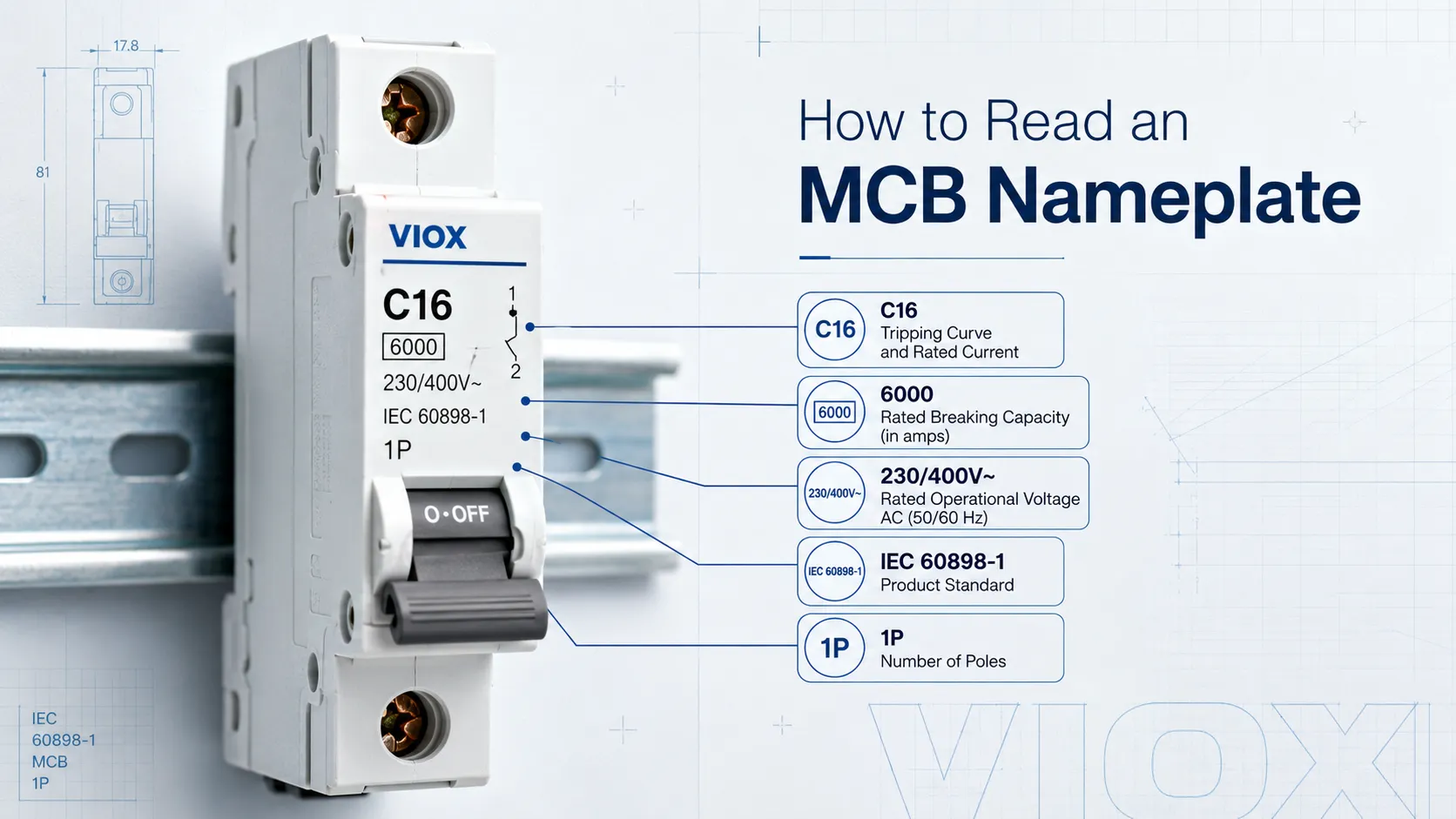
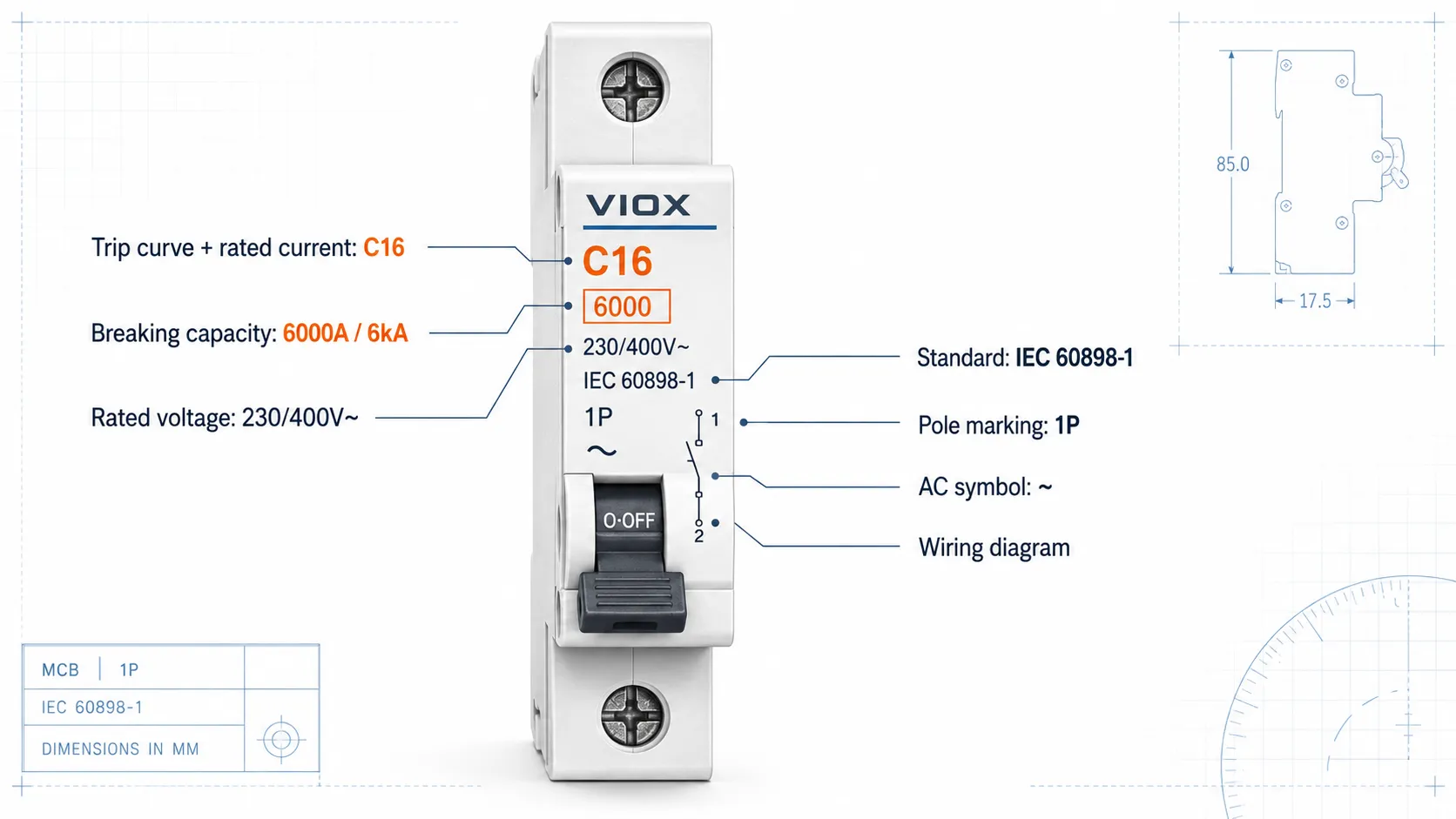
An MCB nameplate tells you the miniature circuit breaker’s rated current, trip curve, voltage rating, breaking capacity, pole configuration, application standard, wiring symbol, and AC or DC suitability. The most common marking format is something like C16 6000 230/400V~ IEC 60898-1, which means a C-curve 16A AC MCB with 6kA rated short-circuit capacity under the stated standard.
Read the markings in this order:
- Trip curve and current rating: B16, C20, D32.
- Rated voltage and AC/DC symbol.
- Breaking capacity: 6000, 6kA, 10000, or 10kA.
- Standard: IEC 60898-1, IEC 60947-2, UL 489, or other regional marking.
- Pole configuration: 1P, 1P+N, 2P, 3P, 4P.
- Wiring diagram, line/load direction, and polarity if marked.
- Manufacturer, model number, certification marks, and accessory markings.
If you are using the nameplate to select a new breaker, also read MCB Selection Guide: How to Choose the Right Miniature Circuit Breaker. This article focuses on decoding the markings.
MCB Nameplate Markings at a Glance
| Marking | Example | Meaning | Selection risk |
|---|---|---|---|
| Trip curve + rated current | C16, B20, D32 | Curve letter plus rated current in amperes | Wrong curve may cause nuisance trips or poor fault protection |
| Rated current | 16A, 32A, 63A | Current the MCB is designed to carry continuously under specified conditions | Oversizing may fail to protect the cable |
| Trip curve | B, C, D | Instantaneous magnetic trip characteristic | Must match load inrush behavior |
| Breaking capacity | 6000, 6kA, 10000, 10kA | Maximum short-circuit current the MCB can interrupt under rated conditions | Must exceed available fault current |
| Rated voltage | 230/400V~ | AC operating voltage rating | Must match system voltage and pole use |
| Standard | IEC 60898-1, IEC 60947-2 | Product test/application standard | Household/similar vs industrial application context |
| Pole marking | 1P, 1P+N, 2P, 3P, 4P | Number and arrangement of switched/protected poles | Wrong pole count can create wiring and isolation problems |
| AC/DC symbol | ~, DC mark, + / – |
Current type and sometimes polarity | AC MCB cannot be assumed suitable for DC |
| Wiring diagram | line/load or internal contact diagram | How terminals and poles are arranged | Miswiring can defeat protection or indication |
| Certification mark | CE, UL, TUV, CCC, etc. | Market or certification indication | Must match the exact model and project requirement |
For a broader MCB definition page, see What Is a Miniature Circuit Breaker (MCB)?.
What Does C16, B20, or D32 Mean on an MCB?
The marking C16 combines two pieces of information:
C= trip curve16= rated current in amperes
So C16 means a C-curve MCB with a rated current of 16A.
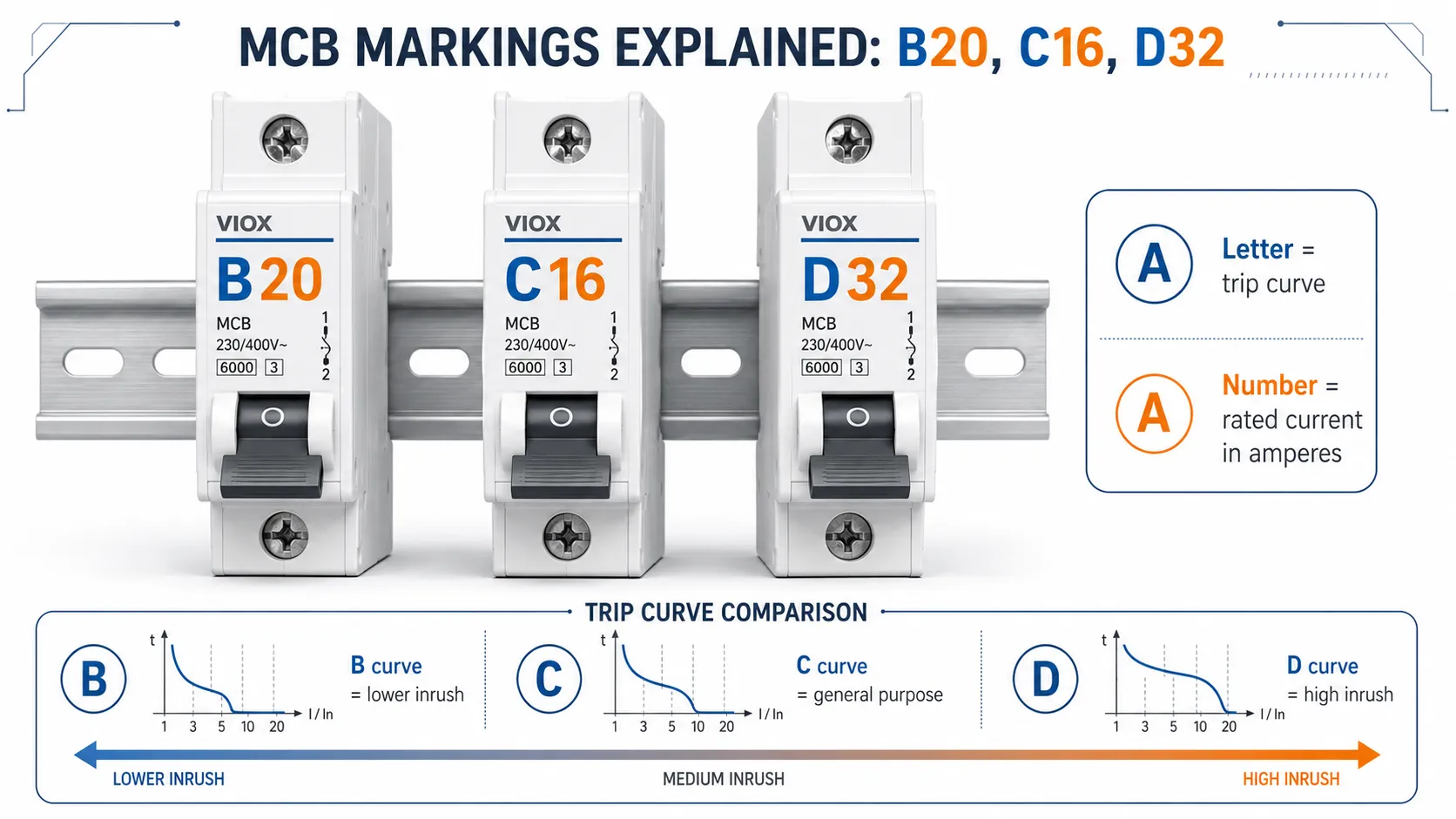
Other examples:
| Marking | Curve | Rated current | Typical interpretation |
|---|---|---|---|
| B10 | B curve | 10A | Sensitive instantaneous trip, often used for low-inrush circuits |
| C16 | C curve | 16A | General-purpose circuit with moderate inrush |
| C32 | C curve | 32A | Higher branch circuit current, still C-curve behavior |
| D32 | D curve | 32A | Higher inrush tolerance, only where suitable for the circuit |
Do not read C16 as “16kA” or “curve C plus 16kA.” The number after the curve letter is the rated current, not the breaking capacity.
For a deeper curve explanation, see Understanding Trip Curves.
B, C, and D Trip Curves on the Nameplate
The trip curve letter tells you the instantaneous magnetic trip range. For common IEC-style MCBs:
| Curve | Typical instantaneous trip range | Common use |
|---|---|---|
| B curve | 3-5 x In | Low-inrush loads, long cable runs where fault current is limited |
| C curve | 5-10 x In | General loads, small motors, lighting groups, mixed circuits |
| D curve | 10-20 x In | High-inrush loads such as transformers or larger motor starting circuits |
In means rated current.
Example: a C16 MCB has a rated current of 16A. Its instantaneous trip range is typically around 5-10 times rated current, so roughly 80-160A under the relevant test conditions.
The curve should be selected based on inrush current and fault-loop conditions. Choosing a D-curve breaker simply to stop nuisance tripping can be unsafe if the available fault current is too low to trip it quickly.
Rated Current vs Breaking Capacity
Two markings are often confused:
- Rated current: the normal current rating, such as 16A or 32A.
- Breaking capacity: the short-circuit interruption rating, such as 6000A or 10kA.
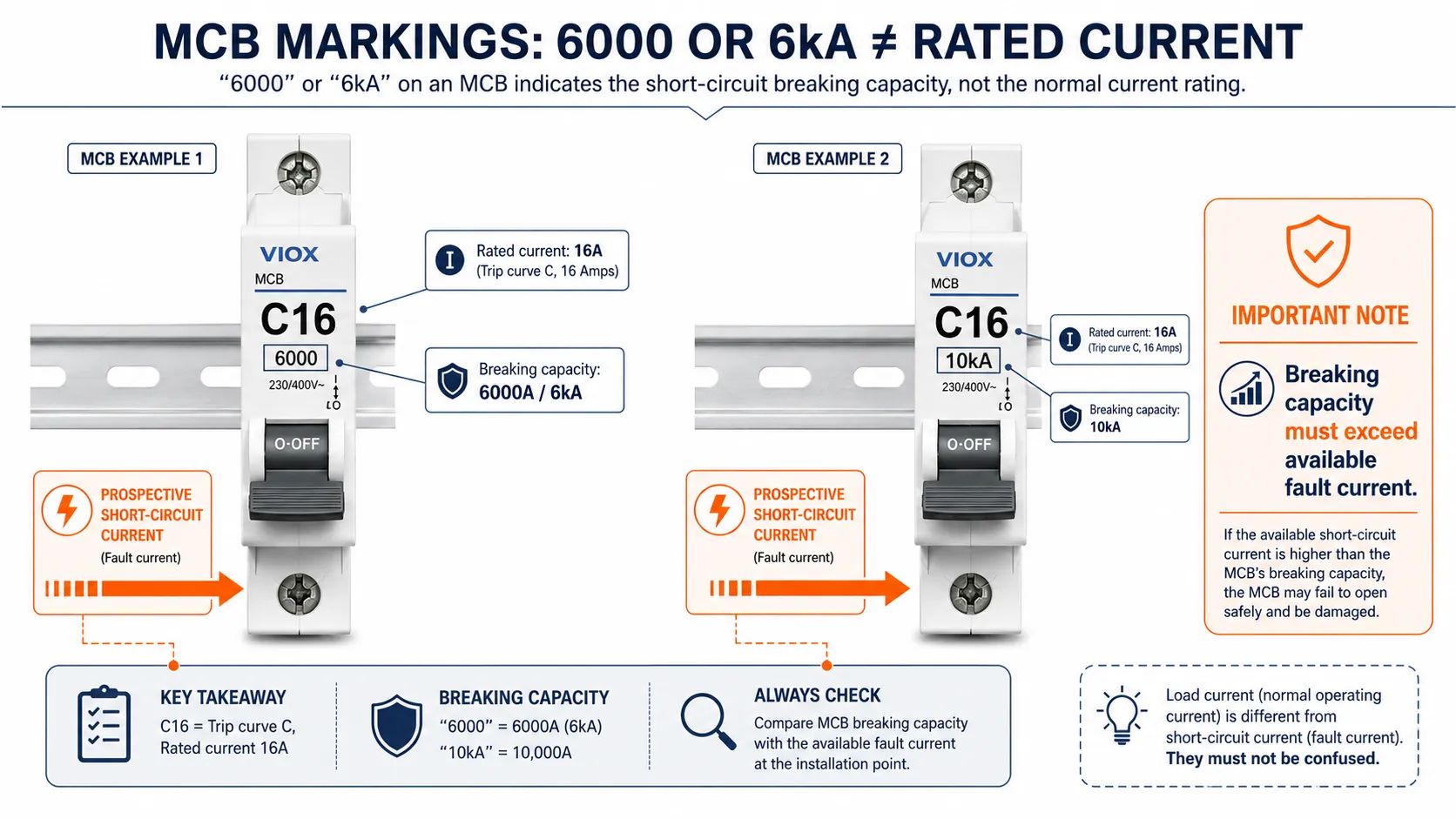
Example:
C16 6000This means:
C16= C-curve, 16A rated current6000= 6000A short-circuit capacity, commonly read as 6kA
The MCB does not carry 6000A continuously. It is rated to interrupt that level of short-circuit current under its specified test conditions.
For more detail, see 6kA vs 10kA MCB Breaking Capacity.
What Does 6000, 6kA, 10000, or 10kA Mean?
MCBs may show breaking capacity as:
60006000A6kA1000010kA
These refer to rated short-circuit breaking capacity under the marked standard and voltage.
| Marking | Meaning |
|---|---|
| 3000 or 3kA | 3,000A short-circuit capacity |
| 4500 or 4.5kA | 4,500A short-circuit capacity |
| 6000 or 6kA | 6,000A short-circuit capacity |
| 10000 or 10kA | 10,000A short-circuit capacity |
The correct rating depends on the prospective short-circuit current at the installation point. A panel close to a transformer may require a higher breaking capacity than a circuit far downstream.
For calculation context, see How to Calculate Short Circuit Current for MCB.
Icn vs Icu vs Ics on MCB Nameplates
Some MCBs show Icn, while others show Icu and Ics. These terms come from different standard contexts.
| Marking | Common standard context | Meaning |
|---|---|---|
| Icn | IEC 60898-1 | Rated short-circuit capacity for household and similar MCB applications |
| Icu | IEC 60947-2 | Ultimate short-circuit breaking capacity |
| Ics | IEC 60947-2 | Service short-circuit breaking capacity |
Do not treat these as identical markings. An MCB intended for household and similar final circuits may mainly show IEC 60898-1 data such as Icn. An industrial DIN-rail MCB may also carry IEC 60947-2 ratings such as Icu and Ics.
The practical rule is simple: read the breaking-capacity value together with the standard, voltage, and application context. A “10kA” marking without the applicable standard and voltage is incomplete.
For a deeper standard comparison, see IEC 60898-1 vs IEC 60947-2 for MCBs. For breaker rating terms, see Icu vs Ics vs Icw vs Icm.
How to Read Rated Voltage and AC/DC Symbols
Voltage markings tell you where the MCB can be used.
Common examples:
| Marking | Meaning |
|---|---|
230V~ |
AC single-phase voltage rating |
230/400V~ |
AC rating for phase-neutral / phase-phase use depending on pole arrangement |
400V~ |
AC three-phase line-to-line use, depending on product and pole type |
DC, VDC, +, - |
Direct current rating or polarity information |
The tilde symbol ~ means alternating current (AC). It does not imply DC suitability.
An AC MCB should not be used in a DC circuit unless the nameplate and datasheet explicitly provide a DC rating and wiring method. DC arc interruption is different from AC interruption, and some DC breakers are polarity-sensitive.
For DC-specific issues, see DC Circuit Breaker Polarity: Polarized vs Non-Polarized DC MCB Guide.
How to Read Pole Markings: 1P, 1P+N, 2P, 3P, 4P
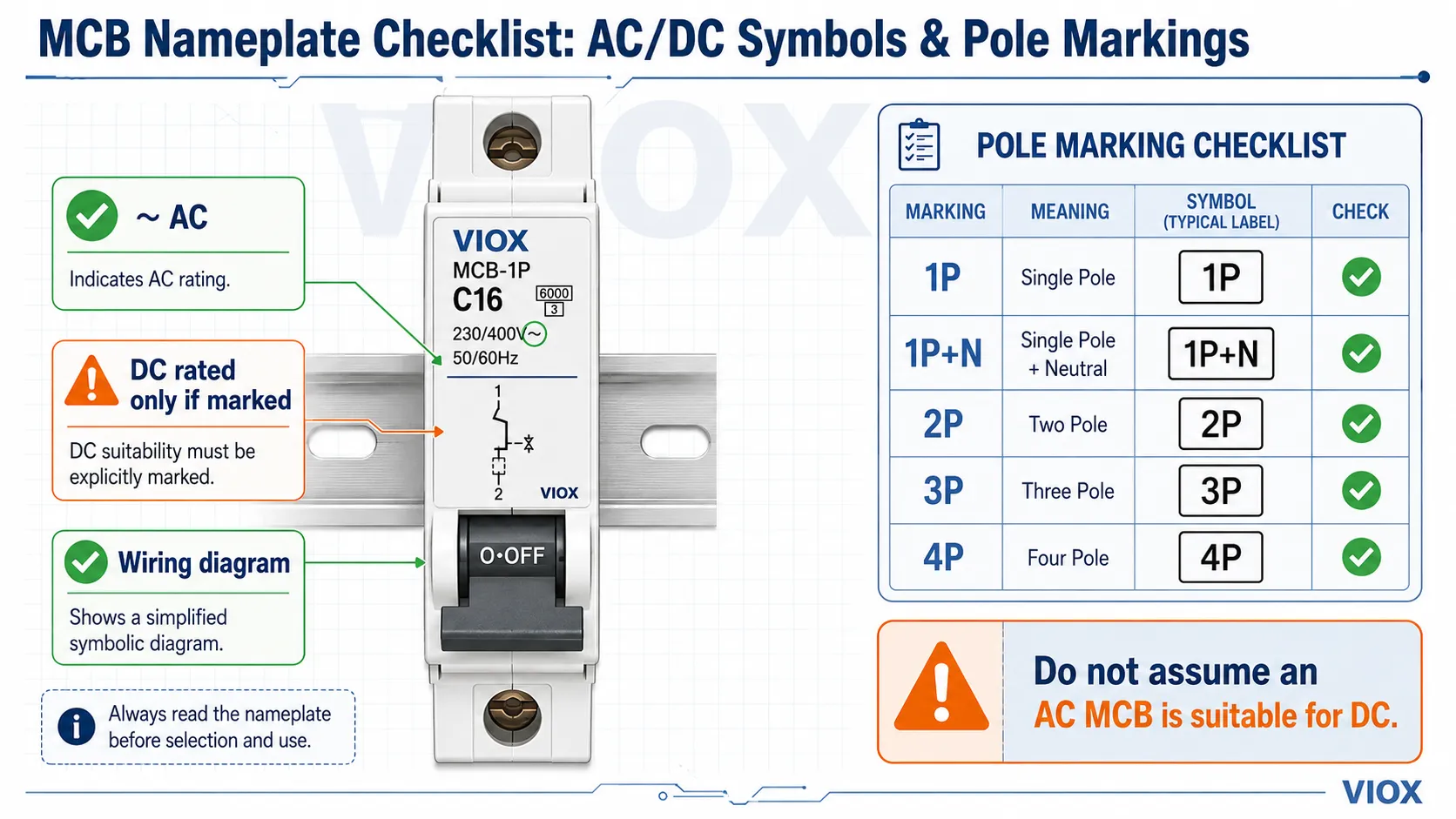
Pole markings tell you how many conductors the MCB switches or protects.
| Marking | Meaning | Typical use |
|---|---|---|
| 1P | One protected pole | Single-phase live conductor in many systems |
| 1P+N | One protected pole plus neutral switching, depending on design | Single-phase circuits where neutral isolation is needed |
| 2P | Two poles | Single-phase two-pole isolation, some DC circuits if rated |
| 3P | Three poles | Three-phase circuits without neutral switching |
| 4P | Four poles | Three-phase plus neutral switching |
Do not assume 1P+N is the same as 2P. In many 1P+N devices, only the phase pole has overcurrent protection, while the neutral pole is switched but not protected. Always check the wiring diagram.
IEC 60898-1 vs IEC 60947-2 on MCB Nameplates
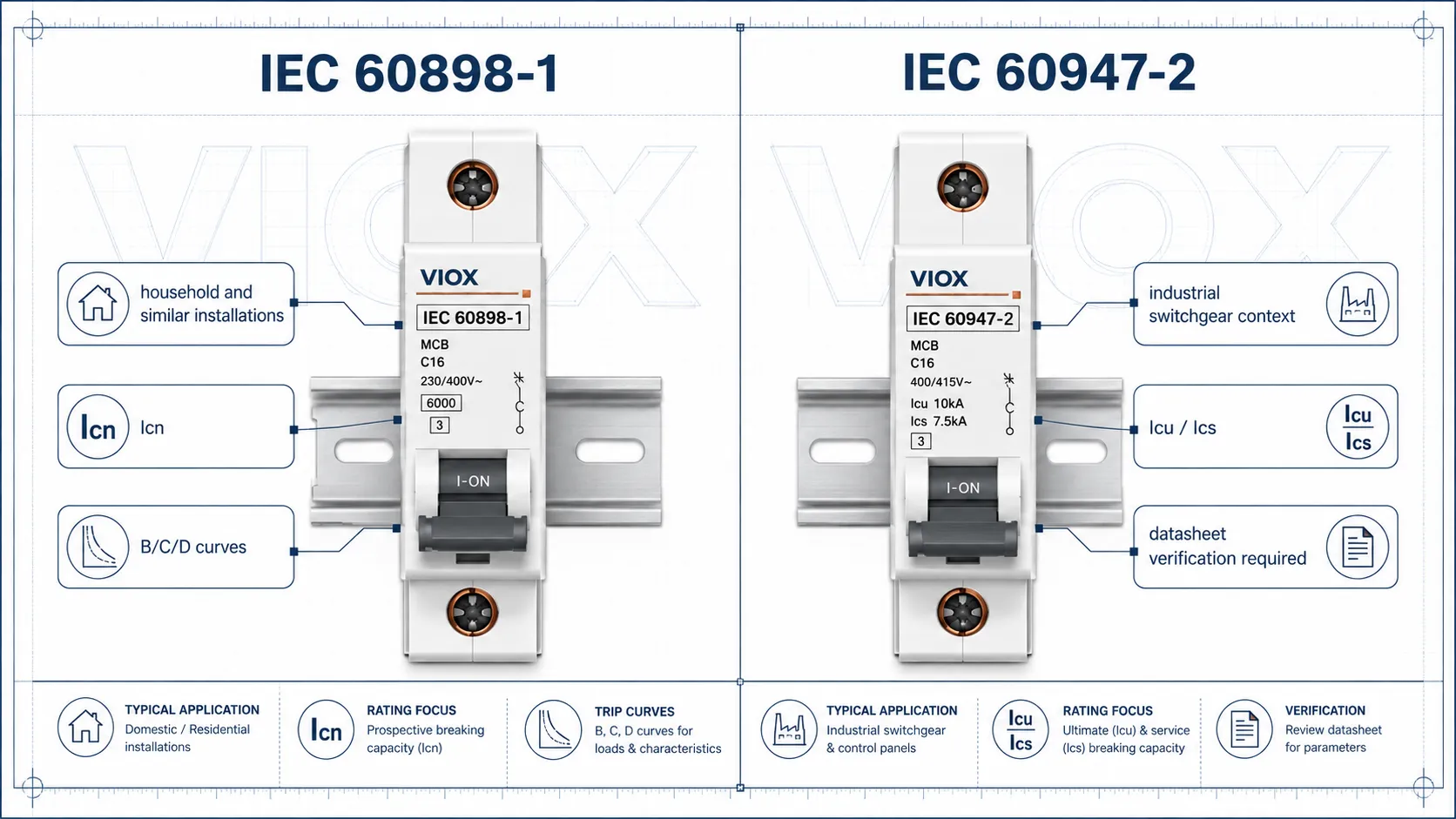
The standard marking helps you understand the intended application context.
| Standard | Typical context | What to check |
|---|---|---|
| IEC 60898-1 | Household and similar AC MCB applications, often operated by ordinary persons | Icn, B/C/D curves, final circuit suitability |
| IEC 60947-2 | Low-voltage circuit breakers for industrial switchgear and controlgear, typically selected by skilled persons | Icu, Ics, utilization context, industrial data |
| UL 489 | North American branch circuit breaker standard | UL listing, voltage system, interrupting rating, panel compatibility |
Some industrial DIN-rail MCBs may carry both IEC 60898-1 and IEC 60947-2 data, but you must verify the exact model and datasheet. Do not assume dual-standard certification from appearance alone.
Real Example: Decode a Typical MCB Marking
Example marking:
C16 6000 230/400V~ IEC 60898-1 1PHow to read it:
| Part | Meaning |
|---|---|
C |
C trip curve |
16 |
16A rated current |
6000 |
6000A, or 6kA, rated short-circuit capacity under the stated conditions |
230/400V~ |
AC voltage rating |
IEC 60898-1 |
Standard/application context |
1P |
One-pole MCB |
This example does not by itself prove suitability. You still need to check:
- load current
- cable size and installation method
- prospective short-circuit current
- AC or DC system type
- trip curve and inrush current
- pole arrangement
- local code or project specification
- manufacturer datasheet
For full selection workflow, see How to Choose the Right Miniature Circuit Breaker.
Common Mistakes When Reading MCB Nameplates
Mistake 1: Confusing rated current with breaking capacity
C16 and 6000 are not the same type of rating. C16 describes curve and rated current. 6000 describes short-circuit capacity.
Mistake 2: Using the 125% rule everywhere
Some codes and continuous-load applications require specific sizing margins, but this is not a universal global rule for every MCB installation. MCB selection must also consider conductor ampacity, load type, installation method, ambient temperature, and local regulations.
Mistake 3: Assuming all 6kA MCBs are equivalent
Breaking capacity must be read with voltage, standard, pole arrangement, and product family. Two breakers marked 6kA may not be interchangeable.
Mistake 4: Ignoring trip curve
A C16 and a B16 have the same rated current, but different instantaneous trip behavior. The wrong curve can cause nuisance tripping or delayed fault clearing.
Mistake 5: Using an AC MCB in a DC circuit
The ~ symbol means AC. DC circuits require explicit DC voltage and breaking ratings, plus correct wiring and polarity if specified.
Mistake 6: Treating 1P+N as the same as 2P
Pole construction affects protection, neutral switching, and wiring. Always read the internal diagram.
Mistake 7: Replacing by front label only
For replacements, check mounting system, busbar compatibility, terminal size, pole arrangement, certification, and manufacturer documentation, not only current rating and curve.
MCB Nameplate Checklist Before Selection
Before approving or replacing an MCB, record:
| Check | Question |
|---|---|
| Current rating | Does In match the load and cable protection requirement? |
| Trip curve | Does B/C/D curve match inrush and fault-loop conditions? |
| Breaking capacity | Is Icn/Icu/Ics high enough for the available fault current? |
| Voltage | Does the rating match the AC or DC system voltage? |
| Standard | Does IEC 60898-1, IEC 60947-2, UL 489, or other marking match the project? |
| Poles | Is 1P, 1P+N, 2P, 3P, or 4P correct for the circuit? |
| Wiring | Does the diagram match line/load direction and neutral arrangement? |
| DC suitability | If DC, is the device explicitly DC-rated and wired correctly? |
| Accessories | Are auxiliary contacts, shunt trips, or busbars compatible? |
| Model number | Does the replacement match the exact product family and datasheet? |
For procurement and supplier selection, see MCB Manufacturer and the VIOX MCB product page.
FAQ
What does C16 mean on an MCB?
C16 means the MCB has a C trip curve and a rated current of 16A. The letter is the trip curve; the number is the current rating.
What does 6000 mean on an MCB?
6000 usually means 6000A, or 6kA, rated short-circuit breaking capacity under the stated standard and voltage conditions.
What does 10kA mean on an MCB?
10kA means the breaker is rated to interrupt a prospective short-circuit current of 10,000A under specified test conditions. It does not mean the breaker can carry 10,000A continuously.
What does the tilde symbol mean on an MCB?
The tilde symbol ~ means AC. It indicates alternating-current rating. DC suitability must be marked separately or confirmed from the datasheet.
What is the difference between B curve and C curve MCB?
B curve MCBs typically trip magnetically at 3-5 times rated current. C curve MCBs typically trip at 5-10 times rated current. C curve is more tolerant of moderate inrush current.
What is the difference between C16 and C32?
Both are C-curve MCBs, but C16 is rated 16A and C32 is rated 32A. The higher current rating does not automatically make it safer; it must match the cable and load.
What is Icn on an MCB?
Icn is the rated short-circuit capacity commonly associated with IEC 60898-1 MCBs. It tells you the fault current the breaker is rated to interrupt under that standard’s test conditions.
Is Icu the same as Icn?
No. Icu is an IEC 60947-2 ultimate breaking capacity rating. Icn is used in IEC 60898-1 contexts. Read each value with its standard and voltage conditions.
Can I replace an MCB with another brand if the markings match?
Not automatically. Electrical ratings may match, but mounting, busbar compatibility, terminal size, certification, accessories, and panel approval may differ.
Can I use an AC MCB for DC?
Only if the MCB is explicitly rated for DC and installed according to its DC wiring diagram. AC ratings alone are not enough for DC circuits.
Summary
An MCB nameplate is a compact technical specification. To read it correctly, decode the curve and current rating first, then check breaking capacity, voltage, standard, pole configuration, AC/DC symbol, wiring diagram, and model data.
The essential distinction is simple:
C16tells you curve and rated current.6000or6kAtells you short-circuit capacity.230/400V~tells you AC voltage suitability.IEC 60898-1orIEC 60947-2tells you the standard context.1P,1P+N,2P,3P, or4Ptells you pole arrangement.
For safe selection, do not read one marking in isolation. Use the nameplate together with the datasheet, cable sizing, available fault current, load type, and applicable project standard.