

On this page
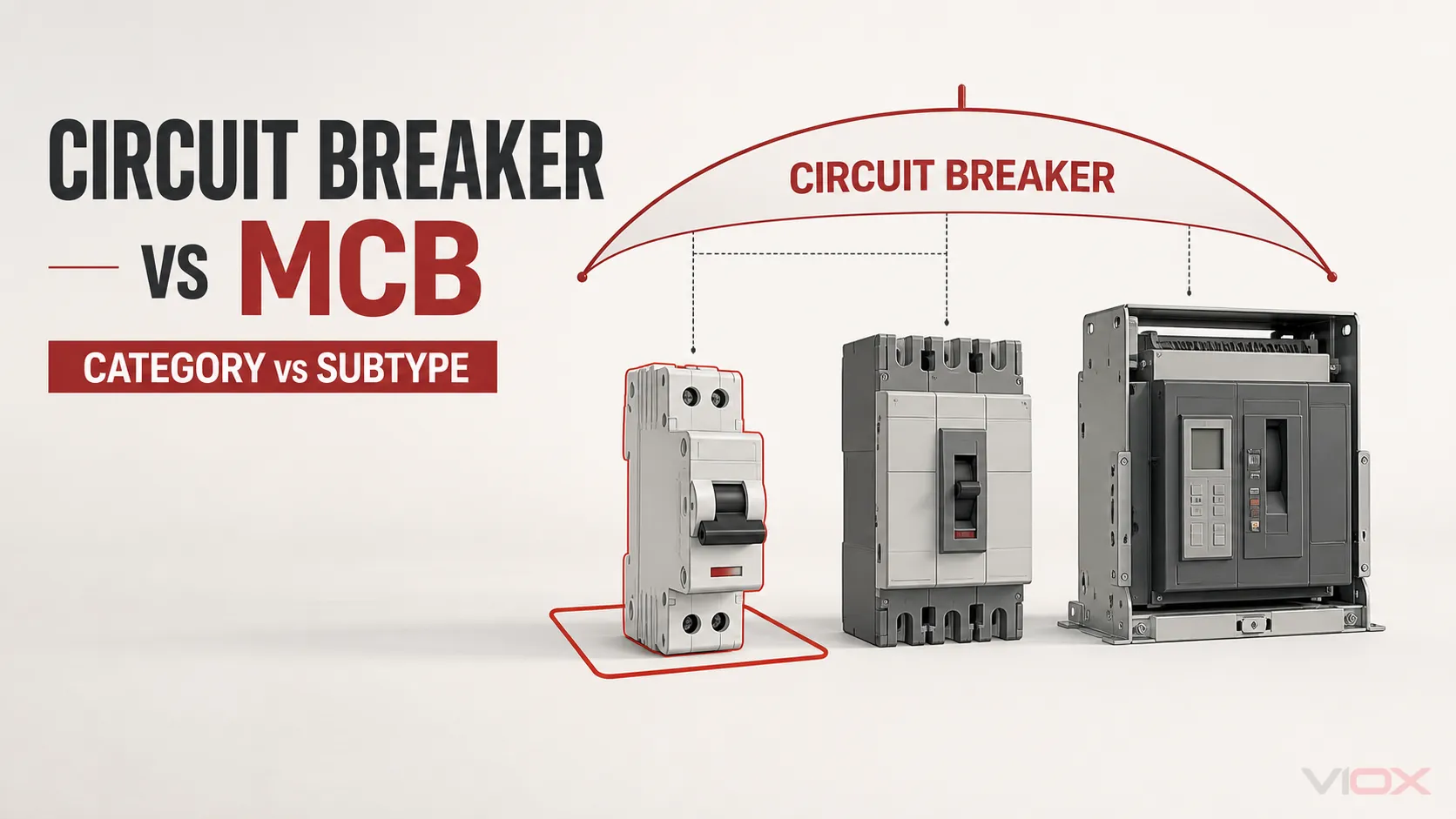
An MCB is a circuit breaker. More precisely, MCB means miniature circuit breaker, so it identifies one product class within the wider circuit-breaker family. The two terms are not parallel alternatives: every MCB is a circuit breaker, but not every circuit breaker is an MCB.
Use circuit breaker when discussing the whole category. Use MCB when the compact, usually modular device class and its applicable product standard, ratings, and trip characteristics have actually been established. A matching ampere label alone does not make an MCB interchangeable with another breaker.
Circuit Breaker vs MCB at a Glance
| Question | Circuit breaker | MCB |
|---|---|---|
| What does the term mean? | An umbrella term for automatic switching devices designed to interrupt a circuit under specified abnormal conditions | Miniature circuit breaker: one defined product class within that umbrella |
| Does the name identify one construction? | No. It can refer to multiple breaker families, sizes, operating mechanisms, trip systems, and voltage classes | More specific, but the name still does not establish every rating or approval |
| Common low-voltage context | May refer to an MCB, MCCB, ACB, or another breaker type | Commonly used in final distribution and similar compact modular applications |
| Are trip settings adjustable? | Cannot be answered from the generic term | Common MCB designs use manufacturer-defined trip characteristics; verify the exact product |
| Can the name prove suitability? | No | No. Check the standard, voltage, current, breaking capacity, trip behavior, poles, terminals, and installation system |
The most important difference is therefore classification, not a universal ratings contest. “Circuit breaker” is a category; “MCB” is a more specific member of that category.
The Circuit-Breaker Family in One Map
In low-voltage distribution, several familiar labels sit under the circuit-breaker umbrella:
- MCB — miniature circuit breaker: compact overcurrent protection commonly used for final circuits and modular distribution assemblies.
- MCCB — molded-case circuit breaker: a molded-case family used across many distribution and equipment applications, often with a wider choice of frames, trip units, accessories, and coordination options.
- ACB — air circuit breaker: a low-voltage breaker family commonly applied at main or large distribution levels where its documented ratings and functions suit the system.
- Other breaker families: application- and market-specific products may use other construction, protection, or installation classifications.
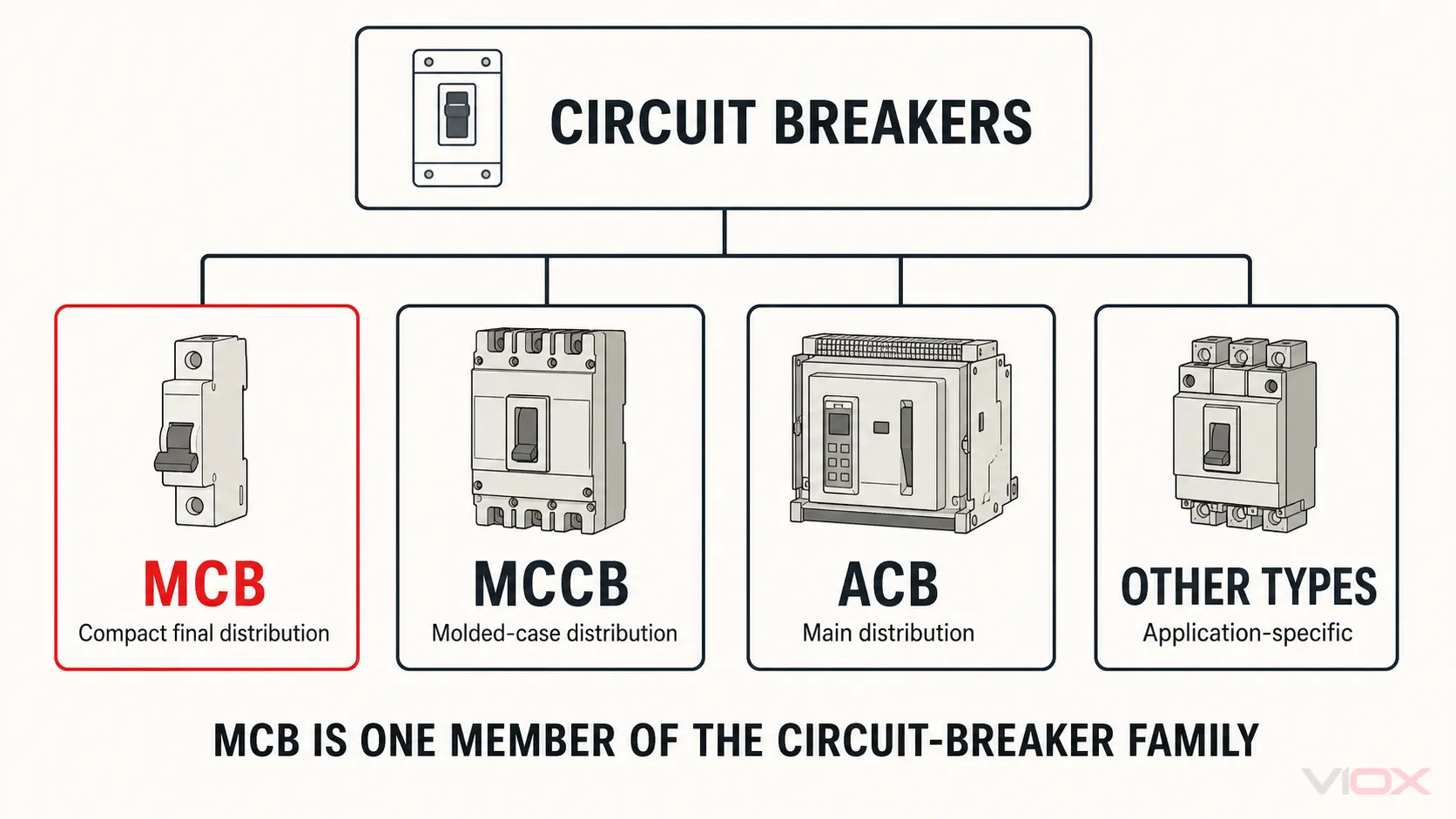
These labels describe product families; they are not a complete specification. The applicable standard and exact manufacturer declaration remain essential.
For example, IEC 60898-1:2015 with Amendment 1:2019 covers specified AC air-break circuit breakers for household and similar installations, within the voltage, current, and short-circuit-capacity limits stated in its scope. IEC 60947-2:2024 covers low-voltage circuit breakers intended for installation and operation by instructed or skilled persons within its stated voltage scope. These standards overlap in everyday conversation but are not interchangeable labels.
If you need the larger taxonomy rather than this terminology comparison, use the dedicated types of circuit breakers guide.
Why “Circuit Breaker vs MCB” Sounds Like a Product Comparison
In everyday use, people often say “circuit breaker” when they mean a physically larger breaker, especially an MCCB. That creates a false comparison:
circuit breaker versus MCB
The technically clearer comparison is usually one of these:
- MCB vs MCCB when comparing two low-voltage breaker families;
- MCB vs ACB when comparing final-distribution and main-distribution product families;
- one exact MCB vs another exact breaker when replacing a device in a real assembly.
This distinction matters in purchasing and engineering. A request for “a 32 A circuit breaker” leaves unanswered whether the project needs an MCB, MCCB, equipment-specific breaker, AC or DC product, particular trip behavior, a required interrupting rating, or compatibility with a specific panel system.
For a direct product-family comparison, see MCB vs MCCB. This page intentionally does not repeat that guide.
What Actually Makes an MCB More Specific?
Calling a device an MCB narrows the field, but only partly. In an IEC-style application, the product marking and documentation may identify:
- the declared product standard;
- rated current and rated voltage;
- AC or DC suitability;
- time-current characteristic or instantaneous pickup designation;
- rated short-circuit capacity;
- number and function of poles;
- terminal conductor range, tightening requirements, and compatible busbar system;
- isolation, accessories, environmental limits, and approvals where declared.
None of these fields should be inferred from the word miniature. MCBs from different standards, series, or markets can use different markings and qualification rules.
Likewise, the generic phrase circuit breaker says nothing reliable about physical size, available adjustments, service conditions, breaking capacity, or installation method. Those properties belong to the selected product—not to the umbrella noun.
Can Another Circuit Breaker Be Replaced with an MCB?
Not from the category name or current rating alone. A replacement is defensible only when the exact device, assembly, and installation requirements have been checked.
Use these six gates:
- Governing standard and market — Confirm the required product standard, certification or listing, destination market, and any assembly-level conditions.
- System voltage and current type — Verify rated operational voltage, frequency, AC or DC suitability, and any polarity requirements.
- Current and conductor coordination — Select the protective rating and trip behavior for the conductors, load, ambient conditions, grouping, and applicable design rules.
- Short-circuit duty — Confirm that the declared breaking capacity is suitable for the prospective short-circuit current at the installation point. Do not choose 6 kA or 10 kA from the load current.
- Trip behavior and coordination — Check starting or inrush current, time-current behavior, upstream/downstream selectivity, and any manufacturer-tested backup combination.
- Physical and functional compatibility — Verify poles, neutral treatment, mounting, terminals, busbar fit, enclosure or panel approval, accessories, isolation function, and exact dimensions.
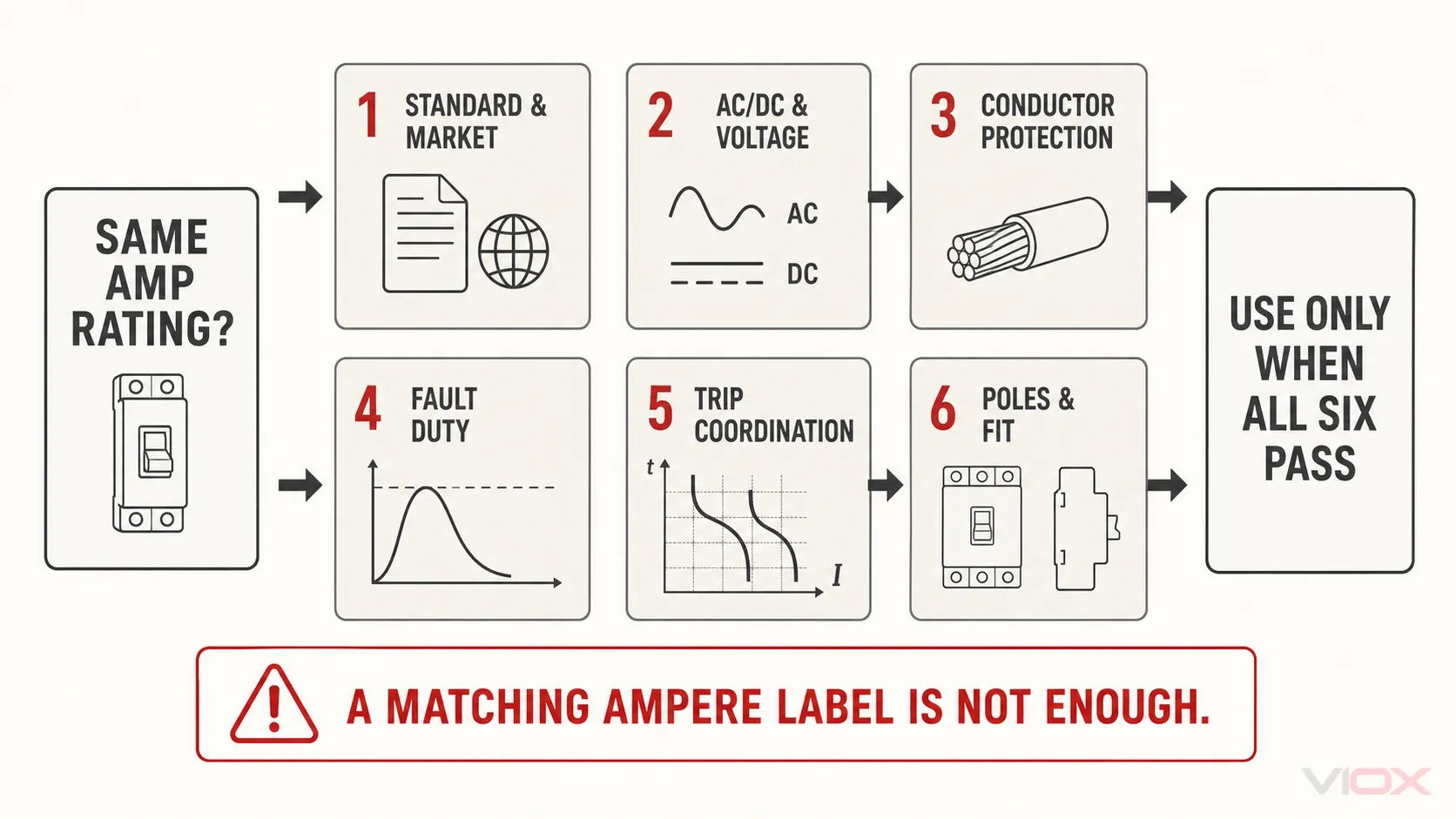
If any gate is unknown, a same-ampere MCB should not be treated as an approved substitute. Obtain the prospective fault-current information, assembly documentation, and manufacturer data before selecting the device. Installation and replacement should be performed by a qualified person under the applicable local rules.
Use the Right Owner for the Next Decision
This page owns one question: how an MCB relates to the circuit-breaker category. Use the more specific VIOX guide for the next engineering task:
| Your next question | Go to |
|---|---|
| What is an MCB and how does it protect a circuit? | What Is a Miniature Circuit Breaker? |
| Which MCB trip curve or type fits a load? | Types of MCB and Circuit Breaker Trip Curves |
| Is 6 kA or 10 kA required? | 6 kA vs 10 kA MCB Breaking Capacity |
| Is the real comparison MCB vs MCCB? | MCB vs MCCB |
| Which IEC product standard applies? | IEC 60898-1 vs IEC 60947-2 |
When the application requirements are known, review the VIOX MCB product range and request the exact series data needed for the destination market and assembly.
Frequently Asked Questions
Is an MCB the same as a circuit breaker?
An MCB is a type of circuit breaker. In casual conversation, the terms may refer to the same installed device, but they are not equal as category labels: circuit breaker is broader than MCB.
Is every residential circuit breaker an MCB?
No. Product construction, terminology, standards, and panel systems vary by market. Identify the exact device and its declared standard rather than classifying it from the building type alone.
Can an MCB replace an MCCB if the ampere rating is the same?
Not on that basis alone. The standard, voltage, fault-current duty, trip characteristics, coordination, poles, mounting, terminals, accessories, and assembly approval may differ. Use the six-gate check and exact manufacturer documentation.