

On this page
What Are the Main Types of MCB?
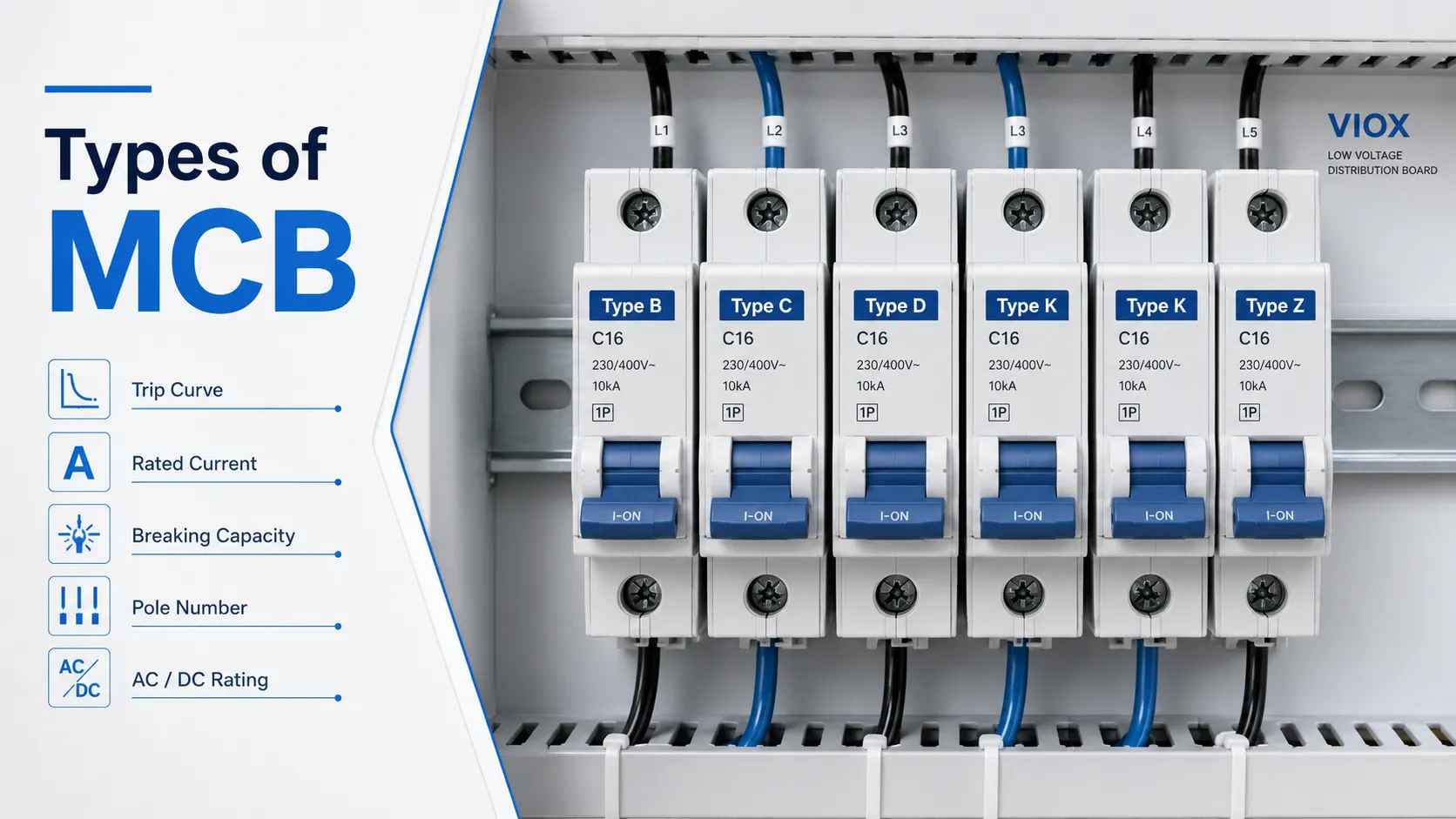
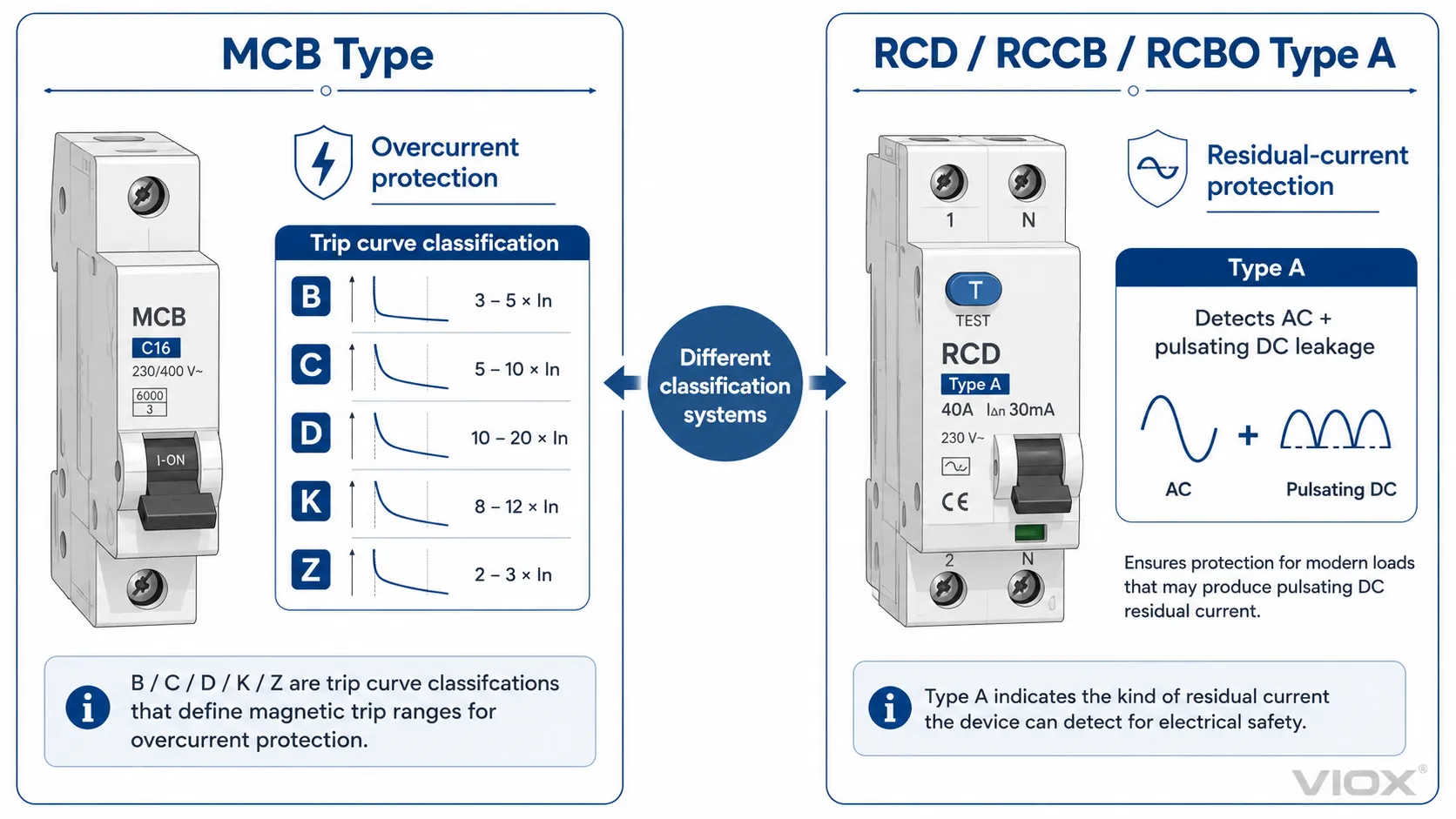
The most common MCB types are Type B, Type C, and Type D, classified by magnetic trip curve. Type K and Type Z are also used in some applications and manufacturer ranges. MCBs can also be classified by pole number, rated current, breaking capacity, AC/DC rating, and application.
For most residential low-inrush circuits, Type B is common. For commercial circuits and small motor loads, Type C is common. For high-inrush loads such as transformers or larger motors, Type D may be used, but only after checking fault-loop conditions and available short-circuit current.
For product evaluation, see VIOX MCB products.
MCB Types at a Glance
| MCB Type | Magnetic Trip Range | Typical Use | Main Risk if Misused |
|---|---|---|---|
| Type B | 3 to 5 x In | Residential lighting, sockets, low-inrush loads | May nuisance trip on motor or transformer inrush |
| Type C | 5 to 10 x In | Commercial circuits, small motors, HVAC, general distribution | May trip too slowly if fault current is low |
| Type D | 10 to 20 x In | Transformers, large motors, high-inrush industrial loads | Requires fault-loop and disconnection-time verification |
| Type K | Often around 8 to 12 x In, depending on manufacturer | Motor and inductive loads | Less universal; must check datasheet |
| Type Z | Often around 2 to 3 x In, depending on manufacturer | Sensitive electronics, semiconductor and control circuits | Can nuisance trip if inrush current is present |
These ranges are practical reference values. Always verify the exact trip curve from the manufacturer’s datasheet and the applicable product standard.
Trip Curve Types: B, C, D, K, and Z
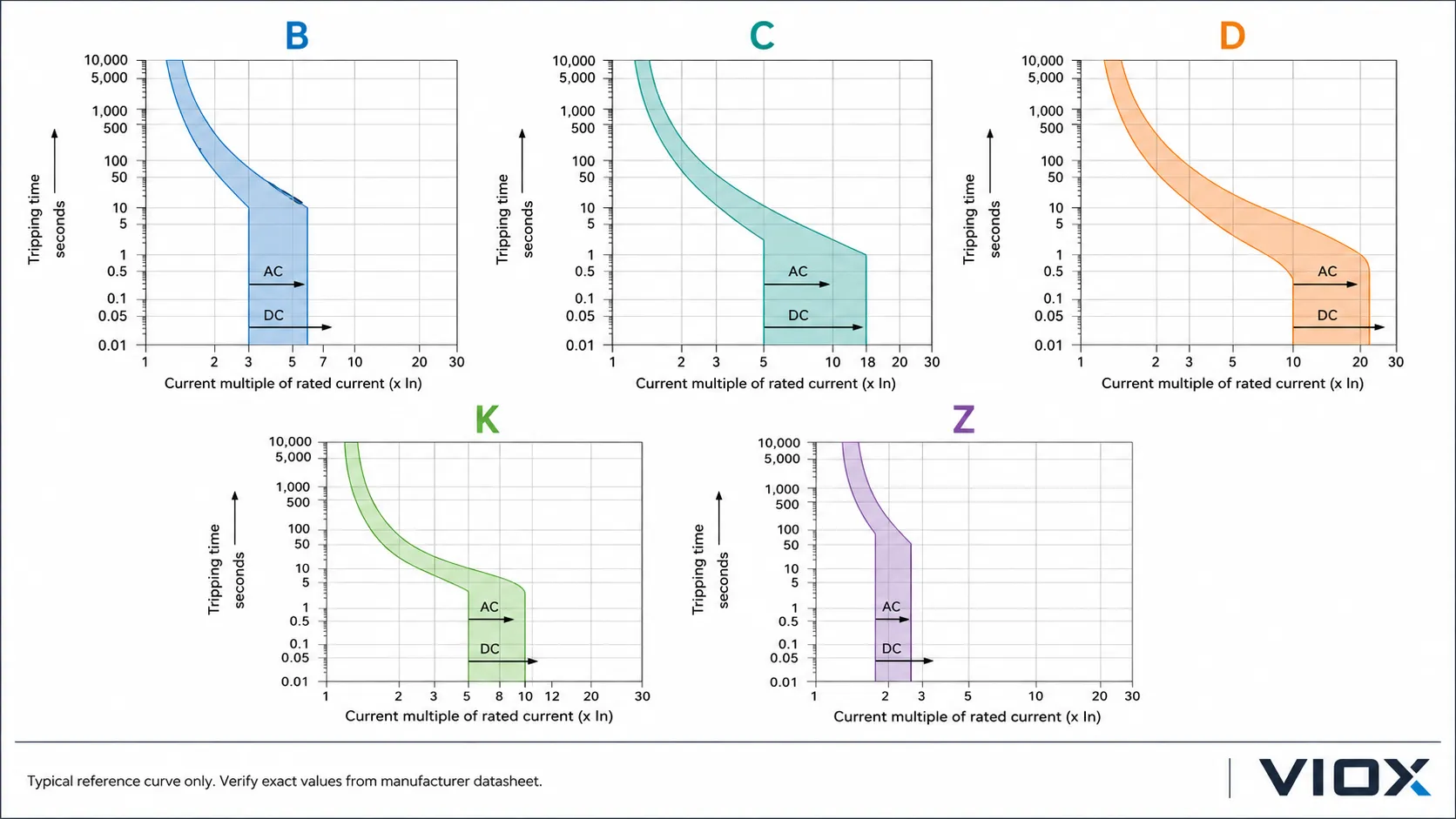
The trip curve describes how quickly the MCB trips when current rises above its rated current. It is one of the most important MCB characteristics because it determines whether the breaker tolerates normal inrush current or trips too early.
An MCB has two basic trip responses:
- Thermal trip for overload, usually using a bimetallic strip.
- Magnetic trip for short circuit, usually using an electromagnetic coil or solenoid.
The B, C, D, K, and Z types mainly describe the magnetic instantaneous trip range.
Type B MCB
Type B MCBs typically trip magnetically at 3 to 5 times rated current.
They are commonly used for:
- residential lighting circuits
- socket circuits with low inrush
- small resistive loads
- general household final circuits
- circuits where available fault current may be limited
Type B is sensitive compared with Type C or Type D. That makes it useful for low-inrush loads, but it may nuisance trip when used with motors, transformers, power supplies, or other equipment with higher startup current.
Type C MCB
Type C MCBs typically trip magnetically at 5 to 10 times rated current.
They are commonly used for:
- commercial distribution circuits
- small motors
- HVAC equipment
- fluorescent or LED lighting groups with inrush
- small pumps and fans
- general industrial control panels
Type C is often the practical middle ground. It tolerates more inrush than Type B, but it still needs enough fault current to trip quickly under short-circuit conditions.
VIOX engineer’s field tip: A common mistake is replacing Type C with Type D only because an older motor or transformer causes nuisance tripping. That may hide the symptom but create a new risk: if the cable run is long and the fault-loop impedance is high, the Type D breaker may not trip fast enough during a short circuit. Before changing the curve, verify the load inrush, cable size, available fault current, and fault-loop impedance.
Type D MCB
Type D MCBs typically trip magnetically at 10 to 20 times rated current.
They are commonly used for:
- transformers
- large motors
- welders
- high-inrush industrial loads
- certain machine circuits
Type D should not be selected only because nuisance tripping occurs with Type B or Type C. The higher magnetic trip threshold means the circuit must have enough available fault current for fast disconnection. Fault-loop impedance, cable length, supply capacity, and local rules must be checked.
Type K and Type Z MCB
Type K and Type Z are less universal than B, C, and D, but they are important in some product ranges.
Type K MCB
Type K is often used for motor and inductive loads where short inrush current must be tolerated. The exact trip behavior depends on the manufacturer and product standard, so the datasheet matters more than the letter alone.
Type Z MCB
Type Z is more sensitive and is often associated with electronic, semiconductor, measurement, and control circuits. It can help protect sensitive equipment, but it may nuisance trip if the load has inrush current.
Do not assume K and Z curves are available or identical across all manufacturers. Check the product series, standard, and trip curve graph.
Is There a Type A MCB?
Some legacy documents, regional references, or manufacturer-specific materials may mention Type A, but Type B, Type C, and Type D are the most widely recognized MCB trip curves for general selection.
For SEO searches such as MCB types A B C D, it is better to explain Type A cautiously rather than present it as a mainstream modern MCB category. If a project specification mentions Type A, verify the exact standard, manufacturer datasheet, and intended meaning.
Note: many users searching for “Type A” are actually looking for Type A RCDs, RCCBs, or RCBOs, not Type A MCBs. Type A residual-current devices are designed to detect AC residual current and pulsating DC residual current from modern electronic loads. That is a different classification system from MCB trip curves.
Other Ways to Classify MCBs
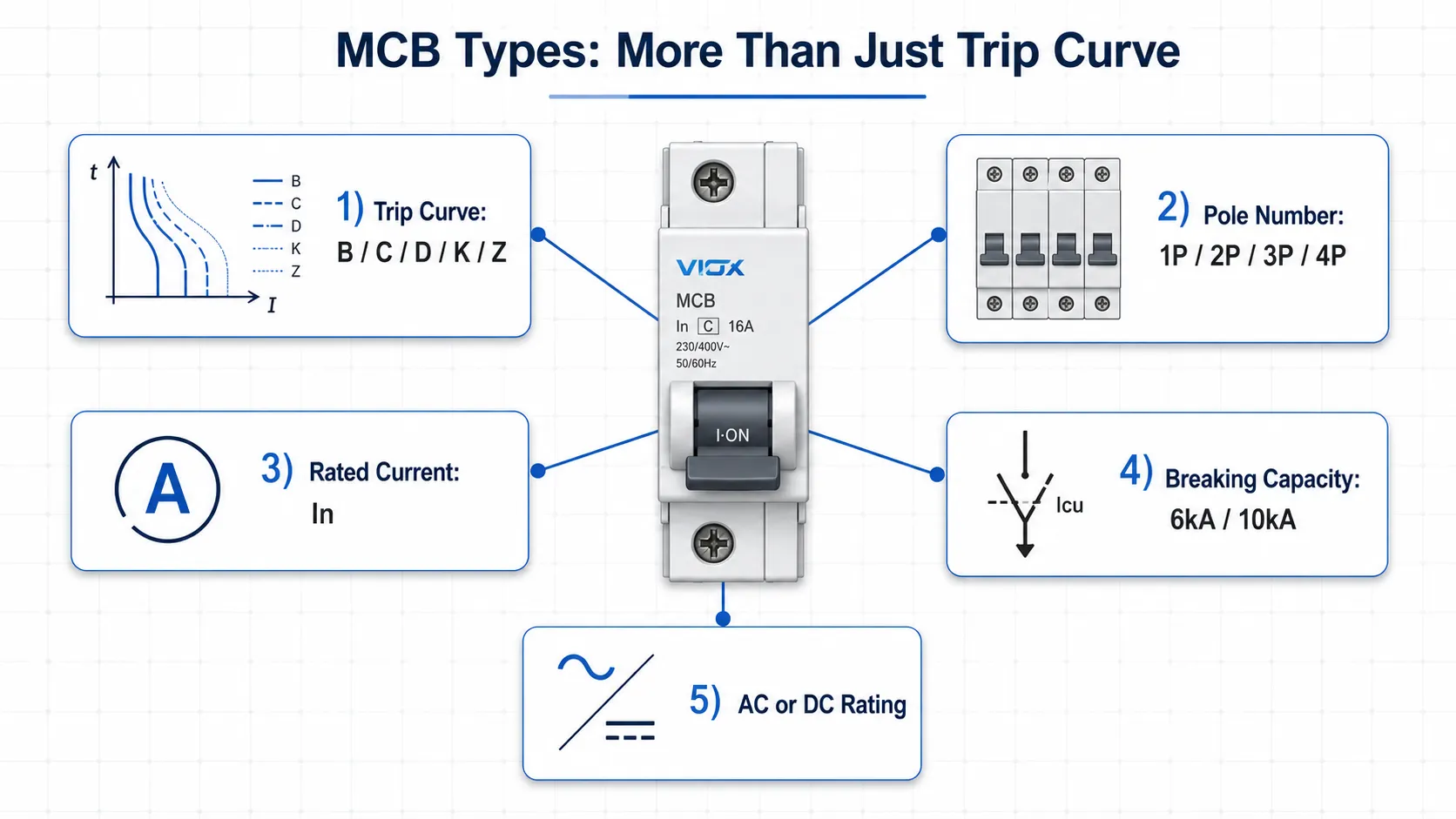
Trip curve is only one way to classify miniature circuit breakers. A complete MCB selection also checks pole number, current rating, breaking capacity, voltage, and AC/DC use.
By Pole Number
| Pole Type | Typical Use |
|---|---|
| 1P | Single-phase live conductor protection |
| 1P+N | Phase protection with neutral switching or neutral connection depending on design |
| 2P | Two-pole disconnection, often for single-phase circuits requiring line and neutral switching |
| 3P | Three-phase circuits without switched neutral |
| 3P+N / 4P | Three-phase circuits where neutral switching or isolation is required |
Always check whether the neutral pole is protected, switched, or only connected through the device. The front label alone may not be enough.
By Rated Current
MCB rated current is the continuous current rating under specified conditions. Common ratings in many distribution boards include 6A, 10A, 16A, 20A, 25A, 32A, 40A, 50A, and 63A, with higher ratings available in some series.
Rated current must be selected according to:
- load current
- cable size
- installation method
- ambient temperature
- grouping and enclosure conditions
- applicable wiring rules
Do not oversize an MCB just to avoid nuisance trips. Oversizing can leave the cable inadequately protected.
By Breaking Capacity
Breaking capacity is the maximum short-circuit current the MCB can safely interrupt under its declared rating.
Common values in many residential and commercial installations include:
- 6kA
- 10kA
- higher values in selected product ranges
The required breaking capacity depends on the prospective short-circuit current at the installation point. If the fault current exceeds the MCB rating, the device is not suitable.
For a deeper guide, see 6kA vs 10kA MCB Breaking Capacity.
AC MCB vs DC MCB
AC and DC MCBs are not automatically interchangeable. DC arcs are harder to extinguish because DC current has no natural zero crossing.
For DC circuits, check:
- DC voltage rating
- polarity marking
- non-polarized or polarized design
- number of poles in series
- breaking capacity at DC voltage
- wiring diagram
For DC selection, see How to Choose a DC Circuit Breaker and DC Circuit Breaker Polarity.
MCB Characteristics Buyers Should Check
| Characteristic | Why It Matters |
|---|---|
| Rated current In | Must match load and cable protection |
| Trip curve | Determines tolerance to inrush and short-circuit trip behavior |
| Breaking capacity Icn / Icu | Must exceed prospective short-circuit current |
| Rated voltage | Must match AC or DC system voltage |
| AC or DC rating | Prevents incorrect use in DC circuits |
| Pole number | Must match circuit wiring and isolation requirements |
| Frequency | Relevant for AC systems and product marking |
| Terminal capacity | Must match conductor size and installation method |
| Standard | IEC 60898-1, IEC 60947-2, UL 489, or local requirement |
| Accessories | Auxiliary contact, shunt trip, undervoltage release, busbar compatibility |
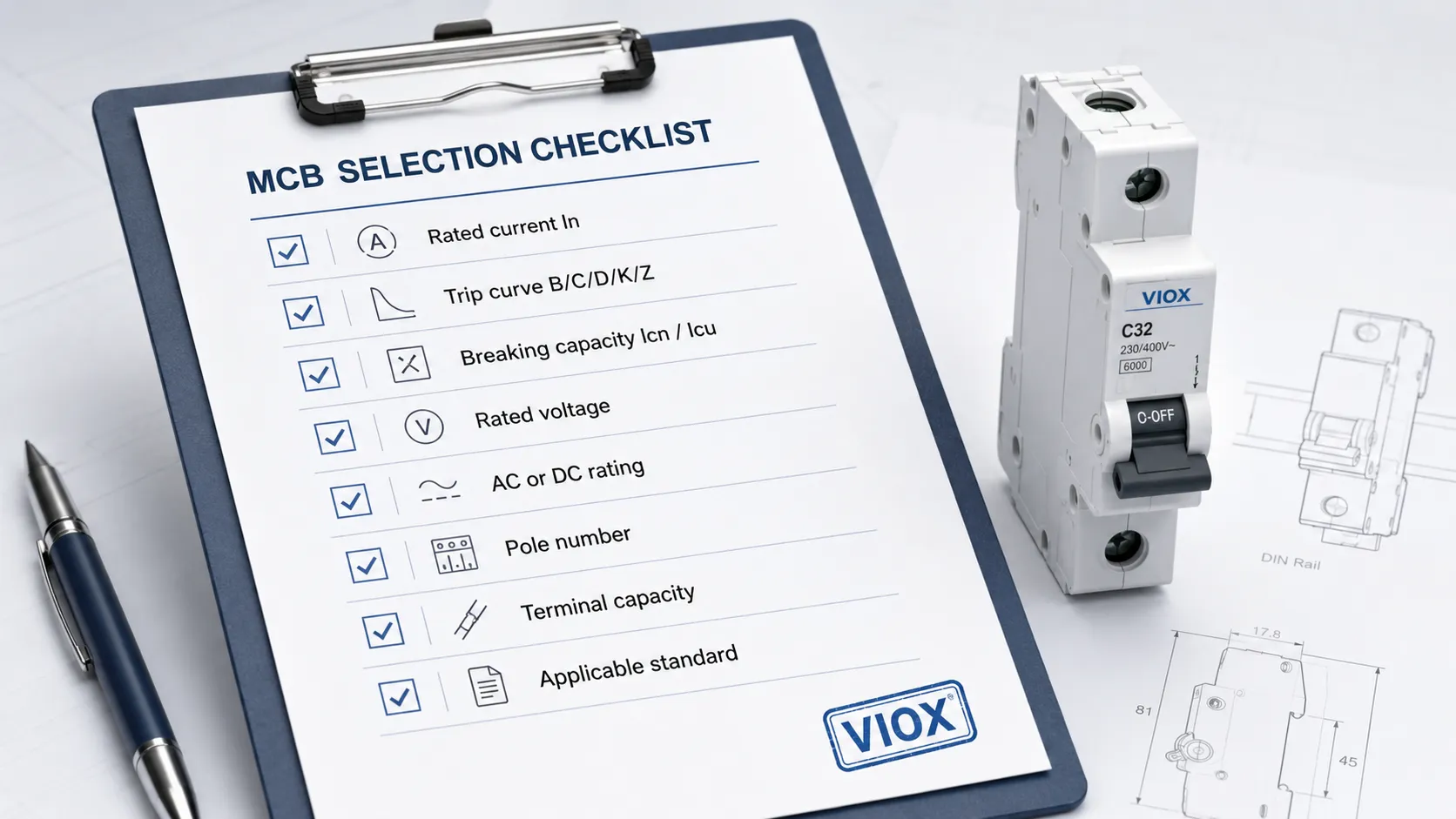
For nameplate reading, see How to Read an MCB Nameplate.
How to Choose the Right MCB Type
Start with the circuit, not the breaker letter.
| Application | Common Starting Point | What to Verify |
|---|---|---|
| Residential lighting | Type B | Inrush, cable size, fault-loop impedance |
| Residential sockets | Type B or Type C depending on market and load | Local wiring rules and load behavior |
| Commercial distribution | Type C | Fault current and nuisance trip risk |
| Small motors, fans, pumps | Type C | Starting current and disconnection time |
| Large motors or transformers | Type D or motor-specific protection | Fault-loop impedance and protection coordination |
| Sensitive electronics | Type Z where appropriate | Inrush current and manufacturer guidance |
| Inductive loads | Type C, D, or K depending on load | Datasheet curve and starting current |
| DC circuits | DC-rated MCB | DC voltage, polarity, breaking capacity |
The safest selection process is:
- Identify the load type.
- Calculate or estimate normal operating current.
- Check startup or inrush current.
- Select the rated current based on load and cable protection.
- Select the trip curve based on inrush and fault-loop conditions.
- Verify breaking capacity against available fault current.
- Check voltage, AC/DC rating, poles, and installation standard.
Common MCB Selection Mistakes
Mistake 1: Choosing Type D Only to Stop Nuisance Tripping
Type D may stop nuisance trips, but it may also delay short-circuit tripping if the available fault current is too low. Investigate the cause of nuisance tripping before changing the curve.
In field selection, the safer question is not “which curve stops nuisance tripping?” but “which curve tolerates normal inrush while still meeting disconnection requirements under fault conditions?”
Mistake 2: Using Type B for Motor Loads Without Checking Inrush
Motor, transformer, LED driver, and power supply inrush can trip Type B devices. Type C or another curve may be better, but only after confirming cable protection and fault conditions.
Mistake 3: Ignoring Breaking Capacity
The MCB ampere rating does not tell you whether it can safely interrupt the available short-circuit current. Check 6kA, 10kA, or higher ratings against the installation point.
Mistake 4: Assuming AC MCBs Work in DC Systems
AC-only MCBs should not be used in DC circuits unless the manufacturer explicitly provides a DC rating and wiring diagram.
Mistake 5: Confusing MCB Type With Pole Number
Type B, C, D, K, and Z refer to trip curve. 1P, 2P, 3P, and 4P refer to pole configuration. They are different selection dimensions.
Mistake 6: Oversizing the MCB to Avoid Trips
Increasing the current rating without checking cable size can create an unsafe condition. The MCB must protect the conductor as well as serve the load.
FAQ
What are the main types of MCB?
The main MCB trip curve types are Type B, Type C, and Type D. Type K and Type Z are also used in some manufacturer ranges and special applications.
What is the difference between Type B, C, and D MCB?
Type B trips magnetically at about 3 to 5 times rated current, Type C at about 5 to 10 times, and Type D at about 10 to 20 times. Higher trip ranges tolerate more inrush but require higher fault current for fast disconnection.
Which MCB type is used for homes?
Type B is commonly used for many residential low-inrush circuits. In some markets or circuits, Type C may also be used. Always follow local wiring rules and fault-loop requirements.
What is Type C MCB used for?
Type C is commonly used for commercial circuits, small motors, HVAC equipment, lighting groups with inrush, pumps, fans, and general distribution.
What is Type D MCB used for?
Type D is used for high-inrush loads such as transformers, large motors, welders, and some industrial circuits. It should be selected only after checking fault-loop conditions.
What is MCB Z type?
Type Z is a sensitive MCB curve used in some electronic, semiconductor, measurement, and control applications. It trips at lower magnetic current levels than B, C, or D, depending on the manufacturer.
What are standard MCB ratings?
Common MCB current ratings include 6A, 10A, 16A, 20A, 25A, 32A, 40A, 50A, and 63A in many distribution boards. Availability depends on product series and market.
How do I choose the right MCB type?
Choose by load type, rated current, inrush current, cable size, fault current, trip curve, breaking capacity, pole number, voltage, AC/DC rating, and local installation rules.
Final Advice
MCB type does not mean only B, C, or D curve. A complete selection checks trip curve, rated current, pole number, breaking capacity, AC/DC rating, voltage, and application.
For quick selection, start with the trip curve: Type B for low-inrush circuits, Type C for general commercial and small motor loads, Type D for high-inrush loads after verification, and Type K or Z only where the product datasheet and application justify it.
The most important rule is simple: the MCB must tolerate normal startup current, trip safely under fault current, and protect the cable connected to it.