On this page
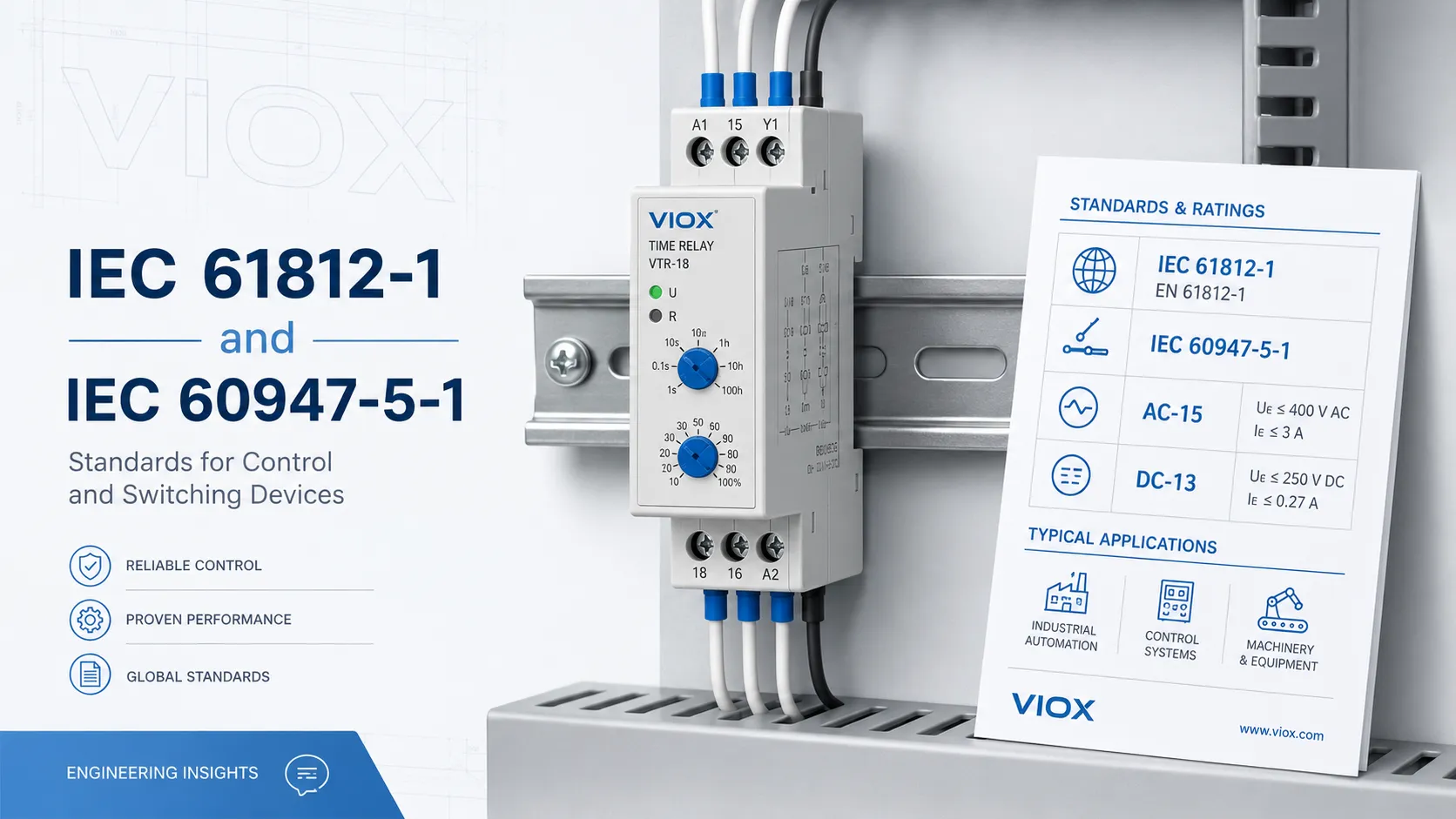
IEC 61812-1 is the international standard for time relays used in industrial and similar applications. It defines requirements and test methods for timer relay functions, operating characteristics, marking, insulation, temperature rise, mechanical and electrical endurance, and performance verification.
For buyers and engineers, IEC 61812-1 helps confirm that a timer relay is evaluated as a timing device, not just as a generic relay. It is especially relevant when selecting on-delay, off-delay, interval, cyclic, star-delta, and multifunction time relays for control panels, machinery, HVAC equipment, pumps, compressors, and industrial automation systems.
But IEC 61812-1 is only one part of correct selection. A time relay also has output contacts, and those contacts must switch the real load safely. This is where IEC 60947-5-1 becomes important, because it is widely used for control-circuit devices and helps buyers interpret contact load categories such as AC-15 and DC-13.
In simple terms:
IEC 61812-1 tells you whether the device is properly evaluated as a time relay. IEC 60947-5-1 helps you understand whether the output contact rating fits the control load.
For product evaluation, see VIOX timer relay products.
Key Takeaways
- IEC 61812-1 applies to time relays, not general power relays or ordinary circuit breakers.
- EN 61812-1 is the European adoption of IEC 61812-1, commonly seen in EU documentation and datasheets.
- IEC 60947-5-1 is relevant for output contacts and control-circuit load categories, especially AC-15 and DC-13.
- A timer relay’s contact rating must be checked against the actual load, not only the printed ampere value.
- For inductive loads such as contactor coils, solenoids, and control relays, AC-15 / DC-13 ratings matter more than resistive AC-1 ratings.
- A timer relay datasheet should show timing function, supply voltage, time range, output contact type, load category, insulation ratings, and environmental limits.
IEC 61812-1, EN 61812-1, IEC 60947-5-1, and UL 61810-1: How They Relate
These standards are often mentioned together, but they do not mean the same thing.
| Standard | What It Means | Why It Matters |
|---|---|---|
| IEC 61812-1 | Time relay product standard | Evaluates timer relay functions, timing behavior, markings, safety, and performance |
| EN 61812-1 | European adoption of IEC 61812-1 | Common in EU declarations, documentation, and project specifications |
| IEC 60947-5-1 | Control circuit devices and switching elements | Helps interpret contact ratings and control load categories such as AC-15 and DC-13 |
| UL 61810-1 | Electromechanical elementary relays | Relevant when users compare relay standards for UL / North American markets |
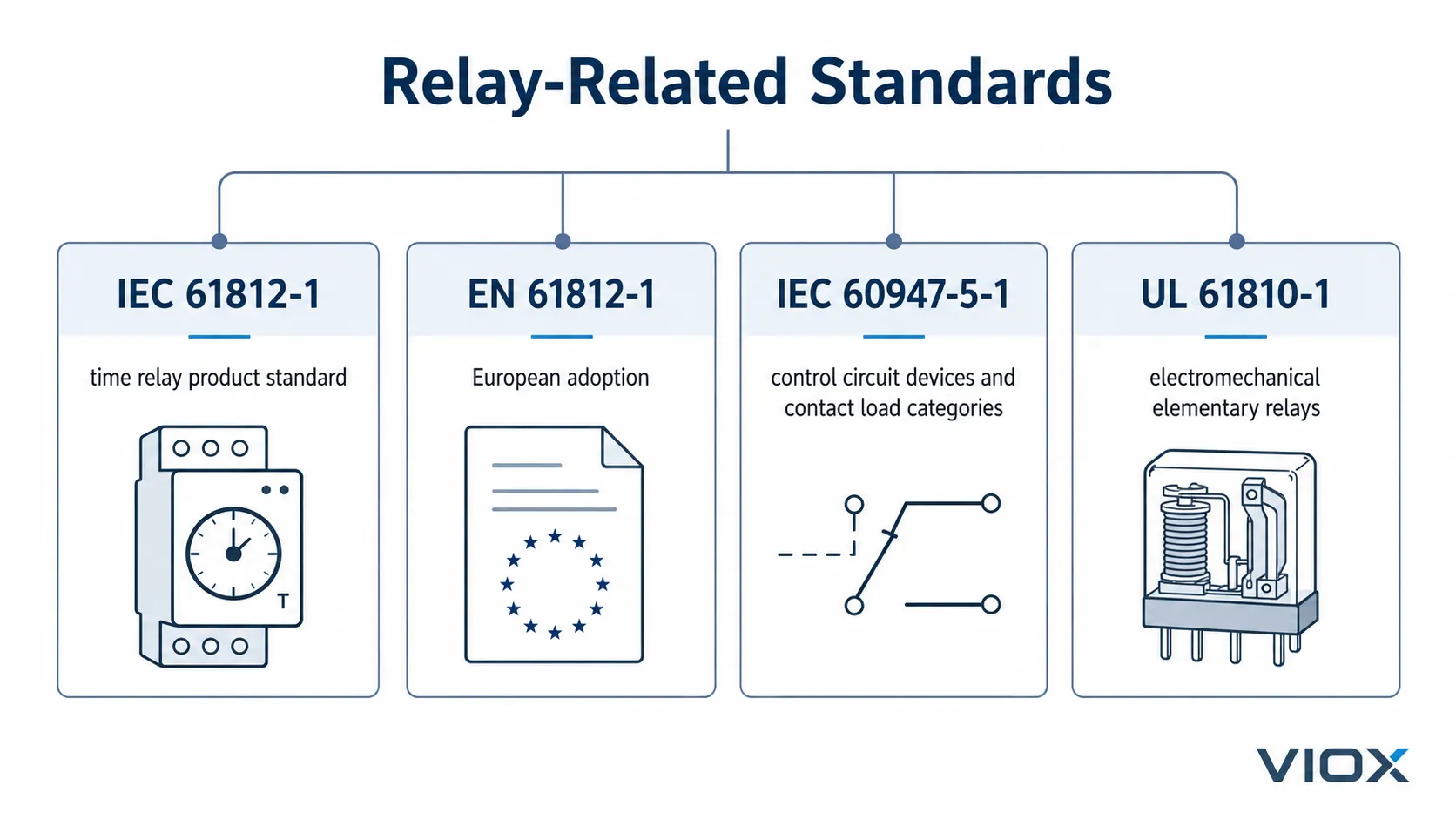
The mistake is treating one standard as a replacement for all the others. IEC 61812-1 focuses on the time relay as a timing device. IEC 60947-5-1 becomes important when the output contact switches control-circuit loads, especially inductive loads.
IEC 61812-1 Scope in Plain English
IEC 61812-1 is concerned with time relays and coupling relays used in industrial and similar applications. For timer relays, it addresses the product characteristics that matter to engineers:
- Timing functions
- Rated control supply voltage
- Operating behavior
- Timing accuracy and repeatability
- Marking and documentation
- Insulation and dielectric performance
- Temperature rise
- Mechanical and electrical endurance
- EMC-related performance where applicable
- Environmental and mounting conditions
This makes IEC 61812-1 different from a simple “relay contact” standard. A timer relay has timing electronics or timing mechanisms, not just a coil and contact set. The standard helps create a common language for checking whether the timing function behaves as stated.
For a basic explanation of timer relay operation, see What Is a Time Relay?.
EN 61812-1 vs IEC 61812-1
For many buyers, the question is simple: “Is EN 61812-1 the same as IEC 61812-1?”
In practical documentation, EN 61812-1 is the European adoption of the IEC 61812-1 standard framework. If a datasheet, declaration, or project specification lists EN 61812-1, it usually means the product is being positioned for European market requirements.
| Item | IEC 61812-1 | EN 61812-1 |
|---|---|---|
| Standard system | International IEC standard | European adoption |
| Common use | Global technical reference | EU documentation and harmonized standard context |
| Product focus | Time relays and coupling relays | Same general technical direction in European adoption |
| Buyer action | Check exact edition and product coverage | Check EN edition, declaration, and model match |
For procurement, the exact edition and the exact model coverage matter more than the acronym alone. Do not approve a product only because the datasheet says “IEC” or “EN.” Check the certificate, declaration, datasheet, and model number together.
IEC 61812-1 vs IEC 60947-5-1
IEC 61812-1 and IEC 60947-5-1 are connected in practice, but they solve different problems.
| Question | IEC 61812-1 | IEC 60947-5-1 |
|---|---|---|
| Is it mainly about time relays? | Yes | No |
| Does it define timer relay performance? | Yes | Not the main focus |
| Is it useful for contact ratings? | Partly | Yes |
| Does it cover control circuit devices? | Limited relevance | Yes |
| Common buyer use | Verify time relay compliance and timing performance | Check contact load suitability and utilization categories |
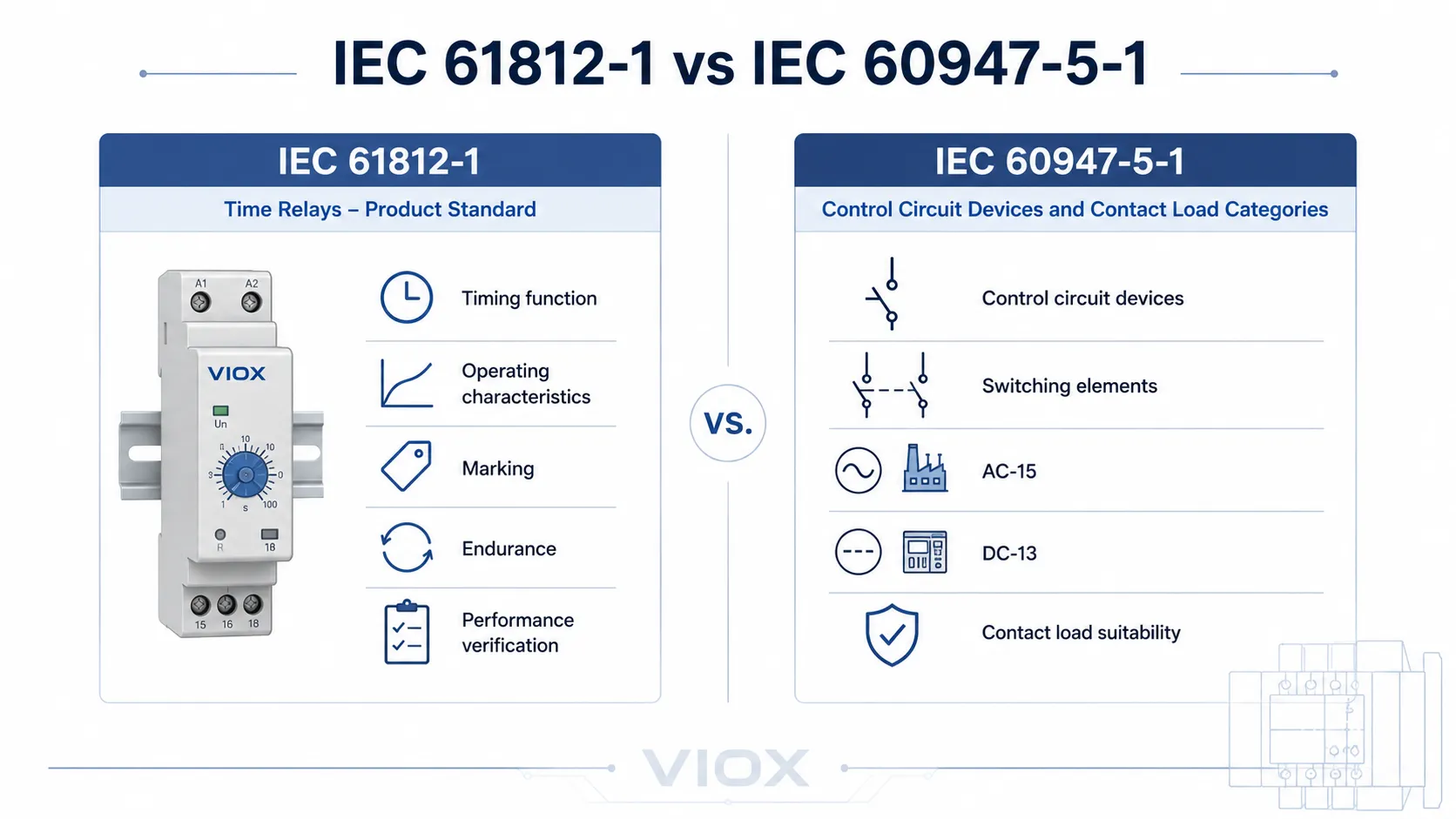
Why does this matter? Because many timer relays are selected correctly for timing function but incorrectly for output load. The relay may time properly, but its contacts may fail early if the load is a contactor coil, solenoid valve, small motor control circuit, or DC inductive load.
This is why IEC 60947-5-1 contact categories such as AC-15 and DC-13 are important when a timer relay output is used in a real control circuit.
IEC 61812-1 vs UL 61810-1
UL 61810-1 is commonly associated with electromechanical elementary relays. It is relevant when buyers compare relay safety standards across IEC and UL markets.
The key difference is product focus:
| Standard | Main Focus | Practical Use |
|---|---|---|
| IEC 61812-1 | Time relays and timing performance | Timer relay function and performance verification |
| UL 61810-1 | Electromechanical elementary relays | Relay component safety and ratings in UL markets |
If a timer relay is sold globally, buyers may see both IEC and UL references in datasheets. This does not mean the standards are identical. Always verify which standard applies to the actual model, rated voltage, output contact, and target market.
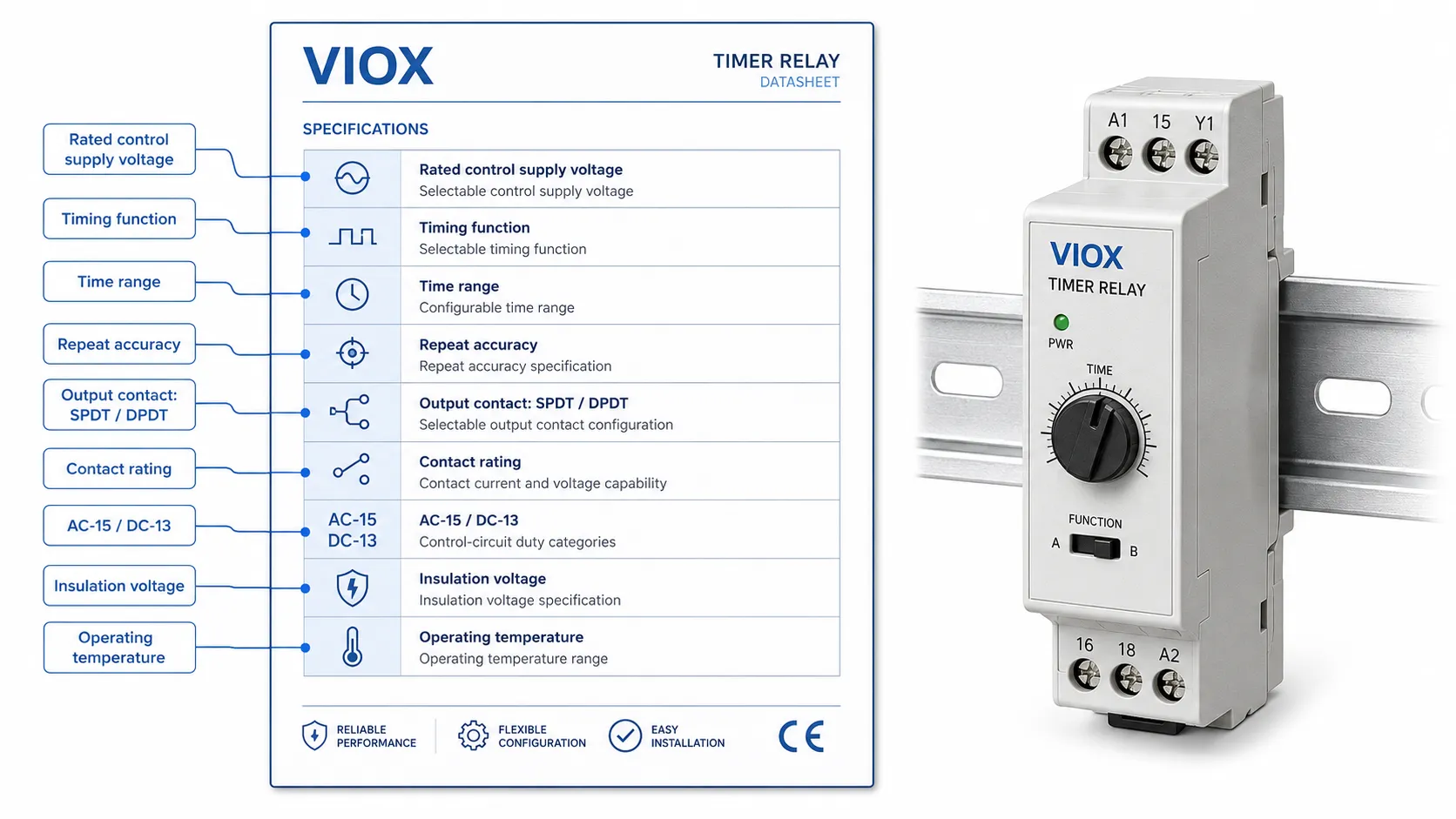
What Ratings Should Buyers Check on a Timer Relay Datasheet?
The most useful timer relay datasheets do more than list “5A” or “10A” contact capacity. They show how the product behaves as a timing device and how its output is allowed to switch real loads.
| Datasheet Item | Why It Matters |
|---|---|
| Rated control supply voltage | Determines compatible coil or electronic supply input |
| Timing function | On-delay, off-delay, interval, cyclic, star-delta, multifunction |
| Time range and repeat accuracy | Determines whether timing performance fits the application |
| Output contact configuration | SPDT, DPDT, relay output, transistor output |
| Contact rating | Must match resistive or inductive load type |
| AC-15 / DC-13 rating | Important for contactor coils, solenoids, and control circuits |
| Insulation voltage / impulse withstand | Relevant for panel safety and coordination |
| Operating temperature | Determines suitability for control cabinet environment |
| Mounting method | DIN rail, socket, panel mount, or PCB application |
| Wiring diagram | Prevents miswiring of A1/A2, trigger input, and output contacts |
For practical product selection, see How to Choose the Right Timer Relay.
Why Contact Ratings Matter: AC-1, AC-15, and DC-13
This is the part many timer relay buyers miss.
A timer relay contact marked “10A” may not mean it can switch a 10A inductive control load. Contact ratings depend on the load type.
| Load Category | Typical Meaning | Common Timer Relay Relevance |
|---|---|---|
| AC-1 | Resistive or slightly inductive AC load | Heating elements, simple resistive loads |
| AC-15 | AC electromagnetic control load | Contactor coils, relays, solenoids, pilot devices |
| DC-13 | DC electromagnetic control load | DC coils, solenoids, relay coils |
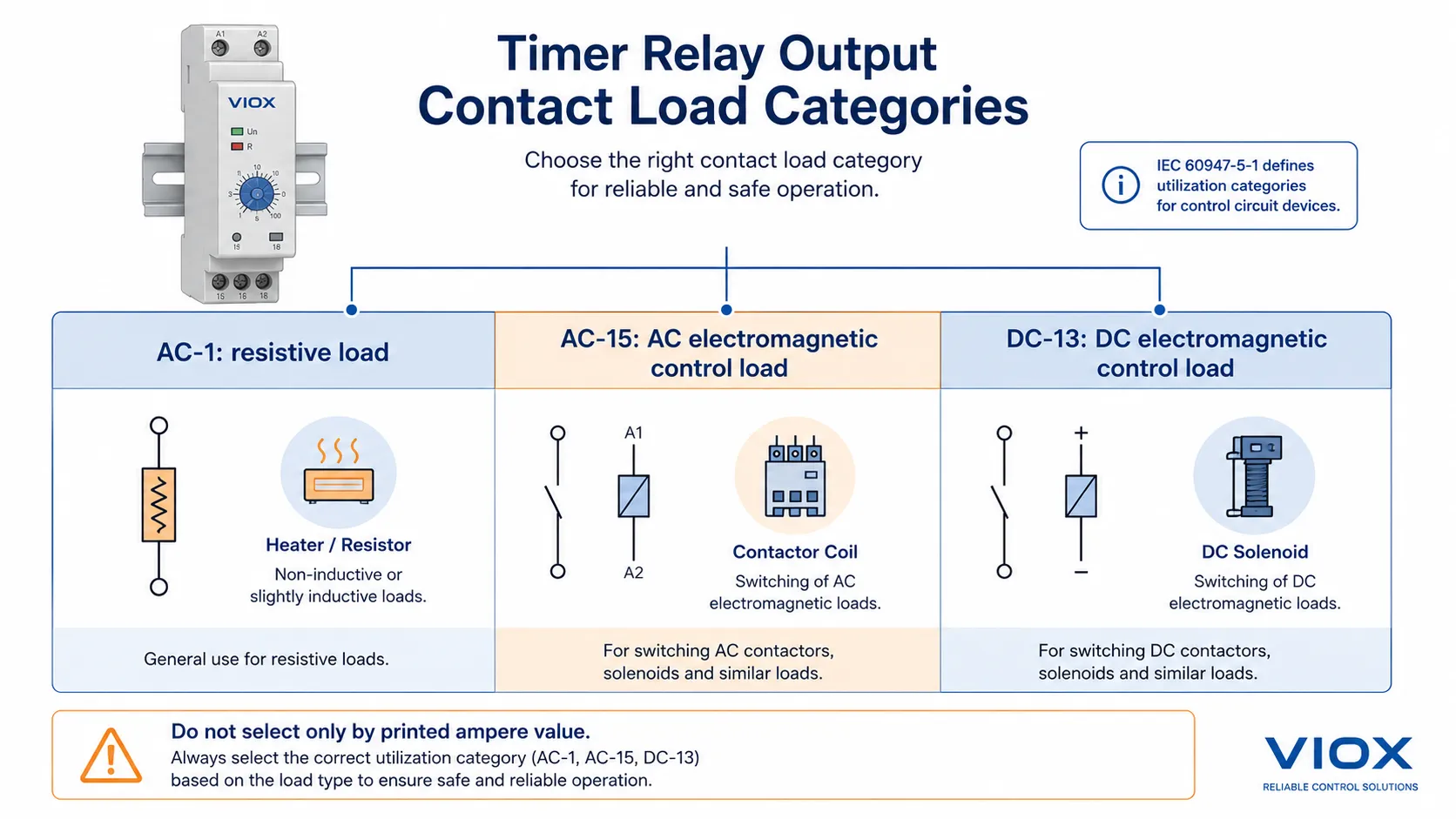
For example, a timer relay may be rated for a higher current under resistive load than under AC-15 inductive control load. This is not a defect. It reflects the fact that inductive loads create more contact stress during opening and closing.
When a timer relay switches a contactor coil, pump control coil, solenoid valve, or DC relay coil, the AC-15 or DC-13 rating is usually more relevant than the headline resistive ampere rating.
For a deeper failure explanation, see Why Time Relay Contacts Fail on Inductive Loads.
Practical Example: Why a “10A Timer Relay” Can Still Fail
Imagine a timer relay used to switch a contactor coil in a control panel.
The datasheet headline says:
- Output contact: 10A
- Supply voltage: 230V AC
- Function: on-delay
That is not enough information.
The engineer still needs to check:
- Is the 10A rating for resistive AC-1 load?
- Does the datasheet provide AC-15 rating?
- What is the contactor coil inrush and holding current?
- Does the load require an RC snubber, varistor, or suppression module?
- Is the timer relay output switching AC or DC?
- Is the relay contact rated for the switching voltage and load category?
If the relay is switching an inductive coil using only a resistive rating as the selection basis, contact welding, contact erosion, or early failure may occur.
Common Selection Mistakes
Mistake 1: Treating IEC 61812-1 as a General Relay Standard
IEC 61812-1 is specific to time relays and coupling relays. It should not be used as a blanket substitute for every relay or control device standard.
Mistake 2: Ignoring IEC 60947-5-1 Contact Load Categories
The timing function may be correct, but the contact may still be overloaded if the load category is wrong. AC-15 and DC-13 ratings are critical for control coils and inductive loads.
Mistake 3: Selecting Only by Printed Ampere Rating
A printed “10A” rating may refer to resistive load. Always check whether the datasheet gives AC-15 or DC-13 values for the actual application.
Mistake 4: Confusing EN 61812-1 and IEC 61812-1 Documentation
EN 61812-1 is the European adoption. For EU projects, check the exact EN edition and declaration. For international projects, check whether IEC documentation is required.
Mistake 5: Ignoring Supply Voltage and Timing Function
A timer relay with the correct contact rating can still be wrong if the supply voltage, timing mode, trigger input, or time range does not match the circuit.
Supplier Verification Checklist
Before approving a timer relay supplier, ask for:
- Datasheet for the exact model
- IEC 61812-1 or EN 61812-1 reference if required by the project
- Rated control supply voltage range
- Timing functions and time ranges
- Timing accuracy and repeatability
- Output contact configuration
- Contact rating by load category
- AC-15 and DC-13 ratings where applicable
- Wiring diagram
- Operating temperature and mounting method
- Declaration or certificate matching the exact product model
If a supplier cannot explain whether the output contact rating is resistive, AC-15, or DC-13, the product is not ready for serious control panel specification.
FAQ
What is IEC 61812-1?
IEC 61812-1 is the international standard for time relays and coupling relays. It defines requirements and tests for timer relay functions, ratings, marking, insulation, endurance, and performance verification.
What is EN 61812-1?
EN 61812-1 is the European adoption of IEC 61812-1. It is commonly referenced in European datasheets, declarations, and project documentation.
Is IEC 61812-1 the same as EN 61812-1?
They are closely related, but not identical labels. IEC 61812-1 is the international standard, while EN 61812-1 is the European adoption. Always check the exact edition and document scope.
Does IEC 61812-1 apply to timer relays?
Yes. IEC 61812-1 applies to time relays and coupling relays used in industrial and similar applications.
What is the difference between IEC 61812-1 and IEC 60947-5-1?
IEC 61812-1 focuses on time relay requirements and timing performance. IEC 60947-5-1 focuses on control circuit devices and switching elements, and is important for interpreting contact load categories such as AC-15 and DC-13.
Is IEC 61812-1 the same as UL 61810-1?
No. IEC 61812-1 focuses on time relays and timing performance. UL 61810-1 is relevant to electromechanical elementary relays in UL markets.
Why does a timer relay contact rating depend on AC-15 or DC-13?
Because inductive control loads create more contact stress than resistive loads. AC-15 and DC-13 ratings show whether the relay contact is suitable for AC or DC electromagnetic control loads such as contactor coils and solenoids.
Can I select a timer relay only by ampere rating?
No. You must check supply voltage, timing function, time range, output contact type, resistive and inductive contact ratings, AC-15/DC-13 ratings, wiring diagram, and operating environment.
Final Advice
IEC 61812-1 and IEC 60947-5-1 answer different but connected questions.
IEC 61812-1 helps verify whether a device is properly evaluated as a time relay. IEC 60947-5-1 helps interpret whether its output contact is suitable for the actual control load.
For engineers and buyers, the safest approach is to specify the timer relay by both timing requirements and contact load requirements. A relay that times correctly but switches the wrong load category is still the wrong relay.
Related VIOX Timer Relay Resources
- VIOX Timer Relay Products — Timer relay models for control panels, automation, and industrial applications.
- What Is a Time Relay? — Basic definition, working principle, types, and wiring.
- How to Choose the Right Timer Relay — Function, voltage, contact rating, time range, and wiring selection guide.
- Why Time Relay Contacts Fail on Inductive Loads — AC-1 vs AC-15 and contact failure explanation.
- Timer Relay Manufacturer — VIOX timer relay manufacturing and supply capabilities.
Official Standards References
- IEC 61812-1 publication — Official IEC Webstore page for IEC 61812-1.
- IEC 60947-5-1 publication — Official IEC Webstore page for IEC 60947-5-1.