

On this page
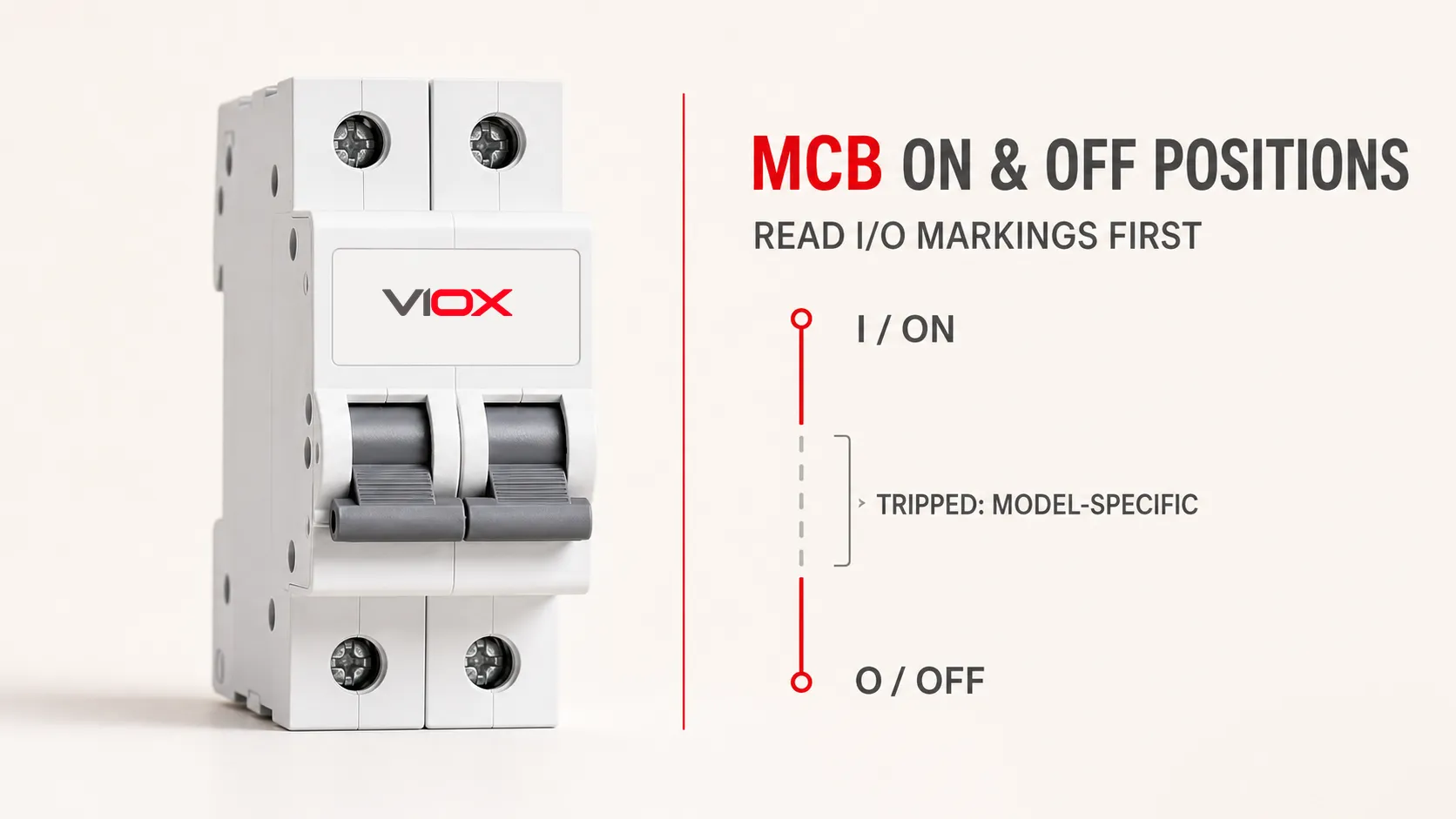
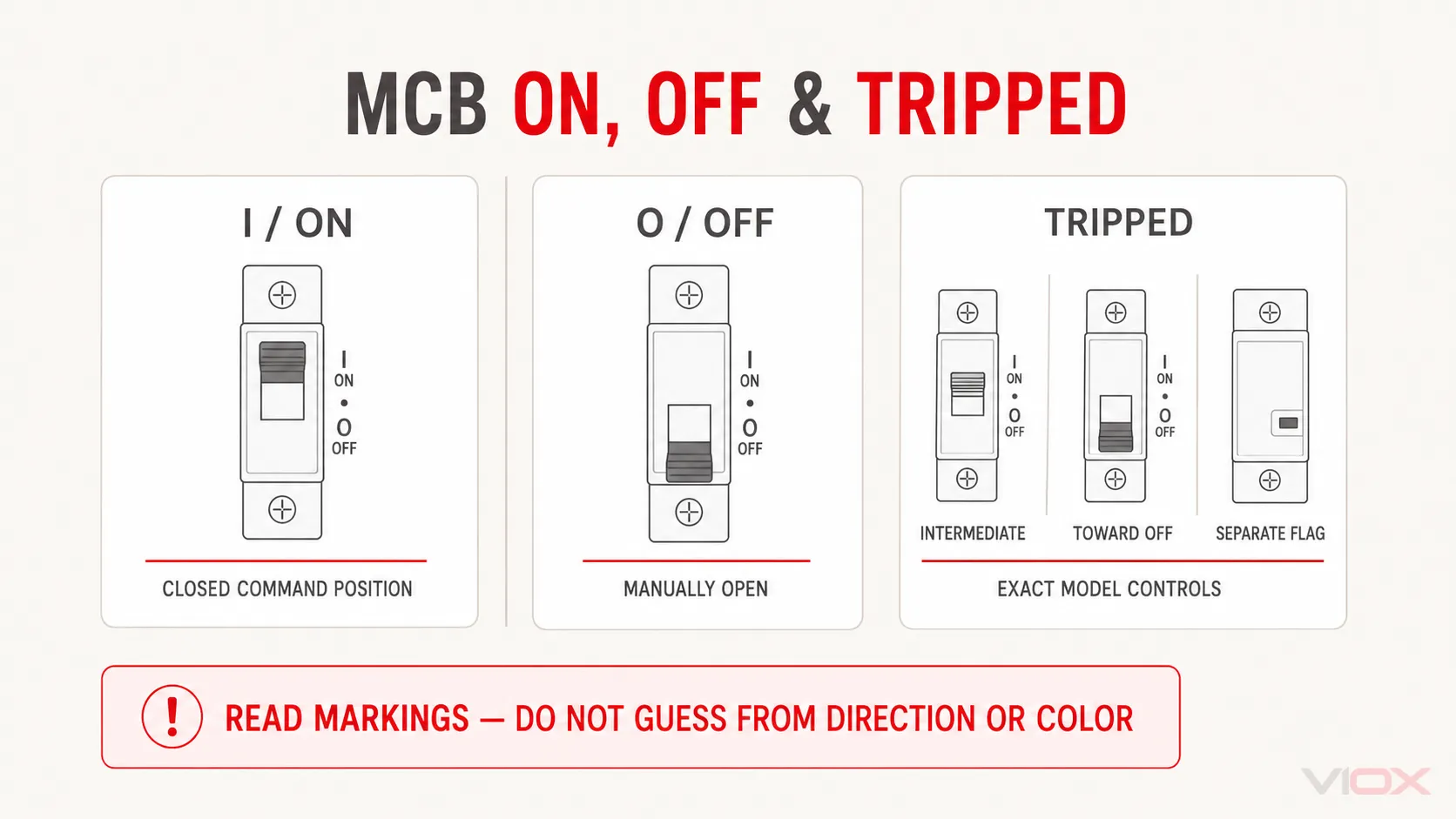
To identify an MCB’s ON and OFF positions, read the markings on the device first. I or ON identifies the closed command position; O or OFF identifies the open command position. In many vertically mounted toggle MCBs, the handle is up for ON and down for OFF, but direction alone is not a universal rule.
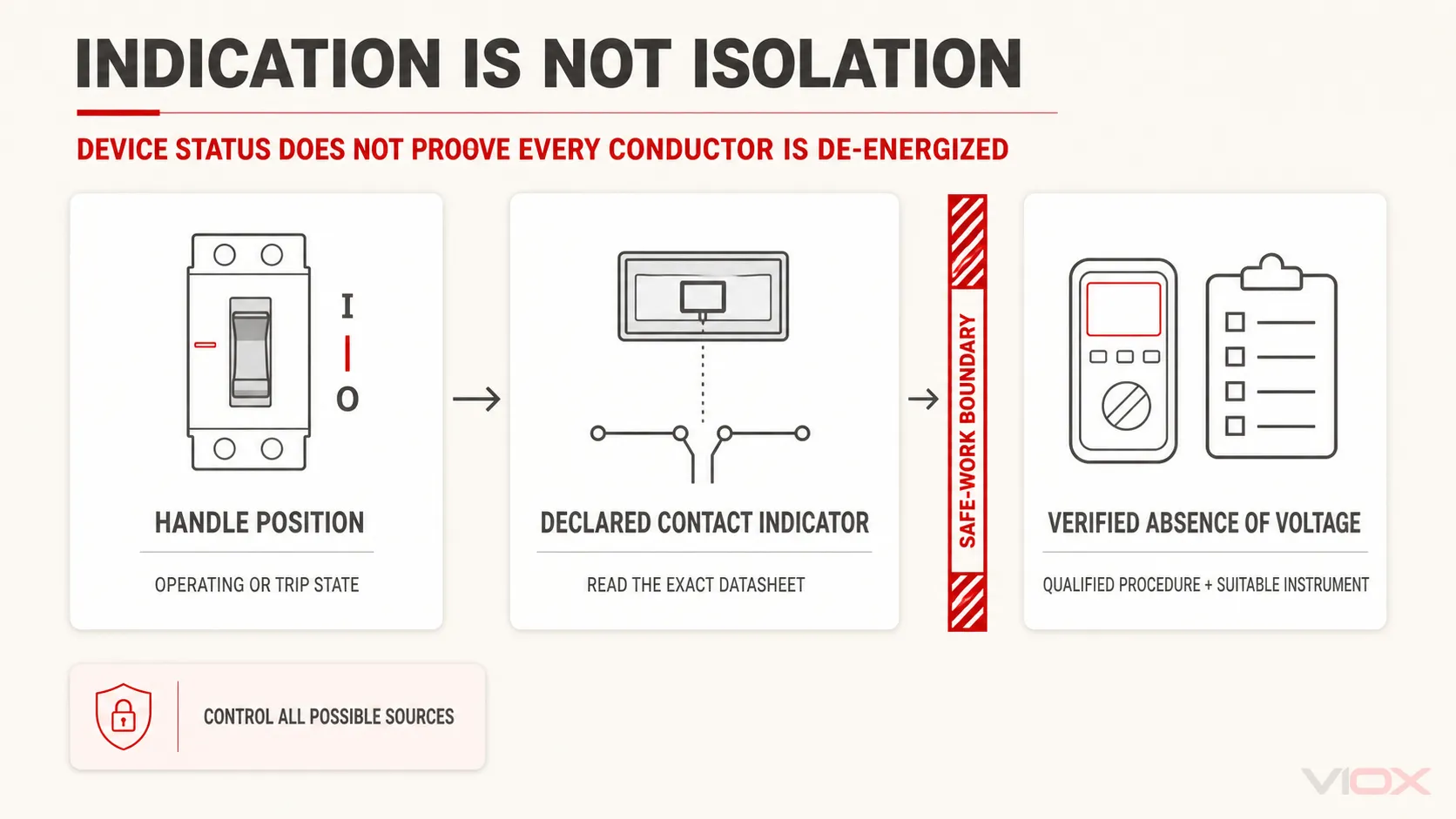
A tripped handle may sit between ON and OFF, move toward OFF, or be identified by a separate trip flag, depending on the product. Most importantly, the handle position or a colored window does not by itself prove that every relevant conductor is de-energized and safe to touch.
MCB ON, OFF, and Tripped Positions at a Glance
| Visible state | What it normally indicates | What it does not prove |
|---|---|---|
I or ON |
The breaker has been placed in its closed command position; the protected circuit may be energized | That voltage is present at every load, that the circuit is healthy, or that the internal contacts are serviceable |
O or OFF |
The breaker has been manually placed in its open command position | That the line terminals, every conductor, or equipment supplied from another source is de-energized |
TRIP, an intermediate handle, or a product-specific trip flag |
The breaker or an accessory has operated automatically | The cause of the trip, or that every breaker model uses the same handle position or indicator color |
| Unclear, damaged, or contradictory indication | The state cannot be established reliably by appearance | That comparing it with an adjacent breaker or forcing the handle is a safe solution |
The visual state is useful for operation and first-level identification. It is not a substitute for the safe-isolation and voltage-verification procedure required before electrical work.
What Do I and O Mean on an MCB?
IEC 60417 identifies symbol 5007 as ON (power) and symbol 5008 as OFF (power). On equipment, these are commonly presented as a vertical line and a circle and are often read as I and O or as 1 and 0.
I/ON: the operating control is in the closed position.O/OFF: the operating control is in the open position.
These symbols identify the intended switching state; they are not arrows showing which way current “flows.” In particular, the O symbol does not mean current flows downward to neutral or earth. That memory aid is electrically incorrect.
For a broader explanation of the device and its protection function, see What Is a Miniature Circuit Breaker?.
Is an MCB ON When the Handle Is Up or Down?
For the common upright DIN-rail arrangement, the handle is usually up for ON and down for OFF. In the North American context, NEC requirements summarized by Schneider Electric state that when a breaker handle is operated vertically, the up position is the ON position.
That rule should not be turned into a global visual shortcut. Breakers can be mounted or operated horizontally, and some products use rotary, pushbutton, or motor operators rather than a simple vertical toggle. A user may also be looking at the panel from an unusual orientation.
Use this order of evidence:
- Read
I/OorON/OFFon the exact device. - Check the handle or operator against those markings.
- Read any manufacturer-declared contact or trip indicator according to the exact product documentation.
- If the marking is hidden, damaged, or inconsistent with the operator, treat the status as uncertain and obtain qualified help.
Do not decide the state only by copying the position of adjacent breakers. Adjacent devices may control different circuits, use different mechanisms, or themselves be in an unknown state.
Handle Position, Contact Indicator, and Trip Indicator Are Different
An MCB can present more than one layer of status information.
| Information layer | What it tells you | Important boundary |
|---|---|---|
| Handle or toggle | The operating mechanism’s selected or tripped position | The exact trip position varies by model |
| Contact-position indicator | The position reported by a manufacturer-declared mechanism associated with the main contacts | Do not assume every colored window is contact-linked; verify the datasheet |
| Trip indicator | That an automatic trip event occurred | It may not identify the fault type, and not every MCB has a separate trip flag |
| Electrical verification | Whether voltage is absent at the required points under a defined safe-work procedure | Requires the correct method, equipment, competence, and control of all possible sources |
ABB, for example, documents MCB families with a real contact-position indication associated with the moving contact and a separate trip indicator. That feature is useful evidence for those named products; it is not permission to apply ABB’s colors or indicator logic to another breaker.
The safest universal rule is therefore: read the exact marking and exact datasheet; never assign a state from color alone.
How to Check Whether an MCB Is ON, OFF, or Tripped
Use this visual check only when the panel is intact, accessible, dry, and free from burning smell, smoke, arcing, unusual heat, or water ingress.
- Identify the correct circuit. Read the panel schedule and circuit label, but remember that labels can be wrong or outdated.
- Read the device face. Find
I/ONandO/OFFrather than relying on direction from memory. - Observe the handle. A handle aligned with
I/ONindicates ON; one aligned withO/OFFindicates manually OFF. - Check declared indicators. Use a contact-position or trip window only as described in the exact manufacturer instructions.
- Treat an intermediate or unclear state as possibly tripped. Do not force the handle or assume that every trip is visually identical.
- Stop if the breaker is damaged or repeatedly trips. Do not hold it in ON, increase its rating, or keep resetting it.
If your purpose is to restore power after a trip, follow the dedicated circuit-breaker reset procedure. If it trips again, use the separate MCB tripping diagnostic guide rather than repeating the reset.
Does the OFF Position Mean the Circuit Is Safe?
No. An MCB in O/OFF normally indicates that its main current path has been opened, but visual OFF is not proof that the entire work area is de-energized.
Possible remaining hazards include:
- live conductors and terminals on the supply side of the breaker;
- another supply, generator, photovoltaic source, uninterruptible power supply, or backfeed path;
- incorrect circuit identification or an outdated panel schedule;
- coupled control or auxiliary supplies;
- a damaged device or an installation that does not provide the required isolation function.
For electrical work, a qualified person must identify all relevant sources, use the appropriate disconnecting and lockout procedure, and verify absence of voltage with a suitable instrument and method required by the applicable rules. A non-contact voltage detector can be a useful preliminary screening tool, but it should not be presented as the sole method for proving a circuit dead.
If the enclosure is damaged, wet, smoking, arcing, or unusually hot, do not approach or operate it. Keep clear and obtain emergency or qualified electrical assistance appropriate to the situation.
What Does a Tripped MCB Look Like?
Many toggle breakers move to an intermediate position after a trip. UL guidance recognizes this arrangement and requires appropriate trip and reset marking when the handle uses an intermediate position. Schneider Electric documents an approximately middle trip position for its QO branch breakers.
However, other breaker designs can move the actuator toward OFF or use a separate visual flag. A breaker may also show that the contacts are open without showing whether the opening was manual or caused by a trip. Therefore, “middle always means tripped” is too broad for a global MCB guide.
For models that use a resettable intermediate trip position, the usual sequence is to move the handle fully to O/OFF before returning it to I/ON. Apply that sequence only after the downstream condition has been considered and the exact instructions permit a user reset. A trip is an event to understand, not just a handle position to clear.
Frequently Asked Questions
Which direction is ON for an MCB?
For many upright toggle MCBs, ON is up. Confirm it from the I or ON marking on the exact breaker rather than relying on direction alone.
Which direction is OFF for an MCB?
For many upright toggle MCBs, OFF is down and aligned with O or OFF. Horizontal, rotary, motor-operated, and differently mounted devices must be read from their own markings.
Is a breaker in the middle position tripped?
Often, but not universally. Some breaker families use an intermediate trip position, while others move toward OFF or provide a separate trip indicator. Check the exact product instructions.
What do red and green MCB indicators mean?
There is no safe universal color rule. A window may indicate contact position, trip status, or another product-specific state. Use the manufacturer’s legend and datasheet for that exact model.
Can I use the handle or indicator to prove the circuit is dead?
No. Handle and indicator information help identify device state, but electrical work requires control of every relevant source and an appropriate verification procedure.
Bottom Line
Use I/ON and O/OFF as the primary MCB position references. Treat up-for-ON and down-for-OFF as a common vertically mounted arrangement, not a universal law. Recognize that tripped handles and colored indicators vary by product, and never treat visual OFF as proof that a circuit is safe for electrical work.
For an exact VIOX model, consult the corresponding product documentation in the VIOX MCB range before relying on an indicator, accessory, or operating sequence.