

On this page
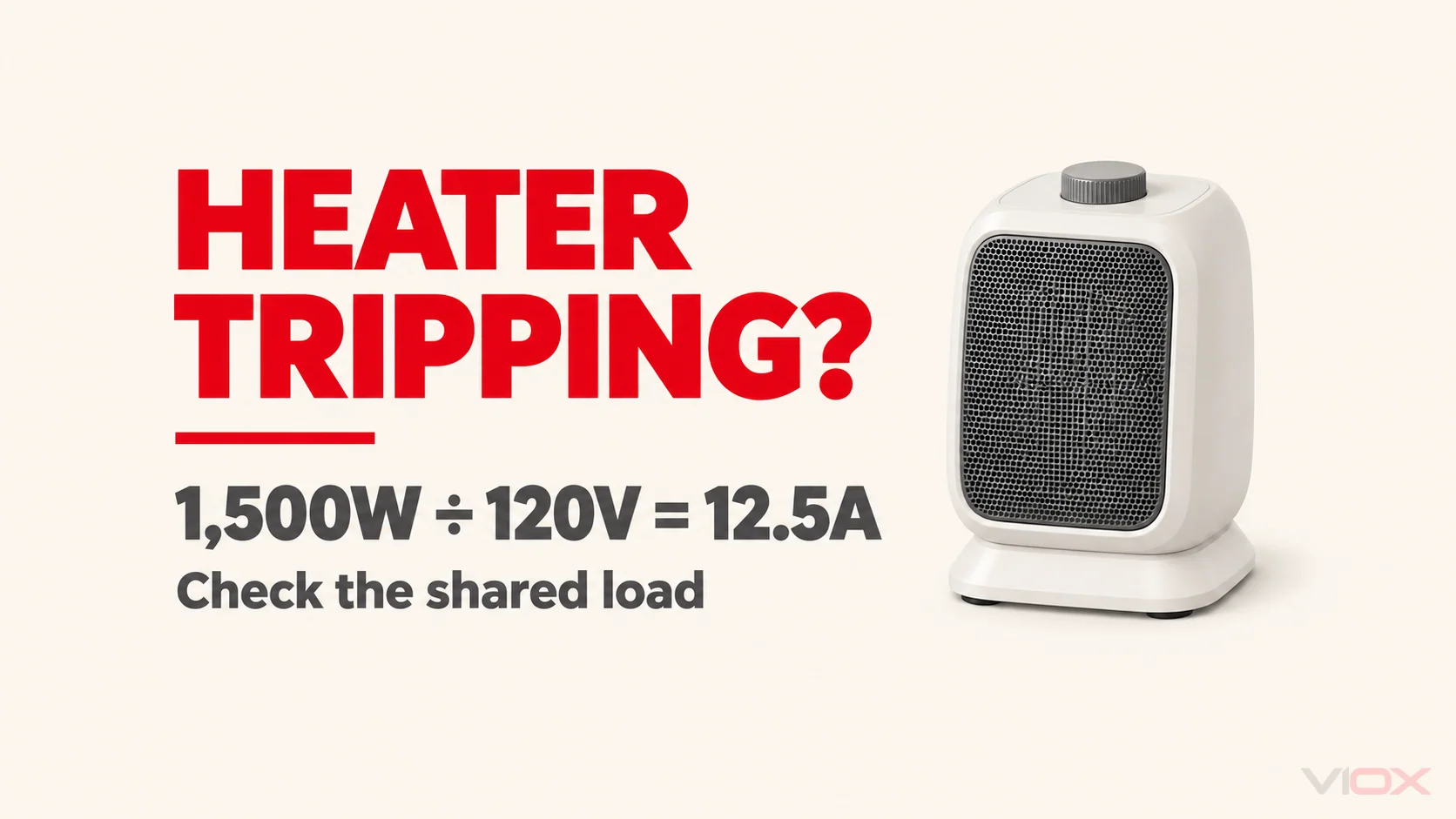
Short answer: A 1,500W space heater draws approximately 12.5A at 120V: 83.3% of a 15A circuit, and above its usual 12A continuous-load allowance when that sizing rule applies. If it trips after 20-30 minutes, check the total circuit load first; timing alone does not prove overload. Move other loads off the circuit, use a documented low-wattage setting, or have an electrician add a dedicated circuit. Never fit a bigger breaker as a workaround, and never use an extension cord or power strip.
A heater running alone at 12.5A does not, by itself, explain why a healthy 15A breaker would open after 20 minutes. If the heater really is the only circuit load and trips continue, stop using that arrangement and arrange an inspection.
This guide covers portable electric heaters on 120V household circuits. Use the actual appliance label and instructions; these numbers do not apply unchanged to a 230V heater.
How many amps does a 1,500W heater draw, and what does 80% mean?
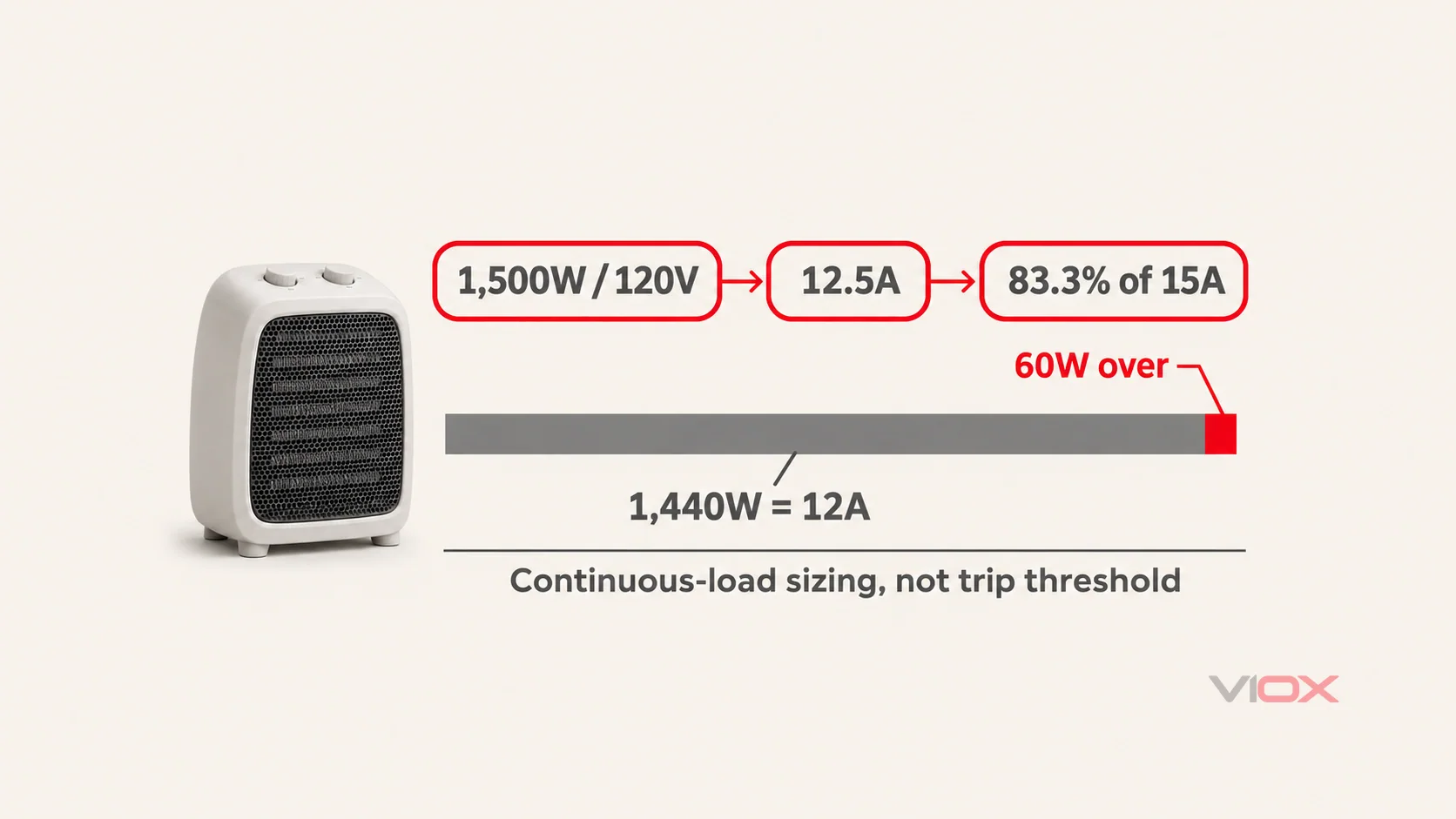
A 1,500W heater draws approximately 12.5A at 120V, equal to 83.3% of a 15A circuit rating. For this predominantly resistive heating load, the nominal calculation is:
1,500W ÷ 120V = 12.5A
12.5A ÷ 15A × 100 = 83.3%
For ordinary breakers not marked for 100% continuous operation, UL’s circuit-breaker application guide describes an 80% continuous-use limit when the load continues for three hours or more. The relevant continuous-load condition is maximum current expected to continue for that duration—not simply owning a heater or switching it on for 20 minutes.
For the heater example:
- 15A × 0.80 = 12A
- 12A × 120V = 1,440W
- 1,500W − 1,440W = 60W above that allowance
- Equivalently, 12.5A × 1.25 = 15.625A for the continuous portion of a sizing calculation.
So a full-power 1,500W heater treated as a continuous load already exceeds that allowance on a 15A circuit, even without another appliance. This does not make 12A a trip setting or prove every portable heater must run continuously at maximum power.
For a 1,500W heater at 120V, this quick check compares the heater with the usual continuous-load allowance for ordinary breakers not rated for 100% continuous operation:
| Circuit rating | Continuous-load current allowance | Continuous-load power allowance at 120V | 1,500W heater alone |
|---|---|---|---|
| 15A | 15A × 0.80 = 12A | 12A × 120V = 1,440W | 60W above the allowance |
| 20A | 20A × 0.80 = 16A | 16A × 120V = 1,920W | Within the allowance; do not add another large load |
These are continuous-load sizing allowances, not breaker trip settings or a blanket installation approval. The same UL application guidance supports the 80% basis; the table values are arithmetic at 120V. For the broader rules, see How Many Watts on a 20 Amp Circuit?.
Myth: A 15A breaker trips as soon as the heater load reaches 12A.
Fact: 12A is the usual continuous-load sizing allowance for an ordinary 15A breaker, not its trip threshold. A 1,500W heater at 120V draws approximately 12.5A; that calculation alone does not prove why the breaker operated.
Why does a space heater trip the breaker after 20-30 minutes?
A heater on an overloaded shared circuit can trip the breaker after heat accumulates, especially when a cold room keeps the heater calling for full heat. A 20-30-minute delay alone does not establish the cause. The breaker may be providing normal overload protection; timing is not proof that the breaker is defective.
There is no universal “20-minute heater trip” specification. Actual timing depends on the current, the particular breaker and its thermal conditions. Manufacturer documentation distinguishes thermal trip testing from rated-current carrying performance; for example, Schneider Electric’s thermal-magnetic breaker test guidance includes a rated-current hold test. Those are professional test procedures, not checks to perform at home.
For your heater, the useful question is: what else was operating on that breaker during those minutes? “Nothing else in this socket” does not mean “nothing else on this circuit.” Outlets across the room or in an adjoining room may share it.
If the confirmed load really is only the heater, recurring trips need investigation of the appliance, circuit connections, breaker and any additional protective function. Do not keep resetting it or dismiss the event as normal because 12.5A exceeds 12A. The general diagnostic path belongs in Why Does My MCB Keep Tripping?.
What if the breaker trips immediately when the heater starts?
An immediate heater trip is not explained by the 12A continuous-load allowance; stop using the heater and avoid repeated resets.
If safe, switch the heater off and unplug it; leave damaged, hot or discolored connections alone and obtain help.
Preserve any AFCI/GFCI trip indication and have the heater and circuit checked; do not bypass protection or increase the breaker rating.
For the wider diagnostic path, follow the MCB trip guide or the AFCI/GFCI guide.
What happens when another appliance shares the circuit?
A 1,500W heater combined with any of the three manufacturer-rated examples exceeds the load budget of both a 15A and a 20A circuit. The table uses a 1,500W heater at 120V plus published manufacturer ratings. These are simultaneous load-budget examples, not measured currents or permission to operate the combinations.
| Appliances running together | Second appliance: verified rating | Calculation at 120V | Combined load budget |
|---|---|---|---|
| Heater + hair dryer | Dyson Supersonic: 1,600W, 120V | (1,500 + 1,600) ÷ 120 | 25.83A power-equivalent minimum* |
| Heater + kettle | Hamilton Beach 40867: 1,500W | 12.5 + (1,500 ÷ 120) | Approximately 25A |
| Heater + microwave | GE JNM1541DNCC: 15A electrical input at 120V | 12.5 + 15 | 27.5A sum of load allowances |
In short: At 120V, a 1,500W heater plus the 1,600W hair dryer represents a 25.83A power-equivalent minimum under the stated unity-power-factor assumption; the heater plus the 1,500W kettle draws approximately 25A; and the heater plus the microwave’s 15A input rating gives a 27.5A sum of load allowances. All three load budgets exceed both 15A and 20A. These are planning figures, not measured combined currents.
Sources: Dyson’s US technical specification, Hamilton Beach’s 40867 specification, and GE’s JNM1541DNCC electrical ratings.
The hair-dryer figure assumes the stated real-power inputs are being drawn and unity power factor. A motor or electronic load can draw more RMS current for that wattage; use its marked input amps for the actual circuit assessment. The kettle estimate treats its heating load as resistive. The microwave row deliberately uses the manufacturer’s input amperage: adding ratings is a planning check, not an exact prediction of the combined current waveform.
Do not divide a microwave’s advertised cooking watts by 120V to size its electrical load. This GE example lists 950W cooking output, 1,580W electrical input and 15A input amperage—different quantities serving different purposes.
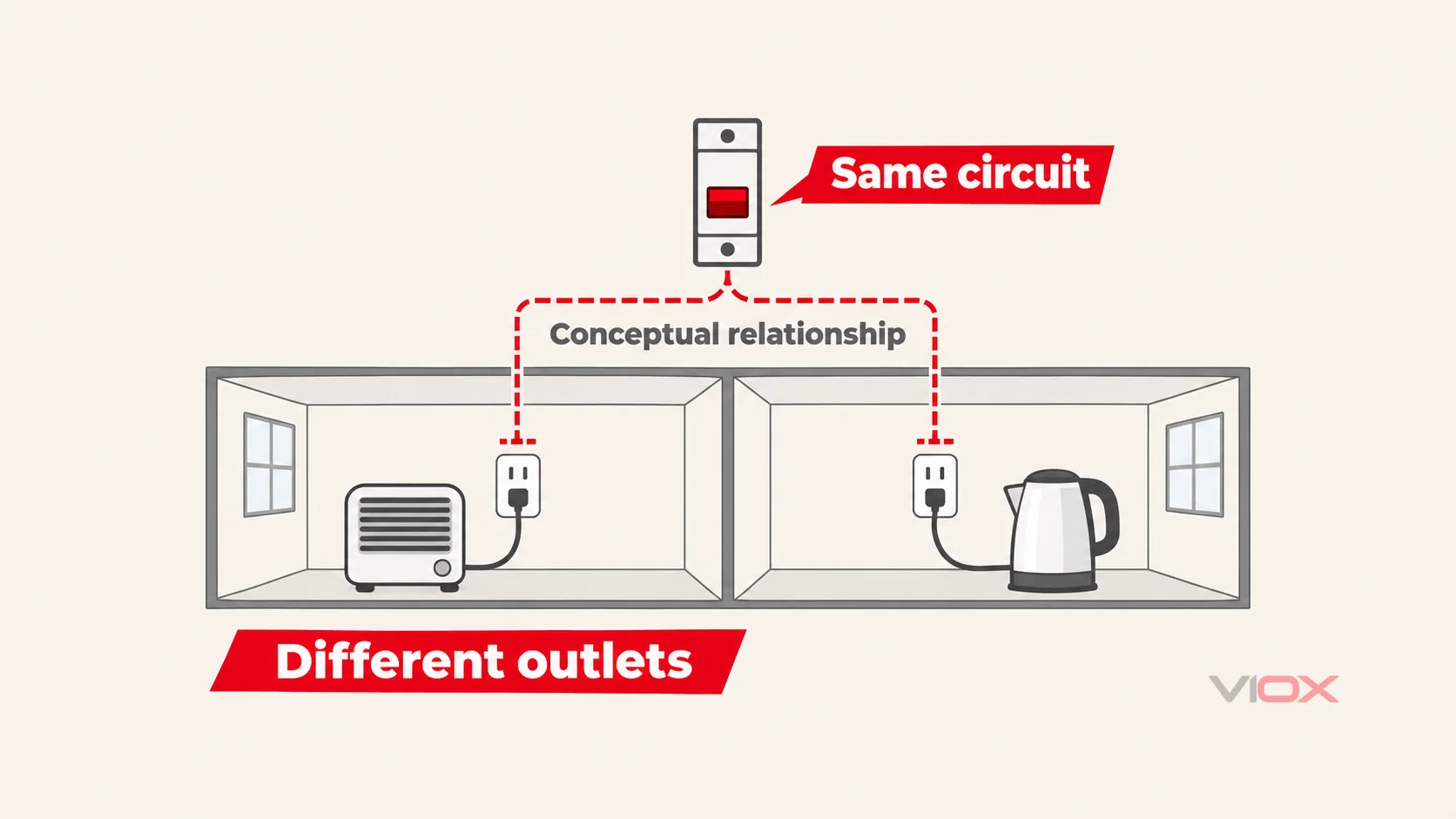
If the heater trips only when the kettle, dryer or microwave starts, remove the competing load rather than replacing the breaker. For the underlying concept, see What Is a Circuit Overload?.
Can a space heater use an extension cord or power strip?
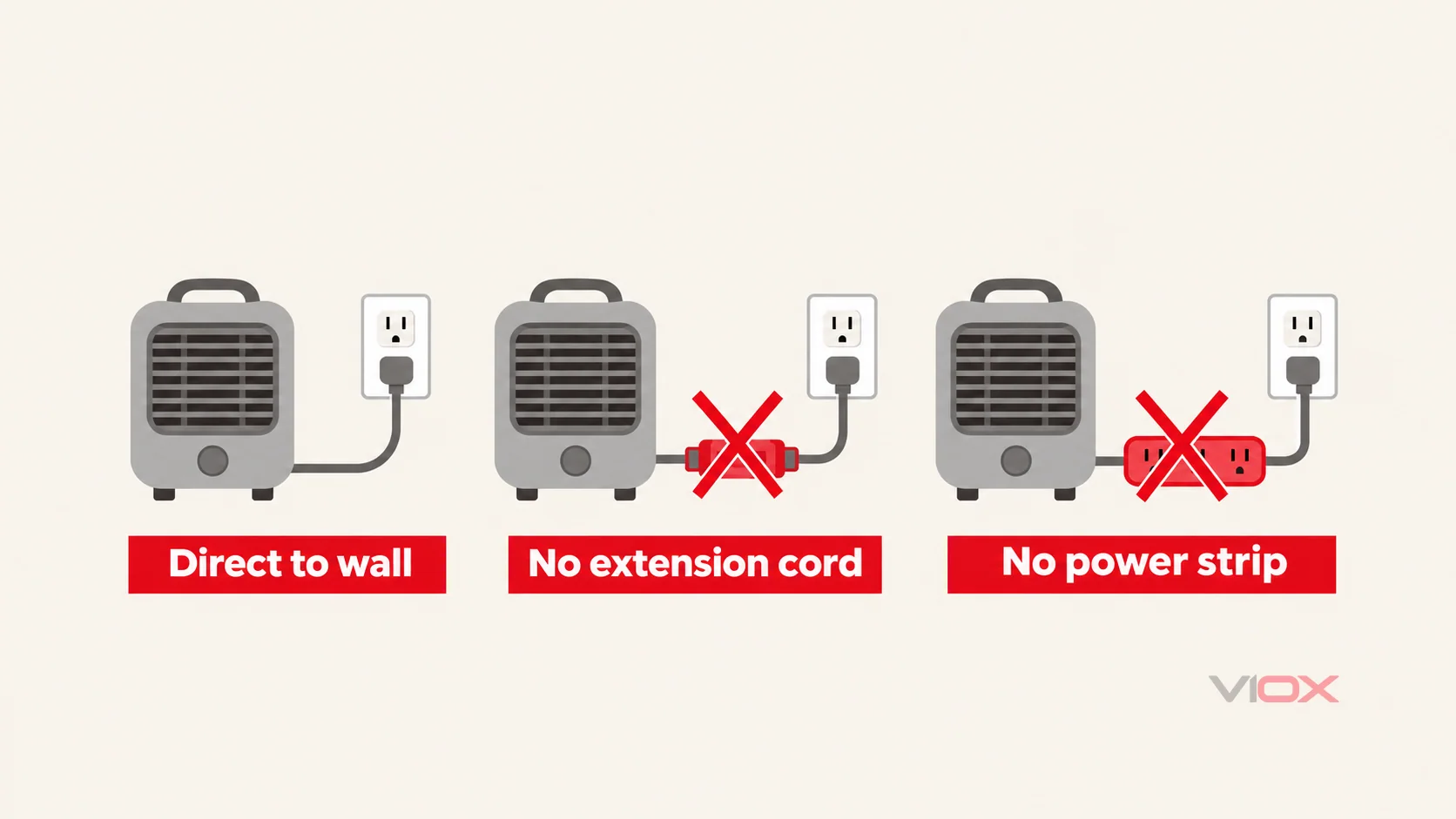
No. A portable electric heater should connect its factory cord directly to a suitable wall outlet, with no extension cord or power strip, following the US Consumer Product Safety Commission’s heater guidance.
A heater puts sustained demand on the cord and plug contacts. An added lead or strip introduces more connections and components that can overheat; a surge-protection label does not increase the branch circuit’s capacity. Even a strip marked “15A” is not an exception to the heater guidance.
If the heater cannot reach a suitable outlet, relocate it safely or have an electrician provide an appropriate outlet and supply. Do not bridge the distance with an extension lead.
Stop using the heater if its plug fits loosely, the plug or outlet becomes hot, or there is discoloration, melting or a burning smell. Have the fault checked; a breaker remaining on does not certify that a poor connection is safe. Following the same CPSC guidance, keep combustible materials at least 3 feet (0.9 m) from the front, sides and rear of the heater, and never leave it running unattended or while sleeping.
Do oil-filled and ceramic heaters draw different current?
At full power, oil-filled and ceramic heaters rated 1,500W at 120V draw approximately the same current, about 12.5A. Average consumption over time depends on thermostat cycling and power settings; oil retains heat between cycles, so steady warmth does not mean uninterrupted electrical current.
DREO’s oil-filled radiator FAQ describes stopping at the set temperature and restarting when the room cools. De’Longhi’s oil-column heater description explains continued heat release after a heating cycle pauses. These regional sources establish thermal and control behavior, not US voltage compatibility.
A ceramic fan heater transfers heat to moving air and can also cycle or change power under thermostat control. DREO’s Atom One documentation lists multiple heat modes, an adjustable thermostat and a 1,000–1,500W range. The exact control behavior depends on the model and selected mode.
For breaker loading, distinguish three things:
- While heating at full power: either type rated 1,500W at 120V has approximately the same 12.5A nominal demand. Oil-filled does not inherently mean lower current.
- While maintaining temperature: thermostat off-periods or reduced-power operation can lower average consumption. Neither type has a universal cycling interval.
- While warming a cold room: either may remain at high demand for long periods. Do not rely on future thermostat cycling to make an overloaded circuit acceptable.
Lowering the temperature setpoint may shorten heating time while leaving the on-cycle current unchanged. Selecting a genuinely lower wattage mode reduces the nominal demand while it heats. Buying a different heater technology at the same wattage is not a dependable overload fix.
What actually fixes a space heater that keeps tripping the breaker?
Reduce the circuit demand with a suitable separate circuit or a documented lower-wattage setting; if full output is needed regularly, ask an electrician to design a dedicated supply. A bigger breaker alone does not increase the existing circuit’s capacity.
1. Will moving the heater to another circuit help?
Moving the heater helps only when the destination is a suitable separate circuit with adequate capacity for its intended duty. Turn the heater off and unplug it before moving it. Check the circuit directory and which outlets lost power when the breaker opened. Room boundaries are not circuit boundaries; if the mapping is uncertain, have an electrician confirm it without opening the panel yourself.
Choose a sound wall outlet on a circuit with adequate capacity for the heater’s intended duty. Remove competing loads; US Fire Administration heater guidance advises against plugging other devices into the same circuit. A lightly loaded circuit is a starting point for checking capacity, not automatic approval for prolonged full-power operation.
Do not transfer the heater to a kitchen or bathroom outlet simply because it appears to have a larger breaker. The circuit’s permitted use, existing loads, protective devices and the heater’s placement instructions still matter.
2. Does a low-wattage heat setting reduce the load?
Yes. A documented lower-wattage heat mode reduces the nominal current while the heater is heating. If the manual specifies a 1,000W heat mode, the heater’s nominal demand becomes 1,000W ÷ 120V ≈ 8.33A. That removes about 4.17A compared with 1,500W operation. It also provides less heat.
Check the manual rather than assuming every “Low,” “Eco,” fan-speed control or lower thermostat setting means 1,000W. Some automatic modes return to full power. Use a documented lower-power heat setting, then reassess all circuit loads.
If trips recur with competing loads removed and the heater on a documented low setting, stop using that arrangement and have it inspected. Repeated resets are not a way to verify safety.
3. When should an electrician add a dedicated circuit?
If regular heating requires full output and the existing circuit cannot support it, request a properly designed dedicated circuit and conveniently located receptacle. Give the electrician the heater’s nameplate, manual, intended operating duration and the list of other loads.
Do not replace a 15A breaker with a 20A breaker simply to stop the trips. A higher number on the breaker does not upgrade the wiring, connections, receptacles or panel compatibility. Circuit capacity must be assessed as an installation; the breaker protects that installation.
If an arc-fault circuit interrupter (AFCI) or ground-fault circuit interrupter (GFCI) indicates an arc or leakage event, do not remove that protection or assume the watts explain it. Use the separate AFCI/GFCI nuisance-tripping guide for that diagnostic branch and have the fault evaluated.
FAQ
Why does my space heater trip the breaker after 20 minutes?
A shared-circuit overload can take time to operate the breaker’s thermal protection. Twenty minutes alone does not prove the cause. A 1,500W heater is approximately 12.5A at 120V; the 80% continuous-load allowance is not a 12A trip threshold. If it repeatedly trips with no other circuit load, arrange inspection.
Can I just use a bigger breaker for my space heater?
No. Do not fit a bigger breaker to stop space-heater trips. Reduce the load, use an appropriate separate circuit, or have an electrician design a dedicated supply. Increasing the breaker rating without verifying the entire circuit can leave the wiring inadequately protected.
Is it safe to plug a space heater into a power strip?
No. A portable space heater must plug directly into a suitable wall outlet. CPSC advises against both power strips and extension cords for portable electric heaters, including strips sold with surge protection.
How many amps does a 1,500 watt heater draw?
A 1,500W space heater draws approximately 12.5A at 120V. That is 83.3% of a 15A circuit rating, above the usual 12A continuous-load allowance when applicable. Actual assessment must use the heater label and operating mode; the 12A allowance is not a breaker trip threshold.
Can a space heater run on a 20 amp circuit?
A 1,500W heater at 120V draws approximately 12.5A, within the usual 16A / 1,920W continuous-load allowance on an ordinary 20A circuit. The outlet, circuit condition, other loads and heater instructions must also be suitable. Do not add another large appliance or assume a 20A breaker prevents every kind of trip.
Does the low setting on a space heater use less electricity?
A documented 1,000W heat setting draws approximately 8.33A at 120V, compared with approximately 12.5A at 1,500W, so it uses less power while heating. Total energy consumption also depends on operating time. Lowering only the thermostat setpoint may leave on-cycle power unchanged; check the model’s documented heat setting.
References
Ratings checked November 2026. Appliance figures are model-specific; circuit allowances are calculations at 120V based on the cited continuous-load guidance.
- UL Solutions: Circuit Breaker Marking and Application Guide – ordinary continuous-use limits and application boundaries.
- CPSC: Reducing Fire Hazards for Portable Electric Heaters – direct-wall connection, hot or loose connection warnings, and 3-foot combustible clearance.
- US Fire Administration: Heater Fire Safety – circuit sharing and direct-outlet guidance.
- Dyson Supersonic US technical specification – 1,600W at 120V.
- Hamilton Beach 40867 kettle specification – 1,500W kettle example.
- GE JNM1541DNCC specifications – 15A at 120V, 1,580W input and 950W cooking output.
- Schneider Electric: Thermal-Magnetic Circuit Breaker Performance Tests – thermal trip and rated-current hold-test distinction.
- DREO Atom One US documentation – 1,000-1,500W range and thermostat control.
- DREO oil-filled radiator FAQ – thermostat stopping and restarting; regional behavior evidence only.
- De’Longhi oil-column heater description – heat retention between cycles; regional thermal-behavior evidence only.