

On this page
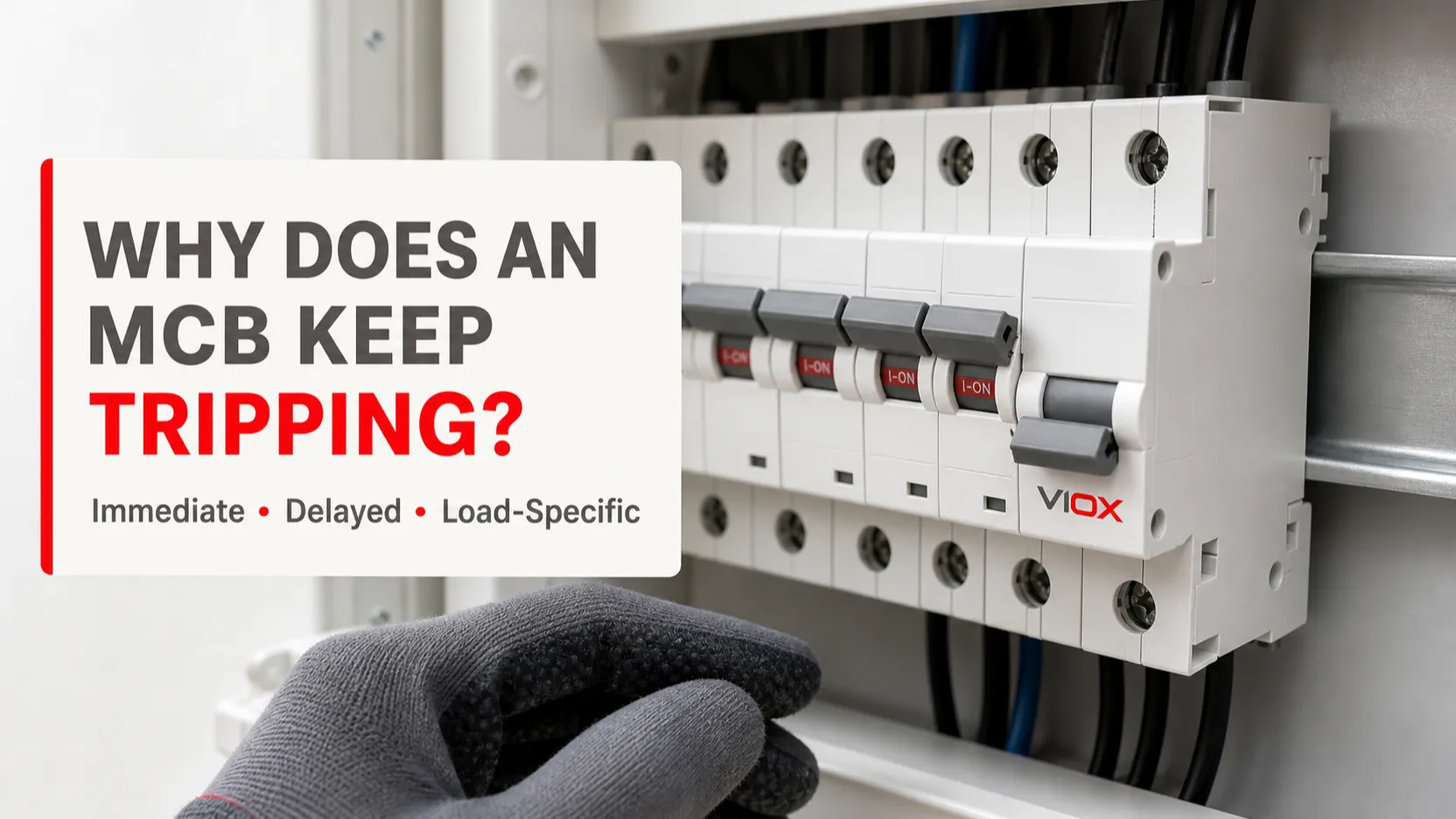
If an MCB keeps tripping, the circuit is usually reaching the breaker’s thermal or instantaneous pickup region repeatedly—or an installation or device condition is affecting the protective mechanism. Do not solve repeated tripping by repeatedly resetting the breaker or installing a higher current rating. First identify which protective device operated, note when it trips, remove only safely accessible loads, and stop if the circuit shows signs of damage.
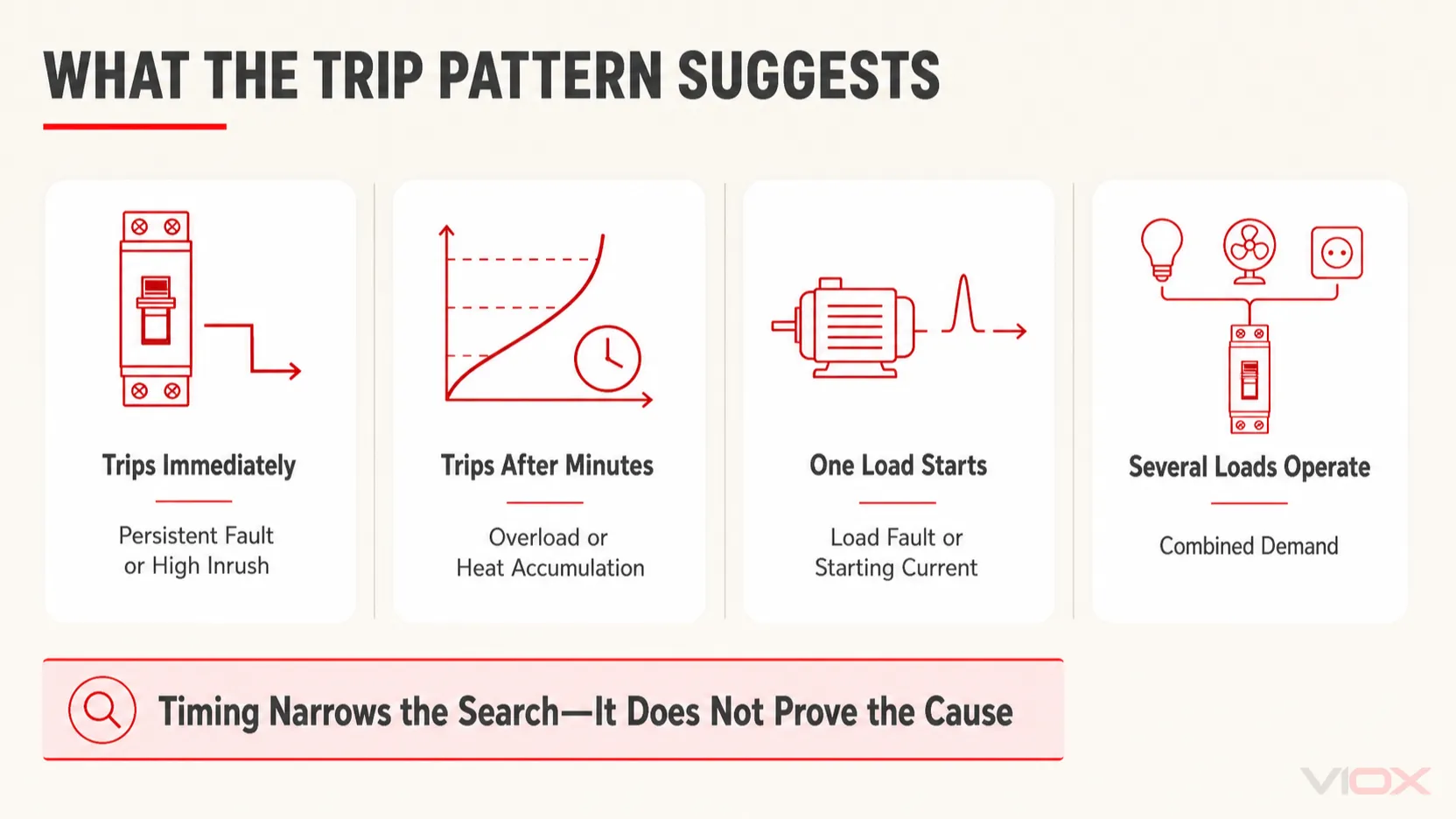
Trip timing is a useful clue, not a final diagnosis. An immediate trip may indicate a short circuit, but high starting current can also enter the magnetic pickup range. A trip after several minutes often points toward sustained overload or accumulated heat, but it can also involve a poor connection, high ambient temperature, damaged equipment, or an unsuitable installation.
Key Takeaways
- Trips immediately: suspect a persistent fault or very high inrush current; do not keep resetting it.
- Trips after a few minutes: investigate sustained current and heating rather than assuming the MCB is defective.
- Trips when one load starts: isolate that load and verify its condition, starting current, and protective-device coordination.
- Trips only with several loads: the combined demand may exceed the circuit’s intended capacity.
- Trips with no accessible loads connected: leave the circuit off and arrange qualified testing.
- Burning odor, discoloration, melted insulation, crackling, sparking, water exposure, or unusual panel heat: stop troubleshooting and contact a qualified electrician.
First Confirm Which Device Is Tripping
People often use “MCB” to describe every device in a distribution board. That can send the diagnosis in the wrong direction because an MCB and a residual-current device respond to different electrical quantities.
| Device that operated | Common identification clues | What normally causes it to operate | Diagnostic implication |
|---|---|---|---|
| MCB | Current rating such as 16 A or 32 A; IEC-style products may show B, C, or D before the rating | Overcurrent through the protected pole: sustained overload or current in the instantaneous pickup region | Focus on circuit current, inrush, short circuit, thermal conditions, connections, and breaker condition |
| RCCB/RCD | Test button and residual-current marking such as IΔn; may show 30 mA, 100 mA, or 300 mA | Residual-current imbalance; it does not provide integral overcurrent protection | Focus on leakage, insulation, moisture, neutral-to-earth problems, and cumulative leakage |
| RCBO | MCB-style current/curve marking plus a test button and residual-current marking | Either overcurrent or residual current, depending on the event and device indication | Determine which protection function operated before selecting the test path |
A standard MCB is not a residual-current device and does not provide additional protection based on residual current. An earth fault may operate an MCB if the resulting overcurrent reaches its trip threshold, but the MCB must not be treated as a substitute for an RCCB, RCBO, or—where North American terminology applies—a GFCI.
Diagnose the Pattern Before You Reset
The following matrix is designed to narrow the investigation without pretending that one observation proves the cause.
| What you observe | Likely direction | What would strengthen the diagnosis | Safe next action |
|---|---|---|---|
| MCB trips immediately after one reset attempt | Persistent short circuit, damaged wiring or load, or starting current entering the instantaneous range | It still trips with all safely accessible loads switched off or unplugged; damage or odor is present | Leave the circuit off. Do not repeat the reset. Arrange qualified testing |
| MCB trips after a few minutes or about 10 minutes | Sustained overload, thermal accumulation, warm enclosure, adjacent-device heating, poor connection, or equipment drawing excessive current | Trip time shortens as load or panel temperature rises; measured current or thermal inspection identifies an abnormal condition | Reduce accessible load. If recurrence remains, keep the circuit off and test current, connections, and thermal conditions |
| MCB trips only when one appliance or machine starts | Faulty equipment, high starting current, stalled motor, unsuitable trip characteristic, or undersized circuit | The event consistently follows the same load command; startup-current measurement or equipment testing identifies the cause | Disconnect the suspected load and have it checked. Do not test a damaged appliance on another circuit |
| MCB trips only when several loads run together | Combined load exceeds the circuit design or one load is drawing more than expected | The circuit remains stable when high-demand loads are not operated together; current measurement confirms the loading pattern | Stop simultaneous operation. Have circuit capacity and load allocation reviewed if this is a recurring operating need |
| MCB trips randomly, later in the day, or when the panel is warm | Intermittent equipment cycle, ambient heating, dense-device heating, loose or oxidized connection, or an intermittent wiring fault | Event timing follows temperature, an automatic load cycle, moisture, or an identifiable operating state | Record the operating pattern. Qualified personnel should inspect and measure rather than guessing from the handle position |
| MCB will not reset or stay on with accessible loads removed | Fixed wiring fault, internal equipment still connected, damaged breaker, incomplete mechanical reset, or another protection device actually operated | Correct device identification and a proper OFF-to-ON reset do not restore the circuit | Leave it off. Do not open the panel or replace the breaker without testing the circuit |
For a deeper evidence-based distinction between overload, short circuit, and an inconclusive trip, see How to Know Why a Breaker Tripped. That separate guide explains why timing alone cannot identify the operated protection function with certainty.
Stop Immediately if There Are Signs of Damage
Do not attempt another reset if any of the following is present:
- persistent burning or acrid odor;
- visible discoloration, melted insulation, or a deformed breaker enclosure;
- sparking, crackling, buzzing, or signs of arcing;
- smoke, fire damage, or water inside or near electrical equipment;
- an electric shock or tingling sensation from connected equipment;
- a panel cover or breaker area that is unusually hot compared with similar loaded circuits;
- immediate retripping after accessible loads have been disconnected;
- uncertainty about which device operated or which circuit it controls.
Switch off the affected circuit if this can be done without approaching damaged equipment. For smoke, fire, or a visibly unsafe panel, follow local emergency procedures and do not touch the equipment.
Why an MCB Trips After a Few Minutes or About 10 Minutes
A delayed trip commonly involves the MCB’s thermal release. Current heats a bimetal element, and the time required to release the mechanism depends on current magnitude, prior loading, ambient temperature, neighboring devices, conductor heat flow, and the product’s time-current characteristic.
This inverse-time behavior means there is no universal “10-minute fault.” Higher sustained overcurrent generally produces a faster thermal response, while a smaller overload may take longer. Manufacturer trip curves show a tolerance band, not one exact operating time. The mechanism is explained in more depth in How Does an MCB Work?.
Sustained overload is the first condition to check
An overload exists when the operating current exceeds what the circuit and protection arrangement are intended to carry for the relevant duration. Common operating patterns include:
- several heating appliances or other high-demand loads on one final circuit;
- a motor, compressor, or pump drawing excessive running current;
- a machine operating in a mechanically overloaded or stalled condition;
- added equipment increasing the demand beyond the original circuit design;
- a load whose current has risen because of an internal fault or degraded operating condition.
For a simple resistive single-phase load, current can be estimated approximately as:
I ≈ P / VThis estimate is not sufficient for motors, electronic power supplies, nonlinear loads, or equipment with significant power-factor and efficiency effects. A qualified person should measure operating and starting current and compare the results with the equipment data, conductor capacity, MCB rating, installation conditions, and applicable design rules.
Do not apply a universal “80% rule” to every installation. Continuous-load rules and conductor/protection requirements depend on the applicable code, device standard, conductor system, installation method, and market.
Ambient and adjacent-device heat can move the trip point
Thermal-magnetic MCBs are calibrated under declared conditions. A hot enclosure, dense rows of loaded devices, inadequate ventilation, or a recently tripped breaker can place the thermal release closer to operation. ABB’s published MCB guidance notes that thermal behavior depends on ambient temperature and that designers should use the manufacturer’s current-correction data for the specific series.
The correct response is not to assume that the breaker is “too sensitive.” Verify the actual current, panel temperature, device spacing or correction requirements, conductor loading, and product documentation.
A loose connection is a heating hazard, not an automatic diagnosis
A loose, contaminated, or oxidized termination can create high contact resistance and localized heating. That condition does not necessarily create enough overcurrent to trip an MCB directly. Repeated tripping may occur if heat is conducted into the breaker’s thermal system, if the connection damages insulation and develops into a fault, or if the load and thermal conditions together cross the trip characteristic.
Do not remove a panel cover or retorque terminals as a DIY test. Qualified personnel should de-energize and secure the equipment, inspect for damage, verify connections using the manufacturer’s specified method and torque data, and compare thermal measurements under known load conditions. Schneider Electric’s troubleshooting guidance specifically includes overheating at loose or oxidized wire and bus connections as a condition that must be investigated.
Why an MCB Trips Immediately After Resetting
A magnetic release responds rapidly when overcurrent reaches its instantaneous pickup range, typically during a short circuit. However, an immediate trip does not prove that a short circuit exists.
Possible causes include:
- phase-to-neutral or phase-to-phase short circuit;
- damaged cable insulation or a fault in fixed wiring;
- an appliance or machine with an internal short circuit;
- a motor, transformer, power supply, lamp driver, or capacitor bank with starting current above the MCB’s instantaneous pickup band;
- a mechanically stalled motor drawing high current;
- an unsuitable MCB characteristic for a properly designed high-inrush load;
- incorrect wiring or a damaged protective device.
If the MCB immediately trips again after accessible loads have been switched off or unplugged, leave it off. Repeated closing onto a fault can impose additional electrical and mechanical stress on the circuit and switching device.
Why the MCB Trips When One Appliance or Machine Starts
When one load consistently triggers the trip, there are two broad possibilities:
- The load is abnormal. Damaged insulation, an internal short circuit, a stalled motor, worn mechanical parts, or a defective power supply can produce excessive current.
- The load is healthy but poorly coordinated with the circuit. Starting or energization current may enter the MCB’s instantaneous pickup band even though steady-state current is acceptable.
The safe first action is to stop using and disconnect the suspected load if it can be unplugged or isolated through its normal controls. Do not move a suspect appliance to another circuit merely to see whether another breaker trips. Have the equipment inspected or tested according to its product instructions.
For a fixed or industrial load, diagnosis may require startup-current capture, operating-current measurement, insulation testing, motor or mechanical inspection, and comparison with the manufacturer’s time-current data.
Do not change from B to C or D on guesswork
In IEC-style MCB marking, B, C, and D characteristics have different instantaneous pickup ranges. A curve with a higher magnetic pickup band may tolerate more inrush, but it also requires verification that the available fault current can still operate the protective device within the required conditions.
Changing the curve or rating can affect conductor protection, fault disconnection, coordination with upstream and downstream devices, and the installation’s compliance basis. Use the MCB curve and type guide to understand the terminology, then verify the actual selection through an electrical design assessment.
Why the MCB Trips Only When Several Loads Operate Together
This pattern strongly suggests that combined demand matters, but it does not prove every connected appliance is healthy. One deteriorating load may draw more current than expected and push an otherwise acceptable circuit beyond its operating limit.
Start by recording:
- which loads were operating;
- whether any heating, motor, compressor, or high-power appliance had just started;
- how long the circuit operated before the trip;
- whether the same combination reproduces the event;
- whether the panel had already been heavily loaded or warm.
Turning off non-essential accessible loads may prevent an immediate recurrence, but it is not a permanent solution when the operating requirement regularly exceeds the circuit design. An electrician or system designer should review load allocation, conductor capacity, the protective-device rating, and the need for a dedicated circuit.
Never install a higher-ampere MCB solely to stop tripping. The existing MCB may be limiting current to protect conductors whose size, installation method, grouping, and temperature rating have not changed.
Why the MCB Trips Randomly or Later in the Day
“Random” tripping often becomes less random when operating conditions are logged. Look for a relationship with:
- thermostat-controlled heaters or water-heating equipment;
- refrigeration, HVAC, pumps, or compressors cycling automatically;
- production equipment entering a particular process step;
- solar, storage, or charging equipment changing operating mode;
- rainfall, condensation, washdown, or humidity;
- rising enclosure temperature or simultaneous loading later in the day;
- vibration or movement affecting damaged wiring or connections.
A simple event log should record time, connected loads, operating state, weather or moisture conditions, and whether the trip was immediate or delayed. This does not replace measurement, but it gives the electrician a reproducible condition to investigate.
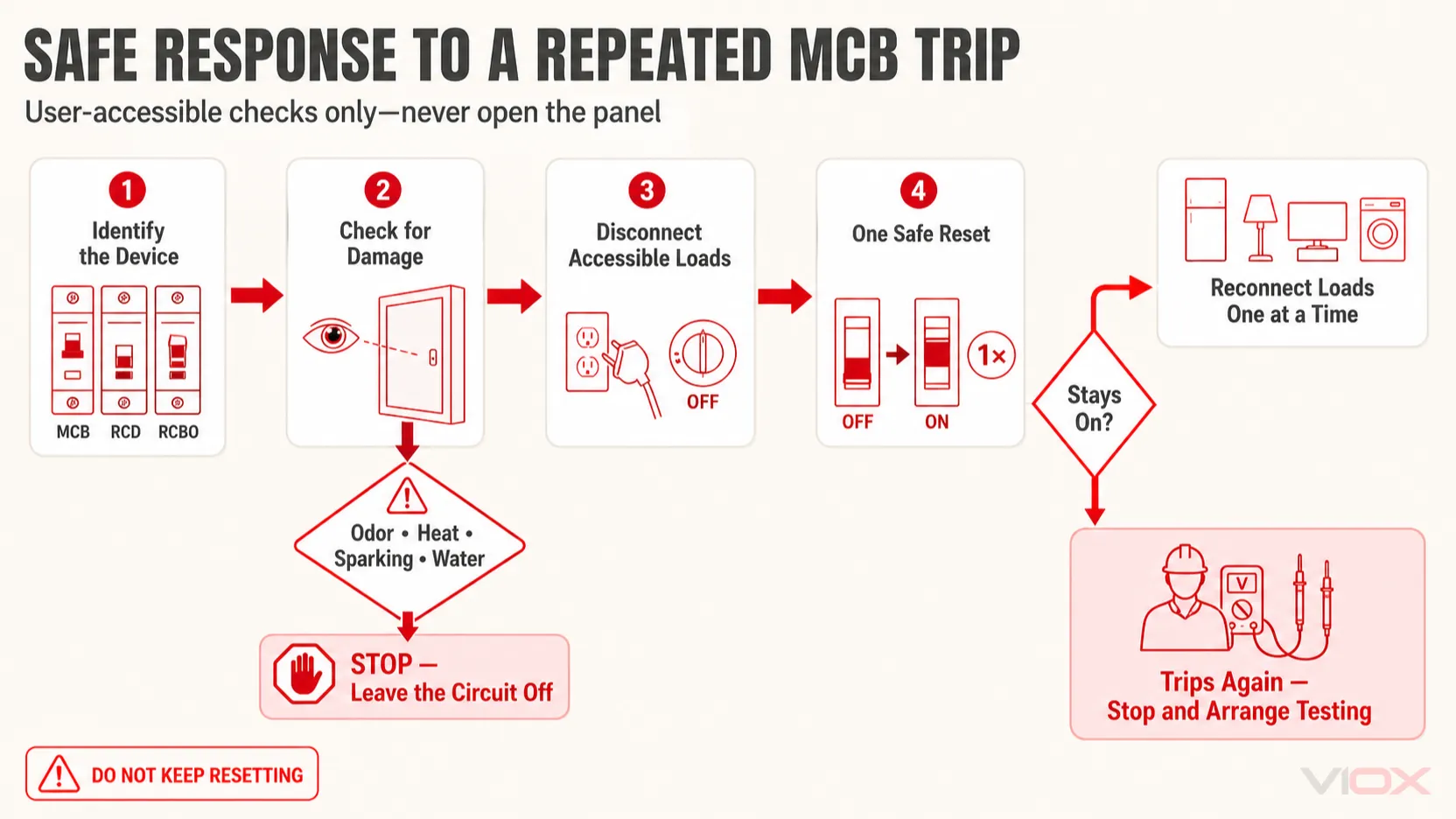
Safe Checks Before One Reset Attempt
These checks are limited to normal user-accessible controls and plug-connected loads. Do not remove covers, access terminals, use improvised test equipment, or work on exposed energized parts.
- Identify the device and affected circuit. Confirm whether the operated device is an MCB, RCCB/RCD, or RCBO.
- Look and listen from a safe position. If there is odor, heat, discoloration, crackling, moisture, or damage, stop.
- Switch off or unplug accessible loads on the affected circuit. Do not handle damaged plugs, cords, or wet equipment.
- Reset only if there are no danger signs and the suspected accessible load has been removed. Many breaker mechanisms must first be moved fully to OFF and then to ON.
- Stop if it trips again. Do not repeat the reset to “test” a persistent fault.
For the complete mechanical reset procedure and its limitations, use How to Reset a Circuit Breaker.
What a Qualified Electrician Should Verify
The correct test sequence depends on the circuit, device, and event pattern. It may include:
| Verification | What it can reveal |
|---|---|
| Load and startup-current measurement | Sustained overload, excessive starting current, stalled equipment, or a current pattern inconsistent with the load data |
| Inspection of conductors, terminals, bus connections, and the breaker seat | Loose, oxidized, discolored, pitted, or heat-damaged connections and components |
| Insulation-resistance and circuit testing | Faulted wiring, damaged equipment insulation, or a fault that remains after accessible loads are removed |
| Thermal comparison under known load | Abnormal heating relative to similar devices and connections operating under comparable conditions |
| Review of time-current curves and correction data | Whether the MCB rating and characteristic coordinate with operating current, inrush, ambient conditions, conductors, and available fault current |
| Breaker trip testing when justified | Whether the device operates within the manufacturer’s characteristic under a controlled test method |
Measurements must be interpreted against the exact MCB series, declared standard, installation conditions, and manufacturer data. A generic trip time or temperature taken from another product is not a valid replacement criterion.
When the MCB Itself May Be Faulty
An MCB can be damaged, worn, contaminated, incorrectly installed, or thermally affected, but it should not be treated as the first explanation for every repeated trip. Suspect the device more strongly when:
- verified circuit current and starting current are within the coordinated design limits;
- wiring and connected equipment pass the required tests;
- terminals and mounting interfaces are correct and free of damage;
- ambient and grouping conditions satisfy the product requirements;
- the breaker shows mechanical damage, discoloration, poor engagement, or abnormal operation;
- controlled testing places its performance outside the manufacturer’s characteristic.
There is no universal 25-year, 30-year, or 40-year replacement rule for every MCB. Condition, fault duty, switching history, installation environment, manufacturer instructions, and verified test results matter more than an unsupported age estimate. See How to Know if a Circuit Breaker Is Bad for the separate breaker-condition workflow.
What Not to Do
- Do not keep resetting an MCB that trips immediately or repeatedly.
- Do not hold the handle in the ON position.
- Do not replace it with a higher current rating to suppress tripping.
- Do not change the trip curve without verifying inrush, conductor protection, available fault current, and required disconnection behavior.
- Do not bypass the MCB or substitute wire, foil, or another improvised conductor.
- Do not open the distribution board or tighten terminals unless you are qualified and the equipment has been placed in a verified safe state.
- Do not test a suspected faulty appliance on another circuit.
- Do not assume that an MCB provides the residual-current protection of an RCCB, RCBO, or GFCI.
Frequently Asked Questions
Why does my MCB trip after 10 minutes?
A trip after about 10 minutes often points toward thermal accumulation from sustained current, but the time alone does not prove an overload. Actual load current, previous loading, ambient temperature, adjacent-device heating, connections, and equipment condition must also be checked against the manufacturer’s time-current data.
Why does an MCB trip immediately when I switch it on?
The current may be entering the MCB’s instantaneous pickup range. A persistent short circuit is one possibility, but high inrush current, a stalled motor, damaged equipment, incorrect wiring, or an unsuitable protective-device characteristic can produce a similar pattern. Do not keep resetting it.
Can a faulty MCB keep tripping even when the load is low?
Yes, but the breaker should be considered suspect only after actual current, connected equipment, wiring, terminals, ambient conditions, and installation compatibility have been checked. Replacing the breaker without finding the cause can leave the real fault in service.
Will installing a larger MCB stop repeated tripping?
It may suppress the warning while leaving conductors or equipment inadequately protected. A higher rating is acceptable only after the circuit design, conductor capacity, installation conditions, load, fault current, and applicable rules have been verified.
Does an MCB trip because of earth leakage?
A standard MCB does not measure residual current. It may disconnect an earth fault when the resulting overcurrent reaches its thermal or instantaneous threshold, but additional residual-current protection requires an RCCB, RCBO, GFCI, or other appropriate device for the applicable system and market.
Technical References
- IEC 60898-1: Circuit-breakers for overcurrent protection for household and similar installations
- Schneider Electric: Determining why a thermal-magnetic breaker nuisance trips
- ABB: Circuit Protection Characteristics—MCB Tripping Characteristics
- Electrical Safety Foundation International: Understanding Your Home Electrical System
Repeated tripping is resolved by removing or repairing the cause—not by weakening the protective setting. If the circuit cannot be restored after one safe attempt with accessible loads removed, keep it off and arrange qualified testing. For MCB replacement or application evaluation after the fault has been identified, review the VIOX MCB product family or submit the circuit and load requirements for technical selection support.