On this page
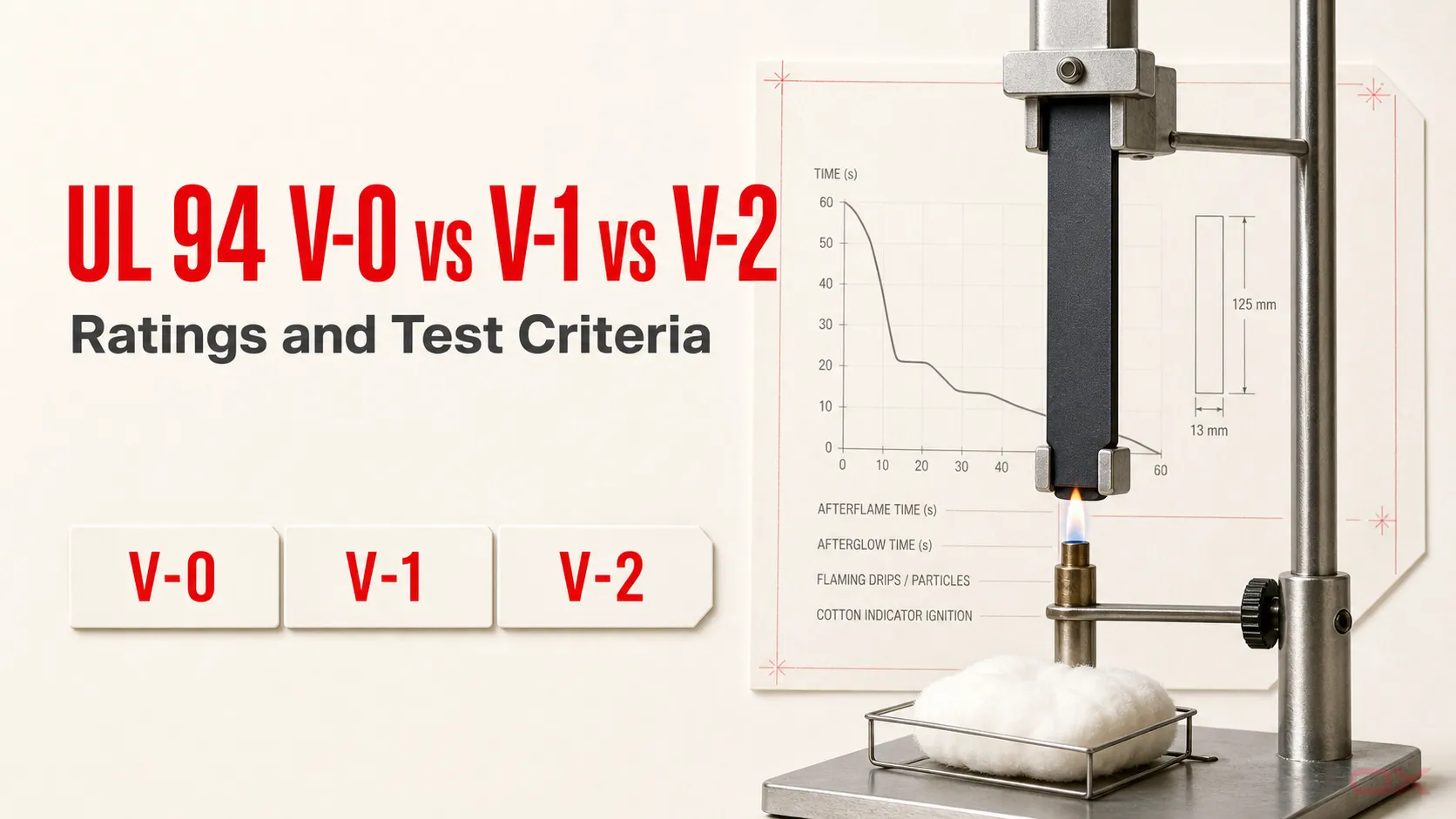
UL 94 V-0, V-1, and V-2 are classifications from the 50 W, 20 mm vertical burning test for polymeric materials. V-0 has the shortest permitted afterflame times. V-1 allows longer times but does not permit flaming drips that ignite the cotton indicator. V-2 uses the same time limits as V-1 but permits those flaming drips.
These classifications describe the behavior of evaluated specimens under controlled, small-scale test conditions. They are not finished-product fire ratings, and a result applies only within the recognized material, thickness, color, conditioning, and other limitations recorded for that evaluation.
UL 94 V-0, V-1, and V-2 Criteria at a Glance
The vertical test applies the specified flame twice to each specimen and records afterflame, afterglow, burning progression, and flaming drips. The complete classification criteria are:
| Test criterion | V-0 | V-1 | V-2 |
|---|---|---|---|
| Afterflame time after either flame application, for each specimen | 10 seconds maximum | 30 seconds maximum | 30 seconds maximum |
| Total afterflame time for the set of five specimens across 10 flame applications | 50 seconds maximum | 250 seconds maximum | 250 seconds maximum |
| Afterflame plus afterglow after the second flame application, for each specimen | 30 seconds maximum | 60 seconds maximum | 60 seconds maximum |
| Flaming or glowing combustion reaches the holding clamp | Not permitted | Not permitted | Not permitted |
| Flaming drips ignite the cotton indicator | Not permitted | Not permitted | Permitted |
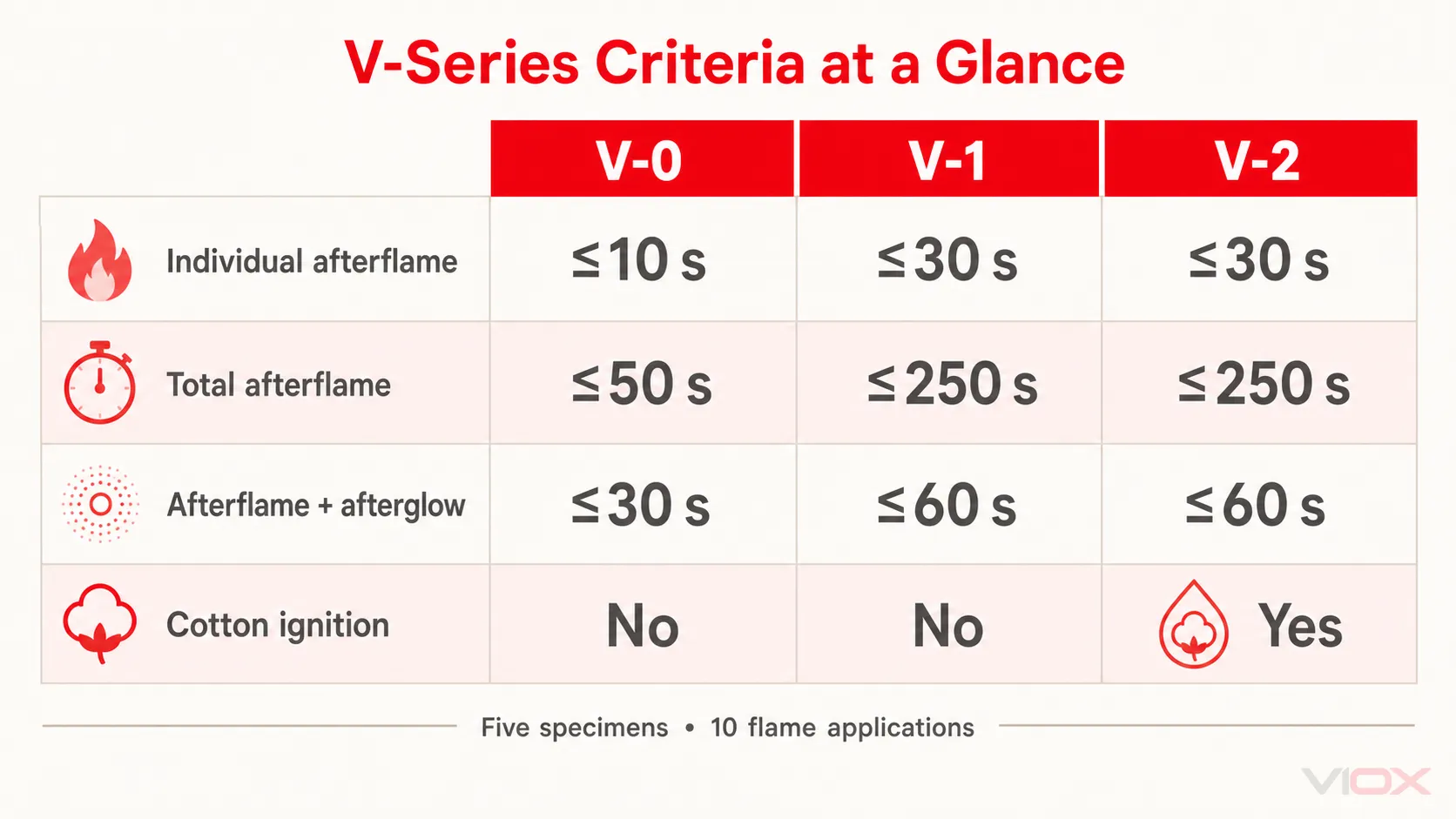
The word permitted does not mean every V-2 specimen must ignite the cotton. It means cotton ignition by flaming particles does not automatically prevent a V-2 classification when the other V-2 criteria are satisfied.
The practical hierarchy within this one test method is therefore V-0, then V-1, then V-2. That hierarchy should not be extended indiscriminately to HB, VTM, HF, or 5V classifications because those names belong to different specimen types or test methods.
What a UL 94 Classification Does—and Does Not—Prove
UL 94 is often reduced to two characters on a datasheet, but the scope boundary matters as much as the classification.
| Question | Correct interpretation |
|---|---|
| What does the test evaluate? | How a polymeric specimen burns, self-extinguishes, glows, and drips after exposure to a defined ignition source under controlled conditions. |
| What does V-0, V-1, or V-2 prove? | The evaluated specimens met the criteria for that classification at the reported conditions and thickness. |
| Does the rating certify a complete enclosure, terminal block, switch, or appliance? | No. End-product suitability depends on the applicable product standard, construction, component position, and certification program. |
| Does V-0 mean the material will not ignite? | No. The test begins by applying a flame. The classification describes behavior after and during the specified exposure; it does not mean noncombustible or fireproof. |
| Does the result predict a large or developing fire? | No. UL 94 uses small-scale laboratory tests and does not reproduce every real fire condition. |
| Does the rating cover smoke, toxicity, heat release, electrical performance, or weathering? | Not by itself. Those properties require other evaluations when they matter to the end product. |
This boundary prevents a common specification error: writing “UL 94 V-0 product” without identifying whether the requirement applies to a polymeric material, a recognized component, or the complete end product.
How the 50 W Vertical Test Produces a Classification
In the UL 94 V test, a polymer specimen is held vertically. A 20 mm test flame with nominal thermal power of 50 W is applied to the lower end for 10 seconds and removed. After the first afterflame ends, the flame is applied a second time for 10 seconds.
The observations are not limited to a single “self-extinguishing time.” The classification uses:
- the afterflame time following each application;
- the total afterflame time across the complete specimen set;
- afterflame plus afterglow following the second application;
- whether combustion progresses to the holding clamp; and
- whether flaming drops ignite the cotton indicator below the specimen.
UL Solutions also describes two conditioning regimes for the test sets: 48 hours at 23°C and 50% relative humidity, and seven days in a 70°C hot-air oven. Engineers should use the applicable standard and laboratory or recognition record for the complete preparation and acceptance procedure rather than treating this article as a laboratory instruction.
V-0 vs V-1: The Difference Is More Than One Time Limit
V-0 and V-1 both prohibit flaming drips that ignite the cotton indicator and both prohibit combustion from reaching the holding clamp. Their differences are the permitted time limits:
- V-0: no individual afterflame time may exceed 10 seconds, and the total for 10 flame applications may not exceed 50 seconds.
- V-1: an individual afterflame time may be as long as 30 seconds, and the total may be as high as 250 seconds.
- The afterflame-plus-afterglow limit following the second application is 30 seconds for V-0 and 60 seconds for V-1.
A V-0 result is therefore stricter within the V-series method, but “stricter” is not the same as “required.” The minimum acceptable classification must come from the applicable end-product or component requirements.
V-1 vs V-2: Timing Is the Same; Cotton Ignition Is Different
V-1 and V-2 share the same three time limits: 30 seconds for each afterflame period, 250 seconds in total, and 60 seconds for afterflame plus afterglow after the second application. Both also prohibit combustion from reaching the clamp.
The distinguishing criterion is flaming drips:
- V-1 does not permit flaming drops to ignite the cotton indicator.
- V-2 permits cotton ignition by flaming drops.
This is why “V-2 burns for 30 seconds while V-1 burns for less” is an incomplete explanation. A specimen can satisfy the V-1 timing limits yet be classified V-2 because of flaming-drip behavior.
V-0 vs V-2: Both Time and Dripping Criteria Change
Compared with V-2, V-0 imposes shorter individual and total afterflame limits, a shorter afterflame-plus-afterglow limit, and the prohibition on flaming drips igniting cotton. The two classifications therefore differ in more than a simple 10-second-versus-30-second headline.
For a buyer, however, the label alone still does not complete the decision. A V-0 result at one thickness cannot automatically replace a V-2 result at another thickness, and neither result establishes that the material meets every requirement of the finished component.
Thickness, Color, and Formulation Are Part of the Rating
A UL 94 classification belongs to an evaluated material construction, not to a generic polymer name. “Polycarbonate V-0” or “nylon V-2” is not enough information for a defensible specification.
At minimum, verify:
- the material manufacturer and exact grade designation;
- the classification and the minimum recognized thickness or thickness range;
- the recognized colors or whether the record covers all colors;
- formulation or processing limitations relevant to the supplied material; and
- the applicable UL recognition record or Yellow Card.
A grade may achieve one classification at a thicker specimen and another at a thinner specimen. Colorants, additives, fillers, recycled content, or other formulation changes may also fall outside the evaluated recognition. The fact that two products share the same base polymer does not transfer a classification from one grade to the other.
UL Solutions’ Yellow Card provides a digital record of safety- and performance-related properties for a recognized polymeric material. Procurement documentation should match the supplier, grade, color coverage, and thickness used in the actual part rather than merely attaching an unrelated V-0 certificate.
UL 94 is also only one material-selection input. An enclosure, for example, may require mechanical, ultraviolet, ingress, temperature, chemical, and electrical properties in addition to flammability. The VIOX electrical enclosure material selection guide covers that broader decision. The same multi-property principle applies when selecting cable gland materials.
UL 94 Classification Families Are Not One Universal Ladder
UL 94 contains multiple test families for different specimen forms and ignition conditions. Similar-looking suffixes do not make the results interchangeable.
| Classification family | Main specimen or test context | Key interpretation boundary |
|---|---|---|
| HB | Horizontal burning of solid polymer specimens | Reports controlled horizontal burning behavior; it is not a failed or abbreviated V test. |
| V-0, V-1, V-2 | 50 W, 20 mm vertical burning test for self-supporting specimens | Compare these three only within the V-series criteria and recognized thickness. |
| 5VA, 5VB | 500 W, 125 mm vertical test with additional plaque observations | Uses a substantially more severe ignition source and different criteria; 5VA and 5VB are not obtained by simply extending the V test time. |
| VTM-0, VTM-1, VTM-2 | Thin materials that generally cannot support themselves in the standard vertical position | VTM-0 is not equivalent to V-0 because the specimen preparation and test method differ. |
| HBF, HF-1, HF-2 | Low-density foam materials | These classifications should not be substituted directly for V classifications on solid self-supporting parts. |
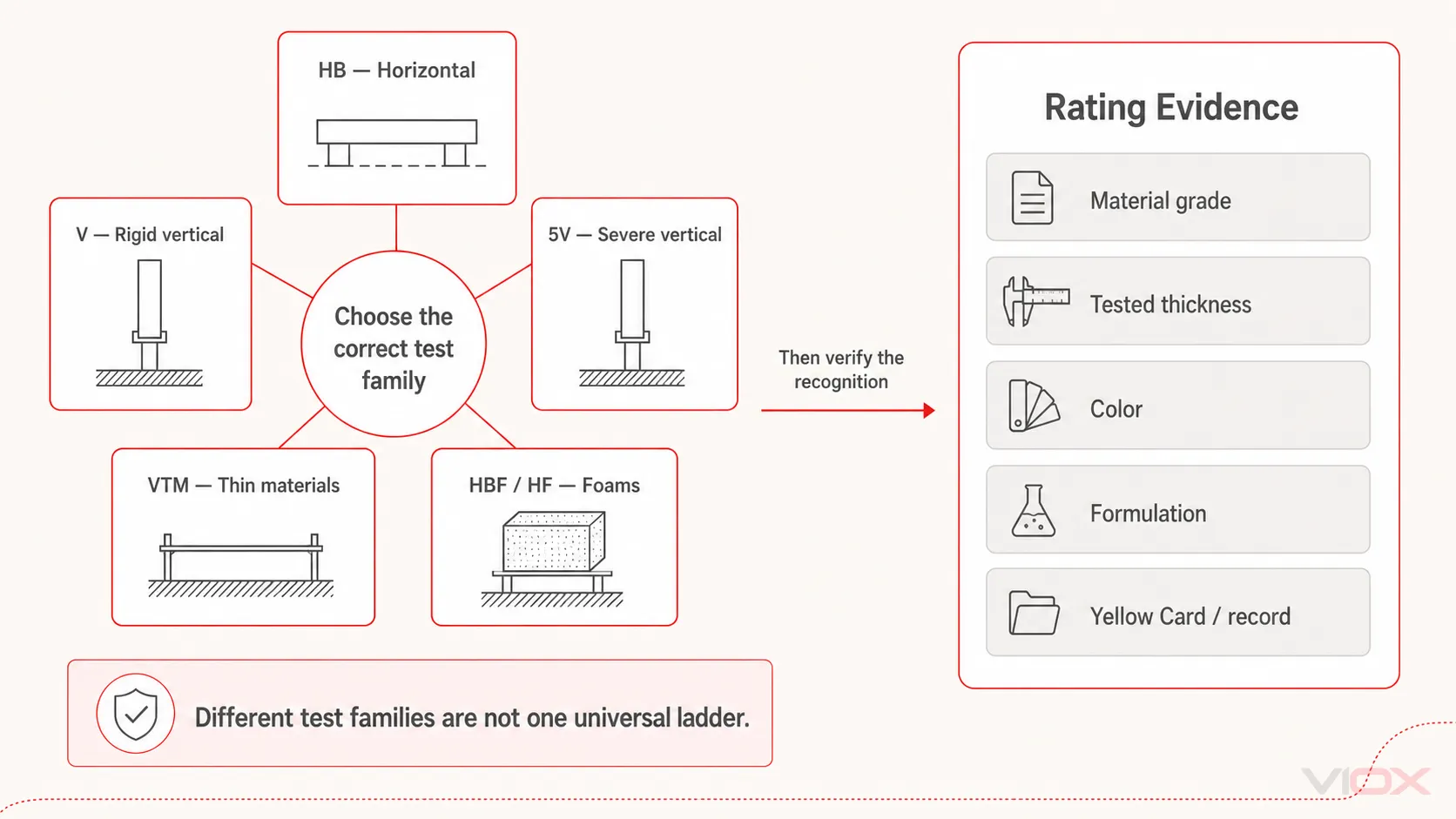
This family map also explains why a search for UL 94 HF-1 or UL 94 VTM-0 should not be answered by copying the V-0/V-1/V-2 table. The test method must match the material form.
A Five-Field Evidence Check for Engineers and Buyers
Before accepting a UL 94 claim on a quotation, drawing, or material datasheet, record these five fields:
| Field | Evidence to request | Why it matters |
|---|---|---|
| 1. Governing requirement | Applicable end-product/component standard and required flammability class | Prevents choosing a classification based on habit rather than the actual compliance path. |
| 2. Material identity | Manufacturer and exact material grade | Prevents transferring a result between different formulations. |
| 3. Recognized thickness | Minimum thickness or recognized thickness range | Confirms the molded wall is within the evaluated range. |
| 4. Color/formulation coverage | Recognized color entry and relevant additive or processing limitations | Prevents an unrecognized colorant or modification from being treated as automatically covered. |
| 5. Recognition record | Current Yellow Card, UL Product iQ record, or evidence required by the certification program | Connects the claim to the evaluated material rather than an unsupported datasheet statement. |
If any field is missing, write the missing item into the RFQ or approval record. Do not repair the gap by assuming that V-0 at one thickness, in one color, or from one supplier covers all versions of the material.
Common UL 94 Misinterpretations
“V-0 means the plastic is fireproof”
Incorrect. V-0 is a small-scale flammability classification under specified test conditions. It does not mean the material cannot ignite, cannot burn, or will provide a particular fire-resistance duration in a finished assembly.
“Every V-0 grade is suitable wherever V-0 is specified”
Incorrect. The material identity, recognized thickness, color, and end-product conditions still have to match.
“VTM-0 is another way of writing V-0”
Incorrect. VTM classifications apply to thin materials tested with a different procedure. UL Solutions explicitly states that VTM-0, VTM-1, and VTM-2 cannot be considered equivalent to their V-series namesakes.
“UL 94 and IEC 60695-11-10 reports are automatically interchangeable”
Incorrect. IEC 60695-11-10 defines related 50 W horizontal and vertical small-flame methods, and UL Solutions lists it as a corresponding test framework. The required certification or recognition evidence still depends on the market, end-product standard, and conformity-assessment route. Confirm acceptance rather than substituting one report by name alone.
Frequently Asked Questions
Is UL 94 V-0 better than V-1 and V-2?
V-0 is the strictest of these three classifications within the same 50 W vertical test because it has shorter time limits and does not permit flaming drips to ignite cotton. Whether it is the correct requirement depends on the applicable end-product or component standard.
What does 94V-0 mean?
94V-0, UL 94 V-0, and UL94 V0 are commonly used to refer to the V-0 vertical-burning classification. For procurement, use the formal classification together with the exact material grade and recognized thickness.
Can a material’s UL 94 rating change with thickness?
Yes. The reported classification is thickness-dependent. A grade recognized as V-0 at one thickness may have a different classification, or no relevant recognition, at a thinner section. Verify the minimum thickness or range on the recognition record.
Is UL 94 VTM-0 equivalent to UL 94 V-0?
No. VTM-0 is for thin materials that generally cannot support themselves in the standard V test. The procedures differ, so the classifications are not interchangeable.