

On this page
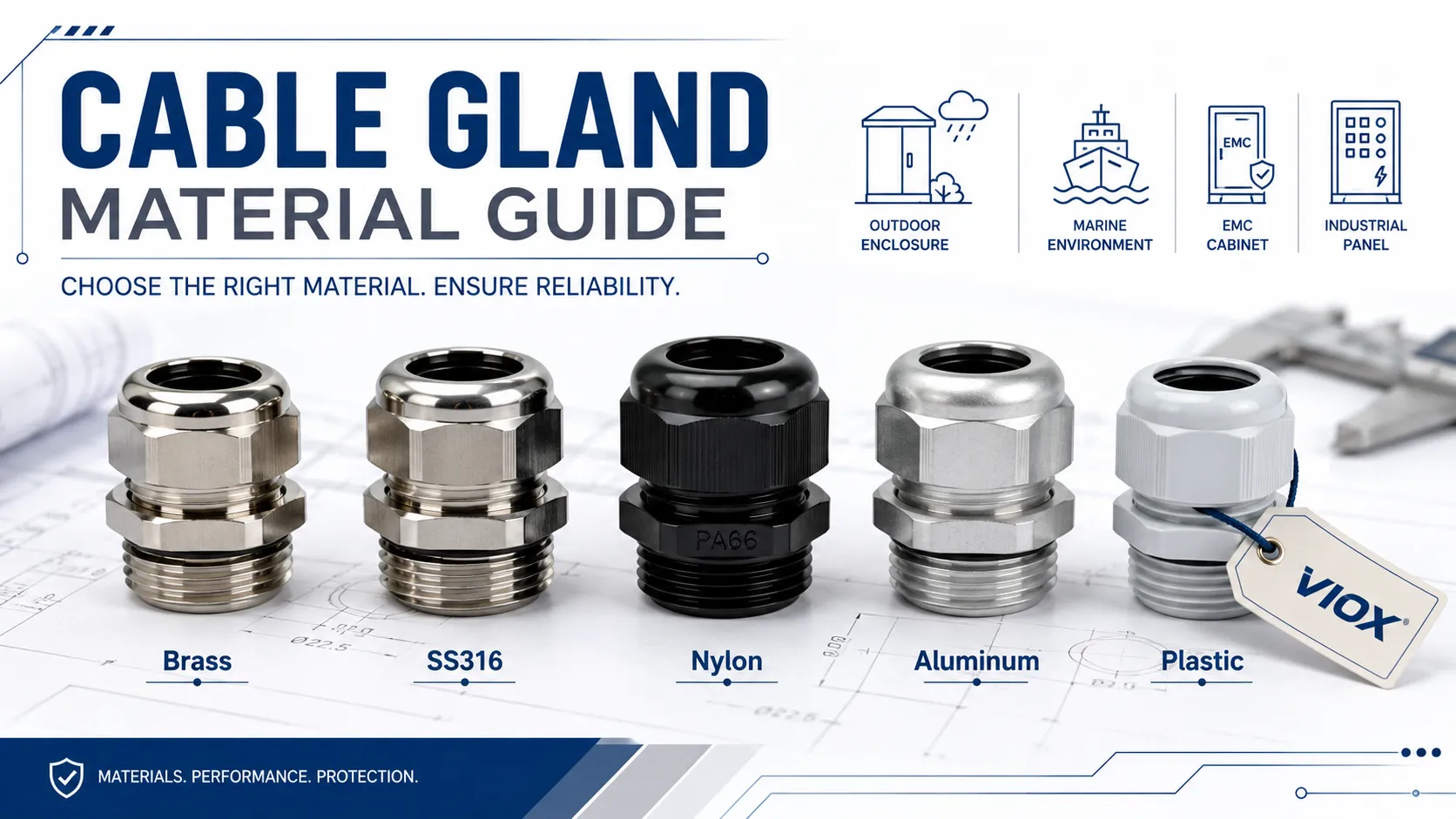
Quick Answer: Which Cable Gland Material Should You Choose?
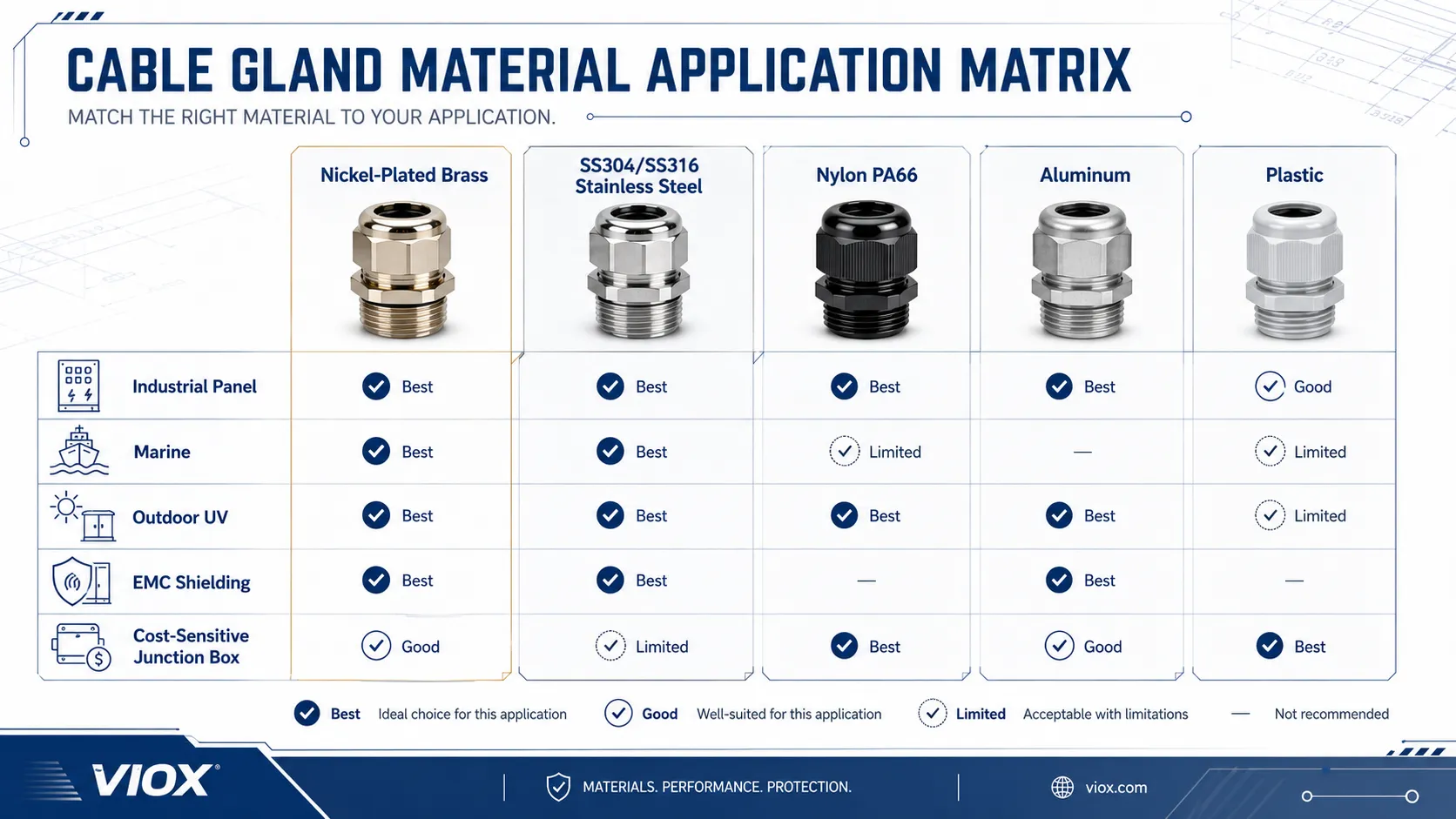
For most industrial control panels and machinery, nickel-plated brass cable glands are the default choice because they offer good mechanical strength, conductivity, durability, and compatibility with EMC designs.
For harsh corrosion, marine, offshore, food, pharmaceutical, or chemical environments, choose stainless steel cable glands, especially SS316 where chloride or salt exposure is present.
For cost-sensitive junction boxes, light-duty panels, and general indoor/outdoor applications, nylon PA66 cable glands are often the practical choice because they are lightweight, insulating, and economical.
Do not choose by price alone. The right cable gland material depends on corrosion, UV exposure, chemical exposure, temperature, mechanical strain, EMC requirements, Ex/ATEX requirements, enclosure material, and sealing performance.
Key Takeaways
- Nickel-plated brass is the most common metal choice for industrial cable glands.
- SS304 and SS316 are not the same. SS316 is better for marine, coastal, and chemical exposure.
- Nylon PA66 is not a “cheap metal replacement.” It is useful where insulation, cost, and light weight matter.
- EMC cable glands usually need conductive metal construction. The shield must bond reliably to the enclosure.
- Ex/ATEX cable glands require more than material selection. Thread form, sealing, certification, armor clamping, and installation method matter.
- Outdoor glands need material + seal compatibility. UV, IP rating, gasket material, and cable jacket compatibility all affect service life.
Cable Gland Material Comparison Table
| Material | Main Strength | Main Limitation | Best For |
|---|---|---|---|
| Nickel-plated brass | Strong, durable, conductive, good for EMC versions | Heavier and more expensive than nylon | industrial panels, machinery, EMC glands |
| Stainless steel 304 | Good corrosion resistance and clean appearance | Weaker in chloride/marine environments than 316 | food, pharmaceutical, indoor corrosive areas |
| Stainless steel 316 | Excellent corrosion resistance | Higher cost | marine, offshore, coastal, chemical plants |
| Nylon PA66 | Lightweight, economical, insulating, corrosion-free | Lower mechanical strength than metal | junction boxes, distribution boxes, light industrial panels |
| Aluminum | Lightweight metal option | Galvanic corrosion and thread wear must be checked | transport, EV, lightweight enclosures |
| PP / PVC / TPE plastics | Cost-effective or flexible for specific use cases | Limited industrial durability compared with brass/SS/PA66 | light-duty, special sealing, non-critical applications |
For general product evaluation, see the VIOX cable gland product page.
Nickel-Plated Brass Cable Glands
Nickel-plated brass is the standard industrial material for many cable glands. Brass provides mechanical strength and conductivity. Nickel plating improves surface hardness, corrosion resistance, and appearance.
Use nickel-plated brass when you need:
- strong thread engagement
- reliable cable clamping
- good mechanical durability
- conductive body for bonding or EMC versions
- compatibility with metal enclosures
- better impact resistance than plastic
Nickel-plated brass is common in control cabinets, motors, machinery, automation equipment, distribution boxes, and industrial wiring.
When Brass Is Not Enough
Nickel-plated brass is not always the best material for marine, offshore, washdown, highly corrosive, or chemical environments. In those cases, stainless steel may be more appropriate.
Stainless Steel Cable Glands: SS304 vs SS316
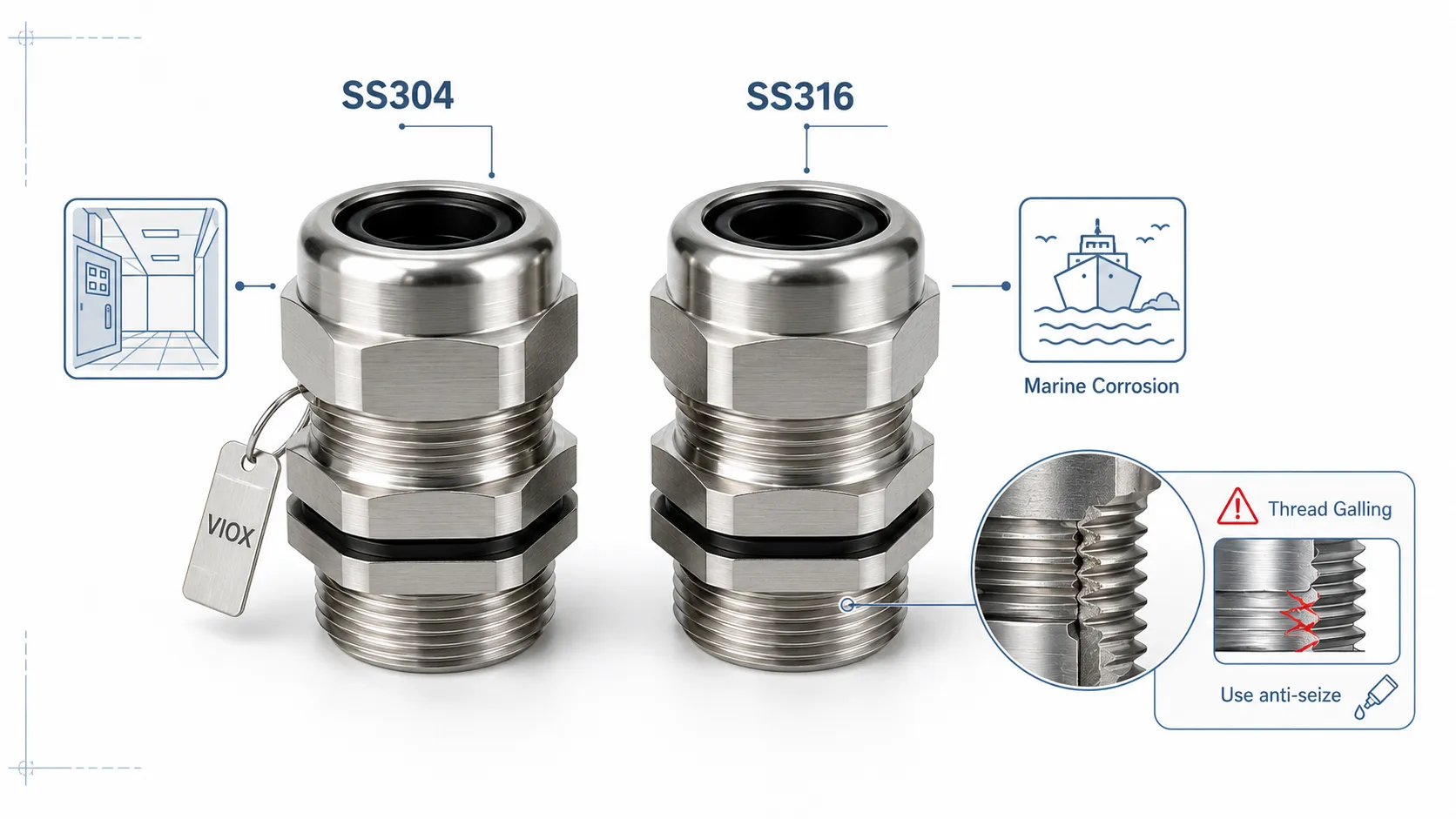
Stainless steel glands are selected when corrosion resistance and hygiene matter more than cost.
| Stainless Steel Grade | Typical Strength | Best Application |
|---|---|---|
| SS304 | Good general corrosion resistance | indoor food, pharmaceutical, clean industrial areas |
| SS316 | Better chloride and marine corrosion resistance | coastal, offshore, marine, chemical processing, harsh outdoor exposure |
SS316 is usually preferred for salt spray, seawater, coastal facilities, and aggressive cleaning environments. SS304 can be suitable for indoor or moderate corrosive environments, but it is not the same as SS316 in chloride exposure.
Stainless Steel Thread Galling: A Practical Warning
Stainless steel has one field problem that is easy to miss in a material comparison table: thread galling. When stainless threads are tightened under pressure, the mating surfaces can cold-weld and seize, especially with dry threads, high torque, poor surface finish, or repeated assembly.
For stainless steel cable glands, installers should follow the manufacturer’s torque instructions and consider a compatible anti-seize compound where the project specification allows it. This is especially important for SS316 glands in marine, offshore, and washdown environments where disassembly for maintenance may be required later.
Choose stainless steel cable glands for:
- marine and offshore equipment
- coastal outdoor panels
- food and beverage washdown areas
- pharmaceutical plants
- chemical processing
- wastewater treatment
- harsh industrial environments
Nylon PA66 Cable Glands
Nylon cable glands are usually made from polyamide, often PA66. They are widely used because they are light, economical, insulating, and resistant to many common industrial environments.
Use nylon PA66 cable glands when you need:
- electrical insulation
- low cost
- light weight
- corrosion-free installation
- quick installation in plastic enclosures
- general IP-rated cable entry
Nylon is common in junction boxes, distribution boxes, control panels, lighting equipment, telecom boxes, and general-purpose electrical enclosures.
Nylon Material Checks
For industrial use, check:
- flame-retardant grade
- UV resistance for outdoor use
- operating temperature range
- chemical compatibility
- thread strength
- seal material
- IP rating after installation
Not every black nylon gland is UV-stabilized. Outdoor solar, telecom, and rooftop installations should use glands specified for UV exposure.
Typical Temperature Ranges to Verify
Temperature limits depend on the complete gland assembly, not only the body material. The sealing insert, O-ring, cable jacket, and certification all matter.
| Material Direction | Typical Practical Range to Verify | Selection Note |
|---|---|---|
| Nylon PA66 | Often around -40°C to +100°C, depending on formulation | UV-stabilized and flame-retardant grades vary |
| Nickel-plated brass | Body can tolerate higher temperatures than many seals | Actual limit often depends on NBR, EPDM, silicone, or other seal material |
| Stainless steel | Body material is highly temperature tolerant | Seal material and certification usually define the final working range |
| PP / PVC / TPE | Strongly formulation-dependent | Use only with a datasheet-confirmed temperature range |
For high-temperature panels, motors, heaters, or outdoor solar enclosures, do not approve the material based on the gland body alone.
Aluminum Cable Glands
Aluminum cable glands are used where a lightweight metal gland is helpful. They may be considered in transportation, EV equipment, aerospace-related systems, and lightweight enclosures.
The main risks are corrosion compatibility and mechanical durability. Aluminum can suffer from galvanic corrosion when paired with dissimilar metals in wet or conductive environments.
Use aluminum only when:
- weight reduction matters
- enclosure material compatibility is checked
- corrosion environment is understood
- thread wear and mechanical stress are acceptable
Plastic Cable Glands: PP, PVC, and TPE
Plastic cable glands include nylon, polypropylene (PP), polyvinyl chloride (PVC), thermoplastic elastomer (TPE), and other polymers. In most industrial cable gland discussions, nylon PA66 is the most common engineering plastic.
Other plastics may be used for special sealing, flexibility, low-cost applications, or light-duty equipment. However, they should not be treated as universal substitutes for brass, stainless steel, or PA66.
Check:
- temperature range
- UV resistance
- flame rating
- chemical resistance
- compression set of seals
- thread strength
- aging behavior
- enclosure compatibility
EMC Cable Gland Material Requirements
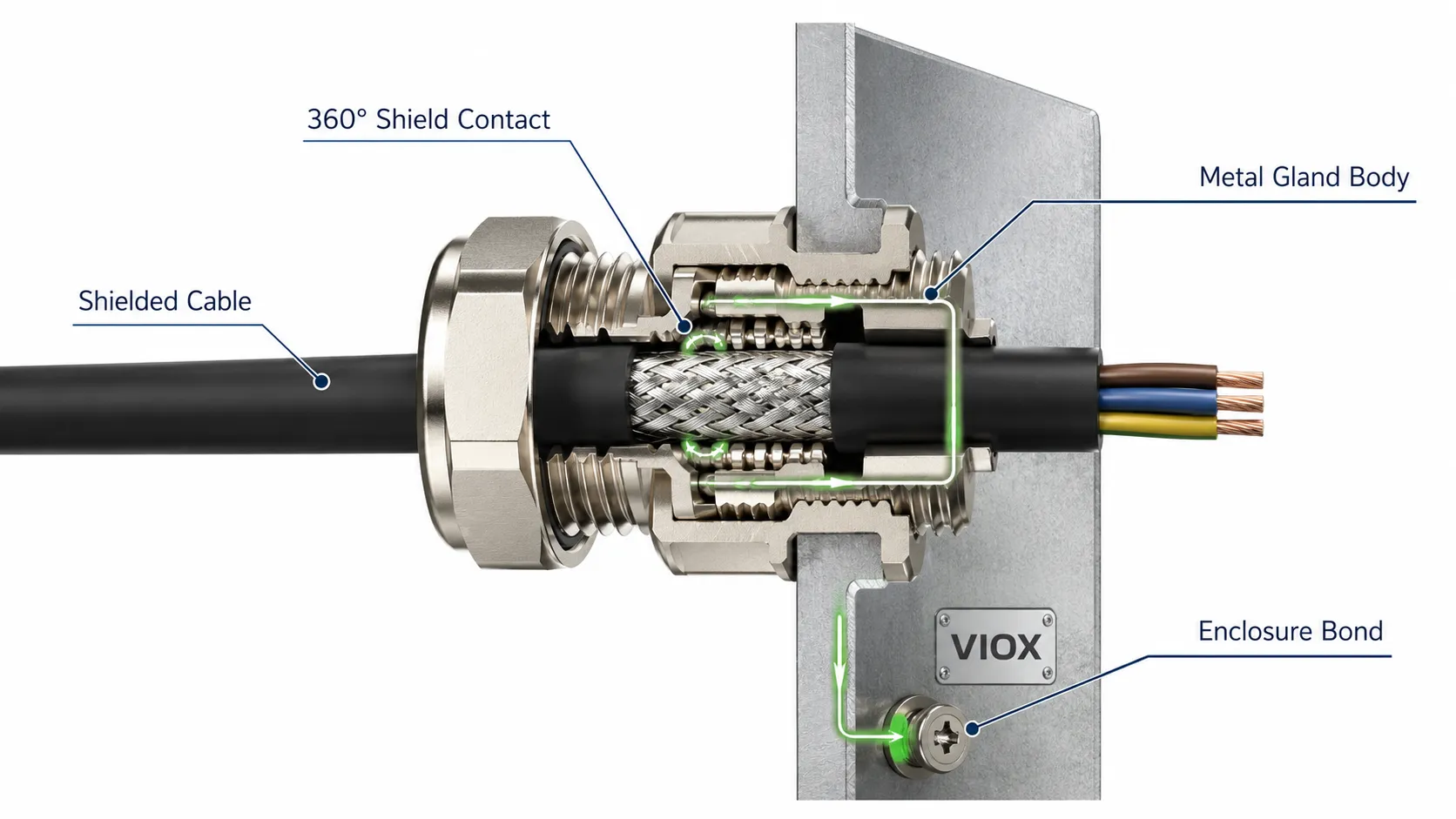
An EMC cable gland must do more than seal a cable. It must provide reliable electrical bonding between the cable shield and the enclosure.
For this reason, EMC glands are usually made from conductive metal such as nickel-plated brass or stainless steel. The shield contact design may use spring fingers, clamping rings, or other conductive contact structures.
When selecting EMC cable gland material, check:
- conductive gland body
- 360-degree shield contact
- low contact resistance
- plating quality
- compatibility with shielded cable diameter
- enclosure bonding surface
- corrosion resistance
- vibration resistance
For a deeper comparison, see VIOX’s EMC vs standard cable glands guide.
Ex / ATEX Cable Gland Material Requirements
Explosion-protected cable glands cannot be selected by material alone. For Ex or ATEX applications, the gland must be certified for the applicable protection concept, equipment group, gas or dust environment, temperature class, cable type, and installation method.
Metal materials such as nickel-plated brass and stainless steel are common, but material is only one part of the selection. In international projects, hazardous-area cable glands are commonly evaluated under the IEC 60079 series and relevant ATEX or IECEx certification documents.
Check:
- Ex d or Ex e protection concept
- ATEX / IECEx certification
- cable armor or non-armored cable type
- barrier gland requirement
- sealing compound requirement
- thread type and thread engagement
- IP rating
- temperature range
- corrosion environment
- installation instructions
Do not substitute a standard brass gland for a certified Ex gland.
Thread Type and Material: Metric, PG, and NPT
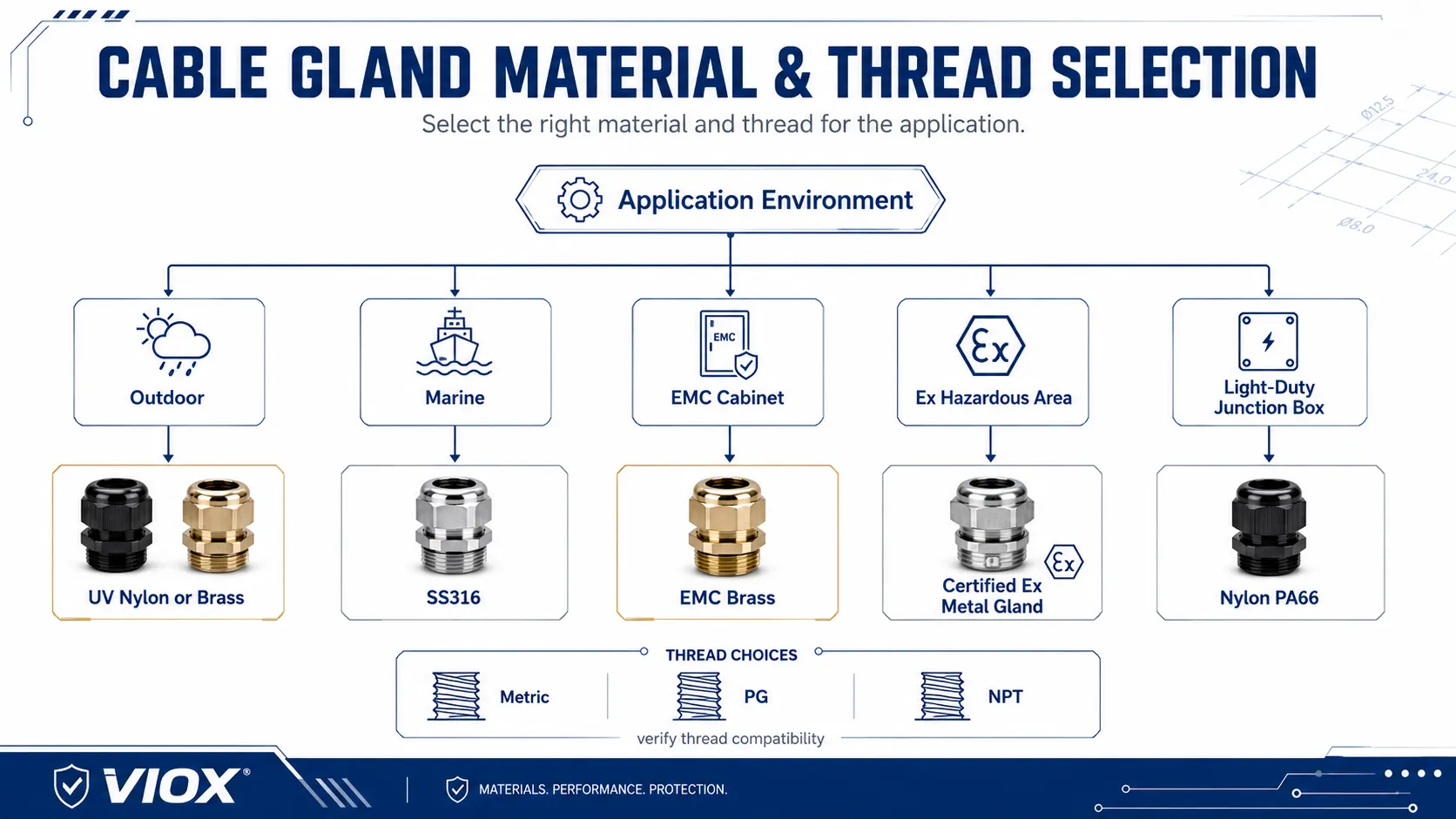
Cable gland material selection is also connected to thread system and market practice.
| Thread Type | Common Market / Use | Material Notes |
|---|---|---|
| Metric | IEC-style panels, machinery, distribution boxes | Common in brass, stainless steel, and nylon glands |
| PG | Older European equipment and legacy panels | Still found in nylon and brass replacement glands |
| NPT | North American industrial and hazardous-location work | Often associated with metal glands and conduit-style installations |
Thread compatibility matters because sealing and mechanical strength depend on correct engagement. Do not force a Metric gland into an NPT hole or treat PG and Metric as interchangeable. Adapters can help, but they must preserve IP rating, grounding, EMC bonding, and hazardous-area certification where applicable.
Application Guide by Environment
| Application | Recommended Material Direction | Notes |
|---|---|---|
| Indoor control panel | Nickel-plated brass or nylon PA66 | Choose brass for strength/EMC, nylon for insulation and cost |
| Outdoor junction box | UV-resistant nylon or nickel-plated brass | Check IP rating, seal, UV, and temperature |
| Solar PV combiner box | UV-resistant nylon, nickel-plated brass, or stainless steel | Match cable jacket, UV, IP rating, and outdoor heat |
| Marine / offshore | SS316 | Check salt spray, chloride exposure, and galvanic compatibility |
| Food and beverage | SS304 or SS316 | SS316 preferred for aggressive washdown |
| Chemical plant | SS316 or special material | Confirm chemical compatibility |
| EMC cabinet | Nickel-plated brass or stainless EMC gland | Shield bonding is critical |
| Ex hazardous area | Certified Ex metal gland | Material alone is not enough |
| EV / transport | Aluminum, brass, or stainless depending on design | Check weight, vibration, corrosion, and shielding |
Common Material Selection Mistakes
Mistake 1: Choosing Nylon Only Because It Is Cheaper
Nylon can be a good material, but not when high mechanical stress, EMC shielding, fire performance, UV exposure, or hazardous-area certification requires another material.
Mistake 2: Using SS304 in Marine Environments
SS304 is corrosion resistant, but SS316 is usually the safer choice around salt, chlorides, offshore equipment, and coastal outdoor installations.
Mistake 3: Ignoring Stainless Steel Thread Galling
SS316 may be the right corrosion choice, but stainless threads can seize during installation if the torque, lubrication, or thread quality is wrong. In maintenance-heavy sites, galling can turn a future cable replacement into a damaged enclosure or broken gland.
Mistake 4: Ignoring the Seal Material
The gland body may be brass or stainless steel, but the sealing insert may be nitrile, EPDM, silicone, or another elastomer. Chemical resistance and temperature depend on the complete gland assembly.
Mistake 5: Treating EMC Glands as Ordinary Metal Glands
EMC performance depends on shield contact and enclosure bonding, not only the fact that the gland is metal.
Mistake 6: Ignoring Enclosure Material
Metal gland on plastic enclosure, stainless gland on aluminum enclosure, or brass gland in a corrosive outdoor installation can all create different mechanical, sealing, or corrosion concerns.
Field Selection Examples
Example 1: Coastal Panel Using the Wrong Stainless Grade
A panel installed near a coastal area may look acceptable with SS304 glands at commissioning. Months later, salt exposure and washdown cycles can start attacking threads and surfaces. In that environment, SS316 is usually the safer material direction, and the seal material should also be checked for salt, cleaning chemicals, and temperature.
Example 2: EMC Cabinet with Standard Brass Glands
A machine control cabinet may use shielded VFD cables but ordinary nickel-plated brass glands. The enclosure looks professional, but the cable shield is not bonded through a proper 360-degree EMC contact. The better selection is an EMC-rated conductive gland designed to bond the shield reliably to the cabinet wall.
Cable Gland Material Selection Checklist
| Question | Why It Matters |
|---|---|
| Indoor or outdoor? | Determines UV, IP, and corrosion needs |
| Metal or plastic enclosure? | Affects grounding, sealing, and thread compatibility |
| EMC required? | Usually requires conductive shield bonding |
| Ex/ATEX required? | Requires certified gland, not just correct material |
| Marine or chemical exposure? | Often pushes selection toward SS316 |
| High vibration? | Favors stronger thread and clamping design |
| High temperature? | Requires body and seal material check |
| Cable jacket material? | Seal compatibility matters |
| Required IP rating? | Depends on gland, seal, cable, and installation |
| Cost-sensitive project? | Nylon may be suitable if environment is not severe |
FAQ
Why do stainless steel cable gland threads seize?
Stainless steel threads can suffer from galling, where the mating surfaces cold-weld under pressure. Follow the gland manufacturer’s torque instructions and use compatible anti-seize compound where allowed by the project specification.
What temperature range should I check for a cable gland?
Check the complete assembly temperature range, not only the body material. Nylon PA66, brass, and stainless steel bodies may all be limited by the seal material, cable jacket, certification, or enclosure temperature.
Are Metric, PG, and NPT cable gland threads interchangeable?
No. Metric, PG, and NPT threads have different profiles and sealing behavior. Using the wrong thread can damage the enclosure, reduce IP protection, or break certification requirements.
What material is used for EMC cable glands?
EMC cable glands are usually made from conductive metal such as nickel-plated brass or stainless steel because they must bond the cable shield to the enclosure.
Which standard applies to Ex cable glands?
Hazardous-area cable glands are commonly evaluated under the IEC 60079 series, with ATEX or IECEx certification depending on the market. The exact certificate, protection concept, cable type, and installation instructions matter more than material alone.
Can plastic cable glands be used in industrial panels?
Yes, nylon PA66 cable glands are widely used in industrial panels, especially where insulation, cost, and corrosion-free installation are important. They may not be suitable for high mechanical stress, EMC, Ex, or harsh chemical environments.
Conclusion
Cable gland material selection is not a cosmetic decision. It affects sealing, corrosion resistance, grounding, EMC performance, mechanical strength, UV durability, temperature resistance, and long-term installation safety.
Use nickel-plated brass for general industrial strength, stainless steel 316 for harsh corrosion, nylon PA66 for practical light-duty and insulating applications, and certified metal glands for EMC or hazardous-area requirements.
If the environment is severe, verify the complete gland assembly: body material, seal material, thread, IP rating, certification, cable compatibility, and installation instructions.