

On this page
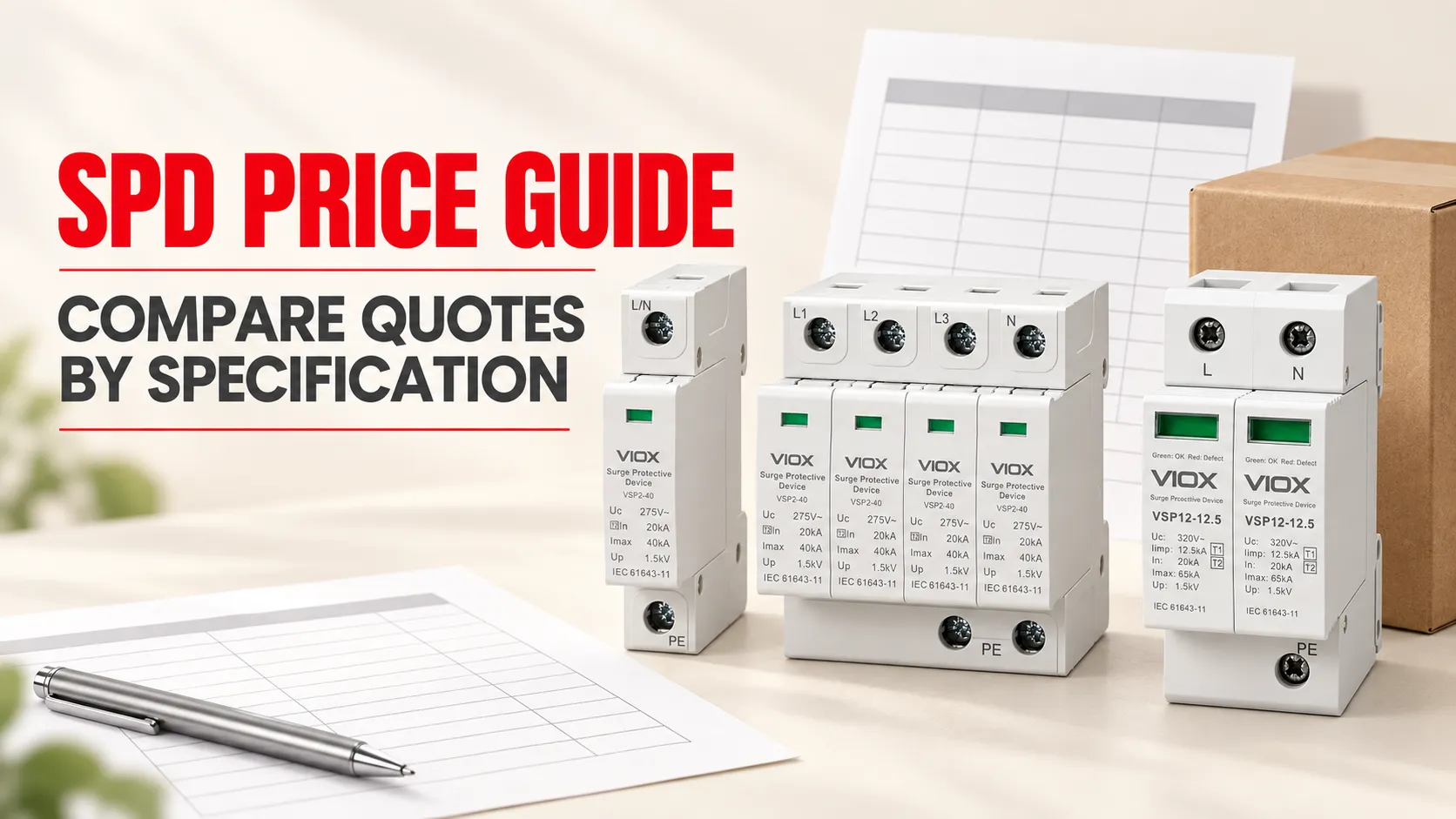
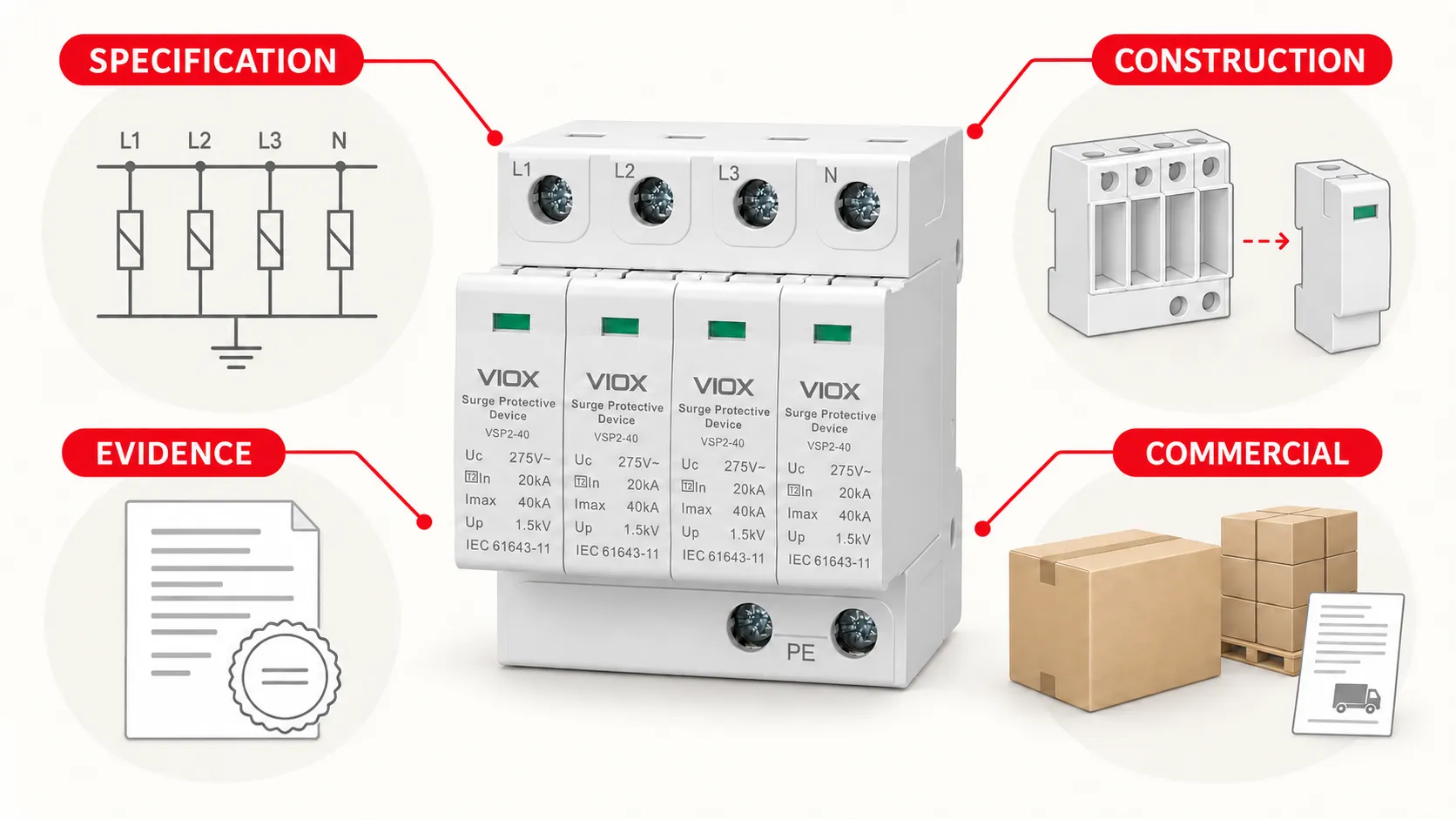
An SPD cannot be priced accurately from its kA rating alone. A valid surge protection device quote also needs the SPD Type or test class, referenced standard, AC/DC/PV system voltage, maximum continuous operating voltage, pole configuration, protection modes, discharge-current ratings and waveforms, construction options, documentary evidence, order quantity, branding, packaging, destination, and trade terms.
Two products both advertised as “40 kA SPDs” may therefore have different prices—and may not be technically interchangeable. The first step is not to ask, “How much is a 40 kA SPD?” It is to put every quotation on the same technical and commercial basis.
The Minimum Information Needed for an SPD Price
Use this checklist before requesting or comparing a quotation.
| Quote input | What to state | Why it changes the quote |
|---|---|---|
| Application | AC distribution, industrial panel, PV DC, or another defined system | The application determines the relevant device family and evidence scope |
| Referenced framework | IEC or UL market requirement, plus the required standard edition or project specification | “Type” terminology, test evidence, markings, and acceptance criteria depend on the framework |
| SPD classification | Type 1, Type 2, Type 1+2, or the classification required by the project | Different impulse duties and test programs require different designs |
| System voltage | Nominal AC or DC voltage and maximum expected operating voltage | Voltage class affects the protection element, insulation, and module arrangement |
| Uc or MCOV | Required maximum continuous operating voltage | A nominal system voltage alone is not enough to select the device safely |
| Poles and modes | 1P, 2P, 3P, 4P, 1+NPE, 3+NPE; L-N, L-PE, N-PE, or other required modes | More conductors and protection modes generally require more components and terminals |
| Discharge ratings | In, Imax, and/or Iimp, including waveform and whether the value is per pole, per mode, or total | The same kA number can describe different tests and duties |
| Protection level | Required Up or VPR/SVR where applicable | The protective performance must be compared under the relevant test framework |
| Construction | Fixed or pluggable module, base included, replacement cartridge requirements | A cartridge-only price is not comparable with a complete base-and-module assembly |
| Monitoring | Visual indicator, remote signaling contact, or neither | Remote contacts and associated terminals add hardware and verification requirements |
| Evidence | Test report, declaration, certificate, listing/file reference, or project-specific documentation | Document scope and third-party verification can materially affect the supplied package |
| Order scope | Sample or production quantity, number of SKUs, spares, OEM label, packaging, manuals | Small mixed orders and customized packaging have a different cost structure from standard production |
| Delivery basis | Destination, currency, EXW/FOB/CIF or other Incoterm, requested date | Freight, insurance, duties, taxes, and responsibility boundaries are not part of every unit quote |
If several fields are unknown, start with the system and application rather than guessing a model. The VIOX SPD overview can be used to identify the relevant AC, DC, or PV product family before an RFQ is prepared.
Why This Guide Does Not Publish a Fixed SPD Price Table
A fixed market-price table would imply that devices with the same short description have the same scope. They do not. A quoted item may be a replaceable cartridge, a complete module with base, a multipole assembly, a device with remote contacts, or a project package that includes additional documentation and packaging.
Currency and commercial terms also change the meaning of a number. An EXW sample price cannot be compared directly with a production-volume CIF price. A retail price that includes local tax and channel margin is not the same object as an OEM factory quote.
VIOX should publish a numerical indicative band only when it can be tied to all of the following:
- an identified product specification or model family;
- a stated quantity or minimum order basis;
- currency and Incoterm;
- included base, modules, accessories, documents, branding, and packaging;
- quote date and validity period; and
- a clear statement that the range is indicative, not a binding quotation.
Without that context, a precise-looking price is less useful than a transparent quote framework.
The Cost Drivers That Matter Most
1. Type 1, Type 2, and Type 1+2 Are Different Quote Objects
The classification must be recorded with its referenced standard and declared ratings. A Type 1 quote normally needs an impulse-current rating and associated test information; a Type 2 quote normally centers on nominal and maximum discharge-current data under the applicable framework. A combined Type 1+2 device must demonstrate both functions claimed by the supplier.
Do not use a generic multiplier such as “Type 1 costs three times as much as Type 2.” The difference depends on the actual impulse duty, voltage class, number of modes, construction, and evidence supplied. For the full classification boundary, use the VIOX Type 1, Type 2, and Type 3 comparison.
2. AC, General DC, and PV DC Must Not Be Quoted as One Family
The application changes both the device design and the relevant evidence. IEC 61643-11:2025 covers SPDs connected to AC low-voltage power systems up to 1,000 V RMS and specifies performance, safety, tests, and ratings within that scope. IEC 61643-31:2018 applies to SPDs for the DC side of photovoltaic installations up to 1,500 V DC.
Therefore, “385 V AC,” “600 V DC,” “1,000 V PV,” and “1,500 V PV” are not just different labels on the same item. The quotation should identify the intended circuit, voltage basis, Uc or Ucpv, pole arrangement, and applicable product evidence. If the project is photovoltaic, the DC SPD selection guide explains the system inputs that must be settled before price comparison.
3. Poles and Protection Modes Change the Hardware Scope
A single-pole cartridge, a two-pole assembly, and a 3+NPE configuration do not contain the same number of current paths, terminals, or replaceable modules. The requested protection modes also matter: a line-to-neutral path is not automatically equivalent to line-to-earth or neutral-to-earth protection.
Ask the supplier to state:
- whether the quote is per cartridge, per pole, or per complete assembly;
- which base or connector is included;
- every protected conductor and mode;
- whether replacement modules can be ordered separately; and
- whether a neutral-to-earth element is included where the design calls for one.
This avoids the common error of comparing a module-only number with a complete multipole device.
4. In, Imax, and Iimp Need Their Test Context
A kA figure is meaningful only when the rating name, waveform, test condition, and reference point are known. In, Imax, and Iimp describe different declared duties. The number may also be stated per pole, per mode, or for an assembly.
If a quotation says only “40 kA,” return it for clarification. A buyer who needs a deeper rating review can use the SPD datasheet guide and the main-versus-branch kA selection guide before finalizing the RFQ.
5. MOV, GDT, Hybrid Design, and Thermal Disconnection Affect Scope
Metal-oxide varistors (MOVs), gas discharge tubes (GDTs), spark-gap structures, and hybrid arrangements do not create a universal quality ladder. Each technology has operating characteristics and application limits. The relevant commercial question is what topology and protective functions are required for the specified modes and test duty.
For MOV-based products, the quote should clarify whether the complete assembly includes the required disconnection and indication functions. For hybrid or gap-based designs, the buyer should request the applicable ratings and test evidence rather than assuming that the component name alone proves performance.
6. Pluggable Modules and Remote Signaling Add Deliverables
A pluggable SPD may be quoted as a complete set or as a replacement cartridge. A product with a remote signaling contact also includes additional terminals and an electrical contact arrangement that must match the monitoring circuit.
Normalize the quote by recording:
- fixed or pluggable construction;
- base included or excluded;
- number of cartridges;
- spare-cartridge quantity;
- visual status indication; and
- remote contact requirement and contact documentation.
For monitoring-system integration, refer to the SPD remote signaling guide rather than expanding this price page into a wiring article.
7. Certification Evidence Is a Line Item, Not a Logo Assumption
“IEC compliant,” “UL design,” and “UL Listed” do not mean the same thing. A quotation should state exactly what evidence is supplied and which model or family it covers. For UL claims, UL Product iQ is the appropriate place to verify certification information by company, model, category, or file reference.
The cost discussion should remain evidence-based: request the report, certificate, listing, or declaration required by the destination market or project, and verify that its model designation matches the quoted item. The UL 1449 versus IEC 61643 guide explains why the evidence packages should not be treated as interchangeable.
8. Quantity, OEM Scope, Packaging, and Trade Terms Complete the Price
The technical device is only one part of a commercial quotation. Unit cost can also depend on order quantity, the number of variants, customized labels, manuals, cartons, inspection requirements, spare ratios, and shipping terms.
Do not ask only for “best price.” State which deliverables are mandatory and which are optional. This lets the supplier separate the standard product from customization rather than hiding both in one unexplained number.
Why Two “40 kA” SPD Quotes May Not Be Comparable
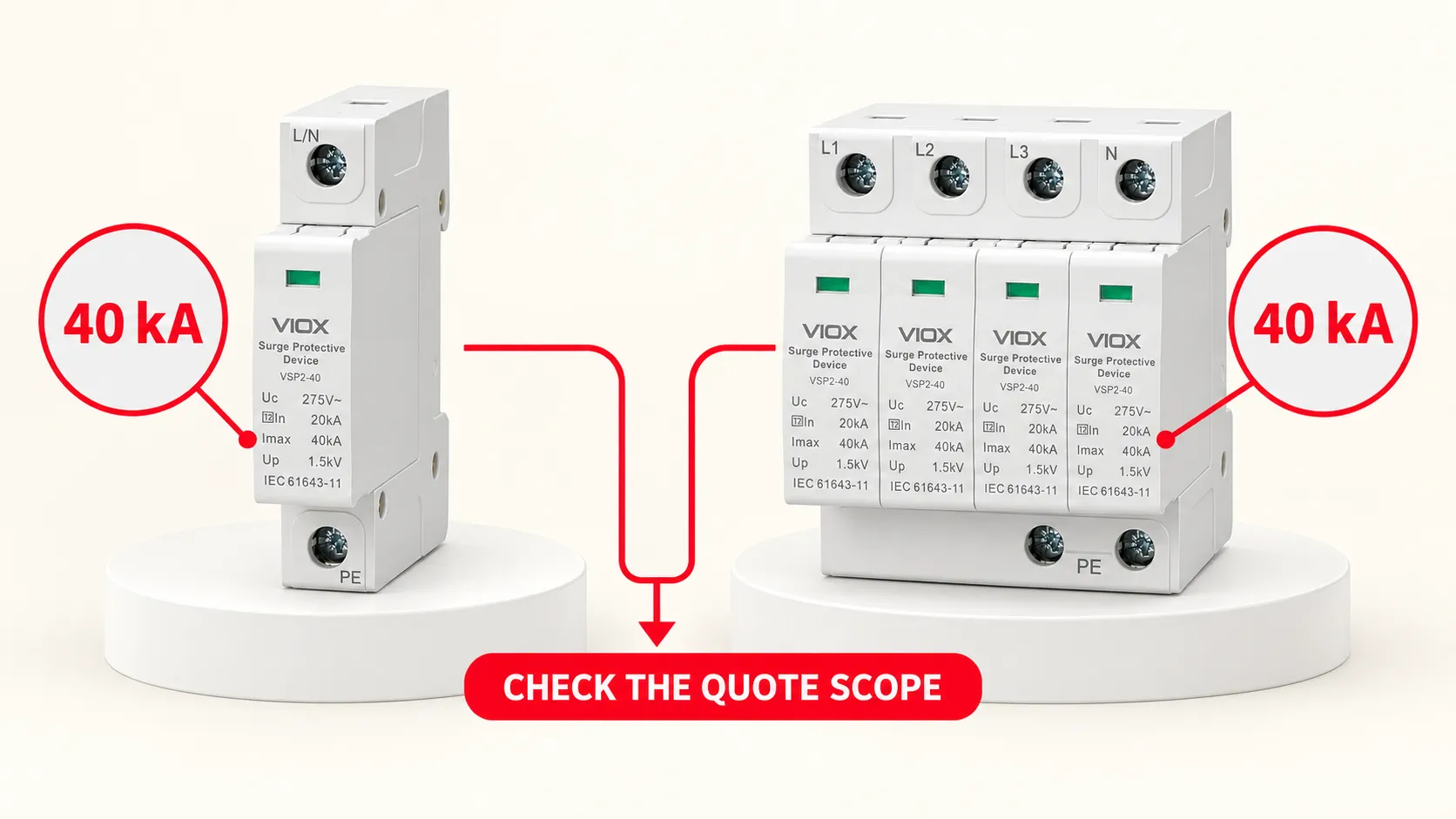
The table below is illustrative. It shows the questions a buyer must resolve; it does not represent two specific VIOX models.
| Comparison field | Quote A | Quote B | What the buyer must verify |
|---|---|---|---|
| Label shown | 40 kA | 40 kA | Is this In, Imax, Iimp, or another value? |
| Waveform | Not stated | Declared in test data | A bare current value is incomplete |
| Classification | Type 2 | Type 1+2 | These do not describe the same impulse duty |
| Voltage | 275 V AC Uc | 385 V AC Uc | Confirm the system and earthing conditions before comparing |
| Configuration | One cartridge | 3+NPE assembly | Confirm whether the quote is per module or complete set |
| Protection modes | Not stated | Listed by mode | Mode coverage affects the supplied hardware |
| Construction | Replacement cartridge | Base plus pluggable modules | Normalize included components |
| Monitoring | Visual indicator only | Visual plus remote contact | Confirm whether monitoring is required |
| Evidence | Marketing datasheet | Model-linked report/certificate reference | Verify the exact document scope rather than the presence of a logo |
| Commercial basis | Sample, EXW | Production quantity, FOB | Normalize quantity, currency, Incoterm, and validity |
The correct decision is not automatically the cheaper or more expensive quotation. It is the quotation that matches the required system, ratings, evidence, and delivery scope with the fewest unresolved assumptions.
Four Common RFQ Scenarios
AC Type 2 Distribution-Panel SPD
State the nominal system voltage, maximum continuous voltage requirement, phase and neutral arrangement, earthing system, poles and modes, required In/Imax declarations, Up requirement, pluggable or fixed construction, backup-protection requirements from the project, and requested evidence. “Type 2, 40 kA” is not a complete RFQ.
Type 1+2 Service-Entrance SPD
Add the required Iimp value and waveform, number of poles or modes, follow-current considerations where relevant to the design, short-circuit/backup-protection information required by the project, and whether downstream coordination is part of the supply scope. Do not infer these requirements from the Type label alone.
1,000 V or 1,500 V PV DC SPD
State maximum PV array voltage under the project’s environmental assumptions, required Ucpv, PV-side installation point, pole arrangement, short-circuit-current considerations, Type/test requirement, replaceable-module preference, and IEC 61643-31 evidence requirement. Do not substitute a general-purpose AC device because its printed voltage appears similar.
Industrial SPD With Remote Signaling
In addition to the power-circuit specification, state the required dry-contact arrangement, monitoring voltage/current limits to be verified from the selected datasheet, terminal preference, alarm logic, cable/interface responsibility, and documentation needed by the panel builder or PLC/BMS integrator.
Compare Landed Cost, Not Just Unit Price
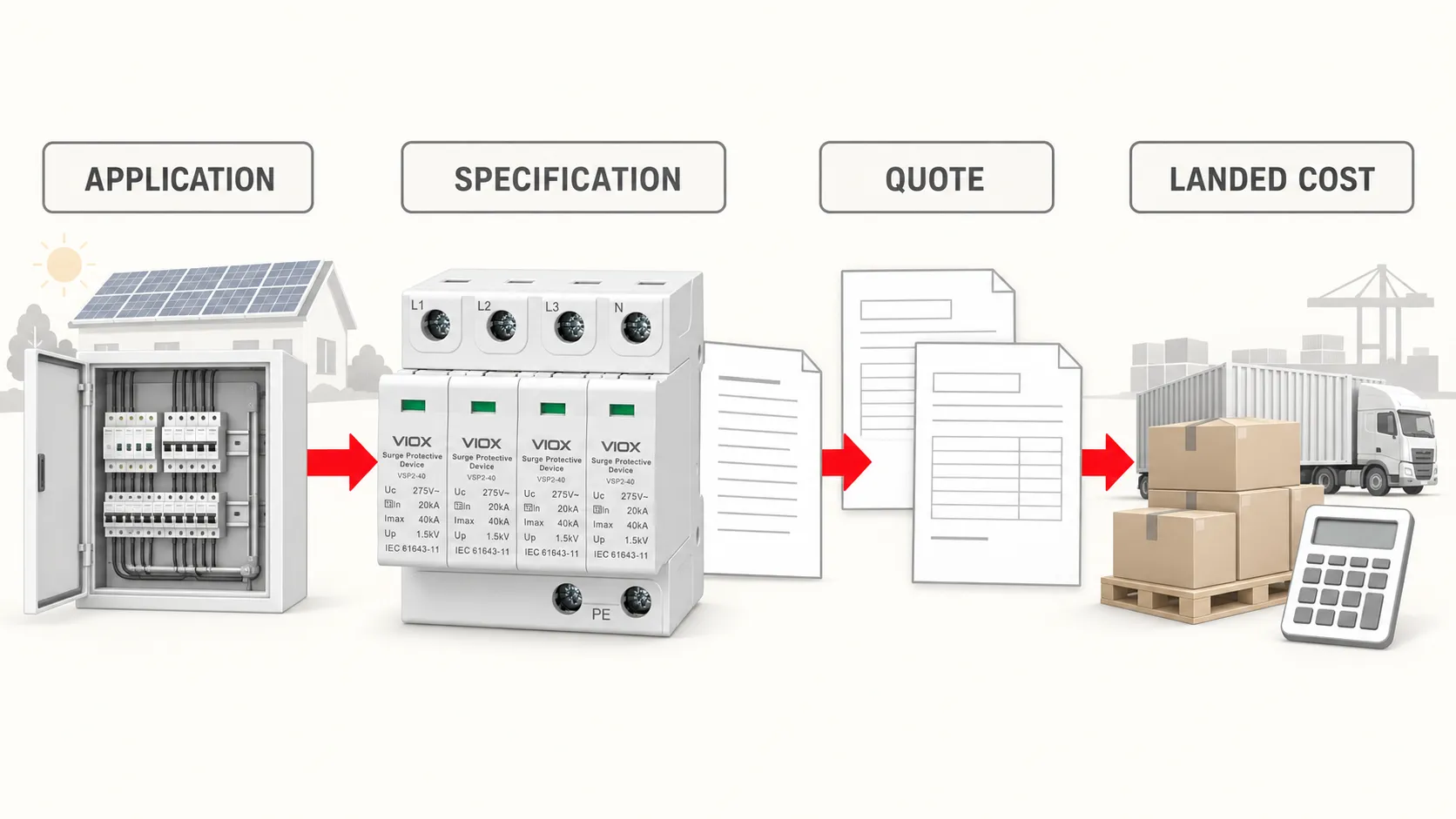
A useful commercial comparison separates the quoted device from the cost of delivering an acceptable order:
Landed/project cost =
(device quantity × normalized unit quote)
+ customization
+ required documentation/testing
+ packaging
+ freight/insurance
+ duties/taxes
+ planned spares
Only include a term when it belongs to the buyer’s responsibility under the selected trade arrangement. Installation labor, external backup protection, enclosure space, wiring, commissioning, and future replacement modules may also affect project cost, but they should not be silently mixed into a device-only quotation.
Before approving a supplier comparison, confirm that both offers use the same:
- electrical specification and standard framework;
- complete assembly scope;
- evidence package;
- quantity and customization scope;
- currency and Incoterm;
- destination and tax assumptions; and
- quote date and validity period.
If one of these differs, adjust the comparison or request a revised quote.
Copy-Ready SPD RFQ Template
Use the following block when contacting VIOX or another qualified supplier:
Application / protected system:
Destination country and required market framework:
AC, general DC, or PV DC:
Nominal system voltage:
Maximum operating voltage and required Uc/Ucpv:
Earthing / conductor arrangement:
Required SPD Type or test class:
Required In, Imax, and/or Iimp, including waveform:
Required Up, VPR, or other protection-level declaration:
Poles and protection modes:
Fixed or pluggable construction:
Complete base required: yes / no
Replacement cartridges or planned spares:
Visual indication required: yes / no
Remote signaling required: yes / no
Required test report, certificate, listing, or declaration:
Backup-protection / short-circuit information required by project:
Quantity per configuration:
Sample quantity, if any:
OEM label, manual, and packaging requirements:
Requested currency and Incoterm:
Delivery destination:
Requested delivery date:
Other project requirements:
Submit the completed specification to [email protected] or use the VIOX surge protective device product page to identify the appropriate product family. VIOX should confirm the model, evidence scope, commercial basis, and validity in the resulting quotation; the article itself does not promise a fixed price or certification for an unspecified product.