

On this page
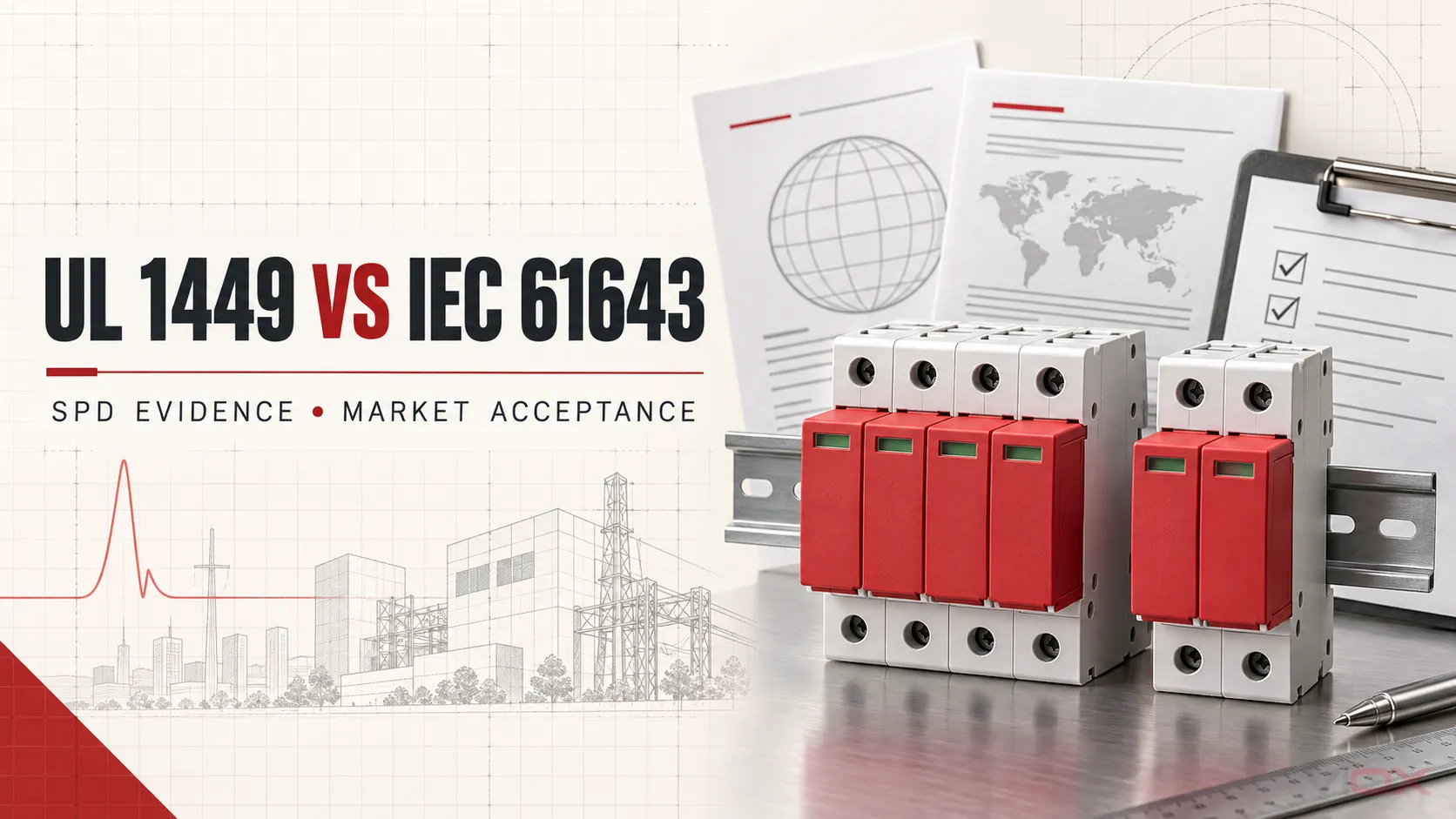
UL 1449 and IEC 61643 are different product-standard frameworks for surge protective devices (SPDs). They are not interchangeable certificates, and there is no reliable one-to-one conversion between their Type designations or between IEC voltage protection level (Up) and UL voltage protection rating (VPR). For procurement, verify the exact model, applicable standard and edition, test or certification record, marked ratings, installation instructions, and the requirements of the destination market.
| Question | IEC route | UL route | Procurement decision |
|---|---|---|---|
| What technical document applies to an AC low-voltage SPD? | IEC 61643-01:2024 together with IEC 61643-11:2025 | UL 1449 for products within its scope | State the exact standard and edition required by the project. |
| What proves a model was evaluated? | A model-specific test report and, where applicable, a CB Test Certificate with its associated CB Test Report or national certificate | A model-specific Listing or other applicable certification record | Match manufacturer, model, ratings, standard and record status. |
| Does the document grant market access everywhere? | No. National adoption, deviations, regulation and project rules still apply. | No. The certification must be acceptable to the authority and suitable for the installation. | Check the destination country, authority having jurisdiction and project specification. |
| Can Type or voltage-protection values be converted directly? | IEC definitions and tests apply. | UL definitions and tests apply. | Compare system suitability and evidence within each framework; do not translate labels by a shortcut table. |
The Four Evidence Layers That Prevent Specification Errors
Many SPD specifications fail because they use “standard,” “tested,” “certified,” “listed,” and “approved” as if these words describe the same evidence. They do not.
- Standard: defines scope, terminology, ratings, tests, markings and acceptance criteria.
- Laboratory evidence: records what representative samples of an identified product were tested against and under which conditions.
- Conformity document or mark: may be a certification record, CB Test Certificate and Report, supplier declaration, EU Declaration of Conformity, or another scheme-specific output.
- Market and installation acceptance: depends on the destination jurisdiction, adopted rules, authority, project specification, installation conditions and exact equipment instructions.
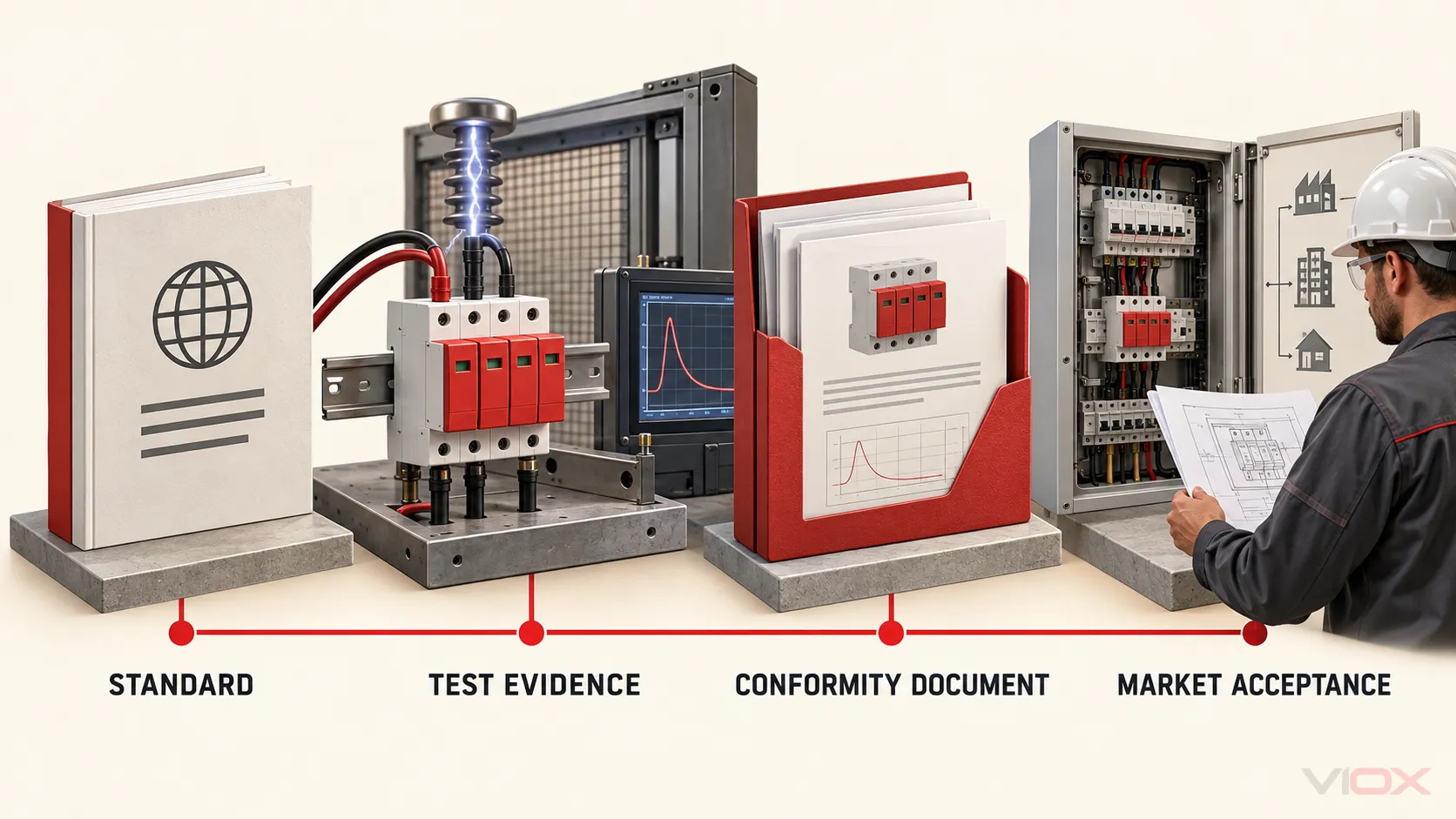
A standard does not issue a certificate, and a certificate does not replace the installation rules of the destination market.
A statement such as “IEC 61643 certified” is therefore incomplete. The buyer should ask: which part and edition, which model, tested by whom, which report or certificate number, and accepted for which market?
IEC 61643 for AC Low-Voltage SPDs
The current IEC architecture separates common SPD requirements from application-specific requirements.
The official scope of IEC 61643-01:2024 says that it contains common requirements for SPDs connected to circuits or equipment rated up to 1,000 V AC RMS or 1,500 V DC. It specifies general performance and safety requirements, tests and ratings.
For an SPD connected to an AC low-voltage power system, IEC 61643-11:2025 supplements, modifies or replaces parts of IEC 61643-01 and must be read with the latest IEC 61643-01 edition. The current combination is therefore:
IEC 61643-01:2024 + IEC 61643-11:2025
This is more precise than citing only IEC 61643-11:2011. The older 2011 edition remains relevant to historical certificates and national adoptions, but it should not be presented as the current IEC route for a newly specified AC SPD.
The IECEE Test Report Form 61643-111D:2026 also identifies IEC 61643-11:2025 used together with IEC 61643-01:2024. This confirms the current test-report structure; it does not prove that any particular product has completed that evaluation.
For the other IEC 61643 product parts, use the separate IEC 61643 SPD standards guide. This page is intentionally limited to the evidence and market-acceptance comparison with UL 1449.
What an IEC Test Report Proves
A complete, model-specific report can show that identified samples were evaluated against the stated standard edition and conditions. Its value depends on traceability:
- manufacturer and production identity;
- exact model and allowed variants;
- rated voltage and system configuration;
- modes of protection;
- declared ratings and classifications;
- standard part, edition and national differences;
- sample description, photographs and critical components;
- test results, deviations and conditions.
It does not automatically create a UL Listing, CE marking, national approval, or permission to use the product in every project.
UL 1449 and Model-Level Listing Evidence
UL 1449 is the North American product-safety standard associated with SPDs within its scope. It evaluates products using UL definitions, tests, markings and installation categories. A specification should not reduce this to “the U.S. version of IEC 61643,” because the two frameworks organize classifications and ratings differently.
A UL Listed claim should be verifiable at model level. The record should connect the manufacturer, product category, file or record identifier, model designation, applicable standard edition, electrical ratings and conditions of use. UL’s Lightning Protection Application Guide identifies the surge protective device category with UL 1449 and explains Listing as equipment included in an acceptable published list, with evaluation and follow-up provisions defined by the certification organization.
For procurement, distinguish these statements:
| Supplier statement | What it may mean | Required verification |
|---|---|---|
| “Designed to UL 1449” | The supplier used the standard as a design reference. | This is not proof of Listing. Request the certification record. |
| “Tested to UL 1449” | Some or all tests may have been performed. | Request the complete report, laboratory identity, exact model scope and test basis. |
| “UL Recognized component” | A component may be evaluated for use within other equipment under conditions of acceptability. | Do not treat it as a complete field-installed Listed SPD. Review the end-product conditions. |
| “UL Listed SPD” | The exact model may appear in the relevant certification category. | Verify the current record, model, ratings, Type and installation limitations. |
The applicable installation code and authority having jurisdiction remain a separate layer. UL 1449 product evaluation does not by itself approve a wiring method, conductor route, upstream protection choice or installation location for every project. The SPD installation requirements guide addresses that separate task.
Why UL Type and IEC Type Are Not Direct Equivalents
Both frameworks use the word Type, but the labels are assigned within different classification and test systems. Similar installation outcomes do not establish one-to-one equivalence.
An IEC Type 1 classification is linked to tests that include impulse discharge current Iimp. IEC Type 2 uses the nominal discharge current In test framework, and Type 3 involves its applicable combination-wave tests. UL SPD Types also communicate permitted connection location and product construction or component status within the UL framework.
The correct comparison is not:
IEC Type 1 = UL Type 1
The defensible comparison is:
- define the surge environment and installation position;
- identify the classification required by the applicable framework;
- verify the ratings and test evidence defined by that framework;
- confirm the exact model’s permitted installation and protective-device conditions.
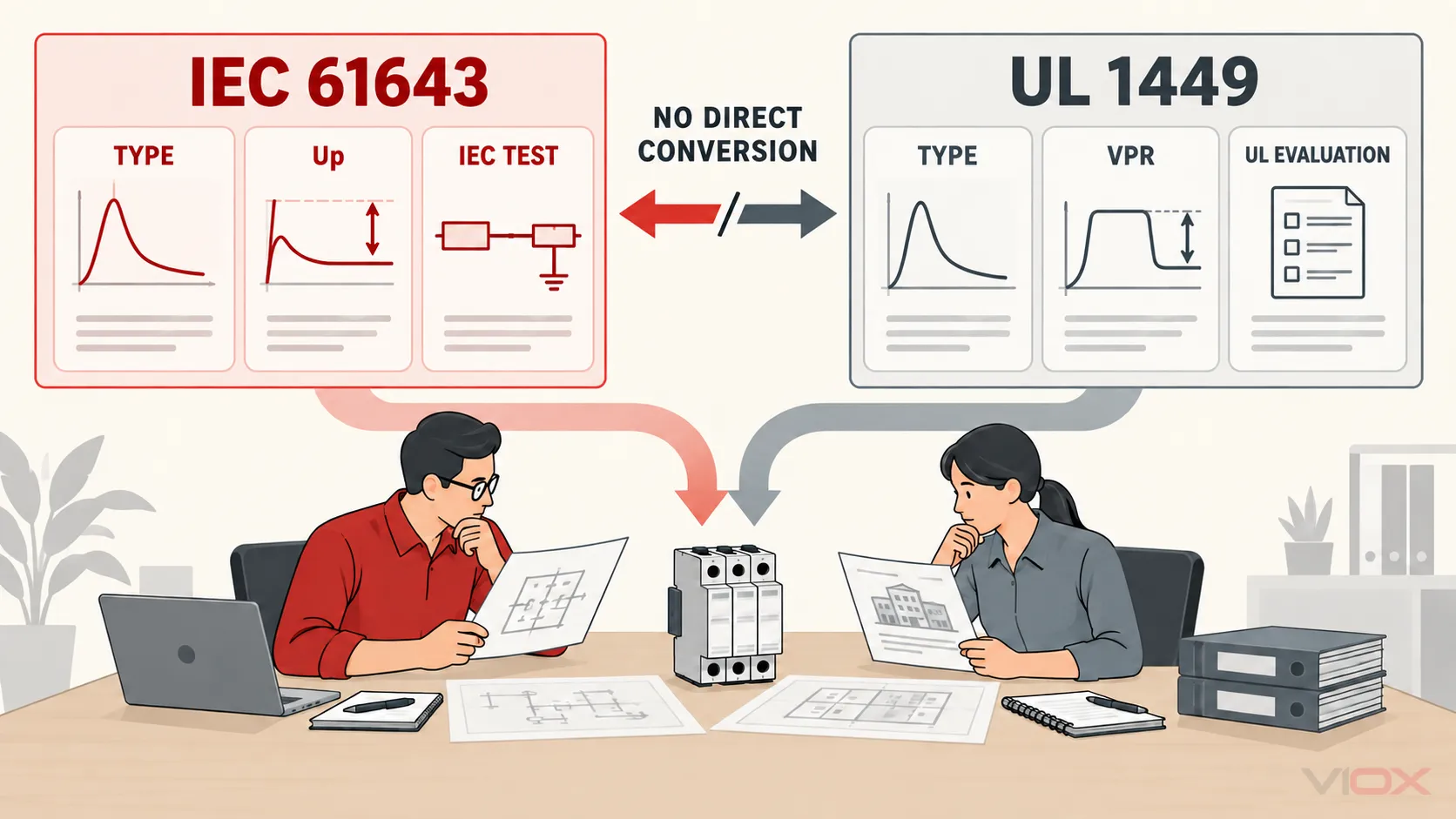
Shared terminology does not make the test methods, classifications or evidence interchangeable.
For an installation-focused comparison, see Type 1 vs Type 2 vs Type 3 SPDs. That page owns the Type-selection task; this page owns the conformity-evidence boundary.
Why Up and VPR Cannot Be Converted Directly
IEC Up and UL VPR both communicate voltage-limiting performance, but each value is established and assigned within its own standard’s test and reporting method. They are not two units for one universal measurement.
Do not publish or use a table such as “VPR 330 V equals Up 1.5 kV.” It can hide differences in:
- test waveform and current;
- measurement and assigned-value method;
- protected mode;
- nominal system voltage and grounding configuration;
- lead arrangement and product construction;
- standard edition and marking rules.
Within an IEC specification, compare Uc, Up, In, Imax or Iimp only according to their defined use and the system requirements. Within a UL specification, verify MCOV, VPR, In, SCCR, SPD Type and other marked conditions as applicable. The SPD datasheet guide explains the individual ratings without turning them into a cross-standard conversion.
CB Test Certificates, CE Marking and National Approval
IECEE CB Scheme
The IECEE CB Scheme is a route for mutual recognition of test results among participating National Certification Bodies. The official IECEE scheme overview describes an application for a CB Test Certificate and associated Test Report, testing to applicable IEC standards, review by an NCB, and later use of those documents when seeking national certification.
This distinction matters:
- a CB Test Certificate should be reviewed with its associated CB Test Report;
- the documents apply to the identified product and standard scope;
- national differences or additional requirements may still apply;
- CB documents are not a universal installation approval;
- CB evidence does not turn into a UL Listing by terminology alone.
Check the certificate and report identifiers, issuing NCB, standard edition, model family, ratings, production locations where relevant, and any national differences. Do not accept a cropped certificate logo as the complete evidence package.
CE Marking and EU Declaration of Conformity
CE marking is also frequently mislabeled as “CE certification.” The European Union’s official CE marking guidance explains that the manufacturer is responsible for identifying applicable requirements, completing conformity assessment, preparing technical documentation, drawing up and signing an EU Declaration of Conformity, and affixing the CE mark when the legislation requires it.
There is no single central EU body that issues a universal “CE certificate.” A notified body participates only when the applicable legislation and conformity-assessment procedure require it. For an SPD, the buyer should review the exact EU Declaration of Conformity, the legislation and harmonized standards cited, the product identity, and the supporting technical file rather than treating a CE logo as stand-alone proof of IEC 61643 testing.
Where GB/T 18802.11 Fits
GB/T 18802 is China’s national SPD standards family. The current official Chinese standards database lists GB/T 18802.11-2020 as active for SPDs connected to low-voltage power systems. The SAMR record identifies it as a modified adoption of IEC 61643-11:2011.
That creates an important edition boundary in 2026:
| Framework | Current document relevant here | Relationship |
|---|---|---|
| IEC | IEC 61643-01:2024 + IEC 61643-11:2025 | Current IEC route for AC low-voltage SPDs |
| China | GB/T 18802.11-2020 | Current Chinese national standard; modified adoption of IEC 61643-11:2011 |
| UL | UL 1449 | Separate UL product-standard framework |
GB/T 18802.11 should therefore not be described as “identical to the current IEC standard.” Nor should compliance with the GB/T document be treated as automatic UL or international market acceptance. For a Chinese project, verify the required standard, conformity-assessment route and tender or regulatory requirements with the responsible local authority. Do not assume that one national requirement applies to every SPD or every sales channel.
A Procurement Workflow for IEC, UL and Multi-Market Projects
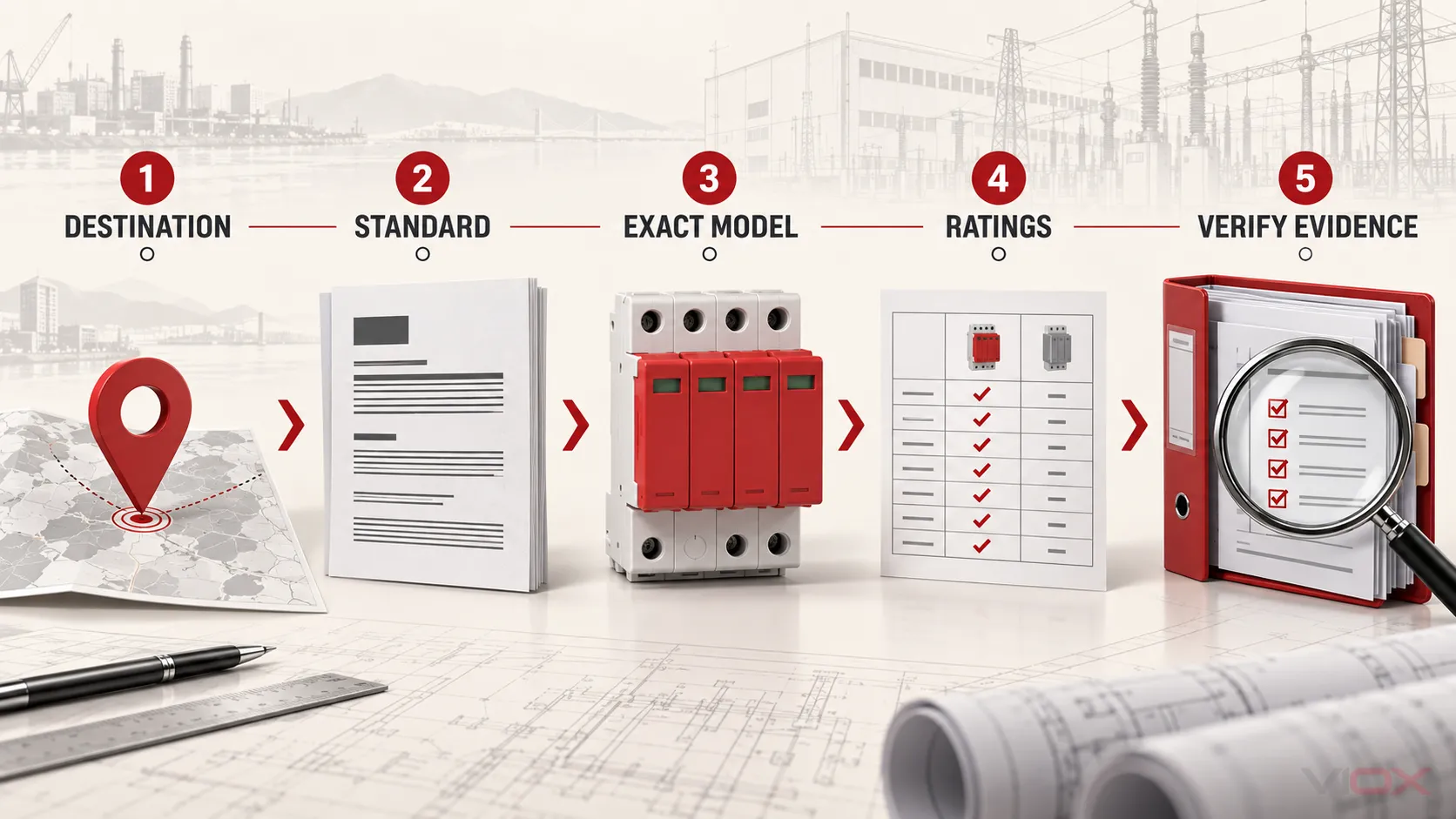
Start with the destination market and installation, then verify the exact model and its evidence rather than starting with a logo.
Step 1: Define the Destination and Installation
Record the country, adopted code or project standard, authority or approval body, system voltage, AC or DC duty, earthing arrangement, connection position, available fault current, enclosure environment and application. A “global SPD” specification without this information is not reviewable.
Step 2: State the Technical Standard Precisely
Write the standard number and edition. For a new IEC-based AC low-voltage SPD specification, the current technical route is IEC 61643-01:2024 together with IEC 61643-11:2025. If a national adoption or project standard names another edition, record that difference rather than silently substituting the IEC edition.
Step 3: Identify the Exact Product
Require the manufacturer name, model, variant code, pole or mode configuration, voltage designation, accessories and production identity covered by the evidence. A certificate for a similar model or a product-family name is not enough unless the document explicitly includes the supplied variant.
Step 4: Match Ratings Within the Correct Framework
For an IEC-based product, review the applicable Uc, Up, In, Imax, Iimp, Type, modes of protection, short-circuit behavior and backup-protection conditions. For a UL-based product, review the applicable nominal voltage, MCOV, VPR by mode, In, SCCR, SPD Type, environmental rating and installation conditions. Do not fill missing UL data by translating IEC values, or vice versa.
Step 5: Validate the Evidence Package
Use this model-level checklist:
- exact manufacturer and model match;
- standard number and edition;
- certificate, Listing or report number;
- issuing certification body or laboratory;
- report scope and test conditions;
- ratings and protection modes matching the ordered product;
- required accessories and upstream protection;
- production-site or surveillance conditions where applicable;
- installation manual revision;
- declaration or national approval required by the destination market;
- current record status checked in the issuer’s database.
If any item cannot be matched, record it as an open compliance question rather than marking the product “equivalent.”
Common Reasons an SPD Evidence Package Should Be Rejected
Reject or escalate the review when:
- the supplier provides only a standards logo or marketing statement;
- the certificate model does not match the quotation or nameplate;
- a report cites an obsolete edition without explaining project acceptance;
- a CB Test Certificate is provided without its associated report or usable model scope;
- a CE mark is presented without the relevant EU Declaration of Conformity;
- an IEC test report is offered as proof of UL Listing;
- UL Recognized component status is presented as a complete field-installed Listed SPD;
- IEC Type and UL Type are mapped as exact equivalents;
- Up and VPR are converted numerically;
- national rules, installation instructions or upstream protective-device conditions are omitted.
Frequently Asked Questions
Is UL 1449 equivalent to IEC 61643?
No. They address related SPD safety and performance functions, but use different classifications, tests, markings and conformity routes. A product can be evaluated to both frameworks, but each claim needs its own model-specific evidence.
What does “IEC 61643-11 certification” mean?
By itself, the phrase is incomplete. IEC 61643-11 is a standard, not a universal certificate. Ask for the exact standard edition, model-specific test report, issuing body, and any CB Test Certificate or national certificate claimed. For current AC low-voltage SPD evaluation, IEC 61643-11:2025 is used with IEC 61643-01:2024.
Does a CB Test Certificate allow an SPD to be sold in every CB Scheme country?
No. It facilitates recognition of test results by participating bodies. National certification, deviations, registration, regulation or project approval may still be required. Review the associated CB Test Report and destination-market process.
Does CE marking prove that an SPD is independently certified?
Not necessarily. CE marking is the manufacturer’s declaration that applicable EU requirements have been met after the required conformity-assessment process. Review the EU Declaration of Conformity and supporting technical evidence; third-party involvement depends on the applicable legislation and procedure.
Can an IEC-tested SPD be used in a North American panel?
IEC testing alone does not establish UL Listing or acceptance for that installation. Verify the applicable code, authority requirements, exact product certification category, model record, ratings and installation instructions.
Is GB/T 18802.11 the same as IEC 61643-11?
GB/T 18802.11-2020 is a Chinese national standard identified as a modified adoption of IEC 61643-11:2011. It should not be described as identical to the current IEC 61643-01:2024 plus IEC 61643-11:2025 route.
Final Specification Rule
Do not buy an SPD certificate; buy an identified product with traceable evidence for a defined installation and market. Start with the destination requirements, specify the correct standard and edition, match the exact model to the certification or test record, and keep IEC and UL ratings inside their own frameworks.
To review VIOX options, browse the VIOX SPD product family and request the exact model datasheet, test reports, declarations and certification records needed for your project. Product images and general catalog statements are not substitutes for model-specific evidence.
Sources
- IEC 61643-01:2024 — general requirements and test methods
- IEC 61643-11:2025 — SPDs connected to AC low-voltage power systems
- IECEE TRF 61643-111D:2026
- UL Lightning Protection Application Guide and SPD certification categories
- IECEE conformity-assessment scheme overview
- European Union guidance on CE marking
- GB/T 18802.11-2020 official standards record