

On this page
An old consumer unit does not need replacing simply because of its age, plastic enclosure, rewireable fuses, or installation under an earlier edition of the UK Wiring Regulations. The decision should be based on its condition, protective measures, test results, the connected wiring, and any new electrical work being planned.
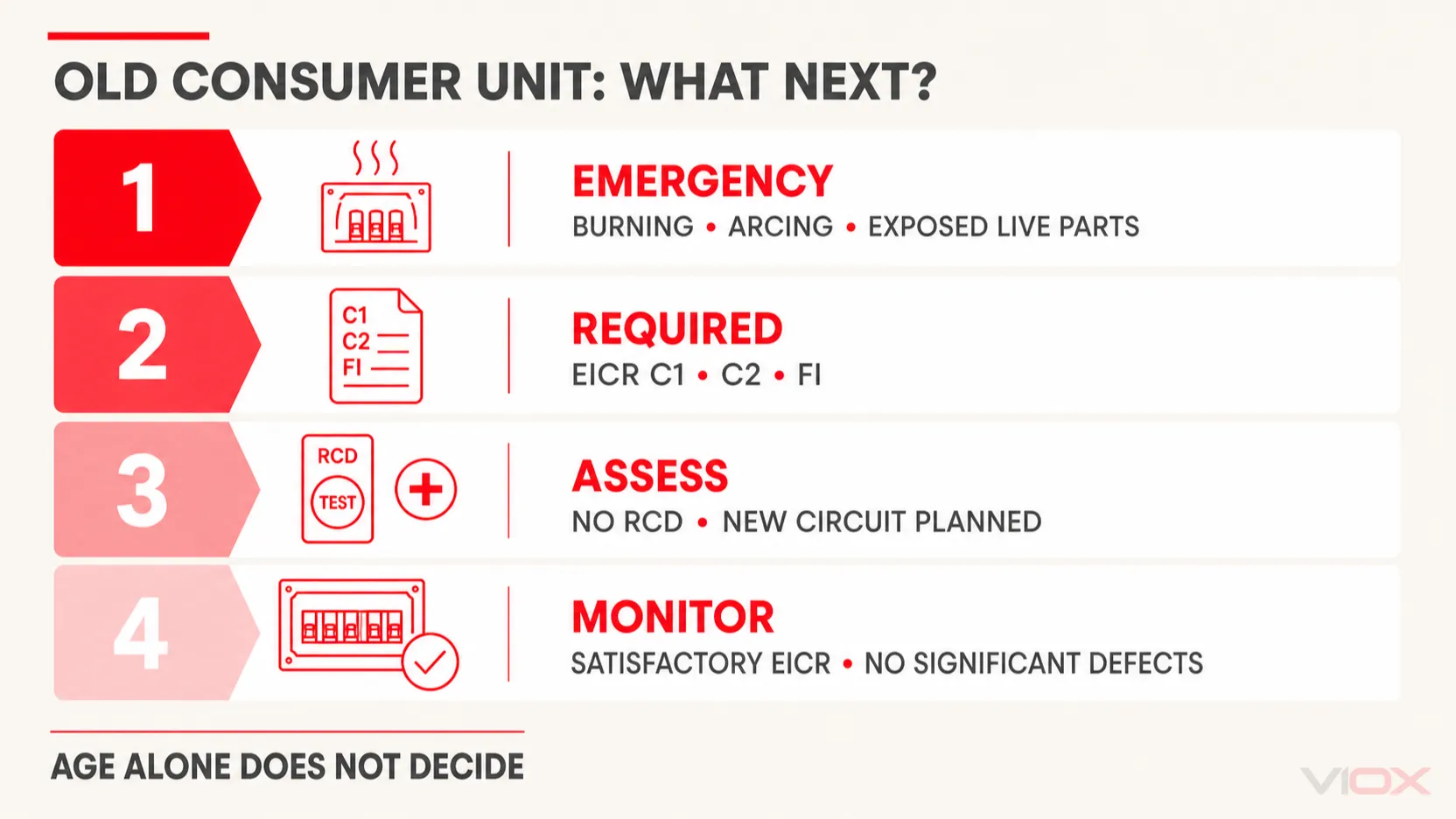
Visible burning, melting, smoke, arcing, exposed live parts, or an Electrical Installation Condition Report (EICR) coded C1 requires immediate action. C2 or Further Investigation (FI) observations also require remedial work or investigation. In less urgent cases, an EICR can establish whether the existing fuse box remains safe or whether upgrading is the practical solution.
Do not remove the cover or attempt internal checks yourself. Consumer-unit inspection and replacement should be carried out by a competent electrician.
Key Takeaways
- “Old” does not automatically mean unsafe or illegal.
- A plastic consumer unit is not an automatic reason for replacement.
- Rewireable fuses or missing residual current device (RCD) protection should prompt assessment, but neither condition alone proves the whole unit must be replaced.
- Heat damage, accessible live parts, or C1/C2 EICR observations require urgent attention.
- New circuits for an electric vehicle charger, heat pump, solar photovoltaic system, battery, or extension may make an old board unsuitable.
- Replacing the consumer unit does not correct defective wiring, inadequate earthing, or missing bonding.
Quick Decision Table
| What you find | Likely decision | Priority |
|---|---|---|
| Smoke, burning smell, heat damage, arcing, melting, or exposed live parts | Isolate safely if possible and obtain urgent professional help | Emergency |
| EICR code C1 or C2, or unresolved FI | Complete remedial work or investigation; replacement may be required | Required |
| No RCD protection, old fuse gear, repeated tripping, or unreliable equipment | Arrange inspection and compare repair, added protection, and replacement options | High |
| New circuit, EV charger, heat pump, solar, battery, or extension planned | Verify capacity, protection, earthing, and board suitability before design | Before project |
| Plastic enclosure with no damage and a satisfactory EICR | Not an automatic replacement requirement | Monitor |
| Older board that tests satisfactorily and has no significant defects | Immediate replacement may not be necessary | Planned improvement |
Signs an Old Consumer Unit Needs Professional Assessment
Heat, burning, or physical damage
Scorch marks, a burning smell, buzzing, crackling, melted material, smoke, or a cover that feels unusually warm may indicate a loose connection, damaged device, poor contact, or overloaded circuit. Broken covers, missing blanking plates, water entry, and openings that may permit contact with live parts also require prompt attention.
Do not repeatedly reset a device when there are signs of heat or arcing. Arrange safe isolation and inspection.
No RCD protection
An RCD detects current leaking from its intended path and disconnects the supply to reduce electric-shock risk. A test button marked T or Test is a useful visible indication that an RCD or residual current breaker with overcurrent protection (RCBO) is present, although it does not confirm which circuits are protected or whether the device operates correctly.
The absence of RCD protection is a significant limitation, especially for socket-outlets, bathrooms, outdoor equipment, and planned alterations. However, Electrical Safety First guidance explains that lack of RCD protection does not, by itself, make consumer-unit replacement mandatory; another compliant solution may sometimes be possible. The correct action depends on inspection, circuit use, and the scope of new work.
For the device distinction, see the VIOX comparison of RCBOs and MCBs.
Rewireable fuses or obsolete equipment
Fuse wire, ceramic carriers, wooden backing, bakelite parts, or cast-iron switches indicate an older installation. These features justify an inspection because the board may also lack modern residual-current protection, clear identification, compatible spare ways, or reliable replacement parts.
They do not automatically prove that the existing overcurrent protection is defective. Electrical Safety First’s consumer-unit replacement guidance states that older fuses or circuit-breakers alone are not sufficient reasons for replacement when they still provide satisfactory overcurrent protection. Condition and test results decide the outcome.
Repeated tripping or blown fuses
Frequent operation may be caused by a faulty appliance, overload, wiring fault, accumulated earth leakage, moisture, or a protective-device problem. A new consumer unit will not necessarily cure the cause. Testing should come before replacement, particularly when several circuits or appliances may be contributing.
Poor labelling or undocumented alterations
Missing or inaccurate labels make safe isolation harder. Mixed devices, crowded entries, crossed-out circuit descriptions, or obvious do-it-yourself alterations can also indicate that the installation has changed without adequate records. Labelling alone may be repairable, but the broader installation should be verified before further circuits are added.
Insufficient capacity for new work
An older consumer unit may have no suitable spare ways or may not provide the protection required for a new circuit. This often becomes relevant when installing:
- an EV charger;
- a heat pump;
- solar PV or battery storage;
- an electric shower or induction hob;
- an extension, garden office, or outdoor supply.
The installer must assess the supply, maximum demand, earthing arrangement, existing circuits, protective devices, and applicable RCD requirements. Adding a breaker to an available space is not a complete design check. For EV projects, see the VIOX EV charger circuit-breaker sizing guide.
Do Plastic Consumer Units Have to Be Replaced?
No—not solely because they are plastic.
Requirements for new domestic consumer units changed to improve fire containment, but that did not create a blanket instruction to remove every existing plastic enclosure. An older unit may remain in service when its condition and the installation are assessed as satisfactory. Damage, overheating, openings, location, and other defects can change that assessment.
If the consumer unit is replaced, the new work must follow the BS 7671 edition applicable to the project and the relevant Building Regulations route. It is important to distinguish between evaluating an existing installation and specifying new work: an installation designed to an earlier edition is not automatically unsafe merely because later requirements are different.
What Do the Current UK Regulations Mean?
BS 7671 is the national standard for UK electrical installations, but building-control and rental requirements vary by nation. This article focuses mainly on England, with some references relevant to England and Wales.
At the time of this August 2026 update, BS 7671:2018+A4:2026 has been published. The IET states that BS 7671:2018+A3:2024 remains valid during the transition period until 15 October 2026. Installers should verify which edition applies when the work is designed and certified rather than relying on a generic “18th Edition” claim.
In England, installing a new or replacement consumer unit is notifiable work under Part P of the Building Regulations. The work can normally be notified through a registered Competent Person Scheme installer or the appropriate building-control process. Requirements in Scotland, Wales, and Northern Ireland should be checked separately.
Use the EICR to Make the Decision
An EICR evaluates whether the installation is safe for continued use. It is more useful than judging a consumer unit from age or a front-cover photograph.
| EICR code | Meaning | What it means for the decision |
|---|---|---|
| C1 | Danger present | Immediate action is required |
| C2 | Potentially dangerous | Remedial work is required |
| FI | Further investigation required without delay | Investigate before safety can be confirmed |
| C3 | Improvement recommended | Does not by itself make the report unsatisfactory |
A satisfactory EICR does not mean the installation contains every feature expected in new work. It means the inspector did not identify defects that make it unsatisfactory for continued use within the inspection’s scope and limitations.
In England, electrical installations in covered rented homes must be inspected and tested by a qualified person at least every five years. Where the report identifies C1, C2, or FI, the landlord must arrange the required work within the applicable period. C3 is a recommendation rather than an automatic requirement for remedial work.
Consumer Unit Upgrade or Full Rewire?
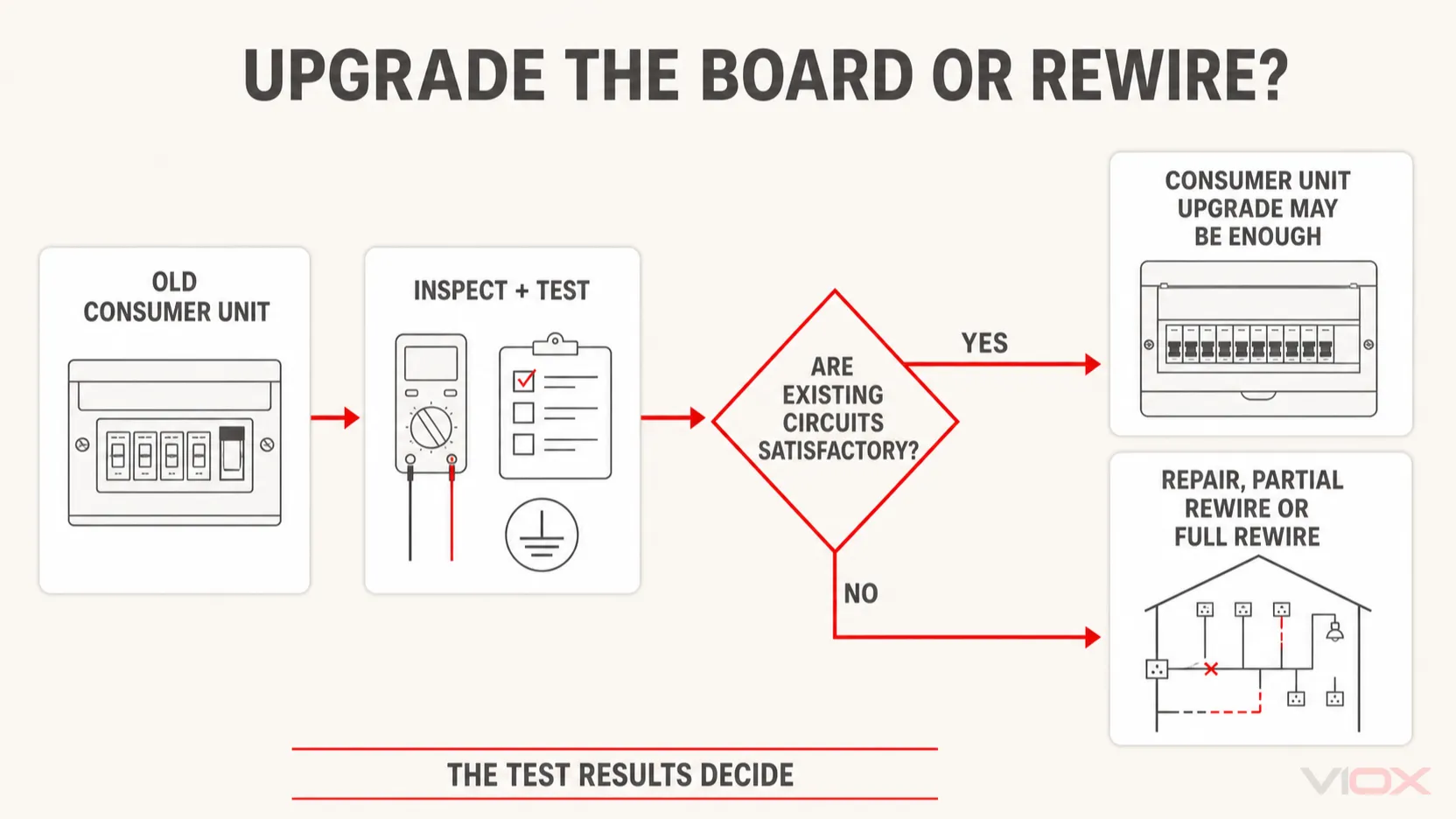
A consumer-unit replacement may be sufficient when the board is unsuitable but the existing circuits, earthing, and bonding test satisfactorily. A partial or full rewire may be needed when testing reveals deteriorated insulation, unsafe older cable, missing circuit protective conductors, borrowed neutrals, extensive undocumented alterations, or other defects that cannot be corrected at the board.
Before replacement, the electrician should check the existing wiring, earthing and bonding, polarity, circuit continuity, insulation resistance, loop impedance, prospective fault current, meter tails, and any conditions likely to cause unwanted RCD operation. Electrical Safety First recommends an EICR before a planned replacement; if a full EICR is not accepted, an adequate pre-work survey is still necessary before the work proceeds.
What Should a Replacement Achieve?
The replacement design should provide suitable circuit protection, residual-current protection, safe cable entries, clear labelling, and enough capacity for the intended installation. Individual RCBOs may limit loss of supply to the affected circuit and simplify fault identification compared with arrangements where one RCD protects several circuits. Surge protective devices and arc fault detection devices must be assessed against the applicable requirements and installation conditions rather than added from a generic checklist.
The finished work should be inspected, tested, certified, and—where required—notified. Product selection must also match the board manufacturer’s approved assembly, ratings, and instructions; protective devices should not be mixed solely because they fit mechanically.
Final Checklist
Arrange an electrician’s assessment if any answer below is yes:
- Is there heat damage, burning, buzzing, arcing, smoke, or melting?
- Is the enclosure broken or could live parts be accessible?
- Is RCD protection absent, defective, or unclear?
- Are old protective devices damaged or difficult to replace correctly?
- Does the EICR contain C1, C2, or FI observations?
- Are earthing, bonding, or existing circuits in doubt?
- Is a substantial new electrical load or circuit planned?
- Is the board full, poorly labelled, or altered with mixed equipment?
If none applies and the installation has a satisfactory inspection, immediate replacement may not be necessary. Upgrading can still improve protection and fault isolation, but the decision should follow evidence rather than age alone.
Frequently Asked Questions
Does an old consumer unit have to be replaced by law?
Not simply because it is old. Replacement may be required when defects are identified, when remedial work cannot otherwise make the installation safe, or when planned work requires a suitable new board.
Do plastic consumer units need to be replaced?
Not automatically. A plastic enclosure should be assessed for condition, damage, fire risk, location, and other defects. A new replacement must meet the requirements applicable to the new work.
Does a consumer unit without RCD protection need replacing?
Not in every case, but missing RCD protection is an important safety limitation. A competent electrician should determine whether added protection is possible or whether replacement is the appropriate solution.
Can a consumer unit be replaced without rewiring the house?
Yes, when the existing circuits test satisfactorily and any defects are corrected. Replacement does not make unsafe wiring acceptable.
Should I get an EICR before replacement?
For a planned replacement, an EICR is strongly recommended because it can reveal defects that would affect the new board. At minimum, an adequate pre-work survey and testing are required.
Is consumer-unit replacement notifiable under Part P?
In England, a new or replacement consumer unit is notifiable work. The notification route differs elsewhere in the UK, so check the rules for the property’s nation.