

On this page
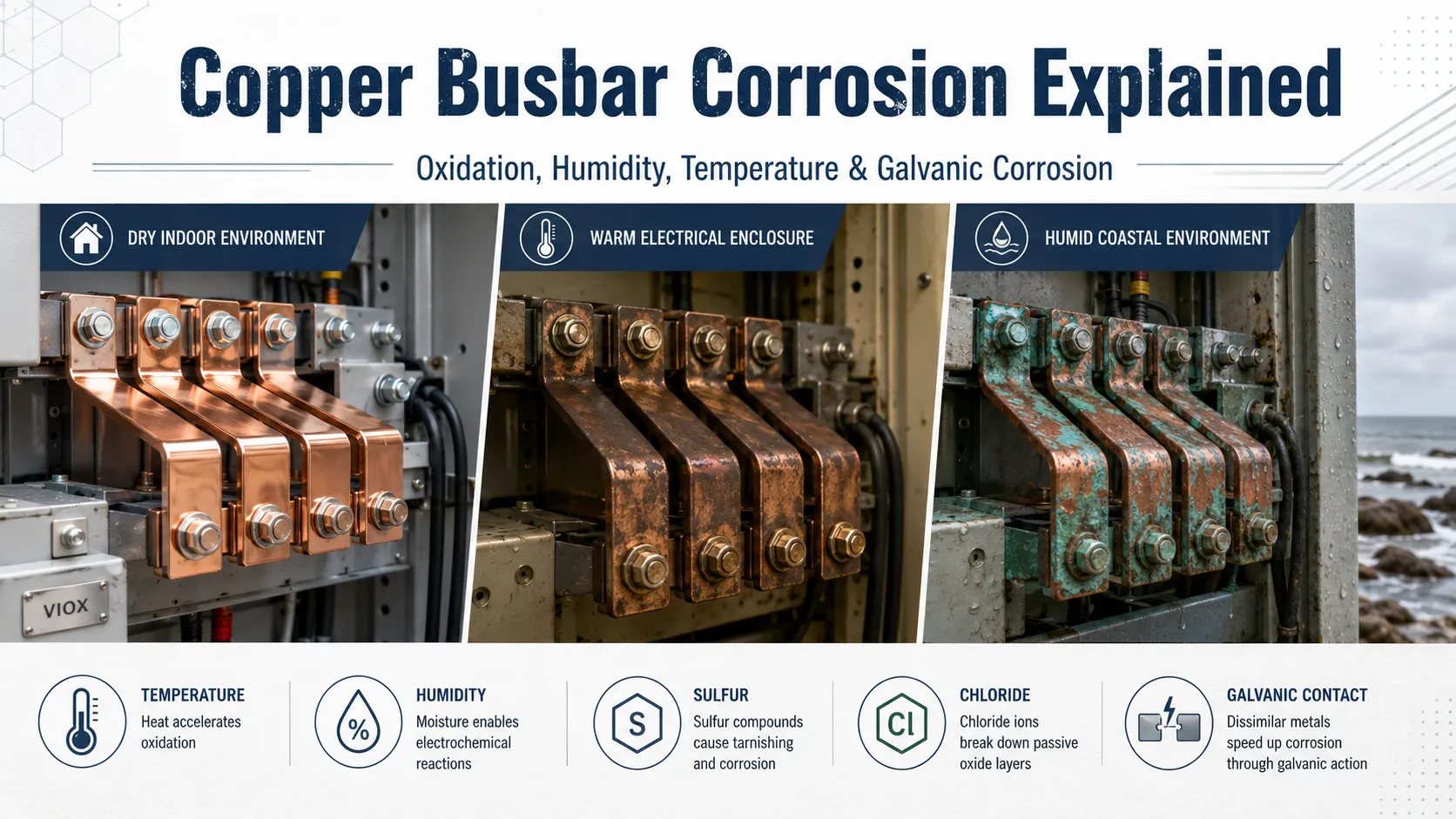
Copper busbars and copper terminals do not corrode at one fixed speed. A copper bar stored in a dry warehouse may stay bright for years, while the same copper inside a hot coastal distribution box may darken within months. The difference is not only the copper grade. It is the environment: temperature, humidity, sulfur, chloride, airflow, contact pressure, and whether copper is touching another metal.
For electrical panels, the real question is not “will copper oxidize?” Copper will always form a surface film. The engineering question is whether that film remains a thin, stable surface layer or becomes a corrosion problem that increases contact resistance, raises temperature, and reduces connection reliability.
This guide explains how copper busbar oxidation works, why copper turns brown, black, or green, how temperature accelerates the process, why sulfur and chloride are more dangerous than clean air, and how to reduce corrosion risk in busbars, terminals, cable lugs, and distribution boxes.
Quick Answer: How Long Does Copper Take to Oxidize?
In clean, dry indoor air, copper forms an ultra-thin oxide film very quickly, but visible discoloration may take months or years. In warm, humid, sulfur-rich, chloride-rich, or coastal industrial environments, visible darkening can occur much faster. Inside hot electrical enclosures, corrosion risk increases because higher temperature accelerates oxidation and also speeds up contact degradation.
As a practical engineering approximation, many chemical reactions follow Arrhenius-type temperature acceleration. In electrical reliability work, the well-known 10°C rule is often used for insulation aging and electronic component life: every 10°C rise may roughly double the aging rate. Copper atmospheric corrosion is more environment-dependent than that simple rule, but the engineering message is the same: higher temperature reduces the margin, especially when humidity, sulfur, chloride, or poor contact pressure are also present.
Why Copper Turns Brown, Black, or Green
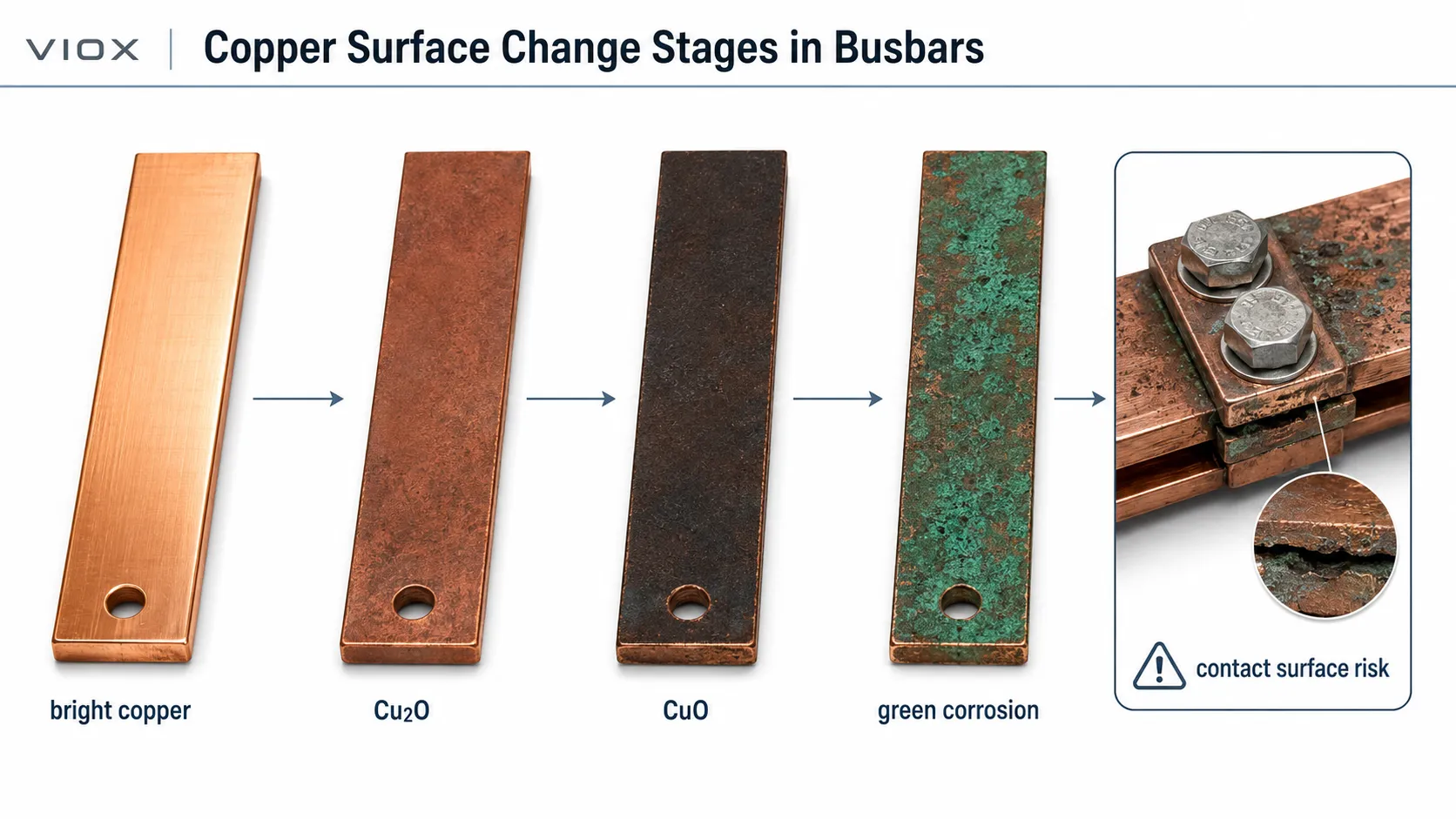
Copper surface color changes because different copper compounds form under different environmental conditions.
| Stage | Main Surface Compound | Typical Color | Common Condition | Engineering Meaning |
|---|---|---|---|---|
| Initial oxidation | Cu2O, cuprous oxide | Pink, light brown, reddish brown | Normal air exposure | Usually thin and stable |
| Continued oxidation | CuO, cupric oxide | Dark brown to black | More oxygen, heat, time, humidity | Can indicate aging or higher thermal stress |
| Environmental corrosion | Basic copper sulfate, basic copper carbonate, chlorides | Green, blue-green, powdery deposits | Sulfur, carbon dioxide, chloride, moisture | Higher corrosion concern, especially near contacts |
| Sulfidation | Copper sulfides | Dark brown to black | Sulfur-containing industrial or polluted atmosphere | Can increase contact resistance |
Dark copper is not automatically failed copper. A thin oxide film on a non-contact surface is often only a surface condition. The critical area is the contact interface: where the busbar, terminal, lug, bolt, washer, and conductor must maintain low resistance under pressure.
Temperature: Why Hot Electrical Panels Corrode Faster
Temperature changes the corrosion story. In dry, cool air, copper oxidation is slow. In a warm enclosure, the same surface film grows faster. In a hot enclosure with humidity or pollutants, the corrosion mechanism becomes much more aggressive.
A conservative reliability approximation is:
Many aging reactions can accelerate strongly with temperature; in electrical reliability work, a 10°C rise is often treated as a possible doubling of aging rate.
This is not a universal copper-corrosion law. Copper oxidation depends on humidity, pollutants, surface finish, airflow, and contact chemistry. Still, it is a practical warning for electrical design: lowering internal enclosure temperature improves both electrical reliability and corrosion margin.
| Copper Surface Temperature | Practical Corrosion/Aging Risk | Practical Observation |
|---|---|---|
| 25°C | Low in clean dry indoor air | Clean indoor copper may remain bright for a long time |
| 55°C | Higher surface aging risk | Visible darkening becomes more likely over time |
| 85°C | High risk if humidity or pollutants are present | Oxide growth and contact aging accelerate |
| 115°C | Severe thermal stress for many panel materials | Inspect material, contact pressure, load, and insulation condition |
The important point is consistency. If a copper busbar in a cool storeroom stays bright for a year, while another busbar in a sealed control cabinet turns dark in three months, the environment has changed the oxidation rate. It does not necessarily prove the copper material is defective.
In accordance with IEC 61439 design principles for low-voltage switchgear and controlgear assemblies, internal temperature rise and component compatibility should be verified at assembly level. Corrosion prevention is not only a material choice; it is also an enclosure temperature, ventilation, spacing, and contact-pressure problem.
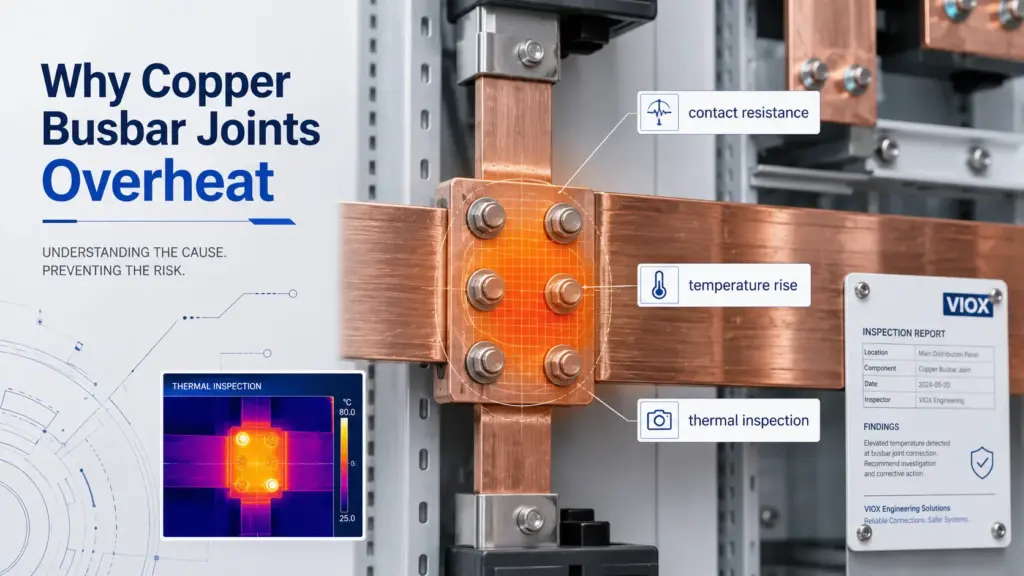
For thermal aging at joints, this topic can be connected with a separate article on copper busbar joint overheating, contact resistance, and thermal imaging once that page is published.
Humidity: The Difference Between Oxidation and Corrosion
Oxygen alone is usually not the worst enemy. Moisture makes the surface electrochemically active. When a thin water film forms on copper, dissolved gases and salts can move through the film and react with the metal surface.
High humidity increases risk because it:
- Helps oxygen and pollutants react on the copper surface.
- Dissolves sulfur and chloride compounds.
- Supports galvanic corrosion between dissimilar metals.
- Allows leakage paths across contaminated insulation.
- Makes dust deposits more conductive.
In a sealed outdoor box, humidity can be worse than expected. Day-night temperature swings can create condensation, especially in metal enclosures, solar combiner boxes, coastal cabinets, and pump-control boxes.
Sulfur and Chloride: The Hidden Accelerators
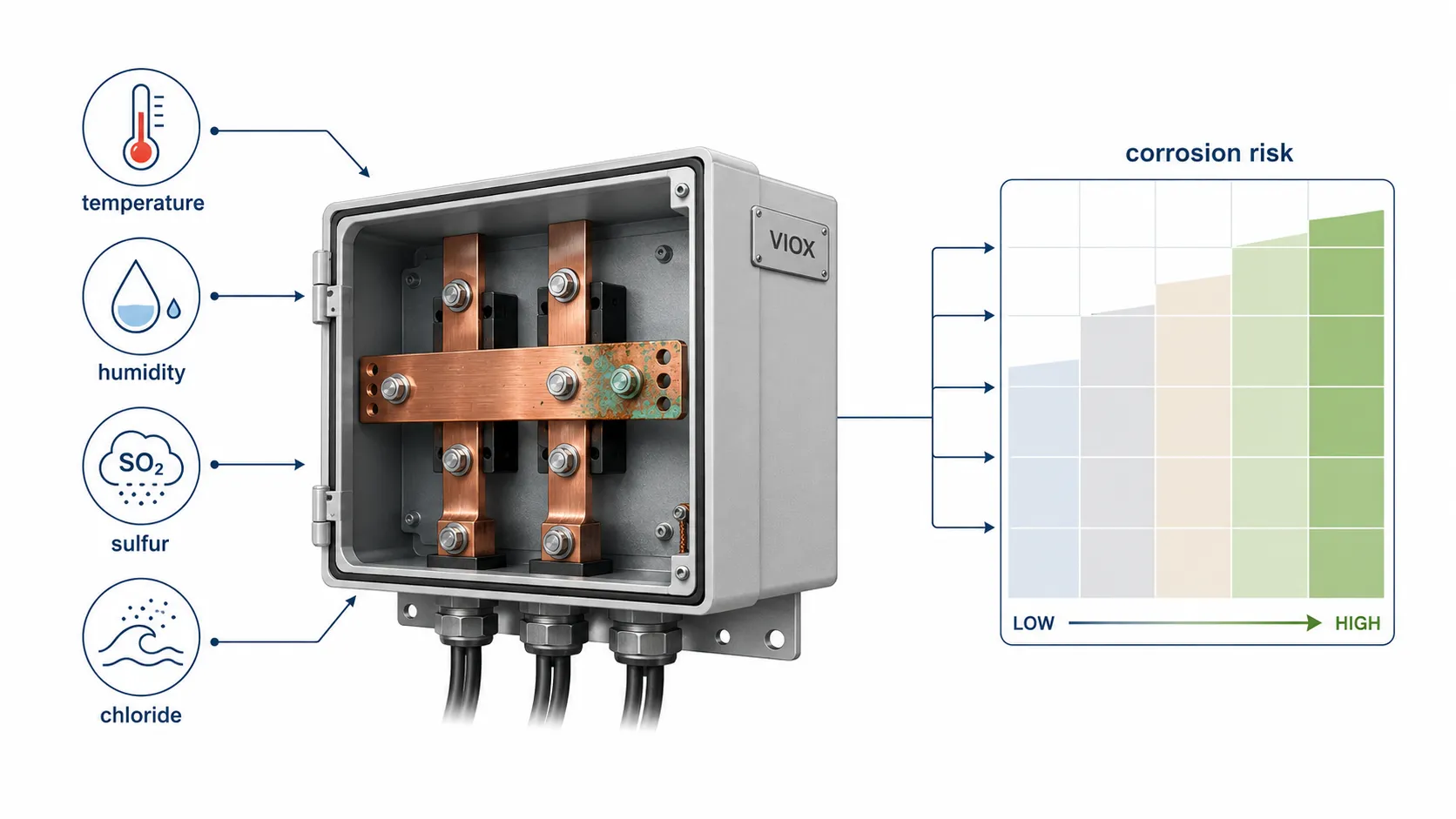
If copper is exposed only to clean indoor air, oxide growth is usually slow and predictable. The real acceleration often comes from sulfur and chloride contamination.
Sulfur-containing atmospheres
Sulfur compounds are common near industrial areas, wastewater facilities, rubber processing, paper mills, some chemical plants, and polluted urban environments. Sulfur can darken copper surfaces and contribute to copper sulfide formation. On current-carrying contact surfaces, sulfide films are more concerning than ordinary cosmetic discoloration.
Chloride-containing atmospheres
Chloride is common in coastal environments, marine installations, road-salt areas, and chemical plants. Chloride can penetrate or destabilize protective films, creating more active corrosion. Copper terminals, lugs, and busbars in coastal cabinets should be treated as corrosion-sensitive even if the enclosure looks dry.
Typical environment comparison
The table below gives practical relative risk levels, not fixed guaranteed corrosion rates. Actual results depend on enclosure design, ventilation, temperature, humidity, surface finish, and maintenance.
| Environment | Typical Location | Copper Corrosion Risk | Design Note |
|---|---|---|---|
| Dry indoor | Offices, laboratories, clean storage | Low | Bare copper may remain visually acceptable for long periods |
| Rural indoor/outdoor | Farm buildings, low pollution areas | Low to medium | Watch humidity, ammonia, and dust contamination |
| Urban/industrial | Workshops, factories, city panels | Medium | Sulfur and dust increase surface film growth |
| Heavy industrial | Steel plants, power plants, chemical zones | High | Consider plating, sealing, and periodic inspection |
| Coastal | Near sea, marine equipment, port areas | High | Chloride control and enclosure sealing are critical |
| Coastal industrial | Port + chemical/industrial exposure | Very high | Use more conservative material and enclosure strategy |
Galvanic Corrosion: When Copper Touches Another Metal
Copper oxidation by itself is usually manageable. The more serious problem appears when copper contacts another metal in the presence of moisture or conductive contamination. This is galvanic corrosion.
When two dissimilar metals are electrically connected and an electrolyte is present, a small electrochemical cell forms. The more active metal corrodes faster.
Common electrical connection pairings
| Metal Pair | Risk Level | Practical Comment |
|---|---|---|
| Copper to copper | Low | Best for stable low-resistance joints |
| Copper to brass | Low to medium | Usually manageable if clean and properly tightened |
| Copper to tin-plated copper | Low | Common electrical contact solution |
| Copper to aluminum | High | Use bimetal transition parts or approved Al/Cu connectors |
| Copper to galvanized steel | High | Zinc coating may be consumed in moist environments |
| Copper to stainless steel | Medium, environment-dependent | Area ratio, moisture, and contact design matter |
| Copper to silver-plated contact | Usually manageable | Silver may tarnish or sulfidize; check application |
The key risk is not just the metal pair. It is the metal pair plus moisture, salts, area ratio, temperature, and contact pressure. A dry indoor copper-to-steel mounting detail may last for years; the same detail in a coastal cabinet can become a corrosion cell.
Copper-to-Aluminum Connections Need Special Care
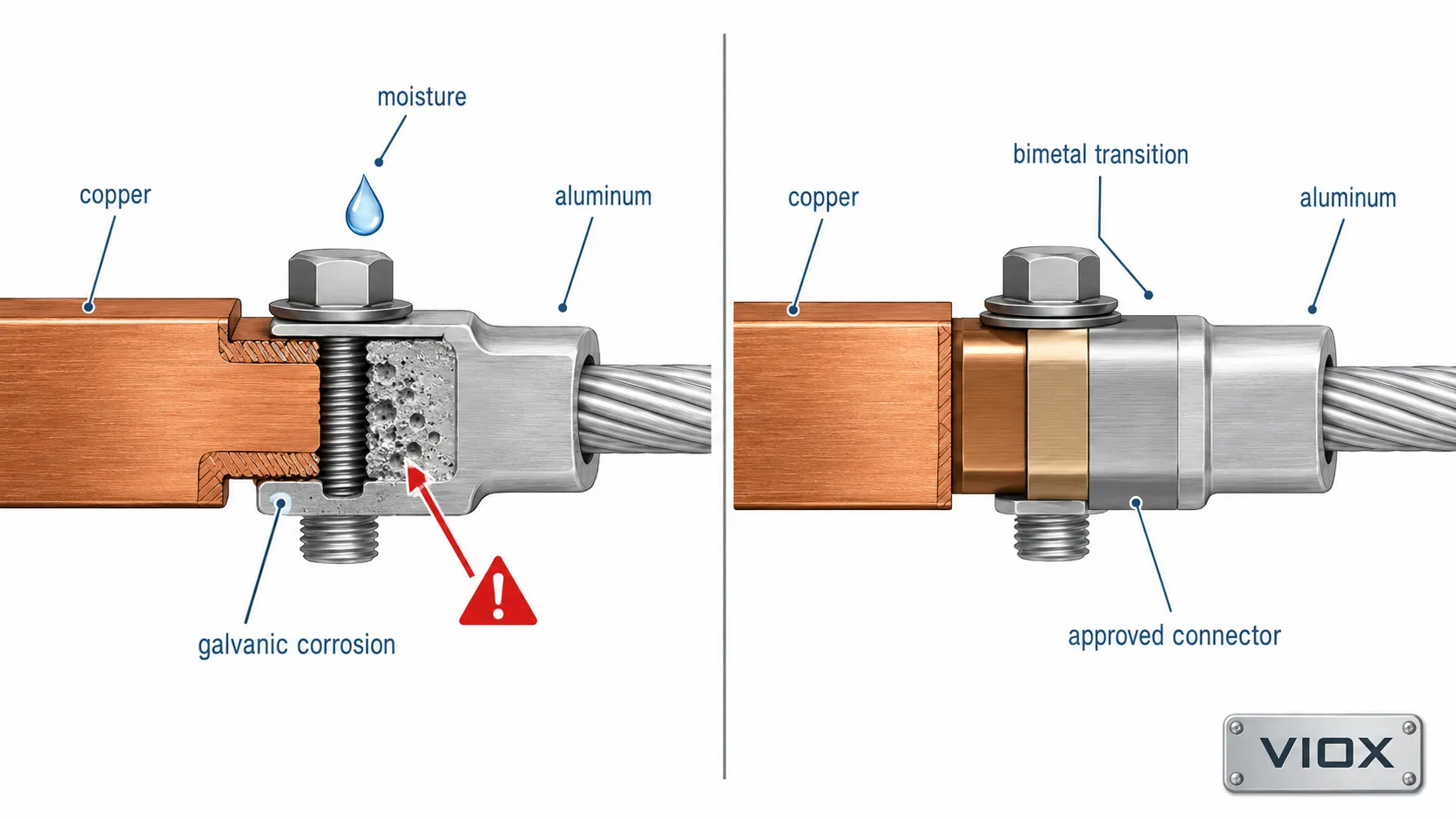
Copper and aluminum are both common in electrical distribution, but they should not be directly joined without a suitable transition method. Aluminum is more active and can corrode rapidly when connected to copper in a moist or salty environment.
Good practice includes:
- Use bimetallic transition lugs or bimetallic washers where required.
- Use connectors specifically rated for Cu/Al conductors.
- Follow the connector manufacturer’s preparation and torque instructions.
- Use oxide-inhibiting compound where specified.
- Avoid mixing copper and aluminum surfaces casually inside humid enclosures.
For a broader comparison, see VIOX’s guide to copper and aluminum busbar differences.
Does Tin Plating Prevent Copper Corrosion?
Tin plating does not make copper immune to corrosion, but it can improve contact stability and corrosion resistance in many electrical applications. Tin is commonly used because it is compatible with copper, relatively economical, solderable, and better suited than bare copper for many terminal surfaces.
Tin plating helps by:
- Reducing direct copper exposure.
- Improving contact behavior in many terminal applications.
- Slowing visible copper oxidation.
- Reducing galvanic mismatch in some contact systems.
However, tin plating can still be damaged by abrasion, poor handling, high temperature, or aggressive atmospheres. Once the plating is worn through, the copper substrate can corrode locally.
For plating selection, link this topic with VIOX’s busbar material and plating guide.
Manufacturer’s Note: What to Ask for When Buying Tin-Plated Copper Parts
For B2B sourcing, “tin-plated copper” is not enough as a specification. Buyers should ask for the copper grade, plating process, plating thickness tolerance, surface inspection criteria, and whether salt spray or environmental testing is available for the intended project environment.
As an electrical accessories manufacturer, VIOX treats plating as part of the connection design, not only a cosmetic finish. For busbars, terminals, and lugs used in humid, coastal, or industrial panels, the practical quality checks should include uniform plating coverage, clean edges, stable contact geometry, and packaging that prevents abrasion before installation. If a project requires salt spray testing or a specified plating thickness, confirm those requirements before production instead of after shipment.
When Silver Plating Makes Sense
Silver plating is used where conductivity, contact performance, and high-current reliability are more important than cost. It is common in some switchgear contacts, high-current joints, and special electrical interfaces.
Silver can tarnish, especially in sulfur-containing atmospheres, but silver oxide is generally more conductive than many other metal oxides. The concern in industrial atmospheres is often silver sulfide formation and surface contamination, not simple color change alone.
Use silver plating where the device design and operating conditions justify it. Do not specify silver plating just because the environment is corrosive; for many busbars and terminals, tin plating, enclosure control, and correct contact pressure are more practical.
Anti-Oxidation Compound: What It Actually Does
Anti-oxidation compound, sometimes called contact grease or conductive joint compound, is often misunderstood. Its main function is not magic conductivity improvement. The main functions are:
- Exclude oxygen and moisture from the contact interface.
- Reduce oxide growth at the joint.
- Fill small surface voids.
- Help stabilize copper-aluminum or aluminum connections where the connector instructions require it.
The contact surface must still be clean, mechanically sound, and correctly tightened. Grease cannot fix a loose joint, wrong washer stack, wrong metal pairing, or undersized conductor.
Use anti-oxidation compound according to the connector or equipment manufacturer’s instructions. It is commonly considered in high-humidity, coastal, copper-aluminum, and heavy-load joints, but it should not be applied blindly where a certified assembly or terminal instruction prohibits it.
Why Crimped Copper Terminals Can Resist Internal Oxidation
A properly crimped copper terminal can create a gas-tight connection between conductor strands and the terminal barrel. This is why a cable lug may look oxidized on the outside while the internal crimp interface remains electrically reliable.
The outside surface is exposed to air, moisture, and contaminants. The crimped interface, if made correctly, has very little internal air space and stable metal-to-metal contact pressure.
This is also why poor crimping is dangerous. If the crimp is under-compressed, contaminated, or mechanically loose, moisture can enter the interface and corrosion can grow where it directly affects resistance.
For lug selection, see VIOX’s copper lug selection guide.
Engineering Prevention Rules
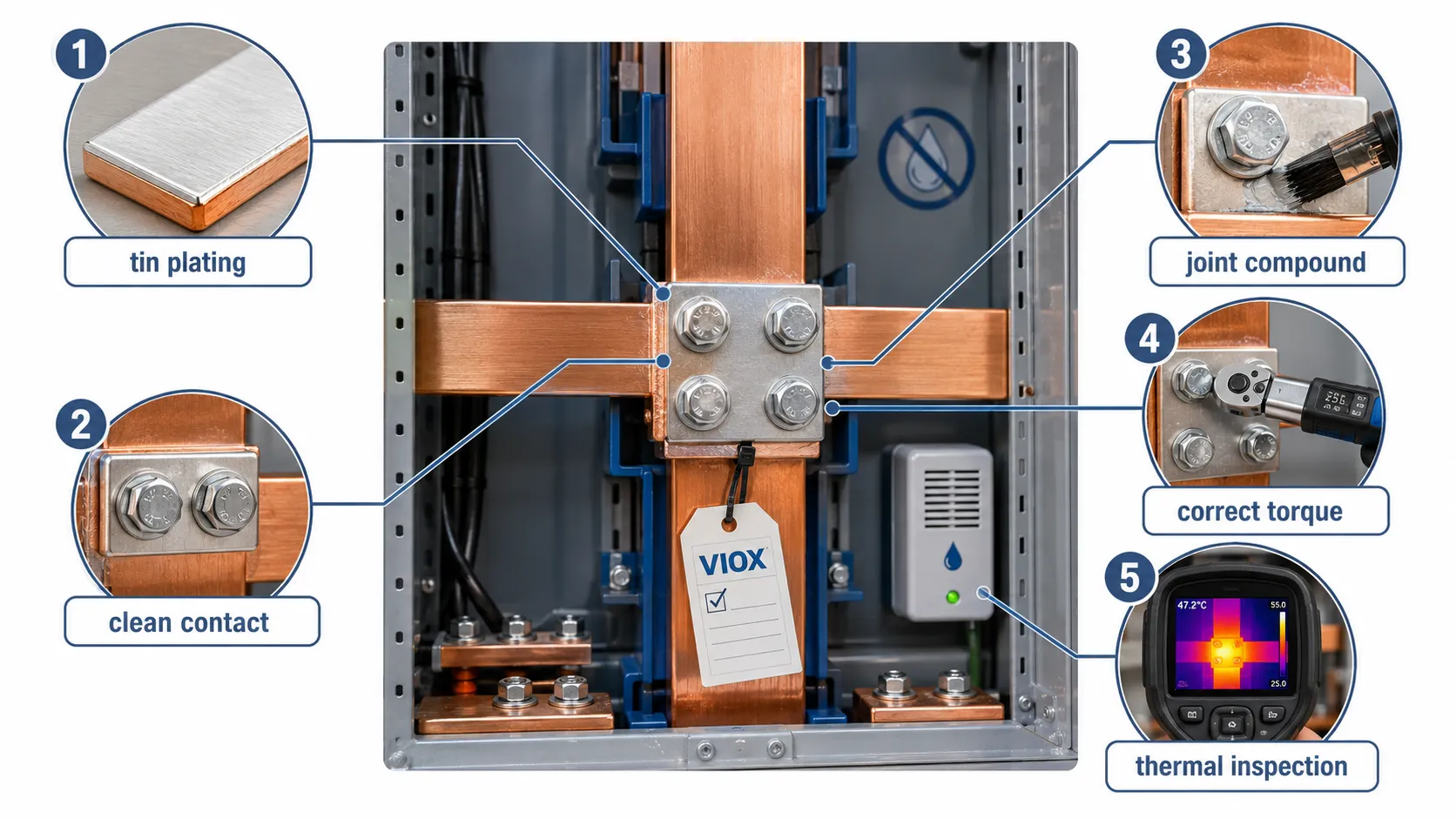
1. Control temperature
Lower busbar temperature reduces oxidation speed and slows contact aging. Good busbar sizing, proper ventilation, reduced contact resistance, and balanced load distribution all help.
2. Control humidity and condensation
Use proper enclosure sealing, breather vents where appropriate, drainage strategy, anti-condensation heaters where required, and suitable cable glands.
3. Avoid direct dissimilar metal contact
Use bimetal transition parts or approved connectors when joining copper and aluminum. Be cautious with galvanized steel, stainless steel, and other mixed-metal contact details in humid locations.
4. Use plating intelligently
Tin plating is often practical for copper busbars and terminals. Silver plating is useful for specific high-performance contact systems. The correct plating depends on current, temperature, environment, and contact design.
5. Protect the contact interface
Clean the contact surface, use correct torque, keep contact pressure stable, and apply approved anti-oxidation compound only when specified or appropriate.
6. Inspect by trend, not only by appearance
A blackened copper surface is not automatically failed, and bright copper is not automatically safe. Use thermal imaging, contact resistance testing, torque inspection, and historical trend records to judge risk.
Field Inspection Checklist
| Check Item | What to Look For | Risk Signal |
|---|---|---|
| Surface color | Brown, black, green, powdery, or uneven deposits | Green or powdery corrosion near contacts |
| Contact area | Lug, washer, bolt, busbar overlap | Discoloration concentrated at joint |
| Temperature | Compare with similar phases or adjacent joints | One phase significantly hotter than others |
| Moisture | Condensation, water marks, rust on hardware | Enclosure sealing or breathing issue |
| Metal pairing | Copper-aluminum, copper-steel, copper-stainless | Galvanic corrosion risk |
| Plating condition | Tin or silver surface worn through | Local corrosion at exposed base copper |
| Torque and pressure | Loose bolts, relaxed joints, damaged washers | Rising contact resistance |
| Environment | Coastal, sulfur, chemical, dust, high humidity | Need stronger corrosion control |
When Does Copper Corrosion Become an Electrical Problem?
Copper surface discoloration becomes an electrical problem when it affects the contact interface or indicates a larger environmental issue. Pay attention when you see:
- Black or green deposits at bolted joints.
- Local heating at one phase or one connection.
- Loose hardware or reduced contact pressure.
- Powdery corrosion around washers and lugs.
- Copper-aluminum contact without a proper transition part.
- Repeated thermal alarms at the same joint.
- Increasing contact resistance compared with the commissioning baseline.
If discoloration is only on an exposed non-contact surface and thermal imaging is normal, it may be cosmetic. If discoloration is concentrated at the joint and temperature is rising, treat it as a maintenance issue.
FAQ
Why does copper turn black?
Copper can turn black when copper oxide or copper sulfide films form on the surface. Heat, humidity, and sulfur-containing atmospheres can accelerate this process.
Why does copper turn green?
Green copper deposits usually come from environmental corrosion products such as basic copper carbonate, basic copper sulfate, or chloride-related compounds. They are more likely in humid, polluted, coastal, or outdoor environments.
Is black copper busbar dangerous?
Not always. A thin dark film on a non-contact surface may be mostly cosmetic. It becomes concerning when discoloration appears at joints, contact surfaces, lugs, or terminals, especially with heat rise or loose connections.
Does copper oxidize faster in heat?
Yes. Higher temperature generally accelerates oxidation and aging reactions. In electrical reliability work, the conservative 10°C rule is often used for aging discussions, but copper atmospheric corrosion also depends heavily on humidity, sulfur, chloride, airflow, and surface condition.
Is tin-plated copper better than bare copper?
Tin-plated copper often provides better surface stability and contact behavior than bare copper in many terminal and busbar applications. It is not immune to corrosion, but it can slow direct copper oxidation and improve long-term contact reliability.
Why is copper-aluminum contact risky?
Copper and aluminum form a galvanic pair in the presence of moisture or salts. Aluminum is more active and can corrode faster. Use bimetallic lugs, transition parts, or approved Cu/Al connectors.
Does anti-oxidation compound reduce resistance?
The main purpose is to exclude air and moisture and slow oxide growth. The contact must still be clean and mechanically tight. Compound cannot compensate for a loose joint or wrong connector.
How do I prevent copper busbar corrosion in coastal panels?
Use suitable enclosure protection, condensation control, tin-plated or otherwise protected copper surfaces where appropriate, approved cable glands, proper torque, and regular thermal inspection. Avoid direct dissimilar metal contact without transition parts.
Final Recommendation
Copper corrosion is not a single problem. It can be harmless surface oxidation, aggressive environmental corrosion, or a serious contact interface failure. For electrical panels, the priority is to control the environment and protect the joint.
Keep busbars cool, dry, clean, and correctly tightened. Use tin plating, silver plating, anti-oxidation compound, bimetallic transition parts, and enclosure protection where the application requires them. Most importantly, judge corrosion by location and trend: discoloration on an exposed surface is different from corrosion at a current-carrying contact.