

On this page
Quick Answer
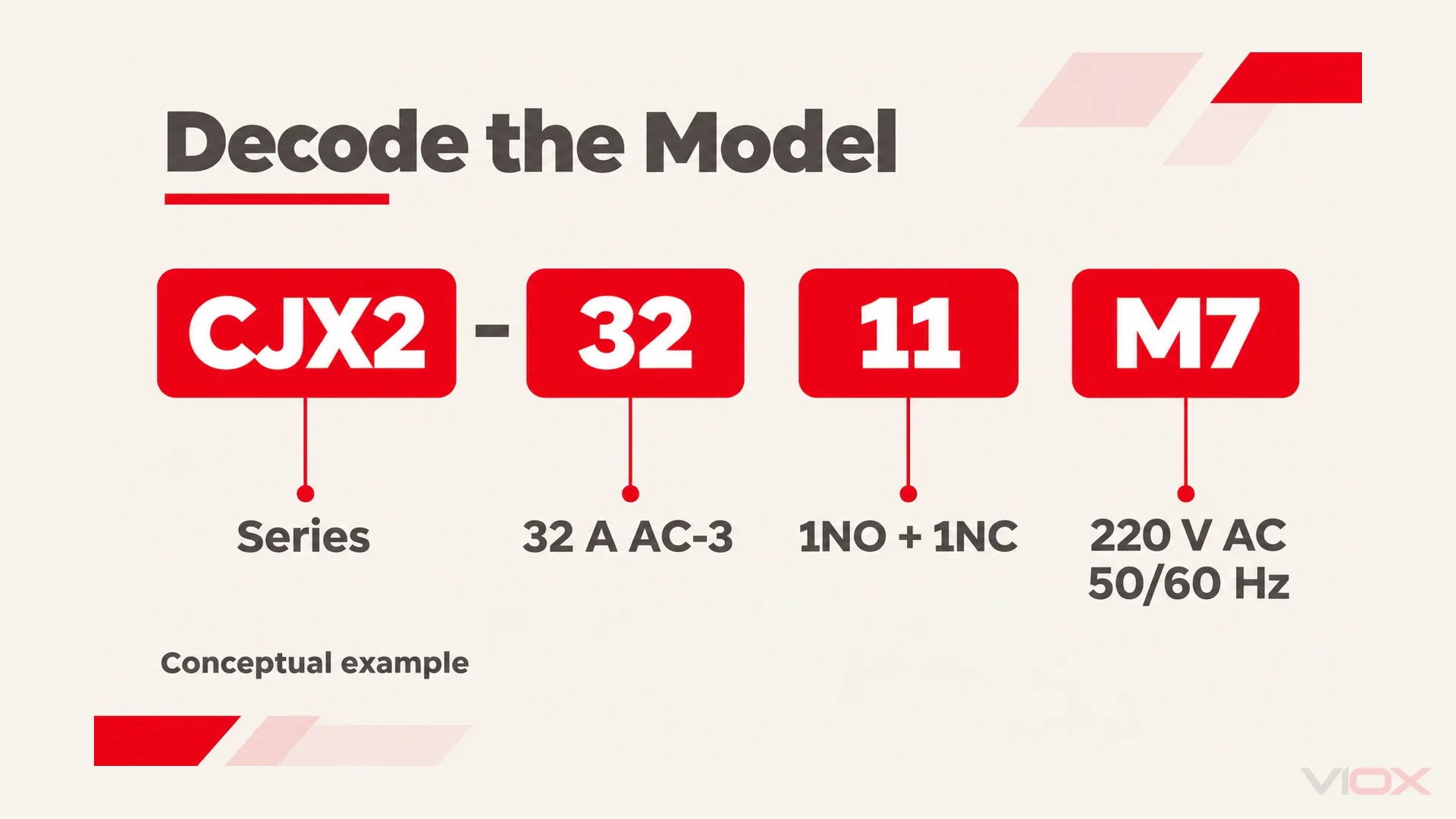
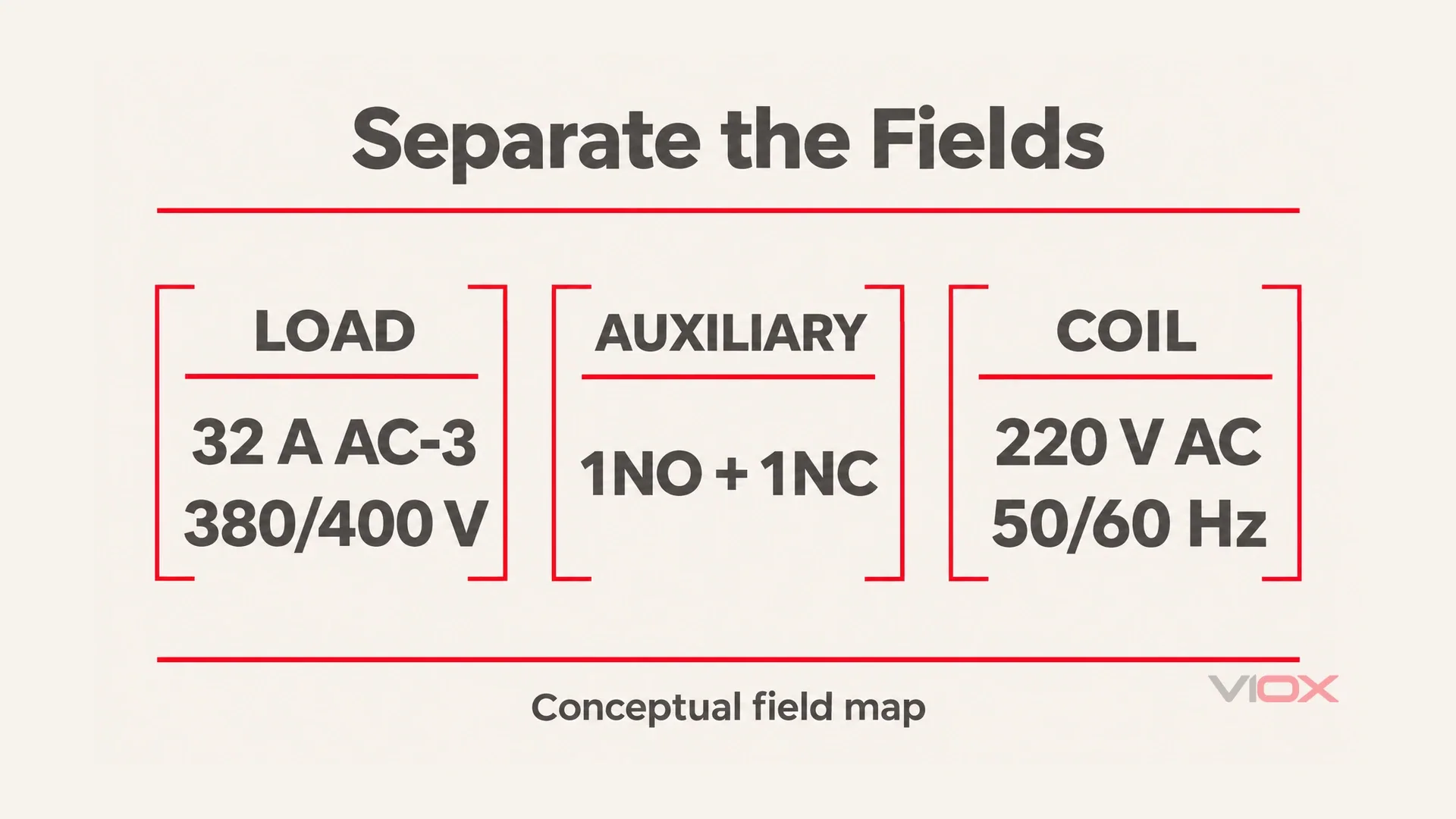
To establish a contactor model number meaning, identify the manufacturer’s series, then decode its current token, auxiliary-contact suffix and coil option against that series’ tables. In the legacy CJX2 syntax, CJX2-3211M7 reads as CJX2 family, 32 A AC-3 at 380/400 V, 1NO + 1NC built-in auxiliaries, and a 220 V AC, 50/60 Hz coil. This is a reading example assembled from VIOX’s legacy definitions, not a claim that the complete string is a stocked SKU. The current token refers to the specified AC-3 duty, not a higher AC-1 or thermal-current figure. Coil codes are manufacturer-specific, so an unfamiliar brand’s suffix must never substitute for a stated voltage, AC/DC supply and frequency.
Segment 1 – Series Letters
Start with the family identifier. For this article’s main example, that identifier is CJX2. It tells you which manufacturer’s definition and rating tables to open; the remaining characters become useful only after that choice.
Letter mnemonics are not an IEC-wide ordering language. IEC 60947-4-1 addresses contactors and motor starters, but it does not make every manufacturer’s model string a common decoder. Do not use an assumed expansion of C, J or X as evidence of electrical capability. If the device itself is unfamiliar, first establish what a contactor does, then return to its exact catalogue entry.
For Schneider Electric, LC1D identifies the relevant TeSys D/Deca family context. The letters establish a catalogue family; they do not make its accessories, coil options or dimensional interfaces interchangeable with another maker’s family.
Keep CJX2 and current CJX2s documentation separate
The current VIOX CJX2s AC contactor series lists CJX2s-09 through CJX2s-110. Earlier VIOX CJX2 product listings carry the type-definition and coil-code tables used for the legacy decoding examples below.
Both sets of documents associate model current tokens with category-specific ratings. That similarity does not, by itself, establish an identical complete ordering syntax. Keep the series spelling intact when requesting a quotation, and ask the supplier to confirm the complete order string, auxiliary arrangement and coil option. A legacy decoder is useful evidence; it is not authorization to remove the s from a current order.
When reading an existing unit, preserve punctuation and suffixes in the record. A partly obscured label should remain an incomplete identification until its missing fields are confirmed. Do not let an apparently familiar housing fill those gaps: the same visible body can be offered with different control supplies or auxiliary arrangements. Separate what was actually read from what the supplier still needs to establish.
Segment 2 – The Current Digits Are AC-3 Amps
In the cited VIOX CJX2 tables, the digits following the family correspond to the AC-3 rated operational current in the 380/400 V row. Read the category and voltage together with the number.
The following ladder is reproduced from VIOX’s legacy CJX2 specifications. The corresponding current and motor-power pairs also appear in the current CJX2s table.
| Current token | AC-3 current at 380/400 V | Motor power at 380/400 V |
|---|---|---|
| 09 | 9 A | 4 kW |
| 12 | 12 A | 5.5 kW |
| 18 | 18 A | 7.5 kW |
| 25 | 25 A | 11 kW |
| 32 | 32 A | 15 kW |
| 40 | 40 A | 18.5 kW |
| 50 | 50 A | 22 kW |
| 65 | 65 A | 30 kW |
| 80 | 80 A | 37 kW |
| 95 | 95 A | 45 kW |
Source: VIOX CJX2-3211 product listing, “Specifications,” AC-3 current and power rows; checked against the current CJX2s series table. These are catalogue motor-duty ratings, not permission to omit installation-specific checks.
The ladder is not a universal numbering rule
The current CJX2s series spans 9-110 A and includes CJX2s-38 at 38 A / 18.5 kW and CJX2s-110 at 110 A / 55 kW, at 380/400 V AC-3. Those entries come from that series’ detailed specifications, not an assumed list of standard frame steps.
For an enquiry, copy the target manufacturer’s actual row. A familiar-looking current token does not prove that another brand uses the same nominal step, enclosure or contact system. Motor power is also tied to the stated voltage and duty; it is not a standalone replacement code.
Trap: substituting a thermal rating for motor duty
VIOX’s legacy CJX2 table shows a conventional thermal-current row with 20 A for the 9 A model, 50 A for the 32 A model, and 125 A for the 95 A model. These larger figures do not turn those devices into equivalently rated AC-3 motor contactors.
Conventional thermal current, Ith, and AC-1 rated operational current are distinct rating concepts, even when a catalogue displays them together or gives equal values. Neither should replace the AC-3 row for the stated motor duty. Also, do not transfer the legacy thermal-current row wholesale to the newer CJX2s family: its detailed table must be read independently.
Trap: carrying the current across voltage rows
The same legacy table labels its higher-voltage AC-3 row 660/690 V. There, the 32 A model is rated 22 A, and the 95 A model is rated 49 A. The current token has not changed, but the applicable operating rating has.
Likewise, Ui 690 V is a rated insulation-voltage field. It does not mean that the contactor can switch its lower-voltage AC-3 current at every voltage up to that figure. Preserve category, operating voltage and operational current as separate fields on the purchase record.
For a motor replacement, the useful comparison is the proposed contactor’s applicable operational row against the actual motor and duty requirements. A model decoder does not calculate those requirements. If the old purchase description contains only an ampere figure, obtain its category and voltage context before using it as the specification for a new order.
Segment 3 – Auxiliary Contact Suffix 10 / 01 / 11
For the cited legacy CJX2 syntax, read the auxiliary suffix digit by digit. NO means normally open; NC means normally closed. These descriptions refer to the normal, unenergized state.
| Auxiliary suffix | Built-in normally open contacts | Built-in normally closed contacts |
|---|---|---|
| 10 | 1 NO | 0 NC |
| 01 | 0 NO | 1 NC |
| 11 | 1 NO | 1 NC |
Source: VIOX legacy CJX2 “Type Designation” table and the CJX2-0911/CJX2-3211 product listings. The suffix describes auxiliary contacts, not main power poles.
The type table lists 10/01 constructions across the 9-32 A range, including CJX2-1810 and CJX2-1801. It lists 11 constructions across 40-95 A, including CJX2-4011 and CJX2-9511. However, VIOX also has product listings for CJX2-0911 and CJX2-3211. Therefore, frame size is not a reliable shortcut for predicting the auxiliary arrangement.
That distinction matters when auxiliaries provide an interlock, holding circuit or feedback signal. An incorrect suffix can leave the power-current rating apparently correct while making the control function wrong. Record built-in contacts separately from any add-on auxiliary block; a photographed accessory is not proof of what the base order includes.
Also distinguish the contact quantity from the circuit function assigned to it. The suffix identifies available NO and NC elements; it does not say which element the equipment designer used for a particular signal. Preserve that function in the enquiry when the replacement must reconnect to an existing control circuit.
Segment 4 – Coil Voltage Code
In VIOX’s legacy CJX2 type definition, the coil-option position follows the auxiliary suffix. The definition uses CJX2-####*, with the asterisk representing the coil option. Confirm the printed coil marking as well as the requested catalogue string.
Read the AC voltage letter and frequency ending together
The following subset comes from VIOX’s legacy CJX2 “Coil Voltage Of AC Contactor and Code” table. Every entry shown is AC and uses the dual-frequency ending.
| Coil code | Control supply | Frequency |
|---|---|---|
| B7 | 24 V AC | 50/60 Hz |
| E7 | 48 V AC | 50/60 Hz |
| F7 | 110 V AC | 50/60 Hz |
| M7 | 220 V AC | 50/60 Hz |
| P7 | 230 V AC | 50/60 Hz |
| U7 | 240 V AC | 50/60 Hz |
| Q7 | 380 V AC | 50/60 Hz |
| V7 | 400 V AC | 50/60 Hz |
For these documented AC-code tables, an ending 5 means 50 Hz, 6 means 60 Hz, and 7 means 50/60 Hz. VIOX lists frequency-specific variants in its legacy table. Schneider’s official frequency-code explanation confirms the same ending convention for the TeSys products it covers. Meaning and availability are separate: confirm that the required voltage/frequency option is offered for the exact frame and series.
The main-circuit operating voltage is not the coil voltage. A contactor’s load-duty row and control-supply row answer different questions, even if both display volts. Keep both values in the enquiry rather than relying on whichever voltage is largest on a photograph.
DC and other manufacturers use different code systems
Schneider’s official TeSys coil-code FAQ lists BD = 24 V DC, FD = 110 V DC, and MD = 220 V DC for the standard DC coil options covered there. These are Schneider references. They are not evidence that VIOX offers those DC codes, and an AC suffix must not be converted into a DC order by assumption.
The Siemens SIRIUS examples checked use the AP0 segment with 230 V AC and BB4 with 24 V DC. Read those segments within their complete Siemens ordering context; do not treat either as a universal voltage abbreviation. Siemens’ official catalogue identifies both supplies in the corresponding product rows.
ABB AF documentation gives another pattern: the checked -13 option accepts 100-250 V AC/DC. For the checked -11 option, the AC range is 24-60 V AC; the DC limits have their own entry and must not be assumed identical. These are bounded examples from ABB’s AF product and low-voltage coil documentation, not a cross-brand conversion table.
Worked Examples
CJX2-3211M7: read from the legacy definition
| Segment | Document-supported reading |
|---|---|
| CJX2 | Family identifier for the cited legacy table |
| 32 | 32 A AC-3 at 380/400 V; corresponding motor-power row 15 kW |
| 11 | 1 NO + 1 NC built-in auxiliaries |
| M7 | 220 V AC, 50/60 Hz coil option |
Read or write this as an illustrative order description assembled from the definition table. Before ordering, have the supplier confirm that the complete construction and coil option are available together. Do not silently relabel it CJX2s or assume that a product-page base designation confirms every possible suffix combination.
LC1D25P7: decode within Schneider’s catalogue
| Segment | Document-supported reading |
|---|---|
| LC1D | TeSys D/Deca family context |
| 25 | 25 A AC-3 in the relevant motor-duty specifications |
| P7 | 230 V AC, 50/60 Hz coil |
Source: Schneider’s LC1D25P7 product record and its coil-code documentation. The similar-looking voltage suffix does not establish mechanical interchangeability or identical accessories with CJX2.
AF26-30-00-13: do not force it into the CJX2 pattern
| Segment | Document-supported reading |
|---|---|
| AF26 | ABB family/model token; read its AC-3 rating from ABB’s own product row |
| 30 | Three normally open main contacts in the named product |
| 00 | No built-in auxiliary contacts in the named product |
| -13 | 100-250 V AC/DC electronic coil supply |
ABB’s product record identifies the main-contact and auxiliary configuration and the wide-range control supply. The family token is not permission to substitute a nearby current step from another manufacturer’s ladder. This example demonstrates why a decoder must stop at the manufacturer’s boundary: a familiar number does not carry a universal AC-3 meaning.
What the Model Number Does Not Tell You
A readable order string is an identification aid, not a complete application approval. Check the contactor utilization-category guide when the actual load duty differs from the catalogue row you decoded.
Short-circuit Type 1 and Type 2 coordination requires the manufacturer’s combination tables for the actual protective device and installation conditions. The contactor current token does not specify a complete protective combination. Likewise, do not infer an AC-3e declaration for a high-efficiency motor application from a conventional AC-3 entry alone.
Series-level construction matters too. VIOX’s own catalogue describes CJX2s-W as an electronic electromagnetic contactor series. That W identifies a different series context; its control-supply specification must be read from its own documentation rather than grafted onto the legacy coil-code table. Four-pole variants also require explicit confirmation instead of assumptions based on a familiar current token.
If a rating appears inconsistent with the hardware, use the AC contactor component guide to distinguish the coil, power-contact system and auxiliaries. Those functions explain why seemingly similar bodies can have different ordering requirements.
Ordering Mistakes and Enquiry Checklist
The avoidable mistakes follow directly from incomplete decoding:
- Giving only the series name leaves the supplier to guess the current, auxiliaries and coil.
- Giving only a coil code across brands leaves its meaning ambiguous; include the numerical supply and AC/DC type.
- Using a higher AC-1 or thermal-current figure as the motor-duty rating selects from the wrong row.
Keep the decoded order string beside the following specification fields. Do not release an order for shipment until the essential fields are confirmed.
| Enquiry field | What to provide | What the supplier should confirm |
|---|---|---|
| Motor/load duty | AC-3 current, or motor kW with operating voltage and duty | Exact rated operational row for the proposed model |
| Coil supply | Numerical voltage, AC/DC and applicable frequency | Matching coil option and complete order designation |
| Auxiliary function | Required built-in NO/NC quantities; add-ons identified separately | Supplied contact arrangement and compatible accessories |
Attach a legible existing label and the circuit requirements when procuring a replacement. Keep terminal markings separate from the model string: L1, L2, T1 and T2 markings describe connections, not ordering suffixes. Once the ordered construction is confirmed, follow the contactor wiring guide for the separate installation task.
Ask the supplier to return both the proposed full reference and its decoded specification, rather than replying with a shortened family name. Compare that response with the enquiry before accepting the order. An unexplained difference between the requested suffix, the quoted description and the coil marking is a reason to clarify the documents before shipment, even when the main current figure agrees.
For a VIOX enquiry, use the AC contactor range with the completed fields and exact requested series spelling.
FAQ
What does the 10 in CJX2-3210 mean?
In the cited legacy CJX2 definition, 10 means one built-in normally open auxiliary contact and no normally closed auxiliary contact. The corresponding 01 means one NC and no NO; 11 means one of each. Read the actual suffix and documentation rather than predicting it from the frame size.
Is the coil voltage always in the contactor model number?
No. A complete ordering reference may encode it, while an abbreviated body designation or listing omits the option. Check the actual coil label and manufacturer documentation. For a replacement enquiry, provide the numerical coil supply even when a suffix is visible.
What does the 7 mean in a coil code like M7?
For the cited CJX2 and TeSys AC-code convention, 7 means 50/60 Hz. Endings 5 and 6 indicate 50 Hz and 60 Hz respectively where those options are documented. The voltage letter and frequency ending must be read together; do not apply that rule to unrelated code families.
Can I replace an LC1D with a CJX2 with the same numbers?
Matching numbers alone are insufficient. Verify AC-3 duty at the operating voltage, the complete coil supply, auxiliaries, dimensions and accessory interfaces. Decoding tells you what each candidate claims; it does not prove equivalence or authorize a substitution.