

On this page
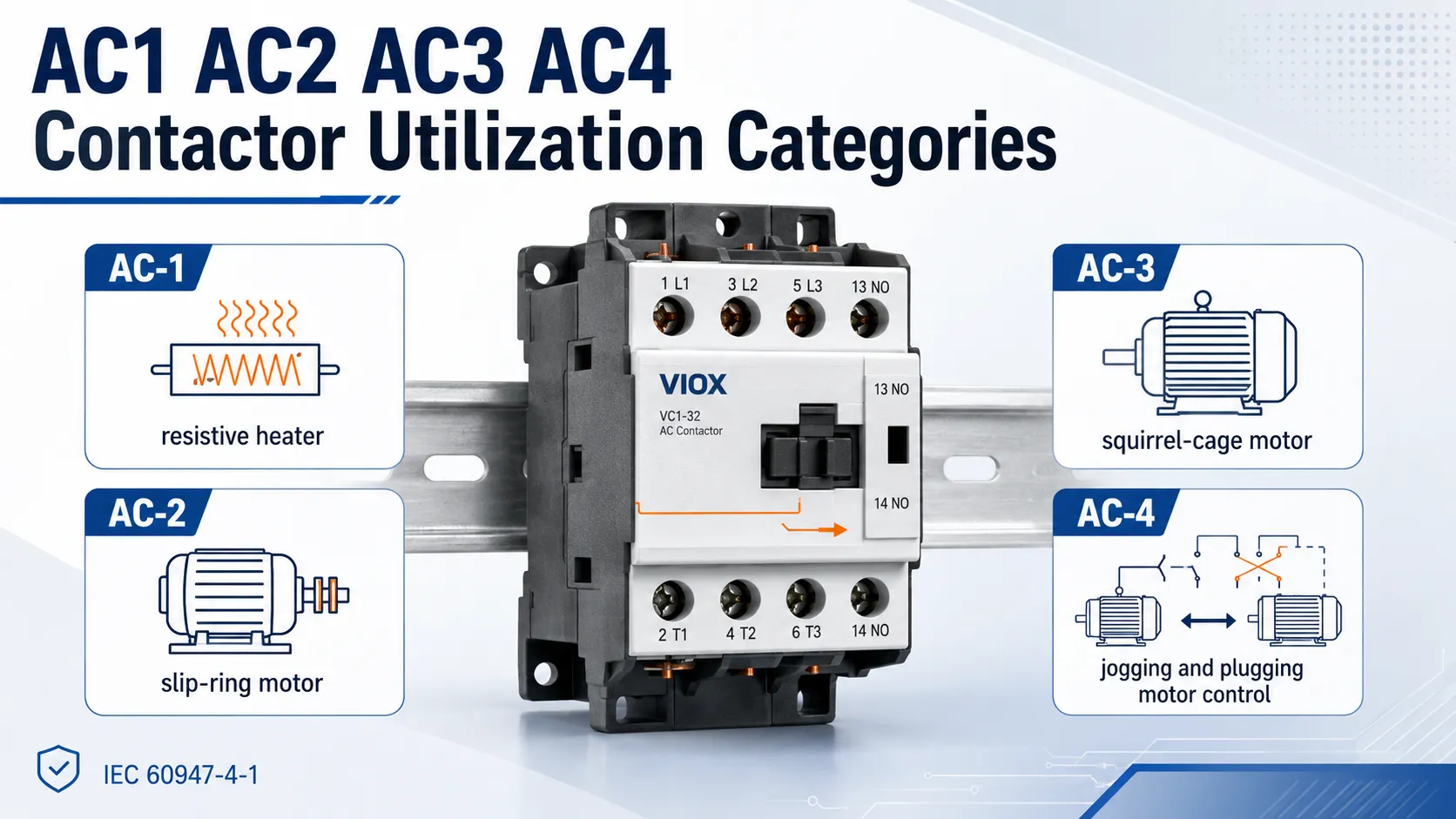
AC-1, AC-2, AC-3, and AC-4 are utilization categories used to describe what type of load a contactor can switch. They matter because the same contactor can have very different current ratings depending on the load. A contactor that can carry a high current under AC-1 resistive duty may have a much lower rating under AC-3 motor duty.
For most industrial motor applications, AC-3 is the key rating to check. For heaters and other mainly resistive loads, AC-1 is usually more relevant. For inching, plugging, jogging, or reversing motor duty, AC-4 is much harsher than AC-3 and requires careful selection from the manufacturer’s data.
The main standard framework for electromechanical contactors and motor starters is IEC 60947-4-1. Always use the utilization category printed on the contactor nameplate or datasheet, not only the ampere value on the front label.
Quick Rating Chart: AC-1, AC-2, AC-3, AC-4
| Utilization Category | Typical Load | Typical Application | Selection Warning |
|---|---|---|---|
| AC-1 | Non-inductive or slightly inductive AC loads | Resistive heaters, ovens, distribution loads | Rating is usually higher than motor duty, but not suitable for all motor loads |
| AC-2 | Slip-ring motors | Cranes, hoists, high-starting-torque machinery | More demanding than AC-1 and less common in modern general panels |
| AC-3 | Squirrel-cage motors | Pumps, fans, compressors, conveyors, HVAC motors | Most common motor contactor category |
| AC-4 | Squirrel-cage motors with inching, plugging, reversing | Crane jogging, reversing drives, frequent start-stop duty | Much harsher than AC-3; electrical life drops quickly if misapplied |
| DC-1 | Non-inductive or slightly inductive DC loads | DC heaters, resistive DC circuits | Easier DC duty, but DC arc behavior still matters |
| DC-3 | Shunt DC motors | Starting, plugging, inching, dynamic braking | Requires DC-rated breaking performance |
| DC-5 | Series DC motors | Traction, winches, heavy DC motor duty | More severe DC motor switching duty |
What Is a Utilization Category?
A utilization category defines the type of load and switching duty a contactor is designed to handle. It is not just a label; it changes the usable current rating of the same contactor.
For example, a contactor may show one current value for AC-1 and a lower current value for AC-3. That does not mean the manufacturer is inconsistent. It means resistive heating loads and motor loads stress the contacts differently.
Important factors include:
- load current
- voltage
- power factor
- motor starting current
- inrush current
- inductance
- switching frequency
- whether the contactor makes or breaks high current
- whether the load is AC or DC
- expected electrical life
This is why selecting a contactor by frame size or ampere rating alone can lead to overheating, contact welding, premature wear, or nuisance failure.
Key Electrical Parameters Behind the Categories
Utilization categories are not just application names. They are tied to switching stress: how much current the contactor must make, how much it must break, and how difficult the arc is to extinguish.
| Parameter | Meaning | Why It Matters |
|---|---|---|
| Ie | Rated operational current | The current value used for the specified voltage and utilization category |
| Ue | Rated operational voltage | The voltage at which the current rating applies |
| I make / Ie | Making-current severity | Indicates how much inrush or starting current the contactor must close onto |
| I break / Ie | Breaking-current severity | Indicates how much current the contactor must interrupt when opening |
| cos phi | AC power factor | Lower power factor means more inductive stress and harder arc interruption |
| L/R time constant | DC circuit inductance behavior | Higher L/R time means the DC arc is harder to interrupt |
As a simplified engineering reference, AC-1 is associated with high-power-factor resistive loads, often discussed around cos phi >= 0.95. AC-3 motor duty is much harsher because the contactor must close onto motor starting current; many IEC-based catalog explanations describe AC-3 making duty in the range of several times the rated operational current, commonly shown as I make = 6 x Ie in simplified examples. Always confirm the exact test duty and rating from the applicable standard edition and manufacturer datasheet.
AC-1 vs AC-3: The Most Important Difference
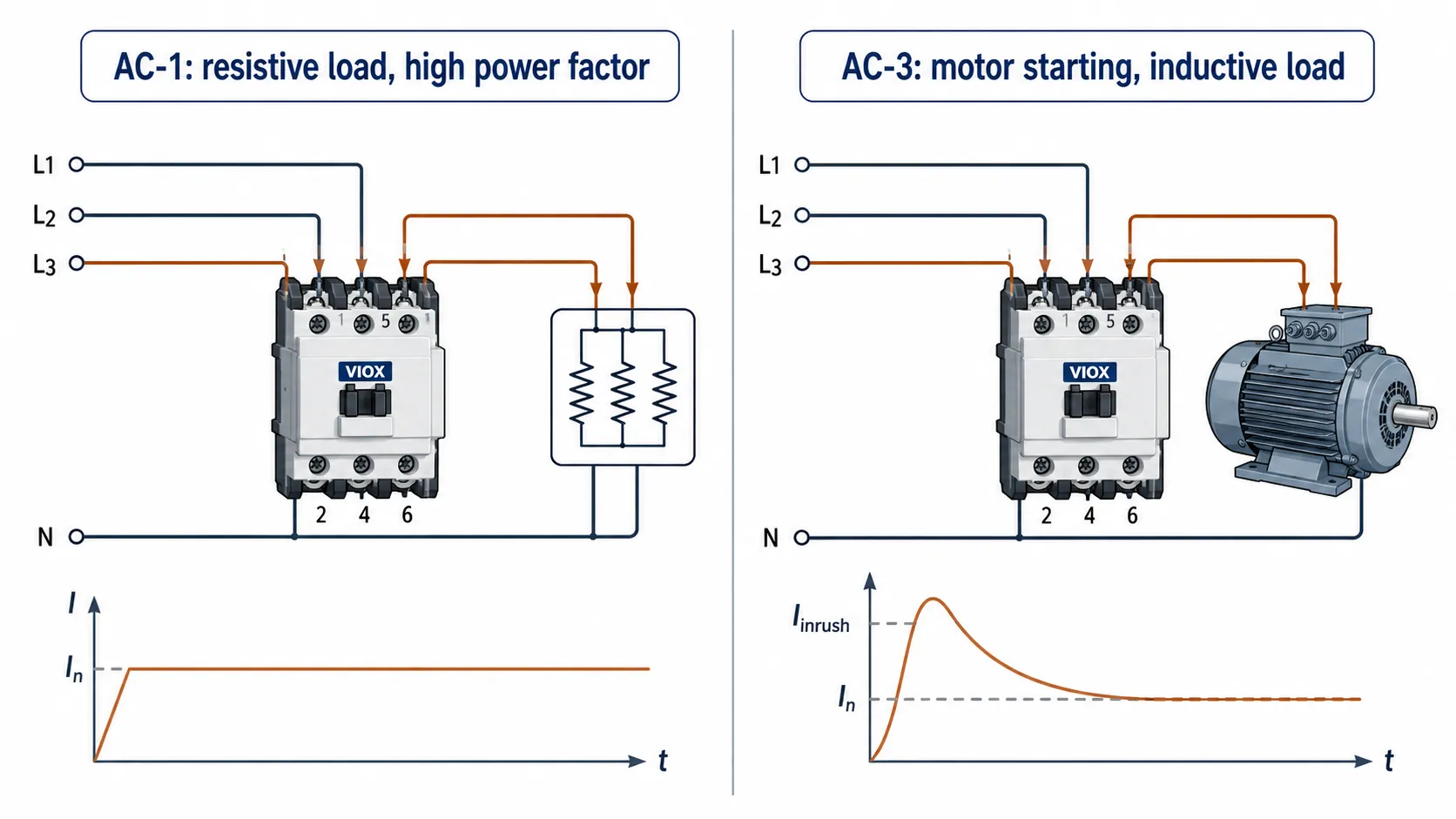
The most common confusion is AC-1 vs AC-3.
AC-1 applies to non-inductive or slightly inductive loads, such as resistive heating. The contactor usually switches a current that is relatively stable and easier to interrupt.
AC-3 applies to squirrel-cage motor duty. The contactor closes on motor starting current and opens the motor circuit after the motor has reached normal running speed. This is more demanding than AC-1 because motors create high inrush current and inductive switching stress.
| Question | AC-1 | AC-3 |
|---|---|---|
| Main load type | Resistive or slightly inductive loads | Squirrel-cage motors |
| Typical application | Heaters, ovens, resistive loads | Pumps, fans, compressors, conveyors |
| Switching stress | Lower | Higher |
| Current rating on same contactor | Usually higher | Usually lower |
| Main risk if misused | Overheating if undersized | Contact wear, welding, shortened electrical life |
The simple rule: Use AC-1 for resistive loads and AC-3 for normal motor starting duty. Do not size a motor contactor from the AC-1 current rating.
AC-1 Contactors: Resistive and Slightly Inductive Loads
AC-1 is used for non-inductive or slightly inductive AC loads. These loads have a high power factor and do not create the same switching stress as motors.
Common AC-1 applications include:
- resistance heaters
- industrial ovens
- heating elements
- some distribution loads
- non-motor resistive loads
AC-1 ratings are often higher than AC-3 ratings on the same contactor because the load is easier to switch. This is why many selection errors happen: a buyer sees a high AC-1 current on the nameplate and assumes the same contactor can handle the same current motor load. It usually cannot.
AC-2 Contactors: Slip-Ring Motor Duty
AC-2 applies to slip-ring motors. These motors are less common than standard squirrel-cage motors in many modern installations, but they still appear in applications requiring high starting torque or controlled starting behavior.
Typical AC-2 applications include:
- cranes
- hoists
- large conveyors
- crushers
- heavy starting machinery
AC-2 is more demanding than AC-1 because it involves motor starting and switching conditions. If a project uses slip-ring motors, do not default to AC-3 without checking the motor type and duty.
AC-3 Contactors: Standard Motor Starting Duty
AC-3 is the most important category for many industrial users because it covers normal squirrel-cage motor starting and stopping.
Typical AC-3 applications include:
- pumps
- fans
- compressors
- conveyors
- HVAC motors
- machine tools
- general three-phase motor control
Under AC-3 duty, the contactor makes the motor starting current and normally breaks the motor running current. The motor starting current can be several times higher than the running current, so the contactor must be selected according to the manufacturer’s AC-3 rating, motor power, voltage, and duty cycle.
If you are selecting a contactor for a standard three-phase induction motor, the AC-3 rating is usually the first rating to check.
For product selection, see the VIOX AC contactor range.
AC-4 Contactors: Inching, Plugging, and Reversing Duty
AC-4 is used for severe motor switching duty. It covers operations such as inching, plugging, jogging, and reversing. In these applications, the contactor may make and break high motor currents repeatedly.
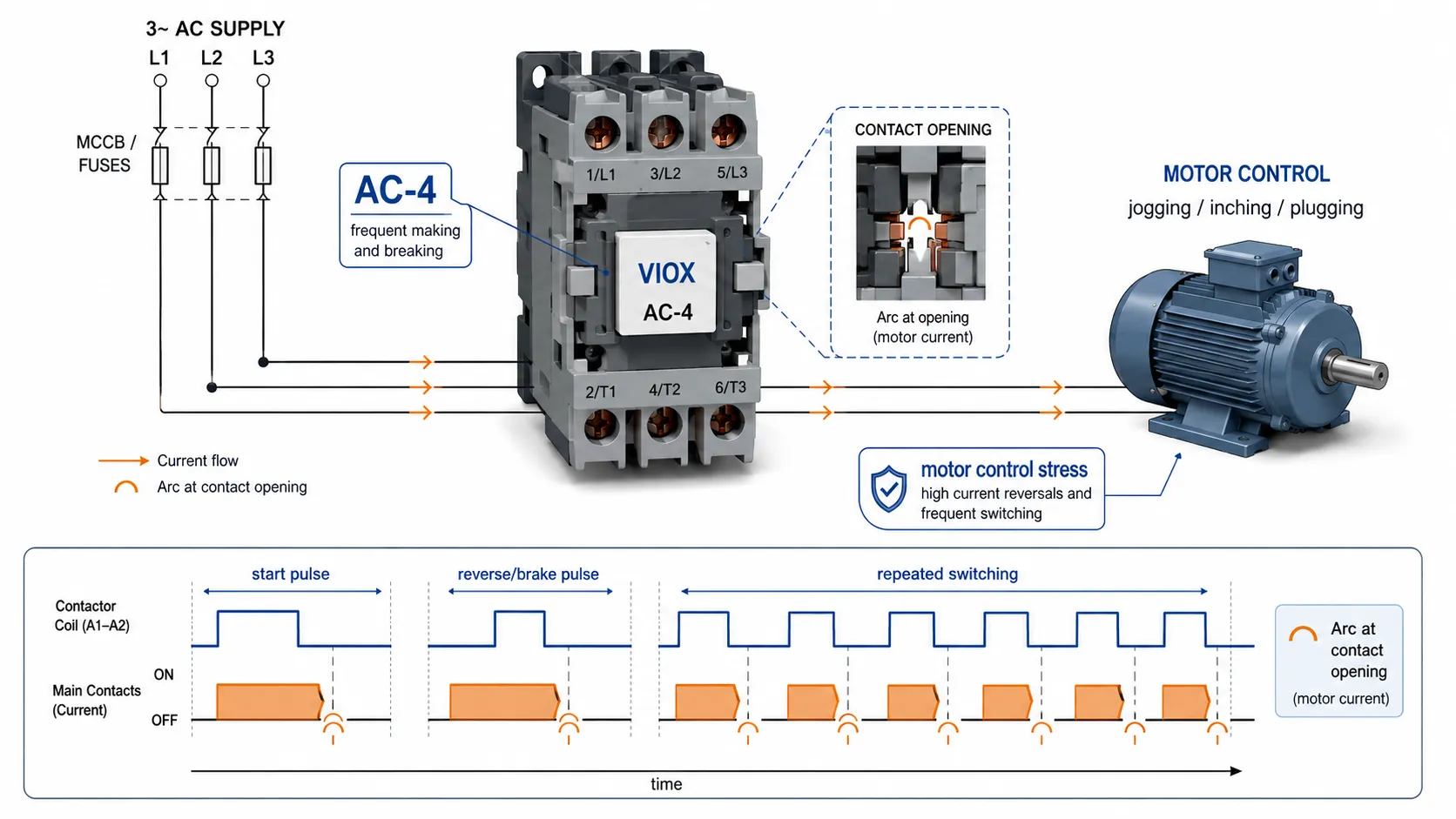
Typical AC-4 applications include:
- crane control
- hoist positioning
- reversing motor circuits
- frequent jog control
- plug braking
- machinery requiring short repeated motor movements
AC-4 is much harsher than AC-3. A contactor that works well in AC-3 service may fail quickly in AC-4 duty if it is not selected correctly. Contact erosion, arc damage, and contact welding become more likely because the contactor is interrupting more severe currents more frequently.
Use the manufacturer’s AC-4 data or electrical life curves when selecting contactors for these applications.
AC-5 and AC-6: Lighting, Transformers, and Capacitor Banks
AC-1 to AC-4 cover the most common heater and motor discussions, but many real panels include loads that do not fit neatly into those four categories. Lighting, transformers, and capacitor banks can create high inrush or special switching stress.
| Category | Typical Load | Why It Matters |
|---|---|---|
| AC-5a | Discharge lamps | Lighting circuits can have special inrush and arc behavior |
| AC-5b | Incandescent lamps | Cold filament inrush can be much higher than steady current |
| AC-6a | Transformers | Magnetizing inrush can be severe during energization |
| AC-6b | Capacitor banks | Capacitor switching can create high peak currents and contact stress |
For capacitor banks, do not select a standard AC-1 or AC-3 contactor by current alone. Use a capacitor-duty contactor or a device specifically rated for capacitor switching when the application requires it. For transformers and lighting banks, check the manufacturer’s utilization category data and inrush limits rather than assuming the steady-state current is enough.
DC Utilization Categories: DC-1, DC-3, and DC-5
DC contactor categories are important because DC arcs do not naturally pass through zero like AC arcs. DC switching often requires stronger arc suppression, larger contact gaps, magnetic blowout, or special contact structures.
| DC Category | Typical Load | Practical Meaning |
|---|---|---|
| DC-1 | Non-inductive or slightly inductive DC loads | Easier DC switching duty |
| DC-3 | Shunt DC motors | Starting, plugging, inching, and dynamic braking |
| DC-5 | Series DC motors | More severe DC motor switching duty |
Some datasheets or older references may show additional or different DC category wording. When in doubt, follow the manufacturer’s datasheet and the project standard. For modern DC loads such as batteries, solar PV, EV systems, and energy storage, do not assume an AC-rated contactor is suitable.
PV, ESS, and High-Voltage DC Loads
Solar PV strings, battery energy storage systems (ESS), and electric vehicle power circuits create a different selection problem from classical DC motor categories. The current may be bidirectional, the DC voltage can be high, and fault interruption is difficult because there is no natural current zero-crossing.
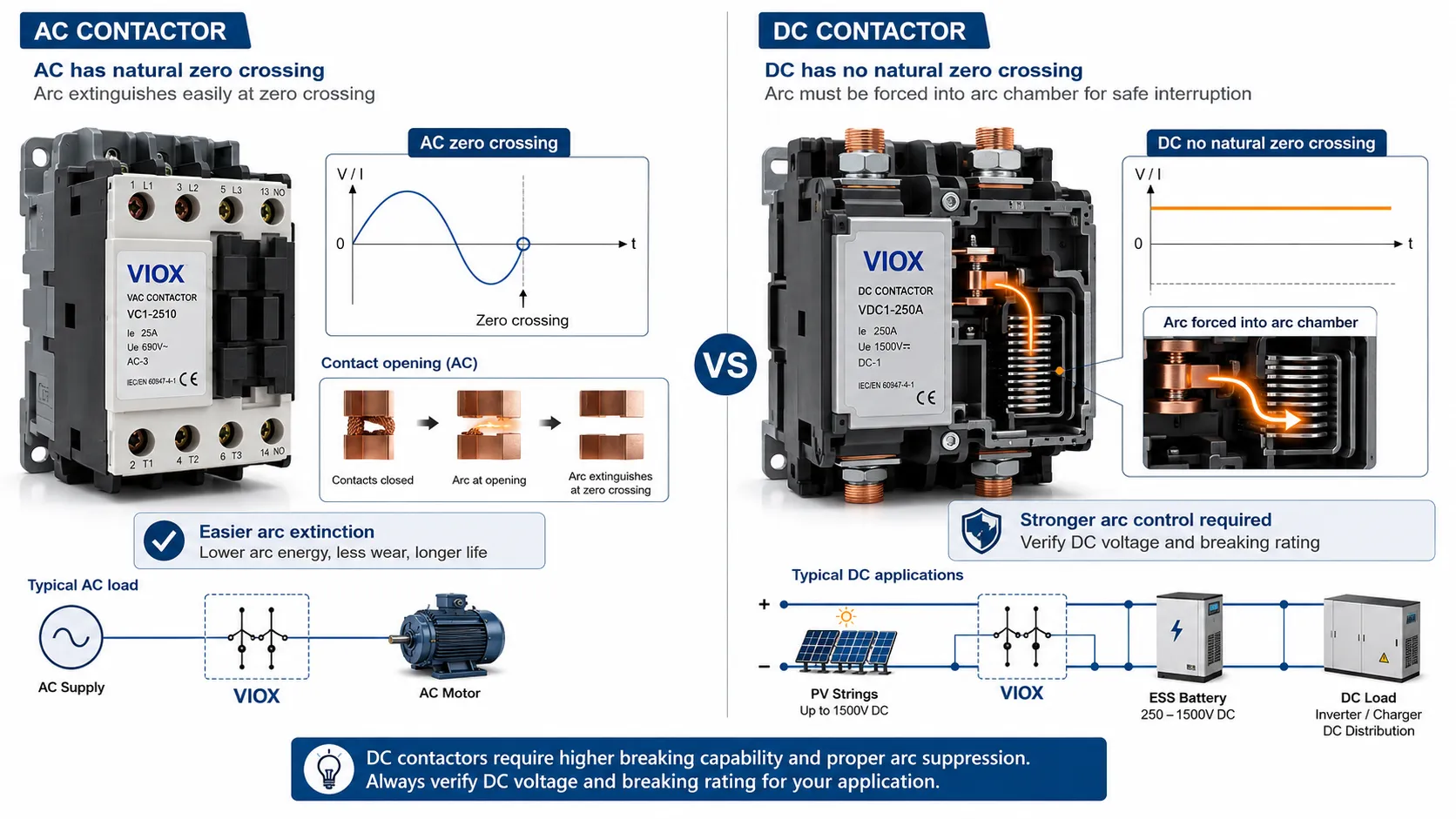
Some PV and DC switching products are specified using specialized DC or PV switching categories in their own product standards and datasheets. Do not assume that a classical DC-1 rating automatically covers a PV string isolator, battery contactor, or EV disconnect duty. For PV/ESS projects, check the exact DC voltage, current direction, time constant, polarity, short-circuit protection, and the manufacturer’s declared application rating.
For the difference between AC and DC contactor design, see VIOX’s AC vs DC contactor guide.
How to Read AC-1 and AC-3 Ratings on a Contactor Nameplate
A contactor nameplate may show several current ratings. The number that matters depends on your load.
Look for:
- rated operational voltage, such as 230V, 400V, or 690V
- rated operational current under AC-1
- rated operational current under AC-3
- motor power rating in kW or HP
- coil voltage, such as 24V DC, 110V AC, or 230V AC
- utilization category
- frequency
- auxiliary contact ratings
- manufacturer wiring diagram
- terminal markings
If the same contactor shows a higher AC-1 current and a lower AC-3 current, the AC-1 value is not the correct selection value for a motor unless the datasheet specifically permits that application. For a motor, check AC-3 motor current or motor power rating.
Contactor Selection Guide by Load Type
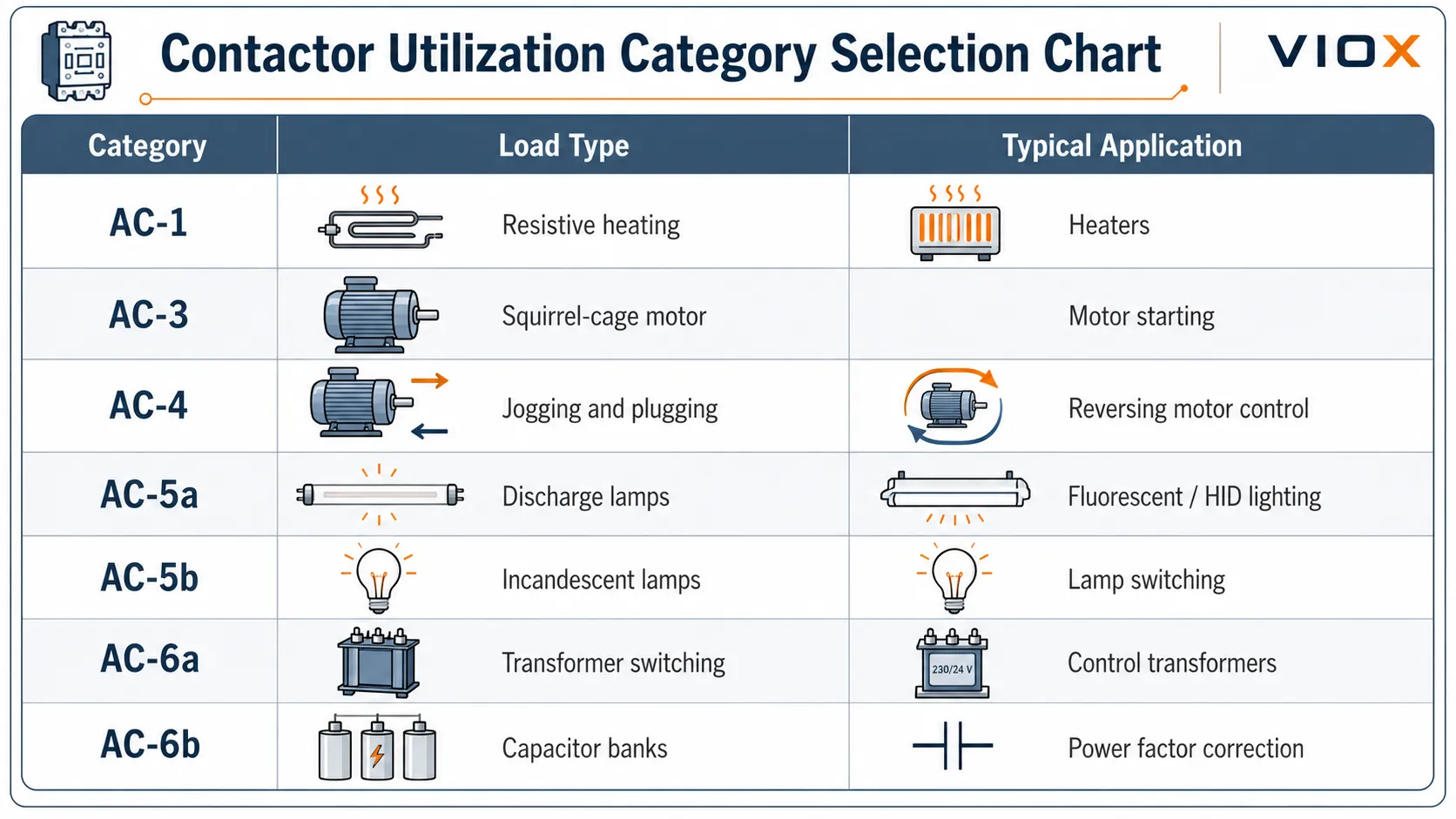
| Load Type | Category to Check First | Notes |
|---|---|---|
| Resistive heater | AC-1 | Check current, voltage, temperature, and duty cycle |
| Standard three-phase motor | AC-3 | Most common motor duty |
| Reversing motor | AC-4 or special application data | Check reversing frequency and electrical life |
| Jogging/inching motor | AC-4 | Severe duty; do not use AC-3 blindly |
| Slip-ring motor | AC-2 | Check motor type and starting method |
| DC resistive load | DC-1 | Verify DC voltage and breaking capability |
| DC motor | DC-3 or DC-5 depending on motor type | DC arc suppression is critical |
| Lighting load | AC-5a / AC-5b or manufacturer data | Inrush may be high depending on lamp type |
| Capacitor bank | AC-6b or capacitor-duty contactor | Use capacitor switching contactor where required |
| Transformer | AC-6a or manufacturer data | Magnetizing inrush can be severe |
The category tells you the type of stress the contactor is designed to handle. It does not replace checking the full datasheet.
Why AC-1 Ratings Are Higher Than AC-3 Ratings
AC-1 loads are easier to switch because they are mainly resistive. The current waveform and voltage waveform are closer together, and the contactor does not normally have to manage motor starting behavior.
AC-3 loads are harder because motors draw high inrush current during starting and create inductive switching stress. Even if the motor running current looks modest, the contactor must survive the repeated making and breaking behavior defined for that category.
This is the reason a contactor’s AC-1 current can be much higher than its AC-3 current. It is not a marketing trick. It is the result of different electrical duty.
Common Selection Mistakes
Mistake 1: Using AC-1 Current for a Motor
This is the most common mistake. If the load is a motor, check AC-3 or the specific motor duty category. Do not size from the AC-1 rating.
Mistake 2: Treating AC-3 and AC-4 as Similar
AC-4 is much more severe than AC-3. Reversing, inching, jogging, and plugging can shorten electrical life if the contactor is not selected for that duty.
Mistake 3: Ignoring the Coil Voltage
The main contacts may be correct, but the contactor still will not work if the coil voltage is wrong. Always verify AC/DC coil type and rated control voltage.
Mistake 4: Forgetting Short-Circuit Protection
A contactor is not a circuit breaker. It must be coordinated with fuses, MCBs, MCCBs, motor protection circuit breakers, or overload relays depending on the circuit design.
Mistake 5: Ignoring Duty Cycle and Switching Frequency
Frequent operation creates heat and contact wear. If the application starts and stops many times per hour, check the manufacturer’s electrical life and switching frequency data.
Mistake 6: Using an AC Contactor on a DC Load
DC loads need DC-rated switching capability. A contactor suitable for AC-3 motor duty is not automatically suitable for DC motor or battery circuits.
Engineer’s Field Note
When a contactor fails early, the nameplate often tells the story. A heater wired through a contactor selected by AC-3 may be overbuilt and costly. A motor wired through a contactor selected by AC-1 is the dangerous case: it may work during commissioning, then weld contacts after repeated starts.
For motor panels, the best habit is to write the load type next to the contactor on the bill of materials: “AC-3 pump motor,” “AC-4 jog duty,” or “AC-1 heater.” That small note prevents many procurement substitutions that look equivalent by amperage but are not equivalent by utilization category.
FAQ
Can I use an AC-1 contactor for a motor?
Do not select a motor contactor from the AC-1 rating. For a standard squirrel-cage motor, use the AC-3 rating or the motor power rating specified by the manufacturer.
What is the difference between AC-3 and AC-4?
AC-3 is normal motor starting and stopping after the motor is running. AC-4 includes frequent high-stress operations such as reversing or inching, where the contactor may make and break higher currents more often.
Why does the same contactor have different AC-1 and AC-3 amp ratings?
Because load type changes contact stress. Resistive loads are easier to switch, while motors create inrush current and inductive arcing. The utilization category adjusts the usable rating to match the load.
Which category should I use for a capacitor bank?
Capacitor banks require special attention because they can create high peak inrush current. Check AC-6b or the manufacturer’s capacitor-duty contactor rating instead of selecting only by AC-1 current.
Which category should I use for a transformer?
Transformer energization can produce high magnetizing inrush. Check AC-6a or the manufacturer’s transformer switching data rather than selecting only by steady-state current.
Is DC-1 enough for PV or battery switching?
Not automatically. PV strings, battery systems, and ESS circuits may require special DC switching ratings, polarity rules, and application-specific datasheet approval. Confirm the exact DC voltage, current direction, time constant, and manufacturer rating.
Where can I find the correct contactor rating?
Check the contactor nameplate and datasheet. Look for rated voltage, utilization category, AC-1 current, AC-3 current, motor kW/HP rating, and coil voltage.
Conclusion
AC-1, AC-2, AC-3, and AC-4 are not just code labels. They tell you what kind of load a contactor is designed to switch. For resistive loads, AC-1 is usually the key rating. For standard induction motors, AC-3 is the main rating. For inching, plugging, jogging, or reversing, AC-4 requires special attention. For DC loads, DC-1, DC-3, and DC-5 help distinguish resistive and motor duties where arc suppression is more difficult.
The safest selection method is simple: identify the load first, then choose the contactor by utilization category, voltage, current, coil supply, duty cycle, and manufacturer data. Never choose a motor contactor only from the AC-1 amp rating.