

On this page
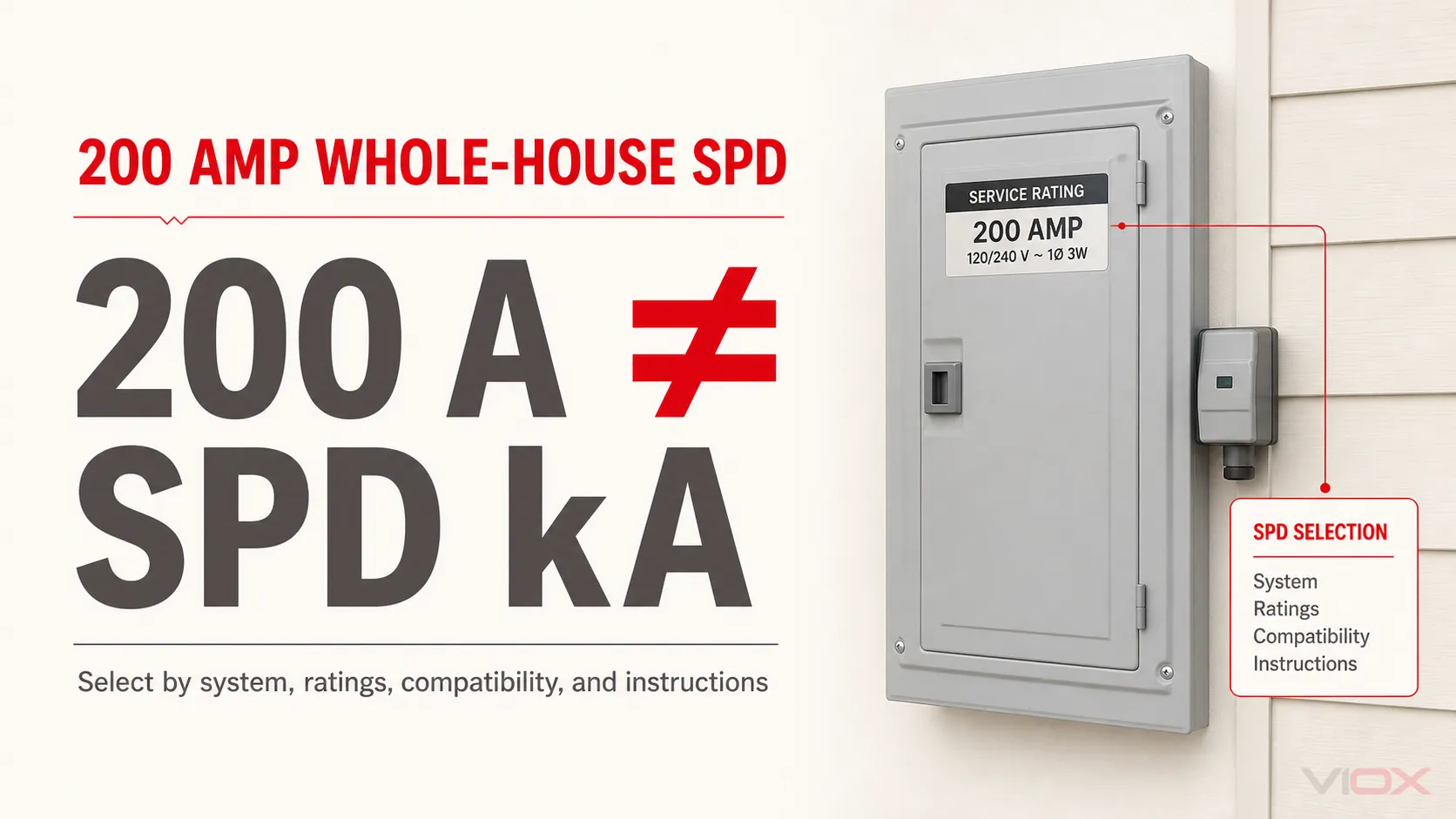
A 200 amp service does not determine the kA rating of a whole-house surge protective device (SPD). The 200 A label describes how much continuous load current the service equipment is designed to carry. An SPD is connected in parallel and responds to short-duration transient overvoltage; it is not a 200 A load-carrying device.
For a typical North American 120/240 V split-phase home, select a listed Type 1 or Type 2 SPD by checking the installation location, nominal system voltage, protection modes, maximum continuous operating voltage (MCOV), voltage protection rating (VPR), nominal discharge current (In), short-circuit current rating (SCCR), manufacturer-declared surge-current capacity, panel compatibility, connection instructions, and protection-status indication. There is no defensible formula that converts “200 A service” into “60 kA,” “80 kA,” or any other universal SPD rating.
Selection boundary: The service rating identifies the panel context. The SPD datasheet and installation instructions determine whether a particular device is suitable.
What the 200 Amp Label Tells You—and What It Does Not
The fastest way to avoid a sizing error is to separate two different current ratings.
| The 200 A service rating tells you | It does not tell you |
|---|---|
| The continuous-current class of the service equipment | The magnitude of the next transient surge |
| The panel or service configuration in which the SPD must be integrated | The required SPD surge-current capacity in kA |
| That panel compatibility, available spaces, and connection method must be checked | The correct MCOV, VPR, In, or SCCR by itself |
| That available fault current and equipment ratings matter at the installation point | That an SPD must be labeled “200 A” |
| The installation is service/panel work requiring exact instructions and local-code review | That a larger house or more expensive electronics automatically needs a specific extra kA amount |
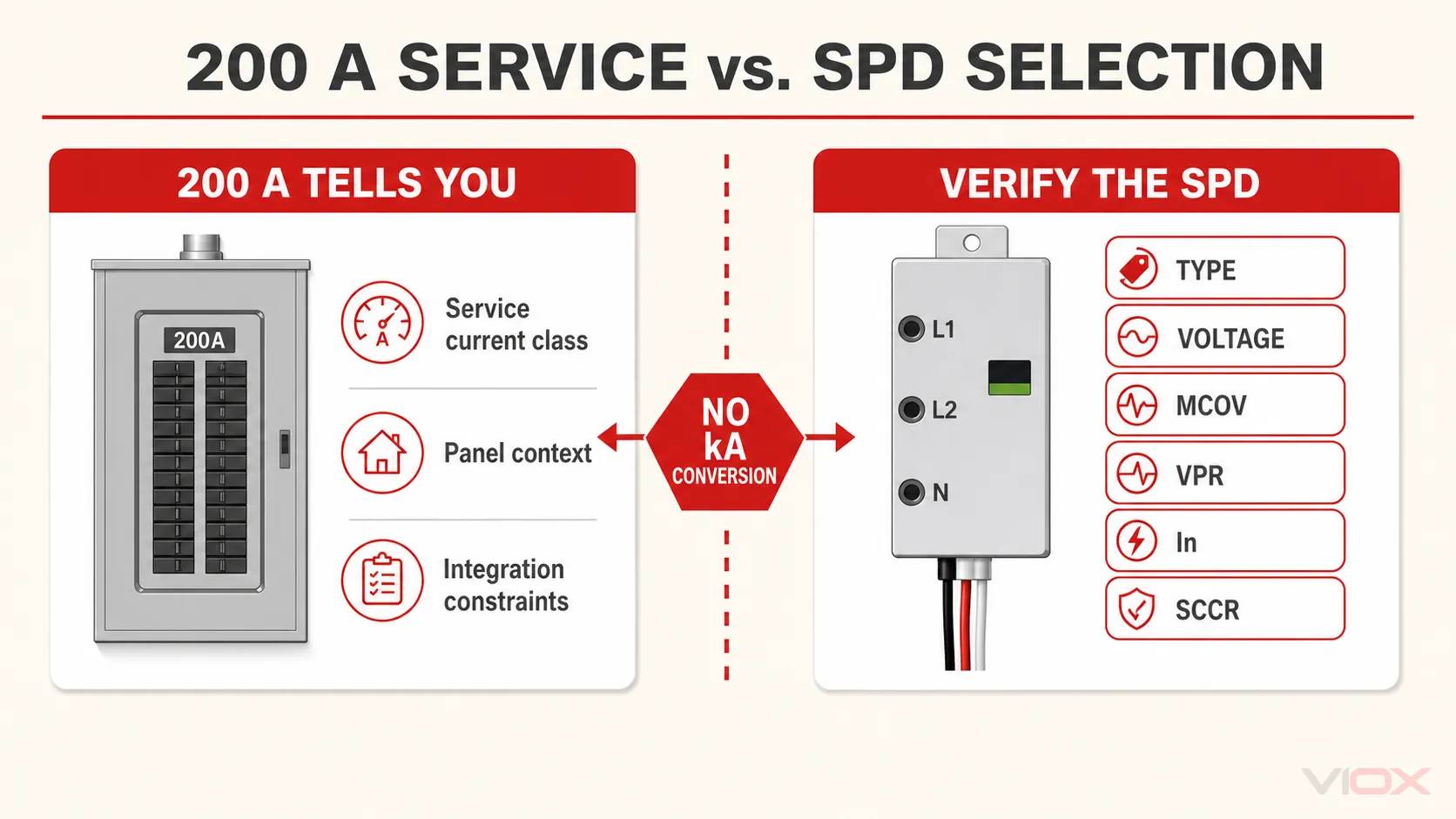
This distinction matters because two listed SPDs can both be intended for 120/240 V residential systems yet carry different VPR, In, SCCR, surge-current, mounting, and compatibility declarations. The right choice is the device whose complete ratings and instructions fit the actual installation—not the device with the largest headline number.
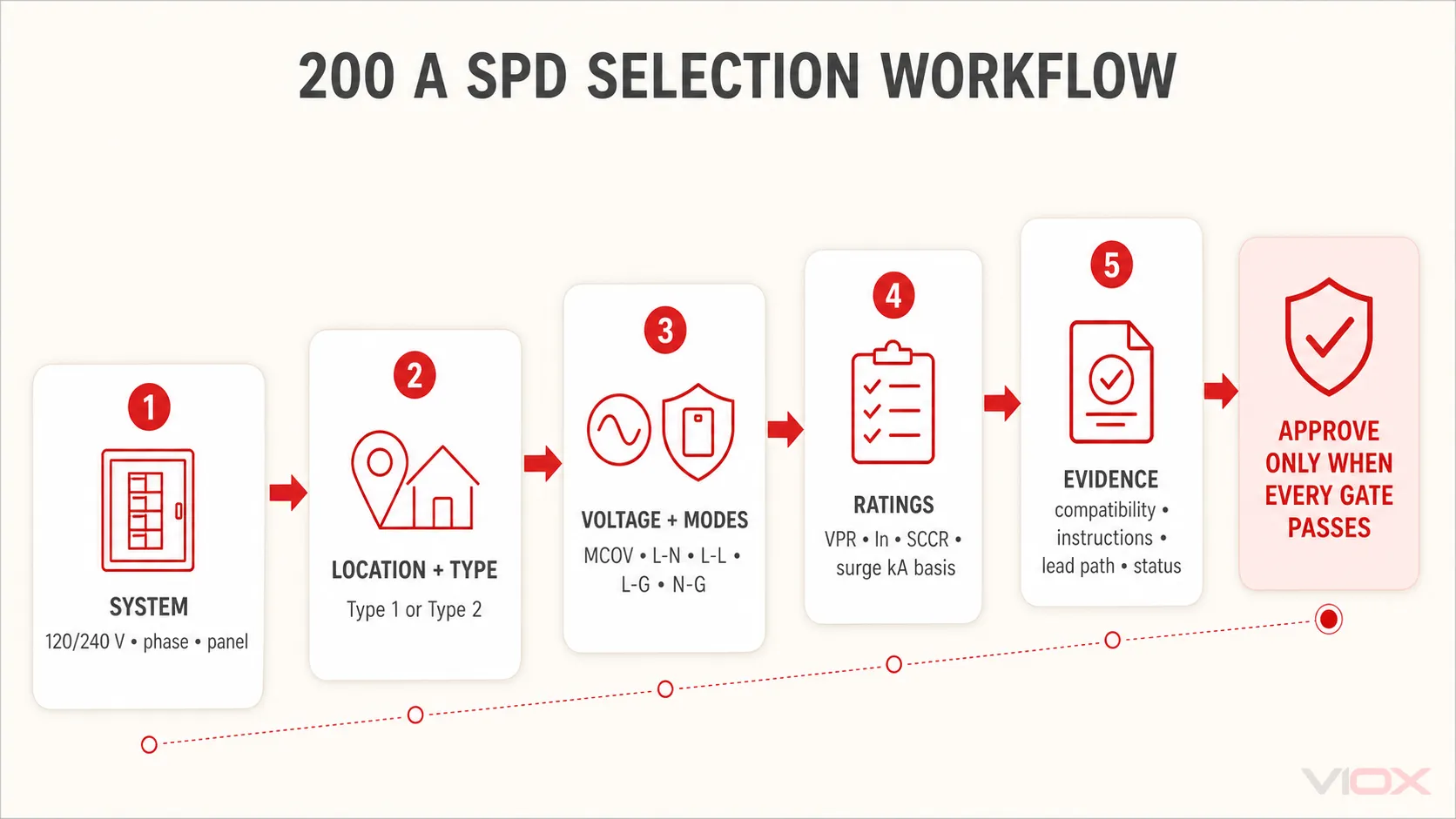
Use This Input-to-Specification Workflow
1. Confirm the electrical system—not just “200 amps”
Record the nameplate system before comparing products:
- nominal voltage: commonly 120/240 V AC for a US single-family dwelling;
- phase and conductors: commonly single-phase, three-wire split phase;
- service equipment and panel manufacturer/model;
- indoor or outdoor installation;
- available installation position and physical space;
- location of neutral and equipment-grounding connections;
- available fault-current information, when known.
Do not assume every 200 A installation has the same voltage, topology, panel construction, or fault-current environment. If the site is not a 120/240 V split-phase dwelling, this article is not the final selection authority.
2. Choose the SPD Type by location and listing
Under the UL system, Type 1 and Type 2 identify installation categories, not simple “stronger” and “weaker” grades.
| Selection question | Type 1 | Type 2 |
|---|---|---|
| Typical permitted location | On the line or load side of the service disconnect, as listed and instructed | On the load side of the service overcurrent device |
| Separate upstream overcurrent device | Follow the exact listing and instructions | Often connected through a specified breaker or other method; follow exact instructions |
| What must be verified | Suitability for the specific service/location and equipment | Panel compatibility, branch connection, breaker requirements, and conductor routing |
Do not infer the installation method from Type alone. A plug-on SPD, an externally mounted SPD, and an SPD integrated into service equipment can have different compatibility and connection requirements even when their Type designation is similar. See the detailed Type 1 vs Type 2 vs Type 3 SPD guide for the category boundaries.
Where an adopted electrical code requires surge protection, the edition enforced by the local authority having jurisdiction (AHJ) controls. In the United States, NEC requirements and adoption dates vary by jurisdiction; the electrician or plan reviewer should confirm the applicable edition and location rule.
3. Match nominal voltage, MCOV, and protection modes
Voltage compatibility is a gate, not an optional preference.
- Nominal system voltage must match the actual service configuration stated by the manufacturer.
- MCOV is the maximum continuous RMS voltage that may be applied to a protection mode without causing the SPD to operate improperly or age prematurely. Compare MCOV mode by mode; do not select it from the “200 A” label.
- Protection modes identify the conductor pairs across which protection components are connected, such as line-to-neutral (L-N), line-to-line (L-L), line-to-ground (L-G), or neutral-to-ground (N-G). Required and available modes depend on the product design and installation context.
A product advertised as “240 V” is not automatically correct for every 120/240 V split-phase panel. Confirm the full system designation, conductors, modes, and wiring diagram in the exact datasheet and instructions.
4. Compare VPR by the same protection mode
Voltage protection rating (VPR) is a standardized marked value used to compare the measured limiting voltage of UL 1449 SPDs under specified test conditions. Compare:
- the same nominal system voltage;
- the same protection mode;
- the same product category and intended location;
- values from current manufacturer or certification documentation.
A lower VPR can be favorable when all other application requirements are satisfied, but there is no universal “400 V or lower” rule for every mode and every 120/240 V whole-house product. Real listed products show different VPR values by mode. Installation conductor length and routing also affect the voltage that protected equipment actually experiences, so a favorable nameplate VPR cannot compensate for a poor connection path.
5. Read In, SCCR, and kA as different declarations
These ratings answer different questions:
| Datasheet field | What it tells you | What it does not tell you |
|---|---|---|
| In — nominal discharge current | A standardized duty/test current declaration associated with the SPD listing | The home’s service ampacity or the maximum single-event surge claim |
| SCCR — short-circuit current rating | The fault-current suitability of the SPD under its stated installation conditions | Surge protection capacity or VPR |
| Surge-current capacity / maximum surge current (kA) | A manufacturer-declared maximum surge-current capability, with basis and mode/phase wording that must be read carefully | A universal protection level, the available fault current, or a value calculated from 200 A |
| VPR | Standardized measured limiting-voltage category by mode | Energy capacity, service ampacity, or installed let-through voltage with arbitrary lead routing |
| MCOV | Continuous voltage the protection mode can tolerate | The nominal service current or short-circuit rating |
UL Solutions identifies nominal system voltage and SCCR as key safety selections, and In, MCOV, and VPR as key performance/protection selections. That is why a selection based only on the largest kA number is incomplete. For a deeper cross-market explanation of discharge-current terminology, use the separate SPD kA rating sizing guide and SPD datasheet guide.
6. Verify SCCR against the installation point
The SPD’s SCCR must be suitable for the available short-circuit current at the point of installation under the conditions stated in its listing and instructions. Do not confuse:
- 200 A, the service equipment’s continuous-current rating;
- available fault current, a site-specific prospective short-circuit value;
- SCCR, the SPD’s marked short-circuit suitability;
- surge current in kA, a transient-performance declaration.
These values may all use amperes or kiloamperes, but they are not interchangeable. If the available fault current is not documented, the electrician or engineer should determine the appropriate verification method rather than assume that a high surge-current number covers the short-circuit requirement.
7. Check panel compatibility and the exact connection method
Before purchase, obtain the installation instructions for the exact catalog number and verify:
- whether the device is permitted in or adjacent to the specific panel;
- whether it is plug-on, internally integrated, or externally connected;
- whether the manufacturer specifies a dedicated breaker, fuse, or another connection method;
- the permitted breaker family and position, if applicable;
- conductor size, terminal, torque, and routing instructions;
- indoor/outdoor enclosure suitability;
- any limits or conditions attached to the stated SCCR;
- whether all required protection-status indicators remain visible.
Never choose a generic breaker value from an online rule of thumb. The correct connection and overcurrent-protection arrangement comes from the exact SPD and panel documentation. The separate guide Can I Connect a Surge Protector to an Existing Breaker? explains the approval boundary without substituting for model instructions.
8. Treat lead routing and status indication as selection criteria
UL Solutions advises keeping SPD conductors as short as possible and avoiding 90-degree bends where practical. A product that cannot be installed close to the intended connection point may be a worse system choice than a differently packaged device with a shorter, straighter path.
Also verify how the product reports loss of protection. Depending on the model, this may be a mechanical flag, LED, audible alarm, remote contact, or a combination. The indication method must be observable and included in the homeowner’s inspection plan. “Power is still on” does not prove that the SPD remains functional.
For installation planning—not DIY work—see the SPD wiring guide. Work inside service equipment can expose personnel to lethal voltage and arc-flash hazards; installation belongs to qualified persons following the exact instructions and local rules.
A Worked Paper Comparison: Why There Is No Universal 200 A kA Answer
Consider two published manufacturer examples for 120/240 V residential applications:
| Published field | Siemens QSPD2A035B example | Eaton BRPSURGE example |
|---|---|---|
| System | 120/240 V, 1-phase, 3-wire | 120/240 V, single split-phase |
| Type | Type 1; also suitable for Type 2 applications per instructions | Type 2 |
| Surge-current declaration | 35 kA | 18 kA per phase |
| In | 20 kA | 3 kA |
| Published SCCR | 22 kA system rating | 10 kA |
| Published VPR | 700 V L-N/L-G | 500 V |
| Integration | Siemens QP-compatible loadcenters, with listed exceptions | Eaton BR panel family product |
This table is not a recommendation and the values must be checked against the current exact documents before use. Its purpose is to show the selection principle: both products are presented for 120/240 V residential systems, yet their declarations and compatibility conditions differ. “The panel is 200 A” does not select either one and does not create a third universal kA requirement.
The correct paper decision is:
- reject any device that does not match the system, installation location, listing, panel, or SCCR requirement;
- compare VPR by relevant mode and verify MCOV and In;
- compare manufacturer surge-current declarations only on the same basis—per mode, per phase, or total wording can differ;
- choose an installation arrangement that supports a short, direct connection path;
- confirm status indication and replacement procedure;
- let the qualified installer and AHJ resolve site-specific installation requirements.
Whole-House Protection Is One Layer
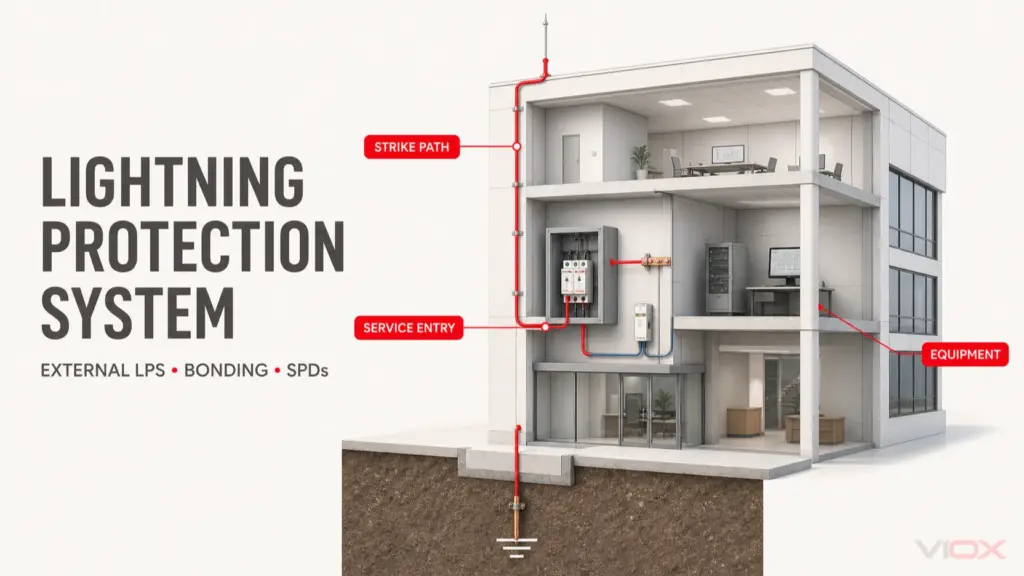
A service- or panel-level SPD protects the power path at that location. It does not make every other entry path disappear. Communications, coaxial, antenna, control, gate, outdoor, and other conductive lines may need interface-appropriate protection and bonding. Sensitive plug-in equipment can also use listed point-of-use protection as part of a coordinated strategy.
Read whole-house surge protector vs power strip for the boundary between panel-level and point-of-use protection. Neither layer should be marketed as guaranteed protection against every event, including a direct lightning strike.
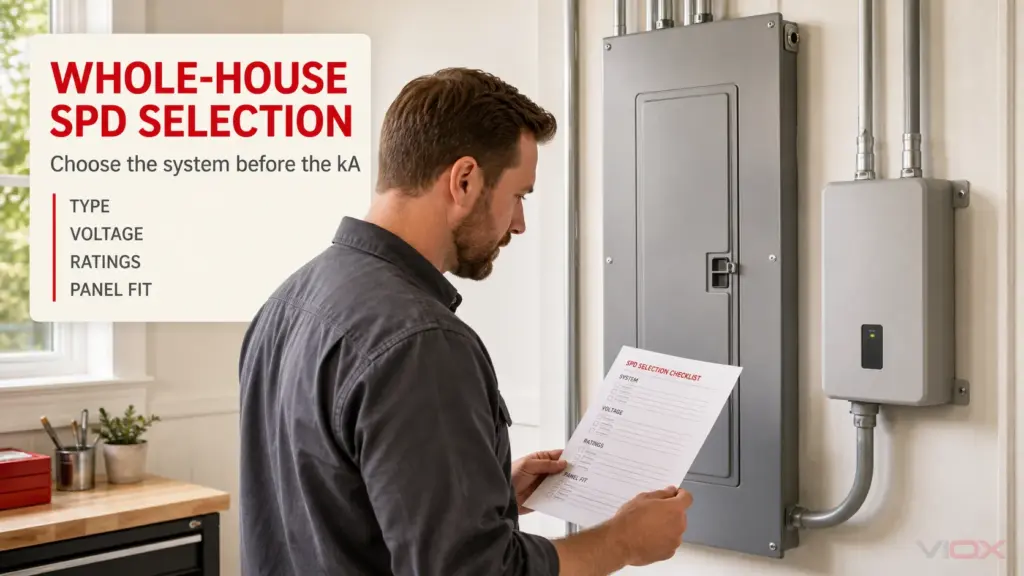
Copy-Ready 200 Amp SPD Specification Checklist
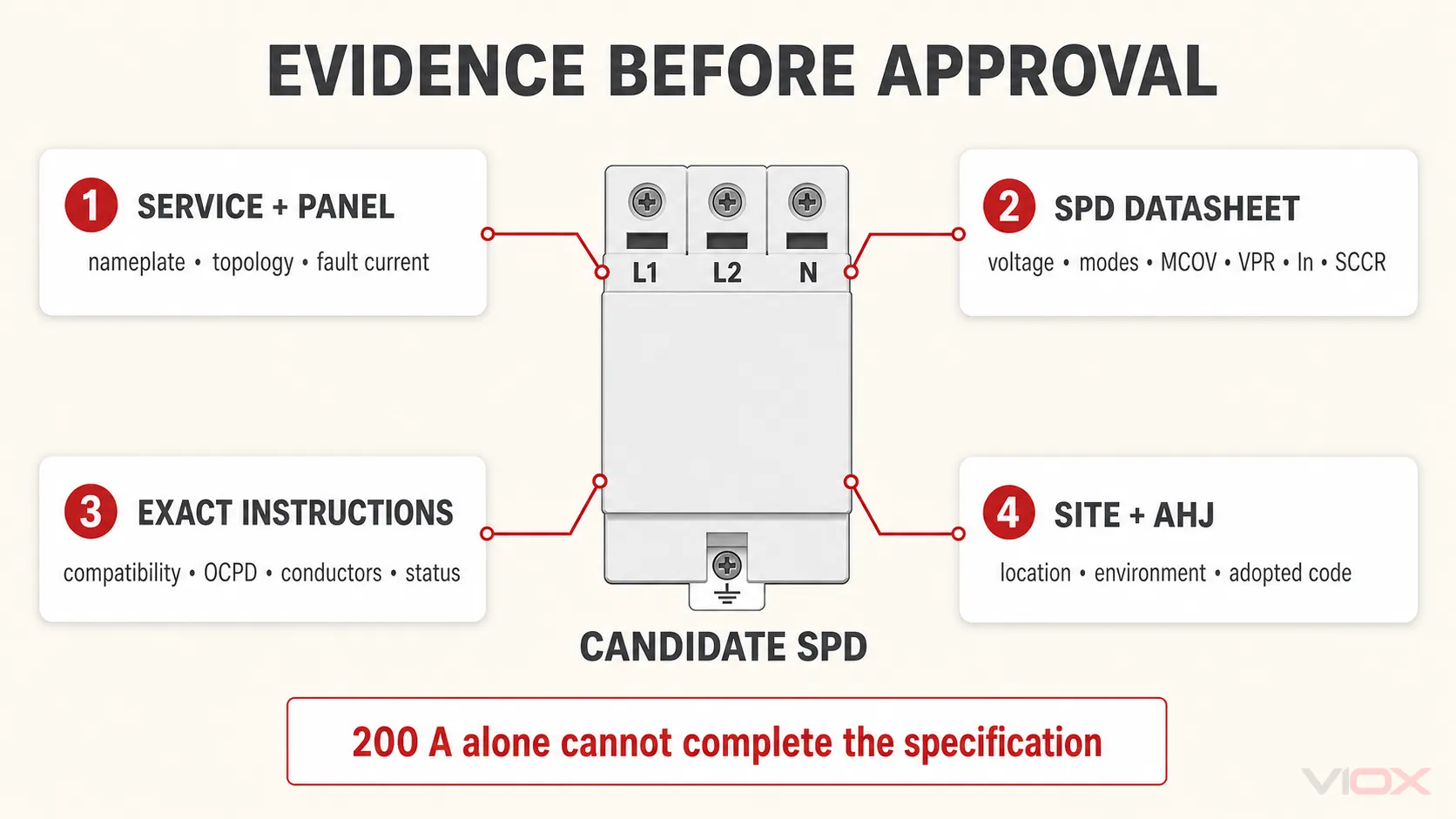
Use this as a procurement and electrician-review worksheet. Do not fill unknown fields by assumption.
| Required input or evidence | Project entry |
|---|---|
| Service equipment rating | 200 A |
| Nominal system | ___ V, ___ phase, ___ wire |
| Service/panel manufacturer and model | ___ |
| Intended SPD location | Service equipment / immediately adjacent / load-side panel / other: ___ |
| Required UL SPD Type for that location | Type ___ |
| Exact SPD catalog number | ___ |
| Listed nominal voltage/system | ___ |
| Protection modes | L-N ___; L-L ___; L-G ___; N-G ___ |
| MCOV by applicable mode | ___ |
| VPR by applicable mode | ___ |
| In | ___ kA |
| Manufacturer surge-current declaration and basis | ___ kA per mode / per phase / other: ___ |
| SPD SCCR and stated installation conditions | ___ kA |
| Available fault current at installation point | ___ kA; source/date: ___ |
| Panel compatibility evidence | Datasheet/instruction page: ___ |
| Required connection/OCPD method | Exact instruction reference: ___ |
| Planned conductor route | Length/bends reviewed: yes / no |
| Protection-status indication | LED / flag / alarm / remote / other: ___ |
| Enclosure/environment rating suitable | yes / no; evidence: ___ |
| Local code edition and AHJ review | ___ |
| Downstream/other-service-entry protection reviewed | yes / no |
If a supplier cannot provide the marked ratings, listing information, exact instructions, and compatibility evidence needed to complete this table, the product is not ready for approval.
Frequently Asked Questions
Does a 200 amp panel need a 200 amp surge protector?
No. A whole-house SPD is normally connected in parallel and is not selected to carry the panel’s 200 A continuous load. Select it by system voltage, Type/location, modes, MCOV, VPR, In, SCCR, manufacturer surge-current declaration, panel compatibility, and installation instructions.
Is 80 kA enough for a 200 amp service?
The 200 A service rating cannot answer that question. First verify the complete listing, voltage, modes, MCOV, VPR, In, SCCR, installation method, and how the manufacturer defines the 80 kA value. A larger kA declaration does not repair a voltage mismatch, inadequate SCCR, incompatible panel connection, or poor lead routing.
Is a higher kA whole-house SPD always better?
Not by itself. A higher manufacturer surge-current declaration may indicate greater capacity on the stated test basis, but the comparison is meaningful only when the products are suitable for the same system and the figures use the same per-mode or per-phase basis. VPR, MCOV, In, SCCR, Type, compatibility, routing, and status indication still matter.
Should a whole-house SPD use a dedicated breaker?
Use the exact product and panel instructions. Some Type 2 products require connection through a specified compatible breaker; other products use a different approved arrangement. Do not derive the breaker rating from the 200 A main rating or from a generic article.
Can one whole-house SPD protect everything in the home?
It protects the power system at its installation point but does not automatically protect every communications or external conductive path. A coordinated system may include point-of-use and signal-line protection appropriate to the interfaces present.
Sources
- UL Solutions: Overvoltage Protection — SPD safety/performance rating priorities and conductor-routing guidance.
- Siemens QSPD2A035B Series Installation Instructions — bounded 120/240 V product example and compatibility conditions.
- Eaton Type 2 Surge Protection Product Selection — bounded 120/240 V ratings example and field definitions.
- NFPA 70 code-development material for Section 230.67 — US code context; the locally adopted edition and AHJ remain controlling.
For OEM, distribution, or panel-building inquiries, send the completed specification checklist to [email protected]. VIOX can review the requested electrical parameters and product-documentation needs; final installation approval remains with the qualified designer, installer, and applicable authority.