

On this page
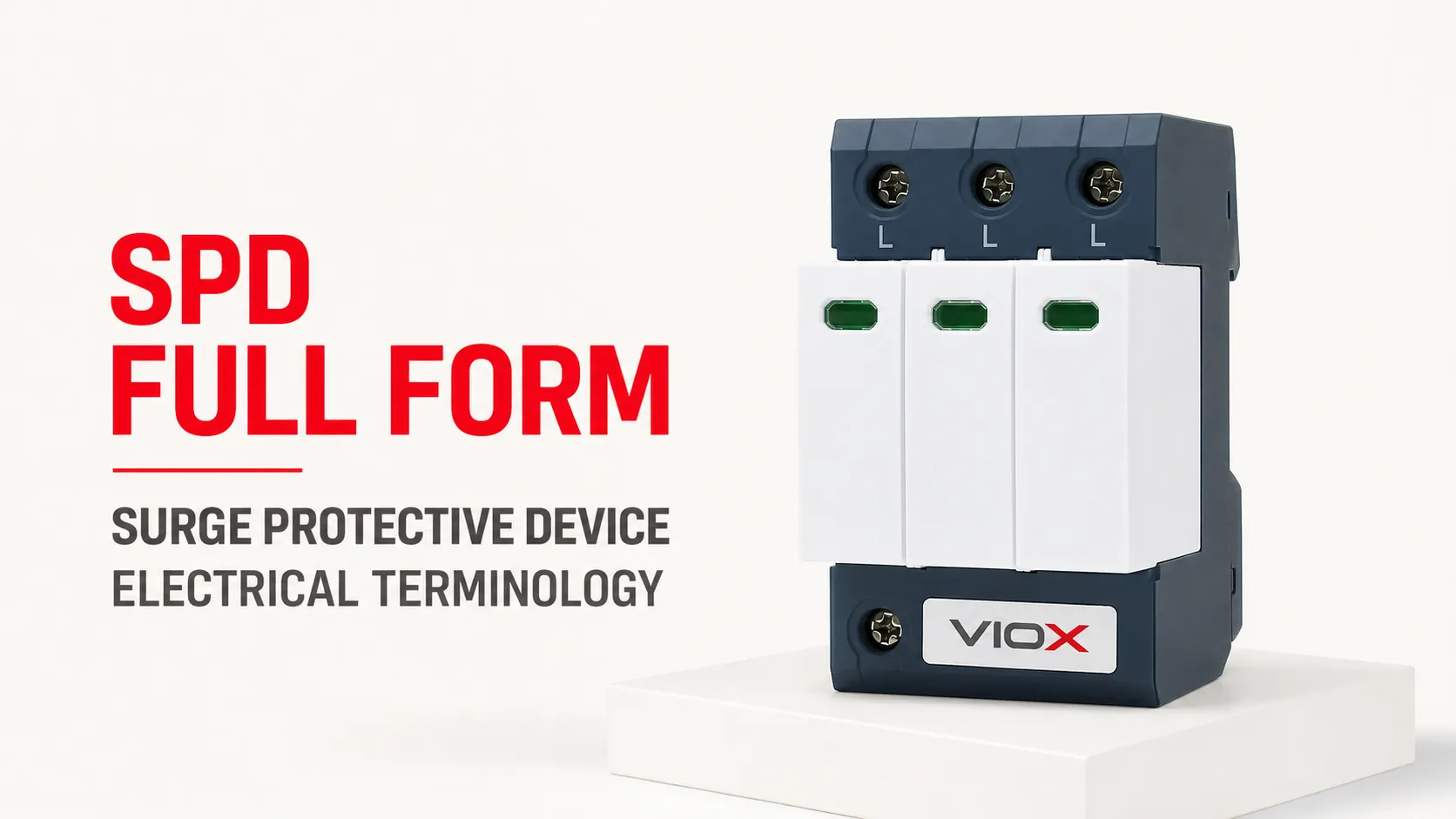
SPD stands for Surge Protective Device. In an electrical system, an SPD limits transient overvoltage and diverts surge current through a defined protection path. It is used for short-duration surge events; it does not replace a circuit breaker, residual-current device, or voltage protector.
| Question | Direct answer |
|---|---|
| What is the full form of SPD? | Surge Protective Device |
| What does an SPD do? | Limits surge voltage and diverts surge current |
| What does it protect against? | Transient overvoltage associated with lightning effects, switching and similar short-duration events |
| What does it not replace? | MCB/MCCB, fuse, RCD/RCCB, voltage protector or lightning protection system |
| Where is the term used? | Electrical panels, drawings, bills of materials, specifications and product datasheets |
The wording Surge Protective Device is not just a convenient expansion of the letters. It is the technical term used by the IEC 61643 series. IEC 61643-01:2024 describes SPDs as devices containing at least one nonlinear component that are intended to limit surge voltages and divert surge currents.
What Does Each Word in SPD Mean?
Breaking down the abbreviation helps establish the device’s actual scope.
| Word | Meaning in this context | Practical implication |
|---|---|---|
| Surge | A transient electrical event rather than a normal operating condition | The device responds to short-duration overvoltage, not every voltage-quality problem |
| Protective | Intended to reduce the surge stress presented to an electrical installation or connected equipment | Protection is not absolute; the resulting voltage depends on the SPD, installation and surge conditions |
| Device | A component or assembly with declared electrical ratings and a defined installation method | “SPD” alone is not a complete specification; its type, voltage and discharge-current ratings must also be checked |
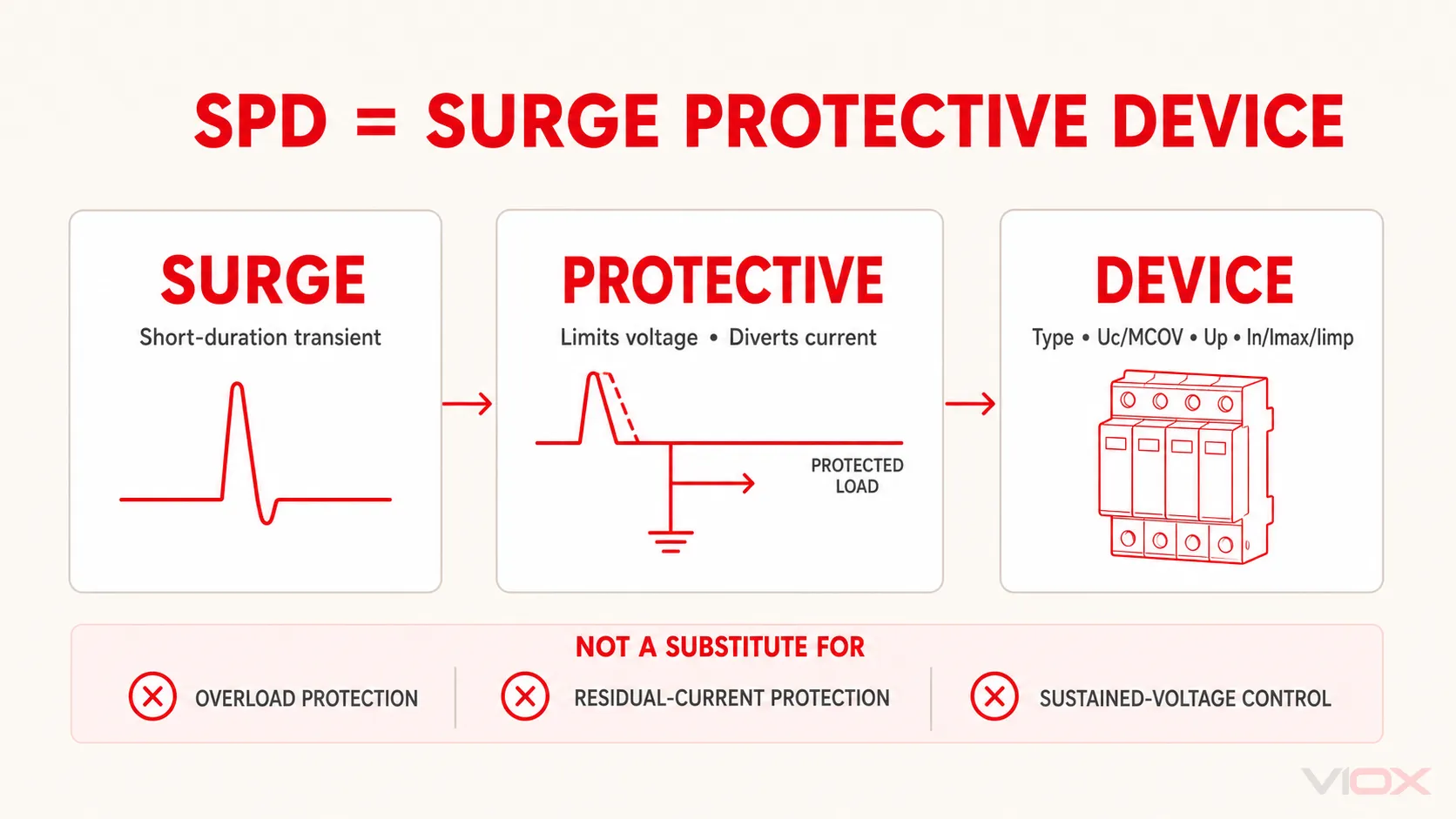
You may sometimes see SPD expanded informally as Surge Protection Device. The intended product is usually clear, but Surge Protective Device is the standards-based term and the preferred wording for specifications, technical articles and procurement documents.
What Does an SPD Do in an Electrical System?
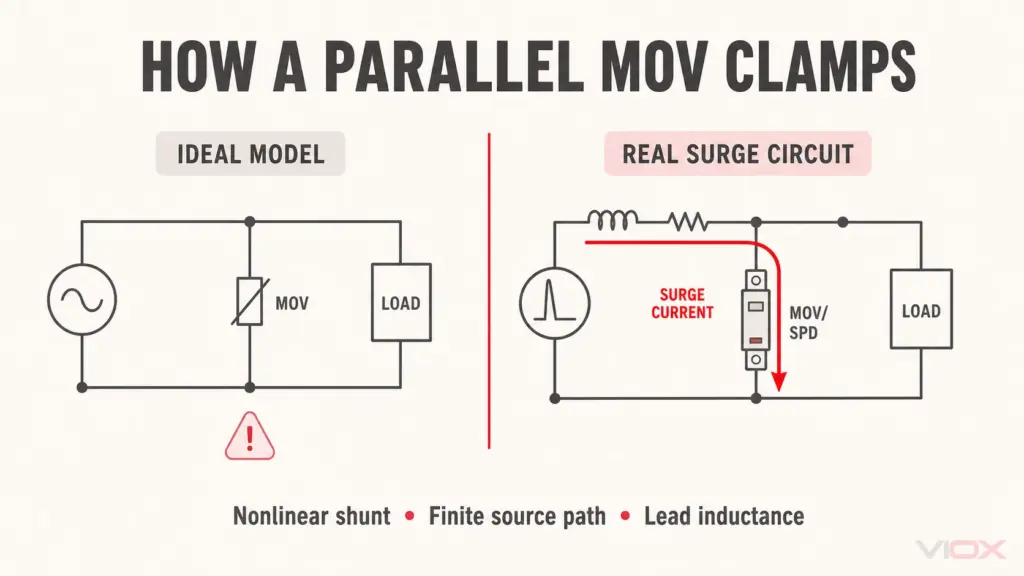
During normal operation, an SPD presents a high-impedance path and should not carry the normal load current. When a transient overvoltage occurs, its nonlinear protection elements conduct through the applicable protection mode, limiting the voltage across the protected circuit and diverting surge current.
Once the transient has passed, a serviceable SPD returns to its normal state. The exact behavior depends on the SPD technology, protection mode, system configuration and event severity.
This is intentionally a short explanation. For the complete operating model—including protection modes, residual voltage and common internal technologies—see what a surge protective device is and how it works.
What Does SPD Mean on a Panel, Drawing or Datasheet?
The same abbreviation may appear in several project documents, but the information you should look for next changes with the document.
| Where “SPD” appears | What it normally identifies | What to verify next |
|---|---|---|
| Panel label or distribution-board schedule | A surge protective device installed at that board | Device status, protected conductors, upstream protection and installation instructions |
| Single-line diagram | A surge-protection point within the distribution architecture | Installation boundary, system earthing arrangement, protection modes and coordination with other SPDs |
| BOQ or BOM | A product category that still requires a complete specification | AC or DC application, Type, poles/topology, voltage ratings, discharge-current ratings and required standard |
| Product datasheet | A particular SPD or product family | Uc/MCOV, Up or VPR, In, Imax, Iimp where applicable, short-circuit declaration, backup protection and status functions |
| Solar or DC drawing | An SPD intended for a DC circuit | Maximum continuous operating voltage, polarity/topology, installation location and suitability for the actual DC system |
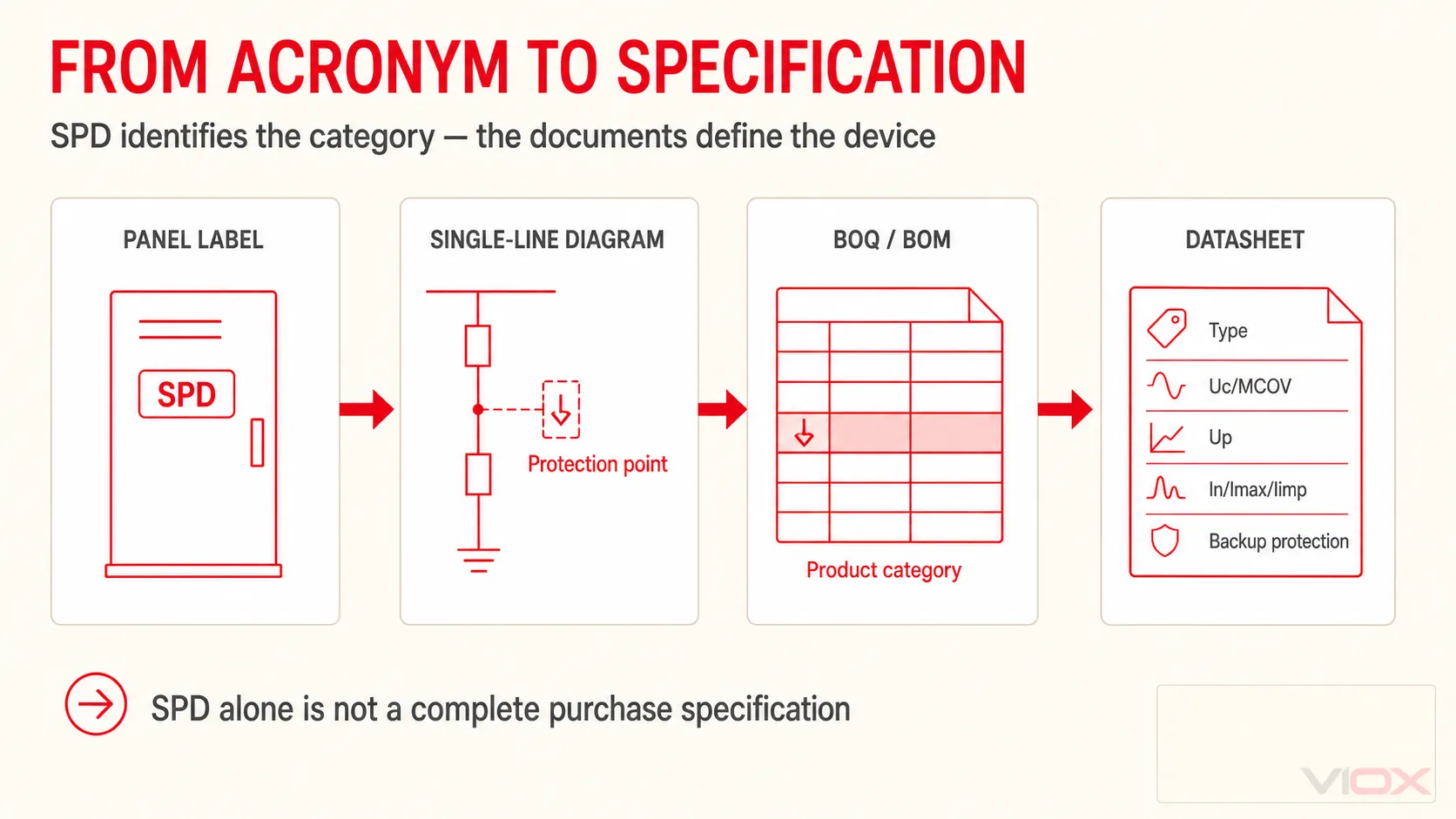
This table exposes a common procurement error: “SPD” is a device category, not a complete purchase description. Two products can both be SPDs while being unsuitable substitutes because their voltage rating, Type, protection mode, current ratings or short-circuit conditions differ.
When evaluating a real device, use the SPD datasheet guide to move from the abbreviation to a defensible specification.
What an SPD Does Not Mean
An SPD has a specific protection job. Similar-looking devices may be installed in the same panel but respond to different electrical conditions.
| Device or term | Primary function | Does it replace an SPD? |
|---|---|---|
| MCB, MCCB or fuse | Interrupts overload and short-circuit current within its declared capability | No |
| RCD, RCCB or GFCI | Detects residual or ground-fault current for its intended protection function | No |
| Voltage protector or monitoring relay | Responds to sustained overvoltage, undervoltage or other monitored supply conditions according to its settings | No |
| Lightning protection system | Intercepts and conducts lightning current through an external protection and earthing system | No; coordinated surge protection may still be required |
| UPS | Supports power continuity and may provide some power conditioning depending on design | No |
Conversely, an SPD does not replace these devices. A surge that lasts for microseconds and a supply voltage that remains outside its permitted range are not the same problem. The distinction is explained in more detail in voltage protector vs surge protector.
The GSC query SPD MCB full form also reflects a frequent point of confusion: SPD means Surge Protective Device, while MCB means Miniature Circuit Breaker. An MCB may be involved in the connection or backup protection of an SPD, but the two devices perform different functions.
Is SPD the Same as a Surge Protector, TVSS or Surge Arrester?
These terms overlap in everyday usage, but they are not always interchangeable across documents and markets.
| Term | How to interpret it |
|---|---|
| SPD | The preferred technical abbreviation for Surge Protective Device |
| Surge protector | A broad everyday description that may refer to a panel-mounted SPD or a consumer plug-in product |
| TVSS | Transient Voltage Surge Suppressor, a legacy term replaced by SPD in the North American UL 1449 terminology transition |
| Surge arrester / lightning arrester | A term whose meaning depends on voltage class, market and standard context; do not assume it is an exact synonym without checking the specification |
NEMA notes that TVSS was replaced by SPD terminology with the adoption of ANSI/UL 1449 Third Edition in 2009. However, legacy drawings, maintenance records and customer enquiries may still use TVSS.
For a detailed terminology boundary, see surge arrester vs SPD vs lightning arrester.
Does Type 1, Type 2 or Type 3 Change the SPD Full Form?
No. Type 1 SPD, Type 2 SPD and Type 3 SPD all use the same full form: Surge Protective Device. The Type identifies a classification and application context; it does not change the meaning of the acronym.
Type selection requires more than choosing the largest number or installing every device in the same location. Use the dedicated Type 1 vs Type 2 vs Type 3 SPD guide for that decision.
After Identifying an SPD, What Should You Check Next?
If you are reading a drawing, tender or product label, do not stop at the full form. At minimum, verify:
- whether the circuit is AC, DC, PV DC, power or signal;
- the SPD Type or applicable classification;
- system voltage and the continuous operating voltage rating, such as Uc or MCOV;
- voltage protection level, such as Up, or the applicable VPR in a UL context;
- discharge-current ratings such as In, Imax and Iimp where applicable;
- poles, topology and modes of protection;
- short-circuit and backup-protection requirements using the declaration applicable to the product and market;
- status indication, replaceable modules and remote signaling if required;
- the relevant standard, certificate and test documentation for the actual model.
VIOX organizes AC, DC, PV and related surge protective device product families for readers who have progressed from terminology to specification and product evaluation.
Frequently Asked Questions
What is the full form of SPD in electrical?
The full form of SPD in electrical is Surge Protective Device. It is intended to limit transient surge voltage and divert surge current through a defined protection path.
Is it Surge Protective Device or Surge Protection Device?
Surge Protective Device is the standards-based term used by the IEC 61643 series and is the preferred expansion of SPD. “Surge Protection Device” is commonly used informally but is not the precise term used in that standard title and definition.
What does SPD mean in an electrical panel?
On a panel schedule or label, SPD normally identifies a surge protective device connected to protect that distribution point. The label alone does not establish its Type, ratings, protection modes or suitability; those must be checked against the product and installation documents.
Is an SPD the same as an MCB?
No. SPD means Surge Protective Device, while MCB means Miniature Circuit Breaker. An SPD responds to transient overvoltage; an MCB provides overcurrent protection within its declared ratings.
Does an SPD protect against sustained high or low voltage?
An SPD is intended for transient overvoltage. Sustained overvoltage or undervoltage requires the appropriate monitoring, disconnection or voltage-protection solution. An SPD must also be selected with appropriate continuous operating voltage and temporary overvoltage behavior for the installation.