On this page
Quick Answer: Does an Air Conditioner Need a Dedicated Circuit?
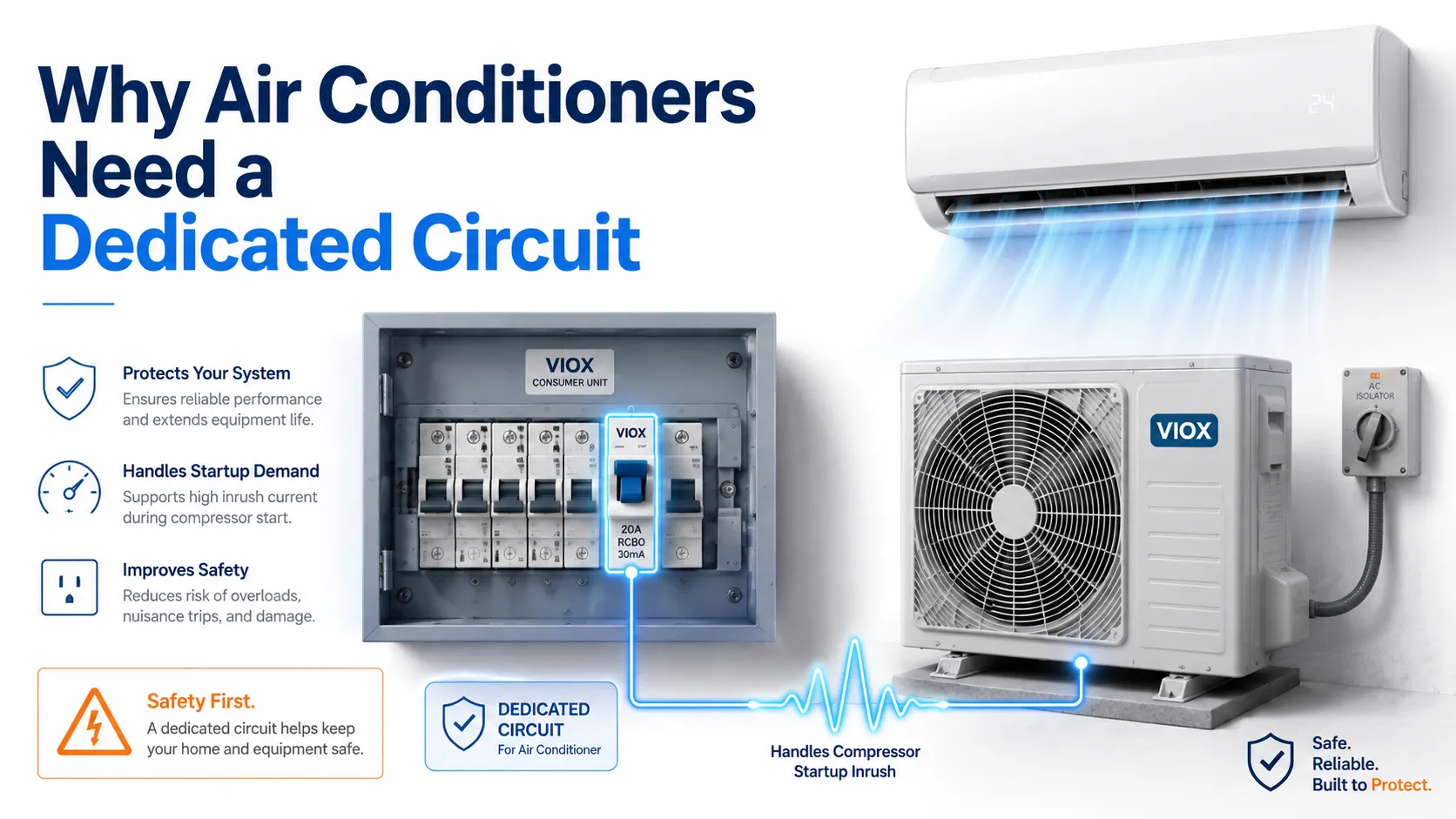
Many air conditioners should be on a dedicated circuit because they are compressor loads, not simple resistive loads. Even if the running wattage looks modest, the compressor can draw a short startup surge, run for hours, create voltage dips, heat weak outlets, and trip breakers when it shares a circuit with other appliances.
A small portable AC may sometimes run on a healthy general-purpose circuit. A window AC, split AC, larger portable unit, or heat-pump system is much more likely to need a dedicated circuit sized according to the appliance nameplate, cable size, breaker rating, residual-current protection, and local electrical code.
The key point is simple:
An air conditioner stresses a circuit differently from an air fryer, kettle, or heater. The problem is not only watts. It is inrush current, continuous runtime, motor load behavior, and weak connection points.
Key Takeaways
- Air conditioners are inductive/compressor loads. They do not behave like purely resistive heaters.
- Startup inrush matters. A compressor can briefly draw several times its normal running current.
- A breaker protects the cable, not every weak outlet. A loose receptacle, old plug, or poor terminal can overheat before a breaker trips.
- Shared circuits increase trip risk. AC plus microwave, kettle, heater, or other loads can overload the circuit.
- Dedicated circuits improve reliability. They reduce nuisance trips, voltage dips, overheating risk, and confusion during maintenance.
- Do not solve AC trips by installing a larger breaker. The cable and circuit design must be checked first.
Why a Low-Watt AC Can Be Riskier Than a Higher-Watt Air Fryer
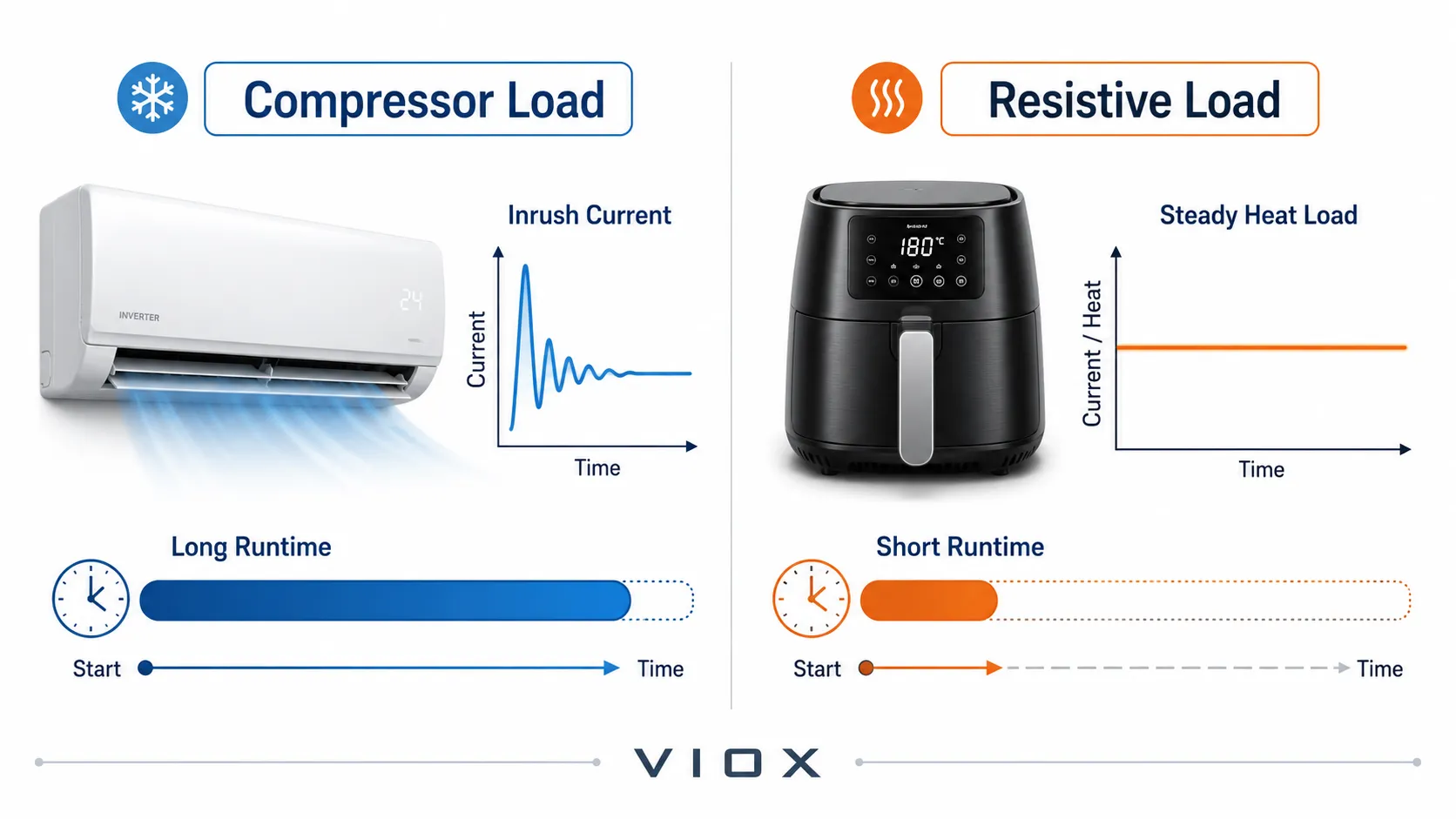
An 800W air conditioner may create more circuit stress than a 1,500W air fryer in some situations. That sounds wrong until you look at the load type.
| Appliance | Load Type | Startup Surge | Runtime Pattern | Main Circuit Risk |
|---|---|---|---|---|
| Air fryer | Mostly resistive heating | Low | Short cycles | Overload if shared with other loads |
| Kettle | Resistive heating | Low | Short duration | High current for a few minutes |
| Microwave | Transformer/electronic load | Medium | Short cycles | Voltage dip or overload |
| Portable AC | Compressor and fan motor | Medium to high | Long runtime | Inrush, outlet heat, shared-circuit trips |
| Window AC | Compressor and fan motor | Medium to high | Long runtime | Dedicated circuit often preferred |
| Split AC | Compressor/inverter electronics | Depends on design | Long runtime | Usually requires a properly specified circuit |
The air fryer draws high current, but it behaves more predictably. The air conditioner starts a motor/compressor, may cycle repeatedly, and often runs for long periods in hot weather.
Resistive Load vs Inductive Load
Resistive loads convert electrical energy mainly into heat. Examples include kettles, simple heaters, and many air fryer heating elements. Their current is easier to estimate.
Air conditioners are different. They include compressors, fan motors, capacitors, inverter electronics, and control boards. These are inductive or electronic loads. Their current depends on motor behavior, power factor, starting condition, voltage, temperature, and control method.
For a simple resistive load:
I = P / V
For a single-phase AC motor or compressor load, running current is more accurately estimated with power factor:
I = P / (V x cos phi)
For example, a 1,200W air conditioner at 230V with a power factor of 0.90 draws about 5.8A while running, not 5.2A. The nameplate current is still more important than a simple calculation because startup current and operating mode are not captured by the formula.
Running Current vs Inrush Current
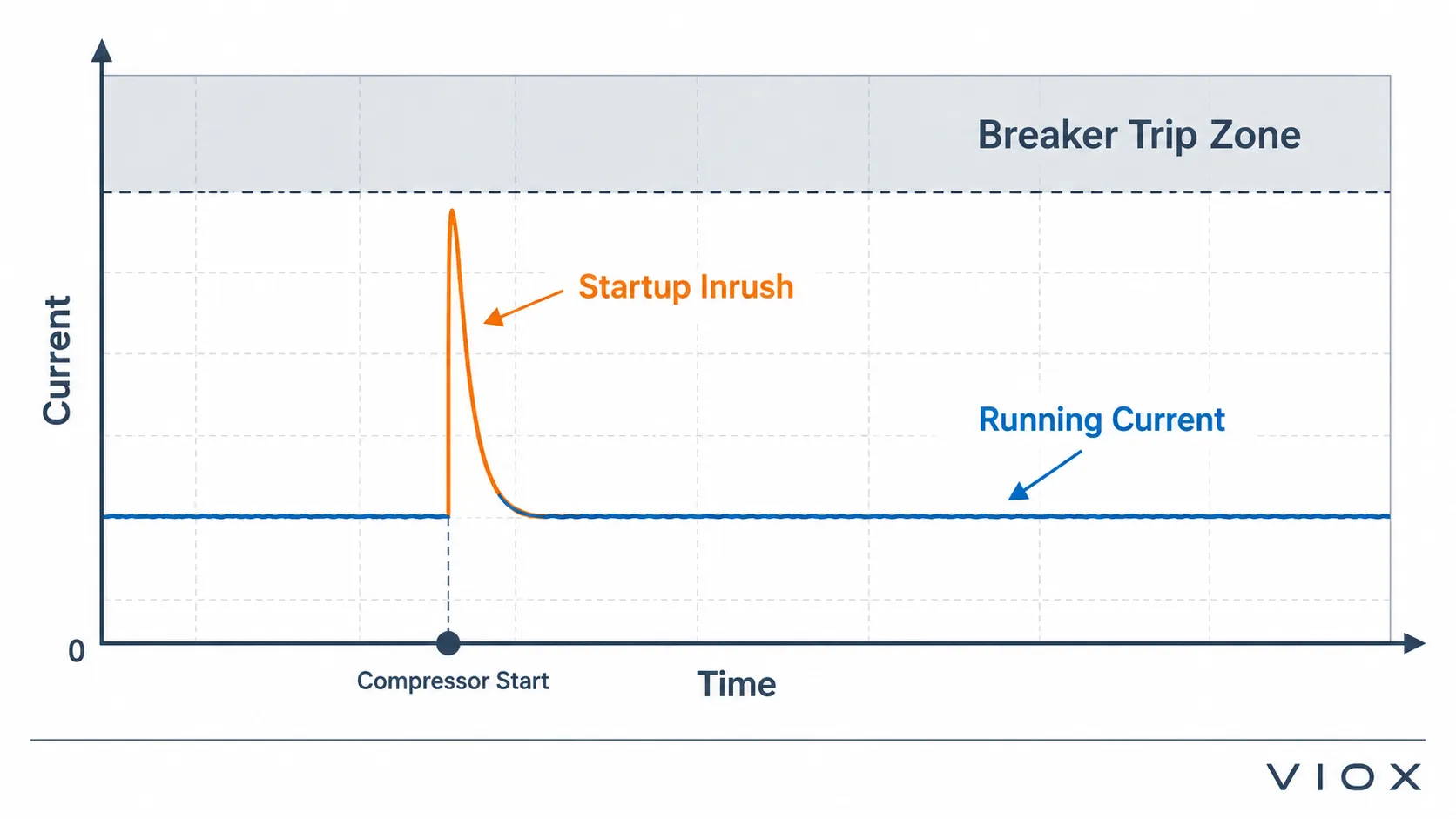
Running current is the current the air conditioner draws after it is operating normally. Inrush current is the short surge when the compressor starts.
Depending on the compressor design, an AC unit can briefly draw several times its running current during startup. Older fixed-speed compressors often have stronger startup surges. Inverter-driven units may start more smoothly, but they can still introduce leakage current, electronic switching effects, and protection coordination issues.
This is why a circuit can look fine on paper but still cause:
- flickering lights when the compressor starts
- breaker trips when another appliance is running
- buzzing or warm receptacles
- voltage dips
- repeated nuisance tripping
- damaged plugs or outlets over time
Why Lights Flicker When the AC Starts
Lights often flicker because the compressor startup surge causes a brief voltage drop on the circuit. This is more likely when:
- the circuit is long
- the cable is undersized for the load
- the outlet contact is worn
- the circuit is shared with other appliances
- the panel or terminal connection is loose
- the compressor is older or hard-starting
A brief flicker does not always mean immediate danger. But repeated flicker, warm outlets, buzzing, burning smell, discolored plugs, or repeated breaker trips should be treated as warning signs.
Why the Breaker May Not Trip Before an Outlet Overheats
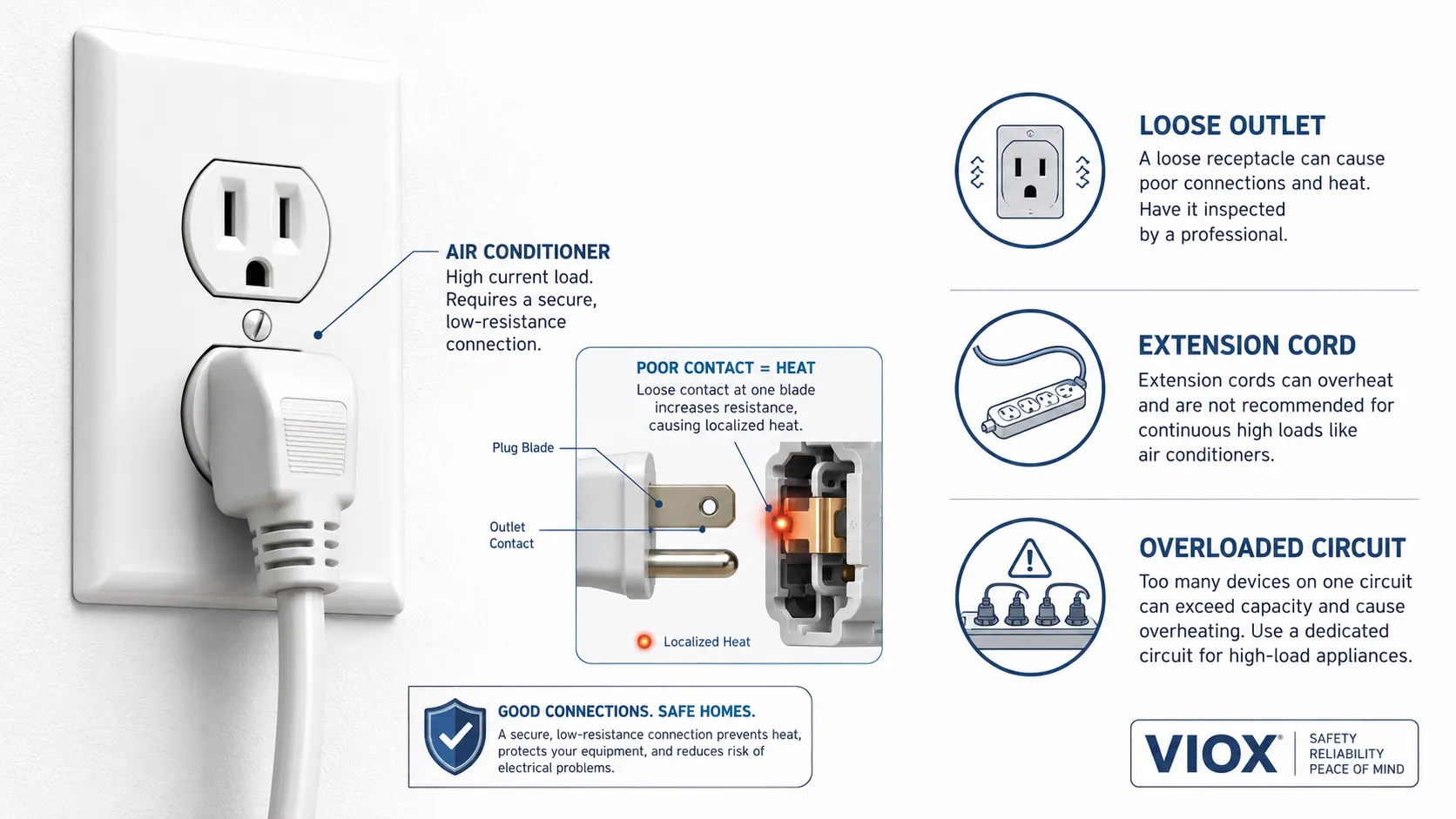
A breaker is designed primarily to protect the circuit conductors from overload and short circuit. It is not a perfect sensor for every weak plug, loose receptacle, corroded terminal, or damaged extension cord.
An outlet can overheat when contact resistance is high, even if the current is below the breaker rating. This is why air conditioners should not be run through:
- loose receptacles
- undersized extension cords
- multi-socket adapters
- old power strips
- damaged plugs
- overheated or discolored outlets
A dedicated circuit reduces shared-load risk, but the receptacle, plug, terminals, and cable must still be in good condition.
Portable AC vs Window AC vs Split AC: When Is a Dedicated Circuit Needed?
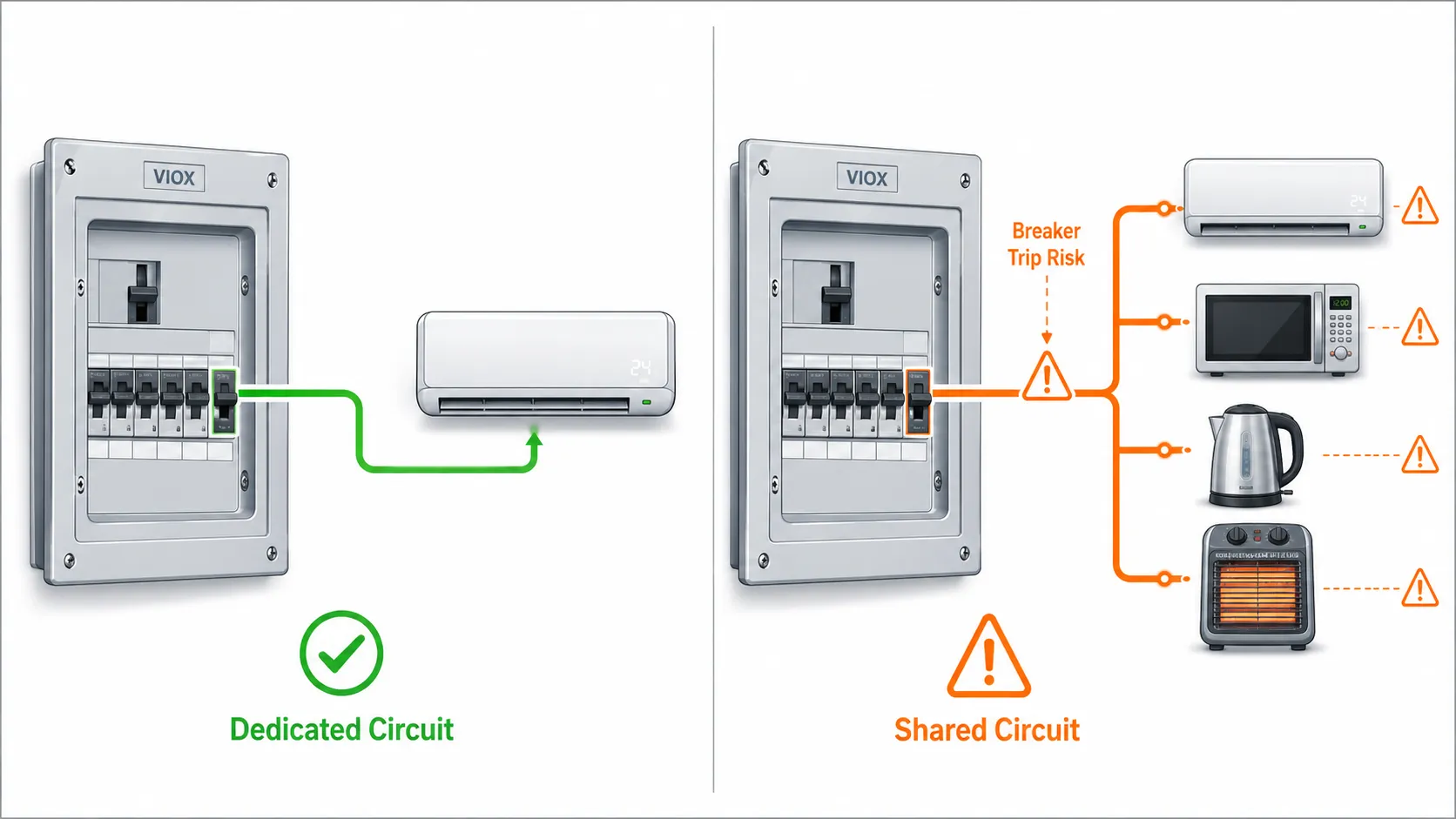
The answer depends on the appliance nameplate, local code, and circuit condition.
| AC Type | Dedicated Circuit Needed? | Practical Guidance |
|---|---|---|
| Small portable AC | Sometimes | May use an existing circuit if lightly loaded and in good condition |
| Larger portable AC | Often recommended | Avoid shared kitchen, heater, or laundry circuits |
| Window AC | Often recommended or required | Check nameplate current and manufacturer instructions |
| Through-wall AC | Usually | Often treated as a fixed appliance |
| Mini-split / split AC | Usually yes | Follow manufacturer’s circuit and isolator requirements |
| Heat pump system | Yes | Requires engineered circuit protection and disconnecting means |
If the installation manual specifies a dedicated circuit, follow it. If the AC repeatedly trips a breaker or heats the outlet, do not keep resetting the breaker.
What Breaker Size Does an Air Conditioner Need?
There is no universal breaker size for all air conditioners.
The breaker size depends on:
- nameplate current
- manufacturer maximum overcurrent protection rating
- supply voltage
- cable size
- circuit length
- installation method
- startup/inrush characteristics
- breaker curve
- AFCI/GFCI/RCD/RCBO requirements
- local code
For many small plug-in AC units, the circuit may be 15A or 20A depending on the region and wiring system. Larger units may require a dedicated 20A circuit, 240V circuit, isolator, or manufacturer-specified protection.
Never install a larger breaker just to stop tripping. The breaker protects the wire. If the wire cannot safely carry the higher current, upsizing the breaker creates a fire risk.
B-Curve vs C-Curve MCB for Air Conditioners
In IEC-style systems, miniature circuit breakers (MCBs) may use B, C, or D trip curves.
| MCB Curve | Magnetic Trip Range | Practical AC Relevance |
|---|---|---|
| B curve | 3-5 x rated current | Common for lighting and general loads; may trip with high motor inrush |
| C curve | 5-10 x rated current | Often considered for compressor, fan, pump, and small motor loads |
| D curve | 10-20 x rated current | Usually for high-inrush equipment, not ordinary home AC unless engineered |
A C-curve MCB can help with compressor inrush, but it is not a universal fix. The electrician must verify fault loop impedance, disconnection time, cable size, available fault current, and local rules.
Dedicated Circuit Checklist
Before installing or using an air conditioner, check:
| Check Item | Why It Matters |
|---|---|
| AC nameplate current | Real rating is better than wattage estimate |
| Manufacturer instructions | May require dedicated circuit or maximum breaker size |
| Cable size | Breaker must protect the cable |
| Circuit sharing | Other appliances can cause overload |
| Outlet condition | Loose contacts create heat |
| Extension cord use | Long or undersized cords are unsafe for AC loads |
| Breaker curve | Compressor inrush may affect trip behavior |
| RCD/RCBO type | Modern inverter AC may need appropriate residual-current protection |
| Panel capacity | A new circuit needs available load capacity |
| Local code | Requirements differ by country and installation type |
Common Mistakes
Mistake 1: Judging Only by Wattage
Wattage is useful, but air conditioners also have compressor inrush, long runtime, motor behavior, and power factor. A low-watt AC can still stress a weak circuit.
Mistake 2: Using an Extension Cord
Many extension cords and power strips are not suitable for continuous compressor loads. Voltage drop and poor contact can overheat the cord or plug.
Mistake 3: Sharing with Kitchen or Heating Loads
Kettles, microwaves, air fryers, electric heaters, and AC units can overload a shared circuit when used together.
Mistake 4: Installing a Larger Breaker
If the breaker trips, the cause may be overload, inrush, a weak breaker, damaged outlet, undersized wire, or appliance fault. Installing a larger breaker without checking the cable is unsafe.
Mistake 5: Ignoring Outlet Heat
A warm outlet or plug is a warning sign. The breaker may not trip if the current is below its rating, but the local contact point can still overheat.
Mistake 6: Forgetting Residual-Current Protection
Depending on region and appliance type, the circuit may need GFCI, RCD, RCCB, or RCBO protection. Inverter-driven AC units may require the correct residual-current device type.
When to Call an Electrician
Call a qualified electrician if:
- the breaker trips repeatedly
- lights dim strongly when the AC starts
- the outlet or plug feels warm
- the receptacle is loose or discolored
- there is buzzing, burning smell, or visible damage
- the AC manual requires a dedicated circuit
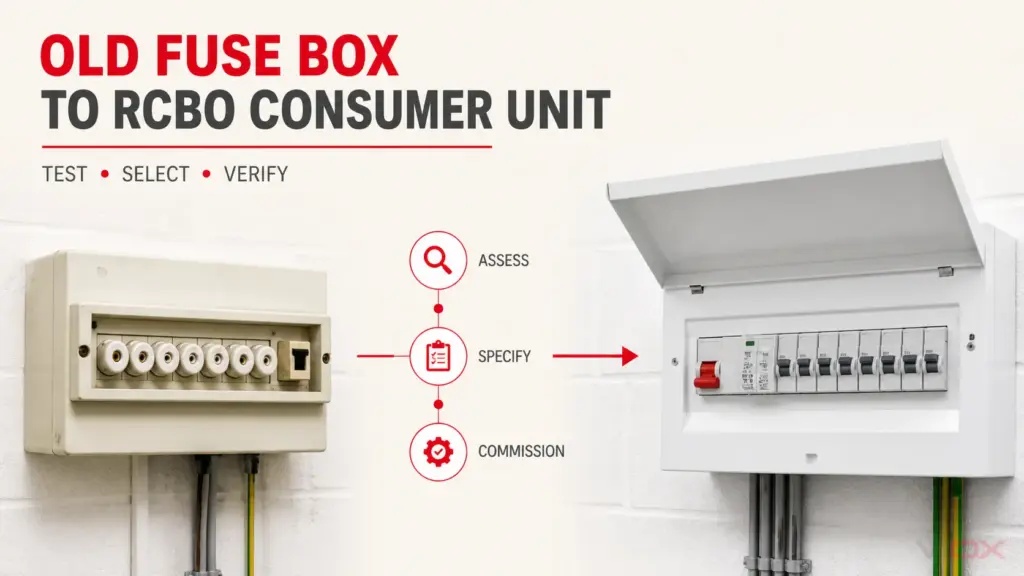
- you need a new breaker, RCBO, isolator, or consumer unit upgrade
- the panel has no spare spaces
For European heatwave retrofit issues, including old consumer units and RCBO upgrades, see VIOX’s Europe heatwave air conditioner circuit breaker guide.
FAQ
Does a portable air conditioner need a dedicated circuit?
Small portable units may run on an existing circuit if the circuit is healthy and lightly loaded. Larger portable units, long runtime, repeated breaker trips, warm outlets, or shared high-load appliances are strong reasons to use a dedicated circuit.
Does a window air conditioner need a dedicated circuit?
Many window AC units should use a dedicated circuit, especially larger models. Always check the appliance nameplate and installation manual.
Why does my breaker trip when the AC starts?
Common causes include compressor inrush, overloaded shared circuit, wrong breaker curve, weak breaker, voltage drop, faulty compressor, or poor outlet connection.
Can I use a 20A breaker for my air conditioner?
Only if the cable, outlet, appliance instructions, and local code allow it. A 20A breaker must not be used on wiring that is only rated for a smaller circuit.
Can I plug an AC into a power strip?
No. Air conditioners should generally be plugged directly into a properly rated outlet. Power strips and light-duty extension cords can overheat under continuous compressor loads.
Why can an 800W AC cause more problems than a 1500W air fryer?
The air fryer is mostly resistive and predictable. The air conditioner has compressor startup inrush, motor behavior, long runtime, and possible voltage dip. The load type matters as much as wattage.
What kind of breaker is best for an air conditioner?
The correct breaker depends on the appliance nameplate, cable size, supply voltage, local code, and inrush behavior. In IEC systems, C-curve MCBs are often considered for compressor loads, but the fault loop and disconnection time must be verified.
Conclusion
An air conditioner often needs a dedicated circuit not because its wattage is always the highest load in the home, but because it behaves differently.
It starts a compressor, may draw inrush current, runs for long periods, stresses weak outlets, and can trip breakers when sharing a circuit with other appliances.
The right solution is not a larger breaker. It is a correctly designed circuit: proper cable size, correct breaker or RCBO, healthy outlet or isolator, suitable residual-current protection, and enough panel capacity.