Why This Guide Matters for Distributors in 2026
Every year, electrical distributors face the same challenge: customers demand reliable surge protection, yet the market floods with inconsistent specifications, vague datasheets, and manufacturers who disappear when warranty claims arrive. A single bad procurement decision can cascade into customer complaints, equipment failures, and reputational damage that takes years to repair.
The global surge protection device market reached $3.65 billion in 2024 and projects to $5.55 billion by 2030—a 6.4% CAGR driven by renewable energy expansion, smart infrastructure, and stricter electrical codes. For distributors, this growth translates to opportunity, but only if you can navigate the technical complexity of SPD selection and partner with proven SPD manufacturers who deliver consistent quality.
This comprehensive guide cuts through the confusion. As a leading SPD manufacturer with ISO 9001, UL 1449, and IEC 61643 certifications, VIOX has supplied over 2 million surge protective devices to distributors across 50+ countries. We’ve distilled our engineering expertise into actionable procurement criteria that help you stock the right products, reduce warranty returns, and build long-term customer trust.
What you’ll learn:
- How to decode SPD specifications and avoid purchasing mistakes
- Application-specific selection criteria for solar, residential, industrial, and EV markets
- Quality verification methods to distinguish premium manufacturers from commodity suppliers
- Lifecycle management strategies to optimize inventory turnover and margins
Whether you’re expanding into surge protection or refining your existing portfolio, this guide provides the technical foundation and procurement framework you need.
Understanding SPD Fundamentals
A Surge Protection Device (SPD) is an electrical safety component designed to protect systems from voltage spikes by limiting transient voltages and diverting surge currents to ground. Unlike circuit breakers that protect against sustained overcurrent, SPDs respond to microsecond-duration voltage spikes caused by lightning strikes, utility switching, or inductive load switching.
Why distributors must understand SPD technology:
- Customer education drives sales: Contractors and facility managers need technical guidance—distributors who provide expert advice win repeat business
- Application matching prevents returns: Specifying the wrong SPD type creates warranty headaches and erodes margins
- Regulatory compliance requirements: NEC 2023 mandates SPDs in critical applications, creating mandatory demand
The MOV Technology Reality
Most SPDs use Metal Oxide Varistor (MOV) technology as their core protection element. MOVs work by changing from high resistance to low resistance when voltage exceeds a threshold, shunting surge energy safely to ground. However, MOVs degrade with each surge event—they’re sacrificial components by design.
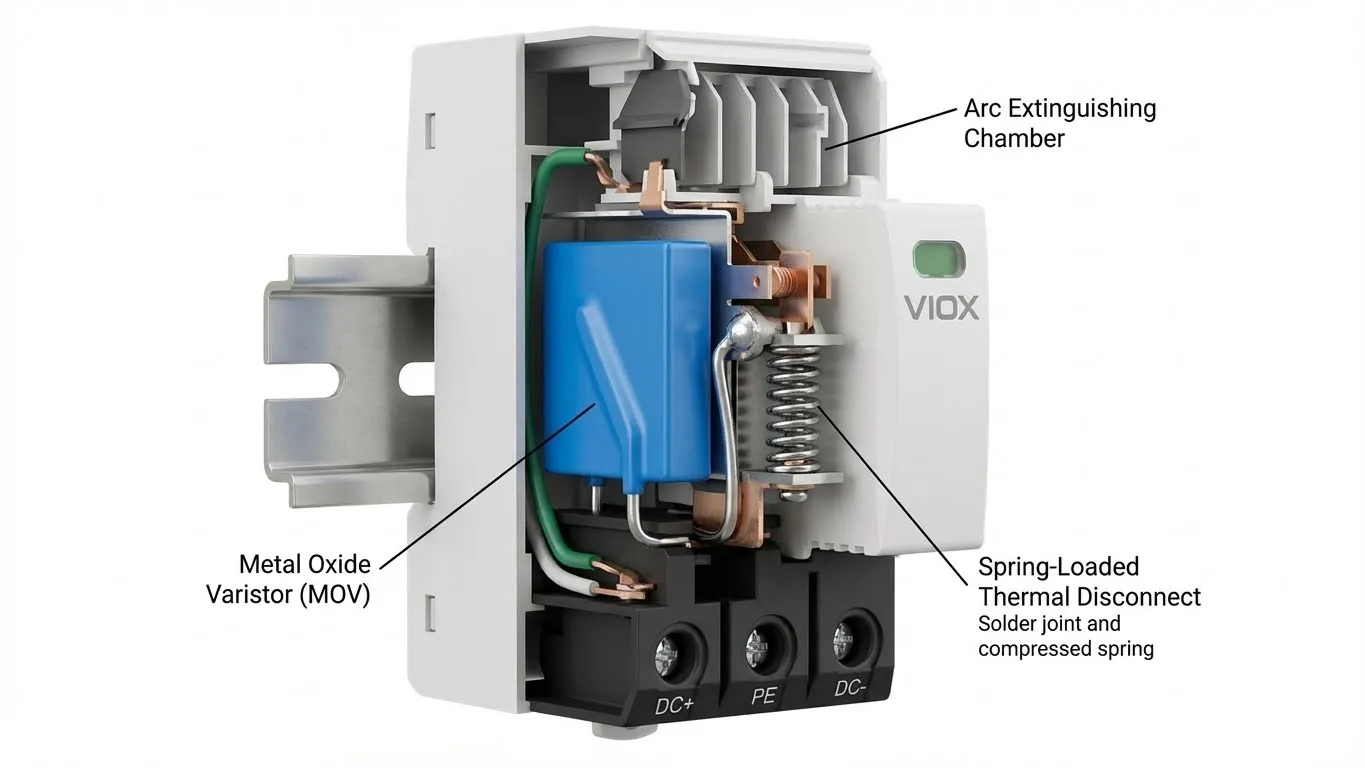
Understanding SPD lifespan and MOV aging mechanisms is critical for inventory planning. Key aging factors include:
- Joule accumulation: Each surge consumes a portion of the MOV’s total energy capacity
- Thermal stress: Repeated heating/cooling cycles degrade the MOV matrix
- Continuous operating voltage: Higher ambient voltages accelerate deterioration
- Environmental conditions: Heat, humidity, and pollution shorten service life
Procurement insight: Premium SPD manufacturers use high-grade MOV blocks with thermal disconnection mechanisms. When the MOV degrades, the device safely disconnects rather than failing catastrophically. This design difference separates professional-grade products from consumer-market knockoffs.
SPD Classification: Type 1 vs Type 2 vs Type 3
Understanding SPD Type 1, Type 2, and Type 3 classifications is foundational for inventory strategy. These categories define where the SPD installs within the electrical system and what level of surge energy it handles.
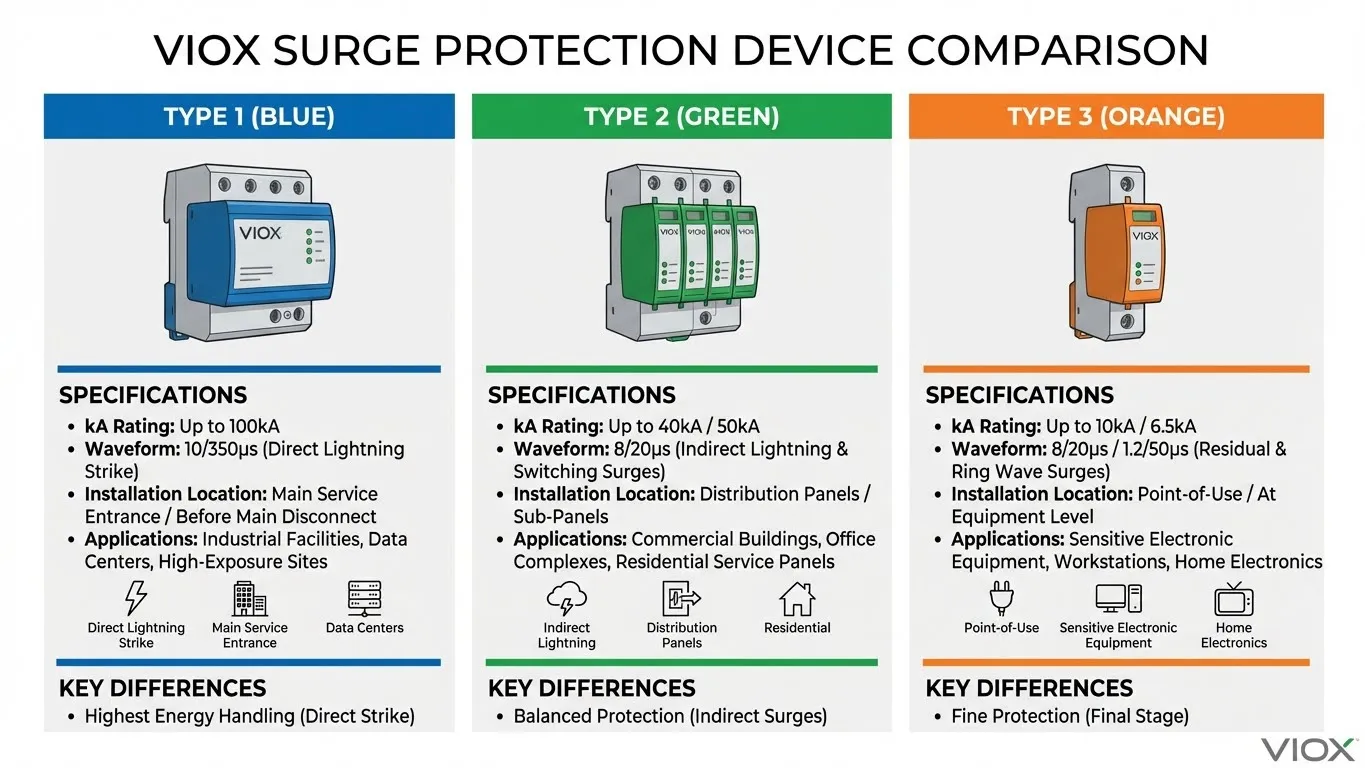
Comprehensive SPD Type Comparison
| Feature | Type 1 SPD | Type 2 SPD | Type 3 SPD |
|---|---|---|---|
| Installation Location | Service entrance, upstream of main breaker | Main distribution panel or subpanel | Point-of-use, near sensitive equipment |
| Test Waveform | 10/350μs (simulates direct lightning) | 8/20μs (simulates induced surges) | Combination wave 1.2/50μs + 8/20μs |
| Energy Capacity | 25kA to 100kA per pole | 20kA to 65kA per pole | 5kA to 20kA per pole |
| Typical Applications | Industrial facilities, buildings with external lightning protection systems | Commercial buildings, residential panels, solar inverters | Server rooms, telecom equipment, medical devices |
| Relative Cost | High (3-5× Type 2) | Moderate (baseline) | Low (0.5-1× Type 2) |
| Distributor Priority | Stock for industrial/commercial quotes | Primary inventory—highest volume | Optional stock for specialty applications |
| Coordination Requirement | Must coordinate with downstream Type 2 | Can operate standalone or with Type 3 | Requires upstream Type 1 or Type 2 |
When Distributors Need Each Type
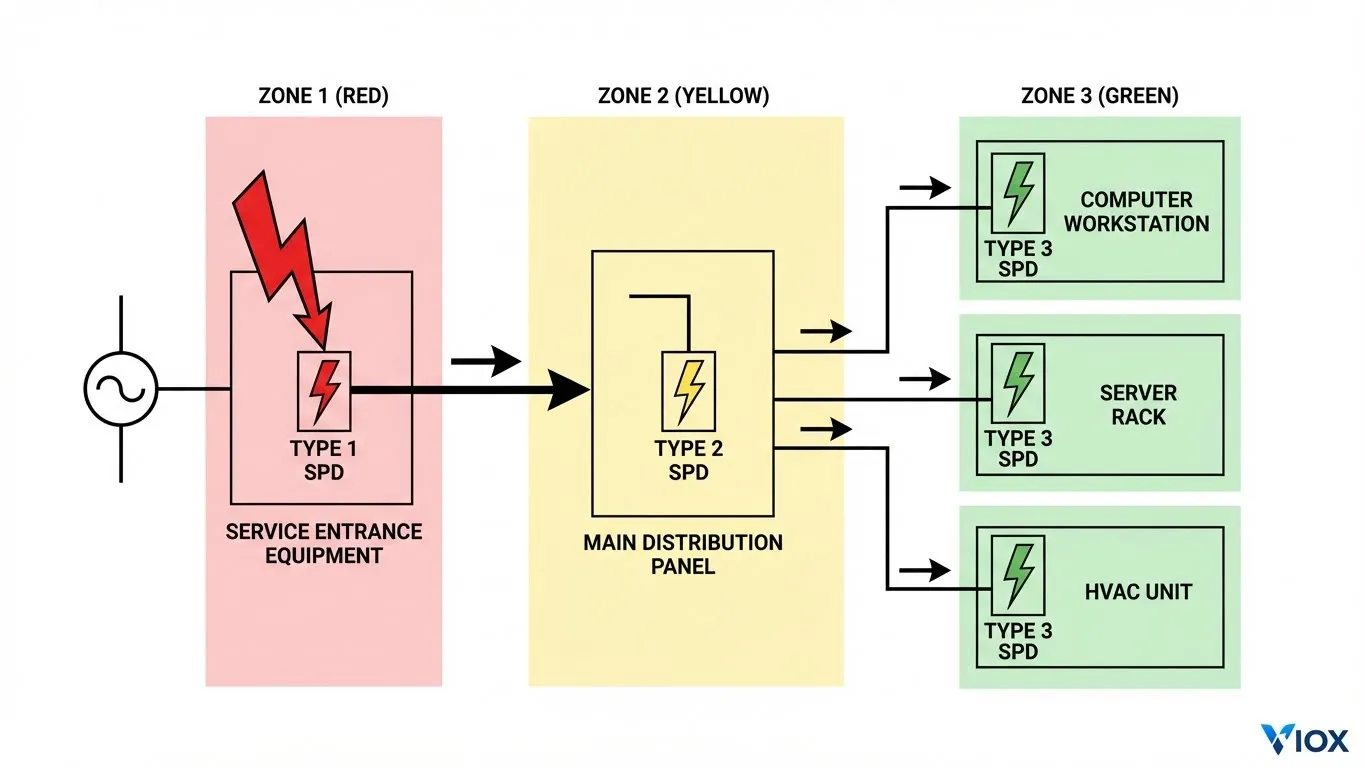
Type 1 SPD demand drivers:
- Industrial facilities with exposed service entrances
- Buildings in high-keraunic regions (frequent lightning)
- Installations with rooftop solar arrays
- Code requirements for structures with lightning protection systems
Type 2 SPD universal applications:
- Residential main panels (200A, 400A services)
- Commercial distribution boards
- Solar combiner boxes and inverter protection
- Standard contractor stock—accounts for 70-80% of distributor SPD volume
Type 3 SPD niche markets:
- Data center equipment protection
- Medical facility sensitive equipment
- Automation and control systems
- Telecom installations
Critical procurement note: Type 1+2 combined devices offer both lightning current and surge protection in a single unit. While more expensive than standalone Type 2, they reduce installation complexity and provide comprehensive protection—an attractive option for premium project specifications.
Critical Selection Parameters for Procurement
Beyond SPD type classification, distributors must understand key electrical parameters that determine application suitability. These specifications directly impact whether an SPD performs correctly in the field or becomes a warranty return.
Voltage Ratings: Uc, Up, and MCOV
Voltage parameters are the most misunderstood SPD specifications. Distributors who master these distinctions gain competitive advantage through accurate application guidance.
Maximum Continuous Operating Voltage (MCOV/Uc): The highest RMS voltage the SPD can tolerate indefinitely without degradation. Understanding MCOV ratings prevents premature failure. Selection rules:
- 120V systems: Uc ≥ 150V AC
- 230V systems: Uc ≥ 275V AC
- 277V systems: Uc ≥ 320V AC
- 400V systems: Uc ≥ 440V AC
Voltage Protection Level (Up): The maximum voltage let-through when the SPD clamps. Lower Up values provide better equipment protection but may sacrifice surge handling capacity. Typical ranges:
- Type 1: Up ≤ 4.0kV
- Type 2: Up ≤ 2.5kV
- Type 3: Up ≤ 1.5kV
Impulse Withstand Voltage (Uimp): The SPD’s ability to withstand high-voltage test pulses without failing. For complete understanding of Uc vs Ui vs Uimp relationships, distributors should reference equipment insulation coordination requirements.
Procurement tip: Stock SPDs with Uc ratings 20-30% above nominal system voltage to account for utility voltage variations and ensure long service life.
Joule Rating & Energy Capacity
Joule ratings indicate total surge energy capacity—how much cumulative surge stress an SPD can absorb before degradation. This specification directly correlates with lifespan and warranty period.
Joule rating guidelines by application:
- Consumer-grade power strips: 200-1,000 joules (avoid for professional installations)
- Residential panel SPDs: 1,000-3,000 joules per phase
- Commercial/industrial SPDs: 3,000-10,000+ joules per phase
- Solar/renewable energy: 5,000-15,000 joules (high surge frequency)
Key distributor insight: Joule ratings aren’t standardized test conditions—manufacturers use different measurement protocols. Verify that joule ratings come from UL 1449 certified test procedures, not marketing calculations.
Warranty correlation: Premium manufacturers typically offer:
- 5-year warranties for ≥3,000 joule residential SPDs
- 10-year warranties for ≥5,000 joule commercial SPDs
- Connected equipment warranties ($25,000-$100,000 coverage)
Stock SPDs with documented joule ratings backed by test reports—customers increasingly demand this verification.
Pole Configuration: 1P, 1+NPE, 3P, 3+NPE
SPD pole configurations determine phase protection coverage. Incorrect pole selection is a common specification error that distributors must prevent.
Configuration guide:
- 1P (single-pole): L-PE protection only—used in single-phase systems with separate neutral
- 1+NPE: L-N-PE protection—comprehensive single-phase protection (most common residential)
- 2P: L1-L2-PE protection—split-phase 120/240V systems
- 3P: L1-L2-L3-PE protection—three-phase systems with TN-C grounding (shared PEN conductor)
- 3+NPE: L1-L2-L3-N-PE protection—comprehensive three-phase with separate neutral (TN-S systems)
Distributor stocking strategy:
- High volume: 1+NPE (residential) and 3+NPE (commercial three-phase)
- Medium volume: 3P (industrial with TN-C systems)
- Special order: 1P, 2P (project-specific applications)
Critical specification note: In TN-S systems (separate neutral and protective earth), failing to protect the neutral path leaves equipment vulnerable. 3+NPE devices cost 15-25% more than 3P but provide complete protection—educate customers on this value proposition.
kA Rating & Discharge Current Capacity
The kA (kiloampere) rating defines surge current handling capacity—the maximum instantaneous current the SPD can safely divert. Understanding kA rating sizing strategies helps distributors recommend appropriate protection levels.
kA rating framework:
- Type 1 SPDs: 25kA to 100kA (tested with 10/350μs waveform)
- Type 2 SPDs: 20kA to 65kA (tested with 8/20μs waveform)
- Type 3 SPDs: 5kA to 20kA (combination wave testing)
Application-based selection:
- Urban residential: 40kA Type 2 sufficient (lower lightning exposure)
- Suburban/rural: 65kA Type 2 recommended (higher lightning risk)
- Industrial facilities: Type 1 (50-100kA) + Type 2 (40-65kA) coordination
- Solar installations: 40kA minimum (frequent switching transients)
Procurement intelligence: Higher kA ratings provide safety margin but increase cost. The “gatekeeper strategy” recommends:
- Install robust Type 1 protection at service entrance (if required)
- Deploy moderate Type 2 protection at distribution panels
- Add point-of-use Type 3 for critical equipment
This tiered approach optimizes protection-to-cost ratio while meeting code requirements.
Application-Specific Selection Guides
Generic SPD specifications mean little without application context. Distributors who understand vertical market requirements can provide consultative value that generic suppliers cannot match.
Solar/PV Systems
Photovoltaic installations face unique surge challenges: DC voltage characteristics, high system voltages (600V-1500V), and frequent switching transients from inverters. Our complete solar SPD selection guide details these considerations.
Solar SPD requirements:
- DC-rated components: AC SPDs fail catastrophically in DC applications (no current zero-crossing)
- High MCOV ratings: 1000V and 1500V DC systems require Uc ≥ 1200V and ≥ 1800V respectively
- Type 1+2 combined protection: Solar arrays act as lightning attractors—robust protection essential
- Reverse current capability: Must handle backfeed current from array
Distributor opportunity: Solar installations represent high-margin SPD sales with longer specification cycles. Stock DC-rated SPDs in common PV system voltages (600V, 1000V, 1500V) and train sales staff on NEC Article 690 requirements.
Residential/Whole House Protection
Whole-house surge protection has shifted from optional to essential as smart home devices, HVAC electronics, and EV chargers proliferate. For 200A service panels specifically, reference our comprehensive sizing guide.
Residential SPD specifications:
- Type 2 classification: Installs in main panel alongside breakers
- 1+NPE configuration: Single-phase 120/240V protection
- 40-80kA discharge capacity: Adequate for most residential exposure
- UL 1449 4th Edition compliance: Mandatory for residential installations
- LED status indicators: Homeowners need visual confirmation of protection status
Market positioning: Premium residential SPDs ($80-$150 wholesale) include connected equipment warranties and smartphone monitoring. Mid-tier products ($30-$60) offer solid protection without connectivity. Avoid ultra-low-cost imports (<$20)—warranty claims will erase margins.
Industrial/Engineering Applications
Industrial procurement officers make data-driven decisions based on total cost of ownership, not initial purchase price. Our engineer’s guide to specifying SPDs addresses their concerns directly.
Industrial SPD priorities:
- Coordination studies: SPDs must coordinate with upstream/downstream protective devices
- Remote monitoring: SCADA integration for predictive maintenance
- High temperature ratings: Industrial environments often exceed 40°C ambient
- Modular replacement: Field-replaceable protection modules reduce downtime
- Certifications: IEC 61643-11, ISO 9001, CE marking for international projects
Distributor value-add: Offer application engineering support for complex industrial installations. Partner with SPD manufacturers who provide coordination studies and technical training—this consultative approach wins long-term contracts.
EV Charging Infrastructure
Electric vehicle charging stations face severe surge exposure from grid-connected high-power electronics and outdoor installation environments. Our analysis of surge protection requirements for EV chargers shows why protection is non-negotiable.
EV charger SPD specifications:
- Type 2 protection: Required at charger distribution panel
- 40-80kA capacity: Commercial charging locations need higher ratings
- Weatherproof enclosures: Many chargers install outdoors (NEMA 3R minimum)
- Three-phase protection: Level 3 DC fast chargers require 3+NPE SPDs
- NEC 625 compliance: Mandatory surge protection as of 2020 code cycle
Market trend: EV infrastructure represents the fastest-growing SPD application segment. Distributors serving electrical contractors, charging network operators, and commercial property developers should prioritize EV-specific SPD inventory.
Installation & Deployment Strategy
Proper SPD application extends beyond selecting the right device—installation location, grounding, and coordination determine whether protection performs as designed. Poor installation practices negate even premium SPD specifications.
Deployment Triage Matrix
Not every panel requires an SPD, and not every application demands the same protection level. Our SPD deployment triage matrix helps distributors guide customers toward cost-effective protection strategies.
Panel priority ranking:
- Critical protection (mandatory):
- Main service entrance (especially if external lightning protection exists)
- Panels feeding life-safety systems (fire alarm, emergency lighting)
- IT/telecom rooms with sensitive equipment
- Renewable energy systems (solar inverters, battery storage)
- High-value protection (recommended):
- Distribution panels feeding expensive manufacturing equipment
- Commercial buildings in high-lightning regions
- Residential homes with whole-house smart systems
- Medical facilities and laboratories
- Optional protection (case-by-case):
- Secondary distribution panels in low-exposure areas
- Temporary panels for construction sites
- Residential subpanels in low-keraunic regions
This risk-based approach helps customers allocate budgets effectively while ensuring critical systems receive adequate protection.
Installation Requirements & Best Practices
Even correctly specified SPDs fail if installation violates basic electrical principles. Understanding SPD installation requirements and code standards prevents field failures.
Critical installation factors:
- Lead length minimization: Every meter of conductor adds inductance—keep SPD connections under 0.5m
- Proper grounding: SPD effectiveness depends on low-impedance ground path (<5Ω)
- Overcurrent protection: SPDs require upstream fusing or circuit breaker coordination
- Physical separation: Maintain minimum 10m cable distance between cascaded SPD stages
- Temperature considerations: Install SPDs away from heat sources that accelerate aging
Warranty protection insight: Many SPD manufacturers void warranties for improper installation. Distributors should provide installation checklists with every sale to reduce warranty disputes.
Common Installation Mistakes
Warranty returns cost distributors money and reputation. Our guide to common SPD installation mistakes identifies preventable errors:
Top installation failures:
- Incorrect voltage rating selection (30% of failures)
- Missing or inadequate grounding (25%)
- Excessive lead length (20%)
- Wrong pole configuration (15%)
- Inadequate overcurrent protection (10%)
Distributor preventive strategy: Create application-specific installation guides for high-volume SPD products. A one-page installation diagram prevents hours of troubleshooting and warranty processing.
SPD Technologies Comparison
While MOVs dominate the SPD market, alternative technologies serve specific applications. Understanding MOV vs GDT vs TVS technology differences helps distributors recommend optimal solutions.
Protection Technology Overview
Metal Oxide Varistor (MOV):
- Advantages: High energy capacity, low cost, excellent voltage clamping
- Limitations: Degrades with repeated surges, thermal runaway risk without disconnect
- Applications: 90% of AC power SPDs, general-purpose surge protection
- Distributor priority: Primary inventory focus
Gas Discharge Tube (GDT):
- Advantages: Extremely high surge current capacity, long lifespan, no degradation
- Limitations: Slow response time (100-200ns), requires coordination with faster devices
- Applications: Telecommunication circuits, coarse protection stages
- Distributor priority: Stock for telecom-specific applications only
Transient Voltage Suppressor (TVS):
- Advantages: Fastest response (<1ns), precise voltage clamping, no degradation
- Limitations: Low energy capacity, higher cost, requires heat sinking
- Applications: Sensitive electronics protection, data lines, control circuits
- Distributor priority: Special-order for specific engineering projects
Hybrid/Multi-technology SPDs:
Combine technologies to optimize protection—example: GDT for initial current handling + MOV for voltage clamping + TVS for final protection. Premium solutions for critical applications.
Procurement recommendation: Stock MOV-based SPDs for 90% of applications. Maintain relationships with manufacturers offering GDT and TVS technologies for specialized projects—these represent higher margins and consultative sales opportunities.
Quality Assurance & Standards
SPD quality varies dramatically across manufacturers. Distributors who stock certified products from reputable suppliers protect their reputation and reduce warranty exposure.
Certification Verification
Mandatory certifications by market:
- North America: UL 1449 4th Edition listing (mandatory for legal sale)
- Europe: CE marking, IEC 61643-11 compliance
- International: ISO 9001 manufacturing quality management
Understanding TVSS vs SPD terminology and UL 1449 standards prevents specification confusion—TVSS is an outdated term that UL retired in favor of standardized SPD classification.
Verification checklist for distributors:
- Request UL listing numbers and verify on UL Product iQ database
- Confirm IEC 61643 test reports from accredited laboratories
- Validate ISO 9001 certification covers manufacturing facilities (not just corporate offices)
- Check for RoHS and REACH compliance for environmental requirements
- Verify connected equipment warranty terms and claim process
Manufacturer Quality Indicators
Beyond certifications, operational factors distinguish premium SPD manufacturers from commodity suppliers:
Red flags indicating poor quality:
- No published warranty terms or claim process
- Inability to provide test reports for specific models
- Missing or unclear product datasheets
- No technical support availability
- Extremely low pricing (>40% below market average)
Green flags indicating manufacturer reliability:
- Comprehensive technical documentation
- Responsive engineering support team
- Established distribution network
- Multi-year warranty with reasonable claim process
- Traceable manufacturing (not just rebranded OEM products)
VIOX quality commitment: As an ISO 9001 certified SPD manufacturer, VIOX maintains rigorous quality control including:
- 100% factory testing of every SPD before shipment
- UL 1449 and IEC 61643 certification for all product lines
- 5-10 year warranties backed by $50M product liability insurance
- Technical support available in 12 languages
- Traceability to raw material suppliers for quality audits
Lifecycle Management for Distributors
SPDs don’t last forever—understanding SPD lifespan expectations helps distributors manage inventory and educate customers about replacement cycles.
Expected Service Life by Application
Typical SPD lifespans:
- Low-exposure residential: 8-12 years (few surge events)
- Urban commercial: 5-8 years (moderate surge frequency)
- Industrial facilities: 3-5 years (frequent switching transients)
- High-lightning regions: 2-4 years (severe exposure)
- Solar/renewable: 3-5 years (frequent surge events)
Storage considerations: Unused SPDs stored properly (climate-controlled, original packaging) maintain full functionality for 5-7 years. MOV components don’t degrade without voltage stress.
Warning Signs & Replacement Triggers
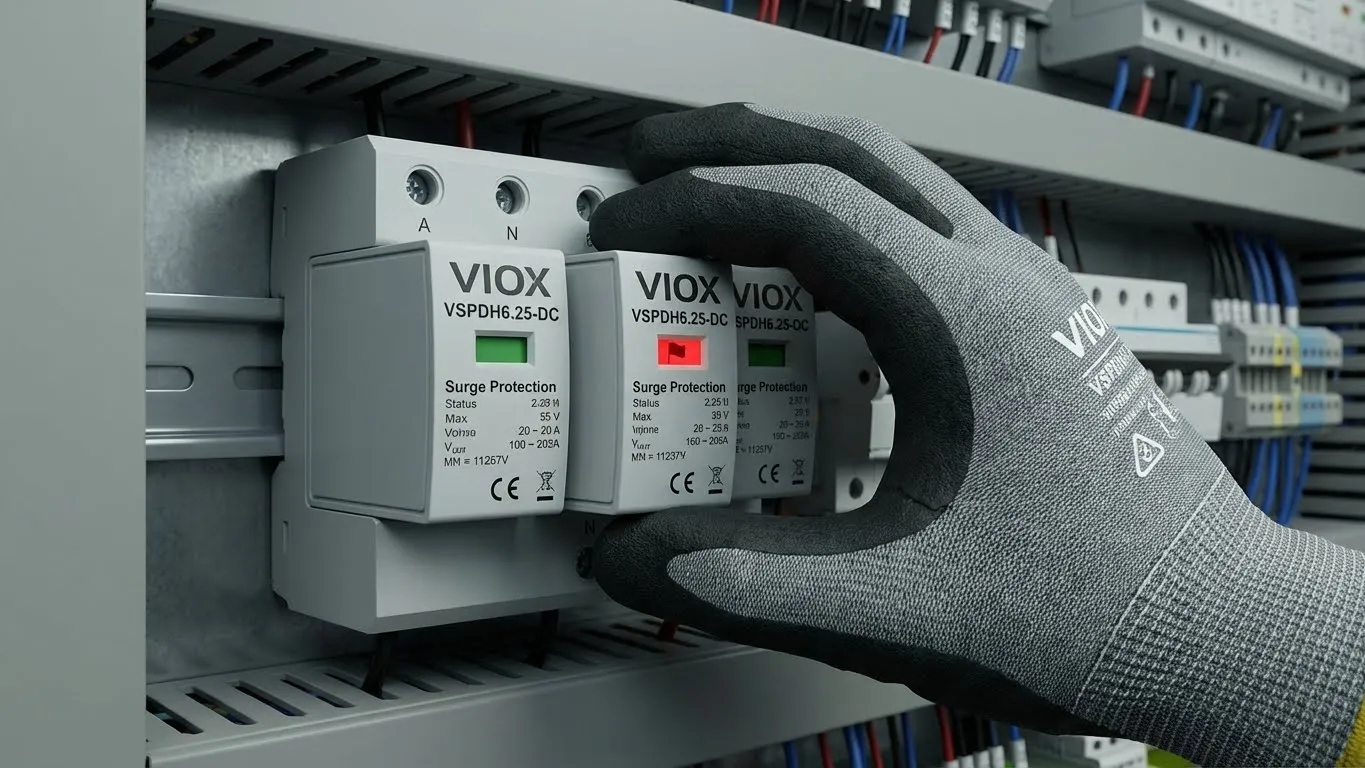
Understanding critical warning signs that SPDs have reached end-of-life helps distributors educate customers and generate replacement sales:
Replacement indicators:
- Visual status indicators: Red fault light or no light (if previously illuminated)
- Thermal disconnect operation: Audible disconnect or visible separation of protection module
- Age-based replacement: Exceeding manufacturer-recommended service life
- Significant surge events: After major lightning storm or utility fault
- Preventive replacement: Prior to warranty expiration for critical applications
- Inspection findings: Discoloration, burning smell, or physical damage
- Surge counter readings: If installed, exceeding recommended event threshold
Distributor opportunity: Implement proactive SPD replacement programs with commercial customers. Annual inspection services generate recurring revenue and prevent failures that would damage customer relationships.
Procurement Checklist for Distributors
Successful SPD distribution requires systematic evaluation of manufacturers and products. This checklist synthesizes critical selection criteria:
Manufacturer Evaluation Matrix
Technical capabilities (weight: 40%):
- ☐ UL 1449 and IEC 61643 certified product lines
- ☐ In-house engineering and testing capabilities
- ☐ Comprehensive technical documentation availability
- ☐ Application engineering support responsiveness
- ☐ Product range covering Type 1, 2, 3 requirements
Business reliability (weight: 30%):
- ☐ Manufacturing capacity adequate for distributor volume
- ☐ Reasonable MOQ requirements (typically 10-50 units per SKU)
- ☐ Lead times under 4 weeks for stock items
- ☐ Financial stability indicators (years in business, credit rating)
- ☐ Clear pricing structure and volume discount tiers
Quality assurance (weight: 20%):
- ☐ ISO 9001 manufacturing certification
- ☐ Published warranty terms (minimum 5 years residential, 10 years commercial)
- ☐ Reasonable warranty claim process and turnaround time
- ☐ Product liability insurance coverage
- ☐ Failure rate data and field performance history
Market positioning (weight: 10%):
- ☐ Brand recognition in target markets
- ☐ Marketing support materials availability
- ☐ Competitive pricing relative to market alternatives
- ☐ Product differentiation factors
- ☐ Geographic distribution network (exclusivity considerations)
Initial Order Strategy
Recommended stocking approach:
- High-volume core products (60% of inventory investment):
- Type 2, 40kA, 1+NPE (residential single-phase)
- Type 2, 40-65kA, 3+NPE (commercial three-phase)
- Solar DC SPDs (600V, 1000V, 1500V)
- Medium-volume specialty items (30% of investment):
- Type 1 SPDs (industrial quotes)
- Type 3 point-of-use protection
- Combined Type 1+2 devices
- Low-volume project-specific products (10% of investment):
- Non-standard voltage ratings
- Specialty pole configurations
- Custom-engineered solutions
Pricing structure expectations:
- Distributor discount: 35-45% off MSRP for established accounts
- Volume tiers: Additional 5-10% discounts at $25K, $50K, $100K annual volumes
- Payment terms: Net 30 standard, Net 45-60 for qualified distributors
- Freight: FOB factory typical, prepaid freight on orders >$5,000
FAQ: Critical Distributor Questions Answered
What’s the difference between SPD manufacturers in terms of quality?
Quality variation stems from three factors: component sourcing (premium manufacturers use high-grade MOV blocks with consistent characteristics), manufacturing process control (ISO 9001 certification indicates systematic quality management), and design validation (extensive testing beyond minimum certification requirements). Price differences of 30-50% typically reflect these quality factors—ultra-low-cost imports often use substandard components that fail prematurely. Verify that manufacturers can provide component traceability and factory audit reports.
How do distributors calculate the right SPD inventory mix?
Analyze your customer base by market segment: residential (prioritize 1+NPE Type 2), commercial (stock 3+NPE Type 2), industrial (maintain Type 1 for quotations), and solar (DC-rated SPDs). A typical distribution is 50% residential, 30% commercial, 15% solar, 5% industrial. Start with 3-month inventory turns and adjust based on sales velocity. Partner with manufacturers offering 30-day stock rotation for slow-moving specialty items.
What certifications should distributors verify before purchasing SPDs?
Mandatory: UL 1449 listing (verify on UL Product iQ database), IEC 61643-11 compliance for international markets. Highly recommended: ISO 9001 manufacturing certification, RoHS/REACH environmental compliance. Value-added: Connected equipment warranty, third-party testing validation (FM Approved, CSA). Avoid manufacturers unable to provide certification documents on request—this indicates potential counterfeit products or misleading claims.
How long do SPDs last in storage vs. in service?
In storage: Properly stored SPDs (climate-controlled, 15-30°C, <70% humidity) retain full functionality for 5-7 years. MOV components don’t degrade without voltage stress. In service: Lifespan depends on surge exposure—residential SPDs typically last 8-12 years, commercial 5-8 years, industrial 3-5 years. Solar installations experience higher surge frequency, reducing lifespan to 3-5 years. Implement first-in-first-out inventory rotation to minimize storage time.
Can Type 2 SPDs be used instead of Type 1 to reduce costs?
Short answer: No, if code requires Type 1 protection. Long answer: Type 1 SPDs handle direct lightning current (10/350μs waveform) that would destroy Type 2 devices. Installing Type 2 where Type 1 is required violates electrical code and creates liability exposure. However, many applications don’t require Type 1—if the building lacks external lightning protection and isn’t in a high-exposure location, Type 2 alone may suffice. Consult local code requirements and consider liability implications before recommending downgrade strategies.
What’s the typical markup for SPD distribution?
Industry standards: Distributor markup: 35-45% off MSRP purchase cost, then sell at 15-25% below MSRP to contractors (keystone pricing). Contractor markup: Contractors typically mark up 30-50% above distributor cost when selling to end customers. Project-specific pricing: Large commercial/industrial projects may involve reverse auctions that compress margins to 10-15%. High-margin opportunities exist in consultative sales where technical support justifies premium pricing.
How to handle SPD warranty claims from end customers?
Establish clear warranty claim procedures with manufacturers before stocking products: Required documentation: Failed SPD unit, installation photos, surge event details, proof of purchase. Typical process: Customer contacts distributor → distributor submits claim to manufacturer → manufacturer evaluates claim → replacement or credit issued (2-4 weeks typical). Best practice: Inspect failed units before forwarding claims—many “failures” result from improper installation or exceeding voltage ratings. Maintain detailed records of all warranty claims to evaluate manufacturer reliability.
Partner with VIOX: Your Trusted SPD Manufacturer
Choosing the right SPD manufacturer partnership determines your success in this high-growth market segment. VIOX Electric offers distributors:
Technical advantages:
- Complete product line: Type 1, Type 2, Type 3, and combined solutions
- DC-rated SPDs for solar/renewable applications (600V-1500V)
- UL 1449, IEC 61643-11, CE certified products
- Application engineering support in 12 languages
Business benefits:
- Competitive distributor pricing with volume tiers
- Reasonable MOQ requirements (10-50 units per SKU)
- 30-day lead times for standard products
- Marketing support materials and technical training
- 5-10 year warranties with responsive claim processing
Quality commitment:
- ISO 9001 certified manufacturing facilities
- 100% factory testing before shipment
- Component traceability for quality audits
- $50M product liability insurance
Ready to optimize your SPD portfolio? Contact VIOX Electric for distributor qualification information, product catalogs, and technical support. Our team helps distributors build profitable surge protection businesses through expert guidance and reliable manufacturing partnership.