On this page
PC Class vs CB Class ATS: Direct Answer
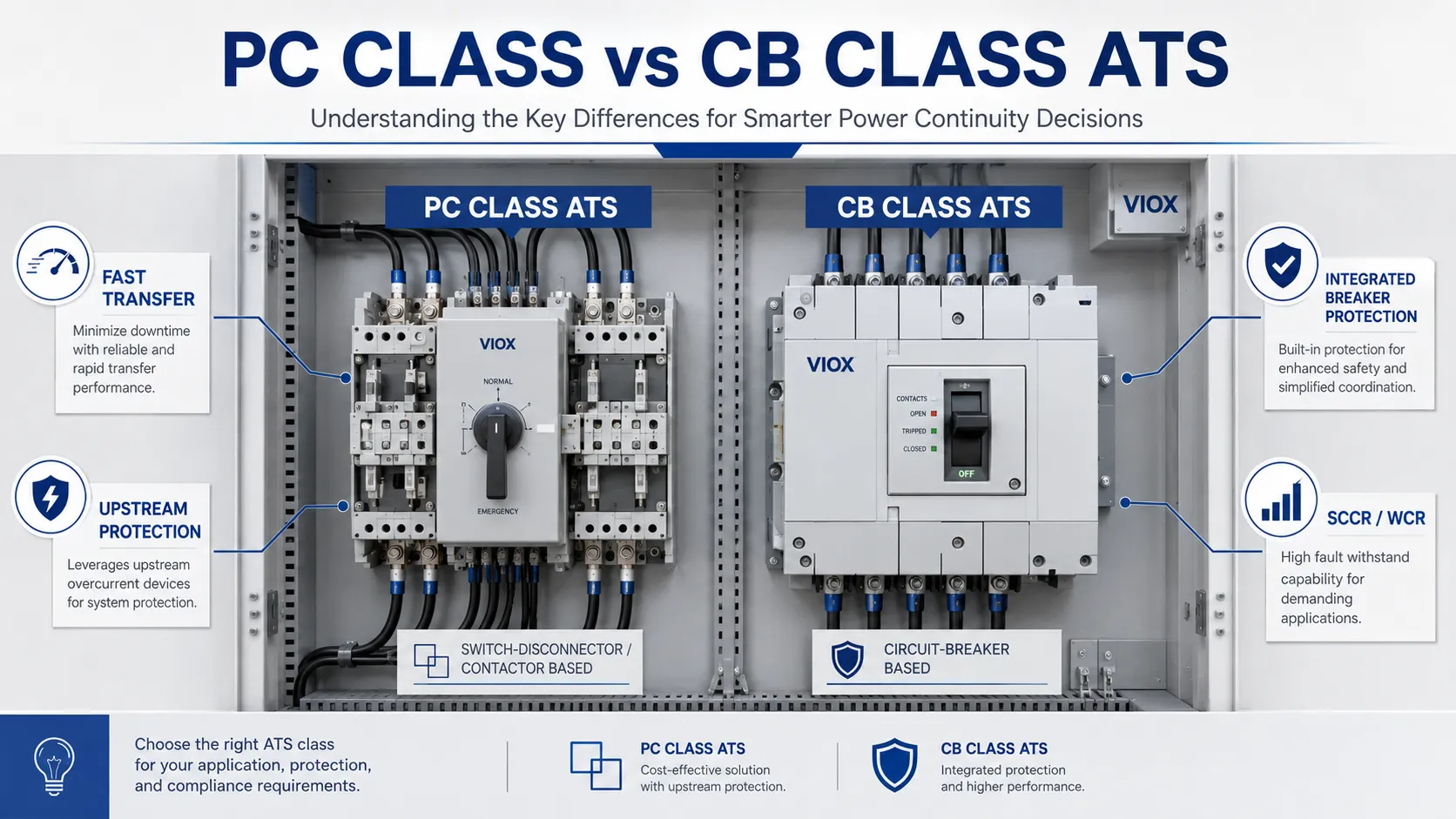
A PC class ATS is a transfer switching device that can make and withstand short-circuit current, but it normally relies on an upstream protective device to interrupt the fault. A CB class ATS uses circuit-breaker-based switching units and can provide integrated overcurrent and short-circuit interruption, depending on the rated design.
Choose a PC class ATS when fast transfer, compact size, and upstream short-circuit protection coordination are already provided. Choose a CB class ATS when the transfer switch must include breaker-based protection, fault interruption, or main-feeder protection at the transfer point.
For product evaluation, see VIOX automatic transfer switch solutions.
PC vs CB Class ATS Comparison Table
| Item | PC Class ATS | CB Class ATS |
|---|---|---|
| Main switching device | Switch, contactor, or motorized changeover mechanism | Circuit breaker based mechanism, usually MCCB or ACB style |
| Short-circuit behavior | Makes and withstands short-circuit current | Makes, withstands, and breaks short-circuit current |
| Fault interruption | Requires upstream fuse or circuit breaker | Integrated breaker can interrupt faults within its rating |
| Overcurrent protection | Not built into the transfer switch | Built into the breaker mechanism or trip unit |
| Transfer speed | Usually faster | Usually slower than PC class, product-dependent |
| Size and cost | Usually more compact and economical | Usually larger and higher cost |
| Main application | Sub-distribution, generator transfer, load transfer with upstream protection | Main incoming feeders, high fault-current points, integrated protection |
| Key rating to verify | SCCR/WCR with upstream protection coordination | Breaking capacity, trip unit, SCCR/WCR, selective coordination |
| Main selection risk | Upstream device not coordinated with ATS rating | Breaker trip settings or selectivity not matched to the system |
The short version: PC class is mainly a transfer device; CB class is a transfer device with breaker-based protection.
Start Here Based on Your Search Intent
Different search queries around this topic usually mean different questions.
| If You Search… | You Probably Need |
|---|---|
| ATS comparison | A side-by-side comparison of ATS types and selection rules |
| ATS types | PC, CB, CC, manual transfer, automatic transfer, and static transfer switch distinctions |
| ATS CB / CB ATS | Whether breaker-based ATS protection is needed |
| Fast transfer switch | Transfer speed differences between PC ATS, CB ATS, and STS |
| Changeover switch | Difference between manual/motorized changeover switches and ATS |
| PC class ATS supplier | A supplier capable of explaining upstream protection and SCCR/WCR |
| Molded case dual motor ATS | Usually a CB-style or breaker-based transfer mechanism; verify actual construction |
| ATS SCCR | Short-circuit current rating and upstream protective device coordination |
This page focuses on the most important engineering distinction: whether the ATS only transfers and withstands fault current, or whether it can also interrupt fault current.
What Is a PC Class ATS?
A PC class automatic transfer switch is a transfer switching device designed to make and withstand short-circuit current, but not to break short-circuit current by itself.
In practice, PC class ATS designs are often based on:
- motorized changeover switches
- contactor-based mechanisms
- dedicated transfer switch mechanisms
- mechanically and electrically interlocked switching units
The PC class concept is associated with transfer switching equipment classification under IEC-style terminology. In many markets, people also use terms such as PC type ATS, PC level ATS, or contactor type ATS, although the exact wording depends on the manufacturer and region.
On electrical schematic diagrams, the ATS symbol for a PC class device is typically drawn as two mechanically interlocked switch-disconnectors, contactors, or changeover switching elements. The symbol should show source transfer, but not imply integrated short-circuit breaking capability.
What PC Class ATS Does Well
PC class ATS is usually chosen when the system already has upstream protection and the transfer switch is mainly responsible for fast, reliable source transfer.
Common strengths include:
- fast transfer behavior compared with breaker-based mechanisms
- compact structure
- simple transfer function
- good fit for sub-distribution systems
- suitable where upstream fuse or breaker coordination is already designed
What PC Class ATS Does Not Do
A PC class ATS should not be treated as an overcurrent protective device. If a downstream short circuit occurs, the ATS may withstand the fault current only until the upstream short-circuit protective device clears the fault.
That upstream device may be:
- MCCB
- ACB
- fuse
- upstream protection built into a switchboard or feeder
The system designer must confirm that the upstream protective device clears the fault within the ATS rated withstand and closing conditions.
What Is a CB Class ATS?
A CB class ATS is a transfer switch built around circuit-breaker-based switching units. It is designed to make, withstand, and break short-circuit current within its rated capability.
In practical terms, CB class ATS may use:
- molded case circuit breakers
- air circuit breakers
- breaker mechanisms with trip units
- mechanically interlocked breaker pairs
The key difference is that the CB class device can include integrated overcurrent and short-circuit protection. This makes it useful where the transfer switch is part of the main power distribution protection scheme.
On CAD drawings, the ATS symbol for a CB class unit is usually represented by two interlocked circuit breakers or breaker-based switching devices. The drawing should make the protective breaker function clear, especially where trip units or overcurrent protection are part of the design.
What CB Class ATS Does Well
CB class ATS is usually selected when the transfer point also needs breaker-based fault protection.
Common strengths include:
- integrated overcurrent protection
- ability to interrupt fault current within its rating
- main-feeder suitability
- better fit for high fault-current or high-consequence systems
- useful where the ATS must act as a protective device, not only a transfer device
What CB Class ATS Does Not Always Do Better
CB class is not automatically better for every installation. It may be:
- larger
- more expensive
- slower than PC class transfer mechanisms
- more complex to coordinate
- unnecessary where upstream protection is already properly designed
For fast source transfer without integrated fault interruption, PC class may be the more practical choice.
Key Difference: Withstand vs Break Short-Circuit Current
The most important technical difference is short-circuit responsibility.
| Fault Question | PC Class ATS | CB Class ATS |
|---|---|---|
| Can it transfer normal load current? | Yes | Yes |
| Can it close onto a fault? | Within rated making/withstand conditions | Within breaker and ATS ratings |
| Can it withstand short-circuit current? | Yes, for the rated condition | Yes, for the rated condition |
| Can it interrupt short-circuit current? | No, normally depends on upstream SCPD | Yes, within integrated breaker rating |
| Does it provide overload protection? | No | Yes, if the breaker/trip unit is configured for it |
| Is upstream protection still important? | Yes, essential | Yes, still important for coordination and available fault current |
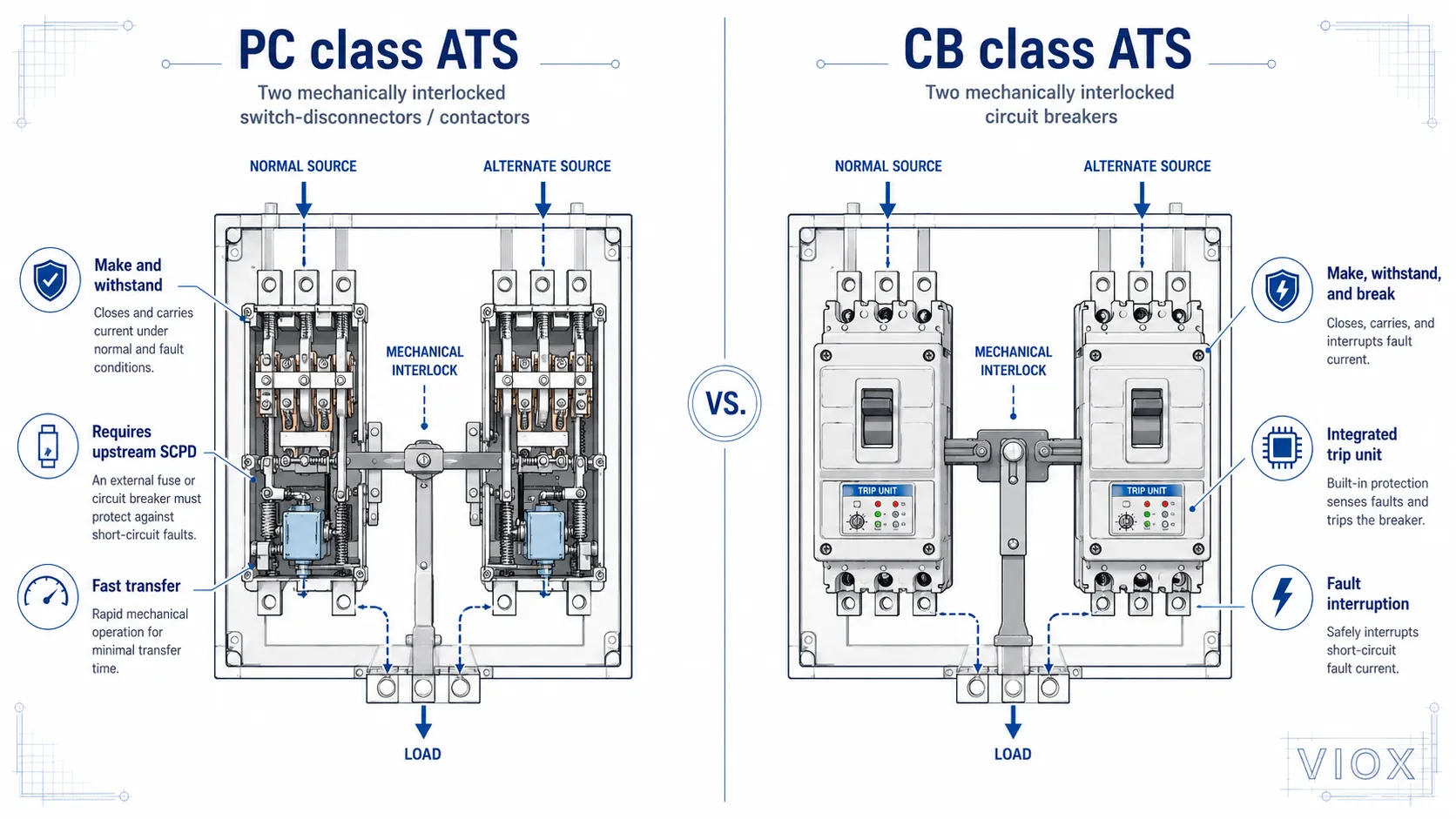
This is the section many buyers miss. A PC class ATS may look robust and may carry a high withstand rating, but that does not mean it can clear a fault by itself.
SCCR, WCR, and Upstream Protection
For ATS selection, short-circuit rating is not only about the current rating printed on the switch frame. You must check how the transfer equipment is rated under short-circuit conditions.
Two terms commonly appear:
- SCCR: short-circuit current rating, often used for equipment-level short-circuit suitability.
- WCR: withstand and closing rating, commonly used in transfer switch contexts to describe the ability to withstand and close on short-circuit current under specified conditions.
PC class ATS usually depends on a coordinated upstream short-circuit protective device. The marked SCCR or WCR may depend on:
- a specific upstream fuse type
- a specific circuit breaker category
- a specific manufacturer and breaker model
- a time-based withstand condition
- a short-time withstand condition
- field marking or installation documentation
CB class ATS may include breaker-based fault interruption, but this does not remove the need for checking:
- available fault current at the ATS terminals
- breaker breaking capacity
- trip unit settings
- selective coordination
- upstream and downstream protection sequence
- manufacturer marking and installation instructions
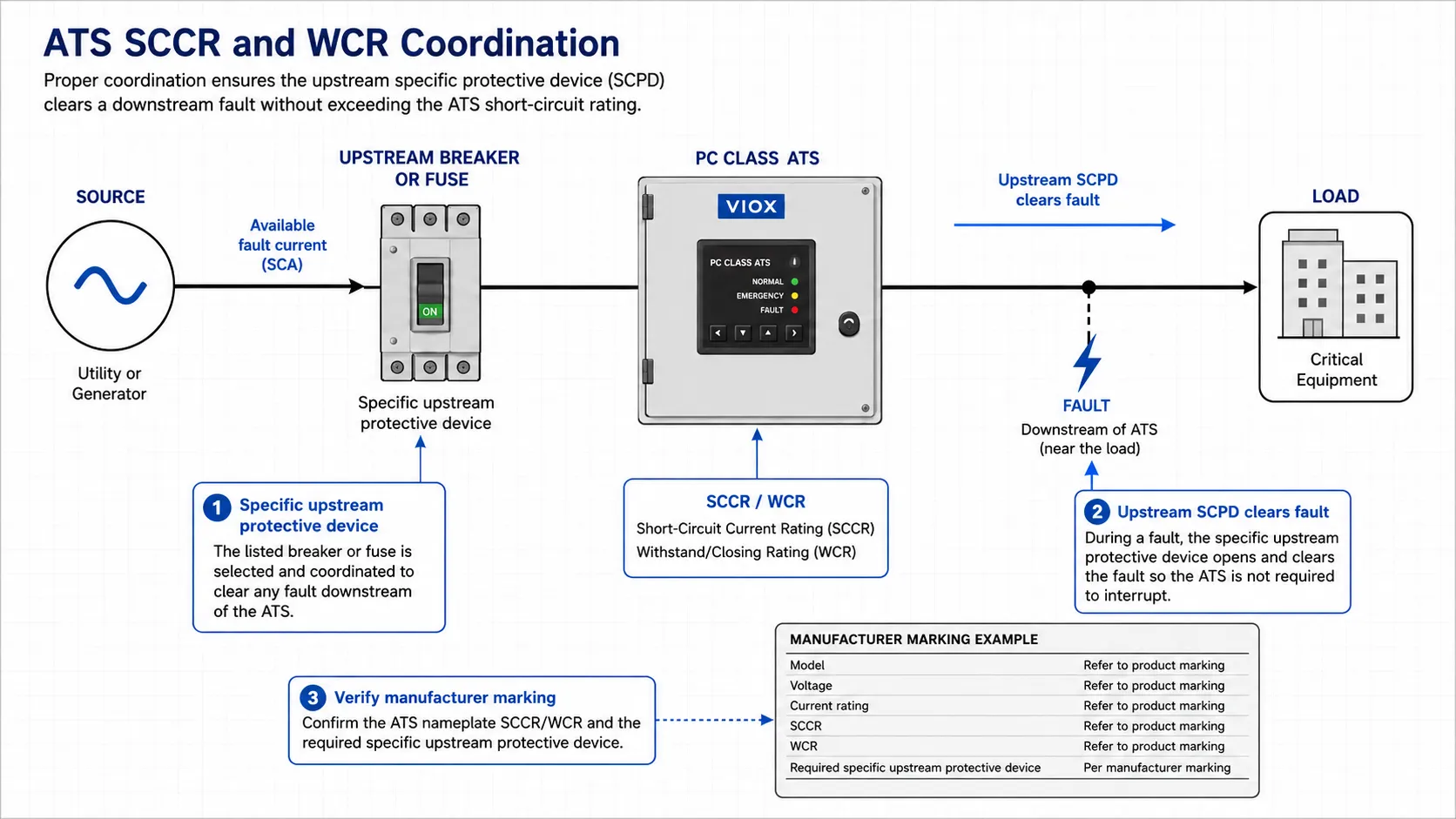
If the available short-circuit current exceeds the marked ATS rating, the installation is not acceptable. A higher ampere rating does not automatically mean a higher SCCR or WCR.
Transfer Speed: PC Class, CB Class, and Fast Transfer Switches
Many users search this topic because they care about transfer speed.
In general:
- PC class ATS is often faster because it uses a dedicated switch or contactor mechanism.
- CB class ATS is often slower because circuit breakers include trip mechanisms and arc-interruption structures.
- Static transfer switches are usually much faster than mechanical ATS designs, but they are a different device category.
Avoid choosing by speed alone. A fast transfer switch is useful only if the protection scheme is also correct.
| Device Type | Typical Role | Transfer Behavior |
|---|---|---|
| PC class ATS | Fast source transfer with upstream protection | Usually fast mechanical transfer |
| CB class ATS | Transfer plus breaker-based protection | Usually slower than PC class |
| Static transfer switch | Critical load transfer using power electronics | Very fast transfer, product and system dependent |
| Manual changeover switch | Manual source switching | Human-operated, not automatic |
For a deeper speed guide, see ATS Switching Time Explained.
ATS Types: PC, CB, CC, STS, and Changeover Switch
Searches for ATS types often mix several concepts. Here is the clean separation.
| Type | What It Means | Main Use |
|---|---|---|
| PC class ATS | Transfer switch that makes and withstands short-circuit current, but does not break it | Fast transfer with upstream protection |
| CB class ATS | Circuit-breaker-based transfer switch with fault interruption capability | Main feeders and integrated protection |
| CC class transfer equipment | Contactor-based concept in IEC-style classification | Specific contactor-based transfer applications |
| Static transfer switch | Solid-state transfer using SCR/thyristor or power electronics | Critical loads requiring very fast transfer |
| Manual changeover switch | Manual source selection switch | Simple generator/utility switching where automatic operation is not required |
| Motorized changeover switch | Electrically operated source selection switch | Basic automatic or remote source transfer systems |
For ATS vs STS, see Automatic Transfer Switch vs Static Transfer Switch. For manual switching, see Manual vs Automatic Transfer Switch.
ATS Symbol in Electrical Drawings
For engineers searching ATS symbol, the important point is that the symbol should match the actual switching and protection function.
| ATS Type | Typical Schematic Representation | What the Symbol Should Communicate |
|---|---|---|
| PC class ATS | Two mechanically interlocked switch-disconnectors, contactors, or changeover switch elements | Source transfer with upstream fault protection required |
| CB class ATS | Two mechanically interlocked circuit breakers | Source transfer plus breaker-based overcurrent and short-circuit protection |
| Manual changeover switch | Manual double-throw or changeover switch symbol | Manual source selection, not automatic transfer logic |
| Static transfer switch | Solid-state switching blocks, often with thyristor/SCR symbols | Fast electronic transfer, not mechanical switching |
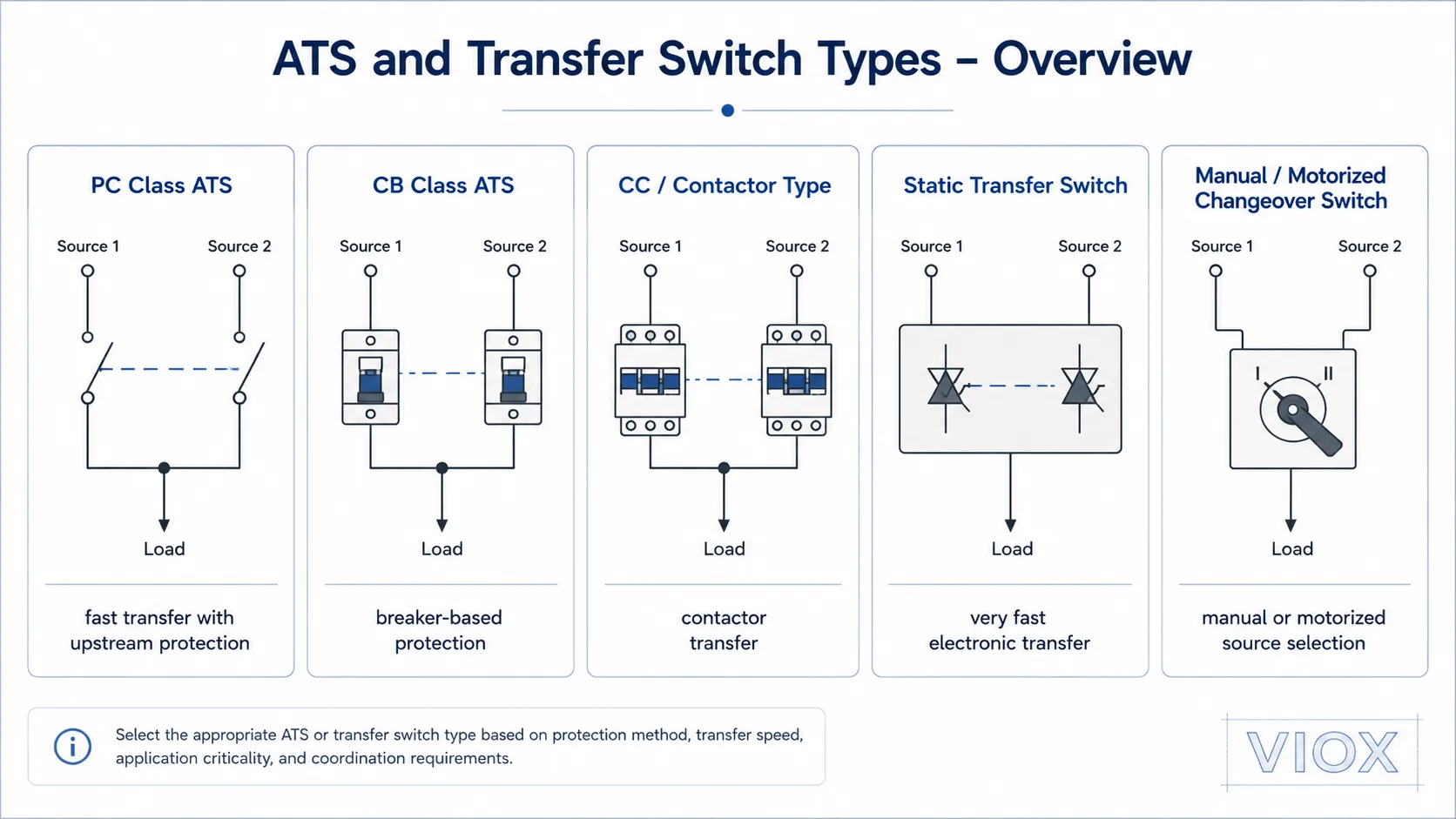
Do not copy a generic ATS symbol into a panel drawing without checking whether the actual device is PC class, CB class, contactor-based, breaker-based, manual, motorized, or static. The wrong symbol can cause the protection function to be misunderstood during design review.
When to Choose PC Class ATS
Choose PC class ATS when the system is already designed with upstream short-circuit protection and the ATS mainly needs to transfer loads between two sources.
PC class is often suitable for:
- generator transfer in sub-distribution boards
- commercial building distribution
- non-main incoming ATS positions
- IT and communication distribution where fast restoration matters
- loads already protected by upstream MCCBs or fuses
- cost-sensitive systems with proper coordination
- applications where compact size is important
Before approving PC class ATS, confirm:
- upstream protective device type
- available fault current
- ATS SCCR/WCR
- coordination between upstream protection and ATS withstand rating
- transfer sequence and load type
- neutral switching requirement
- manual bypass or maintenance needs, if required
When to Choose CB Class ATS
Choose CB class ATS when the transfer equipment also needs breaker-based protection or when the ATS is placed at a critical protection point.
CB class is often suitable for:
- main incoming transfer points
- generator main output transfer
- high fault-current installations
- critical facilities requiring integrated protection
- projects where the ATS must interrupt downstream faults
- distribution systems where breaker trip settings are part of the design
- installations requiring more complete protection at the transfer point
Before approving CB class ATS, confirm:
- breaker breaking capacity
- trip unit type and settings
- selective coordination requirements
- available fault current
- SCCR/WCR marking
- upstream and downstream protective device sequence
- transfer speed tolerance of the load
PC Class vs CB Class: Selection Checklist
| Selection Question | Choose PC Class If… | Choose CB Class If… |
|---|---|---|
| Is upstream protection already provided? | Yes, and properly coordinated | Not enough, or integrated protection is needed |
| Must the ATS interrupt fault current? | No | Yes |
| Is fast transfer the priority? | Usually better fit | Acceptable if protection is more important |
| Is the ATS at the main incoming point? | Usually only if upstream protection exists | Often better fit |
| Is compact size important? | Usually better fit | May be larger |
| Is cost a major constraint? | Often more economical | Usually higher cost |
| Is selective coordination complex? | Depends on upstream protection | Requires breaker setting review |
| Is the load highly critical? | Good if system protection is already complete | Better if integrated fault clearing is required |
Common Selection Mistakes
Mistake 1: Treating PC Class ATS as a Circuit Breaker
PC class ATS can transfer load and withstand fault current within its rating, but it does not normally interrupt short-circuit current. The upstream protective device must clear the fault.
If a downstream short circuit occurs and the upstream breaker or fuse is too slow or incorrectly coordinated, the PC class contacts may overheat or weld shut. The ATS cannot interrupt that fault on its own, so WCR/SCCR coordination is not paperwork; it is part of the protection design.
Mistake 2: Choosing CB Class Only Because It Sounds Safer
CB class ATS may provide integrated protection, but it can be larger, slower, and more expensive. If upstream protection is already correctly coordinated, PC class may be more practical.
Mistake 3: Checking Ampere Rating but Ignoring SCCR or WCR
A 400A ATS is not automatically suitable for every 400A installation. The available fault current and short-circuit rating must be checked.
Mistake 4: Ignoring the Upstream Protective Device
For PC class ATS, the upstream device is part of the protection system. The ATS rating may depend on the specific breaker or fuse used.
Mistake 5: Confusing ATS With Static Transfer Switch
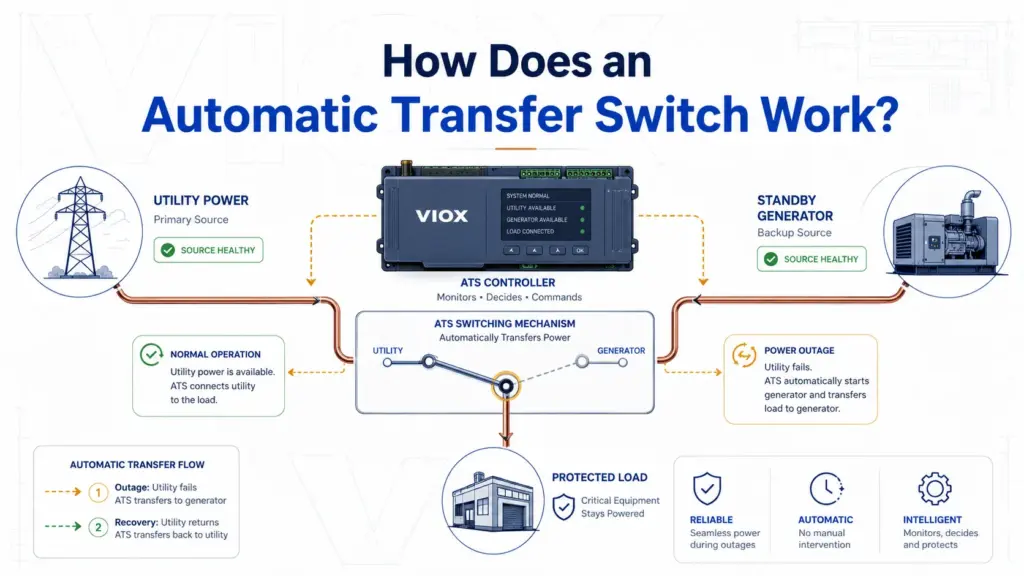
An ATS is a mechanical or electromechanical transfer device. A static transfer switch uses power electronics for much faster transfer. They serve different cost, speed, and reliability requirements.
Mistake 6: Using Changeover Switch and ATS as the Same Term
A changeover switch may be manual or motorized. An ATS includes automatic source monitoring and transfer logic. Do not assume every changeover switch is an automatic transfer switch.
FAQ
Can I upgrade a PC class ATS to a CB class ATS later?
Usually not as a simple field upgrade. PC class and CB class units normally have different internal mechanisms, busbar layouts, enclosure sizes, control wiring, interlocks, and short-circuit ratings. In most projects, changing from PC to CB class means replacing the transfer switch assembly and reviewing the upstream/downstream protection scheme.
Why does my PC class ATS chatter or fail to close during a brownout?
Common causes include unstable source voltage, an undervoltage threshold set too close to the actual supply condition, weak control power, generator voltage not yet stabilized, or contactor coil dropout during voltage dips. Check the ATS controller settings, source sensing wiring, control supply, and the manufacturer’s voltage pickup/dropout values.
Can a PC class ATS be used at the main incoming service?
Only if the system design provides suitable upstream short-circuit protection and the marked SCCR/WCR conditions are satisfied. If the ATS must provide integrated overcurrent protection or fault interruption at the transfer point, a CB class design may be more appropriate.
Why does the upstream breaker type matter for a PC class ATS?
For PC class equipment, the upstream fuse or circuit breaker is part of the short-circuit protection system. The ATS withstand rating may depend on a specific protective device category, trip speed, or manufacturer-tested coordination. Using a different upstream device can invalidate the intended SCCR/WCR coordination.
What should I check if the ATS drawing symbol does not match the installed device?
Confirm whether the actual product is PC class, CB class, contactor-based, breaker-based, manual, motorized, or static. The schematic should show the real switching and protection function. A PC class symbol should not imply breaker-based fault interruption, and a CB class symbol should show the circuit-breaker function clearly.
Does a CB class ATS still need upstream protection coordination?
Yes. CB class ATS may provide integrated fault interruption, but the system still needs proper upstream and downstream coordination, available fault current checking, and SCCR/WCR verification.
What rating matters most for ATS short-circuit safety during design review?
Check the available fault current against the ATS short-circuit rating, such as SCCR or WCR, and confirm any required upstream protective device category. Ampere rating alone is not enough.
Should a generator ATS be PC class or CB class?
Use PC class when the generator transfer point already has properly coordinated upstream protection and fast transfer is important. Use CB class when the transfer point also needs integrated breaker protection or fault interruption.
Final Advice
Do not select an ATS only by ampere rating or transfer speed. The key question is whether the transfer switch must only transfer and withstand fault current, or whether it must also interrupt fault current.
PC class ATS is usually the better fit for fast transfer, compact systems, and sub-distribution applications with proper upstream protection. CB class ATS is usually the better fit for main feeders, integrated overcurrent protection, and installations where fault interruption at the transfer point is required.
For a reliable specification, verify four items before purchase: ATS class, SCCR/WCR, upstream protective device coordination, and load transfer requirements. That is the difference between a switch that merely fits the panel and a transfer system that fits the electrical design.