

On this page
Direct Answer: Overload, Overcurrent, and Short Circuit
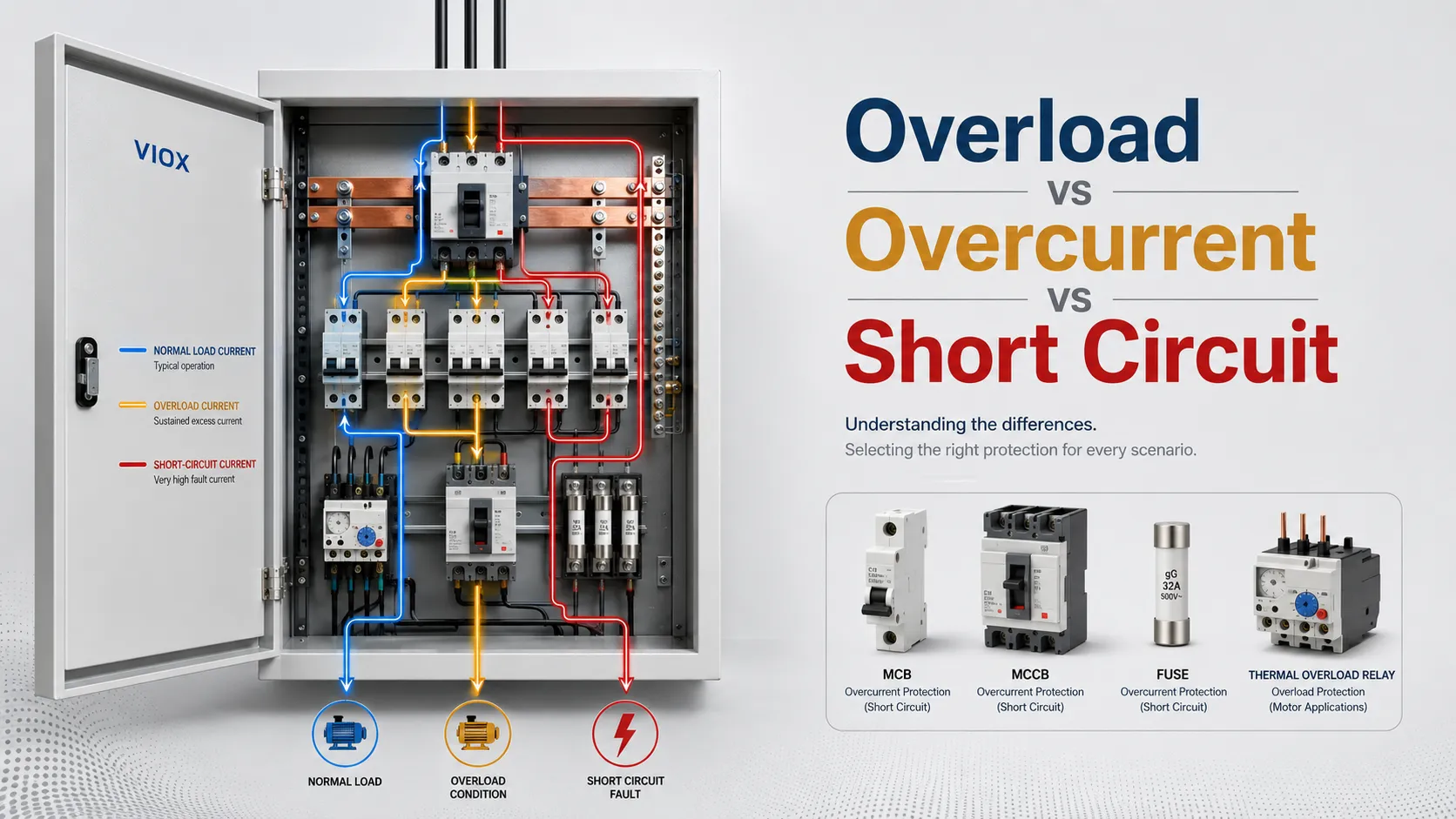
Overcurrent means any current that exceeds the allowed current for a circuit, conductor, or device. Overload and short circuit are two different overcurrent conditions. An overload usually stays in the normal conductive path and develops as a heating problem, while a short circuit creates a low-impedance fault path and can produce very high current almost instantly.
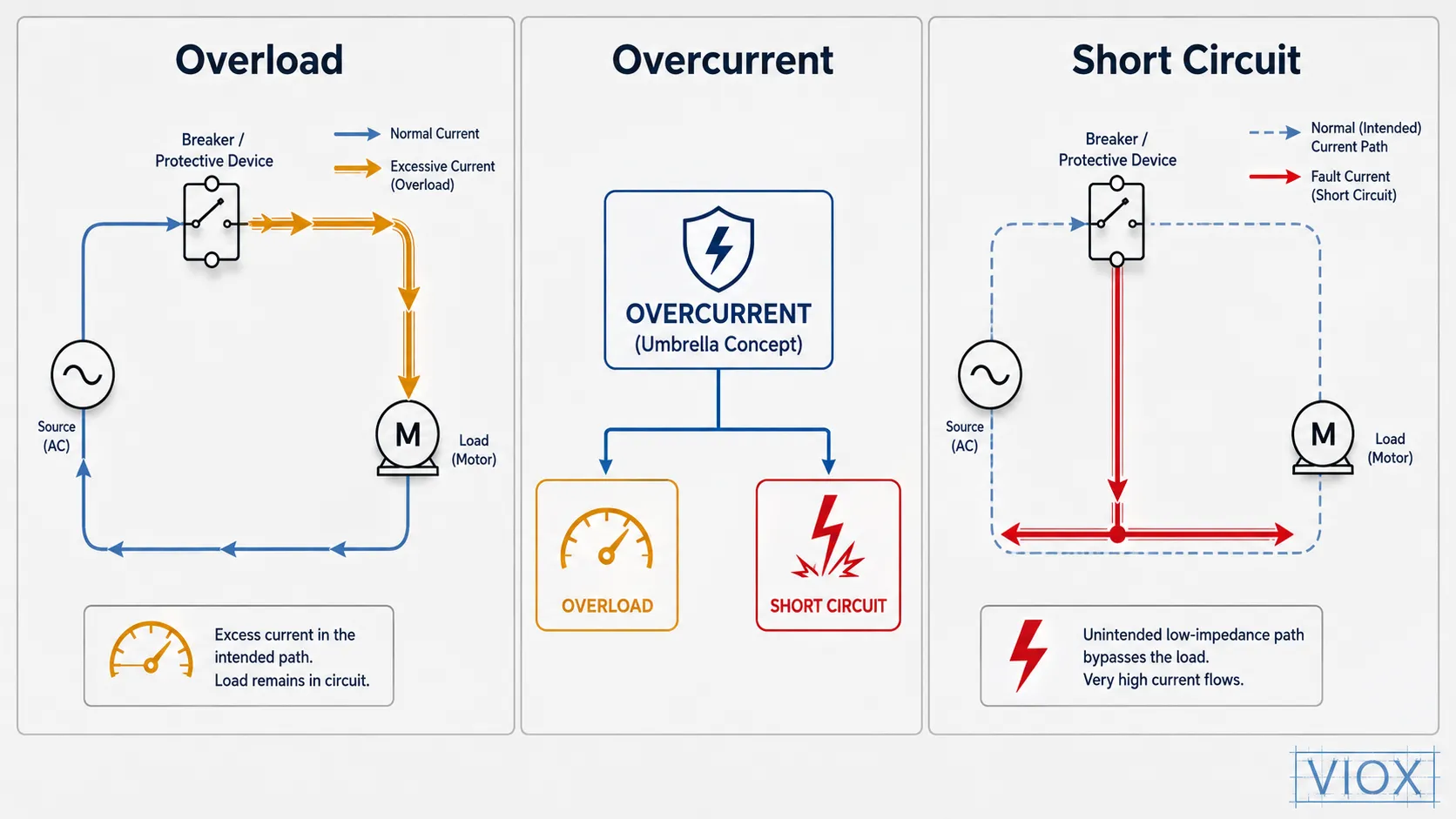
This distinction matters because different faults need different protection behavior. A thermal overload relay may protect a motor from sustained overload, but it cannot replace a fuse or circuit breaker for short-circuit interruption. A circuit breaker may protect against both overload and short circuit, but only if its rated current, trip curve, and breaking capacity match the installation.
Key Takeaways
- Overcurrent is the broad category. Overload and short circuit are common causes or types of overcurrent.
- Overload current usually flows in the normal current path. The main danger is heat buildup over time.
- Short-circuit current flows through an unintended low-impedance path. The main danger is arc energy, fire, and equipment destruction.
- Protection speed is different. Overload protection is usually time-delayed; short-circuit protection must operate very quickly.
- Rated current is not enough. The protective device must also have enough breaking capacity for the available short-circuit current.
Overload vs Overcurrent vs Short Circuit Comparison Table
| Fault Type | What It Means | Current Path | Typical Behavior | Main Risk | Typical Protection |
|---|---|---|---|---|---|
| Overload | Load current exceeds the safe continuous capacity of the circuit or equipment | Normal conductive path | Usually slower, thermal, time-delayed | Heating, insulation aging, motor damage, fire risk | Thermal overload relay, electronic overload relay, breaker thermal trip, motor protection relay |
| Overcurrent | Any current above the permitted value | Depends on cause | Can be slow or very fast | Overheating, nuisance trips, equipment stress, fault damage | Fuse, MCB, MCCB, ACB, MPCB, relay, motor protection device |
| Short circuit | A low-impedance fault between conductors or from conductor to earth/ground | Abnormal fault path | Very fast, high fault current | Arc flash, fire, explosive damage, conductor/equipment destruction | Fuse, MCB, MCCB, ACB, protective relay plus breaker with sufficient breaking capacity |
What Is Overcurrent?
Overcurrent is a condition where current exceeds the rated or permitted current of a circuit, conductor, or electrical device. It is not one single fault type. It is the umbrella term that includes overloads, short circuits, and some ground-fault events when the fault current is high enough to operate an overcurrent protective device.
In practical electrical design, the word overcurrent answers one question:
Is the current higher than the circuit or equipment is allowed to carry?
The cause still needs diagnosis. A circuit can experience overcurrent because a motor is overloaded, too many loads are connected, a conductor is shorted to another conductor, insulation has failed, or the wrong protective device was selected.
That is why saying “the breaker tripped from overcurrent” is only the starting point. The next question is whether the event was an overload, a short circuit, an inrush problem, a ground fault, a wiring error, or a protection coordination issue.
For breaker sizing and protection context, VIOX’s MCB product page and MCCB product page are useful next-step references when the circuit type is already known.
What Is an Overload?
An overload happens when the circuit or equipment carries more current than it should for too long, but the current still flows through the normal conductive path.
A simple example is too many loads operating on the same branch circuit. The current is not taking a shortcut around the load. It is still flowing through the intended conductors, terminals, breaker, and load. The problem is that the amount of current is too high for the wiring, breaker, motor winding, or equipment rating over time.
In motor systems, overload can also happen when:
- a pump is mechanically jammed
- a conveyor is overloaded
- a fan bearing is failing
- a motor is undersized for the load
- one phase is lost or unbalanced
- the overload relay is set incorrectly
The key engineering point is that overload is mainly a thermal problem. Current may be only moderately above normal, but if it continues long enough, heat builds up and damages insulation, terminals, windings, or cables.
For a dedicated explanation of overload symptoms and fire risk, see VIOX’s guide: What Is a Circuit Overload?
What Is a Short Circuit?
A short circuit occurs when current finds an unintended low-impedance path between conductors, or between a live conductor and earth/ground or exposed conductive parts.
Unlike overload current, short-circuit current does not simply mean “too many loads.” It often means the normal circuit path has been bypassed by a fault.
Common short-circuit causes include:
- damaged insulation
- live conductor touching neutral
- phase-to-phase contact
- incorrect wiring
- loose strands bridging terminals
- water ingress in equipment
- crushed cable
- failed component inside a panel
Because the impedance of the fault path can be very low, the current may rise extremely quickly. This is why short-circuit protection focuses on rapid interruption, arc control, and adequate breaking capacity.
For short-circuit current estimation in low-voltage circuits, see How to Calculate Short Circuit Current for MCB.
Why Overload Is Not the Same as Short Circuit
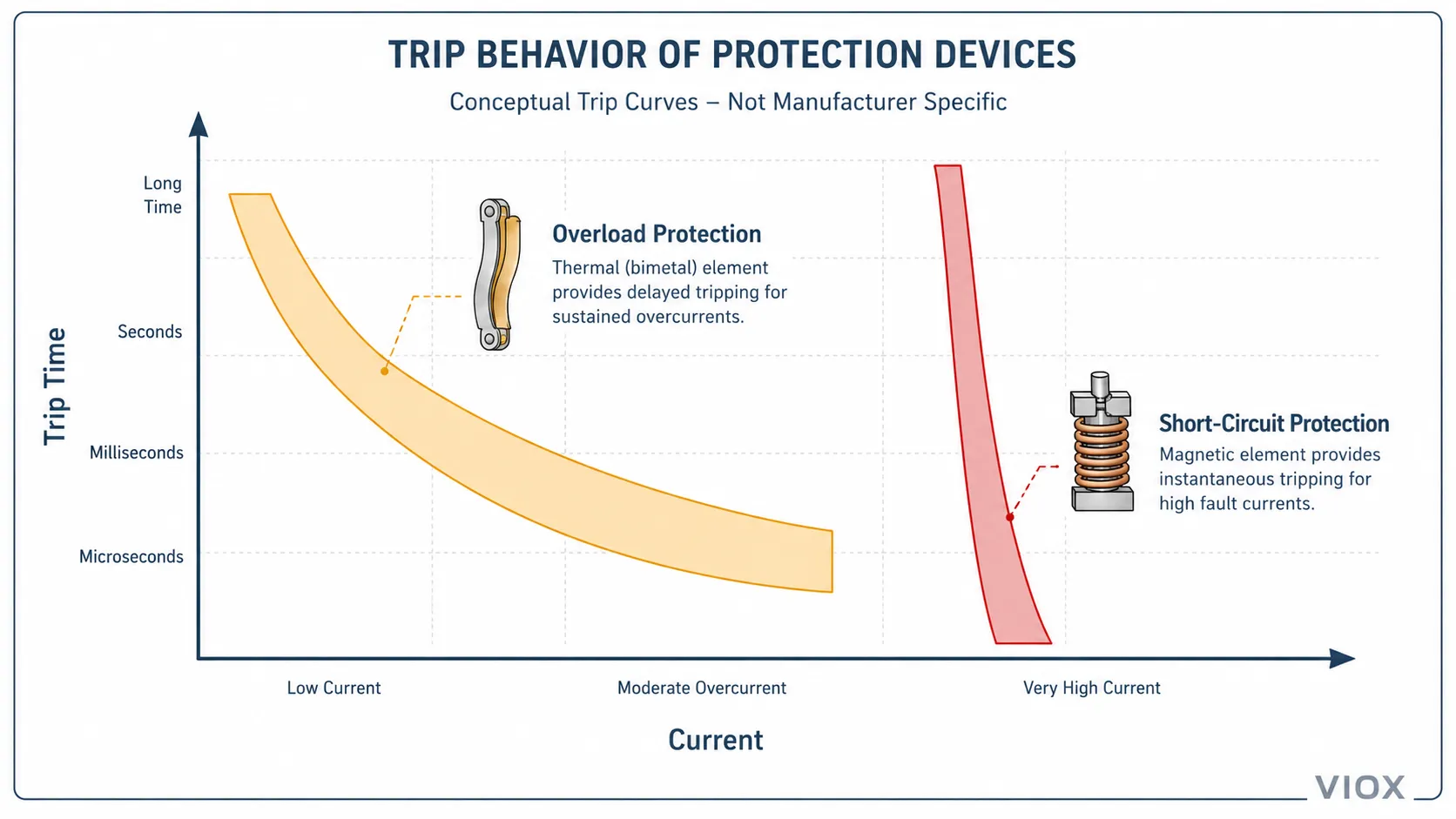
Overload and short circuit can both produce overcurrent, but they do not behave the same way.
| Question | Overload | Short Circuit |
|---|---|---|
| Does current stay in the normal path? | Usually yes | No, it uses an unintended low-impedance path |
| Is the current usually very high instantly? | Not usually | Often yes |
| Is the main danger thermal heating over time? | Yes | Not only; arc and explosive fault energy are major risks |
| Can a thermal overload relay handle it alone? | Yes, for motor overload protection when correctly applied | No |
| Does the device need interrupting/breaking capacity? | Protective devices still need correct ratings | Absolutely critical |
| Typical trip behavior | Time delay | Instantaneous or very fast short-time clearing |
This difference is why exam-style questions often describe overload current as excessive current that remains in the normal conductive path. That wording points to overload, not short circuit.
Protection Devices: Which Device Handles Which Fault?
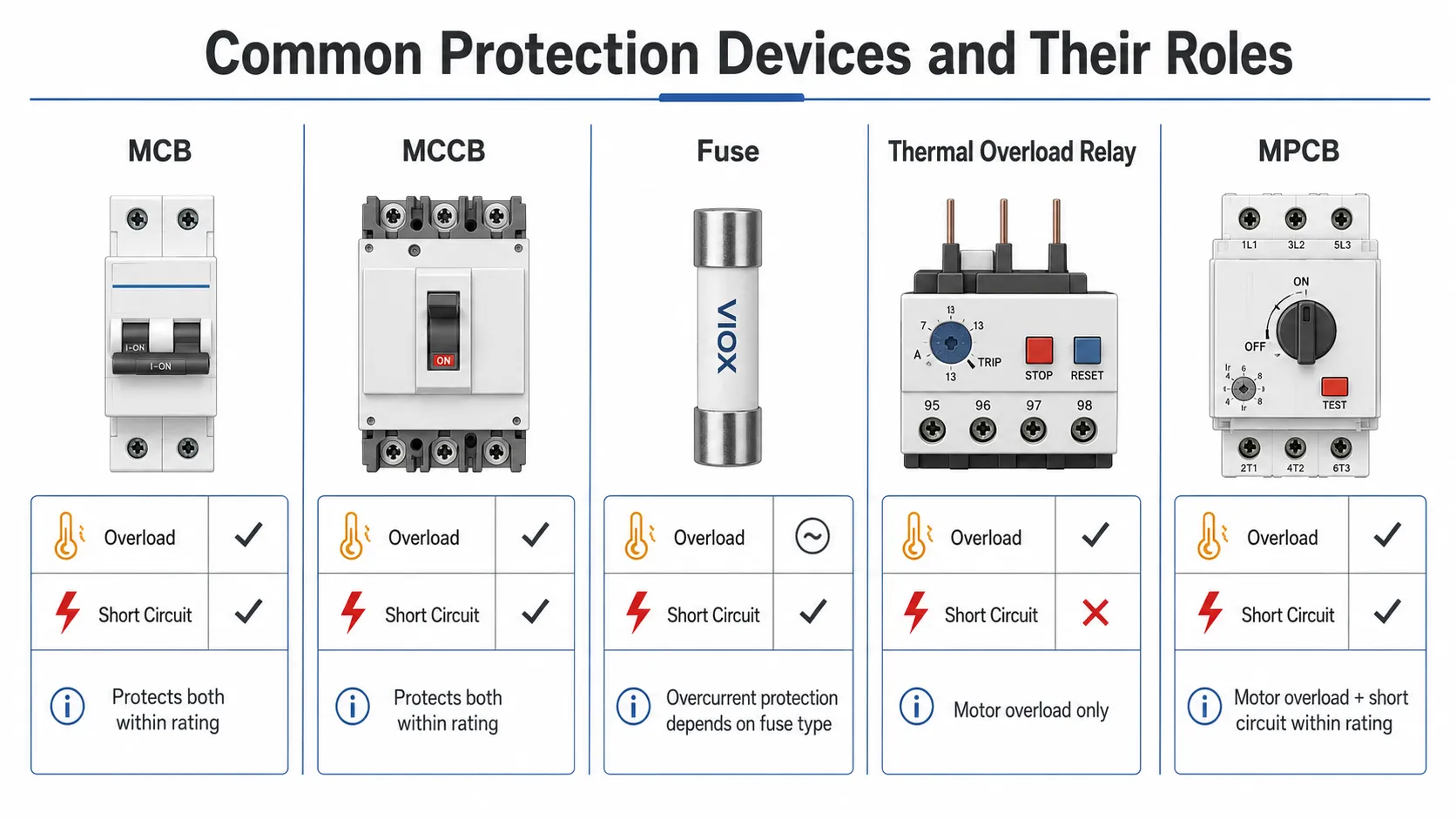
No single protective device should be treated as a magic answer for every fault. The device must match the fault type, voltage, current, breaking capacity, load behavior, and system design.
| Device | Protects Against Overload? | Protects Against Short Circuit? | Where It Fits |
|---|---|---|---|
| MCB | Yes, depending on design | Yes, within rated breaking capacity | Final circuits, distribution boards, small loads |
| MCCB | Yes, depending on trip unit | Yes, within rated breaking capacity | Feeders, industrial panels, higher-current circuits |
| Fuse | Yes or no depending on fuse type and application | Yes, within rated breaking capacity | Equipment protection, current limitation, backup protection |
| Thermal overload relay | Yes, for motor overload | No | Motor circuits with contactor and short-circuit protection |
| Electronic overload relay | Yes, for motor overload and selected protection functions | No, not by itself | Motor control panels and process equipment |
| MPCB | Yes | Yes, within device rating | Compact motor branch protection, depending on coordination |
| Motor protection relay | Yes, plus advanced motor conditions | Requires separate short-circuit interrupter | Larger motors, MCCs, industrial control systems |
| RCCB / RCD | No overcurrent protection by itself | No short-circuit protection by itself | Residual-current or leakage protection |
| RCBO | Yes | Yes, within rating | Combined residual-current and overcurrent protection |
For motor circuits, this division of responsibility is critical. A contactor switches the motor, an overload relay protects against sustained overload, and a fuse, MCB, MCCB, or MPCB handles short-circuit protection. VIOX explains this coordination in more detail here: How to Select Contactors, Overload Relays, and Circuit Breakers for Motor Power.
For overload relay and MPCB selection boundaries, see Thermal Overload Relay vs MPCB.
Breaking Capacity: The Detail Many Buyers Miss
Choosing the correct ampere rating does not prove a protective device can safely interrupt a short circuit.
A 32A breaker may carry a 32A rated load correctly, but if the prospective short-circuit current at the installation point is higher than the breaker’s rated breaking capacity, the breaker may fail dangerously during a fault.
Always check:
- rated current
- rated voltage
- AC or DC application
- breaking capacity or interrupting rating
- prospective short-circuit current at the installation point
- trip curve or protection settings
- upstream and downstream coordination
- cable size and installation method
For MCB applications, the practical difference between common breaking capacity ratings is explained here: MCB Breaking Capacity: 6kA vs 10kA.
For MCCB and industrial breaker terms, see Icu vs Ics vs Icw vs Icm Circuit Breaker Ratings.
Standards and Fault Current Terms to Know
Protection terminology depends on the product family and market. For low-voltage circuit breakers, common standard contexts include:
| Standard Context | Typical Device Scope | Why It Matters |
|---|---|---|
| IEC 60898-1 | Circuit breakers for household and similar overcurrent protection | Common reference for MCB-type final circuit protection |
| IEC 60947-2 | Industrial low-voltage circuit breakers | Common reference for MCCB, ACB, and industrial breaker performance terms |
| UL 489 | Molded-case circuit breakers and similar breakers for North American applications | Important for projects requiring UL-listed branch or feeder circuit breakers |
Do not treat these standards as interchangeable labels. A breaker selected for an IEC final-circuit application, an industrial IEC distribution panel, and a North American UL panel may need different markings, ratings, and approval evidence.
For short-circuit studies, engineers may also distinguish between symmetrical and asymmetrical fault current:
- Symmetrical fault current is the AC fault current component after the DC offset is ignored or has decayed.
- Asymmetrical fault current includes the DC offset that can appear immediately after a fault begins, creating a higher first-cycle peak stress.
For most buyer-level device selection, the practical takeaway is simple: the protective device must be suitable for the fault-current level and the standard context specified by the project. For engineering design, the short-circuit study and the manufacturer’s data should be checked rather than relying only on the front-label ampere rating.
How to Diagnose a Trip in the Field
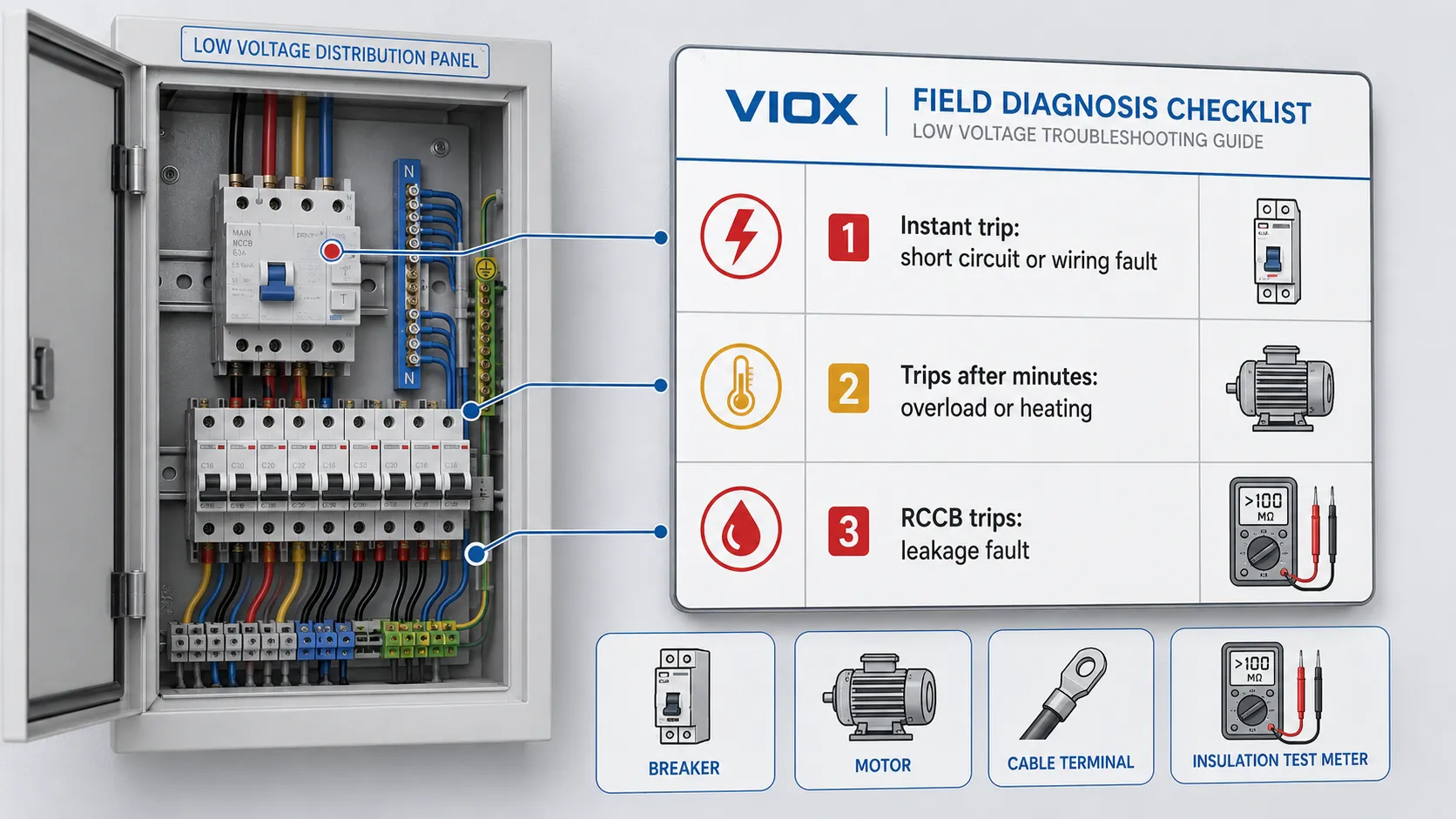
The trip timing often tells you which direction to investigate first.
| Symptom | More Likely Cause | What to Check First |
|---|---|---|
| Breaker trips immediately when switched on | Short circuit, ground fault, wiring error, failed device | Disconnect load, insulation test, inspect wiring and terminals |
| Breaker trips after minutes under load | Overload, undersized circuit, poor ventilation, heating connection | Measure running current, compare load to rating, inspect terminals |
| Motor starts, then overload relay trips | Mechanical overload, phase loss, wrong overload setting, motor issue | Motor current, phase balance, load condition, relay setting |
| Breaker trips during motor starting | Inrush too high, wrong curve/setting, short circuit, locked rotor | Starting current, trip curve, motor condition, cable and starter |
| Fuse blows instantly | Short circuit or severe fault current | Fault isolation, fuse class, voltage rating, fault location |
| Cable or terminal is hot but breaker does not trip | Loose connection, overloaded conductor, wrong protection, local resistance | Torque/connection inspection, load measurement, thermal scan |
| RCCB trips but MCB does not | Residual current or leakage fault | Insulation leakage, moisture, connected equipment, neutral-earth fault |
Do not keep resetting a breaker or replacing a fuse without finding the cause. A protective device that operates repeatedly is usually reporting a real electrical problem.
Common Mistakes When Comparing Overload and Short Circuit
Mistake 1: Treating overcurrent as only a short circuit
Short circuit is only one type of overcurrent. Overload can also create overcurrent, but it usually needs a different trip behavior.
Mistake 2: Using a thermal overload relay as short-circuit protection
A thermal overload relay is designed for sustained motor overload, not high-energy fault interruption. It must be used with suitable short-circuit protection.
Mistake 3: Oversizing the breaker to stop nuisance trips
If a breaker trips during startup or heavy load, the answer is not automatically a larger breaker. The real issue may be overload, inrush, wrong trip curve, poor coordination, or undersized wiring.
Mistake 4: Ignoring cable protection
The breaker protects the conductor as well as the load. If the breaker is oversized relative to the cable, the cable may overheat before protection operates.
Mistake 5: Checking rated current but not breaking capacity
Rated current tells you normal carrying capacity. Breaking capacity tells you whether the device can safely interrupt a short circuit at the installation point.
Mistake 6: Assuming every trip means the breaker is bad
Breakers and fuses are protective devices. Many trips happen because the device is correctly responding to overload, short circuit, leakage, heat, or incorrect application.
Selection Checklist for Overcurrent Protection
Before selecting or replacing a protective device, confirm these items:
| Selection Item | Why It Matters |
|---|---|
| Load current | Determines basic ampere rating |
| Conductor size and installation method | Protection must match cable ampacity |
| Voltage and AC/DC type | Arc interruption behavior differs by system |
| Prospective short-circuit current | Determines required breaking capacity |
| Load type | Motors, heaters, transformers, electronics, and capacitors behave differently |
| Inrush current | Affects breaker curve or trip setting selection |
| Overload protection method | Motor overload and cable overload may need different devices |
| Coordination with upstream/downstream devices | Prevents unnecessary upstream shutdowns |
| Environment | Temperature, enclosure, altitude, dust, and vibration affect selection |
| Standard or project specification | Defines required device category, rating, and documentation |
If the circuit involves motors, start with full-load current, starting method, overload protection, and short-circuit protection together rather than selecting each part separately.
Common Training Question Answers
Many searches around this topic come from electrical training questions. These short answers help separate the terms correctly.
| Training Statement or Question | Correct Interpretation |
|---|---|
| “An overcurrent condition can be defined as…” | Current above the permitted value for the circuit or equipment |
| “Which overcurrent condition is confined to the normal conductive path?” | Overload |
| “Which overcurrent condition leaves the normal current path?” | Short circuit |
| “Is an overload the same as a short circuit?” | No. Both can be overcurrent conditions, but the current path and protection behavior are different |
| “Does a short circuit normally have lower current than an overload?” | No. A short circuit usually produces much higher fault current, depending on system impedance |
| “What does selective coordination mean?” | Protective devices are arranged so the device closest to the fault clears first, limiting the outage area |
| “What is overcurrent protection?” | Protection that opens the circuit when current exceeds a safe or permitted value |
If a training question says the current is excessive but still flows through the normal conductors and loads, it is describing an overload. If it says current takes an unintended shortcut around the load, it is describing a short circuit.
Practical Examples
Example 1: Too Many Appliances on One Circuit
Several high-power appliances operate on the same circuit. Current stays in the normal path, but it exceeds the circuit rating long enough for the breaker to trip.
This is an overload condition. The solution is to reduce load, redistribute circuits, or install a properly designed dedicated circuit.
Example 2: Live and Neutral Touch Inside Equipment
A damaged conductor touches another conductor inside a device. Current takes an unintended low-impedance path and rises very quickly.
This is a short circuit. The protective device must interrupt the fault within its breaking capacity.
Example 3: Motor Trips After Running for Ten Minutes
A motor starts normally but trips the overload relay after running under load. The breaker does not trip.
This points more toward motor overload than short circuit. Check mechanical load, phase balance, cooling, overload relay setting, and motor current.
Example 4: Breaker Trips the Moment a Panel Is Energized
A breaker trips instantly when the panel is powered. The connected load never reaches normal operation.
This suggests a short circuit, wiring error, ground fault, or failed component. Do not upsize the breaker. Isolate the circuit and test the wiring.
FAQ
What is the difference between overcurrent, overload, and short circuit?
Overcurrent is the broad condition: current above the permitted value. Overload is an overcurrent condition that usually stays in the normal current path and causes heating over time. Short circuit is an overcurrent condition caused by an unintended low-impedance fault path.
Which overcurrent condition stays in the normal current path?
Overload current usually stays in the normal current path. This is why overload is mainly associated with heating over time.
Which fault leaves the normal current path?
A short circuit leaves or bypasses the intended load path by creating an unintended low-impedance path between conductors or to earth/ground.
What causes overcurrent?
Common causes include too much connected load, motor overload, short circuit, ground fault, insulation failure, incorrect wiring, wrong breaker size, poor coordination, or equipment failure.
Can a thermal overload relay protect against short circuits?
No. A thermal overload relay protects against sustained motor overload. Short-circuit protection must come from a properly rated fuse, MCB, MCCB, MPCB, or other short-circuit protective device.
How should I match an MPCB and contactor in a motor control panel?
Start with the motor full-load current, starting method, utilization category, short-circuit level, and coordination requirement. The contactor handles switching, the overload or MPCB handles motor overload protection, and the short-circuit protective device must safely clear fault current. Do not choose the contactor, overload relay, and breaker as isolated parts.
Which standard matters for overcurrent protection devices?
It depends on the device and market. IEC 60898-1 is commonly associated with MCB-type household and similar circuit protection, IEC 60947-2 with industrial low-voltage circuit breakers such as MCCBs and ACBs, and UL 489 with listed breakers for North American applications.
Why does a breaker trip instantly?
Instant tripping usually points toward short circuit, ground fault, severe inrush, wiring error, or a failed connected device. The circuit should be diagnosed before resetting repeatedly.
Why does a breaker trip after several minutes?
Delayed tripping often points toward overload, overheating, poor ventilation, undersized conductors, loose terminals, or a load that exceeds the circuit rating.
Is a fuse or circuit breaker better for overcurrent protection?
Both can be correct. A fuse may be better for current limitation or equipment-specific coordination. A circuit breaker may be better where resettable protection and switching convenience are important. The correct choice depends on voltage, current, breaking capacity, load type, and coordination requirements.
Conclusion
The clearest way to understand these terms is:
Overcurrent is the category. Overload and short circuit are different overcurrent conditions.
An overload usually remains in the normal current path and causes heating over time. A short circuit creates an unintended low-impedance path and can create severe fault current very quickly. The protection strategy must match the fault: overload protection for sustained thermal stress, short-circuit protection for rapid fault interruption, and sufficient breaking capacity for the available fault current.
For VIOX circuit protection products, start with the device family that matches the application: MCB for final circuits, MCCB for larger feeders, thermal overload relay for motor overload protection, and correctly rated fuses or breakers for short-circuit protection.