

Sur cette page
Réponse directe : Surcharge, surintensité et court-circuit
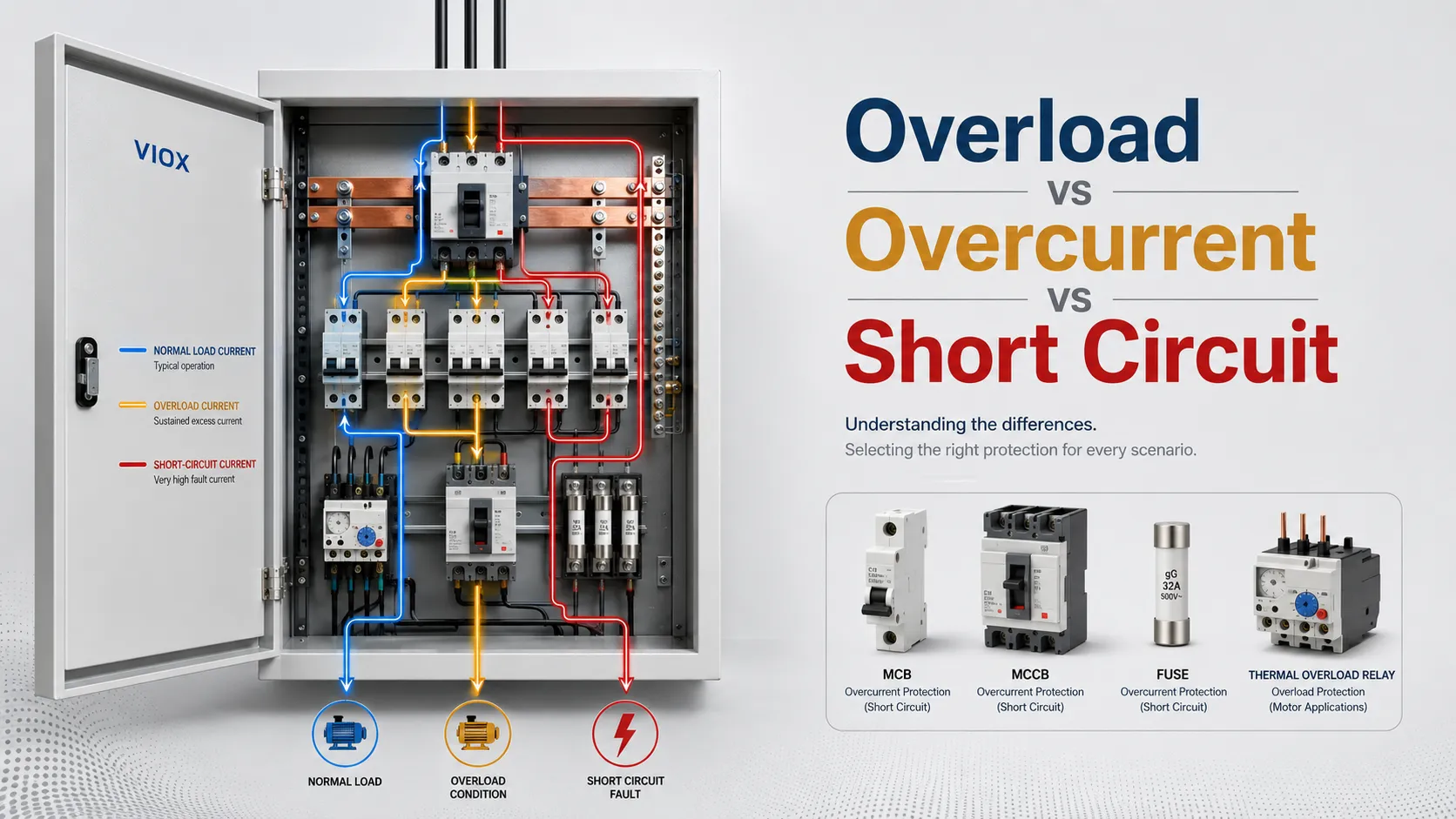
Surintensité désigne tout courant qui dépasse le courant admissible pour un circuit, un conducteur ou un appareil. Surcharge et court-circuit sont deux conditions de surintensité différentes. Une surcharge reste généralement dans le chemin conducteur normal et se développe comme un problème d'échauffement, tandis qu'un court-circuit crée un chemin de défaut à faible impédance et peut produire un courant très élevé presque instantanément.
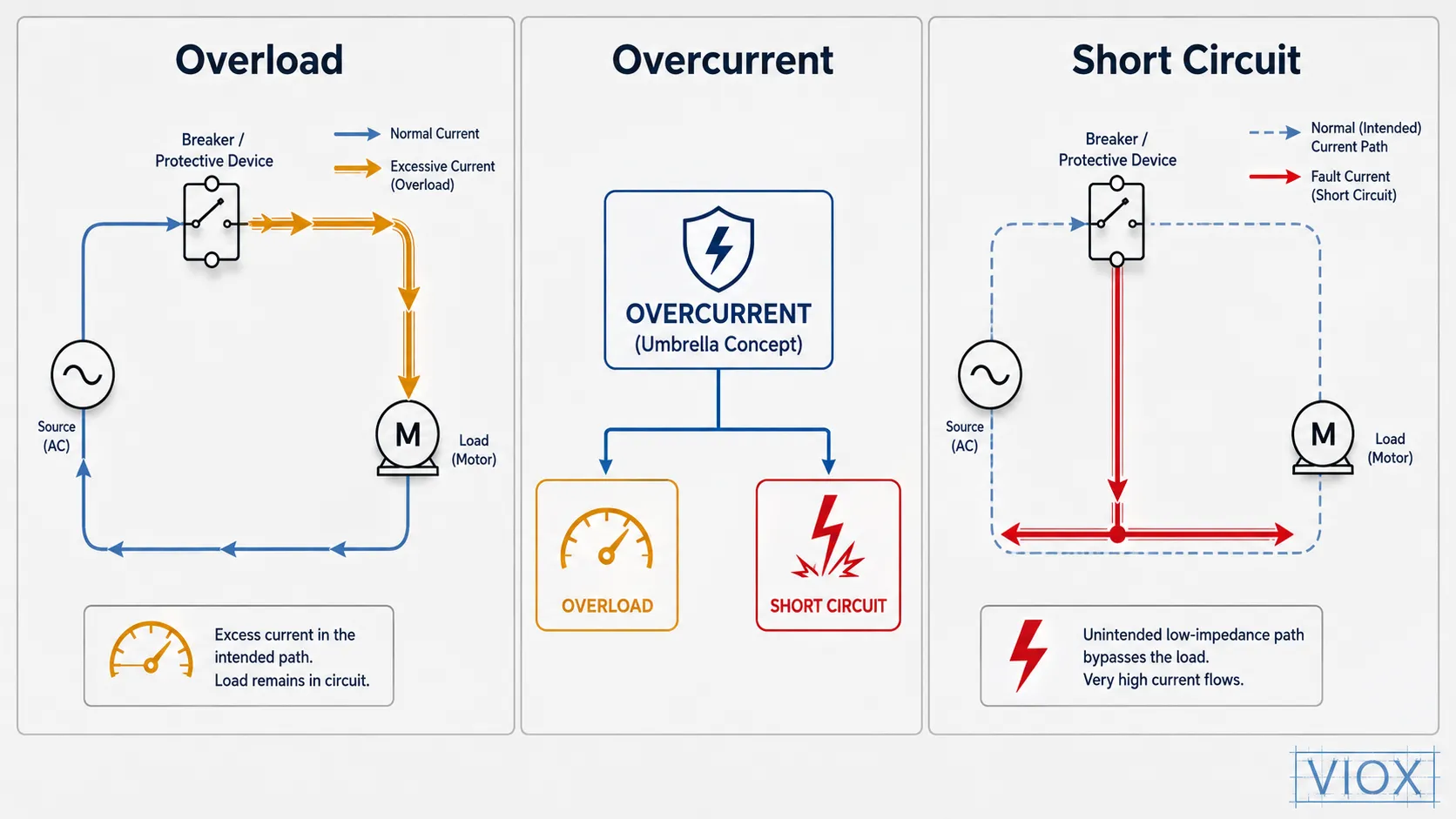
Cette distinction est importante car différents défauts nécessitent des comportements de protection différents. Un relais de surcharge thermique peut protéger un moteur contre une surcharge prolongée, mais il ne peut pas remplacer un fusible ou un disjoncteur pour l'interruption d'un court-circuit. Un disjoncteur peut protéger à la fois contre la surcharge et le court-circuit, mais seulement si son courant nominal, sa courbe de déclenchement et son pouvoir de coupure correspondent à l'installation.
Principaux enseignements
- La surintensité est la catégorie générale. La surcharge et le court-circuit sont des causes ou des types courants de surintensité.
- Le courant de surcharge circule généralement dans le chemin de courant normal. The main danger is heat buildup over time.
- Short-circuit current flows through an unintended low-impedance path. The main danger is arc energy, fire, and equipment destruction.
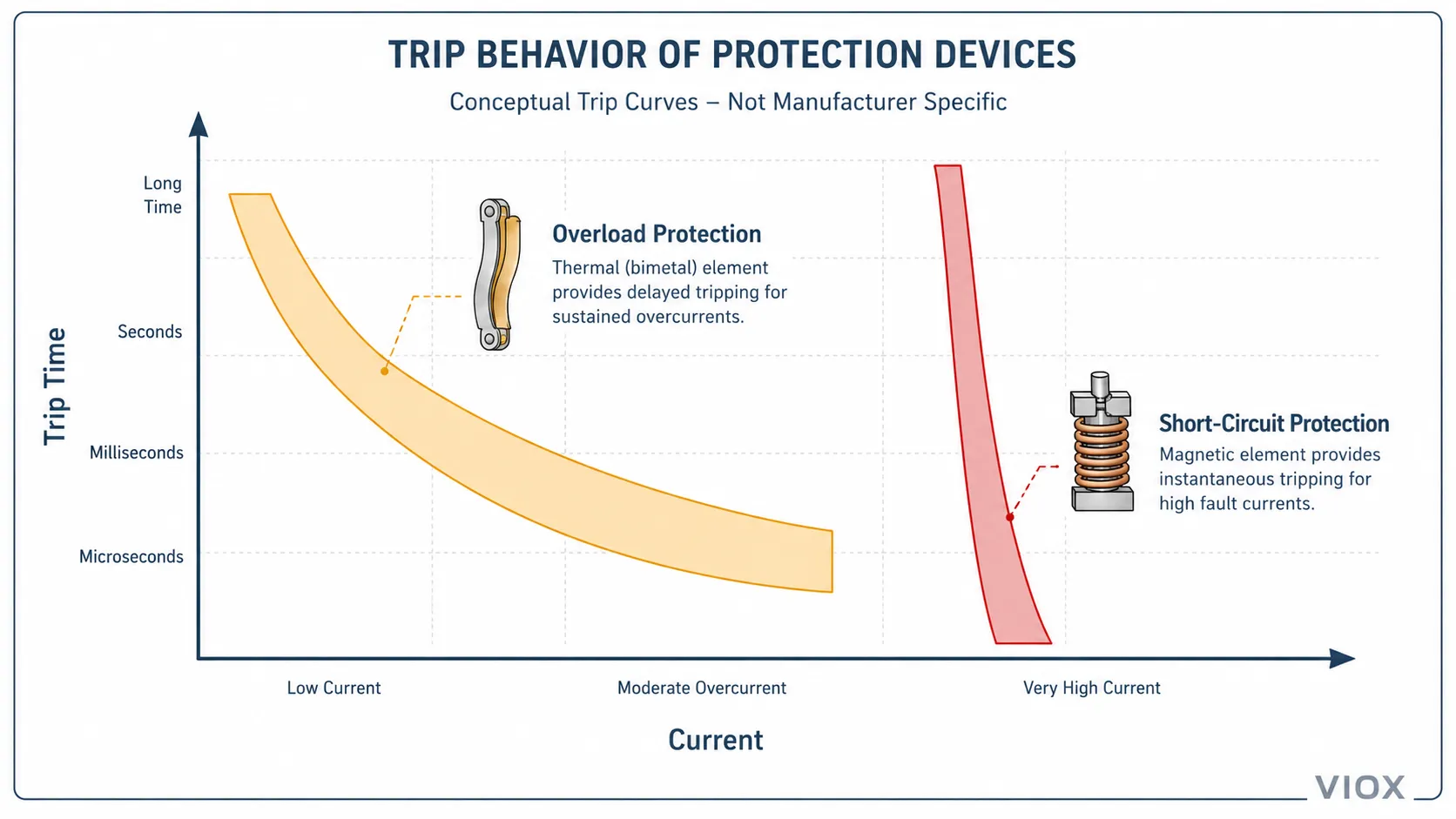
- Protection speed is different. Overload protection is usually time-delayed; short-circuit protection must operate very quickly.
- Rated current is not enough. The protective device must also have enough breaking capacity for the available short-circuit current.
Overload vs Overcurrent vs Short Circuit Comparison Table
| Type de défaut | Ce que cela signifie | Voie actuelle | Comportement typique | Risque principal | Protection typique |
|---|---|---|---|---|---|
| Surcharge | Le courant de charge dépasse la capacité continue admissible du circuit ou de l'équipement | Chemin conducteur normal | Généralement plus lent, thermique, temporisé | Échauffement, vieillissement de l'isolation, dommage moteur, risque d'incendie | Relais de surcharge thermique, relais de surcharge électronique, déclencheur thermique de disjoncteur, relais de protection moteur |
| Surintensité | Tout courant supérieur à la valeur autorisée | Dépend de la cause | Peut être lent ou très rapide | Surchauffe, déclenchements intempestifs, contraintes sur les équipements, dommages dus aux défauts | Fusible, disjoncteur modulaire (MCB), disjoncteur boîtier moulé (MCCB), disjoncteur ouvert (ACB), disjoncteur moteur (MPCB), relais, dispositif de protection moteur |
| Court-circuit | Un défaut à faible impédance entre conducteurs ou entre conducteur et terre | Chemin de défaut anormal | Très rapide, courant de défaut élevé | Arc électrique, incendie, dommages explosifs, destruction de conducteurs/équipements | Fusible, MCB, MCCB, ACB, relais de protection associé à un disjoncteur avec un pouvoir de coupure suffisant |
Qu'est-ce qu'une surintensité ?
Une surintensité est une condition dans laquelle le courant dépasse le courant nominal ou autorisé d'un circuit, d'un conducteur ou d'un appareil électrique. Il ne s'agit pas d'un type de défaut unique. C'est le terme générique qui englobe les surcharges, les courts-circuits et certains défauts à la terre lorsque le courant de défaut est suffisamment élevé pour déclencher un dispositif de protection contre les surintensités.
Dans la conception électrique pratique, le terme surintensité répond à une question :
Le courant est-il supérieur à ce que le circuit ou l'équipement est autorisé à supporter ?
La cause doit encore être diagnostiquée. Un circuit peut subir une surintensité parce qu'un moteur est en surcharge, que trop de charges sont connectées, qu'un conducteur est en court-circuit avec un autre, que l'isolation a échoué ou que le mauvais dispositif de protection a été sélectionné.
C'est pourquoi dire “ le disjoncteur a déclenché à cause d'une surintensité ” n'est qu'un point de départ. La question suivante est de savoir si l'événement était une surcharge, un court-circuit, un problème de courant d'appel, un défaut à la terre, une erreur de câblage ou un problème de coordination des protections.
Pour le dimensionnement des disjoncteurs et le contexte de protection, le VIOX’s Page produit des disjoncteurs modulaires (MCB) et Page produit MCCB sont des références utiles pour les étapes suivantes lorsque le type de circuit est déjà connu.
Qu'est-ce qu'une surcharge ?
Une surcharge se produit lorsque le circuit ou l'équipement transporte plus de courant qu'il ne le devrait pendant trop longtemps, mais que le courant circule toujours à travers le chemin conducteur normal.
Un exemple simple est celui d'un trop grand nombre de charges fonctionnant sur le même circuit de dérivation. Le courant ne prend pas de raccourci autour de la charge. Il circule toujours à travers les conducteurs, les bornes, le disjoncteur et la charge prévus. Le problème est que la quantité de courant est trop élevée pour le câblage, le disjoncteur, l'enroulement du moteur ou la capacité nominale de l'équipement sur la durée.
Dans les systèmes motorisés, une surcharge peut également se produire lorsque :
- une pompe est bloquée mécaniquement
- un convoyeur est surchargé
- un roulement de ventilateur est défaillant
- un moteur est sous-dimensionné pour la charge
- une phase est perdue ou déséquilibrée
- le relais de surcharge est réglé incorrectement
Le point technique clé est que la surcharge est principalement un problème thermique . Le courant peut n'être que modérément supérieur à la normale, mais s'il persiste assez longtemps, la chaleur s'accumule et endommage l'isolation, les bornes, les enroulements ou les câbles.
Pour une explication dédiée des symptômes de surcharge et du risque d'incendie, consultez le guide de VIOX : Qu'est-ce qu'une surcharge de circuit ?
Qu'est-ce qu'un court-circuit ?
Un court-circuit se produit lorsque le courant trouve un chemin à faible impédance non intentionnel entre des conducteurs, ou entre un conducteur sous tension et la terre ou des parties conductrices exposées.
Contrairement au courant de surcharge, le courant de court-circuit ne signifie pas simplement “ trop de charges ”. Il signifie souvent que le chemin normal du circuit a été contourné par un défaut.
Les causes courantes de court-circuit incluent :
- une isolation endommagée
- un conducteur sous tension touchant le neutre
- un contact entre phases
- un câblage incorrect
- des brins lâches créant un pont entre les bornes
- une pénétration d'eau dans l'équipement
- câble écrasé
- composant défectueux à l'intérieur d'un tableau
Étant donné que l'impédance du chemin de défaut peut être très faible, le courant peut augmenter extrêmement rapidement. C'est pourquoi la protection contre les courts-circuits se concentre sur l'interruption rapide, le contrôle de l'arc et un pouvoir de coupure adéquat.
Pour l'estimation du courant de court-circuit dans les circuits basse tension, voir Comment Calculer le Courant de Court-Circuit pour le MCB.
Pourquoi la surcharge n'est pas la même chose qu'un court-circuit
La surcharge et le court-circuit peuvent tous deux produire une surintensité, mais ils ne se comportent pas de la même manière.
| Question | Surcharge | Court-circuit |
|---|---|---|
| Le courant reste-t-il dans le chemin normal ? | Généralement oui | Non, il utilise un chemin à faible impédance non intentionnel |
| Le courant est-il généralement très élevé instantanément ? | Pas habituellement | Souvent oui |
| Le danger principal est-il l'échauffement thermique au fil du temps ? | Oui | Pas seulement ; l'arc électrique et l'énergie de défaut explosive sont des risques majeurs |
| Un relais de surcharge thermique peut-il gérer cela seul ? | Oui, pour la protection contre les surcharges moteur lorsqu'il est correctement appliqué | Pas de |
| L'appareil a-t-il besoin d'un pouvoir de coupure ? | Les dispositifs de protection doivent toujours avoir des calibres corrects | Absolument critique |
| Comportement de déclenchement typique | Délai | Coupure instantanée ou très rapide à court terme |
Cette différence explique pourquoi les questions de type examen décrivent souvent le courant de surcharge comme un courant excessif qui demeure dans le chemin conducteur normal. Cette formulation désigne une surcharge, et non un court-circuit.
Dispositifs de protection : quel dispositif gère quel défaut ?
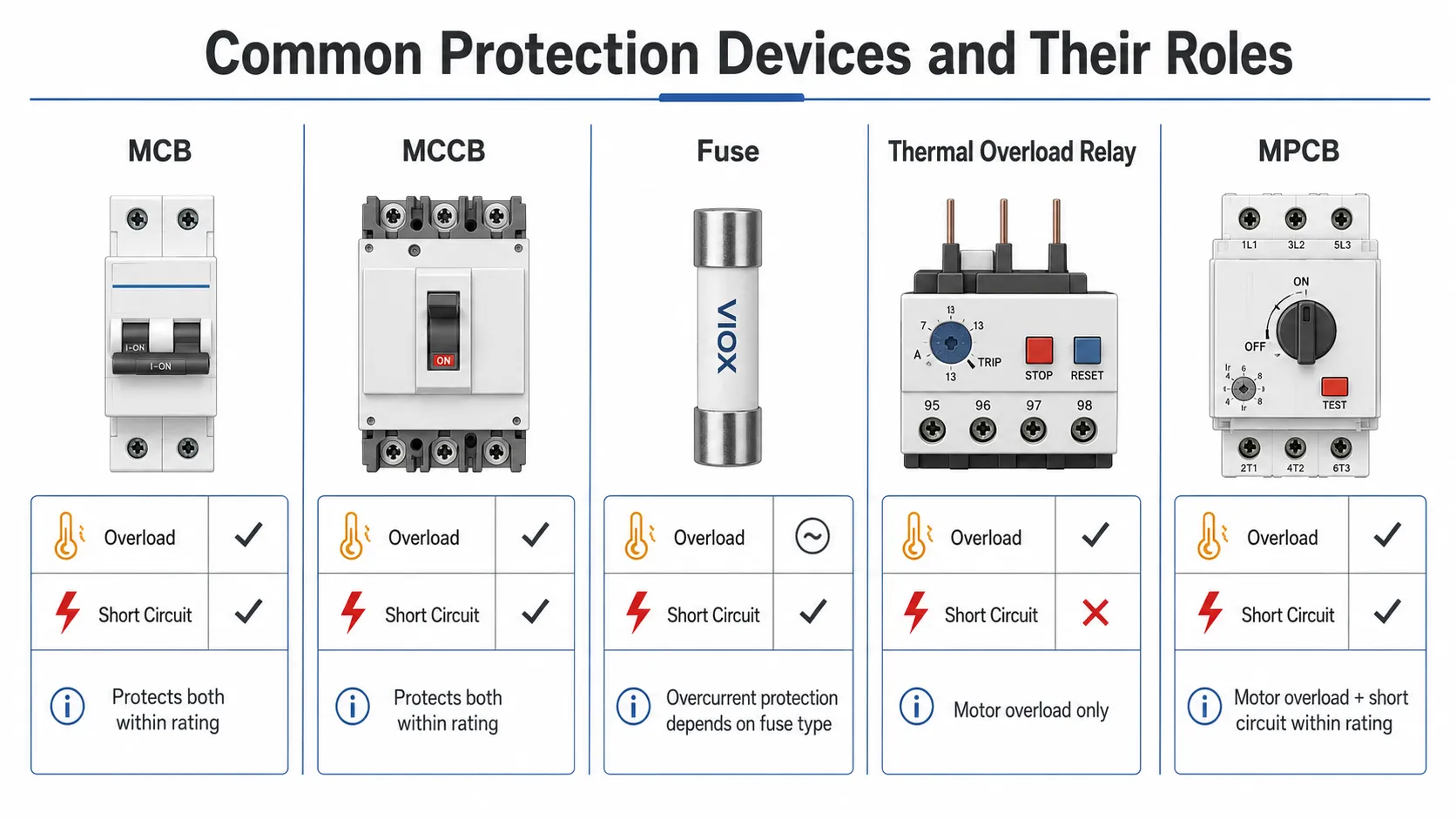
Aucun dispositif de protection unique ne doit être considéré comme une solution miracle pour chaque défaut. Le dispositif doit correspondre au type de défaut, à la tension, au courant, au pouvoir de coupure, au comportement de la charge et à la conception du système électrique.
| Dispositif | Protège contre la surcharge ? | Protège contre le court-circuit ? | Domaine d'application |
|---|---|---|---|
| MCB | Oui, selon la conception | Oui, dans la limite du pouvoir de coupure assigné | Circuits terminaux, tableaux de distribution, petites charges |
| MCCB | Oui, selon l'unité de déclenchement | Oui, dans la limite du pouvoir de coupure assigné | Alimentations, tableaux industriels, circuits à courant élevé |
| Fuse | Oui ou non selon le type de fusible et l'application | Oui, dans la limite du pouvoir de coupure assigné | Protection des équipements, limitation de courant, protection de secours |
| Relais de surcharge thermique | Oui, pour la surcharge moteur | Pas de | Circuits moteurs avec contacteur et protection contre les court-circuits |
| Relais de surcharge électronique | Oui, pour la surcharge moteur et certaines fonctions de protection | Non, pas par lui-même | Panneaux de commande moteur et équipements de processus |
| MPCB | Oui | Oui, dans la limite des caractéristiques nominales de l'appareil | Protection compacte de départ moteur, selon la coordination |
| Relais de protection moteur | Oui, avec en plus des conditions moteur avancées | Nécessite un dispositif de coupure de court-circuit séparé | Moteurs de plus grande taille, MCC, systèmes de contrôle industriel |
| RCCB / DDR (Dispositif Différentiel Résiduel) | Ne dispose pas de protection contre les surintensités par lui-même | Ne dispose pas de protection contre les courts-circuits intégrée | Protection différentielle ou contre les fuites de courant |
| RCBO | Oui | Oui, dans la limite du calibre | Protection combinée contre les courants résiduels et les surintensités |
Pour les circuits moteurs, cette répartition des responsabilités est critique. Un contacteur commute le moteur, un relais de surcharge protège contre les surcharges prolongées, et un fusible, un MCB, un MCCB ou un MPCB assure la protection contre les courts-circuits. VIOX explique cette coordination plus en détail ici : Comment sélectionner les contacteurs, les relais de surcharge et les disjoncteurs pour l'alimentation des moteurs.
Pour les limites de sélection des relais de surcharge et des MPCB, voir Relais de surcharge thermique vs disjoncteur moteur (MPCB).
Pouvoir de coupure : le détail que beaucoup d'acheteurs oublient
Choisir le calibre en ampères correct ne prouve pas qu'un dispositif de protection peut interrompre un court-circuit en toute sécurité.
Un disjoncteur de 32A peut supporter correctement une charge nominale de 32A, mais si le courant de court-circuit présumé au point d'installation est supérieur au pouvoir de coupure nominal du disjoncteur, celui-ci peut défaillir dangereusement lors d'un défaut.
Vérifiez toujours :
- courant nominal
- tension assignée
- application en courant alternatif (AC) ou continu (DC)
- pouvoir de coupure ou capacité d'interruption
- courant de court-circuit présumé au point d'installation
- courbe de déclenchement ou réglages de protection
- coordination amont et aval
- section de câble et méthode d'installation
Pour les applications MCB, la différence pratique entre les pouvoirs de coupure courants est expliquée ici : Pouvoir de coupure des MCB : 6kA vs 10kA.
Pour les termes relatifs aux MCCB et aux disjoncteurs industriels, voir Caractéristiques des disjoncteurs : Icu vs Ics vs Icw vs Icm.
Normes et termes relatifs aux courants de défaut à connaître
La terminologie de protection dépend de la famille de produits et du marché. Pour les disjoncteurs basse tension, les contextes normatifs courants incluent :
| Contexte normatif | Domaine d'application typique de l'appareil | Pourquoi c'est important |
|---|---|---|
| IEC 60898-1 | Disjoncteurs pour la protection contre les surintensités pour usages domestiques et analogues | Référence courante pour la protection des circuits terminaux de type MCB |
| CEI 60947-2 | Disjoncteurs basse tension industriels | Référence courante pour les termes de performance des MCCB, ACB et disjoncteurs industriels |
| UL 489 | Disjoncteurs à boîtier moulé et disjoncteurs similaires pour les applications nord-américaines | Important pour les projets nécessitant des disjoncteurs de dérivation ou d'alimentation homologués UL |
Ne considérez pas ces normes comme des étiquettes interchangeables. Un disjoncteur sélectionné pour une application de circuit terminal IEC, un tableau de distribution industriel IEC et un tableau UL nord-américain peut nécessiter des marquages, des caractéristiques nominales et des preuves d'homologation différents.
Pour les études de court-circuit, les ingénieurs peuvent également distinguer symétrique et asymétrique courant de défaut :
- Le courant de défaut symétrique est la composante du courant de défaut AC après que la composante continue (DC) a été ignorée ou s'est atténuée.
- Courant de défaut asymétrique includes the DC offset that can appear immediately after a fault begins, creating a higher first-cycle peak stress.
Pour la plupart des sélections d'appareils au niveau de l'acheteur, le point clé pratique est simple : le dispositif de protection doit être adapté au niveau de courant de défaut et au contexte normatif spécifié par le projet. Pour la conception technique, l'étude de court-circuit et les données du fabricant doivent être vérifiées plutôt que de se fier uniquement au calibre en ampères indiqué sur l'étiquette frontale.
Comment diagnostiquer un déclenchement sur le terrain
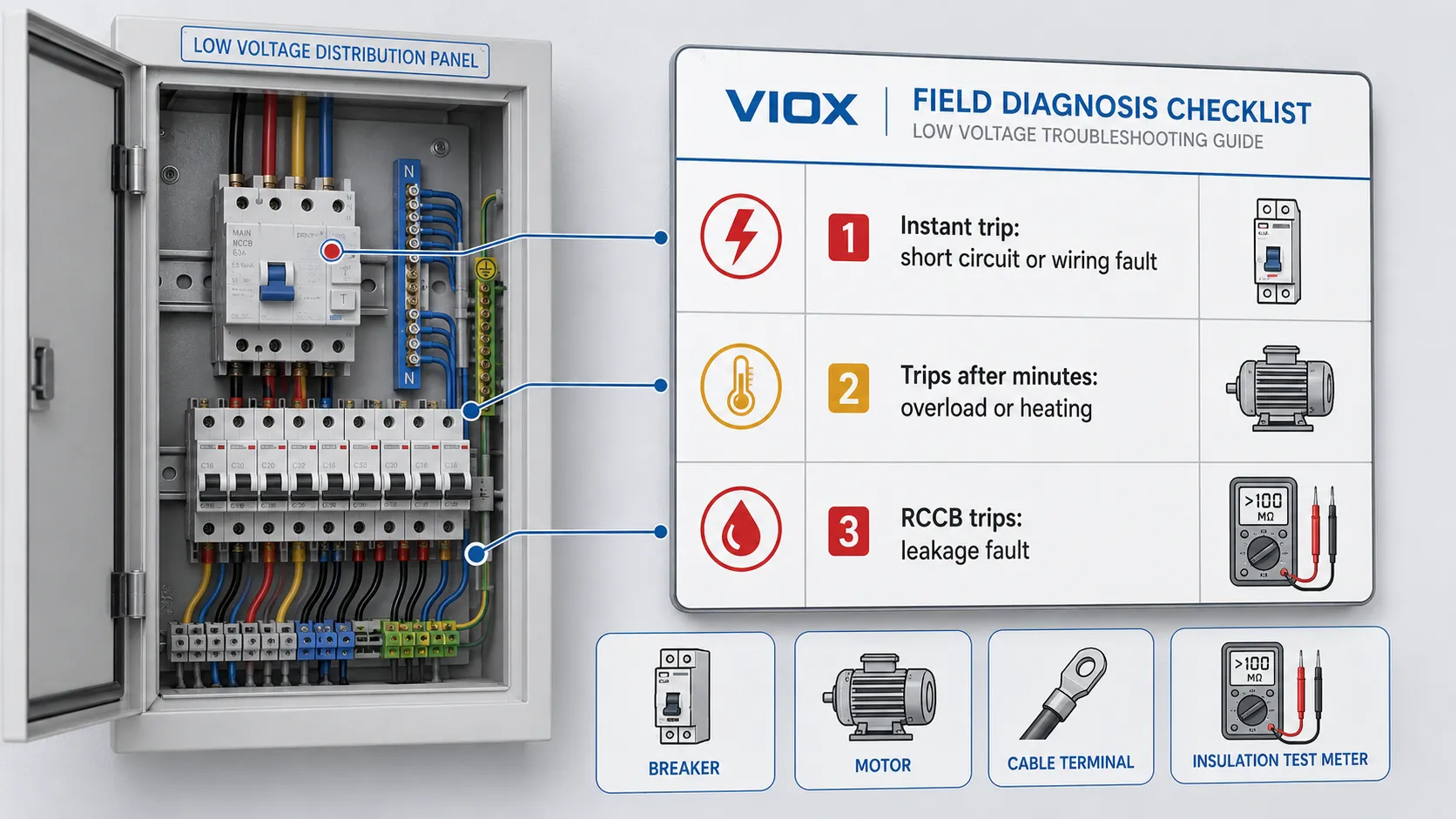
Le temps de déclenchement indique souvent dans quelle direction enquêter en premier.
| Symptôme | Cause la plus probable | Que vérifier en premier |
|---|---|---|
| Le disjoncteur se déclenche immédiatement lors de la mise sous tension | Court-circuit, défaut à la terre, erreur de câblage, défaillance d'un appareil | Déconnecter la charge, effectuer un test d'isolement, inspecter le câblage et les bornes |
| Le disjoncteur se déclenche après quelques minutes sous charge | Surcharge, circuit sous-dimensionné, mauvaise ventilation, connexion chauffante | Mesurer le courant de fonctionnement, comparer la charge au calibre, inspecter les bornes |
| Le moteur démarre, puis le relais de surcharge se déclenche | Surcharge mécanique, perte de phase, mauvais réglage de la surcharge, problème moteur | Courant moteur, équilibrage des phases, état de la charge, réglage du relais |
| Le disjoncteur se déclenche au démarrage du moteur | Courant d'appel trop élevé, courbe/réglage inadapté, court-circuit, rotor bloqué | Courant de démarrage, courbe de déclenchement, état du moteur, câble et démarreur |
| Le fusible fond instantanément | Court-circuit ou courant de défaut important | Isolement du défaut, classe du fusible, tension assignée, localisation du défaut |
| Le câble ou la borne est chaud mais le disjoncteur ne se déclenche pas | Connexion desserrée, conducteur en surcharge, protection inadaptée, résistance locale | Inspection du couple de serrage/de la connexion, mesure de la charge, thermographie |
| Le RCCB se déclenche mais pas le MCB | Courant résiduel ou défaut d'isolement | Défaut d'isolement, humidité, équipement raccordé, défaut neutre-terre |
Ne réarmez pas un disjoncteur et ne remplacez pas un fusible de manière répétée sans en trouver la cause. Un dispositif de protection qui se déclenche fréquemment signale généralement un problème électrique réel.
Erreurs courantes lors de la comparaison entre surcharge et court-circuit
Erreur 1 : Considérer la surintensité uniquement comme un court-circuit
Le court-circuit n'est qu'un type de surintensité. La surcharge peut également créer une surintensité, mais elle nécessite généralement un comportement de déclenchement différent.
Erreur 2 : Utiliser un relais de surcharge thermique comme protection contre les courts-circuits
Un relais de surcharge thermique est conçu pour les surcharges moteur prolongées, et non pour l'interruption de défauts à haute énergie. Il doit être utilisé avec une protection contre les courts-circuits appropriée.
Erreur 3 : Surdimensionner le disjoncteur pour éviter les déclenchements intempestifs
Si un disjoncteur se déclenche au démarrage ou lors d'une charge importante, la solution n'est pas automatiquement un disjoncteur plus gros. Le problème réel peut être une surcharge, un courant d'appel, une courbe de déclenchement inadaptée, une mauvaise coordination ou un câblage sous-dimensionné.
Erreur 4 : Ignorer la protection des câbles
Le disjoncteur protège le conducteur ainsi que la charge. Si le disjoncteur est surdimensionné par rapport au câble, le câble peut surchauffer avant que la protection n'agisse.
Erreur 5 : Vérifier le courant nominal mais pas le pouvoir de coupure
Le courant nominal indique la capacité de transport normale. Le pouvoir de coupure indique si l'appareil peut interrompre en toute sécurité un court-circuit au point d'installation.
Erreur 6 : Supposer que chaque déclenchement signifie que le disjoncteur est défectueux
Les disjoncteurs et les fusibles sont des dispositifs de protection. De nombreux déclenchements surviennent parce que l'appareil réagit correctement à une surcharge, un court-circuit, une fuite, une chaleur excessive ou une application incorrecte.
Liste de contrôle pour la sélection de la protection contre les surintensités
Avant de sélectionner ou de remplacer un dispositif de protection, confirmez les points suivants :
| Élément de sélection | Pourquoi c'est important |
|---|---|
| Courant de charge | Détermine le calibre nominal de base en ampères |
| Section du conducteur et méthode d'installation | La protection doit correspondre à l'ampacité du câble |
| Tension et type CA/CC | Le comportement de coupure d'arc diffère selon le système |
| Courant de court-circuit présumé | Détermine le pouvoir de coupure requis |
| Type de charge | Les moteurs, les chauffages, les transformateurs, l'électronique et les condensateurs se comportent différemment |
| Courant d'appel | Affecte la sélection de la courbe du disjoncteur ou du réglage de déclenchement |
| Méthode de protection contre les surcharges | La surcharge moteur et la surcharge de câble peuvent nécessiter des dispositifs différents |
| Coordination avec les dispositifs en amont/aval | Empêche les déclenchements inutiles en amont |
| Environnement | La température, l'enveloppe, l'altitude, la poussière et les vibrations influencent la sélection |
| Spécification standard ou de projet | Définit la catégorie d'appareil, le calibre et la documentation requis |
Si le circuit implique des moteurs, commencez par le courant à pleine charge, la méthode de démarrage, la protection contre la surcharge et la protection contre les courts-circuits ensemble plutôt que de sélectionner chaque pièce séparément.
Réponses aux questions de formation courantes
De nombreuses recherches sur ce sujet proviennent de questions de formation en électricité. Ces réponses courtes aident à distinguer correctement les termes.
| Énoncé ou question de formation | Interprétation correcte |
|---|---|
| “ Une condition de surintensité peut être définie comme… ” | Courant supérieur à la valeur autorisée pour le circuit ou l'équipement |
| “ Quelle condition de surintensité est confinée au chemin conducteur normal ? ” | Surcharge |
| “ Quelle condition de surintensité quitte le chemin de courant normal ? ” | Court-circuit |
| “ Une surcharge est-elle identique à un court-circuit ? ” | Non. Les deux peuvent être des conditions de surintensité, mais le chemin du courant et le comportement de la protection sont différents |
| “ Un court-circuit a-t-il normalement un courant plus faible qu'une surcharge ? ” | Non. Un court-circuit produit généralement un courant de défaut beaucoup plus élevé, en fonction de l'impédance du système électrique |
| “ Que signifie la coordination sélective ? ” | Les dispositifs de protection sont disposés de manière à ce que le dispositif le plus proche du défaut se déclenche en premier, limitant ainsi la zone de coupure. |
| “ Qu'est-ce que la protection contre les surintensités ? ” | Protection qui ouvre le circuit lorsque le courant dépasse une valeur sûre ou autorisée. |
Si une question de formation indique que le courant est excessif mais circule toujours à travers les conducteurs et les charges normaux, elle décrit une surcharge. Si elle indique que le courant emprunte un raccourci non prévu autour de la charge, elle décrit un court-circuit.
Exemples pratiques
Exemple 1 : Trop d'appareils sur un même circuit
Plusieurs appareils à haute puissance fonctionnent sur le même circuit. Le courant reste dans le chemin normal, mais il dépasse la valeur nominale du circuit suffisamment longtemps pour que le disjoncteur se déclenche.
Il s'agit d'une condition de surcharge. La solution consiste à réduire la charge, à redistribuer les circuits ou à installer un circuit dédié correctement conçu.
Exemple 2 : Contact entre la phase et le neutre à l'intérieur de l'équipement
Un conducteur endommagé touche un autre conducteur à l'intérieur d'un appareil. Le courant emprunte un chemin à faible impédance non prévu et augmente très rapidement.
Il s'agit d'un court-circuit. Le dispositif de protection doit interrompre le défaut dans les limites de son pouvoir de coupure.
Exemple 3 : Déclenchement du moteur après dix minutes de fonctionnement
Un moteur démarre normalement mais déclenche le relais de surcharge après avoir fonctionné en charge. Le disjoncteur ne se déclenche pas.
Cela indique davantage une surcharge moteur qu'un court-circuit. Vérifiez la charge mécanique, l'équilibrage des phases, le refroidissement, le réglage du relais de surcharge et le courant moteur.
Exemple 4 : Le disjoncteur se déclenche dès la mise sous tension du tableau
Un disjoncteur se déclenche instantanément lorsque le tableau est mis sous tension. La charge connectée n'atteint jamais son fonctionnement normal.
Cela suggère un court-circuit, une erreur de câblage, un défaut à la terre ou un composant défaillant. N'augmentez pas le calibre du disjoncteur. Isolez le circuit et testez le câblage.
FAQ
Quelle est la différence entre une surintensité, une surcharge et un court-circuit ?
La surintensité est une condition générale : un courant supérieur à la valeur autorisée. La surcharge est une condition de surintensité qui reste généralement dans le chemin de courant normal et provoque un échauffement au fil du temps. Le court-circuit est une condition de surintensité causée par un chemin de défaut à faible impédance non intentionnel.
Quelle condition de surintensité reste dans le chemin de courant normal ?
Le courant de surcharge reste généralement dans le chemin de courant normal. C'est pourquoi la surcharge est principalement associée à un échauffement dans le temps.
Quel défaut quitte le chemin du courant normal ?
Un court-circuit quitte ou contourne le chemin de charge prévu en créant un chemin à faible impédance non intentionnel entre les conducteurs ou vers la terre.
Quelle est la cause d'une surintensité ?
Les causes courantes incluent une charge connectée trop importante, une surcharge moteur, un court-circuit, un défaut à la terre, une défaillance de l'isolation, un câblage incorrect, un calibre de disjoncteur inadapté, une mauvaise coordination ou une défaillance de l'équipement.
Un relais de surcharge thermique peut-il protéger contre les courts-circuits ?
Non. Un relais de surcharge thermique protège contre la surcharge prolongée du moteur. La protection contre les court-circuits doit être assurée par un fusible, un MCB, un MCCB, un MPCB ou tout autre dispositif de protection contre les court-circuits correctement dimensionné.
Comment dois-je associer un disjoncteur moteur et un contacteur dans une armoire de commande moteur ?
Commencez par le courant à pleine charge du moteur, la méthode de démarrage, la catégorie d'emploi, le niveau de court-circuit et les exigences de coordination. Le contacteur gère la commutation, le relais de surcharge ou le MPCB gère la protection contre les surcharges du moteur, et le dispositif de protection contre les courts-circuits doit éliminer le courant de défaut en toute sécurité. Ne choisissez pas le contacteur, le relais de surcharge et le disjoncteur comme des composants isolés.
Quelle norme s'applique aux dispositifs de protection contre les surintensités ?
Cela dépend de l'appareil et du marché. La norme IEC 60898-1 est couramment associée à la protection des circuits domestiques et similaires par MCB, la norme IEC 60947-2 aux disjoncteurs basse tension industriels tels que les MCCB et les ACB, et la norme UL 489 aux disjoncteurs homologués pour les applications nord-américaines.
Pourquoi un disjoncteur se déclenche-t-il instantanément ?
Un déclenchement instantané indique généralement un court-circuit, un défaut à la terre, un courant d'appel important, une erreur de câblage ou une défaillance de l'appareil raccordé. Le circuit doit être diagnostiqué avant toute réinitialisation répétée.
Pourquoi un disjoncteur se déclenche-t-il après plusieurs minutes ?
Un déclenchement temporisé indique souvent une surcharge, une surchauffe, une mauvaise ventilation, des conducteurs sous-dimensionnés, des bornes desserrées ou une charge dépassant la capacité nominale du circuit.
Le fusible ou le disjoncteur est-il préférable pour la protection contre les surintensités ?
Les deux peuvent être corrects. Un fusible peut être préférable pour la limitation de courant ou la coordination spécifique à l'équipement. Un disjoncteur peut être préférable lorsque la protection réarmable et la commodité de commutation sont importantes. Le choix correct dépend de la tension, du courant, du pouvoir de coupure, du type de charge et des exigences de coordination.
Conclusion
La manière la plus claire de comprendre ces termes est :
La surintensité est la catégorie. La surcharge et le court-circuit sont des conditions de surintensité différentes.
Une surcharge reste généralement dans le chemin de courant normal et provoque un échauffement au fil du temps. Un court-circuit crée un chemin à faible impédance non intentionnel et peut générer un courant de défaut important très rapidement. La stratégie de protection doit correspondre au défaut : protection contre les surcharges pour les contraintes thermiques prolongées, protection contre les courts-circuits pour une interruption rapide du défaut, et un pouvoir de coupure suffisant pour le courant de défaut disponible.
Pour les produits de protection de circuit VIOX, commencez par la famille d'appareils correspondant à l'application : MCB pour les circuits terminaux, MCCB pour les départs plus importants, relais de surcharge thermique pour la protection contre les surcharges moteur, et des fusibles ou disjoncteurs correctement calibrés pour la protection contre les courts-circuits.