

On this page
Yes. A circuit breaker can still supply electricity while its contacts, connections, operating mechanism or trip function are defective. This is often called a partially bad circuit breaker, although it is a description of a fault—not a formal breaker rating or a safe operating condition.
A healthy breaker does not normally regulate an appliance’s voltage or ration its current. However, an unintended high-resistance contact can cause voltage drop and local heating while the breaker remains closed. Separately, a damaged trip mechanism can leave power flowing without dependable overcurrent protection. An ON handle does not prove that either function is healthy.
- Power delivery and protective operation are separate things to verify.
- No tripping, smoke or burning smell does not establish safety.
- Stop using a circuit with suspected overheating, arcing or damaged connections. Do not remove the panel cover or repeatedly reset a breaker to keep equipment running.
What “Partially Bad” Means Inside a Circuit Breaker
A breaker has two essential jobs: carry normal load current through a low-resistance path and interrupt the circuit when its protective conditions are met. One job can deteriorate before the other fails visibly.
| Possible condition | What may still appear to work | What remains unsafe or unverified |
|---|---|---|
| Deteriorated internal contacts | The connected equipment still receives power | Contact resistance, heating and interruption performance |
| Damaged operating or trip mechanism | The handle moves, or the circuit stays energized | Reliable opening and automatic tripping |
| Altered protective response | Normal-load operation looks ordinary | Response to overload or short-circuit conditions |
| Poor terminal or busbar connection | The breaker remains ON | The external connection; the breaker itself may or may not also be damaged |
This is why “it still works” is not a sufficient diagnosis. A device stuck closed may keep an appliance running yet fail when it needs to interrupt a fault. Conversely, an open circuit might be a correctly tripped breaker rather than a damaged one.
For background on the normal thermal and magnetic functions, see our miniature circuit breaker working-principle guide. Different breaker designs have different mechanisms and protective features; not every breaker is a basic thermal-magnetic MCB.
What Causes a Circuit Breaker to Go Bad?
The original fault may be inside the breaker or at its electrical interface. Several deterioration mechanisms deserve separate consideration.
Contact and connection damage
Contact wear, corrosion, contamination or damage following fault interruption can impair the current path. A loose or damaged terminal, or a poor breaker-to-busbar interface, can also introduce resistance. These external faults should not automatically be called an internal breaker failure.
Local heating can then worsen the connection or damage nearby insulation. Simply replacing the breaker may leave the original problem in place if the conductor termination or busbar is also defective.
Mechanical deterioration
A latch, spring or operating mechanism can become damaged or obstructed. Depending on the failure, the breaker may not latch, may not open reliably, or may exhibit abnormal operation. Handle movement alone cannot confirm that the internal contacts and trip mechanism operate correctly.
Protective-function deterioration
Heat exposure, environmental damage or mechanical deterioration can affect protective operation. Electronic protective devices also have functions that cannot be assessed from handle position or ordinary continuity alone.
Do not assume that aging always makes a breaker “more sensitive.” A fault might cause unwanted trips, delayed operation or failure to open. A historical NRC inspection finding concerning industrial molded-case circuit breakers identified the possibility of delayed tripping or remaining ON after an overcurrent condition when maintenance and testing were inadequate. That industrial finding illustrates a failure mode; it does not establish residential MCB failure rates or a universal replacement age.
Can a Bad Breaker Cause Low Voltage Without Tripping?
Yes, a damaged resistive current path can contribute to low voltage under load. But the breaker is not intentionally turning down the voltage, and a low-voltage symptom does not identify the breaker as the cause.
Every real conductor and connection has some resistance. The concern is an abnormal resistance at a contact, termination or interface. With current flowing, that resistance creates both a voltage drop and localized heat:
Voltage drop: ΔV = I × R
Local heating: P = I² × R = ΔV × I
Consider a deliberately simplified example: a fixed 10 A current passes through a faulty connection represented by 0.20 Ω resistance.
ΔV = 10 A × 0.20 Ω = 2 V
P  = (10 A)² × 0.20 Ω = 20 W
The same defect produces a 2 V drop and dissipates 20 W at that location. This is an illustrative calculation, not a measured breaker, an acceptable contact-resistance limit or a temperature prediction. Real connections can behave nonlinearly, and an appliance’s current may change as its supply voltage changes.
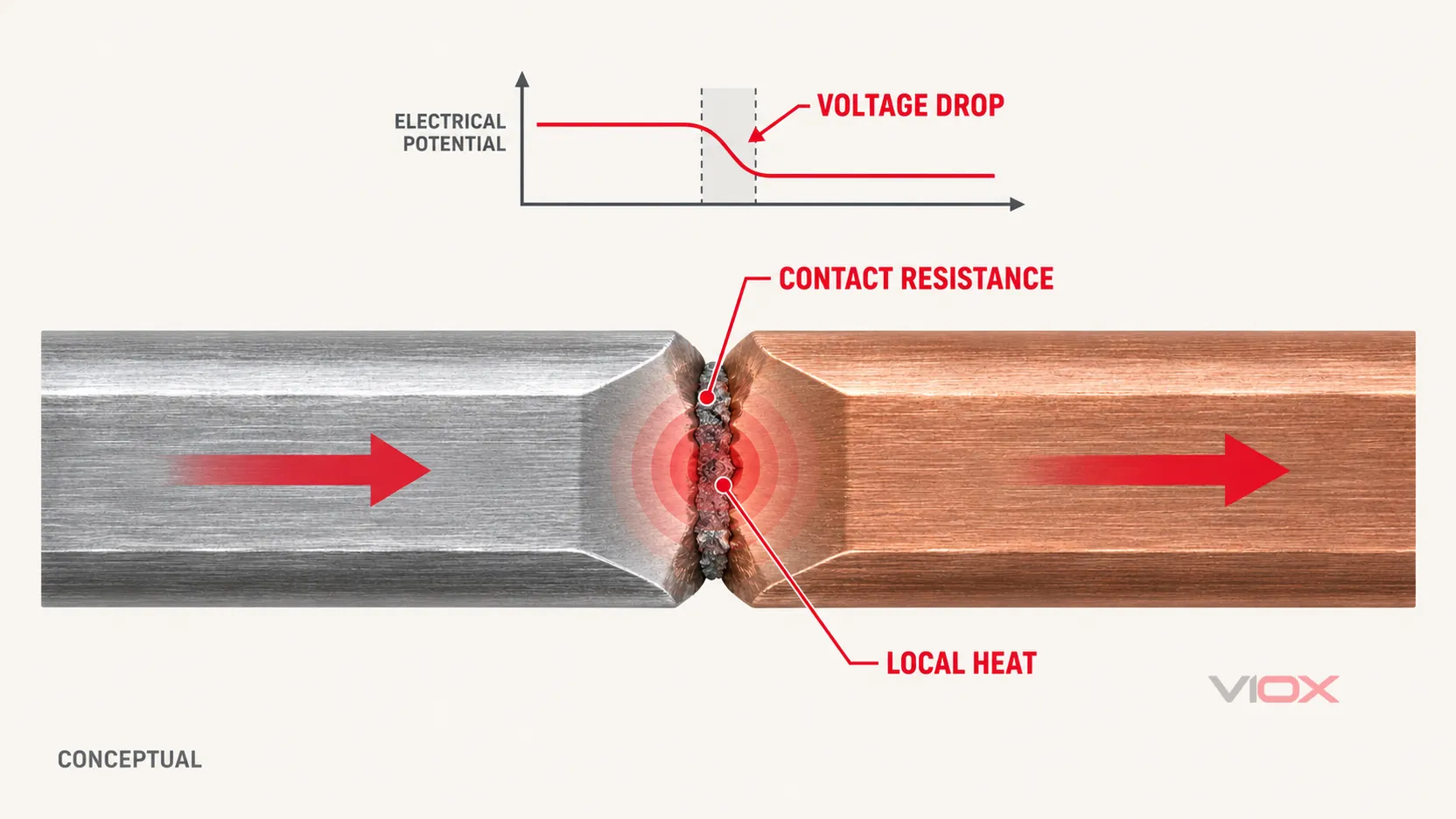
A conventional overcurrent breaker responds to its protective characteristics, not to the temperature of every downstream connection. A poor connection can therefore overheat even when circuit current is below the breaker’s rating. Historical CPSC/UL research on electrical wiring-system fire conditions investigated high-resistance and glowing connections at currents below ordinary branch-circuit overcurrent ratings.
It is also wrong to conclude that a dangerous drop must produce an obvious burning smell. Heat can be concealed, intermittent or present before an odor is noticed. The CPSC home-wiring hazard guide lists odors, overheating, discoloration and abnormal sounds among warning signs; the absence of one sign is not clearance to keep using the circuit.
Is a Partially Tripped Breaker the Same Thing?
No. On some breakers, a tripped handle rests between ON and OFF. That position indicates a trip state according to the manufacturer’s design—not that the breaker is delivering “half power.” Other designs indicate tripping differently.
A breaker that trips during an actual overload may be protecting the circuit correctly. Repeated tripping can result from an overloaded circuit, appliance fault, wiring fault or protective function such as ground-fault detection; it does not by itself prove that the breaker has deteriorated.
Follow the device instructions and identify the reason for the trip before reenergizing. Our safe breaker-reset guide covers the reset task separately. Do not hold the handle ON, bypass protection or keep resetting an unexplained fault.
Symptoms That Justify Inspection—Not a Diagnosis
Symptoms overlap between breaker faults, connection faults and appliance faults. Use them to describe the problem accurately to an electrician rather than to select a replacement by guesswork.
| Observation | What it can suggest | What it cannot prove |
|---|---|---|
| Flickering or voltage disturbance when a load starts | A supply disturbance or load-dependent drop somewhere in the current path | That the breaker is the defective component |
| Discoloration, unusual noise or suspected overheating near the panel | A connection or equipment defect requiring attention | That continued use is safe because no trip occurred |
| Breaker will not latch or operates abnormally | A persistent circuit fault, incorrect reset state or device problem | An internal mechanism defect without assessment |
| Appliance stops while breaker remains ON | An appliance problem, supply interruption or voltage disturbance | That protection is healthy—or that the appliance is definitely faulty |
| Voltage looks normal when the appliance is idle | The supply at that measurement point and moment | Acceptable voltage during the actual failure or under load |
Do not open an energized panel, touch equipment to estimate its temperature or deliberately repeat a suspected heating event. If there is smoke, active arcing or fire, stay clear and contact emergency services.
Breaker, Connection or Appliance: Keep the Fault Boundaries Separate
A breaker is only one part of the supply path. An upstream supply connection, the breaker interface, a conductor termination, a receptacle or the appliance itself can produce overlapping symptoms. In some systems, a neutral fault can also cause voltage abnormalities; it is not equivalent to a breaker “going weak.”
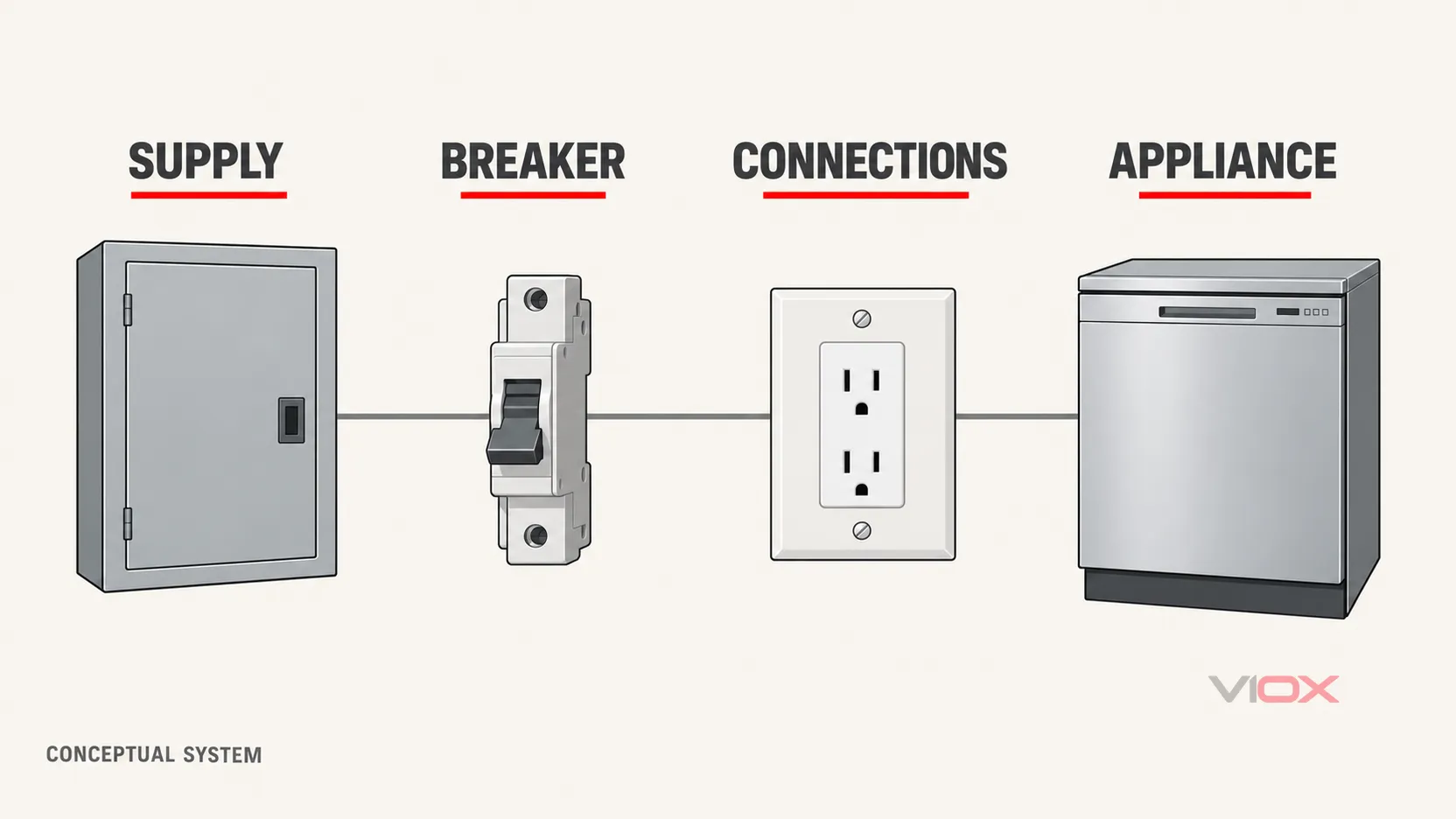
For example, suppose a dishwasher stops mid-cycle and works again only after being unplugged and left to cool. This is a hypothetical symptom pattern, not a confirmed field diagnosis. A controller reset, temperature-dependent appliance fault or supply problem might be involved. “The display goes completely dead” is also a different observation from “the wash pump stops while the display stays lit.”
Neither observation proves a defective breaker. Equally, recovery after cooling does not prove a failed pump, control board or thermal protector. The useful evidence is what stopped, what else lost power, any recorded error, and the supply condition during the event.
Do not use a long extension cord to run a dishwasher from another circuit as a generic diagnostic shortcut. ESFI recommends connecting major appliances directly to a wall receptacle rather than an extension cord, where a cord-and-plug connection is applicable. Even a professionally arranged alternative supply would not automatically exclude an upstream fault shared by both circuits.
What Professional Testing Can Actually Establish
An electrician can distinguish internal breaker damage from a termination, busbar, wiring or appliance problem. The assessment may include inspection after safe isolation, verification of the connected load, and appropriately controlled measurements that localize voltage drop under relevant conditions. No-load readings alone can miss a load-dependent defect.
Electrical testing involves hazards beyond choosing a meter setting. In U.S. workplaces, OSHA 1910.334 requires qualified persons for electrical testing and instruments suitable for the circuit and environment. The same practical boundary applies here: this article is not a homeowner procedure for probing panel terminals.
A continuity test can help determine whether an isolated contact path is open or closed. It cannot certify overload timing, short-circuit interruption, or AFCI/GFCI electronic protection. A normal thermal image also cannot establish trip performance. Device-specific protective testing, where appropriate, needs the manufacturer’s method and suitable specialist equipment.
Our guide to identifying a bad circuit breaker addresses the diagnostic task in more detail. The central distinction remains: proving that power passes through a breaker is not the same as proving that it will interrupt correctly.
When Replacement Is Appropriate—and What Must Match
A breaker with confirmed internal contact damage, defective operating/protective function or damage outside its manufacturer’s service limits should be removed from service and addressed by qualified personnel. Sealed residential and modular breakers are generally replaced as complete devices, not repaired by cleaning internal contacts or adjusting the trip mechanism.
If the defect is at a terminal or busbar, the electrician must assess that connection and any heat-damaged conductor, insulation or panel component as well. A new breaker is not a repair for a damaged mounting interface.
Replacement selection must match the panel or assembly’s permitted devices, system voltage, poles, current rating, interruption capability, protective characteristics and local requirements. Required AFCI, GFCI or other protection must not be lost during replacement. Never increase the breaker rating to suppress unexplained trips without an authorized circuit-design assessment.
For installations designed to accept the relevant modular devices, the VIOX MCB product page provides a starting point for model documentation and selection. An IEC-style DIN-rail MCB is not automatically an approved replacement for a North American plug-in panel breaker. Confirm the specific assembly compatibility and applicable approvals before selecting a product.