

On this page
Quick Answer: IEC 60898-1 vs IEC 60947-2
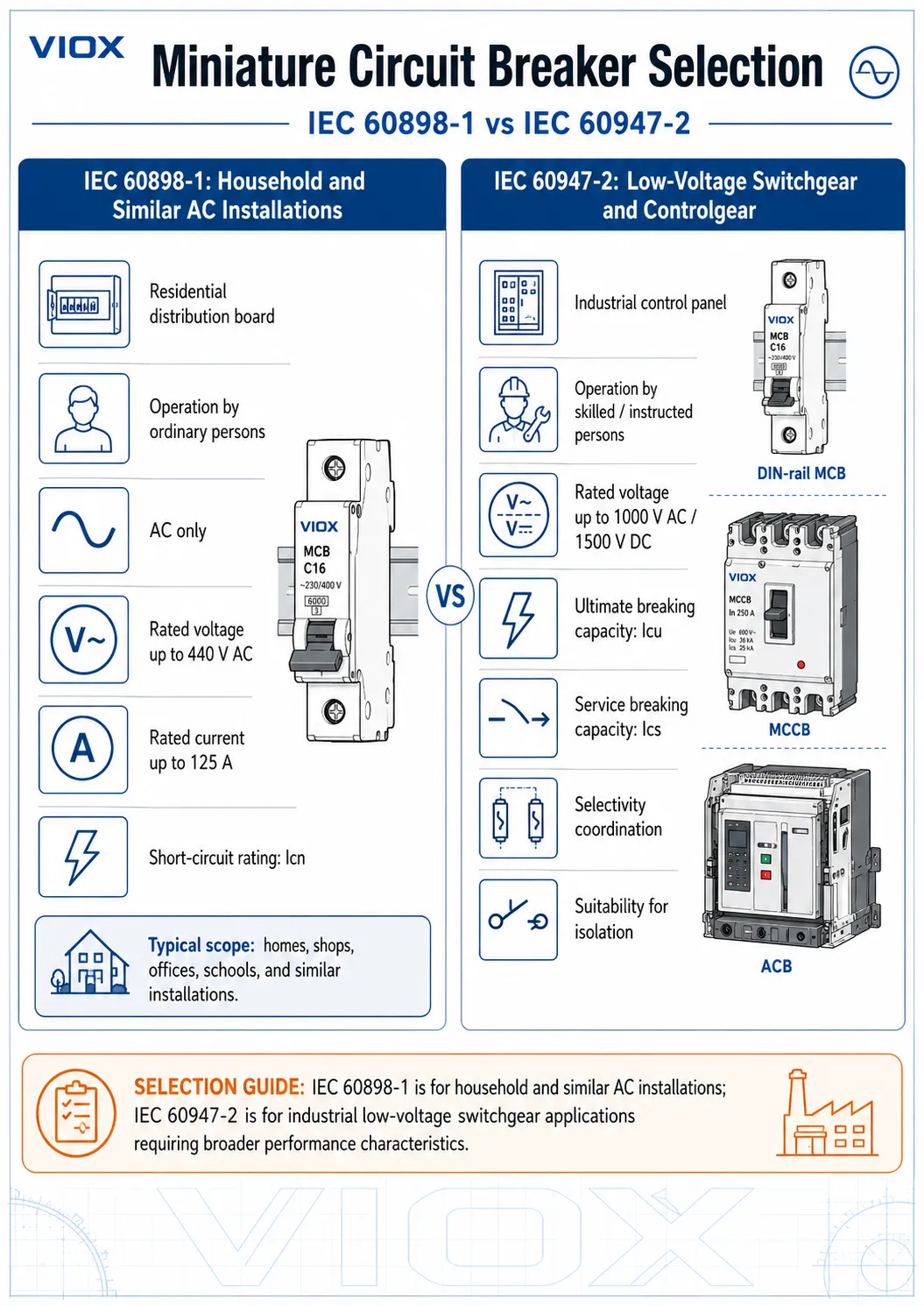
IEC 60898-1 and IEC 60947-2 are not simply "MCB vs MCCB" standards. IEC 60898-1 applies to AC circuit breakers for household and similar installations, typically operated by ordinary persons. IEC 60947-2 applies to low-voltage circuit breakers used in switchgear and controlgear, typically selected, installed, and maintained by instructed or skilled persons.
For MCB selection, the key question is not only current rating or breaking capacity. The real question is whether the breaker is being used in a household or similar final circuit, or in an industrial panel, OEM machine, control cabinet, distribution board, or low-voltage switchgear assembly where IEC 60947-2 performance data such as Icu, Ics, selectivity, pollution degree, and suitability for isolation may be required.
If you are selecting an MCB for a residential or light commercial final circuit, IEC 60898-1 is often the relevant standard. If you are specifying breakers for industrial panels, machine control, factory distribution, or harsh environments, IEC 60947-2 or dual-standard certification is usually the safer specification route.
For broader device background, start with What Is a Miniature Circuit Breaker?. If your main task is sizing and curve selection, use the MCB Selection Guide after reading this standards comparison.
Core Difference in One Table
| Selection point | IEC 60898-1 | IEC 60947-2 |
|---|---|---|
| Primary application | Household and similar AC installations | Low-voltage switchgear, controlgear, industrial panels, distribution systems |
| Typical user assumption | Ordinary persons may operate the device | Instructed or skilled persons select, install, maintain, and operate the device |
| Voltage scope | AC operation up to 440 V between phases | Up to 1000 V AC or 1500 V DC, depending on product rating and application |
| Current scope | Up to 125 A | Broad low-voltage circuit-breaker scope; exact current range depends on product type |
| Breaking capacity term | Icn, rated short-circuit capacity | Icu and Ics, ultimate and service short-circuit breaking capacities |
| Typical curve marking | B, C, D curves are common | B, C, D may appear on DIN-rail MCBs; industrial ranges may also include K, Z, MA or manufacturer-specific trip data |
| Environment expectation | Normal household or similar installation conditions | Industrial environments may require stronger attention to pollution degree, vibration, humidity, temperature, and coordination |
| Maintenance expectation | Replacement after significant fault interruption is often the practical approach | Service continuity and post-fault performance matter more; Ics becomes important |
| Typical products | Residential and similar DIN-rail MCBs | Industrial DIN-rail MCBs, MCCBs, ACBs, and other low-voltage circuit breakers |
The practical point is simple: IEC 60947-2 is not only for MCCBs. A DIN-rail miniature circuit breaker can be tested and marked to IEC 60947-2 if the manufacturer designs and certifies it that way.
IEC 60898-1 Scope: Household and Similar AC Circuit Breakers
IEC 60898-1 covers circuit breakers for overcurrent protection in household and similar installations. The scope is intentionally narrower than IEC 60947-2 because the expected users, environment, and maintenance conditions are different.
Under IEC 60898-1, the standard scope is:
| IEC 60898-1 item | Scope meaning |
|---|---|
| Current type | AC air-break circuit breakers |
| Frequency | 50 Hz, 60 Hz, or 50/60 Hz |
| Rated voltage | Not exceeding 440 V between phases |
| Rated current | Not exceeding 125 A |
| Rated short-circuit capacity | Not exceeding 25,000 A |
| Typical users | Ordinary persons in household and similar installations |
| Typical markings | Curve + current, such as B16, C20, D32; breaking capacity often shown as 4500, 6000, or 10000 A |
This makes IEC 60898-1 highly suitable for residential distribution boards, small commercial final circuits, offices, schools, shops, and similar installations where the breaker may be operated by non-specialists.
It does not make IEC 60898-1 a universal answer for every DIN-rail breaker application. A breaker that is perfectly suitable for a residential final circuit may not provide the industrial performance data required for a machine panel, OEM cabinet, photovoltaic combiner, data center distribution board, or harsh industrial environment.
If the breaker marking is your main question, see How to Read the Nameplate of a Miniature Circuit Breaker.
IEC 60947-2 Scope: Industrial Low-Voltage Circuit Breakers
IEC 60947-2 covers low-voltage circuit breakers used in switchgear and controlgear. Its scope includes circuit breakers connected to circuits with rated voltage not exceeding 1000 V AC or 1500 V DC, and it is written for equipment installed and operated by instructed or skilled persons.
That broader scope matters because industrial installations ask different questions:
- Can the breaker safely interrupt the available fault current at this point in the system?
- What is the difference between ultimate breaking capacity and service breaking capacity?
- Can the breaker remain serviceable after a short-circuit interruption under defined test conditions?
- Is the breaker suitable for isolation?
- How does the breaker coordinate with upstream and downstream protective devices?
- What environmental assumptions apply, including pollution degree, humidity, vibration, enclosure temperature, and installation altitude where relevant?
- Does the application require AC or DC ratings?
IEC 60947-2 can apply to several circuit-breaker families, including:
- DIN-rail MCBs designed for industrial panel use
- MCCBs used in distribution boards, machinery, feeders, and panel mains
- ACBs used in larger low-voltage switchboards and main distribution systems
- Specialized low-voltage circuit breakers where manufacturer data defines the application limits
This is why the common shortcut "IEC 60898-1 equals MCB and IEC 60947-2 equals MCCB" is wrong. The product category and the standard are related, but they are not the same thing.
For product-category comparison, keep that discussion separate: MCCB vs MCB explains the device differences, while this page explains the standards boundary.
Can an MCB Be Certified to Both IEC 60898-1 and IEC 60947-2?
Yes. Many industrial-grade DIN-rail MCBs are tested and marked to both IEC 60898-1 and IEC 60947-2. This is common where one product family is intended to serve both building distribution and industrial panel markets.
However, dual certification must be verified from the product marking, datasheet, or certificate. It should never be assumed from the physical appearance of the breaker.
A dual-certified MCB may show two different breaking capacity values because each standard uses different test assumptions and performance terms. For example, a product may be marked with an IEC 60898-1 value such as 6000 A or 10000 A, while the datasheet also lists IEC 60947-2 values such as Icu and Ics at specific voltages.
That does not mean the manufacturer is contradicting itself. It means the breaker has been evaluated under different standard frameworks.
What to Check on a Dual-Standard MCB
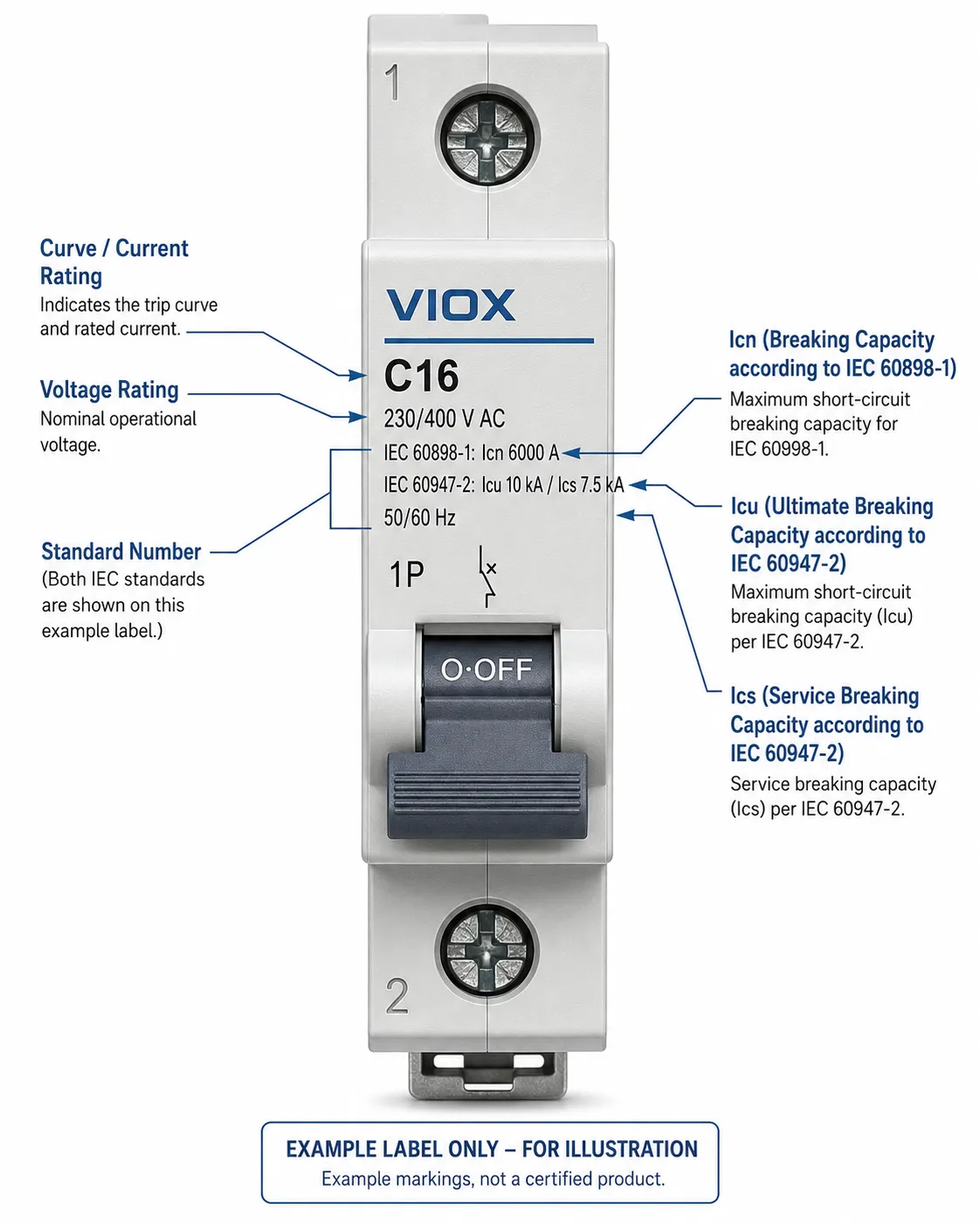
| Check item | Why it matters |
|---|---|
| Both standard numbers are shown | Confirms the device is not merely styled like an industrial MCB |
| Voltage associated with each rating | Breaking capacity can change at different operating voltages |
| Icn under IEC 60898-1 | Relevant for household and similar final-circuit use |
| Icu and Ics under IEC 60947-2 | Relevant for industrial panel and switchgear applications |
| Trip curve and magnetic threshold | B/C/D curves may not be enough for all industrial loads |
| AC/DC rating | IEC 60898-1 is AC; DC applications need explicit DC suitability |
| Temperature and installation conditions | Enclosure heat and grouping can affect practical selection |
If you are building panels for export, dual-standard marking can be useful, but it still does not replace local approval requirements such as UL, CSA, UKCA, or other regional conformity routes where applicable.
Icn vs Icu vs Ics: The Breaking Capacity Terms That Decide the Specification
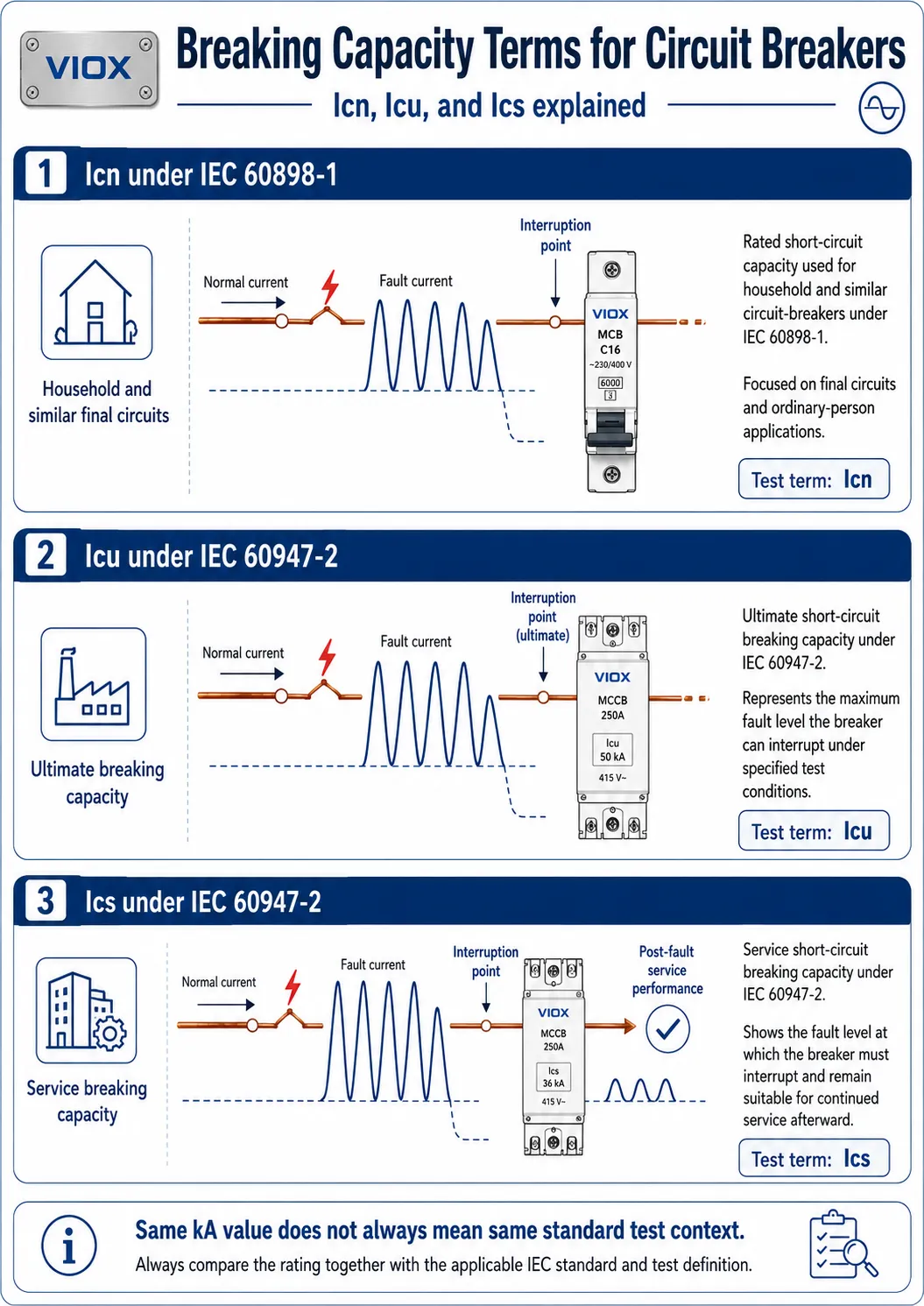
One of the most important differences between IEC 60898-1 and IEC 60947-2 is how short-circuit performance is expressed.
IEC 60898-1 typically uses Icn, the rated short-circuit capacity. IEC 60947-2 uses Icu and Ics, which tell you more about ultimate interruption and service continuity.
| Term | Standard context | Meaning | Practical interpretation |
|---|---|---|---|
| Icn | IEC 60898-1 | Rated short-circuit capacity | The short-circuit current the breaker is rated to interrupt under IEC 60898-1 test conditions |
| Icu | IEC 60947-2 | Rated ultimate short-circuit breaking capacity | The maximum short-circuit current the breaker can interrupt under IEC 60947-2 ultimate test conditions |
| Ics | IEC 60947-2 | Rated service short-circuit breaking capacity | The short-circuit current level at which the breaker is tested for service performance after interruption |
Why Icn Is Not the Same as Icu
Icn belongs to the IEC 60898-1 framework. It is highly useful for household and similar final circuits, where the breaker is expected to protect wiring and provide simple, safe operation.
Icu belongs to the IEC 60947-2 framework. It tells you the maximum fault current the breaker can interrupt under ultimate breaking-capacity test conditions. For industrial design, this value must be compared with the prospective short-circuit current at the installation point.
The mistake is treating a 6 kA marking under one standard as directly equivalent to a 6 kA value under another standard. The number matters, but the test framework behind the number also matters.
If short-circuit capacity is the main selection issue, see MCB Breaking Capacity: 6kA vs 10kA Selection Guide.
Why Ics Matters in Industrial Panels
Ics is often more important than buyers realize. It indicates the service short-circuit breaking capacity under IEC 60947-2. In many datasheets, Ics is expressed as a percentage of Icu, such as 50%, 75%, or 100%.
For a low-risk residential final circuit, the practical response after a major short circuit is often inspection and breaker replacement if needed. In an industrial process, data center, OEM machine, or critical facility, the question is not only "Can the breaker interrupt the fault?" but also "What service performance is expected after that interruption?"
That is why industrial specifications often ask for Icu and Ics together rather than only a headline kA number.
When to Specify IEC 60898-1, IEC 60947-2, or Both
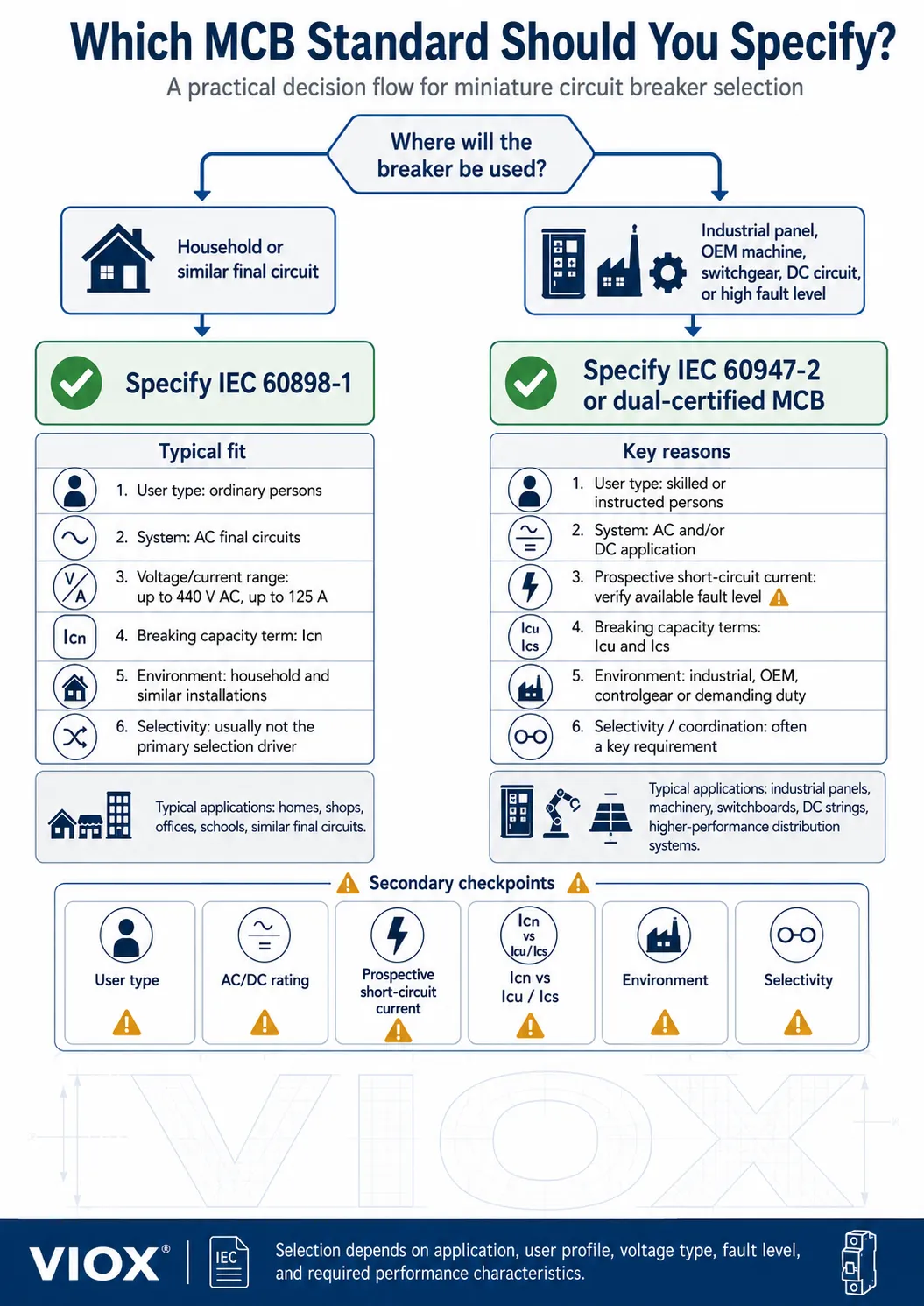
| Application | Better specification route | Engineering reason |
|---|---|---|
| Residential distribution board | IEC 60898-1 | Household/similar final-circuit use with ordinary-person operation |
| Small office or shop final circuits | IEC 60898-1, or dual-certified if specified | Similar installation environment, usually final-circuit protection |
| Commercial distribution board with higher fault level | Dual-certified or IEC 60947-2 | Short-circuit capacity and service data may need closer review |
| Machine control cabinet | IEC 60947-2 or dual-certified industrial MCB | Skilled-person environment, coordination and panel conditions matter |
| OEM equipment panel | IEC 60947-2 or dual-certified, plus local market approvals | Export projects need clear standard basis and documentation |
| Factory distribution panel | IEC 60947-2 | Industrial fault levels, environmental conditions, and selectivity matter |
| Motor control center | IEC 60947-2 | Coordination with contactors, overload relays, MPCBs, or upstream breakers must be engineered |
| Data center or critical infrastructure | IEC 60947-2 or dual-certified with reviewed Icu/Ics/selectivity | Service continuity and coordination are central |
| PV or DC circuit | Explicit DC-rated breaker under the appropriate standard and application data | IEC 60898-1 is for AC operation; DC breaking behavior requires DC-specific rating |
| Harsh environment panel | IEC 60947-2 | Damp heat, vibration, salt mist, dust, altitude, and enclosure temperature may affect selection |
This table is not a substitute for local code review. It is a specification filter: it helps you avoid using a household final-circuit standard as the default answer for industrial switchgear.
For curve and inrush selection after the standard is chosen, see Understanding Trip Curves.
Standard Selection Workflow for Panel Builders
Use this sequence before choosing the part number:
- Define the installation type. Is the breaker for a household/similar final circuit, or for an industrial panel, OEM machine, distribution board, or control cabinet?
- Identify who will operate and maintain it. Ordinary-person operation points toward IEC 60898-1. Skilled-person installation and maintenance often points toward IEC 60947-2.
- Calculate the prospective short-circuit current. Compare it with the correct breaking-capacity term for the selected standard: Icn for IEC 60898-1, Icu/Ics for IEC 60947-2.
- Confirm voltage and current ratings. Do not assume one marking applies at every system voltage.
- Check the trip curve against the load. B, C, and D curves are common, but industrial applications may require a closer look at motor starting, transformer inrush, power supplies, or high-inrush LED loads.
- Review environmental conditions. Enclosure temperature, grouping, pollution degree, humidity, vibration, and altitude can affect the right device choice.
- Verify the product marking and datasheet. If the specification requires IEC 60947-2, the breaker must show IEC 60947-2 data. Physical size or DIN-rail mounting is not proof.
- Check coordination requirements. Cascading, backup protection, and selectivity must come from manufacturer documentation for the actual breaker combination, not from generic assumptions.
For a complete current-rating and cable-coordination process, use the MCB Selection Guide.
Common Specification Mistakes
Mistake 1: Treating IEC 60898-1 as a Universal Industrial Breaker Standard
IEC 60898-1 breakers can appear in some tertiary or industrial environments when no special industrial conditions are present. But that does not mean IEC 60898-1 is automatically enough for machine panels, factory distribution, high-fault-level boards, or harsh environments.
Risk: the breaker may be accepted based on current and kA marking, while the project actually needs IEC 60947-2 data such as Icu, Ics, selectivity, or environmental suitability.
Mistake 2: Looking Only at the kA Number
A buyer sees 6 kA, 10 kA, or 15 kA and assumes the highest number is the best breaker. That is too shallow.
Risk: the breaker may have the right-looking short-circuit number under the wrong standard, at the wrong voltage, or without the required Ics value for industrial service continuity.
Mistake 3: Equating IEC 60947-2 with MCCB Only
IEC 60947-2 covers low-voltage circuit breakers. MCCBs are part of that world, but they are not the whole story. Industrial DIN-rail MCBs can also be certified to IEC 60947-2.
Risk: specifiers may reject a valid industrial MCB because they wrongly believe IEC 60947-2 automatically means MCCB.
Mistake 4: Ignoring Ics
Icu answers the ultimate breaking question. Ics adds the service-performance question. In industrial panels, that difference matters.
Risk: a breaker is selected because its Icu looks acceptable, but the application actually needs stronger service continuity after a fault event.
Mistake 5: Ignoring Pollution Degree and Environment
Industrial enclosures can expose breakers to heat, dust, humidity, vibration, salt mist, and condensation. Those are not cosmetic details; they affect insulation, creepage, corrosion, and mechanical reliability.
Risk: a breaker suitable for a clean distribution board is placed into an enclosure where the environmental assumptions no longer hold.
Mistake 6: Assuming Dual Certification Without Checking the Datasheet
Some MCBs carry both IEC 60898-1 and IEC 60947-2 data. Others do not.
Risk: the quotation says "industrial MCB," but the installed device only carries the household/similar standard needed for a different environment.
Mistake 7: Using IEC 60898-1 Logic for DC or PV Circuits
IEC 60898-1 is for AC operation. DC circuits have different arc behavior and require explicitly DC-rated devices.
Risk: an AC-only breaker is applied to a DC circuit where it may not safely interrupt fault current.
Mistake 8: Confusing Circuit-Breaker Standards with Motor-Starter Coordination
Type 1 and Type 2 coordination are commonly discussed in the context of contactors and motor starters. They should not be used as the headline difference between IEC 60898-1 and IEC 60947-2 for MCB selection.
Risk: the article, specification, or procurement document sounds technical but mixes standard families in a way that experienced engineers will immediately challenge.
Practical Examples
Example 1: Residential Distribution Board
A 230/400 V residential distribution board uses DIN-rail MCBs for socket and lighting final circuits. The expected operator is a homeowner or ordinary building occupant. The prospective short-circuit current is within the device’s marked IEC 60898-1 capacity.
Likely standard route: IEC 60898-1.
The key checks are rated current, curve, pole configuration, breaking capacity, and compatibility with the local wiring rules.
Example 2: OEM Machine Control Cabinet
An OEM builds a packaging machine panel for export. The MCBs protect control transformers, power supplies, auxiliary circuits, and small motor-related circuits. The panel is installed and maintained by trained technicians, and the customer requires industrial documentation.
Likely standard route: IEC 60947-2 or dual-certified MCBs.
The buyer should request Icu/Ics data, voltage-specific breaking capacity, trip curve information, terminal capacity, and coordination documentation where upstream protection is involved.
Example 3: Factory Distribution Panel with Higher Fault Level
A factory sub-distribution panel is installed near a transformer. The prospective short-circuit current is higher than in a typical residential final circuit, and the panel feeds several production machines.
Likely standard route: IEC 60947-2, or dual-certified breakers verified for the exact fault level.
The selection should not stop at "10 kA." It should review the standard behind the value, Icu, Ics, installation voltage, selectivity expectations, and enclosure conditions.
Example 4: DC Auxiliary Circuit
A control panel includes a DC auxiliary circuit or battery-backed DC supply. The breaker looks like an AC MCB, but the circuit is not AC.
Likely standard route: use a breaker with explicit DC voltage and breaking ratings, under the applicable standard and manufacturer data.
IEC 60898-1 alone is not the right basis for this decision because it applies to AC operation.
How VIOX Supports MCB Specification
For panel builders, OEMs, distributors, and electrical contractors, the safest MCB specification starts with the application, not the catalog number. VIOX supplies miniature circuit breakers and related low-voltage protection products for distribution boxes, control panels, and OEM electrical assemblies.
When evaluating a VIOX MCB or any alternative product, request the exact datasheet and confirm:
- applicable standard markings
- rated current and trip curve
- voltage rating
- breaking capacity under the relevant standard
- pole configuration
- terminal capacity
- operating temperature and derating guidance
- AC or DC suitability
- coordination data where required
Need help selecting MCBs for IEC panels, distribution boxes, or OEM projects? Review the VIOX MCB product page or contact the VIOX technical team for model selection support.
FAQ
Is IEC 60947-2 better than IEC 60898-1?
Not universally. IEC 60947-2 is broader and more appropriate for industrial low-voltage switchgear and controlgear applications, but IEC 60898-1 is the correct standard for many household and similar AC final-circuit applications. The right standard depends on the installation, user type, environment, and required performance data.
Can IEC 60898-1 breakers be used in industrial panels?
Sometimes, but only where the application conditions are similar and no specific industrial requirements apply. If the panel requires Icu/Ics data, selectivity studies, harsh-environment suitability, DC ratings, or skilled-person switchgear documentation, IEC 60947-2 or dual-standard certification is usually more appropriate.
What is the difference between Icn and Icu?
Icn is the rated short-circuit capacity used under IEC 60898-1. Icu is the rated ultimate short-circuit breaking capacity used under IEC 60947-2. They are not simply two names for the same value because they belong to different standard frameworks and test assumptions.
What is the difference between Icu and Ics?
Icu is the maximum short-circuit current the breaker can interrupt under ultimate breaking-capacity test conditions. Ics is the service short-circuit breaking capacity and is often expressed as a percentage of Icu. In industrial applications, Ics helps indicate service-performance expectations after fault interruption.
Is IEC 60947-2 only for MCCBs?
No. IEC 60947-2 applies to low-voltage circuit breakers, including ACBs, MCCBs, and DIN-rail MCBs when the product is designed and certified under that standard. Do not treat IEC 60947-2 as a synonym for MCCB.
Can an MCB comply with both IEC 60898-1 and IEC 60947-2?
Yes. Many industrial-grade DIN-rail MCBs are dual-certified. The product marking and datasheet must show both standards and the associated ratings. Do not assume dual certification from appearance, brand, or physical size.
Which standard should I specify for OEM panels?
For OEM control panels, IEC 60947-2 or dual-certified MCBs are usually the safer specification route because the application is normally installed and maintained by skilled persons and may require Icu/Ics data, coordination information, and industrial environmental assumptions.
Does IEC 60898-1 apply to DC breakers?
IEC 60898-1 applies to AC operation. DC circuits require explicitly DC-rated circuit breakers with suitable voltage, current, polarity, and breaking-capacity data. Do not use an AC-only IEC 60898-1 marking as proof of DC suitability.
Why do some MCB datasheets show both 6000 A and 10 kA or 15 kA values?
The values may be listed under different standards, voltages, or test conditions. For example, a breaker may show an IEC 60898-1 short-circuit capacity in amperes and IEC 60947-2 Icu/Ics values in kA. Always read the line item together with the standard and voltage.
Is a 10 kA IEC 60898-1 MCB the same as a 10 kA IEC 60947-2 MCB?
Not automatically. The kA number must be interpreted with the standard, voltage, test condition, and service-performance requirement. Two breakers with the same headline kA value may not be equivalent for an industrial panel.
Sources Reviewed
- IEC 60898-1:2015+A1:2019, Electrical accessories – Circuit-breakers for overcurrent protection for household and similar installations – Part 1: Circuit-breakers for AC operation.
- IEC 60947-2:2024, Low-voltage switchgear and controlgear – Part 2: Circuit-breakers.