

On this page
Quick Answer: Does DC Circuit Breaker Polarity Matter?
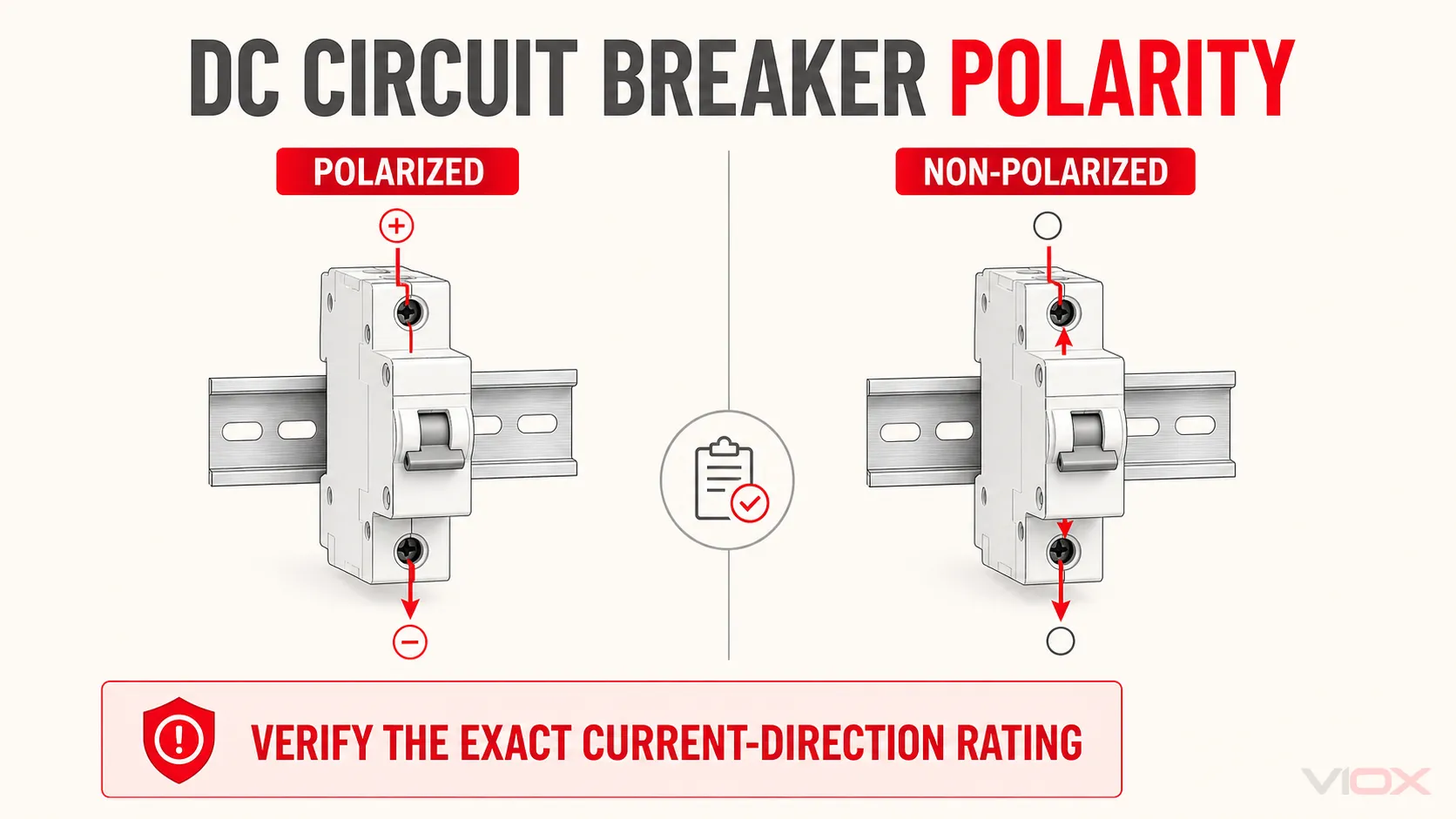
Yes, DC circuit breaker polarity matters when the breaker is a polarized design. A polarized DC miniature circuit breaker (DC MCB) must be connected according to its marked polarity or current direction so its arc-control system can operate as tested during interruption.
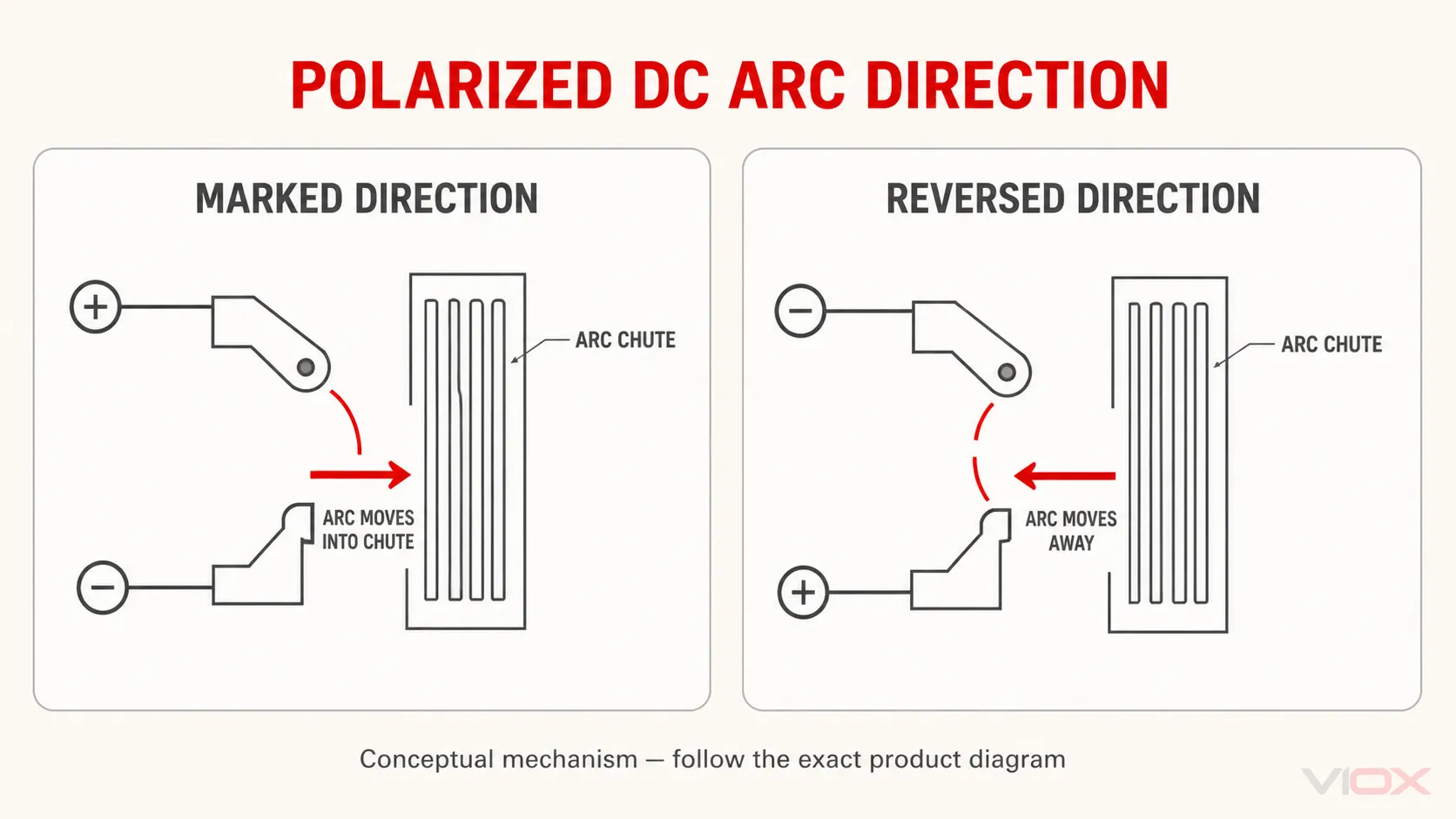
A reversed polarized DC breaker may still close and carry normal current. The danger usually appears when it opens under load or clears a fault: in a magnet-assisted design, reversed current can drive the DC arc away from the intended arc runner and arc chute.
A non-polarized DC breaker is designed to interrupt current in either direction within the conditions declared for that exact product. This can make it suitable for battery charge/discharge paths, PV storage, and other circuits where current direction may reverse. It does not remove the need to verify DC voltage, breaking capacity, pole wiring, application duty, and the manufacturer’s connection diagram.
Safety notice: DC fault interruption can produce a sustained arc. Product selection, installation, testing, and isolation should be performed by qualified electrical personnel using the exact manufacturer’s documentation and the rules applicable to the installation.
For the broader rating process, see How to Choose the Right DC Circuit Breaker. To compare available modular devices, visit the VIOX DC MCB product page.
Key Takeaways
- A polarized DC breaker depends on a defined current direction for its declared interruption performance.
- Reverse wiring may remain hidden during normal operation; the critical risk appears during load or fault interruption.
+and-identify polarity.Line,Load,Source, and arrows identify a connection or current-direction requirement. They are not interchangeable terms.- Non-polarized means the declared interruption capability is not restricted to one current direction; it does not mean unrestricted use.
- For PV and battery systems, map every possible normal and fault-current path before deciding which breaker construction is appropriate.
Polarized vs Non-Polarized DC MCB Comparison
| Item | Polarized DC MCB | Non-polarized DC MCB |
|---|---|---|
| Connection requirement | Must follow the marked polarity or current direction | May accept either current direction within declared conditions |
| Arc-control behavior | Often direction-dependent in magnet-assisted designs | Tested for interruption in either direction at the stated ratings |
| Reversing current | Do not assume it is permitted | Potentially suitable, but verify the exact bidirectional declaration |
| Typical markings | +, -, arrows, Line/Load, or a mandatory connection diagram |
“Non-polarized,” “polarity-free,” “bidirectional,” or an equivalent datasheet statement |
| Suitable use | Defined, unidirectional DC paths supported by product data | Paths that can reverse, subject to all other ratings and wiring rules |
| Always verify | DC voltage, current, breaking capacity, poles, wiring, environment | The same items plus the conditions and limitations of the bidirectional rating |
What Is a Polarized DC Circuit Breaker?
A polarized DC circuit breaker is a breaker whose declared interruption performance depends on current flowing through it in the specified direction. Many such designs use permanent magnets, arc runners, and arc chutes arranged to move an arc along a controlled path.
When the current direction matches the product design, the magnetic force helps move the arc toward the arc chute, where it is lengthened, divided, cooled, and extinguished. If the direction is reversed, the force can move the arc away from that path. The breaker may then suffer increased contact erosion, tracking, case damage, or failure to clear the fault as intended.
This is especially important in DC because the current does not cross zero every half-cycle as it does in AC. Schneider Electric identifies its C60H-DC as a polarized MCB and states that it should not be used where the current direction can change momentarily. That is product-specific evidence—not a rule that can be transferred blindly to every DC breaker.
For more detail on arc extinction and multi-pole series breaking at higher DC voltages, see 1000V DC MCB Design Challenges.
What Is a Non-Polarized DC Circuit Breaker?
A non-polarized DC circuit breaker is designed and rated to interrupt current in either direction under its declared conditions. Depending on the product, this may be described as non-polarized, polarity-free, or bidirectional.
Non-polarized does not mean “no rules.” It does not permit an installer to:
- exceed the rated DC voltage or current;
- exceed the declared DC breaking capacity;
- ignore the required number of poles or their series connection;
- assume the device is suitable for isolation;
- ignore temperature, altitude, enclosure, or coordination limits; or
- treat a product claim as proof of compliance for the complete PV or battery system.
The controlling evidence is the exact model’s datasheet, connection diagram, markings, declared standard, and—where required by the project—certificate or test documentation.
Why Reverse Polarity Can Defeat DC Arc Control
In a polarized magnet-assisted design, the interruption sequence is generally:
- The contacts separate and an arc forms.
- The product’s arc-control system moves the arc toward an arc runner and chute.
- The chute lengthens, splits, and cools the arc.
- The breaker withstands the recovery voltage after current is interrupted.
With current reversed, the magnetic force may act in the opposite direction. The breaker can appear normal while closed but fail at the moment its protective function is needed. Therefore, “reverse polarity creates an immediate short circuit” is not the correct general explanation. The more accurate concern is loss of the intended arc-control performance during interruption.
Line/Load vs +/-: Do Not Confuse Direction with Polarity
These markings describe different things:
+ / -       = electrical polarity
Line / Load = intended source and downstream sides
Top / Bottom = physical terminal positions
Arrow = direction defined by the product diagram| Marking | Usually indicates | Does not automatically prove |
|---|---|---|
+ |
Positive-polarity connection | That the terminal is always the Line side |
- |
Negative-polarity connection | That the terminal is always the Load side |
| Line or Source | Intended supply side | Positive polarity in every circuit |
| Load | Intended downstream side | Negative polarity in every circuit |
| Arrow | Required connection or current direction | Bidirectional suitability without supporting data |
No +/- marks |
No visible polarity marking | That the breaker is non-polarized |
Do not decide from terminal position, housing color, pole count, or a catalog photograph. Some products may permit reverse feeding when no Line/Load or polarity restriction is marked, but manufacturers also publish model-specific exceptions. Verify the exact device.
Where a Polarized DC Breaker May Be Suitable
A polarized breaker may be appropriate where every relevant current path is defined and remains in the approved direction, for example:
- a simple DC load branch with one source;
- some unidirectional PV string circuits;
- a DC control or auxiliary circuit with fixed source and load; or
- a telecom DC branch with documented polarity.
Even then, check maximum system voltage, available fault current, breaking capacity, pole-series arrangement, source/load orientation, earthing arrangement, environmental derating, and any possibility of backfeed from another source.
Where a Non-Polarized DC Breaker May Be the Better Fit
A non-polarized breaker may simplify protection where current can legitimately pass through the same device in either direction. Examples can include:
- battery charge and discharge paths;
- battery energy storage systems (BESS);
- PV storage and hybrid inverter systems;
- multi-source DC buses; and
- some bidirectional converter branches.
However, the application label alone does not decide the breaker. A PV system is not automatically unidirectional, and a battery system does not automatically require a non-polarized MCB at every protective point.
PV and Battery Storage: Check Current Paths, Not the Application Name
Before selecting the breaker, draw the possible current paths in every operating and fault state. ABB’s DC protection guidance shows why the network topology, earthing arrangement, maximum voltage, and available short-circuit current all affect device and pole selection. “Bidirectional” is only one gate in that wider decision.
| Circuit condition | Polarity implication | Evidence to verify |
|---|---|---|
| PV string with one defined source-to-inverter direction and no reverse feed through the device | A polarized breaker may be suitable | Exact product diagram, maximum cold-corrected voltage, fault current, pole arrangement |
| Battery charge and discharge use the same protective path | Current reverses during normal operation | Explicit bidirectional interruption rating at the required DC voltage and breaking capacity |
| Hybrid inverter or multi-source DC bus | Direction may change by mode; more than one fault source may exist | System fault-current study, converter limits, breaker direction rating, coordination |
| Maintenance isolation point | Polarity alone does not establish isolation suitability | Declared isolating function, local rules, lockout procedure, installation design |
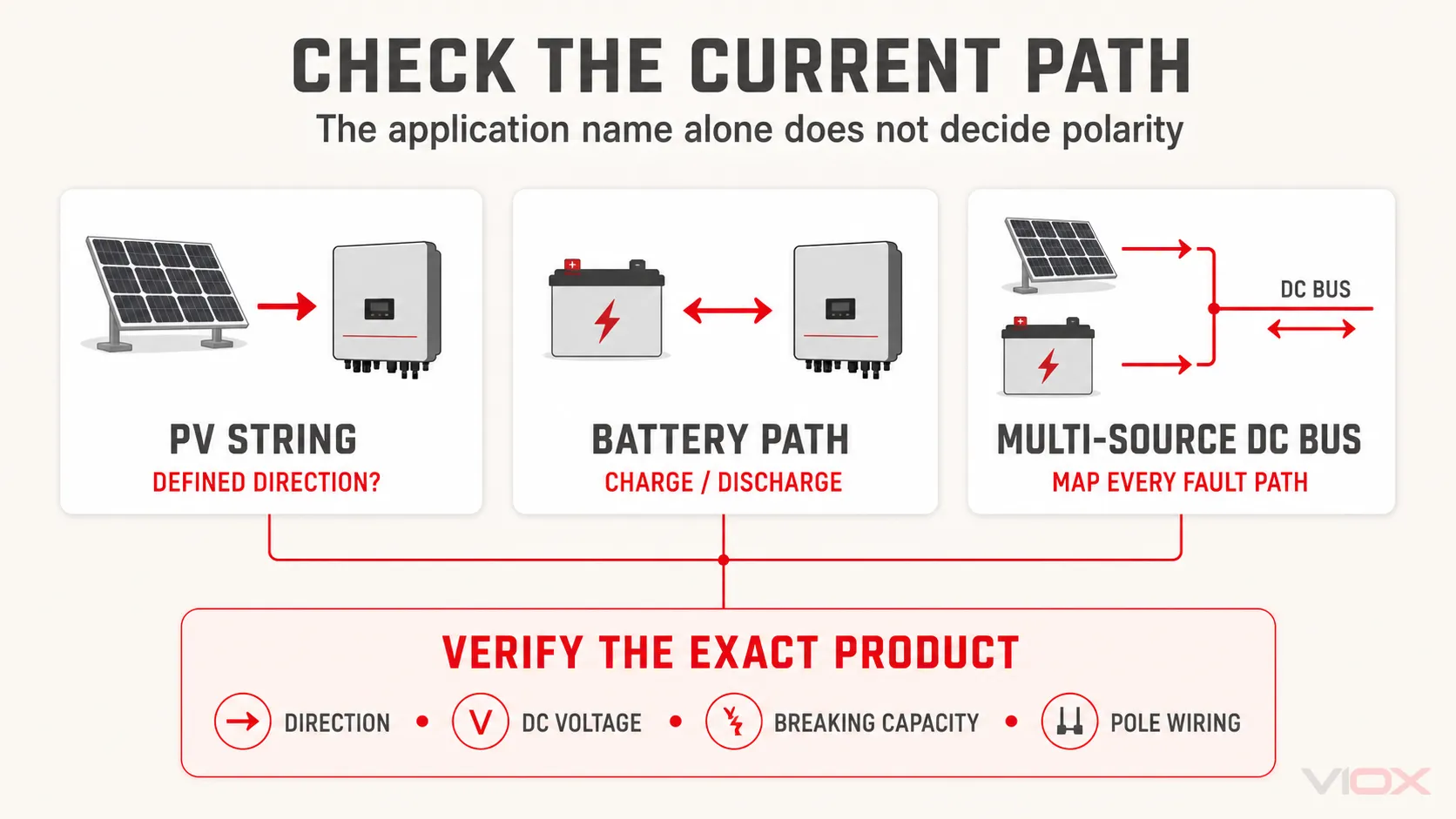
The safe rule is: use a non-polarized breaker when reverse current is possible only if the exact product is rated for that direction, voltage, fault duty, pole connection, and application. Do not infer NEC, IEC, or complete-system compliance from the words “non-polarized” alone.
How to Check Whether a DC Breaker Is Polarized
1. Read the exact datasheet
Look for polarized, non-polarized, polarity-free, bidirectional, Line/Load restrictions, and mandatory wiring diagrams. The exact catalog number matters; adjacent products in one manufacturer’s range may have different rules.
2. Inspect polarity and direction markings
Treat clear + and - markings as connection requirements unless the manufacturer’s documentation explicitly says otherwise. Interpret arrows and Line/Load labels only with the product diagram.
3. Verify the pole arrangement
At higher DC voltages, the rating may require two or more poles in series and a specific route through those poles. Never invent a universal 2P or 4P connection from the breaker’s front view.
4. Confirm bidirectional interruption—not only bidirectional conduction
A closed contact can conduct in both directions, but that does not prove the breaker can safely interrupt a fault in both directions. Ask whether the exact model is tested for bidirectional interruption at the required voltage and breaking capacity.
5. Check the whole DC duty
Confirm maximum operating voltage, rated current, available short-circuit current, time constant where relevant, earthing arrangement, temperature, altitude, enclosure heating, isolation duty, and protection coordination.
6. Do not rely on informal magnet tests
A compass or hand magnet cannot establish the tested interruption rating, internal arc path, or approved wiring. Documentation and model-specific test evidence remain authoritative.
Common Installation Mistakes
Assuming Line means + and Load means -
Line/Load describes source-to-load orientation. Positive/negative describes polarity. Follow the exact diagram.
Believing reverse wiring must fail immediately
A reversed polarized breaker may carry normal current. The dangerous failure can appear only during load or fault interruption.
Selecting by application name
“Solar breaker” or “battery breaker” is not an engineering rating. Map current directions and verify voltage, current, breaking capacity, poles, and system topology.
Treating non-polarized as unlimited
Non-polarized describes current-direction capability under stated conditions. It does not expand any other rating.
Ignoring multi-pole connection requirements
Where poles must be connected in series, the manufacturer’s approved path is part of the voltage and interruption rating.
Selection Checklist
Before approving a DC circuit breaker, confirm:
- Is the exact model polarized, non-polarized, or explicitly bidirectional?
- What do its
+,-, Line, Load, Source, and arrow markings mean? - Can normal or fault current reverse through this protective point?
- What is the maximum DC voltage in the worst operating condition?
- What fault current and DC time constant, if applicable, can occur at the device?
- What DC breaking capacity is declared at that voltage?
- How many poles must be used, and how must they be connected?
- Is isolation suitability required and declared?
- Do the certificate and test documentation match the exact model?
- Does the final installation match the manufacturer’s diagram and applicable rules?
Use the DC circuit breaker selection guide for the complete voltage, current, breaking-capacity, pole, and application workflow.
FAQ
Can a DC circuit breaker be connected backwards?
Only when the exact breaker is declared suitable for that connection and direction at the required DC voltage and interruption duty. Do not reverse a polarized breaker against its markings or wiring diagram.
What happens if a polarized DC breaker is wired backward?
It may still carry current when closed. In a direction-dependent arc-control design, the fault appears during interruption, when the arc may move away from the intended chute and the breaker may not clear the current as tested.
Is Line the same as positive on a DC breaker?
Not necessarily. Line identifies the intended source side; positive identifies polarity. Use the product diagram rather than assuming they are identical.
Are all DC MCBs polarized?
No. Some are polarized; others are declared non-polarized or bidirectional. Only the exact model documentation can answer this safely.
Are non-polarized DC breakers always better?
No. They can be a better fit where current reverses, but they must still satisfy every voltage, current, breaking-capacity, pole, isolation, environmental, and coordination requirement.
Do solar PV systems require non-polarized DC breakers?
Not automatically. The decision depends on system architecture, possible backfeed, maximum PV voltage, fault-current paths, pole arrangement, and the protection design specified by the equipment manufacturer and applicable rules.
Do battery systems require non-polarized DC breakers?
Not at every location. If charging, discharging, or fault current can pass through the same breaker in both directions, use a device whose exact data declares bidirectional interruption for the required DC duty. A polarized breaker is acceptable only where the current path is controlled and its manufacturer permits that arrangement.
Summary
DC circuit breaker polarity is an interruption requirement, not a cosmetic label. In many polarized magnet-assisted designs, current direction determines whether the arc moves into the intended arc chute. A non-polarized breaker can support either direction only within the ratings and connection conditions declared for that exact product.
For PV and battery storage, do not select from the application name alone. Map normal and fault-current directions, then verify voltage, breaking capacity, pole wiring, isolation duty, and product documentation. Review VIOX DC MCB solutions when you are ready to compare models.