

Sur cette page
Réponse rapide : quelles sont les caractéristiques nominales les plus importantes d'un parafoudre ?
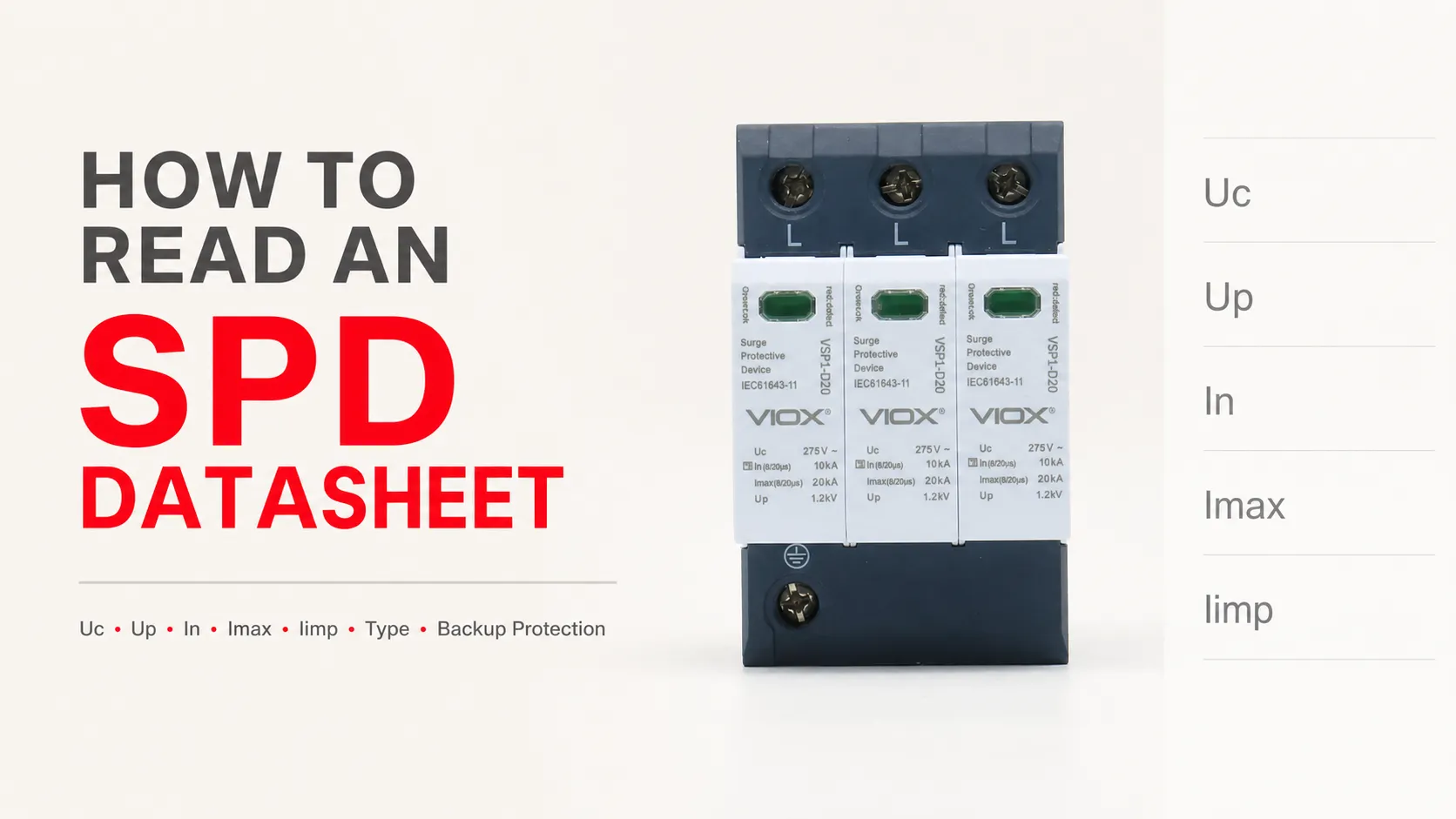
Lorsque vous ouvrez la fiche technique d'un parafoudre (SPD), la première chose que vous voyez est généralement une multitude de chiffres : Uc 275 V, Up ≤ 1,5 kV, In 20 kA, Imax 40 kA, Iimp 12,5 kA, Type 1, Type 2, fusible de protection, et parfois SCCR, Isccrou VPR. Le piège consiste à supposer qu'un seul chiffre résume toute la situation. Ce n'est pas le cas.
Lors de la lecture d'une fiche technique de parafoudre (SPD), commencez par la tension du système et le type de protection, puis vérifiez Uc/MCOV, En haut, En, Imax, Jeimp, Type 1/2/3, tension nominale AC ou DCet exigence en matière de fusible ou de disjoncteur de secours. Ne choisissez pas un parafoudre uniquement en fonction de la valeur kA la plus élevée. Un parafoudre correct doit correspondre à la tension réelle du système, au régime de neutre, à l'emplacement d'installation, à l'exposition aux surtensions, au cadre normatif et à la protection en amont.
Pour une vue d'ensemble des dispositifs, voir d'abord Qu'est-ce qu'un dispositif de protection contre les surtensions ?. Ce guide se concentre spécifiquement sur la lecture des fiches techniques et des plaques signalétiques, telle qu'elle est pratiquée par un acheteur, un tableautier ou un ingénieur électricien.
Ordre de lecture de la fiche technique d'un parafoudre
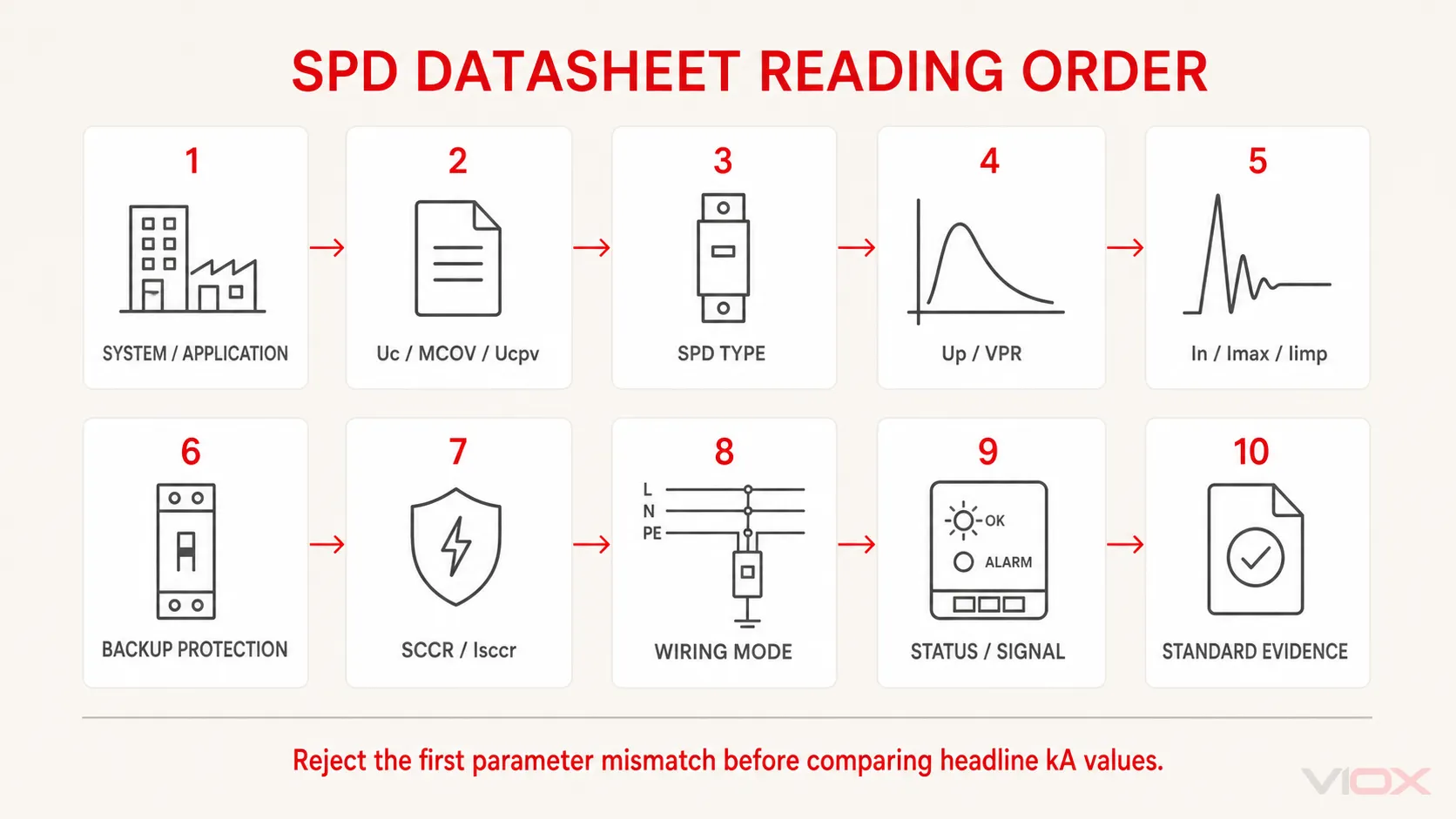
La méthode la plus sûre pour lire la fiche technique d'un parafoudre n'est pas de haut en bas. Lisez-la dans l'ordre qui permet d'éliminer le plus rapidement les produits inadaptés.
| Étape | Ce qu'il faut vérifier | Pourquoi c’est important |
|---|---|---|
| 1 | Type de système : CA, CC, PV, signal, TN-S, TN-C-S, TT, IT | Le câblage et le mode de tension du parafoudre dépendent du système |
| 2 | Uc / MCOV / Ucpv | Doit être suffisamment élevée pour la tension de service continue |
| 3 | Type de parafoudre : Type 1, Type 2, Type 3, Type 1+2 | Doit correspondre au point d'installation et à l'exposition aux surtensions |
| 4 | Up / VPR | Caractérise la performance de limitation de tension dans le cadre du référentiel d'essai applicable |
| 5 | In, Imax, Iimp | Indique la capacité de décharge de surtension selon différentes formes d'onde de test |
| 6 | Protection de sauvegarde | Une coordination des fusibles ou des disjoncteurs peut être requise |
| 7 | SCCR ou déclaration de tenue au court-circuit/courant applicable, telle que Isccr | Doit être compatible avec le courant de court-circuit présumé et la protection en amont |
| 8 | Mode de câblage et configuration des pôles | L-N, L-PE, N-PE, 3+1, 4+0, DC+/DC-, DC vers PE |
| 9 | Indication d'état et signalisation à distance | Nécessaire pour la maintenance et la surveillance |
| 10 | Normes et base de certification | Exigences CEI, UL, GB, EN ou spécifiques au projet |
Cette séquence permet d'éviter une erreur courante : sélectionner d'abord le parafoudre avec l'Imax le plus élevé, puis découvrir plus tard que la tension de service, le fusible de protection ou le type d'installation ne sont pas adaptés.
Exemple de plaque signalétique / fiche technique de parafoudre
L'étiquette d'un parafoudre basse tension typique peut inclure des marquages tels que :
Type 2, Uc 275 VCA, Up ≤ 1,5 kV, In 20 kA, Imax 40 kA, 8/20 μs, CEI 61643-11, fusible de protection max 125 A gG, contact de télésignalisation en optionVoici comment le lire :
| Marquage | Ce qu'il vous dit | Ce qu'il faut vérifier |
|---|---|---|
| Type 2 | Classe de parafoudre pour la protection contre les surtensions au niveau de la distribution | Le Type 2 est-il adapté au point d'installation ? |
| Uc 275 V CA | Tension maximale de fonctionnement continu | Est-ce conforme à la tension du système et au régime de neutre ? |
| Up ≤ 1,5 kV | Niveau de protection en tension dans les conditions d'essai normalisées | L'équipement en aval est-il correctement protégé ? |
| In 20 kA | Courant de décharge nominal, généralement 8/20 μs pour le Type 2 | La capacité de tenue aux surtensions répétées est-elle adaptée au site ? |
| Imax 40 kA | Courant de décharge maximal sous forme d'onde d'essai 8/20 μs | Ne pas considérer ceci comme une capacité répétée normale |
| IEC 61643-11 | Marquage conforme aux normes de produit pour les SPD basse tension en courant alternatif (AC) | Confirmez l'édition, le champ d'application du certificat, le modèle et la documentation d'essai justificative |
| Fusible de protection maximale 125 A gG | Protection contre les surintensités maximale admissible déclarée par le fabricant pour la configuration de SPD indiquée | Comparez le dispositif côté système avec les instructions du fabricant et déterminez si une protection de dérivation dédiée est requise |
| Contact auxiliaire | Permet le signalement d'état vers la GTC/automate/circuit d'alarme | Vérifier la capacité nominale du contact et la logique d'indication de défaut |
Les valeurs ci-dessus sont un exemple de format et non une recommandation universelle. Référez-vous toujours à la fiche technique exacte et aux normes électriques locales.
Quelle édition de la norme IEC devez-vous vérifier ?
Pour les SPD basse tension en courant alternatif (AC) actuels, IEC 61643-01:2024 contient les exigences communes pour les SPD, tandis que CEI 61643-11:2025 contient les exigences spécifiques à l'AC et s'applique conjointement avec la norme IEC 61643-01. Une étiquette portant uniquement la mention “ IEC 61643-11 ” ne suffit pas à établir l'édition, la portée du certificat ou la conformité du modèle livré avec la construction testée.
D'autres applications utilisent différentes parties de la série. Par exemple, les SPD pour applications photovoltaïques (PV) sont couverts par IEC 61643-31, tandis que les SPD pour réseaux de télécommunications et de signalisation sont couverts par IEC 61643-21:2025, qui est également utilisée avec la norme IEC 61643-01:2024. Vérifiez la catégorie du produit avant de comparer les caractéristiques nominales entre différentes normes.
Uc / MCOV : Tension maximale de régime permanent
UC est le terme IEC pour la tension maximale de régime permanent. Dans la terminologie nord-américaine, MCOV signifie tension maximale de régime permanent. Pour les parafoudres DC photovoltaïques, la fiche technique peut utiliser UCVP.
Il s'agit généralement de la première valeur nominale à vérifier, car un parafoudre connecté à une tension supérieure à sa tension nominale de régime permanent peut surchauffer, vieillir rapidement ou tomber en panne prématurément.
Erreur courante de l'acheteur
Choisir une Uc trop proche de la tension nominale.
Par exemple, pour un système 230/400 V AC, le choix ne se fait pas en lisant uniquement "230 V" dans le catalogue. La valeur Uc correcte dépend du mode de connexion phase-neutre ou phase-terre, du régime de neutre, de la tolérance de tension et du schéma de câblage prévu par le fabricant.
Pour un guide plus approfondi, voir Que signifient Uc et Up sur un parafoudre ? et Guide de la tension de fonctionnement continu maximale MCOV SPD.
Haut : Niveau de protection de tension
En haut est le niveau de protection en tension déclaré, établi selon les essais normalisés applicables. Il caractérise les performances de limitation de tension du SPD, mais ne doit pas être considéré comme la tension exacte à laquelle chaque appareil en aval sera soumis dans un système électrique installé.
Une valeur Up plus faible est généralement souhaitable car elle signifie qu'une tension de surtension moindre atteint les équipements en aval. Cependant, une valeur Up plus faible n'est utile que si Uc, le type, la coordination, la longueur des câbles et la compatibilité du système sont corrects. Un parafoudre avec un Up très bas mais un Uc incorrect, un mauvais type, une mauvaise coordination ou une protection de secours inadaptée reste un produit inapproprié.
Ce que le service des achats doit vérifier
- Valeur Up pour le mode de protection concerné
- coordination avec les parafoudres en amont et en aval
- distance par rapport à l'équipement protégé
- longueur des conducteurs et qualité de l'installation
- niveau de tenue aux chocs de l'équipement
L'installation est primordiale. Des conducteurs de parafoudre (SPD) longs augmentent la tension résiduelle effective, même si la valeur Up de la fiche technique semble satisfaisante. Si la question concerne l'emplacement, voir Où installer les SPD : Guide du panneau électrique.
Pourquoi la longueur des conducteurs peut dégrader la valeur Up réelle par rapport à la valeur Up de la fiche technique
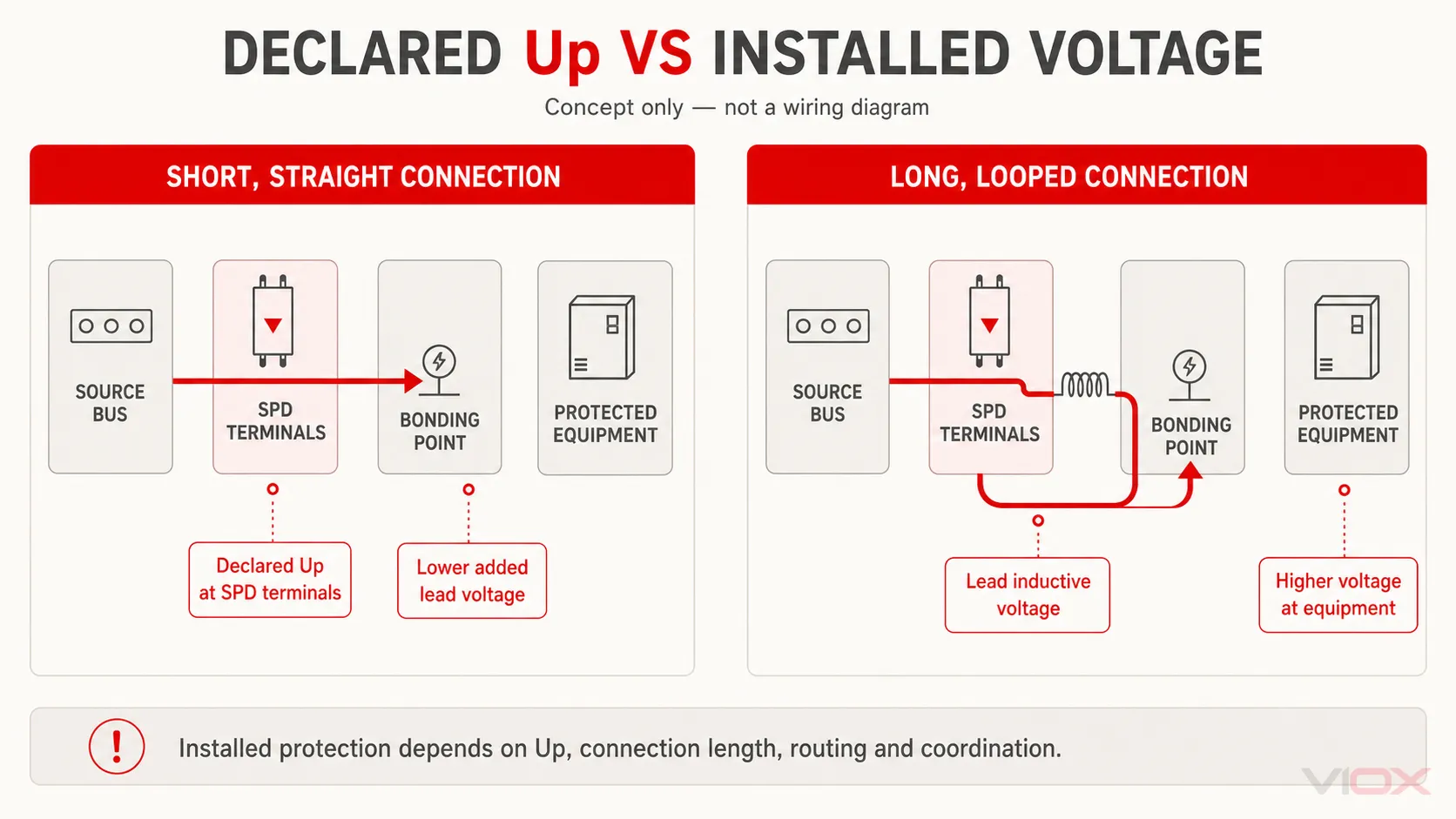
La valeur Up déclarée est établie à partir d'essais normalisés aux bornes du SPD. Dans une armoire réelle, les conducteurs de raccordement ajoutent une chute de tension inductive lors d'un courant de choc rapide. La tension apparaissant au niveau de l'équipement protégé peut donc être supérieure à la valeur Up imprimée.
C'est pourquoi les guides d'installation des SPD insistent sur des conducteurs courts et droits et sur un chemin à faible impédance vers le conducteur de protection ou le point de liaison. Deux SPD avec des valeurs Up déclarées comparables peuvent offrir une protection installée différente si leurs longueurs de connexion et leur acheminement diffèrent.
La règle d'ingénierie est simple : lisez la valeur Up sur la fiche technique, mais évaluez la protection en fonction du cheminement du circuit installé.
Décryptage des courants nominaux : In, Imax et Iimp
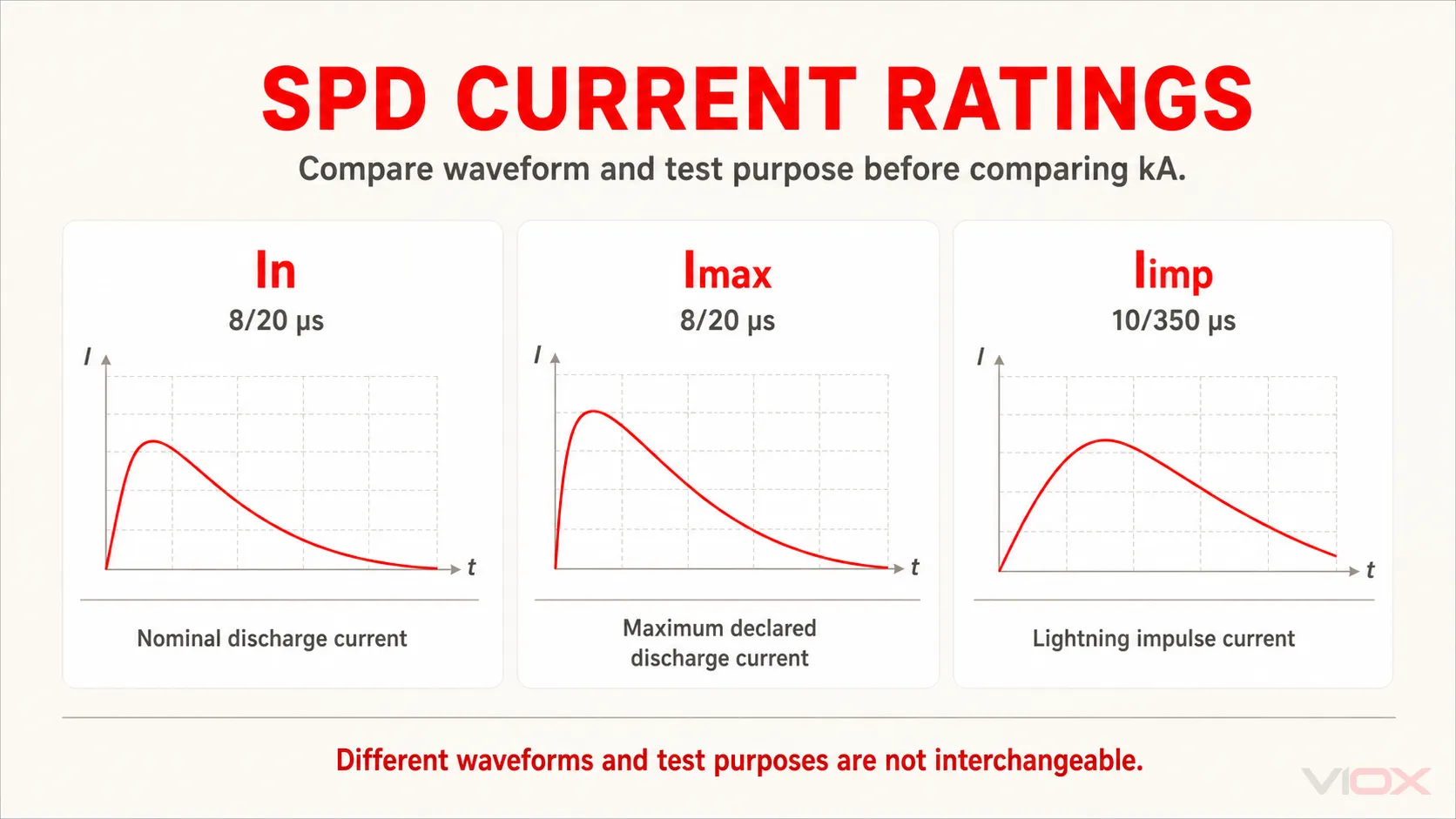
Les courants nominaux des parafoudres ne correspondent pas tous au même type de valeur en kA. Ils utilisent des formes d'onde différentes et répondent à des exigences d'approvisionnement distinctes.
| Evaluation | Forme d'onde courante | Ce qu'elle teste | Contexte général | Erreur d'approvisionnement |
|---|---|---|---|---|
| En | 8/20 μs | Courant de décharge nominal et tenue aux ondes de choc répétées | Évaluation des parafoudres de type 2 | Ignorer l'endurance et acheter uniquement selon l'Imax |
| Imax | 8/20 μs | Courant de décharge maximal déclaré dans les conditions d'essai | Capacité nominale des parafoudres de type 2 | Traitement comme une capacité répétée normale |
| Jeimp | 10/350 μs | Capacité de courant de choc de foudre | Parafoudre de type 1 ou type 1+2 | Comparaison directe avec Imax |
Pour l'approvisionnement, In est généralement plus informatif qu'Imax pour comparer la capacité de courant de décharge nominal au sein d'un même cadre d'essai, alors que Iimp est le paramètre déclaré clé lorsque le projet nécessite une capacité d'impulsion de courant de foudre. Un Imax élevé peut paraître impressionnant sur une fiche technique, mais il ne compense pas un Uc inadapté, un Up élevé, l'absence de protection de secours ou un type de parafoudre inapproprié.
In vs Imax : Courant de décharge nominal vs maximal
En est le courant de décharge nominal, généralement associé à une capacité de décharge répétée sous une onde 8/20 μs pour de nombreux parafoudres de Type 2.
Imax est le courant de décharge maximal, également basé sur une onde 8/20 μs pour les parafoudres de Type 2. Il représente un niveau de surtension déclaré plus élevé dans des conditions de test, mais ne doit pas être considéré comme le courant que le parafoudre peut supporter de manière répétée en service normal.
| Evaluation | Signification | Erreur de l'acheteur |
|---|---|---|
| En | Courant de décharge nominal ; aide à indiquer la capacité de décharge répétée | L'ignorer et ne regarder que l'Imax |
| Imax | Courant de décharge maximal sous onde déclarée | Considérer cela comme une capacité de fonctionnement normale |
| 8/20 μs | Forme d'onde du courant de choc couramment utilisée pour les tests de type 2 | Comparer les valeurs en kA sans vérifier la forme d'onde |
Pour une comparaison détaillée, voir Valeurs nominales Imax et In pour les dispositifs de protection contre les surtensions et Guide de dimensionnement de la valeur nominale kA du SPD.
Iimp : Pourquoi les parafoudres de type 1 utilisent le courant d'impulsion
Jeimp signifie courant d'impulsion. Il est généralement associé aux parafoudres de type 1 et à la 10/350 μs forme d'onde. Pour un même courant de crête, cette impulsion d'essai représente une charge et une énergie spécifique nettement plus élevées qu'une impulsion 8/20 μs ; par conséquent, les deux valeurs en kA ne sont pas interchangeables.
C'est là que se produisent de nombreuses erreurs d'approvisionnement. Une valeur de 25 kA n'est pas automatiquement meilleure ou pire qu'une valeur de 40 kA, à moins que la forme d'onde et le type de parafoudre ne soient identiques.
| Paramètre | Forme d'onde courante | Contexte courant des parafoudres (SPD) | Ce qu'il indique |
|---|---|---|---|
| En | 8/20 μs | Type 2 | Capacité de décharge nominale |
| Imax | 8/20 μs | Type 2 | Courant de décharge maximal déclaré |
| Jeimp | 10/350 μs | Type 1 | Capacité de courant de choc de foudre |
Si le bâtiment est équipé d'un système de protection externe contre la foudre, d'une alimentation aérienne ou si le projet impose des exigences de décharge de courant de foudre, le choix d'un parafoudre de Type 1 ou de Type 1+2 peut être nécessaire. Ne remplacez pas une exigence Iimp de Type 1 par une valeur Imax de Type 2.
Parafoudre de Type 1 vs Type 2 vs Type 3
Le type de parafoudre décrit l'emplacement et le mode d'utilisation prévus pour l'appareil. Les types 1/2/3 selon la norme CEI et les types 1/2/3 selon la norme UL sont des concepts apparentés mais ne constituent pas des systèmes identiques ; ne les comparez donc pas sans vérifier la norme applicable.
| IEC SPD Type | Contexte d'application IEC typique | Paramètre nominal clé |
|---|---|---|
| Type 1 | Origine de l'installation ou limite de zone LPZ où un courant de foudre partiel peut être attendu | Iimp, comportement du courant de suite le cas échéant, coordination en amont |
| Type 2 | Tableau général basse tension ou tableau divisionnaire | In, Imax, Up, Uc |
| Type 3 | À proximité d'équipements sensibles et coordonné avec la protection en amont | Uoc ou données applicables d'onde combinée, niveau de protection en tension, coordination |
| Type 1+2 | Protection combinée contre la foudre et les surtensions | Iimp et paramètres de performance de type 2 |
Il s'agit de contextes d'application IEC typiques et non d'étiquettes d'emplacement universelles. Les désignations de Type UL suivent le cadre de la norme UL 1449 et doivent être interprétées à partir de la documentation produit UL applicable plutôt que d'être directement associées au tableau IEC.
Pour une comparaison complète, voir Dispositif de protection contre les surtensions Type 1 vs Type 2 vs Type 3.
Caractéristiques nominales des parafoudres AC vs DC / PV
Les parafoudres AC et DC ne sont pas interchangeables, sauf si la fiche technique prend explicitement en charge l'application.
Pour les systèmes d'alimentation CA, lire :
- Uc / MCOV (Tension maximale de régime permanent)
- tension du système
- Le régime de neutre (système de mise à la terre)
- Type 1/2/3
- la configuration des pôles
- fusible ou disjoncteur de secours
- SCCR ou déclaration de tenue au court-circuit/courant applicable, telle que Isccr
Pour les applications PV CC ou BESS CC, lire également :
- Ucpv ou tension de fonctionnement CC nominale
- tension en circuit ouvert maximale de la chaîne PV
- polarité et mode de câblage
- modes de protection CC+/CC-, CC vers PE
- IEC 61643-31 ou base normative pertinente pour les parafoudres DC/PV
- protection de secours et comportement en cas de court-circuit DC
Pour les applications spécifiques en courant continu (DC), voir Parafoudres DC : Guide de sélection pour le photovoltaïque, les bornes de recharge VE, le stockage d'énergie (BESS) et les applications industrielles et Guide de protection contre les surtensions pour les BESS.
Exigence de fusible ou de disjoncteur de protection de secours
Le fusible de secours ou la ligne de disjoncteur de secours est une limite d'installation du fabricant, et non une spécification décorative. Il identifie l'agencement de protection contre les surintensités autorisé pour la configuration SPD indiquée et doit être interprété conjointement avec le dispositif de protection côté système, le courant de court-circuit présumé, la disposition des conducteurs et les instructions du fabricant.
Selon la conception et l'installation du parafoudre, une protection de secours peut être nécessaire pour :
- déconnecter le parafoudre en toute sécurité après une défaillance en fin de vie
- coordonner avec le courant de court-circuit disponible
- empêcher la protection amont de dépasser les conditions testées
- respecter les instructions d'installation du fabricant
- satisfaire aux exigences des normes locales ou des normes de tableau
Ce qu'il faut vérifier
| Ligne de fiche technique | Pourquoi c’est important |
|---|---|
| Fusible de secours max | Comparez la protection côté système avec le maximum déclaré ; un fusible de dérivation dédié pour le SPD peut être nécessaire lorsque le dispositif en amont le dépasse |
| Option de disjoncteur de secours | Confirmer la courbe, le calibre et le pouvoir de coupure du disjoncteur si autorisé |
| SCCR / Isccr / déclaration de court-circuit applicable | Vérifiez la norme exacte, la tension, la combinaison de protection et la condition de courant de défaut présumé |
| Sectionneur intégré | Ne dispense pas toujours d'une protection en amont |
| Type de fusible | Les exigences gG, gL, de classe ou spécifiques au fabricant doivent être respectées |
Si la fiche technique indique qu'une protection de secours est requise, ne pas l'omettre sous prétexte que le parafoudre possède déjà un indicateur ou un déconnecteur thermique.
Comment interpréter “ max backup fuse 125 A gG ”
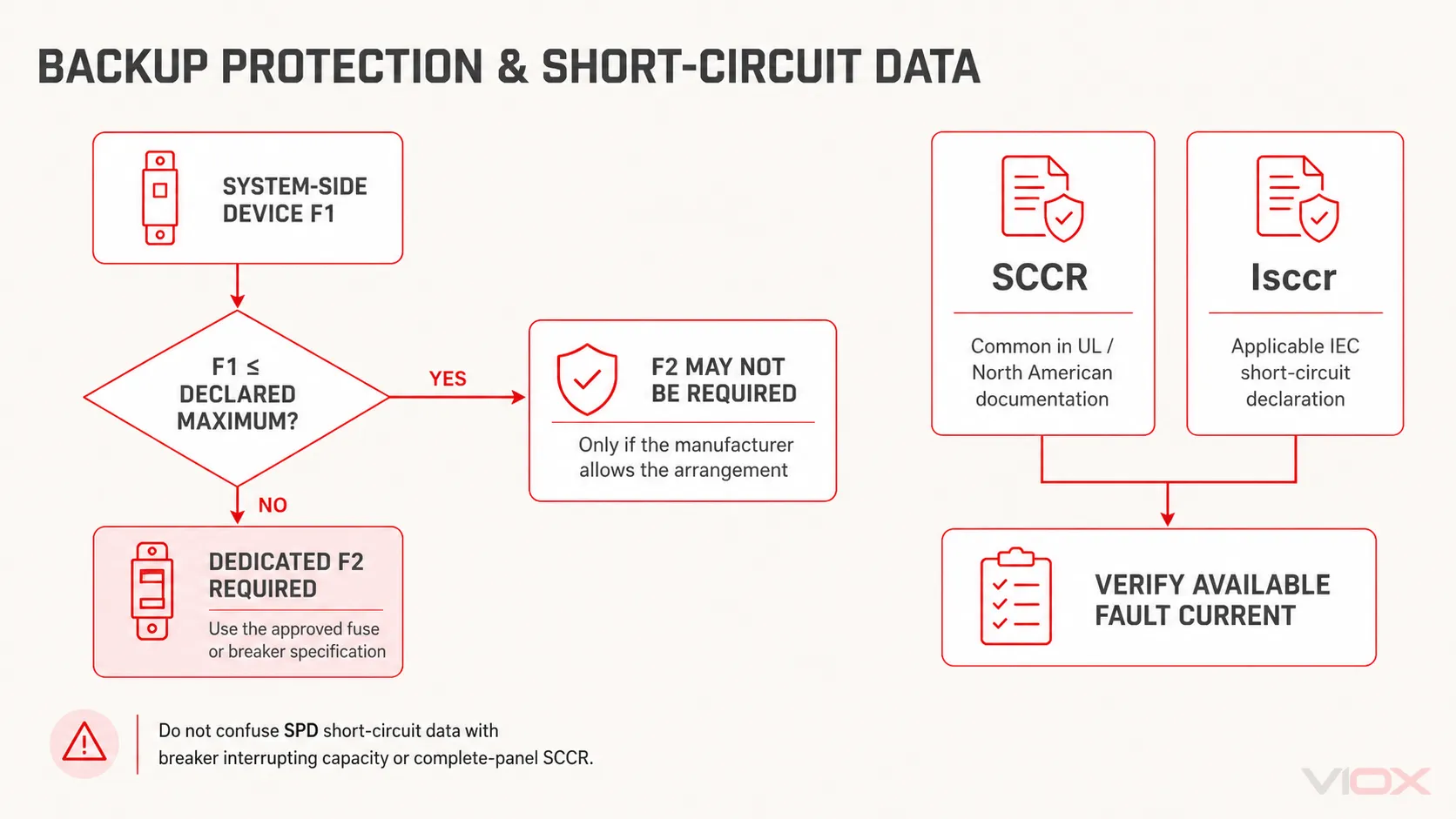
N'interprétez pas automatiquement ce marquage comme signifiant que “ l'installation entière ne peut pas avoir un fusible en amont supérieur à 125 A ”. Pour un SPD branché en dérivation, utilisez les instructions de coordination du fabricant :
- Si le dispositif de protection côté système F1 est égal ou inférieur à la valeur autorisée, un fusible de branchement SPD séparé F2 peut ne pas être nécessaire, à condition que le fabricant autorise cet agencement.
- Si F1 dépasse le maximum déclaré, un fusible de branchement dédié ou un autre dispositif de protection contre les surintensités approuvé est normalement requis.
- Si un disjoncteur est autorisé à la place d'un fusible gG, vérifiez son calibre, sa courbe de déclenchement, son pouvoir de coupure et l'équivalence indiquée par le fabricant. Ne présumez pas que des calibres en ampères identiques sont interchangeables.
- Vérifiez la tenue aux chocs du dispositif de protection de secours sélectionné afin qu'il ne déconnecte pas le SPD lors d'une surtension dans les limites de service prévues.
La terminologie des courts-circuits dépend également du cadre normatif. SCCR est courant dans la documentation nord-américaine et UL. Les fiches techniques IEC peuvent plutôt déclarer une valeur de courant/tenue au court-circuit telle que Isccr. Aucune de ces valeurs ne doit être confondue avec le pouvoir de coupure du disjoncteur situé en amont ou avec le SCCR du tableau complet.
Pour les erreurs d'installation, voir Guide de correction des erreurs d'installation de parafoudres et Exigences d'installation des parafoudres (SPD) : codes et normes de sécurité.
Signalisation à distance, indicateur de défaillance et module remplaçable
L'indication d'état du parafoudre est essentielle car un SPD peut atteindre sa fin de vie après des expositions répétées aux surtensions. Si personne ne vérifie l'indicateur, le tableau peut sembler protégé alors que le module SPD n'est plus fonctionnel.
Les caractéristiques d'état courantes incluent :
- voyant visuel vert/rouge
- module enfichable remplaçable
- contact de signalisation à distance
- sortie d'alarme pour GTC, API, SCADA ou voyant de tableau
- Détrompage de la cartouche pour éviter tout remplacement incorrect
Lors de la lecture de la fiche technique, vérifiez si le contact auxiliaire est normalement ouvert, normalement fermé, inverseur ou à sécurité intégrée selon la logique d'alarme requise. Vérifiez également le pouvoir de coupure du contact avant de le câbler dans un circuit d'alarme.
Ce que les caractéristiques nominales des parafoudres ne vous disent pas
Deux parafoudres peuvent afficher des caractéristiques nominales similaires : Type 2, Uc 275 VCA, Up ≤ 1,5 kV, In 20 kA, Imax 40 kA. Cela ne signifie pas automatiquement qu'ils vieilliront, se déconnecteront, indiqueront une défaillance ou fonctionneront de manière cohérente de la même façon.
Les fiches techniques indiquent les valeurs nominales déclarées lors des tests. Elles ne reflètent pas entièrement la rigueur de fabrication derrière ces valeurs.
Qualité et cohérence des varistances (MOV)
De nombreux parafoudres basse tension utilisent des varistances à oxyde métallique (MOV) comme principal composant limiteur de tension. Les caractéristiques de la MOV influencent le comportement d'écrêtage, le courant de fuite, le vieillissement, la contrainte thermique et la répartition du courant entre les chemins de protection.
Pour les achats, demandez :
- Les caractéristiques nominales des MOV sont-elles adaptées à la tension Uc déclarée et à la capacité d'écoulement de courant de choc ?
- Les MOV sont-ils appariés de manière cohérente entre les pôles ou les modules ?
- Existe-t-il une traçabilité par lot pour les composants de protection contre les surtensions critiques ?
- Le fabricant contrôle-t-il l'inspection des composants entrants ?
Cela ne signifie pas que chaque acheteur doit auditer la production des MOV. Cela signifie qu'un fournisseur sérieux doit être en mesure d'expliquer les contrôles de qualité des composants qui justifient la classification du parafoudre (SPD).
Conception du déconnecteur thermique
Un parafoudre (SPD) doit défaillir en toute sécurité en fin de vie. Pour les parafoudres à base de MOV, le déconnecteur thermique est une fonction de sécurité critique. Il déconnecte le MOV du circuit lorsque la surchauffe ou la dégradation crée une situation dangereuse.
Lors de la comparaison des produits, vérifiez :
- si le parafoudre dispose d'un déconnecteur interne
- comment l'indication de défaillance est liée au mécanisme de déconnexion
- si le module dispose d'une indication d'état visible
- si une protection de secours externe est toujours requise
- si la fiche technique explique clairement le comportement en fin de vie
Ne présumez pas qu'une fenêtre verte/rouge prouve à elle seule que la conception de la déconnexion est robuste. L'indicateur n'est utile que s'il reflète correctement l'état de la protection interne.
Boîtier, contrôle de l'arc et comportement au feu
Les matériaux du boîtier et la disposition interne des parafoudres (SPD) sont importants car les composants de protection contre les surtensions peuvent subir des contraintes thermiques et électriques. La fiche technique peut indiquer l'indice d'inflammabilité, les données d'isolation ou la conformité aux normes, mais l'acheteur doit toujours vérifier si le produit est adapté à l'environnement du tableau électrique et au niveau de défaut attendu.
Les points de contrôle importants incluent :
- l'indice d'inflammabilité du boîtier lorsqu'il est spécifié
- la conception de l'espacement et de l'isolation
- la séparation interne des parties sous tension
- la conception du verrouillage et du remplacement des modules
- la résistance des bornes et la compatibilité des conducteurs
Évitez de prendre des décisions uniquement sur la base de l'étiquette frontale. La qualité du déconnecteur interne et la conception du boîtier font partie intégrante de la sécurité réelle d'un parafoudre.
Certification et constance de la production
Un certificat ou une référence à une norme est important, mais il doit correspondre au modèle réel acheté. Pour les équipementiers (OEM), les distributeurs et les tableautiers, la question pratique n'est pas seulement " un échantillon a-t-il été testé ? " mais aussi " la production reste-t-elle conforme à la conception testée ? "
Demandez :
- une correspondance exacte du numéro de modèle entre la fiche technique, le certificat et l'étiquette du produit
- la norme applicable et la portée du rapport d'essai
- la traçabilité des lots de production
- le contrôle des modifications de composants
- des instructions d'installation correspondant au produit livré
- Instructions claires concernant le fusible ou le disjoncteur de protection
Cette section est celle où les équipes d'approvisionnement sérieuses distinguent une véritable spécification d'une simple déclaration de catalogue.
Erreurs d'approvisionnement courantes
1. Acheter uniquement en fonction de l'Imax
Un chiffre Imax élevé semble attrayant, mais il ne prouve pas que le parafoudre (SPD) est adapté. Uc, Up, Type, forme d'onde, protection de secours et point d'installation sont tous importants.
2. Comparer l'Iimp de Type 1 avec l'Imax de Type 2
Ces valeurs sont basées sur des formes d'onde et des objectifs de test différents. Ne les comparez pas comme s'il s'agissait du même type de valeur nominale en kA.
3. Ignorer l'Uc / MCOV
Un parafoudre avec une tension de fonctionnement continu trop faible peut tomber en panne prématurément. Un parafoudre avec une tension nominale trop élevée peut offrir une limitation de tension moins efficace. Effectuez votre choix en fonction du système réel.
4. Considérer qu'un niveau de protection (Up) plus bas est toujours préférable
Un Up plus bas n'est utile que si le parafoudre est correctement coordonné et installé. La longueur des câbles, le chemin de mise à la terre, la coordination avec le parafoudre en amont et la tension du système restent déterminants.
5. Utiliser un parafoudre AC sur des circuits DC photovoltaïques
Les systèmes DC/PV nécessitent des parafoudres classés pour le courant continu avec une tension Ucpv et un mode de câblage appropriés. Ne vous fiez pas aux marquages AC pour remplacer les caractéristiques nominales PV/DC.
6. Absence de protection de secours
Si la fiche technique du parafoudre spécifie un fusible ou un disjoncteur de secours maximal, celui-ci doit être pris en compte lors de la conception du tableau.
7. Confusion entre les normes de produits
IEC 61643-01:2024, IEC 61643-11:2025, IEC 61643-31, IEC 61643-21:2025, UL 1449 et GB/T 18802 ne couvrent pas tous la même catégorie de produit ou le même cadre de certification. Pour un produit IEC AC, lisez la norme IEC 61643-11:2025 conjointement avec la norme IEC 61643-01:2024 ; pour d'autres applications, vérifiez la partie et l'édition applicables.
Pour une comparaison des normes, voir Normes de protection contre les surtensions : IEC 61643 vs UL 1449 vs GB 18802.
Liste de contrôle des spécifications du parafoudre (SPD)
Utilisez cette liste de contrôle avant d'approuver l'achat ou l'assemblage en tableau d'un parafoudre.
| Élément de contrôle | Question de réussite / échec |
|---|---|
| Type de système | S'agit-il d'un système AC, PV DC, BESS DC, de recharge de VE, de signal ou de ligne de données ? |
| Tension | Uc / MCOV / Ucpv correspondent-ils à la tension réelle du système et à sa tolérance ? |
| Point d'installation | Le type de parafoudre est-il adapté à une utilisation en entrée de service, en tableau de distribution ou côté équipement ? |
| Système de mise à la terre | Le câblage du parafoudre est-il conforme aux régimes de neutre TN-S, TN-C-S, TT, IT ou aux spécifications de mise à la terre du projet ? |
| Niveau de protection | Le niveau de protection Up est-il adapté aux équipements en aval et à la coordination ? |
| Capacité d'écoulement de surtension | Les valeurs In, Imax ou Iimp sont-elles appropriées au niveau d'exposition ? |
| Forme d'onde | Comparez-vous bien du 8/20 μs avec du 8/20 μs et du 10/350 μs avec du 10/350 μs ? |
| Protection de sauvegarde | L'exigence relative au fusible/disjoncteur est-elle incluse dans la conception du tableau ? |
| Données de court-circuit | Le SCCR, Isccr ou toute autre valeur de court-circuit déclarée applicable est-il compatible avec le courant de défaut disponible et la protection en amont ? |
| État du module | Une indication visuelle ou une signalisation à distance est-elle nécessaire ? |
| Standard | La norme correspond-elle au marché et à l'application ? |
| Documentation | La fiche technique, le schéma de câblage, le certificat et le numéro de modèle sont-ils cohérents ? |
FAQ
Quelle est la caractéristique nominale la plus importante pour un parafoudre (SPD) ?
Il n'y a pas une seule caractéristique plus importante que les autres. Uc/MCOV est prioritaire car le SPD doit supporter la tension normale du réseau. Ensuite, vérifiez le type, Up, In, Imax, Iimp, la protection de secours et la norme de référence.
Imax est-il plus important que In ?
Non. Imax indique le courant de décharge maximal déclaré dans des conditions d'essai, généralement pour les parafoudres de type 2 avec une onde 8/20 μs. In est plus utile pour comprendre la capacité nominale de tenue aux surtensions répétées. Les deux doivent être interprétés conjointement.
Quelle est la différence entre Uc et Up ?
Uc est la tension maximale de fonctionnement continu pour le mode et les conditions indiqués. Up est le niveau de protection en tension déclaré établi selon les tests normalisés applicables. Uc concerne la compatibilité avec la tension continue du système ; Up caractérise la limitation des surtensions, tandis que la tension au niveau de l'équipement protégé dépend également du chemin de connexion installé et de la coordination.
Que signifie Iimp sur un parafoudre ?
Iimp signifie courant d'impulsion. Il est généralement associé aux parafoudres de type 1 et à l'onde 10/350 μs utilisée pour les essais d'impulsion de courant de foudre.
Puis-je comparer un Imax de 40 kA avec un Iimp de 25 kA ?
Pas directement. Imax et Iimp utilisent des formes d'onde et des objectifs de test différents. À courant de crête égal, l'impulsion de test 10/350 μs représente une charge et une contrainte en énergie spécifique nettement plus élevées que l'impulsion 8/20 μs.
Chaque parafoudre (SPD) nécessite-t-il un fusible de protection ?
Pas toujours de la même manière, mais la fiche technique doit être respectée. Certains parafoudres nécessitent une protection externe en fonction de certaines conditions de fusible amont ou de courant de court-circuit. D'autres peuvent inclure des dispositifs de déconnexion internes tout en ayant des limites d'installation.
Que signifie la signalisation à distance sur un parafoudre ?
La signalisation à distance signifie que le parafoudre dispose d'un contact auxiliaire qui transmet son état à un voyant de tableau, une GTC, un automate (PLC), un système SCADA ou un circuit d'alarme. Vérifiez le type de contact et ses caractéristiques nominales avant le câblage.
Les parafoudres AC peuvent-ils être utilisés dans des systèmes DC ou photovoltaïques ?
Uniquement si la fiche technique spécifie explicitement que le parafoudre est conçu pour cette application DC ou photovoltaïque. Les systèmes PV/DC nécessitent une valeur Ucpv correcte, un mode de câblage approprié, une polarité le cas échéant, et une conformité aux normes DC/PV.
Résumé
La lecture correcte d'une fiche technique de parafoudre repose principalement sur l'ordre et le contexte. Commencez par la tension du système et le type d'application, puis confirmez les valeurs Uc/MCOV, Up, Type, In, Imax, Iimp, la protection de secours, le mode de câblage, l'indication d'état et la norme de référence.
La meilleure habitude d'achat est simple : ne jamais valider un parafoudre sur la base d'une valeur unique en kA. Un parafoudre adapté est celui dont l'ensemble des caractéristiques correspond au système électrique réel, au point d'installation, à l'exposition aux surtensions et à la conception de la protection du tableau.
Pour l'examen du produit, voir la page produit VIOX SPD page produit SPD, ou utilisez les guides connexes ci-dessus pour comparer les paramètres individuels plus en détail.
Sources utilisées
- IEC 61643-01:2024 : Exigences générales et méthodes d'essai pour les SPD
- IEC 61643-11:2025 : SPD connectés aux systèmes électriques basse tension AC
- IEC 61643-21:2025 : SPD pour les réseaux de télécommunications et de signalisation
- Phoenix Contact : Le fusible de protection adapté pour les parafoudres
- VIOX : Qu'est-ce qu'un parafoudre ?
- VIOX : Signification de Uc et Up sur un parafoudre
- VIOX : Imax vs In, les caractéristiques nominales des parafoudres
- VIOX : Normes de protection contre les surtensions IEC 61643 vs UL 1449 vs GB 18802