


On this page
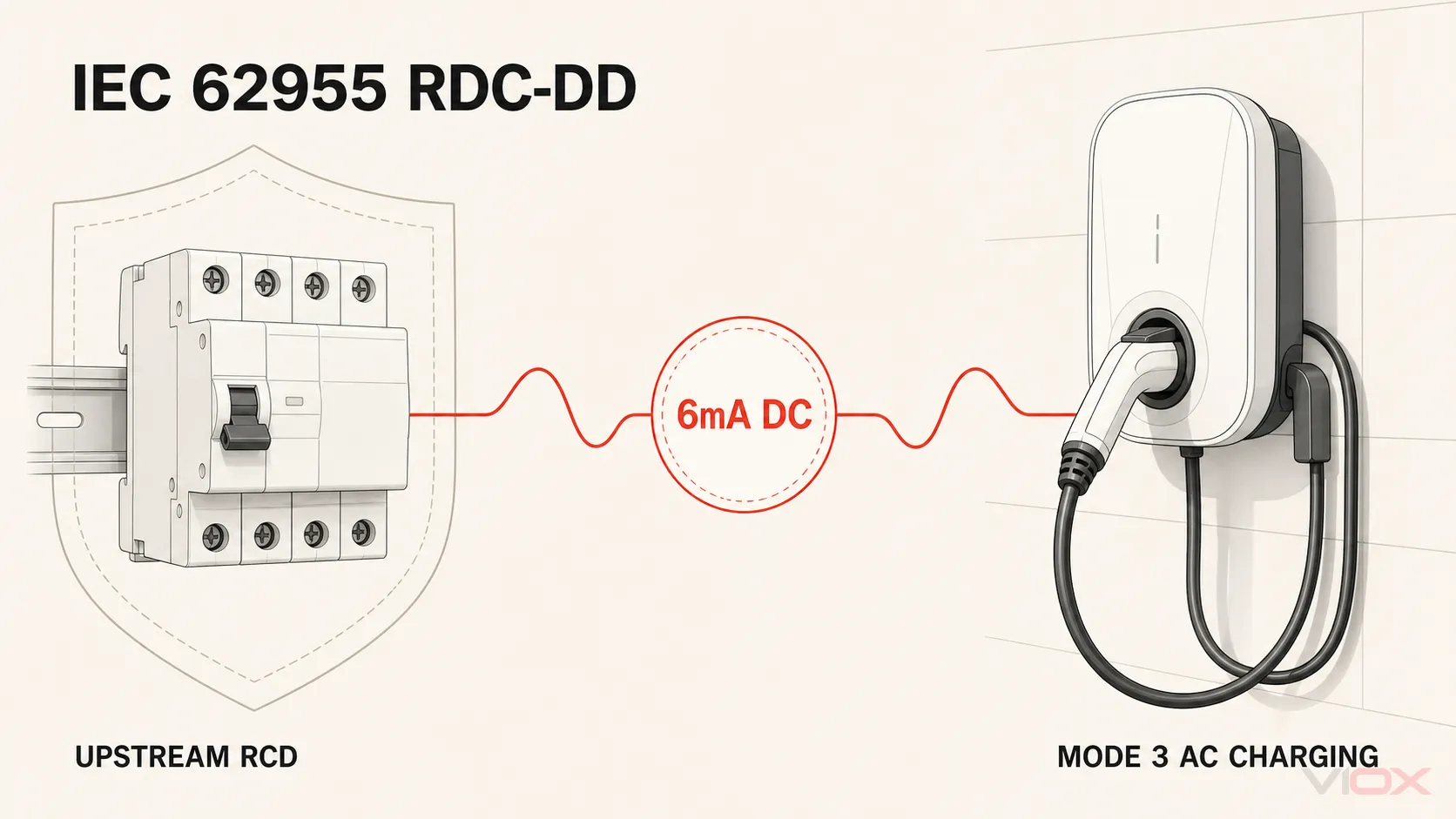
IEC 62955:2018 covers residual direct current detecting devices (RDC-DDs) for permanently connected Mode 3 AC electric vehicle charging stations within its stated ratings. An RDC-DD detects smooth residual DC at 6 mA or above and removes or initiates removal of the EV supply so that the correct operation of an upstream Type A or Type F Residual Current Device (RCD) is not impaired.
An RDC-DD is not simply another RCCB waveform type. IEC 62955 distinguishes residual direct current monitoring devices (RDC-MDs) from residual direct current protective devices (RDC-PDs), and the switching/isolation boundary depends on the architecture. A datasheet statement such as “6mA DC protection” does not by itself prove IEC 62955 conformity, the upstream RCD requirement, or the method used to open the circuit.
IEC 62955 Scope at a Glance
The most useful way to apply IEC 62955 is to separate what the standard covers, what falls outside its declared scope, and what a product-standard claim still does not prove about an installation.
| Question | IEC 62955:2018 boundary | Practical implication |
|---|---|---|
| What equipment is covered? | RDC-DDs for permanently connected AC Mode 3 EV charging stations | Confirm the EVSE architecture before using the standard as the product pathway |
| What classes are identified? | RDC-MD monitoring devices and RDC-PD protective devices | Identify which class and interface the exact product uses |
| What residual current is central? | Smooth residual DC equal to or above 6 mA | The function protects upstream Type A or Type F RCD operation from impairment by excessive smooth DC |
| What supply ratings are in the main scope? | Up to 440 V AC, 50/60 Hz, and rated current up to 125 A | Do not extend a certificate beyond its stated model and ratings |
| What systems are addressed? | Single-phase or multiphase AC circuits in TN, TT, and IT systems | Installation compliance still depends on the relevant system rules |
| Where is the device used? | Within the fixed installation | Portable and other charging arrangements require their own applicable product pathway |
| Is bidirectional power flow covered? | The 2018 document states that its RDC-DDs are not intended for bilateral power flow between the EV and fixed installation | Vehicle-to-grid or bidirectional EVSE needs a separate standards and manufacturer review |
| Does IEC 62955 replace installation rules? | No | Product conformity does not prove that the complete circuit complies with national wiring rules |
| Does it prove the upstream RCD is correct? | No | Follow the EVSE instructions, applicable rules, and exact RCD/RCCB/RCBO documents |
IEC publications are international standards, while adoption and installation requirements can differ by country or region. State the applicable national edition and project specification instead of claiming that one arrangement is universally mandatory.
Why the 6mA Smooth-DC Threshold Matters
EV charging equipment contains power-electronic conversion stages. Under a fault condition, smooth DC residual current may flow in the AC-side protective-conductor path. A conventional Type A or Type F RCD is not intended to provide the same smooth-DC response as a Type B RCD. Sufficient DC bias can impair the upstream device’s ability to respond correctly to the residual-current waveforms it is designed to detect—a condition often described as RCD blinding.
IEC 62955 uses 6 mA smooth residual DC as the threshold at which the RDC-DD is intended to remove or initiate removal of the EV supply. The standard’s stated purpose is to prevent smooth DC above that value from impairing the correct functionality of an upstream Type A or Type F RCD.
Keep three values separate:
| Value or marking | What it describes | What it does not describe |
|---|---|---|
| 6 mA DC | RDC-DD smooth residual-DC operating boundary | The upstream RCD’s rated residual operating current |
| 30 mA IΔn, when required by the applicable design | Rated residual operating current of an RCD/RCCB/RCBO | RDC-DD class or IEC 62955 conformity |
| In, such as 32 A or 40 A | Current-carrying or overcurrent-device rating, depending on the device | Residual-current sensitivity or DC-detection capability |
An RDC-DD and an upstream RCD therefore perform related but non-identical functions. Do not replace one field with another in a specification.
The RDC-DD Functional Chain
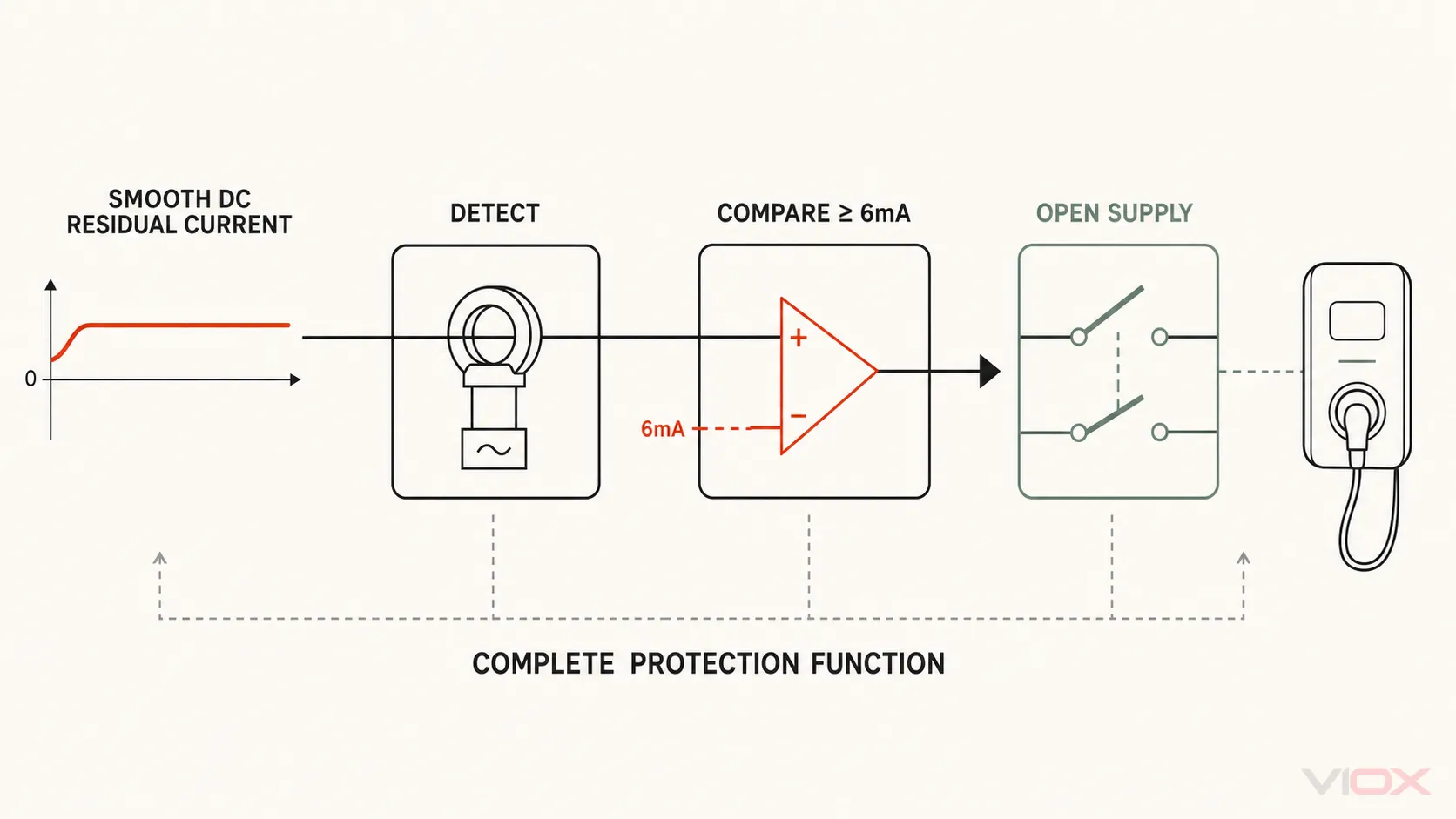
IEC 62955 describes a function that performs three linked operations:
- Detection: Measure the residual direct current in the EV supply circuit.
- Comparison: Compare the measured value with the residual operating value.
- Opening action: Remove the supply or initiate opening when the smooth residual DC exceeds the defined operating boundary.
The third step is critical. A sensor output alone is not the complete protection architecture. The technical file must show which switching or protective device receives the signal, whether the interface is mechanical or electrical, what happens if a component fails, and which device provides isolation.
For a separate installation task, use the dedicated EV charger 6mA DC leakage verification guide. A commissioning test cannot establish product-standard conformity by itself; it verifies defined behavior in the installed system using the applicable procedure and equipment.
RDC-MD vs RDC-PD
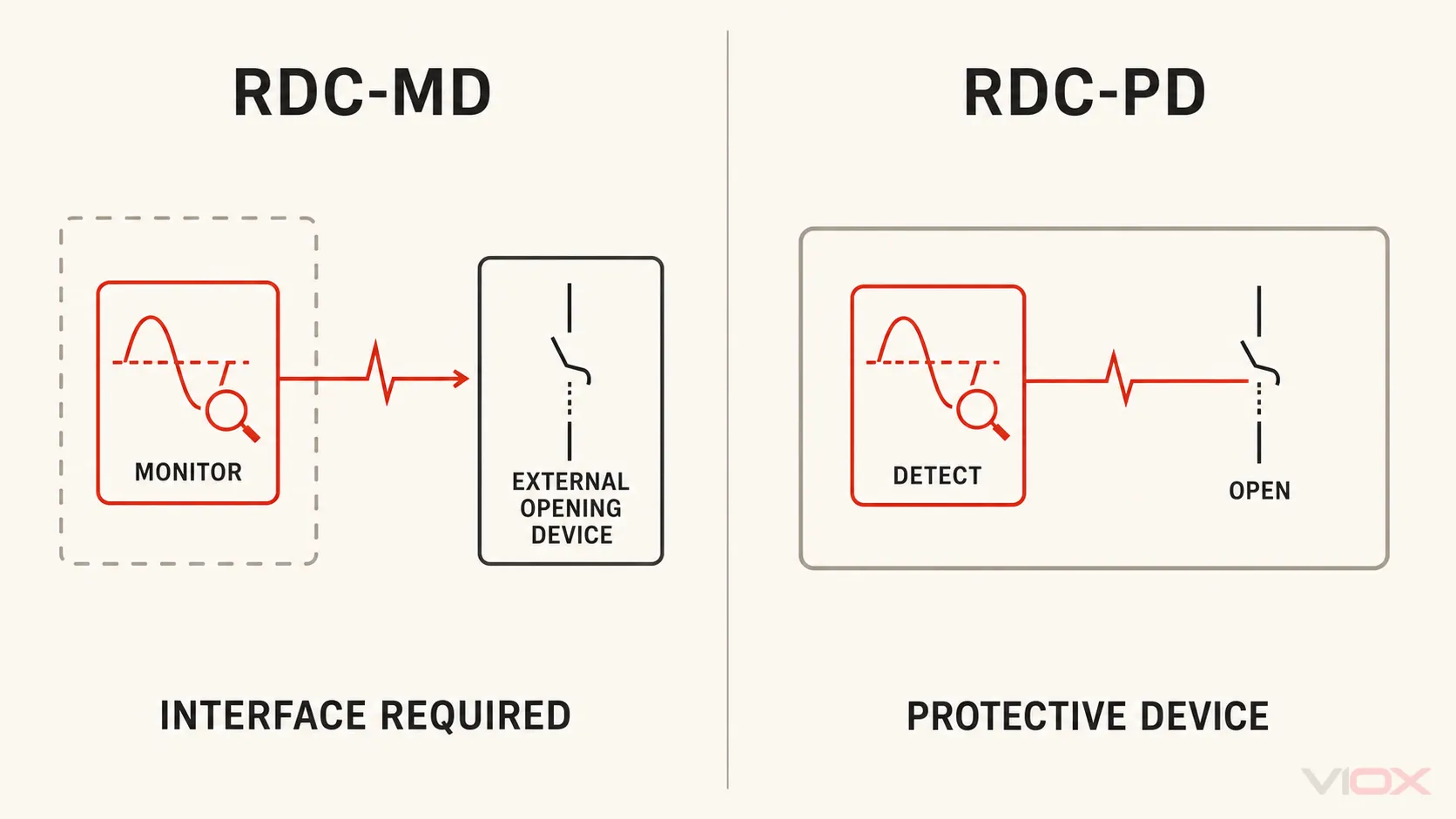
IEC 62955 covers two broad classes. Their names describe the role of the device in the disconnection chain, not a simple good/better ranking.
| Class | System role | Switching and isolation boundary | Documents to request |
|---|---|---|---|
| RDC-MD | Monitors smooth residual DC and initiates opening through an associated device | May use a mechanical interface to a separate protective device or an electrical interface to a switching/protective device; verify the exact architecture | RDC-MD class, interface description, associated device reference, circuit diagram, failure behavior, installation instructions |
| RDC-PD | Combines the defined detection, evaluation, and protective opening functions within the product architecture | IEC 62955 states that RDC-PDs according to the document are suitable for isolation | Exact model declaration/certificate, ratings, isolation/switching documentation, diagram and installation instructions |
The standard also addresses integrated units that combine AC, pulsating DC, and 6 mA DC detection, evaluation, and mechanical switching. Do not infer that every integrated EVSE feature has the same scope. Identify the applicable architecture and annex pathway in the product documentation.
RDC-MD interfaces
At system level, an RDC-MD may be arranged in more than one way:
- an RDC-M unit can have a mechanical interface to a separate protective device such as a circuit breaker or RCD; or
- an RDC-M module can provide a separated detection/evaluation function with an electrical interface to a switching device, such as a contactor, or to a protective device.
The word “monitoring” does not mean that disconnection is optional. The complete IEC 62955 function must initiate the required opening action. The evidence must identify the associated switching device and show that the combined architecture matches the evaluated design.
RDC-PD isolation boundary
An RDC-PD includes the protective-device role and is suitable for isolation within the IEC 62955 product definition. That does not automatically prove that it supplies every residual-current, overcurrent, short-circuit, or installation function required by the EV circuit. Verify the full list of declared functions rather than treating the class name as a complete assembly specification.
IEC 62955 vs IEC 62423
These standards solve different product questions.
| Standard | Primary product scope | Relevant EV charging role | Common misinterpretation |
|---|---|---|---|
| IEC 62955 | RDC-DD for permanently connected Mode 3 AC EV charging | Detects smooth residual DC at 6 mA or above and removes or initiates removal of supply to protect upstream Type A/F functionality | Calling RDC-DD “Type EV RCCB” without identifying its class and switching architecture |
| IEC 62423 | Type F and Type B RCCBs/RCBOs used with the relevant base product standards | Defines additional waveform requirements for Type F and Type B RCDs | Treating Type F as having the same smooth-DC capability as Type B |
| IEC 61008-1 / IEC 61009-1 | Base product rules for RCCBs without and RCBOs with integral overcurrent protection | Defines the underlying RCCB or RCBO product pathway where applicable | Assuming an RCCB product standard proves EVSE DC-detection functionality |
| Applicable installation rules | Complete installed circuit and protective measures | Determines how product functions must be combined in the destination market | Treating an IEC product certificate as approval of the entire installation |
IEC 62423 states that Type F devices are intended for specified composite residual currents associated with certain single-phase frequency-converter loads. Type B devices add coverage for smooth DC and broader residual-current waveforms within their product definition. Neither label describes an RDC-DD class.
How RDC-DD Fits With Upstream RCD Protection
The IEC 62955 introduction describes two protective-measure routes for the relevant Mode 3 context:
- a Type B RCD; or
- a Type A RCD together with appropriate equipment that ensures switching of the supply when DC fault current exceeds 6 mA.
The purpose of the RDC-DD route is to preserve the correct operation of the upstream Type A or Type F RCD. This produces a functional chain rather than a substitution:
EVSE circuit
  → RDC-DD detects and evaluates smooth residual DC
  → associated or integrated switching function opens the EV supply
  → upstream Type A/F RCD remains within its intended DC-bias boundary
The final circuit may still require residual-current protection for shock/fault protection, overload protection, short-circuit protection, isolation, pole switching, and upstream/downstream selectivity. Which products perform those functions depends on the EVSE design and applicable installation rules.
For the complete choice between Type A/F plus RDC-DD and Type B, including current ratings, poles, and RCCB-versus-RCBO architecture, use the EV charger RCCB selection guide.
Evidence Checklist for a “6mA DC Protection” Claim
Before relying on the claim, confirm that every document refers to the same exact EVSE or RDC-DD reference.
| Evidence item | Question to answer | Reject or escalate when |
|---|---|---|
| Product identification | What is the exact model, hardware variant, and document revision? | Evidence applies only to a family name or different variant |
| Standards declaration | Does the manufacturer identify IEC 62955 and the applicable device class? | The material says only “6mA sensor” or “DC protection” |
| Certificate or report | Does it identify the exact model and issuing/evaluating body? | Scope, model, ratings, or validity cannot be matched |
| RDC-DD class | Is it RDC-MD, RDC-PD, or an integrated architecture covered by the declared pathway? | Class and switching arrangement are absent |
| Switching device | Which device actually opens the circuit? | A detection signal is shown without the opening path |
| Isolation | Which component provides isolation, and is that function declared? | Isolation is inferred from a contactor or class name without evidence |
| Upstream RCD | Which RCD type, IΔn, poles, and product standard does the EVSE require? | The upstream device is left to assumption |
| Ratings and supply | Are voltage, frequency, current, phase arrangement, and direction of power flow within scope? | Proposed use exceeds the evidence or involves bilateral power flow without another pathway |
| Installation requirements | Which national rules and project specifications apply? | A product certificate is presented as complete installation approval |
| Verification instructions | How is the installed function tested and reset? | No manufacturer procedure exists for the exact product |
Blank cells are not proof of nonconformity, but they are unresolved evidence. Request the missing documents before using the claim in a protection design or procurement specification.
Focused IEC 62955 Questions
What does RDC-DD stand for?
RDC-DD means residual direct current detecting device. Under IEC 62955, it is used for the defined Mode 3 AC EV charging context to detect smooth residual DC and remove or initiate removal of the EV supply.
Are RDC-MD and RDC-PD the same device?
No. RDC-MD identifies a monitoring-device architecture that works through an associated switching or protective device. RDC-PD identifies a protective-device architecture and is suitable for isolation under the standard’s definition. Exact implementation still depends on the product documents.
Does an RDC-DD replace the upstream Type A RCD?
Not automatically. The RDC-DD addresses the smooth-DC condition that could impair the upstream RCD. The complete installation must still provide all required residual-current, overcurrent, short-circuit, switching, and isolation functions under the applicable rules.
Does IEC 62955 cover bidirectional EV charging?
The 2018 scope states that RDC-DDs under the document are not intended for bilateral power flow between the EV and fixed installation. A bidirectional design therefore needs the standards and manufacturer evidence applicable to that architecture.
Sources Reviewed
- IEC 62955:2018 — RDC-DD for Mode 3 EV charging
- IEC 62955:2018 authorized preview — introduction and scope
- IEC 62423 — Type F and Type B residual-current devices
- IEC 61851-1 — EV conductive charging system general requirements
For procurement review, request the exact RDC-DD class, certificate/report, circuit diagram, upstream RCD instruction, ratings, and destination-market documentation from the EVSE or protective-device supplier. VIOX can review compatible residual-current product documents when the complete circuit requirement is supplied to [email protected].