

On this page
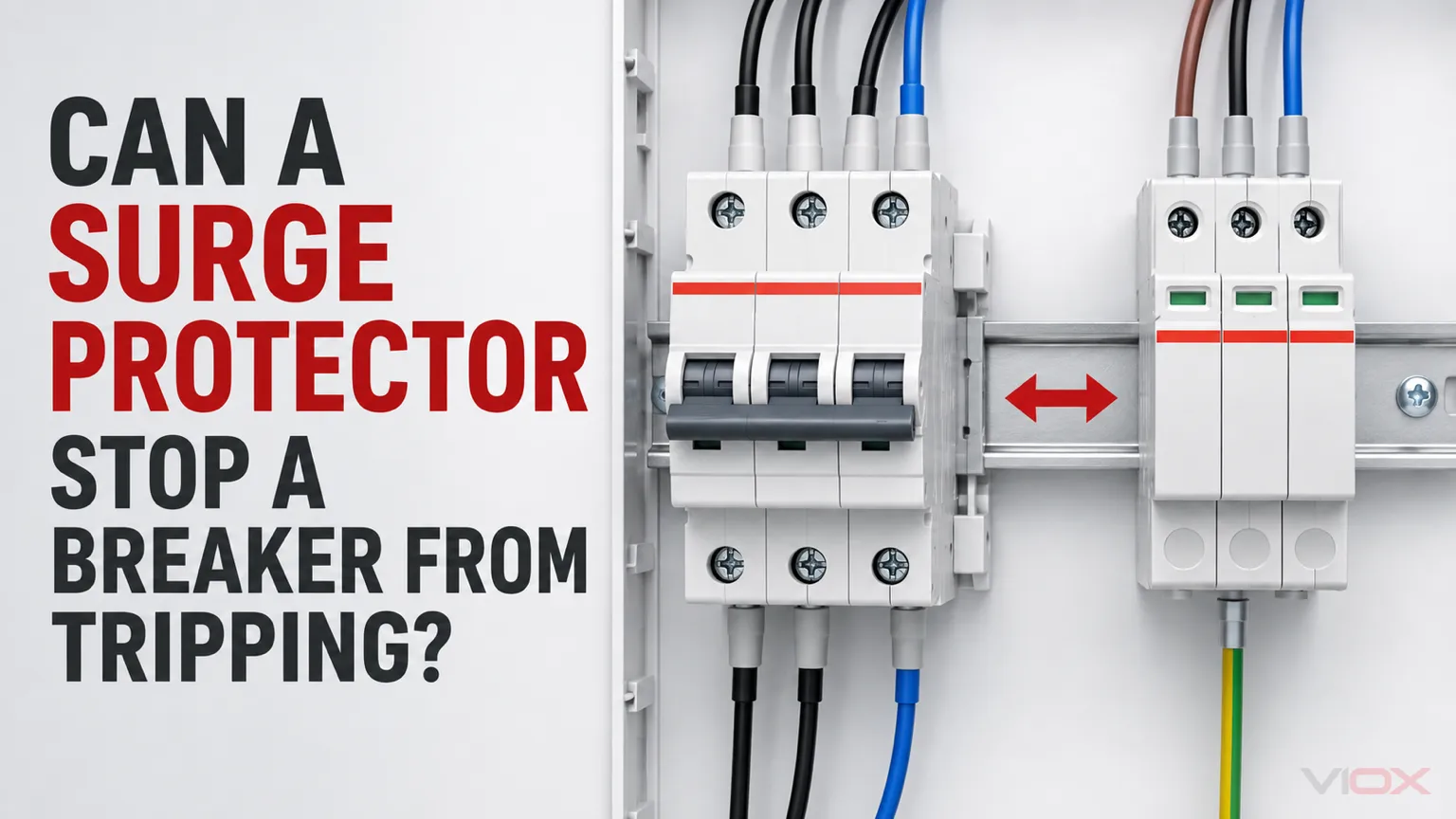
Usually no. A surge protective device (SPD) limits brief transient overvoltage; it does not reduce overload current or clear a short circuit, earth or ground fault, or arc fault. If a breaker keeps tripping, adding a surge protector normally leaves the actual cause unchanged.
There is one important exception: a failed, incorrectly connected, or poorly coordinated SPD can sometimes cause an upstream breaker or fuse to operate. That is a fault condition—not the SPD preventing an ordinary breaker trip.
Stop resetting the device and obtain qualified help if there is smoke, a burning odor, melting, water exposure, visible arcing, an explosive sound, or an immediate repeat trip. Do not bypass protection or replace a breaker with a higher rating as a troubleshooting step.
Key Takeaways
- An SPD limits a short-duration voltage transient; a circuit breaker opens for the current conditions covered by its protective functions.
- A surge protector does not lower the normal current drawn by heaters, motors, computers, chargers, or other loads.
- A plug-in surge strip may contain its own resettable overload breaker. That is separate from the building circuit breaker and separate from its surge-protection components.
- If tripping began after a hardwired SPD was installed, the SPD circuit, wiring, upstream protective device, and manufacturer instructions need to be checked.
- Identify which protective function operated before choosing a remedy. “The breaker tripped” is a symptom, not a complete diagnosis.
Why an SPD Does Not Prevent an Ordinary Breaker Trip
An SPD is normally connected in parallel with the supply. During normal voltage conditions, it draws little current. When a transient occurs, its nonlinear protective components conduct surge current and limit the voltage appearing across the protected circuit. The VIOX SPD overview explains this operating principle in more detail.
A breaker has a different job. Depending on the device, it may respond to sustained overload current, high fault current, residual or ground-fault current, an arc-fault signature, or a combination of these conditions. The exact response depends on the breaker, trip unit, settings, and circuit.
| Electrical condition | Primary protection response | Will adding an SPD normally prevent the trip? |
|---|---|---|
| Too much load current for the circuit | Overcurrent breaker or fuse | No. The SPD does not reduce load current. |
| Line-to-line or line-to-neutral short circuit | Overcurrent protection | No. The fault must be located and cleared. |
| Current leaking to earth or ground | RCD, RCCB, RCBO, GFCI, or ground-fault function as applicable | No. The leakage or insulation problem must be investigated. |
| Detected arc-fault signature | AFCI or arc-fault function where fitted | No. The SPD does not repair damaged wiring or equipment. |
| High starting or inrush current | Overcurrent protection if its time-current boundary is crossed | No. The load, circuit, and protection coordination must be reviewed. |
| Brief transient overvoltage | SPD | This is the SPD’s intended duty; it is not an overload remedy. |
| Temporary or sustained abnormal voltage | Voltage protection, system controls, or equipment-specific response | Not necessarily. A normal SPD is not a general voltage regulator. |
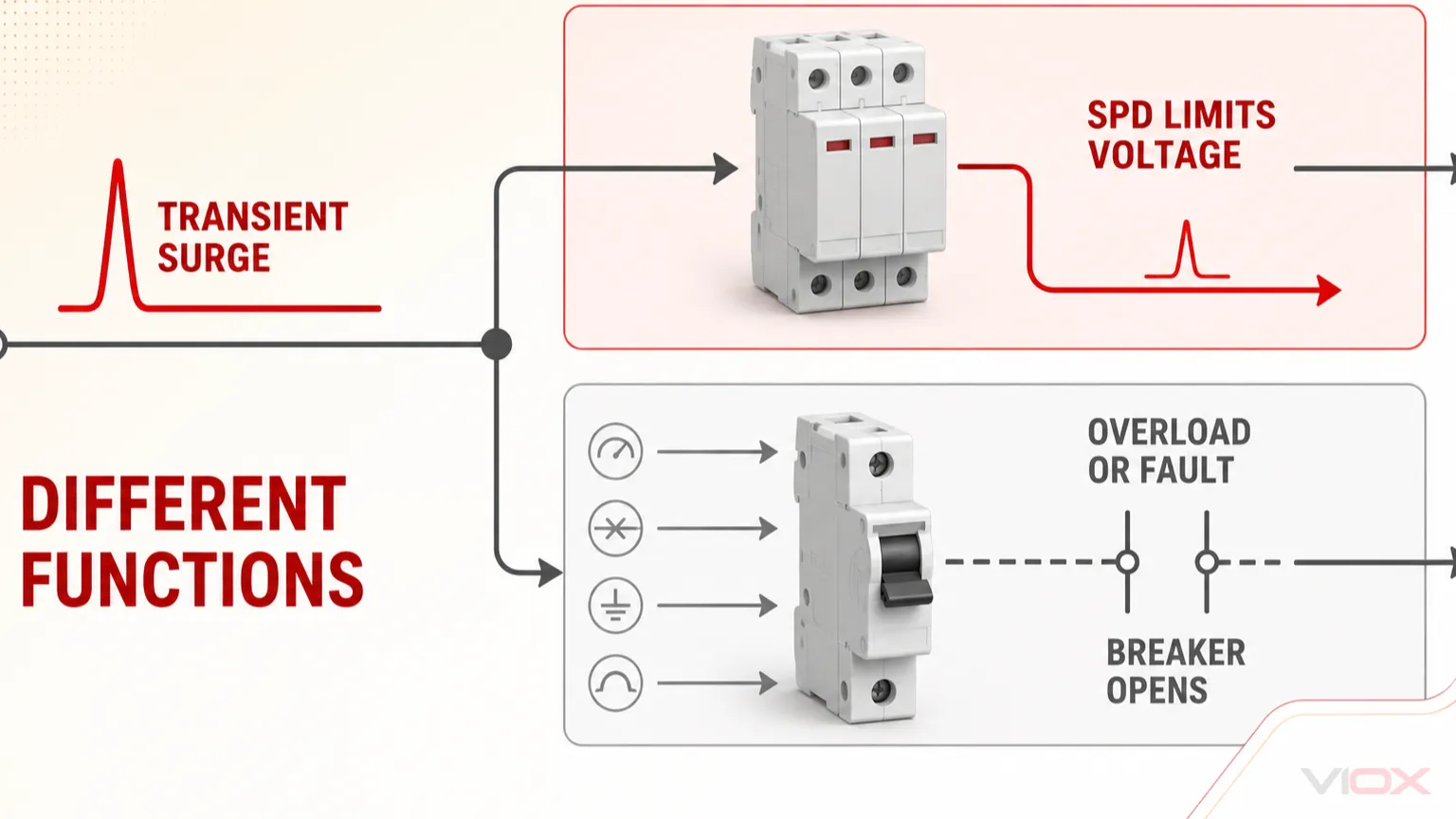
The practical rule is simple: voltage-transient protection and overcurrent/fault protection complement each other, but neither replaces the other. NEMA defines an SPD by its ability to limit transient voltage and divert or limit surge current. Eaton likewise distinguishes surge protection from the overload-current duty of a fuse or circuit breaker.
Use the Trip Pattern to Choose the Next Safe Action
This matrix is an initial routing tool. It does not prove the electrical cause and it does not replace testing by a qualified person.
| What you observe | More likely direction | Safe check without opening the panel | What the result means | Next action |
|---|---|---|---|---|
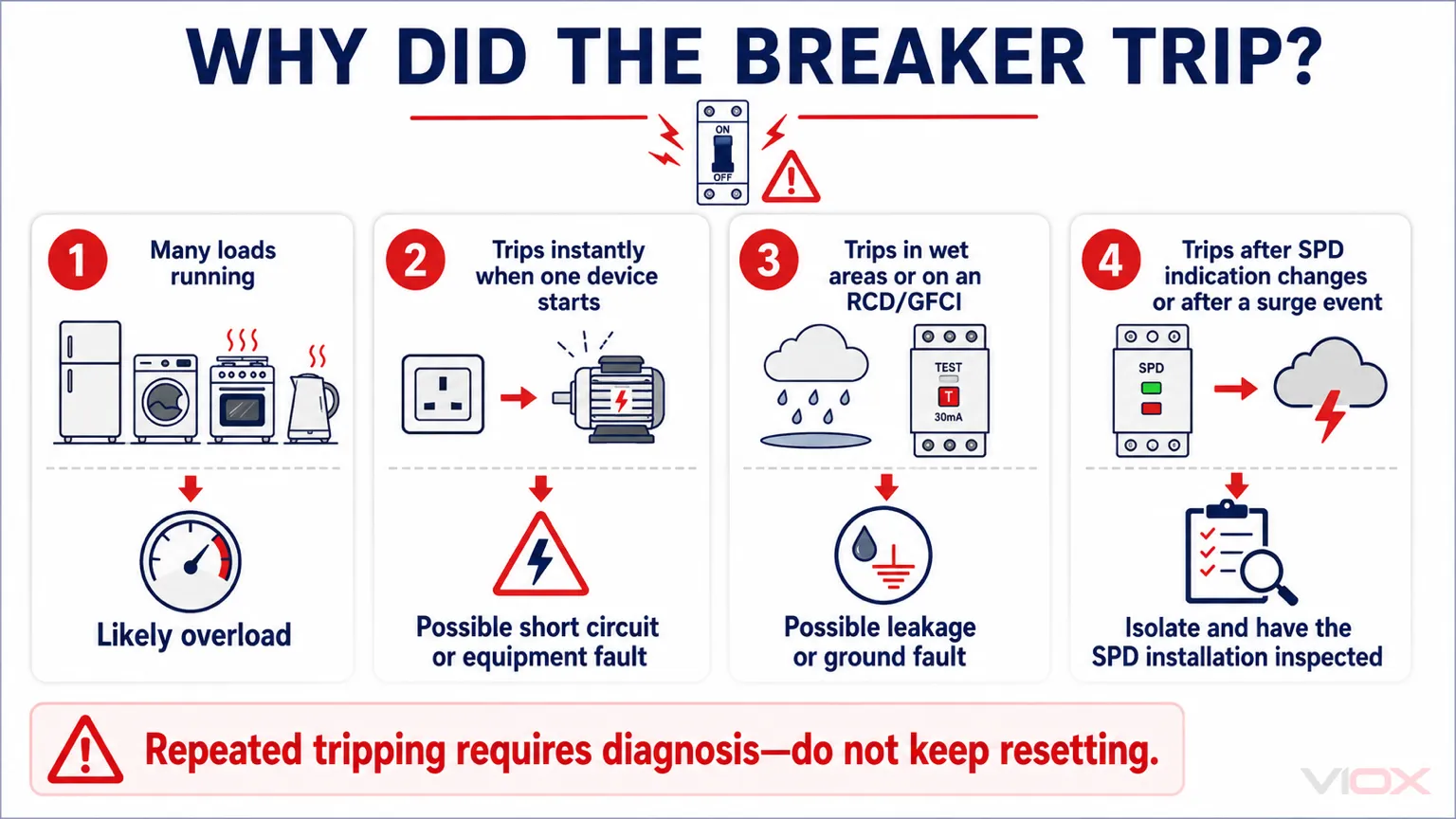
| The circuit trips after several high-power loads operate for a while | Sustained overload, abnormal load current, unsuitable circuit, or equipment problem | Record which loads were operating and whether the event repeats when accessible loads are switched off | If reducing connected load stops the pattern, overload is more likely, but the circuit still needs review if the problem recurs | Use the breaker-trip diagnostic guide rather than adding an SPD |
| It trips immediately when one appliance or machine starts | Equipment fault, short circuit, high inrush current, damaged cord, or protection mismatch | Stop using the implicated equipment; do not repeatedly reproduce the event | A repeatable association identifies where investigation should begin, not the exact internal fault | Have the load and circuit checked before returning them to service |
| An RCD, RCCB, RCBO, GFCI, or ground-fault indicator operates | Leakage to earth/ground, insulation damage, moisture, equipment fault, or a product-specific coordination issue | Preserve the device indication and note what had just been connected or switched | This is not a simple “too many watts” diagnosis | Follow the device instructions and arrange appropriate leakage/insulation testing |
| A plug-in surge strip’s own reset button operates but the panel breaker stays on | The strip’s integral overload protection may have operated | Unplug connected equipment and check the strip label and instructions | The strip’s internal breaker is not proof that a voltage surge occurred | Remove overload, damage, or a suspect strip from service; do not daisy-chain strips |
| The panel breaker trips after a new hardwired SPD is connected | SPD wiring, product compatibility, leakage, upstream protection, or an SPD fault | Do not open the panel; record the SPD model, indicator state, and the device that operated | Timing creates a credible SPD-related lead, but not a final diagnosis | Isolate and verify the installation under the exact product instructions |
| The SPD indicator changes state but the breaker does not trip | SPD internal disconnection, aging, or another SPD-specific condition | Read only externally visible indicators and instructions | An SPD can lose protection without operating the upstream breaker | Follow the failed-SPD indicator diagnostic |
| Lights or equipment behave abnormally for seconds or longer rather than for microseconds | Temporary overvoltage (TOV), supply fault, neutral problem, or another sustained condition | Disconnect sensitive equipment if this can be done safely and record the symptoms | The event is outside the normal “brief surge” model | Use the SPD and TOV guide and obtain qualified investigation |
Can a Surge Protector Cause a Breaker to Trip?
It can, but the mechanism matters. Do not treat every trip near an SPD as evidence that the SPD “absorbed a surge.”
1. The SPD or its branch has developed a fault
An SPD contains components that can degrade or fail. Coordinated overcurrent protection is intended to remove a faulted SPD or branch from the system when required by the product design and installation. NEMA’s SPD safety guidance stresses the difference between surge current and fault current and the need to coordinate the SPD’s short-circuit current rating (SCCR), available fault current, and overcurrent protection.
If a fuse or breaker operates because the SPD is faulted, replacing or repeatedly resetting that protective device without diagnosing the SPD can re-energize the fault.
2. A temporary overvoltage makes the SPD conduct abnormally
A metal-oxide varistor cannot make a long-duration overvoltage disappear. Depending on the SPD design and event, a TOV can cause heating, internal thermal disconnection, failure, or operation of upstream protection. The correct response is to identify the system voltage problem—not install a larger SPD or breaker by guesswork.
3. The installation or backup protection is incorrect
A hardwired SPD must be installed using the connection method, conductor arrangement, upstream protection, and short-circuit conditions permitted by its documentation. A breaker used to connect an SPD is not automatically the same thing as the product’s required backup overcurrent protective device. See whether an SPD may use an existing breaker for that model-specific decision.
The SPD wiring guide covers the full phase, neutral, protective-earth, lead-routing, backup-protection, and verification workflow. This article does not authorize panel wiring or energized testing.
4. Product-specific leakage interacts with ground-fault protection
Some SPD designs have a small current path to earth or ground during normal operation. Whether that is compatible with a ground-fault-protected breaker depends on the exact products and instructions. For example, Schneider Electric states that breakers with ground-fault protection should not be used with certain named SPD families because leakage current may cause nuisance tripping. This is a bounded product example, not a universal rule for every SPD, RCD, GFCI, or breaker.
What to Do Instead of Adding a Surge Protector
- Preserve the evidence. Record which breaker or protective function operated, what loads were running or starting, and whether an SPD or power strip had just been added.
- Remove only accessible suspect loads. Switch off or unplug equipment only when doing so is safe. Do not remove panel covers or disturb fixed wiring.
- Stop after an immediate repeat trip. Repeated resetting is not a test and can re-energize damaged equipment.
- Route the problem correctly. Use the complete breaker diagnostic for overload/short-circuit questions, the TOV guide for sustained voltage abnormalities, or the failed-light guide for SPD status problems.
- Verify the exact product instructions. If the SPD is implicated, check its model, connection method, protection status, required upstream or backup protection, and suitability for the system.
Do not solve a trip by installing a higher-rated breaker unless a qualified design review confirms that the conductors, equipment, fault protection, and applicable rules support a circuit change. A larger breaker can leave the underlying fault or overload in service.
Frequently Asked Questions
Will a surge protector keep a breaker from tripping?
Normally no. It does not reduce the current drawn by connected equipment or clear wiring faults. Identify why the breaker or protective function operated.
Can a bad surge protector trip a breaker?
Yes. A failed SPD, a wiring fault, a TOV response, or an unsuitable protection arrangement can cause a fuse or breaker to operate. The exact SPD and circuit must be inspected before restoration.
Can a power strip trip a circuit breaker?
The equipment connected through a strip can overload the branch circuit, and a damaged strip can create a fault. A surge strip may also contain its own internal overload breaker. Determine which device operated before diagnosing the cause.
Does a breaker protect equipment from voltage surges?
Not by itself. A conventional overcurrent breaker is selected to interrupt specified overcurrent conditions; an SPD limits transient overvoltage. Both may be required because they perform different functions.
Should an SPD have its own breaker?
That depends on the SPD type, exact product instructions, connection point, conductor protection, available fault current, and applicable installation rules. Do not select a breaker from the SPD’s kA surge rating. Use the dedicated SPD breaker and backup-protection guide.
Technical References
- NEMA Surge Protection Institute — What Are SPDs?
- NEMA Surge Protection Institute — SPD Safety and Coordinated Overcurrent Protection
- Eaton — Surge Protectors Explained
- Schneider Electric — Ground-Fault-Protected Breakers and Named SPD Families
- Electrical Safety Foundation International — Understanding Your Home Electrical System
If the real requirement is transient-voltage protection rather than breaker-trip prevention, compare the system voltage, earthing arrangement, installation point, SPD Type, surge-current ratings, voltage protection level, and backup-protection instructions before selecting a device. Review VIOX surge protective devices only after those inputs are defined.
This article provides a diagnostic framework, not an energized-work or DIY panel procedure. Final diagnosis and installation must follow the exact equipment instructions, applicable local rules, and qualified electrical review.