

On this page
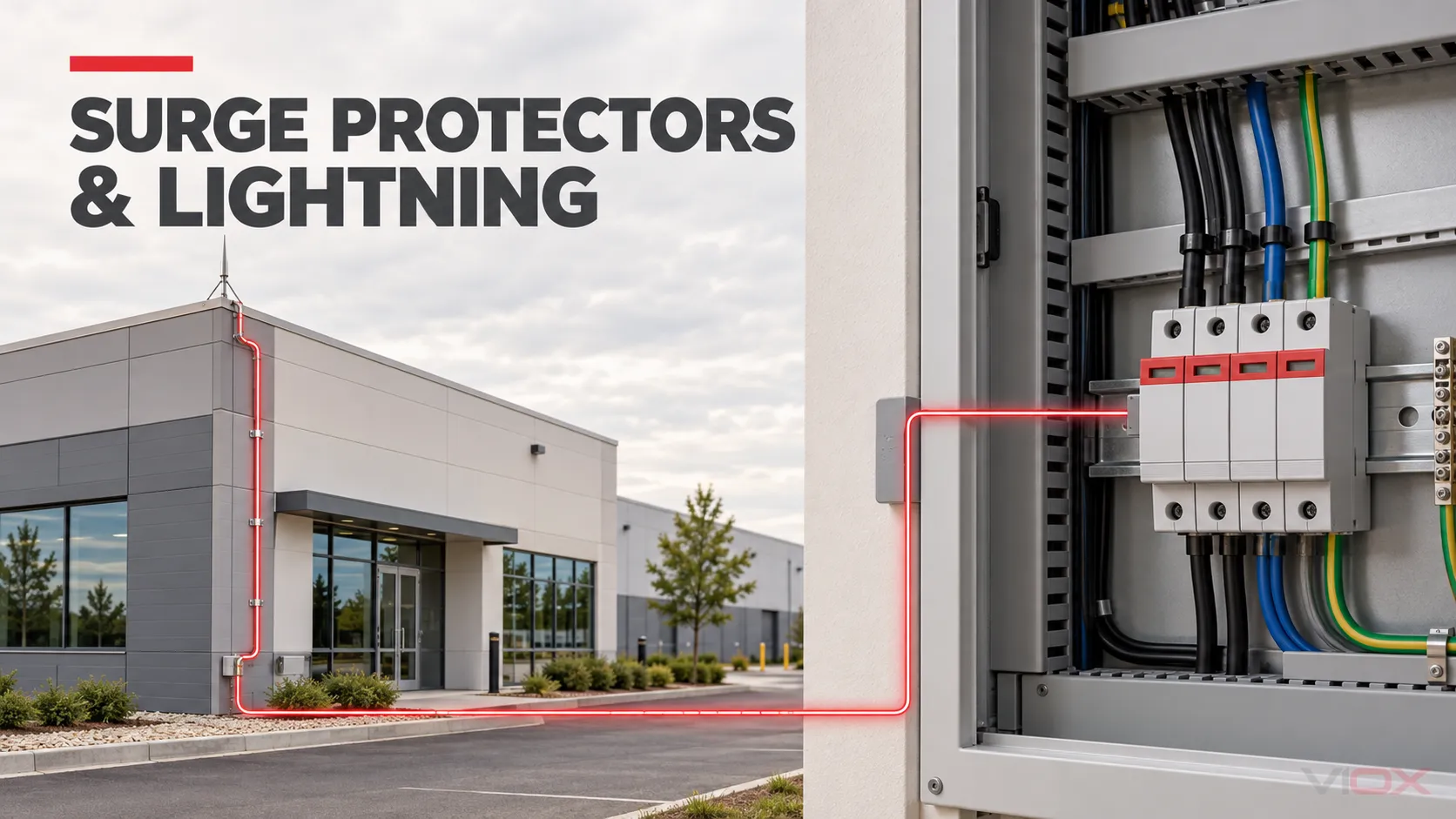
Yes—but only within a defined part of the lightning-protection system. A surge protective device (SPD) can limit a lightning-related transient that reaches equipment through power, data, telecom, antenna, or control conductors. A suitable Type 1 SPD can discharge specified partial lightning current at an installation boundary. However, an SPD cannot intercept a strike, provide a building’s down-conductor path, or replace an external lightning protection system (LPS).
The useful question is therefore not simply “Can an SPD stop lightning?” It is: How can the lightning event enter the installation, which protection layer meets that path, and what residual stress can the connected equipment withstand? If the device terminology is unfamiliar, start with what an SPD is and which ratings describe it.
The Short Answer by Lightning Path
| Event path | What reaches the electrical system | What an SPD can do | What an SPD cannot do | Protection to verify |
|---|---|---|---|---|
| Nearby lightning strike | Induced transient voltage in power, signal, or control wiring | Limit the transient at a protected conductor boundary | Prevent the lightning discharge itself | Coordinated power and signal SPDs, bonding, short connections |
| Lightning strike to an incoming overhead service or connected line | Conducted surge current and overvoltage | A correctly selected service-entry device can divert specified surge current and limit voltage | Guarantee that every connected device survives | Service-entry protection, downstream coordination, all conductive service paths |
| Lightning strike to a protected building | Lightning current flows through the LPS and creates conducted, induced, and potential-difference effects | Type 1 SPDs can be part of the equipotential bonding and internal protection measures | Intercept the strike or carry structural lightning current in place of air terminals and down conductors | External LPS, bonding, earthing, Type 1 SPDs, downstream SPDs, separation measures |
| Utility or equipment switching event | Non-lightning transient on the power system | Limit the transient when the SPD ratings and installation match the circuit | Correct a sustained overvoltage, undervoltage, outage, or overcurrent fault | Correct SPD voltage rating, TOV behavior, overcurrent protection, equipment immunity |
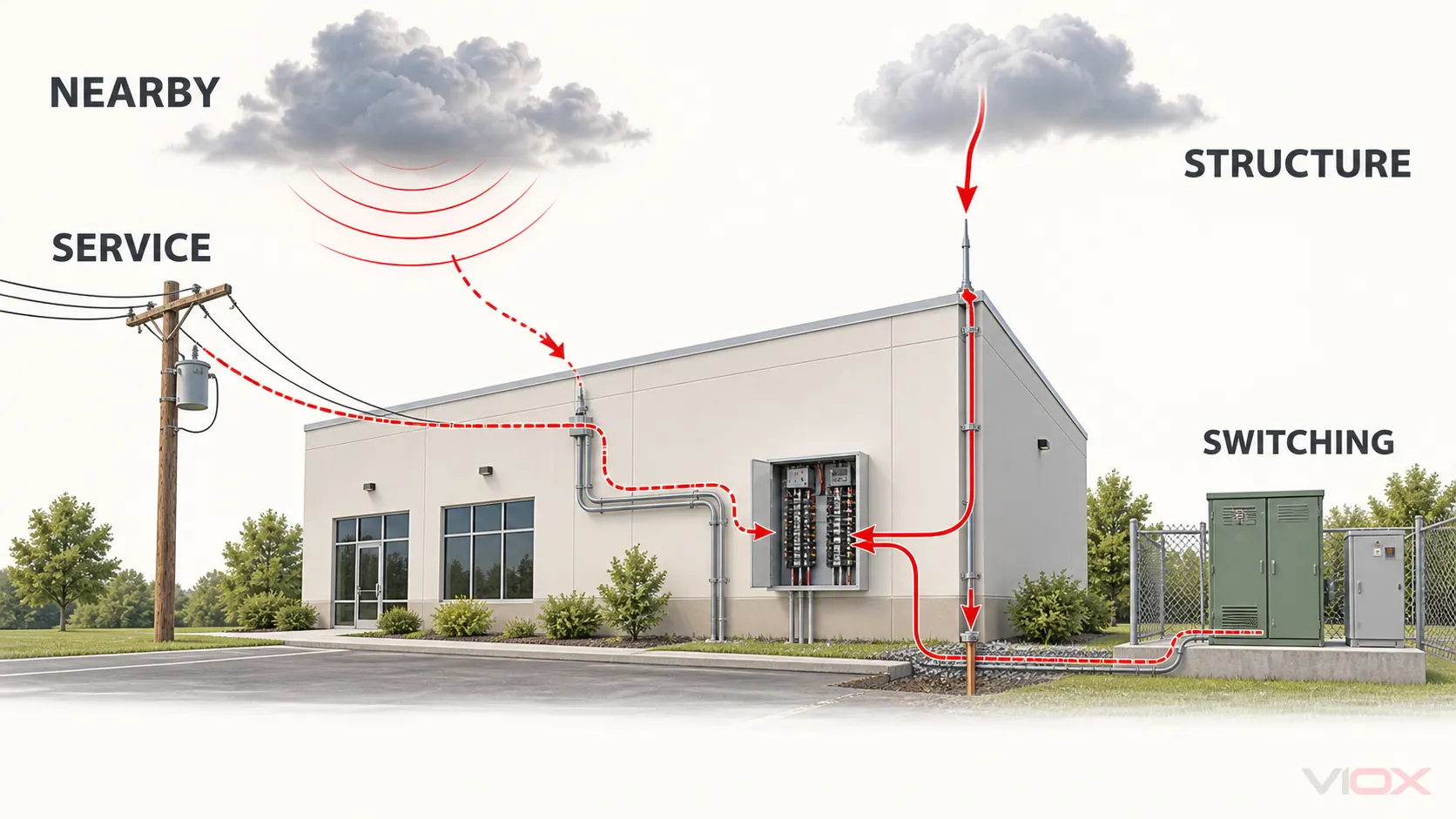
This distinction matters because the phrase “direct lightning strike” can refer to different physical situations. A strike to the structure, a strike to an incoming line, and lightning current entering an installation through bonded services are not the same event. They do not place the same duty on one panel-mounted device.
Type 1 Lightning-Current Duty Is Not Structural Strike Protection
IEC terminology can be misunderstood here. IEC 61643-11:2025 covers low-voltage AC SPDs for protection against indirect and direct effects of lightning or other transient overvoltages. A Type 1 SPD is tested with an impulse current, commonly identified by the 10/350 μs waveform and the Iimp rating. This allows the device to be specified where partial lightning current may enter low-voltage conductors.
That product duty does not turn the SPD into a lightning rod or a complete LPS. Structural protection has a different job: manage strike attachment, conduct lightning current toward earth, limit dangerous potential differences, and reduce fire, physical-damage, and touch-voltage risk. IEC 62305-3:2024 covers protection of structures against physical damage and protection of people near an LPS. The related IEC 62305-4:2024 addresses surge protection measures for electrical and electronic systems inside structures.
Use this practical boundary:
- An external LPS manages the strike attachment and structural lightning-current path.
- Bonding and separation measures control dangerous potential differences and flashover risk.
- Power and signal SPDs limit conducted or induced transient voltage at electrical boundaries.
- Equipment immunity determines how much residual stress the connected equipment can tolerate.
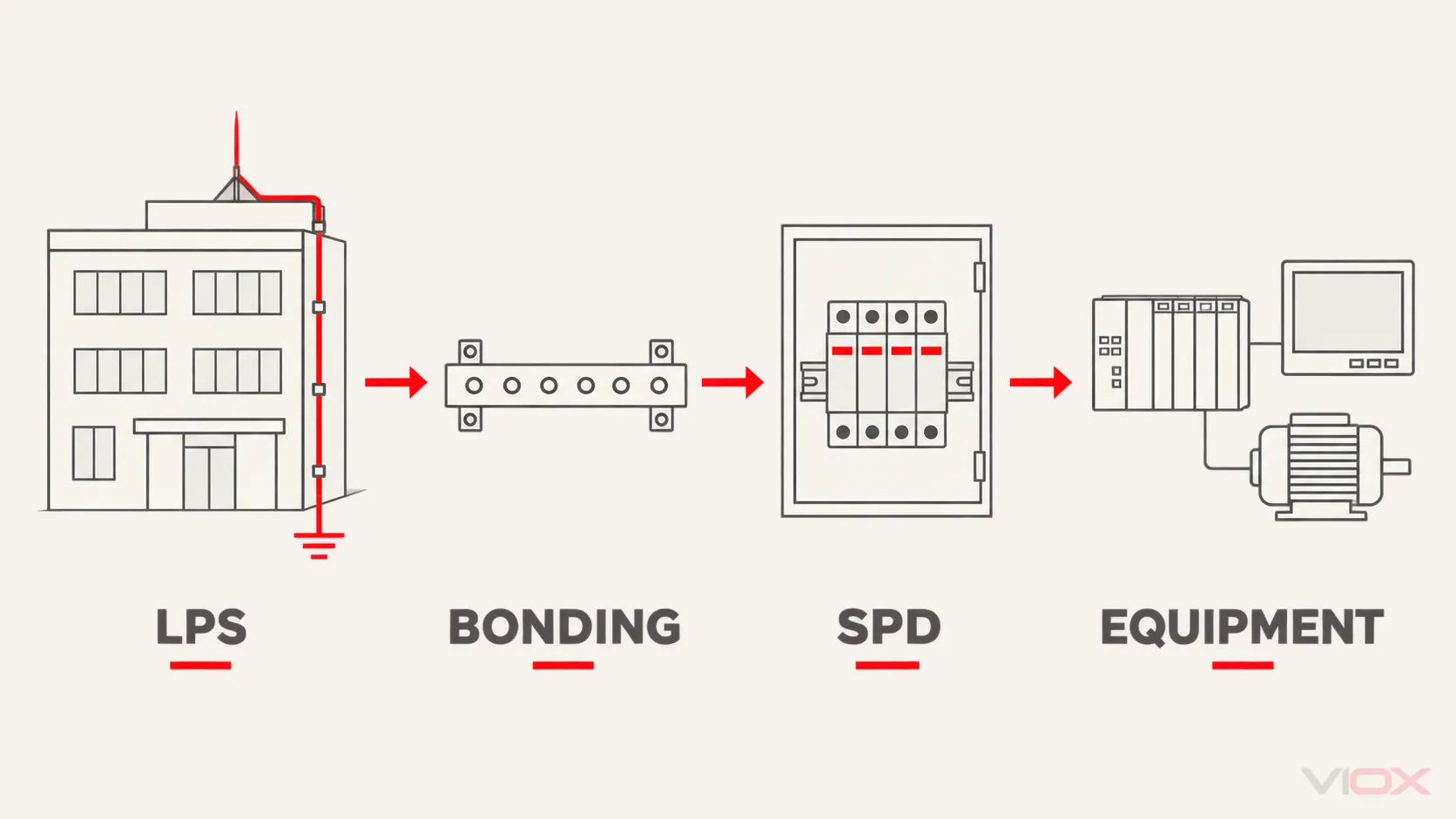
For the complete building-level architecture, see the VIOX guide to external LPS, bonding, earthing, and SPDs. This article remains focused on the narrower question of what the SPD itself can do.
How an SPD Reduces Lightning-Related Stress
Many low-voltage power SPDs are connected in parallel with the protected circuit. At normal system voltage, their protective components remain non-conductive or highly resistive. When a fast transient raises the voltage beyond the device’s operating region, the SPD conducts surge current through its protection path and limits the voltage appearing across the protected circuit.
The SPD does not make the transient disappear. Its performance is better understood as a causal chain:
- A lightning event couples surge energy into a conductor.
- The surge travels toward the installation or equipment.
- The SPD changes to a low-impedance state and diverts current.
- Voltage is limited to a residual level determined by the device and actual installation.
- Downstream wiring and equipment still experience some residual voltage and current.
This is why “the SPD operated” and “the equipment was guaranteed safe” are not equivalent statements. Lead length, bonding, conductor routing, protection mode, distance between stages, and equipment impulse withstand can all change the voltage that reaches the load. The VIOX guide to common SPD installation mistakes explains how avoidable wiring impedance can undermine an otherwise suitable device.
Protection Must Cover Every Conductive Entry Path
A power-panel SPD protects only the conductors and modes included in its installation. It does not automatically protect a device through another incoming path.
For example, a network switch may connect to:
- AC power;
- outdoor Ethernet cable;
- telephone or coaxial cable;
- an antenna feed;
- RS-485, sensor, or alarm wiring;
- grounded metallic equipment in another building or zone.
If the AC supply is protected but an outdoor data cable is not, a lightning-related potential difference can still pass through the communication port. Conversely, installing a data-line protector does not replace protection on the AC supply.
The correct signal protector must match the interface voltage, normal signal level, bandwidth or data rate, shielding and earthing arrangement, connector type, and expected surge environment. Route those decisions to the signal surge protector selection guide rather than using a power SPD as a generic answer.
Whole-Building and Point-of-Use Protection Have Different Jobs
A plug-in surge protector is not a substitute for service-entry or distribution-board protection. Its location and test category are intended for a different part of the installation. It may help reduce the residual transient at a sensitive load, but it should not be expected to carry the same duty as an upstream device installed where larger surge current can enter.
Likewise, installing a high-current SPD at the service entrance does not guarantee an adequately low voltage at every distant or sensitive load. Cable length, branching, oscillation, protection modes, and equipment withstand can justify a downstream SPD. Multiple devices are useful only when their voltage-protection and energy-sharing behavior are compatible.
The labels Type 1, Type 2, and Type 3 are not a universal recipe. IEC and UL use different classification frameworks, and the correct device depends on its standard, installation point, system voltage, and declared ratings. Use the dedicated Type 1 vs Type 2 vs Type 3 SPD comparison for classification details, then verify the actual combination through the SPD coordination and cascading guide.
Do Not Choose Lightning Protection by the Largest kA Number
A higher discharge-current number does not by itself prove better protection for a particular circuit. Before selecting an SPD for lightning-related risk, verify the complete evidence set.
| Evidence to verify | Why it matters | Common mistake |
|---|---|---|
| Product standard and device type | Establishes the applicable test framework and installation role | Comparing IEC and UL type labels as if they were identical |
| Nominal system voltage and wiring configuration | Determines the required protection modes and continuous voltage duty | Buying by pole count without confirming L-N, L-PE, N-PE, or DC arrangement |
Uc or MCOV |
Shows the maximum continuous operating-voltage basis | Selecting too close to normal or expected temporary voltage conditions |
Up or VPR |
Indicates the declared voltage-limiting performance under the applicable test method | Looking only at surge-current capacity |
Iimp, In, or other discharge-current rating |
Describes current duty under a stated waveform and test | Comparing peak kA values without comparing waveform and device class |
| SCCR and required backup protection | Determines compatibility with available fault current and the manufacturer’s protection arrangement | Assuming the SPD’s surge rating is its short-circuit rating |
| Temporary overvoltage behavior | Helps distinguish short transients from longer abnormal system voltage | Expecting an SPD to correct a sustained overvoltage |
| Connection length, routing, and bonding | Affects additional inductive voltage during fast current change | Installing the SPD far from the protected bus with long loops |
| Status and remote indication | Provides evidence that the protection path remains available | Treating an installed enclosure as proof that protection is active |
IEC 61643-12:2020 addresses selection, operation, location, and coordination principles for low-voltage AC SPDs. The final choice still has to follow the exact device instructions and the installation rules adopted for the project.
What to Check After a Suspected Lightning Event
Do not assume that a breaker trip proves the SPD failed, or that a breaker remaining closed proves the SPD is healthy. The SPD’s internal disconnector, upstream overcurrent protective device, alarm contact, and visual indicator perform different functions.
After a suspected event:
- Treat heat, smoke, odor, cracking, or exposed live parts as an electrical hazard. Isolate the equipment through qualified personnel and follow the site safety procedure.
- Record the event and affected circuits. Note which power, data, antenna, or control paths were connected and whether other protective devices operated.
- Check the exact SPD status indication. Interpret the window, LED, or remote contact using the manufacturer’s instructions; colors and NO/NC logic are not universal.
- Inspect associated protection and connections. Check the specified backup fuse or breaker, terminals, bonding path, and visible signs of overheating or flashover.
- Replace or test only within the manufacturer’s permitted method. An intact appearance does not establish remaining protective capacity, and unsafe ad-hoc tests can damage the device or expose personnel.
Use the SPD status-indicator guide for indicator interpretation. For aging and replacement decisions, use the MOV aging and SPD life guide. There is no defensible universal rule that every SPD must be replaced after the same number of years.
Standards Boundary: Product, Installation, and Complete System
Three evidence levels should not be collapsed into one claim:
- Product evidence: IEC 61643 or UL 1449 evaluation applies to an SPD and its declared scope—not to the performance of an entire building.
- Installation evidence: Wiring configuration, lead routing, backup protection, bonding, and placement must comply with the applicable installation rules and manufacturer instructions.
- System evidence: IEC 62305, NFPA 780, or UL 96A addresses the broader lightning-protection system according to the project and jurisdiction.
The UL Lightning Protection Application Guide describes a complete LPS as a system of strike-termination devices, conductors, grounding electrodes, interconnecting conductors, SPDs, connectors, and fittings. It also directs users to UL Product iQ for the applicable product category and certification limitations. A component marking should therefore be verified against the exact model and intended installation; it is not a blanket system guarantee.
Final Decision Rule
A surge protector is necessary in many lightning-protection strategies, but it is not a lightning shield around the building. Judge the protection by the event path and the complete chain:
strike or coupling point → conductive path → bonding boundary → SPD duty → installed voltage protection → equipment withstand
If any incoming power or signal path bypasses that chain, the equipment can remain exposed. If a building requires structural lightning protection, engage a qualified LPS designer or installer. For the SPD portion of the project, prepare the system voltage, earthing arrangement, installation position, available fault current, protection modes, applicable standard, upstream and downstream devices, and communication interfaces before comparing the VIOX SPD product range.
Sources
- IEC 62305-1:2024 — Protection against lightning: General principles
- IEC 62305-3:2024 — Physical damage to structures and life hazard
- IEC 62305-4:2024 — Electrical and electronic systems within structures
- IEC 61643-11:2025 — AC low-voltage SPD requirements and test methods
- IEC 61643-12:2020 — SPD selection and application principles
- UL Lightning Protection Application Guide