

On this page
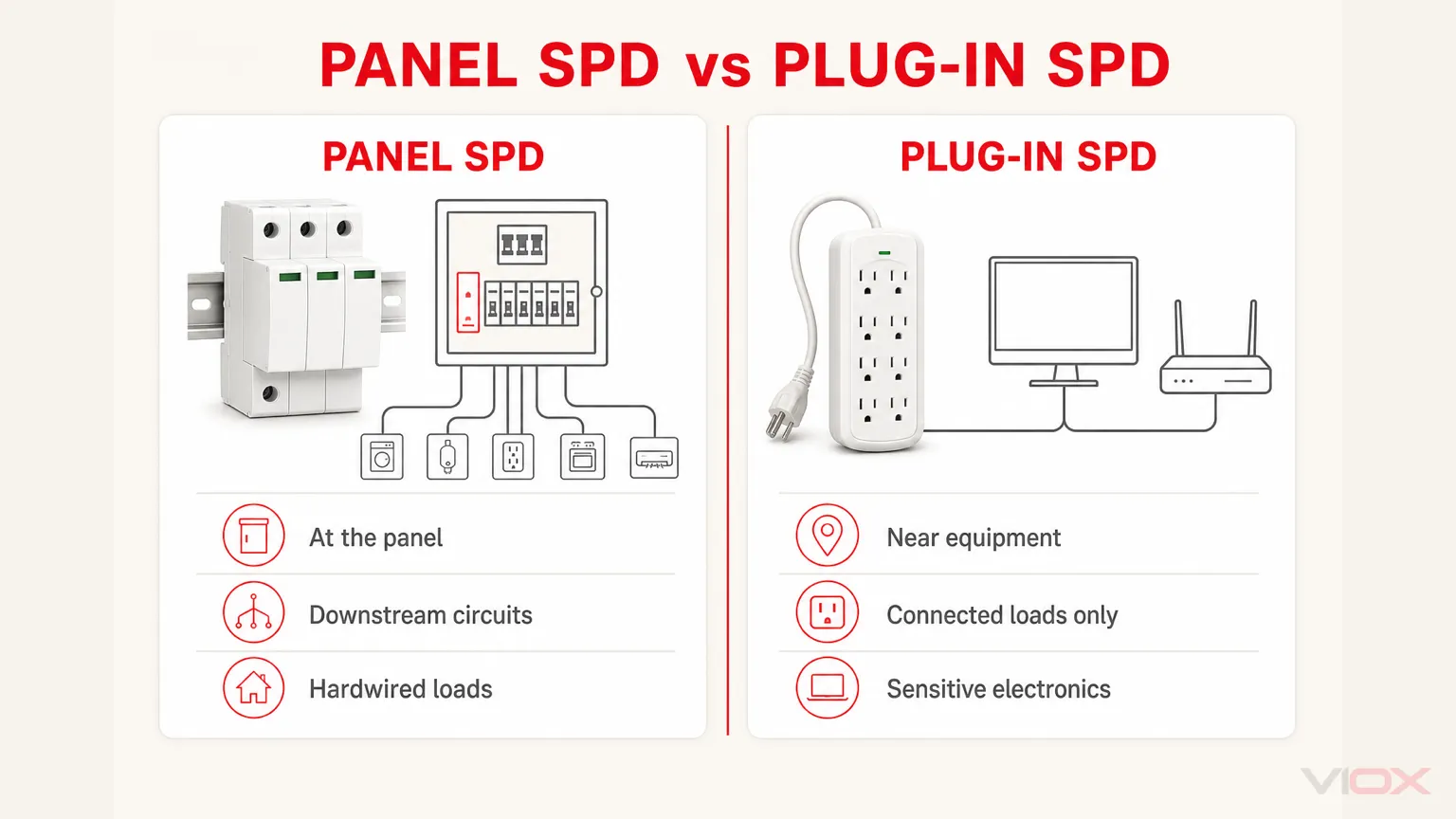
A whole-house surge protective device (SPD) and a plug-in surge protector protect different locations, so they are not direct substitutes. A panel-mounted SPD provides broad protection across downstream circuits and hardwired loads. A plug-in SPD protects only the equipment connected to it and can add protection close to sensitive electronics.
Many owner-occupied homes benefit from both layers. A panel SPD is usually the first priority when the home contains electronic HVAC controls, heat pumps, well pumps, smart appliances, an EV charger, or other hardwired equipment. Plug-in SPDs remain useful at computers, network equipment, televisions, and other sensitive loads. Renters or occupants without panel access may have to begin with plug-in protection.
A plain power strip is different: it may provide extra outlets and overload protection without providing surge protection. If that distinction is your main question, see our guide to the difference between a power strip and a surge protector.
Whole-House SPD vs Plug-In SPD: Quick Comparison
| Decision factor | Whole-house or panel SPD | Plug-in SPD |
|---|---|---|
| Installation point | Service equipment, main panel, or distribution panel, depending on the product and applicable rules | Receptacle near the equipment; may be cord-connected, direct plug-in, or receptacle-integrated |
| Protection scope | Provides a protection path for downstream circuits, outlets, and hardwired equipment | Protects only equipment connected through that device |
| Main strength | Broad protection at the electrical distribution level | Additional protection close to selected sensitive equipment |
| Main limitation | Does not automatically protect coaxial, telephone, Ethernet, antenna, or other non-power entry paths | Cannot protect other outlets, circuits, or hardwired equipment |
| Installation | Normally requires a qualified electrician and access to service or panel equipment | User-connectable when used exactly as marked and instructed |
| Product verification | System voltage, earthing arrangement, protection modes, Type, voltage protection rating or level, discharge-current ratings, short-circuit coordination, and status indication | System voltage, product certification for the market, voltage protection performance, load rating, protection-status indication, and manufacturer instructions |
| Best immediate use | Homes with panel access, multiple circuits, and important hardwired electronic loads | Renters, individual sensitive loads, or an added point-of-use protection stage |
| Can it replace the other? | Not in every application | Not in every application |
An SPD limits transient overvoltage; it does not regulate a supply that remains too high or too low. For the operating principle and functional boundaries, start with what a surge protective device does.
Quick Decision Matrix: Panel, Plug-In, Both, or Neither?
Use this matrix before comparing product ratings.
| Your situation | First priority | Why | What remains to check |
|---|---|---|---|
| You own the home, can modify the panel, and have important hardwired electronic equipment | Whole-house or panel SPD | A plug-in device cannot protect equipment that is not connected through it | Sensitive plug-in loads, signal/data entry paths, and product compatibility |
| You rent or cannot access the electrical panel | Plug-in SPD at selected equipment | It provides an available point-of-use layer without panel work | Whether the building already has upstream protection and whether data/coax lines also need protection |
| You have both hardwired electronic loads and sensitive plug-in equipment | Both | The devices protect different locations and can form a layered strategy | Coordination, installation instructions, and other conductive entry paths |
| Your main problem is sustained high voltage, low voltage, repeated dimming, or unstable supply | Neither as the complete solution | SPDs address short-duration transients, not every power-quality condition | Voltage monitoring, supply diagnosis, wiring faults, and the appropriate voltage-protection function |
| The building has an external lightning-protection system or high lightning exposure | Coordinated design, often including multiple SPD locations | Lightning protection involves bonding, power circuits, signal circuits, and installation boundaries | Risk assessment and design under the applicable local lightning and installation rules |
| The equipment receives power plus coaxial, antenna, Ethernet, telephone, or control cables | Power SPD plus suitable protection for the other interfaces | A surge can reach the equipment through any connected conductive path | Interface voltage, bandwidth, grounding, shielding, and bonding |
The decision is therefore not “which device is better?” It is “which protection paths does this home need?”
What a Whole-House SPD Protects
A whole-house SPD is installed at or near the service or distribution equipment. During normal operation, its protective elements remain in a standby state. When a transient raises the voltage across a protected mode, the SPD provides a controlled path for surge current and limits the voltage stress applied to downstream equipment.
Its practical advantage is coverage. One correctly selected and installed panel SPD can contribute protection to:
- branch circuits throughout the home;
- hardwired HVAC controls and heat pumps;
- fixed pumps, garage equipment, lighting controls, and security systems;
- receptacle circuits and the appliances connected to them;
- downstream distribution panels, subject to system layout and coordination.
That does not mean every connected device sees the same voltage during a surge. Real performance depends on the SPD’s declared characteristics, the surge path, protection mode, conductor routing, bonding, panel configuration, and the impedance of the connections. Long or looped connecting conductors can add voltage during a fast surge even when the SPD itself has a suitable laboratory rating.
What “whole-house” does not mean
A panel SPD does not create an impenetrable shield around the building. In particular, it does not by itself:
- guarantee equipment survival during every lightning event;
- replace an external lightning-protection system where one is required;
- correct poor earthing or equipotential bonding;
- protect an unprotected coaxial, telephone, Ethernet, antenna, or control cable;
- regulate sustained overvoltage or undervoltage;
- replace overcurrent protection, ground-fault protection, or other required safety devices.
Readers evaluating lightning exposure should separately review what an SPD can and cannot do against lightning.
What a Plug-In Surge Protector Protects
A plug-in SPD is installed at the point of utilization. In North American terminology, UL Solutions identifies cord-connected, direct plug-in, and receptacle-type products within the Type 3 SPD context. The exact marking and installation conditions must still be verified on the product.
A plug-in SPD can provide a local protection stage for equipment such as:
- desktop computers and displays;
- routers, switches, and other network equipment;
- televisions and audiovisual systems;
- home-office equipment;
- other plug-connected electronics within the device’s load rating and instructions.
Its boundary is equally important: it protects only the loads connected through it. It cannot protect an HVAC control board, a hardwired heat pump, another room, or a separate branch circuit.
A power strip is not automatically a surge protector
A plain power strip primarily provides additional receptacles. It may include a switch and an overcurrent device without containing an SPD. ESFI likewise warns that not all power strips offer surge protection. Look for product marking that identifies the device as a surge protector or SPD under the certification system used in your market. A generic “power,” “on,” or “grounded” indicator is not necessarily a protection-status indicator.
For plug-in products, evaluate the complete declaration rather than one marketing number. A joule rating may provide energy-related information under the manufacturer’s test method, but it does not replace voltage compatibility, protection performance, certification, status indication, and safe load use. The limits of this metric are covered in the surge protector joule rating guide.
Do You Still Need Plug-In Protectors After Installing a Whole-House SPD?
Often, yes—but not as an automatic rule for every outlet.
The National Institute of Standards and Technology (NIST) residential guidance describes architectures that use a protector at the service panel, with plug-in protectors retained near especially sensitive appliances. The upstream device addresses the broader electrical distribution path; the downstream device adds protection at selected loads.
Plug-in SPDs are most defensible after a panel SPD when:
- the equipment is sensitive, valuable, or difficult to replace;
- several related devices share one location, such as a home office or network cabinet;
- the product manufacturer recommends coordinated upstream protection;
- the power circuit is only one of several interfaces being protected at that equipment;
- the installation has been assessed as needing layered protection.
They are not automatically required on every lamp, charger, or appliance. Adding devices without checking their markings, load limitations, condition, and coordination does not prove better protection.
How Layered Surge Protection Works
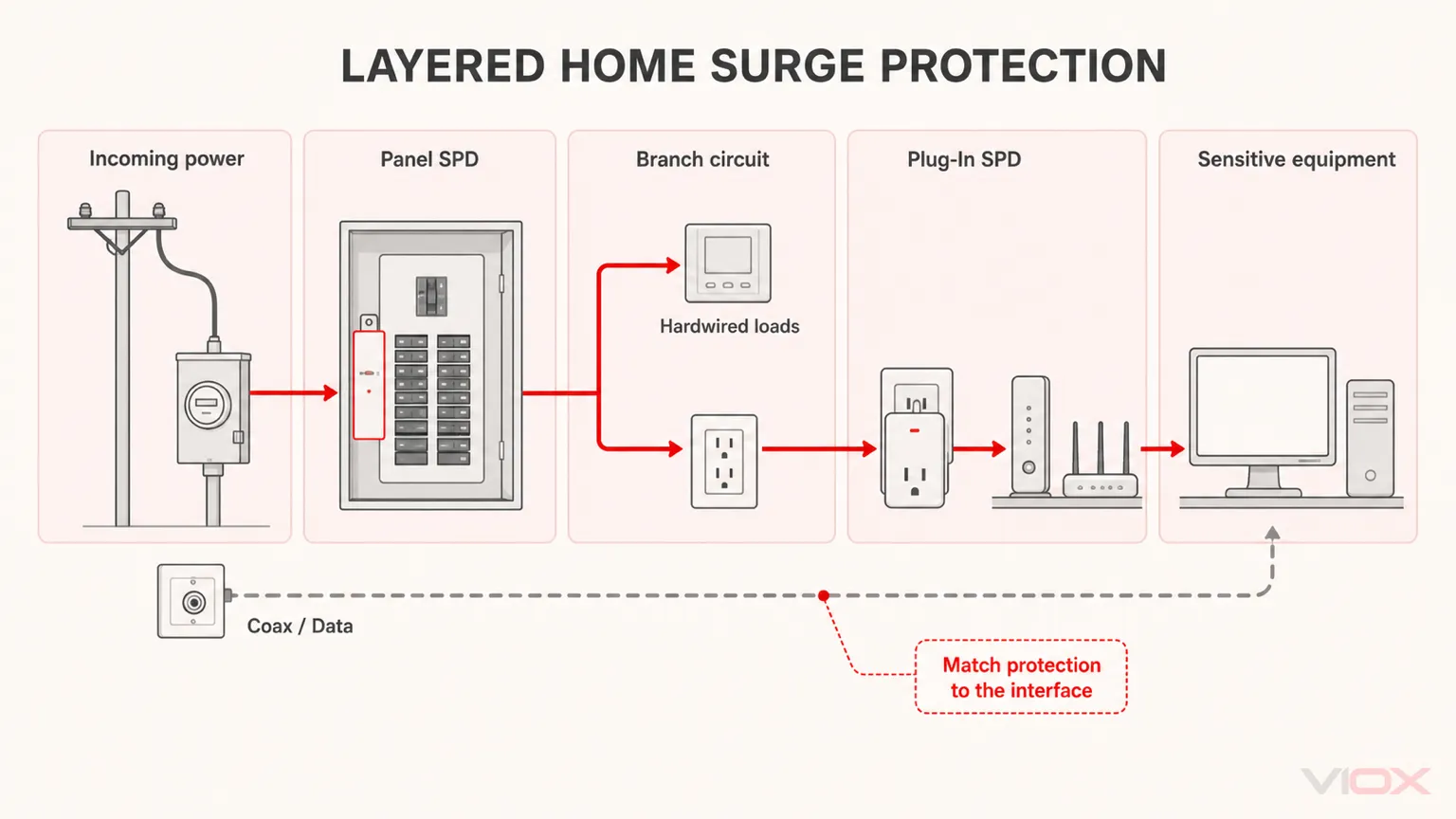
Layered protection places SPDs at different boundaries of the electrical system. A panel SPD creates an upstream surge-current path. A plug-in SPD can provide another protection stage close to selected equipment. Additional SPDs may be used at downstream panels or at other interfaces when the system architecture requires them.
The engineering principle is straightforward, but the current and voltage division is not universal. It depends on:
- the voltage-current characteristics of each SPD;
- the protection modes provided;
- the conductor impedance between stages;
- the surge waveform and source;
- the earthing and bonding arrangement;
- the downstream equipment and its connected interfaces;
- the manufacturer’s coordination and installation requirements.
For that reason, it is not technically sound to claim that a panel SPD will always reduce a particular surge current to a fixed residual current, or that a plug-in SPD will always present one exact voltage to the equipment. Those values require a defined test circuit, products, modes, waveform, and measurement points.
The relevant practical rule is:
Use an upstream SPD suitable for the service or distribution position, then add point-of-use protection where the protected load, exposure, and product instructions justify it. Do not assume that two unrelated products are coordinated merely because both are labeled “surge protector.”
For a deeper comparison of tested SPD positions, see Type 1 vs Type 2 vs Type 3 SPD.
Protection Paths That Both Devices Can Miss
Most residential comparisons stop at the power conductors. That can leave the most important system boundary unexplained.
Coaxial, Ethernet, telephone, antenna, and control lines
Equipment can be connected to more than one conductive network. A television may receive power and coaxial cable. A router may receive AC power and an outdoor Ethernet connection. A security controller may connect to power, sensors, and communication wiring.
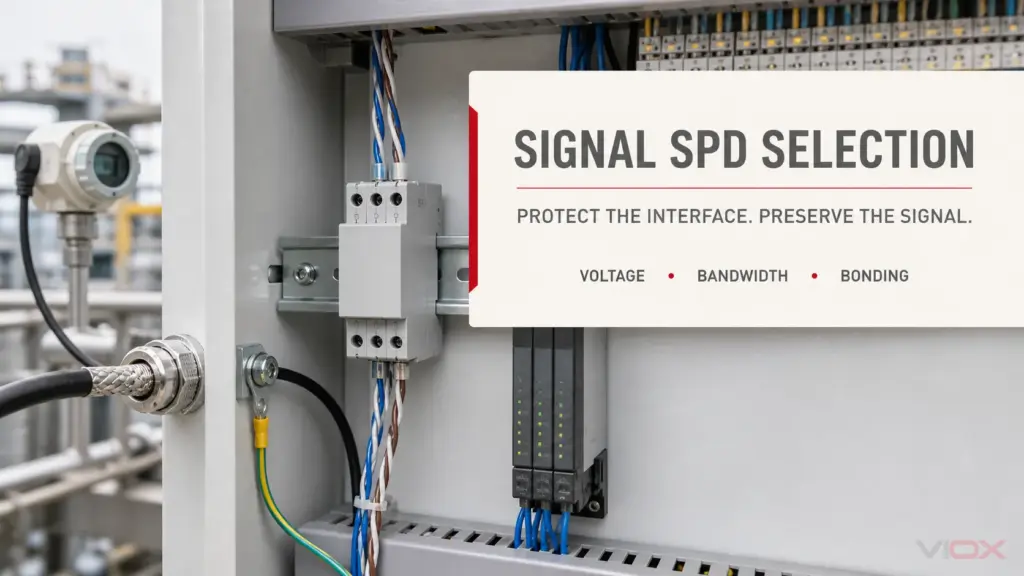
A power SPD does not automatically limit a transient arriving on those other conductors. Where additional interfaces require protection, the selected signal SPD must match the interface voltage, signaling method, bandwidth, connector, shield arrangement, grounding, and installation environment. Treat this as a separate interface-selection task rather than choosing a signal protector from the power SPD’s kA rating.
Sustained overvoltage and undervoltage
An SPD is intended for transient overvoltage. It is not the complete remedy for a supply that remains above or below its normal range, repeated brownouts, a lost neutral, incorrect wiring, or another persistent power-quality fault. These conditions require diagnosis and possibly a voltage-monitoring or disconnection function. The difference is explained in voltage protector vs surge protector.
Direct lightning and structural protection
Neither a plug-in product nor a panel SPD should be presented as a guarantee against a direct lightning strike. A complete lightning-protection strategy can involve strike interception, down conductors, bonding, earthing, power SPDs, and protection for incoming signal services. Requirements depend on the building, exposure, and local rules.
Which Strategy Fits Your Home?
Homeowner with HVAC electronics and several sensitive plug-in loads
Prioritize a panel SPD because important equipment is hardwired and spread across several circuits. Add plug-in SPDs at concentrated sensitive loads such as the home office, network equipment, or audiovisual system where an additional point-of-use stage is justified.
Decision: Both.
Renter without access to service or panel equipment
Use appropriately certified plug-in SPDs at selected equipment. Ask the property manager whether the building already has upstream surge protection. Do not open or modify common electrical equipment.
Decision: Plug-in protection first.
Home with mostly hardwired equipment and few sensitive plug-in devices
A panel SPD provides broader value than buying multiple plug-in units that cannot protect the hardwired loads. Point-of-use protection can be added selectively rather than automatically.
Decision: Panel protection first; add plug-in SPDs where needed.
Home experiencing long periods of high voltage or repeated light flicker
Do not treat this as a simple surge-protector shopping problem. Have the supply, neutral, connections, loading, and voltage behavior assessed. An SPD can remain part of the transient-protection system, but it does not resolve the underlying sustained condition.
Decision: Diagnosis first; neither SPD type is the complete solution.
Home with rooftop antennas, outdoor data cables, or multiple incoming services
Power-circuit protection alone leaves other paths open. The system may need coordinated power and signal protection together with correct bonding at the entry points.
Decision: Coordinated multi-path protection, not simply more power strips.
What to Check Before Comparing Products
The comparison determines the protection location. It does not finish product selection.
Panel SPD checks
- AC system voltage and configuration;
- earthing arrangement and required protection modes;
- permitted installation position and SPD Type under the applicable framework;
- continuous operating voltage rating;
- declared voltage protection level or voltage protection rating;
- discharge-current ratings under their stated test waveforms;
- available fault current and required short-circuit/backup-protection coordination;
- conductor routing and manufacturer lead-length instructions;
- protection-status indication and, where needed, remote signaling;
- certification evidence required by the project or jurisdiction.
Plug-in SPD checks
- suitable supply voltage and plug/receptacle system;
- certification or listing appropriate to the market;
- declared voltage protection performance under the applicable test method;
- load-current and connected-load restrictions;
- a dedicated protection-status indication or disconnection behavior;
- manufacturer restrictions for installation, extension cords, power strips, and connected equipment;
- protection for non-power interfaces when those interfaces are present.
Do not compare a panel SPD’s IEC Up value directly with a plug-in product’s UL Voltage Protection Rating (VPR) as if they were the same measurement. Do not compare Imax, In, SCCR, Isccr, and joules as interchangeable measures. Each declaration answers a different question within a specified test framework. Use How to Read an SPD Datasheet when moving from protection strategy to an actual specification.
Standards Boundary: UL/NEC and IEC Are Not One Classification System
The words Type 1, Type 2, and Type 3 appear in more than one standards environment, but the definitions, tests, ratings, and installation rules must be interpreted within the applicable framework.
| Context | What to verify | Important boundary |
|---|---|---|
| North American product evaluation | Applicable UL 1449 Type, product listing, MCOV, VPR, In, SCCR, protection modes, and installation instructions | UL Solutions includes permanently connected Types 1–3 as well as cord-connected, direct plug-in, and receptacle Type 3 products; use the product’s exact marking |
| United States installation code | Adopted National Electrical Code edition, local amendments, service/feeder requirements, and authority having jurisdiction | NEC requirements are not automatically law everywhere; adoption and amendments vary |
| IEC AC low-voltage SPD | IEC 61643-11 together with IEC 61643-01, declared Type, Uc, Up, In, Imax or Iimp where applicable, protection modes, and short-circuit declarations | IEC terms and test results should not be converted into UL values by a simple one-to-one table |
In the United States, NEC 230.67 addresses listed Type 1 or Type 2 SPDs for services supplying specified occupancies, including dwelling units. Apply the requirement according to the NEC edition and amendments adopted by the local authority. Do not turn the existence of an NEC requirement into a global statement that every existing home in every jurisdiction must be retrofitted in the same way.
For IEC markets, IEC 61643-11:2025 covers AC low-voltage power SPDs and is intended to be read together with the latest edition of IEC 61643-01. Product requirements still have to be combined with national installation rules and the actual electrical system.
Installation and Maintenance Boundaries
Panel SPD installation involves service or distribution equipment and should be carried out by a qualified person under the applicable local rules. The installer must verify the circuit, product instructions, connection modes, overcurrent or backup-protection requirements, available fault current, conductor routing, and safe isolation procedure.
Installation quality is part of surge performance. Avoiding unnecessary conductor length, loops, and shared impedance can be as important as selecting a suitable label rating. See SPD installation mistakes involving lead length, grounding, wiring configuration, and status indication.
After installation:
- identify which indicator specifically shows protection status;
- do not confuse a power indicator with a protection-health indicator;
- follow the manufacturer’s inspection and replacement instructions;
- inspect the protection system after a known severe event when the instructions or site procedure require it;
- replace a failed or disconnected module/device with a compatible product;
- do not apply one universal replacement age to every panel and plug-in SPD.
Whether a switched plug-in SPD continues to provide protection when its switch is off depends on its internal circuit and product design. Do not infer the answer from the switch position alone. If complete isolation is required and it is safe to do so, disconnect the equipment from power and remember that other conductive connections may still remain.
For condition-based replacement guidance, see how to determine when a surge protector has reached end of life.
Final Decision Rule
Choose a whole-house or panel SPD first when the main objective is broad protection for downstream circuits and hardwired electronic equipment.
Choose plug-in SPDs first when panel access is unavailable or when selected plug-connected electronics need an immediate point-of-use protection layer.
Choose both when the home has important hardwired loads and sensitive plug-in equipment, provided the products are suitable for their locations and used according to the applicable instructions.
Choose neither as the complete answer when the real problem is sustained voltage deviation, a wiring fault, missing bonding, an unprotected data/signal path, or a lightning-protection requirement that needs a broader system design.
The best strategy is not the one with the largest kA or joule number. It is the one that closes the relevant surge paths with correctly selected, installed, and maintainable devices. To evaluate available panel-mounted options after defining the protection strategy, review the VIOX SPD product family and request model-specific ratings and certification documents for the intended market.
Sources Reviewed
- NIST Special Publication 960-6 — Surges Happen! How to Protect the Appliances in Your Home
- NIST Surge Protection Anthology — Coordination of Cascaded Surge-Protective Devices
- Electrical Safety Foundation International — Surge Protection: Keeping Your Electronics and Home Safe
- UL Solutions — Surge Protection Device Testing and Certification Services
- NFPA code-development material for NEC 230.67
- IEC 61643-11:2025 — Surge protective devices connected to AC low-voltage power systems
- IECEE TRF 61643-111D:2026 — IEC 61643-11:2025 used with IEC 61643-01:2024