On this page
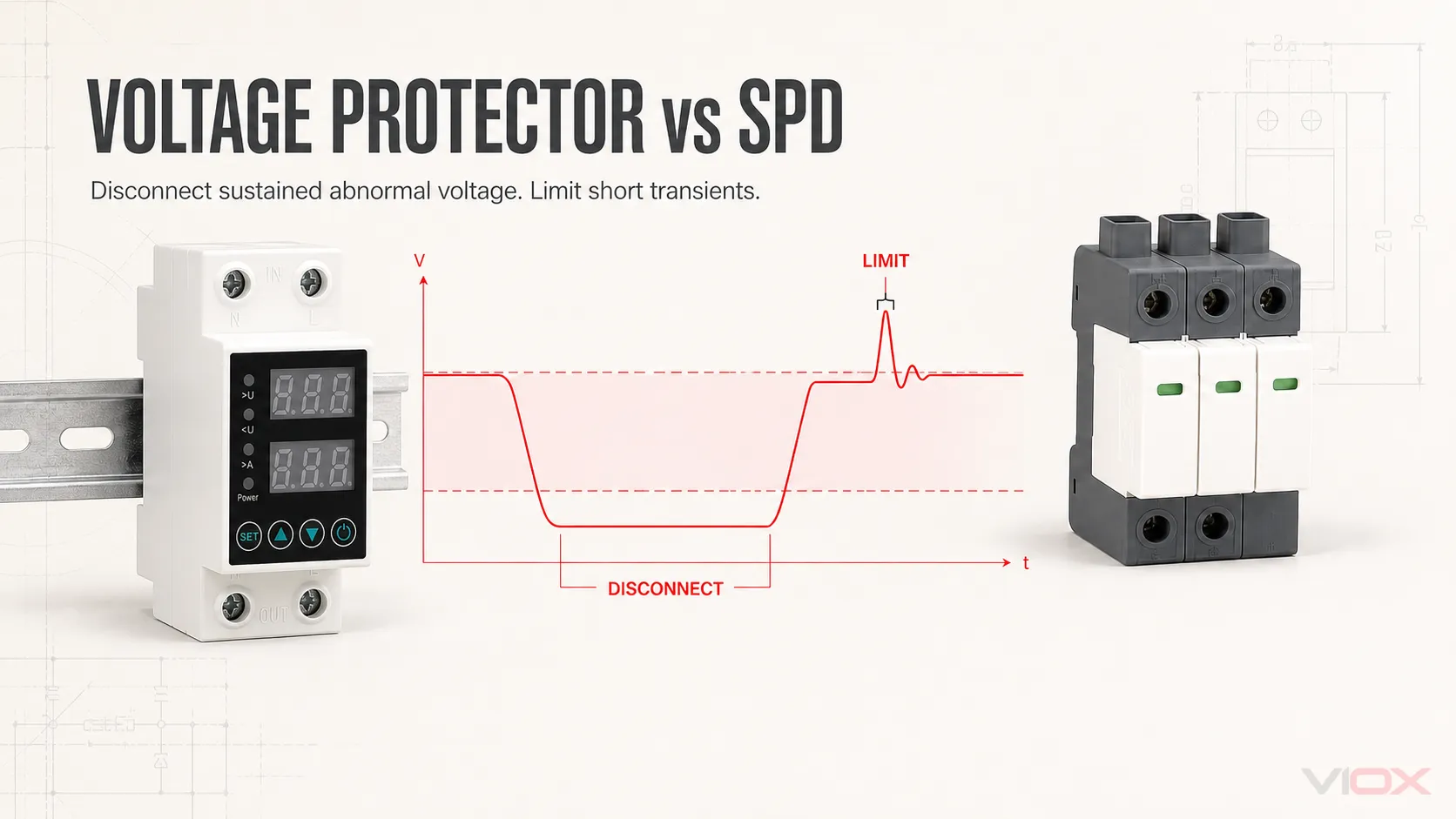
A voltage protector disconnects a load when the measured supply remains above or below configured voltage limits. A surge protector, more precisely a surge protective device (SPD), limits short transient overvoltage by conducting surge current through a defined protection path.
They solve different problems:
- Choose a voltage protector for sustained or recurring overvoltage and undervoltage.
- Choose an SPD for short transients associated with lightning effects, switching, or similar surge events.
- Use both when the installation is exposed to both disturbance types.
- Choose a regulator, UPS, or another solution if the load must continue operating through voltage variation or an outage.
Neither device is universally “better.” The correct choice depends on what the voltage is doing, how long the condition persists, and whether the required response is to disconnect the load or limit a transient.
Scope note: In this article, “voltage protector” means an automatic over and under voltage protector or voltage-monitoring relay that initiates disconnection. Some sellers use the same phrase for voltage regulators, surge strips, or multifunction devices, so the actual datasheet function must always be checked.
Voltage Protector vs Surge Protector: Decision Table
| Decision point | Voltage protector | Surge protector / SPD |
|---|---|---|
| Primary disturbance | Supply remains outside an allowed overvoltage or undervoltage window | Short transient overvoltage |
| Protective action | Opens an internal switching device or commands a contactor to disconnect the load | Changes impedance and conducts surge current, limiting the voltage across protected conductors |
| Load during operation | Power is interrupted | Power is normally not intentionally interrupted by the surge-limiting action |
| Low-voltage protection | Yes, when undervoltage monitoring is provided and configured | No |
| Sustained high-voltage protection | Yes, within the device’s declared monitoring and switching capability | Not the SPD’s intended function |
| Lightning- or switching-induced transient protection | Not a substitute for an SPD | Core function when the SPD is correctly selected and installed |
| Typical connection role | In the load path or in a control circuit that operates a switching device | Usually connected in parallel across defined conductors or protection modes |
| Key limitation | Disconnects rather than corrects the supply and is not intended to limit surge energy | Does not regulate voltage, boost low voltage, provide backup power, or replace sustained-voltage protection |
The shortest reliable rule is:
Out-of-range voltage that persists → disconnect it. Short transient voltage → limit it. Exposure to both → coordinate both functions.
The Key Distinction Is Disturbance Duration and Protective Action
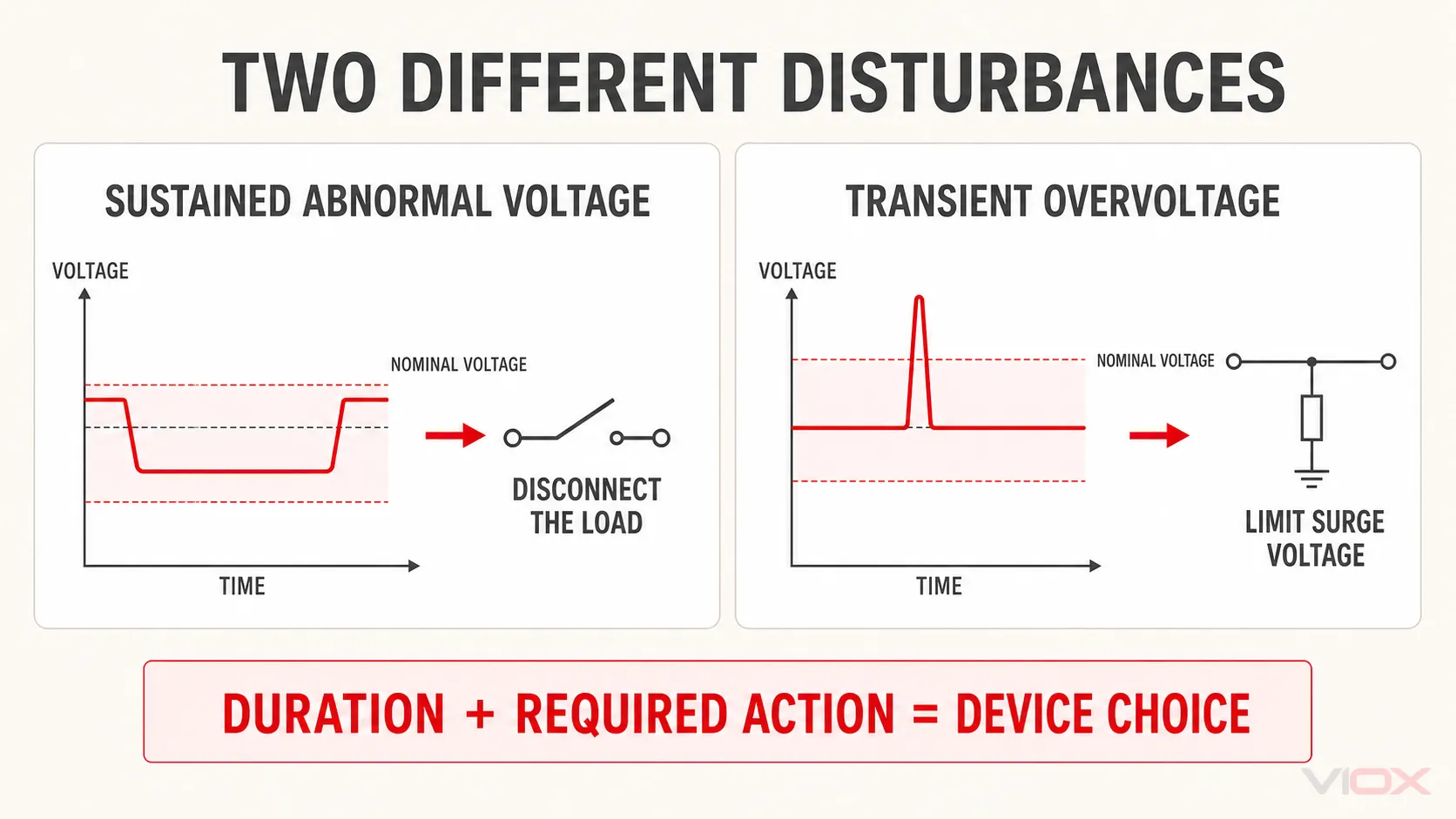
“Overvoltage” is a broad description, not one single electrical event. Two conditions can both rise above nominal voltage yet require different protection.
A sustained abnormal supply voltage remains present long enough for a monitoring device to determine that the supply has left its permitted window. Where load disconnection is an appropriate protective response, reconnection follows the device’s configured recovery logic.
A temporary overvoltage (TOV) requires a more specific system assessment and should not be treated as merely another name for ordinary long-term supply deviation. Whether a voltage protector is an appropriate part of the response depends on the TOV magnitude and duration, the earthing system, equipment withstand capability, the installed SPD’s declared TOV behavior, and applicable local installation rules. A general voltage protector should therefore not be assumed to resolve every TOV scenario by itself.
A transient overvoltage is a short event caused by effects such as lightning or switching. The required action is to limit the voltage stress while providing a path for surge current. IEC 61643-11 describes AC low-voltage SPDs as devices containing at least one nonlinear component and intended to limit surge voltages and divert surge currents.
This distinction also explains why a low-looking voltage number alone cannot identify the right device. A power-quality measurement, event log, equipment alarm, or investigation of the source may be needed to determine whether the problem is a persistent supply condition, a transient, an interruption, or a different disturbance entirely.
How Does a Voltage Protector Respond?
A voltage protector typically follows a monitoring-and-disconnection sequence:
- It measures the relevant supply voltage.
- It compares the measurement with configured overvoltage and undervoltage thresholds.
- When the trip condition is satisfied, its output changes state.
- The load is disconnected directly or through a contactor, depending on the device design.
- Reconnection occurs according to the product’s recovery threshold, hysteresis, and delay logic.
The exact thresholds, delay behavior, contact rating, and reset method are product-specific. A three-phase monitoring relay may also supervise phase loss, phase sequence, or asymmetry, but those features should not be assumed for every voltage protector.
The essential point is that the device removes an unsafe supply from the load. It does not normally hold the output at a constant voltage.
How Does a Surge Protective Device Respond?
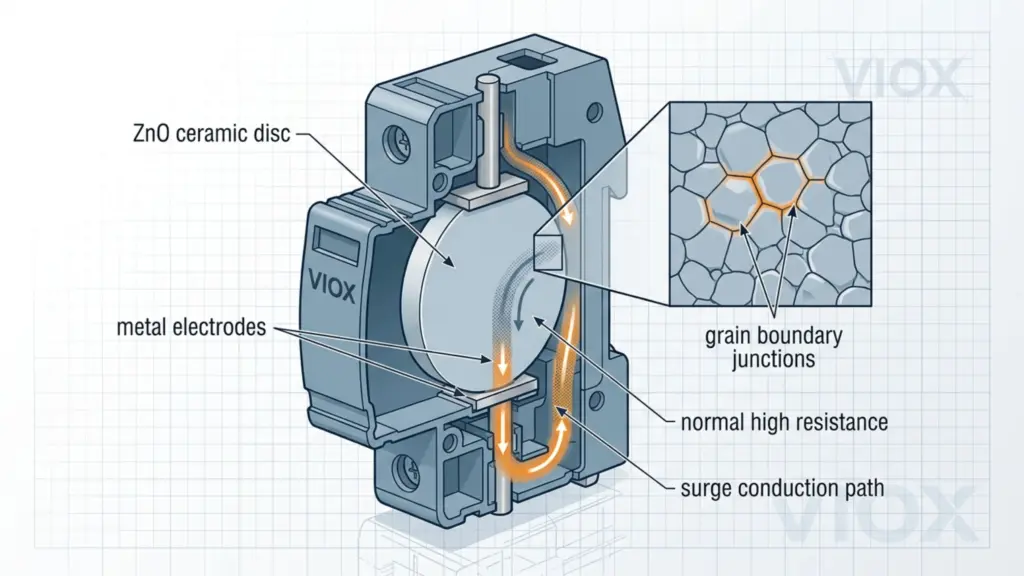
A surge protective device normally remains in a high-impedance standby state at acceptable system voltage. When a transient causes the voltage across a protected mode to rise, a nonlinear component changes state and provides a lower-impedance path for surge current. This limits the transient voltage reaching downstream equipment.
The current does not always travel simply “to ground.” Depending on the system and SPD topology, the protected modes may include line-to-neutral, line-to-protective-earth, neutral-to-protective-earth, line-to-line, or DC conductor combinations. Earthing, bonding, conductor routing, protection mode, and installation position all influence the result.
An SPD is therefore a transient-limiting device—not a voltage stabilizer and not a general high-voltage cutoff. Schneider Electric also states that surge protectors are not intended to safeguard against temporary overvoltages below their maximum continuous operating voltage.
Can a Surge Protector Replace a Voltage Protector?
No. A standard SPD does not provide the core functions required for sustained over/under-voltage protection:
- It does not boost low voltage.
- It does not normally open the load circuit because supply voltage remains below a configured limit.
- It is not intended to continuously absorb or divert the energy of a sustained abnormal supply condition.
- Its Uc or MCOV rating is a continuous operating limit used in SPD selection, not a user-adjustable overvoltage trip threshold for load disconnection.
This directly answers the common question, “Do surge protectors protect against low voltage?” They do not. If undervoltage must cause shutdown, the system needs undervoltage monitoring and an appropriate means of disconnection. If operation must continue, regulation or stored-energy support may be required instead.
Can a Voltage Protector Replace an SPD?
No. A voltage protector is designed to evaluate the supply against monitoring thresholds and then disconnect the load. That is not the same operation as limiting a short transient at the equipment terminals.
Even if a voltage protector includes an overvoltage trip function, that label does not prove it has been tested as an SPD. Surge protection requires declared transient-performance ratings and an applicable test framework. For AC low-voltage SPDs, relevant label and datasheet items may include SPD Type, Uc or MCOV, Up, In, Imax or Iimp, protection modes, and short-circuit coordination.
Therefore, overvoltage protection is not automatically the same as surge protection. Surge protection is one specialized response to transient overvoltage; a voltage protector addresses a different part of the voltage-disturbance spectrum.
Which Device Do You Need?
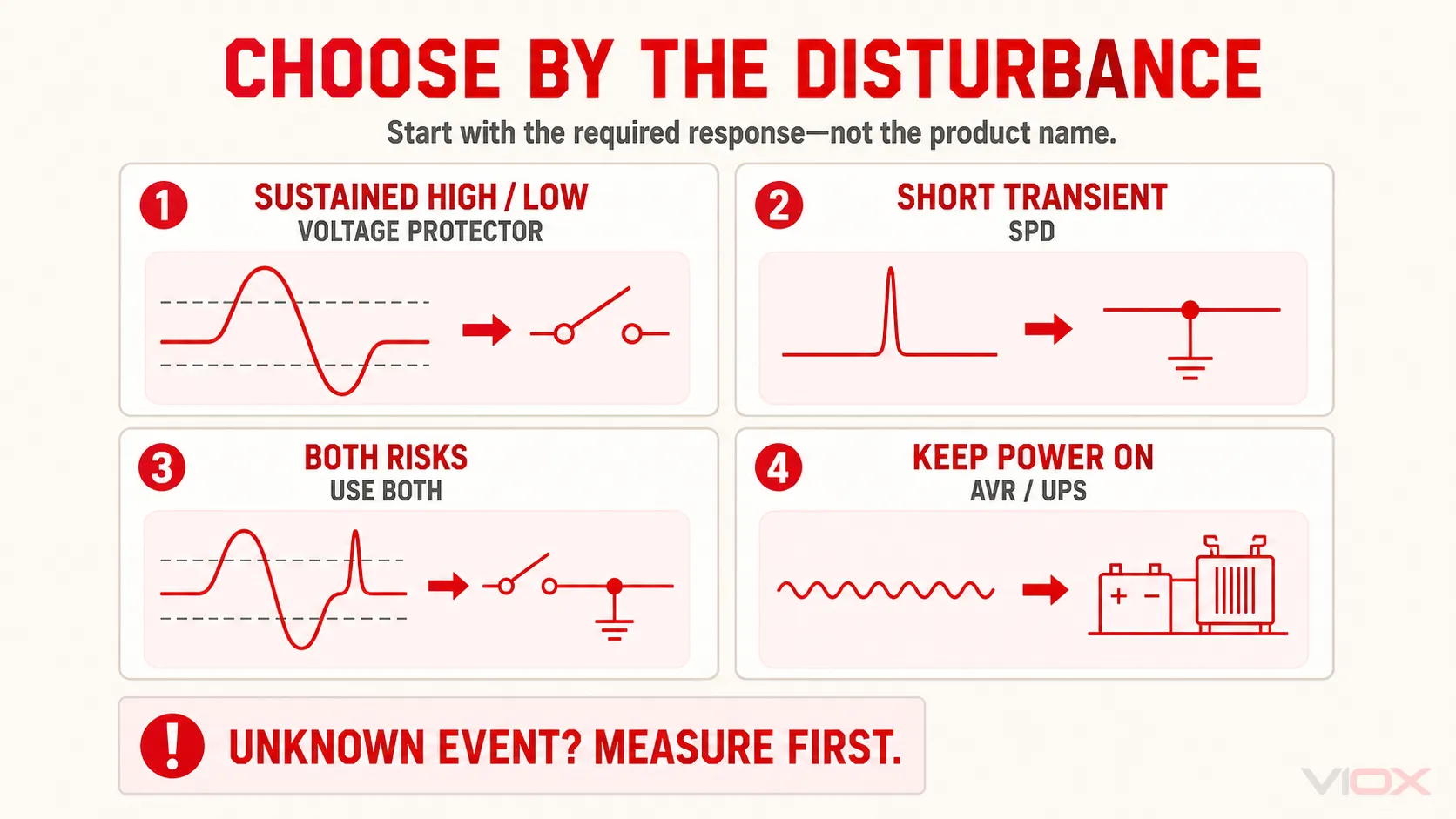
Use the observed problem—not the product name—as the selection starting point.
| Observed requirement | Appropriate direction | Why |
|---|---|---|
| Voltage remains too high or too low and the equipment should shut down | Voltage protector | Threshold monitoring and disconnection match the required response |
| Exposure to lightning-induced or switching transients | SPD | The requirement is transient-voltage limitation and surge-current handling |
| Unstable supply plus credible transient exposure | Both | Each device covers a different disturbance class |
| Equipment must remain energized through moderate voltage variation | Voltage regulator / AVR | Regulation, not disconnection, is required |
| Equipment must continue operating during interruption | UPS or another backup-power system | Neither a voltage protector nor an SPD supplies backup energy |
| Overload, short circuit, or electric-shock protection is the main concern | Appropriate overcurrent or residual-current protection | The problem is not primarily voltage magnitude or transient limitation |
| Disturbance type is unknown | Measure or diagnose first | Product selection without identifying the event can leave the real failure mode unprotected |
Choose a Voltage Protector When
Choose a voltage protector when all three statements are true:
- The important variable is the measured supply voltage.
- The unacceptable condition persists long enough to satisfy the device’s trip logic.
- Disconnecting the load is the desired safe response.
Then verify nominal voltage, single- or three-phase configuration, over/under thresholds, hysteresis, delay and reset logic, contact or controlled-contactor capacity, and any required phase-monitoring functions.
Choose an SPD When
Choose an SPD when the design must limit transient overvoltage on an AC, DC, PV, power, or signal circuit. Selection depends on the applicable standard and installation context, not on one headline kA value.
For an AC power SPD, verify system voltage and earthing arrangement, installation point, SPD Type, Uc or MCOV, voltage protection level, declared discharge-current ratings, protection modes, backup protection, and available short-circuit conditions. The VIOX guide to reading an SPD datasheet explains these parameters in detail.
When Should a Voltage Protector and SPD Be Used Together?
Use both when the risk assessment identifies both unstable supply voltage and transient exposure. A facility may, for example, experience recurring voltage excursions while also having outdoor feeders, lightning exposure, inductive switching, or sensitive electronic controls.
In that arrangement, the devices remain functionally separate:
- The SPD limits transient voltage between its connected conductors.
- The voltage protector monitors supply voltage and initiates load disconnection when its settings require it.
- The breaker or fuse provides the required overcurrent and short-circuit function.
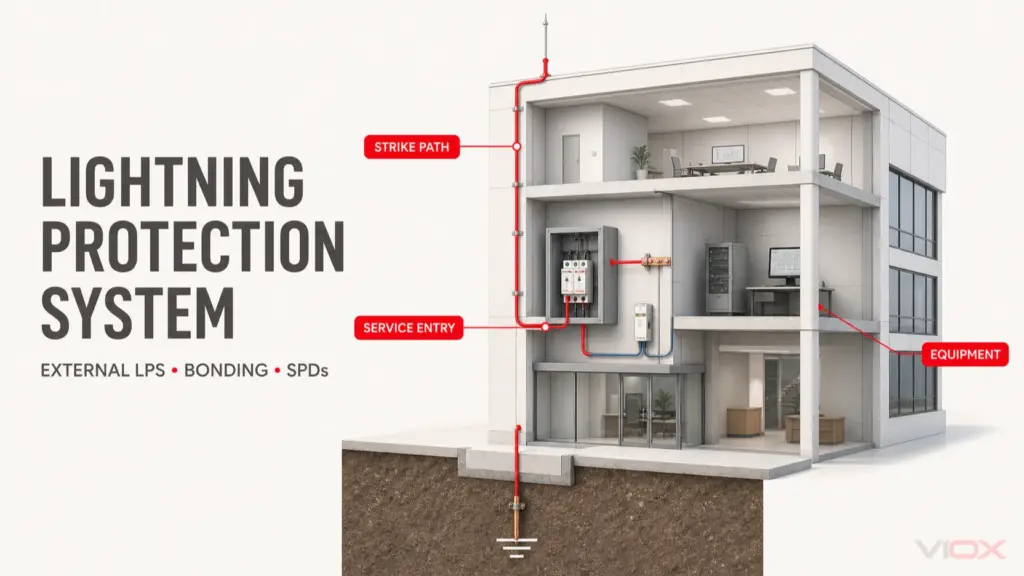
- Earthing and bonding provide the system reference and current paths required by the design.
“Use both” does not create a universal wiring order. Device topology, earthing system, upstream protection, conductor routing, contactor arrangement, local rules, and manufacturer instructions determine the final design. A qualified electrical professional should coordinate these elements for the actual installation.
Voltage Protector vs Voltage Regulator: Do Not Confuse Disconnection With Correction
Some search results use “voltage protector,” “voltage regulator,” and “stabilizer” interchangeably. They are not necessarily the same product.
- A voltage protector decides whether the measured voltage is acceptable and disconnects when its protection logic is met.
- A voltage regulator or AVR changes the input-to-output relationship to keep output voltage within its regulating capability.
- A UPS provides stored energy during an interruption and may also include regulation or surge-related functions.
- An SPD limits transient overvoltage.
A multifunction product may combine more than one function, but each function must be verified from its ratings, test standard, wiring diagram, and declared operating behavior. The word “protection” on the enclosure is not evidence that all four functions are present.
Final Selection Rule
The voltage protector vs surge protector decision becomes straightforward when the disturbance is defined first:
- Sustained high or low supply voltage + shutdown required: voltage protector.
- Short transient overvoltage + voltage limitation required: SPD.
- Both disturbance classes are credible: coordinate both.
- Continuous correction or backup power is required: select a regulator, UPS, or engineered power-quality solution instead.
After identifying SPD as the required product category, compare the VIOX surge protective device range by system voltage, application, SPD Type, protection mode, and declared ratings.