지난 여름에 HVAC 시스템이 고장 났습니다. 두 달 후에는 수영장 펌프가 타 버렸고, 그다음에는 스마트 홈 허브가 부팅되지 않았습니다. 세 번의 수리, $4,200의 자비 지출 후에야 전기 기술자가 당신이 놓치고 있던 점을 말해주었습니다: “파워 스트립만이 아닌, 전기 패널에 서지 보호 장치가 필요합니다.”
대부분의 주택 소유자는 TV 아래 있는 $30 서지 보호기 스트립이 집 전체를 보호한다고 생각합니다. 하지만 그렇지 않습니다. 그것은 여섯 개의 콘센트만 보호할 뿐입니다. 냉장고, HVAC 시스템, 우물 펌프, 차고 문 개폐기, 유선 연결된 스마트 기기들은 어떻게 될까요? 완전히 노출된 상태입니다.
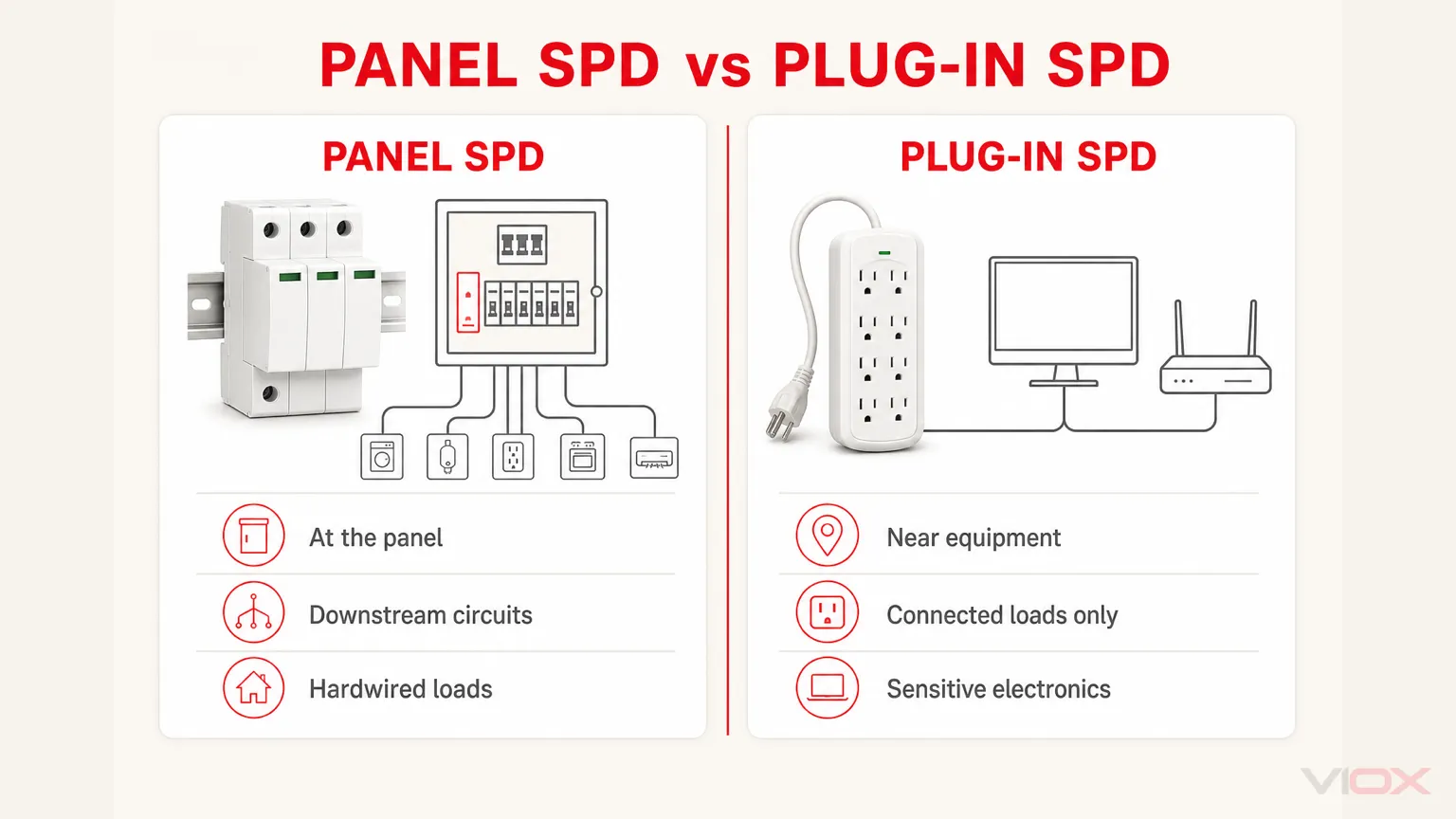
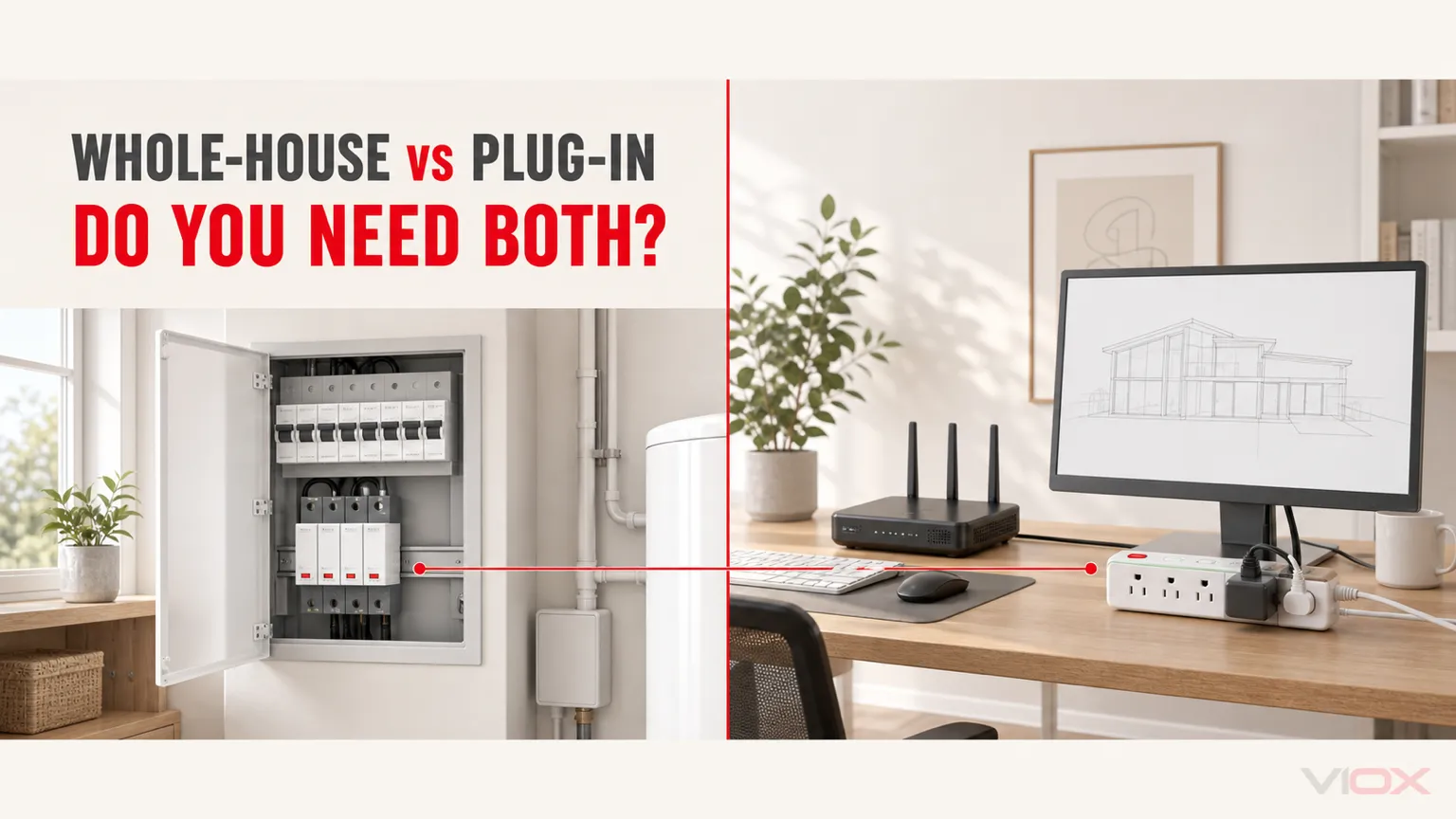
현실은 다음과 같습니다: 가전 서지 보호기 (전기 패널에 설치됨) 및 멀티탭 서지 보호기 (콘센트에 연결되는) 두 가지 서로 다른 보호 영역을 담당합니다. 가전 전체 서지 보호 장치(SPD)는 서비스 입구에서 전체 전기 시스템을 보호합니다. 멀티탭은 연결된 기기만 보호합니다. 서로 대체할 수 없으며, 많은 경우 두 가지 모두 필요합니다.
본 가이드는 각 유형의 보호 범위, 작동 방식, 비용(장비 + 설치), 그리고 언제 하나만 필요하거나 둘 다 필요하거나 계층적 조합이 필요한지 설명합니다. 패널 장착형 SPD가 50~100만 원의 가치가 있는지, 혹은 멀티탭만으로 충분한지 궁금했던 적이 있다면, 끝까지 읽으면 결정을 내릴 수 있는 기준을 갖게 될 것입니다.
가전 전체 서지 보호 장치란?
가전 전체 서지 보호 장치(기술적으로 타입 1 또는 타입 2 서지 보호 장치, 즉 UL 1449 기준의 SPD)는 주 전기 패널에 또는 그 근처에 영구 설치되는 장치입니다. 그 역할은: 유틸리티 선로를 통해 가정으로 유입되는 전압 급상을 분기 회로, 콘센트, 또는 직접 배선된 장비에 도달하기 전에 차단하는 것입니다.
번개가 두 블록 떨어진 변압기에 치거나, 전력 회사가 콘덴서 뱅크를 전환하거나, 이웃의 HVAC 압축기가 작동할 때, 순간적인 과전압이 전력망을 통해 전파됩니다. 전체 주택용 서지 보호 장치(SPD)는 이러한 서지를 수전점에서 차단하여 전기 시스템 전체—모든 회로, 모든 콘센트, 모든 직접 배선된 가전제품—에 걸친 전압 스파이크를 제한합니다.
전체 주택용 SPD가 보호하는 대상:
- 모든 분기 회로—주방, 침실, 차고, 지하실. 모든 콘센트가 패널 레벨 차단의 혜택을 받습니다.
- 직접 배선된 장비—HVAC 시스템, 우물 펌프, 차고 문 개폐기, 천장 선풍기, 전기 온수기, 수영장 장비. 이들은 멀티탭에 꽂을 수 없으므로 패널 레벨 보호가 유일한 방어 수단입니다.
- 스마트 홈 디바이스—직접 배선된 허브, 보안 패널, 조명 컨트롤러, 초인종 변압기.
- 240V 가전제품—전기 레인지, 건조기, EV 충전기, 히트 펌프.
기술 사양:
- 서지 전류 정격최대 서지 전류: 40 kA ~ 100 kA+ (개별 사용점 장치보다 훨씬 높음). 이는 SPD가 고장 없이 분산할 수 있는 최대 서지 전류입니다.
- 정격 방전 전류 (In): 일반적으로 10 kA ~ 20 kA. 2023년 NEC(미국 전기 규정)은 주거용 수전 서비스 및 특정 분전 회로의 SPD에 대해 In ≥ 10 kA를 요구합니다.
- 유형 분류 (UL 1449 제5판):
- 1형유형 1: 공용 변압기와 서비스 장비 과전류 차단 장치(주 차단기 라인 측) 사이, 또는 부하 측에 설치됩니다. 미터 소켓 SPD를 포함합니다.
- 2형유형 2: 서비스 장비의 부하 측(주 분전반 또는 부 분전반)에 설치됩니다. 주거용 개조에 가장 일반적입니다.
- 설치설치: 면허를 가진 전기 기술자가 필요합니다. 일반적으로 패널 내부 DIN 레일에 장착되거나 전용 차단기에 배선됩니다.
규제 준수NEC 규정 준수: 2023년 국가 전기 규정(NEC)은 모든 주거용 단위 서비스에 유형 1 또는 유형 2 SPD를 요구하며, 특정 분전 회로와 시설(기숙사, 병원, 객실)에 대한 확대된 요구사항을 포함합니다. 패널을 신설하거나 업그레이드하는 경우, 대부분의 관할 지역에서 전체 주택용 SPD는 더 이상 선택 사항이 아닙니다—규정입니다.
전체 주택용 SPD는 공용 전력 서비스. 를 통해 유입되는 서지를 처리합니다. 케이블 TV 동축 케이블, 전화선 또는 안테나 연결을 통해 유입되는 서지는 보호하지 않습니다. 완전한 보호를 위해서는 케이블/위성 신호 접속점에 동축 서지 보호기를 사용하고 NEC 제810조에 따른 적절한 접지를 확보하십시오.

그림 1: 주거용 전기 패널의 전문적인 유형 2 SPD 설치. 이 장치는 DIN 레일에 장착되며 색상 코드 배선(검정-상선, 흰색-중성선, 녹색-접지선)과 MOV 상태를 보여주는 LED 상태 표시등을 포함합니다. 이 패널 레벨 설치로 집 전체의 모든 하류 회로, 직접 배선된 가전제품 및 콘센트가 보호됩니다.
멀티탭 서지 보호기란 무엇인가요?
멀티탭 서지 보호기(기술적으로 UL 1449 기준 유형 3 SPD 유형 3 장치 )는 코드로 연결되고 플러그를 꽂는 장치로,. 단일 콘센트 위치.
에서 장비를 보호합니다. 벽면 콘센트에 꽂은 후, 장치들을 그 멀티탭의 콘센트에 꽂습니다. 내부 구성 요소—일반적으로 금속 산화물 바리스터(MOV)—가 사용 지점에서 전압 스파이크를 차단하여 연결된 장비가 받는 서지 전압을 제한합니다.
전체 주택용 SPD가 수전점에서 보호하는 것과 달리, 유형 3 장치는 최종 단계에서 작동합니다. 이들은 민감한 전자 제품—컴퓨터, TV, 라우터, 게임 콘솔, 오디오 장비—을 위한 최후의 방어선입니다.
- 멀티탭 서지 보호기가 보호하는 대상:멀티탭에 꽂은 장치.
- —데스크탑 컴퓨터, 모니터, 라우터, 프린터, TV, 게임 콘솔, 오디오 리시버.잔류 서지에 대비.
—전체 주택용 SPD가 있어도 일부 잔류 전압이 콘센트에 도달할 수 있습니다. 사용점 SPD는 민감한 전자 제품을 위한 두 번째 단계의 차단을 제공합니다.
- 보호하지 않는 대상:다른 회로나 콘센트.
- 직접 배선된 장비—오직 해당 특정 멀티탭에 꽂은 장비만 보호합니다.
- 직접 배선된 장비—HVAC, 우물 펌프, 차고 문 개폐기는 멀티탭에 꽂을 수 없습니다.
기술 사양:
- 다른 유입 경로—케이블 TV 동축 케이블, 이더넷 또는 전화선을 통해 유입되는 서지는 보호하지 않습니다. 단, 멀티탭에 전용 동축/이더넷 포트가 포함된 경우는 예외입니다(일부 모델에는 있음).
- 줄 정격: 300 ~ 3,000+ 줄. 이는 MOV가 성능이 저하되기 전의 총 에너지 흡수 용량을 측정합니다. 높을수록 좋지만, 줄 수치만으로는 전체 상황을 알 수 없습니다—차단 전압과 응답 시간도 중요합니다.
- 차단 전압 (전압 보호 등급, VPR): SPD가 서지를 차단하는 임계값입니다. 낮을수록 좋습니다:.
- 400V330V.
- 500V: 우수한 보호 (소비자용 제품에서는 드뭅니다).
- 400V: 양호한 보호. 우수한 유형 3 SPD에서 일반적입니다.
- 응답 시간500V.
- : 허용 가능. 예산형 SPD.600V+ 회로 차단기.
: 미흡함. 민감한 전자 제품에는 피하십시오.: 영화 응답 시간: MOV는 일반적으로 < 1나노초 내에 응답합니다. 일부 하이브리드 설계에는 고에너지 조정을 위한 가스 방전관(GDT)이 포함되지만, GDT는 더 느립니다(100+ ns). Replace surge protector strips every 3–5 years, or immediately after a known major surge event (nearby lightning strike, power outage with visible flicker/buzz). Many strips have a “protected” or “grounded” LED that goes dark when MOVs fail; if yours has one and it’s off, replace the strip immediately.
Pro-Tip: Never daisy-chain surge protector strips or plug one into another. It creates ground loop issues, exceeds load ratings, and violates UL listings. Plug SPDs directly into wall outlets.
Key Differences: Coverage, Protection Level & Installation
The fundamental difference between whole house and power strip surge protectors isn’t just where they install—it’s what they protect 그리고 how they fit into a protection strategy.
Protection Coverage
| 차원 | Whole House SPD (Type 1/2) | Power Strip SPD (Type 3) |
| 설치 위치 | At service entrance or main/sub-panel | At wall outlet (point of use) |
| Protection scope | Entire electrical system (all circuits, all outlets, hardwired equipment) | Only devices plugged into that strip |
| 직접 배선된 장비 | ✓ Protected (HVAC, well pump, garage door, etc.) | ✗ Cannot protect |
| 240V 가전제품 | ✓ Protected (range, dryer, EV charger) | ✗ Typically not (some strips offer 240V models, but rare) |
| Multiple rooms/circuits | ✓ All circuits protected | ✗ Only the outlet where strip is plugged in |
| Coax/phone line protection | ✗ No (separate devices needed) | Some models include coax/Ethernet/phone ports |
기술적 성능
| 사양 | Whole House SPD (Type 1/2) | Power Strip SPD (Type 3) |
| 서지 전류 정격 | 40 kA to 100 kA+ | Typically 6 kA to 15 kA (lower) |
| Clamping/VPR | Varies; typically 600V–1,200V (higher let-through, but handles massive energy) | 330V–600V (tighter clamping for sensitive electronics) |
| 응답 시간 | < 1 ns (MOVs) or 100+ ns (GDTs in hybrid designs) | < 1 ns (MOVs) |
| Energy coordination | Designed to handle direct lightning-induced surges and utility transients | Designed for residual surges after whole-house clamping, or standalone use in low-risk areas |
| Lifespan/replacement | 10+ years typical (check status indicators annually) | 3–5 years (MOVs degrade faster in point-of-use applications) |
설치 요구 사항
Whole House SPD:
- Requires licensed electrician—installed inside electrical panel or adjacent enclosure.
- Permit and inspection may be required depending on jurisdiction.
- Permanent installation—hardwired or DIN-rail mounted.
- Typical install time: 1–2 hours for an experienced electrician.
Power Strip SPD:
- DIY-friendly—plug into any wall outlet.
- No permit or electrician required.
- Portable—move between rooms or take to a new home.
- Install time: 30 seconds.
When One Protects What the Other Doesn’t
Whole house SPDs protect hardwired equipment and all circuits. If a surge enters via the utility and you have only power strip SPDs at your computer desk and TV, your HVAC control board, well pump, garage door opener, and every other outlet in the house is unprotected. This is why whole house SPDs are now code-required for new construction and service upgrades under the 2023 NEC.
Power strip SPDs provide localized clamping with lower let-through voltage. Even with a whole house SPD, some residual voltage reaches your outlets. For sensitive electronics—computers with SSDs, home theater gear, network equipment—a point-of-use SPD with 400V VPR adds a second stage of protection that whole house SPDs (with higher clamping thresholds) don’t offer.
Whole house SPDs are broad but blunt. They handle high energy across the entire system but let through more voltage than sensitive electronics prefer. Power strip SPDs are narrow but precise. They clamp tightly at the device but protect only what’s plugged in. Neither replaces the other. In most scenarios—especially homes with valuable electronics and hardwired appliances—you need 둘 다.
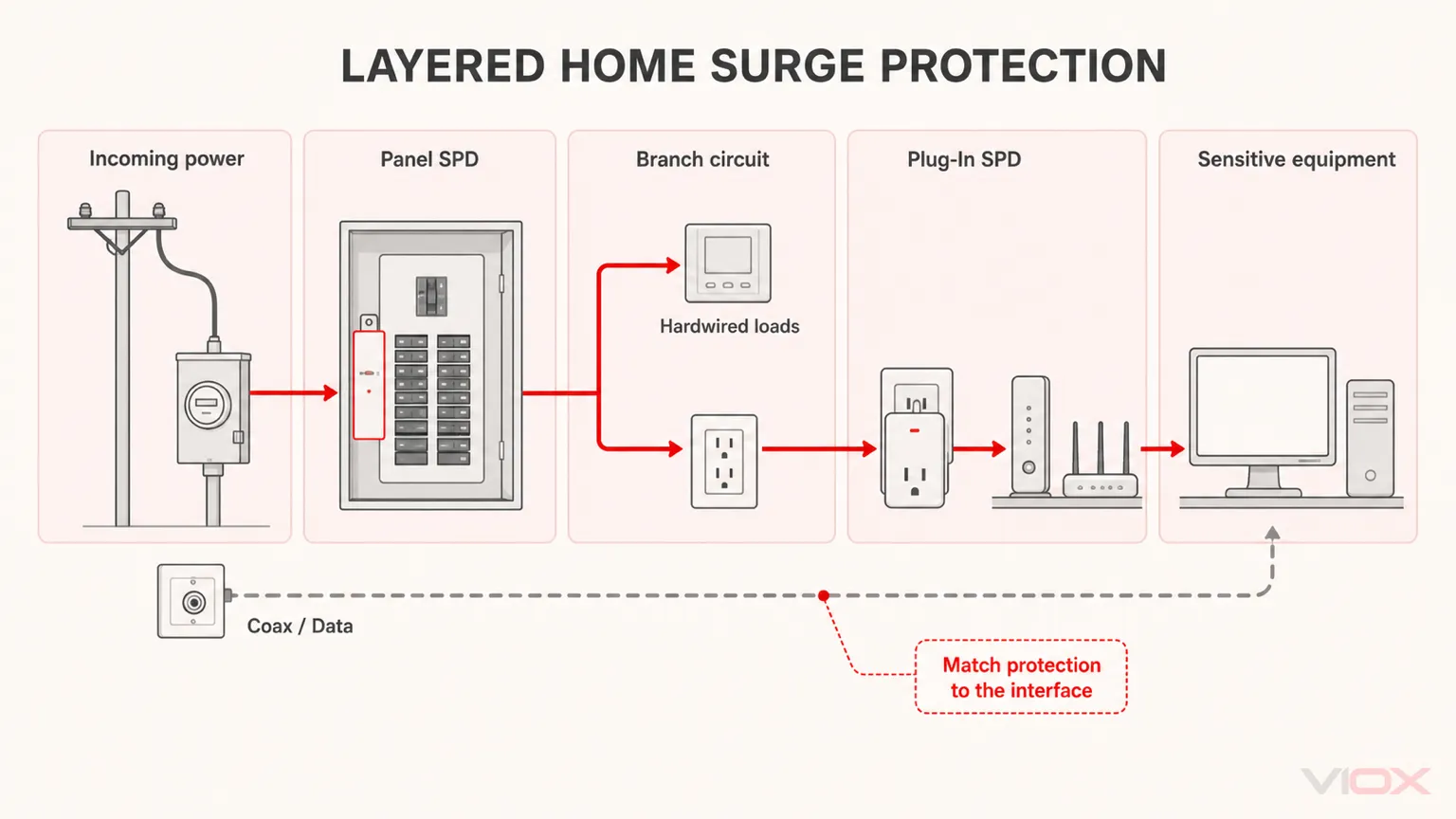
In commercial or high-value residential settings, engineers specify coordinated SPD cascades: Type 1 or 2 at service, Type 2 at sub-panels, and Type 3 at sensitive equipment. Each stage reduces surge energy before the next. This is the “layered protection” strategy recommended by IEEE and NFPA.

Figure 2: Direct comparison between whole house SPD (Type 2, left) and power strip SPD (Type 3, right). Key differences include installation location (panel vs. outlet), protection scope (entire system vs. single location), surge current capacity (40-100kA vs. 6-15kA), and cost structure (professional installation required vs. DIY plug-in). Neither replaces the other—most homes benefit from both.
Cost Comparison: Equipment & Installation
Protection has a price. Here’s what whole house and power strip surge protectors actually cost, including equipment, installation, and long-term replacement.
Whole House SPD Costs
Equipment (Type 2 SPD for typical residential retrofit):
- Budget models: $75–150 (20 kA to 40 kA surge rating, basic status indicator)
- Mid-range models: $150–300 (40 kA to 65 kA, LED status, replaceable MOV modules)
- Premium models: $300–600+ (80 kA to 100 kA+, remote monitoring, surge counters, hybrid MOV+GDT designs)
Installation (licensed electrician required):
- Labor: $150–400 depending on panel accessibility, local labor rates, and whether a new breaker is needed.
- Permit/inspection: $50–150 in jurisdictions that require it.
- Total installed cost: $300–1,000 for most residential installations.
Replacement/maintenance:
- Most Type 2 SPDs last 10+ years. Premium models with replaceable MOV modules let you swap components without replacing the entire unit ($50–150 per module).
- Check the status LED annually. If it indicates failure, replace immediately.
Scenario: A homeowner in Florida (high lightning risk) installs a mid-range 50 kA Type 2 SPD. Equipment: $250. Electrician labor: $300. Permit: $75. Total: $625. Over 10 years, that’s $62.50/year for whole-house protection.
Power Strip SPD Costs
Equipment (Type 3 SPD, typical 6-outlet strip):
- Budget models: $10–25 (300–900 joules, 500–600V VPR, basic or no status indicator)
- Mid-range models: $25–60 (1,000–2,000 joules, 400–500V VPR, “protected” LED, USB charging ports)
- Premium models: $60–150+ (2,000–3,000+ joules, 330–400V VPR, coax/Ethernet protection, replaceable fuses, remote outlets)
설치:
- DIY: Plug it in. $0 labor.
대사:
- Every 3–5 years, or after major surge events. If you buy a $40 strip and replace it every 4 years, that’s $10/year per strip.
Scenario: A homeowner protects 3 locations (home office, entertainment center, network closet) with mid-range strips at $40 each. Upfront: $120. Over 4 years before replacement: $30/year total, or $10/year per location.
Combined Protection: Layered Strategy Cost
Most homes benefit from 둘 다 whole house and point-of-use protection. Here’s what that looks like:
Initial investment:
- Whole house SPD: $625 (equipment + installation)
- 3–4 power strip SPDs for sensitive equipment: $120–160
- Total upfront: $745–785
Ongoing costs (per year, averaged):
- Whole house SPD amortized over 10 years: $62.50/year
- Power strip replacements (4 strips every 4 years): $40/year
- Total annual: ~$100/year for comprehensive home protection
Cost vs. Risk: The Break-Even Calculation
A single HVAC control board replacement: $300–800. A well pump motor: $500–1,200. A desktop computer with data loss: $1,000+ in hardware and recovery. A home theater receiver: $400–1,500. One major surge event can cost more than 5–10 years of full surge protection.
If you live in a high-risk area (frequent lightning, rural overhead lines, unstable utility) and your home contains $5,000+ of electronics and appliances, the payback period for a $750 layered protection system is a single avoided failure.
Some homeowner’s insurance policies offer discounts (5–10%) for whole-house surge protection. Check with your carrier—the annual savings may cover your power strip replacements.

Figure 3: Cost-benefit analysis comparing three surge protection strategies. Layered protection (whole house + power strips, $700-800 upfront) provides comprehensive coverage for all equipment types. The break-even point is a single avoided equipment failure—one HVAC board replacement or computer with data loss exceeds the cost of 5-10 years of full protection.
When to Use Each (or Both)
Not every home needs whole-house protection, and not every device needs a power strip SPD. Here’s a risk-based decision framework.
Use Whole House SPD (Required or Strongly Recommended)
Code-required scenarios (2023 NEC):
- New construction or service upgrades on dwelling units
- Certain feeders and occupancies (dorms, hospitals, guest rooms)
- Any scenario where your local jurisdiction enforces NEC 2023 surge protection requirements
Strongly recommended (high-risk or high-value):
- High lightning frequency: You live in Florida, the Gulf Coast, mountain regions, or anywhere with 25+ thunderstorm days per year.
- Rural overhead power lines: Your utility service enters via above-ground lines (not underground). Overhead lines are far more vulnerable to lightning-induced surges.
- Hardwired equipment you can’t afford to replace: HVAC systems ($3,000–10,000+), well pumps ($800–2,500), solar inverters ($1,500–5,000), EV chargers ($500–2,000).
- History of surge damage: You’ve already lost equipment to surges in the past.
- Whole-home automation or security systems: Hardwired hubs, sensors, and control panels that can’t plug into power strips.
Use Power Strip SPD (Point-of-Use Protection)
필수 사항:
- High-value electronics: Desktop computers ($800+), workstations, gaming PCs, home theater receivers ($400+), 4K/8K TVs, audio equipment.
- Data-critical devices: Computers with irreplaceable files, NAS/RAID arrays, servers, point-of-sale systems.
- Sensitive network equipment: Routers, switches, modems, Wi-Fi access points. Even brief surges can corrupt firmware.
- Multiple devices at one location: Home office setups (computer + monitor + printer + router), entertainment centers (TV + receiver + gaming console + streaming box).
Skip power strip SPDs for:
- Low-value, non-electronic loads: lamps, fans, coffee makers.
- Devices with internal surge protection: Most modern phone/tablet chargers include basic MOV filtering.
- Resistive heating appliances (but watch load limits): Toasters, space heaters—but never plug high-draw appliances (1,200W+) into strips. Run them directly from wall outlets.
Use Both (Layered Protection)
This is the recommended best practice for most homes, especially those with:
- A mix of hardwired equipment (HVAC, well pump) 그리고 sensitive plug-in electronics (computers, home theater).
- High-value equipment throughout the home ($5,000+ total replacement cost).
- Geographic or utility risk factors (lightning-prone area, overhead lines, unstable grid).
Why layered protection works:
- The whole house SPD clamps the massive energy surge at the service entrance (40 kA to 100 kA capacity).
- Residual voltage (reduced but not eliminated) reaches your outlets.
- The power strip SPD at your desk or entertainment center clamps that residual surge with tighter voltage limits (400V VPR vs. 1,000V+ at the panel).
- Your sensitive electronics see minimal voltage stress, while your hardwired equipment (HVAC, etc.) is also protected by the panel-level device.
Scenario 1: Homeowner in suburban Ohio (moderate lightning risk, underground utility service, $8,000 in electronics and appliances). 추천: Whole house SPD (code-required for new construction, recommended for high equipment value) + power strip SPDs at computer desk and entertainment center.
Scenario 2: Apartment renter in urban area (low lightning risk, no control over electrical panel). 추천: Power strip SPDs only, at all valuable electronics. No whole-house option available without landlord consent.
Scenario 3: Rural homeowner in Florida (very high lightning risk, overhead power lines, $15,000+ in appliances, solar system, EV charger). 추천: Premium whole house SPD (80 kA+, hybrid MOV+GDT) + power strip SPDs at every sensitive device + coax surge protectors at cable/antenna entry.
If you install a whole house SPD, don’t assume power strips are unnecessary. Whole house SPDs have higher clamping voltages (letting through more voltage) because they’re designed to handle enormous energy. Sensitive electronics still benefit from the tighter clamping (330–400V VPR) that point-of-use SPDs provide.

Figure 4: Three-stage layered protection strategy in a residential installation. Stage 1 (blue zone): Type 2 SPD at service entrance clamps 50kA surge to 2kA residual, protecting entire home. Stage 2: Building wiring distributes power to all circuits. Stage 3 (green zones): Type 3 SPDs at sensitive equipment (home office, entertainment center) further clamp residual surge to 400V, ensuring minimal voltage stress on electronics. This coordinated cascade approach is recommended by IEEE, NFPA, and IEC standards.
The Layered Protection Strategy: How Type 1, 2 & 3 SPDs Work Together
In electrical engineering, coordinated surge protection means installing SPDs at multiple points in your electrical system so that each device handles a portion of the surge energy, with later stages facing progressively smaller residual surges. This “cascade” approach is recommended by IEEE, NFPA, and IEC standards for high-value or critical installations.
The Three-Stage Model
Stage 1: Service Entrance (Type 1 or Type 2 SPD at main panel)
- 위치: At the utility service entrance, either line-side (Type 1, before main breaker) or load-side (Type 2, after main breaker, most common for residential).
- 기능: Intercepts high-energy surges entering via utility lines. Clamps massive transients (40 kA to 100 kA+) before they propagate into the building’s wiring.
- Let-through voltage: Typically 600V to 1,200V (higher clamping threshold to handle extreme energy).
- 보호합니다: All downstream circuits, all hardwired equipment, all outlets.
Stage 2: Sub-Panels or Branch Distribution (Type 2 SPD, optional in residential, common in commercial)
- 위치: At sub-panels serving remote areas (detached garage, workshop, barn) or high-value zones (data center, lab).
- 기능: Clamps residual surges that passed through the Stage 1 SPD, or surges induced locally within the building’s wiring.
- Let-through voltage: 400V to 800V (tighter than Stage 1).
- 보호합니다: All circuits downstream of that sub-panel.
Stage 3: Point of Use (Type 3 SPD, power strip or receptacle)
- 위치: At the outlet where sensitive equipment plugs in.
- 기능: Final clamping stage. Reduces residual voltage to levels sensitive electronics can tolerate.
- Let-through voltage: 330V to 500V (tightest clamping).
- 보호합니다: Only the devices plugged into that SPD.
Why Cascading Works: Energy Sharing
Imagine a 50 kA lightning-induced surge entering your service. If only a Type 3 SPD (rated for 6 kA to 15 kA) stood between that surge and your computer, it would fail instantly—vaporized MOVs, melted housing, and your computer likely damaged anyway.
With layered protection:
- 그리고 Type 1/2 SPD at the panel handles the bulk of the energy (let’s say it clamps 48 kA and lets through 2 kA at 800V).
- 그리고 Type 3 SPD at your desk sees that much-reduced 2 kA surge and clamps it to 400V.
- Your computer’s power supply sees 400V (which it can handle briefly) instead of 6,000V+ (instant death).
Each stage operates within its design limits. No single device is overwhelmed.
Coordination Distance: The 10-Meter Rule
UL 1449 specifies that Type 3 SPDs should be installed at least 10 meters (30 feet) of conductor length from the service panel to the point of use. This distance provides impedance (resistance in the wiring) that helps coordinate the surge response between panel-level and point-of-use SPDs. If you plug a Type 3 SPD into an outlet 5 feet from the panel, the two SPDs may not coordinate properly, and one could fail prematurely.
Practical note: Most homes easily meet this rule—your computer desk or entertainment center is typically 30+ feet of wiring away from the panel once you account for routing through walls, up floors, etc.
Real-World Layered Protection Example
Scenario: A homeowner in a rural area (high lightning risk, overhead power lines) installs:
- Type 2 SPD at main panel (80 kA, $300 equipment + $300 install)
- Power strip SPD at home office (2,000 joules, 400V VPR, $40)
- Power strip SPD at entertainment center (1,500 joules, 500V VPR, $35)
- Coax surge protector at cable entry ($25)
Total upfront: $700.
A lightning strike hits a nearby transformer. The 60 kA surge enters via the utility service. The panel SPD clamps it to 1 kA residual. The home office power strip SPD further clamps to 400V. The computer sees a brief 400V spike—well within tolerance. The HVAC, protected only by the panel SPD, sees ~800V—also within its design margin. Nothing fails. The $700 investment just saved $10,000+ in equipment.
Pro-Tip: In commercial settings or high-value residential installations, engineers specify SPD coordination studies to ensure devices at each stage are sized and placed correctly. For typical homes, the simple rule is: panel-level Type 2 SPD + point-of-use Type 3 SPDs at sensitive equipment = adequate coordination.
Decision Matrix: Which Protection Do You Need?
Use this matrix to identify your protection strategy based on your situation.
| Your Situation | Whole House SPD? | Power Strip SPDs? | Priority |
| New construction or major electrical upgrade | Required (2023 NEC) | Recommended at sensitive equipment | Code compliance first, then layered protection |
| High lightning area (FL, Gulf Coast, mountains) + overhead power lines | 필수적인 | 필수적인 at all valuable electronics | Both—highest risk scenario |
| Suburban/moderate risk + underground utility + $5,000+ equipment | Strongly recommended | 필수적인 at computers, home theater, network gear | Layered protection |
| Urban/low lightning risk + renter (no panel access) | 불가능 | 필수적인 at all valuable equipment | Power strips only |
| Hardwired high-value equipment (HVAC, well pump, solar, EV charger) | 필수적인 (only way to protect) | Optional (for plug-in devices) | Whole house SPD priority |
| Sensitive electronics only (computers, home theater) + low lightning risk | Optional (good to have) | 필수적인 | Power strips first, consider whole house later |
| Budget-constrained but high-risk area | 필수적인 (protect the whole system first) | Add gradually as budget allows | Whole house SPD first |
| Commercial/light industrial facility | Required (Type 1 or 2 per code) | Required at data equipment, control systems | Both—consult engineer for coordination study |
Quick Decision Tree
Start here: Do you own your home or have control over the electrical panel?
- 아니요 (renter, condo with no panel access) → Power strip SPDs only. Protect every device worth more than $200. Replace strips every 3–5 years.
- 예 → Continue.
Is your home in a high-lightning area, or do you have overhead power lines?
- 예 → Whole house SPD is essential. Add power strip SPDs at sensitive electronics for layered protection.
- No or unsure → Continue.
Do you have hardwired equipment worth $3,000+ (HVAC, well pump, solar, EV charger)?
- 예 → Whole house SPD is essential (only way to protect hardwired equipment). Add power strips at plug-in electronics.
- 아니요 → Continue.
Do you have plug-in electronics worth $5,000+ total (computers, TVs, home theater, network gear)?
- 예 → Power strip SPDs are essential. Whole house SPD is recommended for complete protection, but power strips are your priority if budget is limited.
- 아니요 → Low-priority scenario. Consider basic power strip SPDs ($20–40) at your most valuable devices. Whole house SPD is optional unless code-required for new construction.
If you’re planning an electrical panel upgrade in the next 1–2 years, wait and install a whole house SPD during that project (you’ll already have an electrician and permit). In the meantime, use power strip SPDs for immediate protection.

Figure 5: Decision flowchart for surge protection specification. Start by determining panel access (homeowner vs. renter), then evaluate lightning risk, equipment value, and budget. Most scenarios lead to layered protection (whole house + point-of-use SPDs) as the recommended strategy, balancing comprehensive coverage with cost-effectiveness. Use this flowchart to identify your protection priority based on geographic, equipment, and access factors.
VIOX Whole House & Point-of-Use Surge Protection Solutions
At VIOX, we engineer surge protective devices to UL 1449 and IEC 61643-11 standards for residential, commercial, and industrial applications. Our SPD portfolio is designed for engineers, contractors, and facility managers who demand transparency, repeatability, and compliance.
Whole House SPD Solutions (Type 1 & Type 2)
VIOX Type 2 SPDs for Main Panels and Sub-Panels:
- DIN-rail mount for fast, code-compliant installation in residential and commercial panels
- 서지 전류 정격: 40 kA to 100 kA (8/20 µs waveform per UL 1449)
- 정격 방전 전류 (In): 10 kA, 15 kA, 20 kA options (meets NEC 2023 In ≥ 10 kA requirement)
- Hybrid MOV+GDT designs for high-energy coordination and extended service life
- Clear protection status indication: Separate LED for MOV health (you know when it’s time to replace, not after equipment fails)
- Remote monitoring options: Dry-contact outputs for integration into building management systems (BMS) or home automation platforms
What sets VIOX SPDs apart:
No vague “joule” marketing. Every VIOX datasheet provides complete test data: measured Voltage Protection Rating (VPR), maximum discharge current (Imax), nominal discharge current (In), temporary overvoltage (TOV) withstand, and short-circuit current rating (ISCCR). If you’re specifying protection for a $50,000 HVAC system or a $20,000 solar array, you need numbers you can verify, not claims you have to trust.
Point-of-Use SPD Solutions (Type 3)
VIOX offers Type 3 SPDs for equipment racks, control cabinets, and sensitive electronics installations:
- Rack-mount SPDs with multiple outlet zones for data centers and server rooms
- Compact DIN-rail Type 3 units for control cabinets and industrial automation equipment
- Verified VPR ratings (330V, 400V, 500V options depending on application)
- Replaceable MOV modules in premium units (extend product life, reduce waste)
Coordination and Layered Protection
VIOX SPDs are designed to coordinate across installation levels. Specify a VIOX Type 2 at your main panel and VIOX Type 3 units at sensitive loads, and you’ll have engineered cascade protection with documented let-through voltage at each stage. For commercial projects requiring formal SPD coordination studies, our technical team provides application support and system design review.
Explore VIOX Surge Protection Solutions → [Contact our technical team for datasheets, application notes, and project-specific recommendations]
When specifying SPDs for new construction, panel upgrades, or facility protection, always request complete test data per UL 1449: VPR, In, Imax, TOV rating, and ISCCR. If the manufacturer won’t provide it, specify a different product. Your equipment’s survival depends on verified performance, not marketing claims.
Final Takeaways
Whole house surge protectors (Type 1/Type 2 SPDs) and 멀티탭 서지 보호기 (Type 3 SPDs) serve different protection zones. One guards your entire electrical system at the service entrance. The other protects individual devices at the point of use. Neither replaces the other, and in most scenarios—especially homes with valuable electronics and hardwired appliances—you need 둘 다.
Whole house SPDs protect what power strips can’t: Hardwired HVAC, well pumps, garage door openers, 240V appliances, solar inverters, EV chargers, and every circuit in your home. They’re now code-required under the 2023 NEC for new construction and service upgrades. Installed cost: $300–1,000. Lifespan: 10+ years.
Power strip SPDs protect sensitive electronics with tighter clamping: Even with a whole house SPD, residual voltage reaches your outlets. A point-of-use SPD with 330–400V VPR adds a second stage of protection for computers, TVs, home theater gear, and network equipment—devices that can’t tolerate the higher let-through voltage (600V–1,200V) of panel-level SPDs. Cost: $10–150 per strip. Lifespan: 3–5 years.
The layered protection strategy combines both: Install a Type 2 SPD at your main panel to handle massive surge energy (40 kA to 100 kA+) and protect all circuits. Add Type 3 SPDs at sensitive equipment for tight clamping (330–500V VPR). This coordinated cascade approach is recommended by IEEE, NFPA, and IEC for high-value installations. Total upfront cost for typical residential layered protection: $700–800. Annual cost (amortized): ~$100.
The break-even calculation is simple: A single HVAC control board, well pump, or computer with data loss costs more than 5–10 years of full surge protection. If you live in a high-risk area (frequent lightning, overhead power lines) or have $5,000+ in equipment, the payback period is one avoided failure.
Action steps:
- If you’re building or upgrading your panel: Install a whole house SPD now. It’s code-required in most jurisdictions and costs less when combined with other electrical work.
- If you’re a homeowner with high-value equipment: Install a whole house SPD ($300–1,000 with electrician) + power strip SPDs at sensitive electronics ($40–150 total).
- If you’re a renter or can’t access the panel: Install power strip SPDs at every device worth more than $200. Replace every 3–5 years or after major surge events.
- If you’re in a high-lightning area (Florida, Gulf Coast, mountains) or have overhead power lines: Layered protection is essential, not optional. Budget for both whole house and point-of-use SPDs.
Never assume protection is working: Check status LEDs annually on both whole house and power strip SPDs. Many strips show a green “power” LED even when MOVs have failed. Look for a dedicated “protected” or “grounded” LED. If it’s off, replace immediately.
That $700 investment in a whole house SPD + power strips can save you $10,000+ in equipment and days of lost productivity. Choose wisely, install correctly, and replace proactively. Your electronics—and your budget—will thank you.