Auf dieser Seite
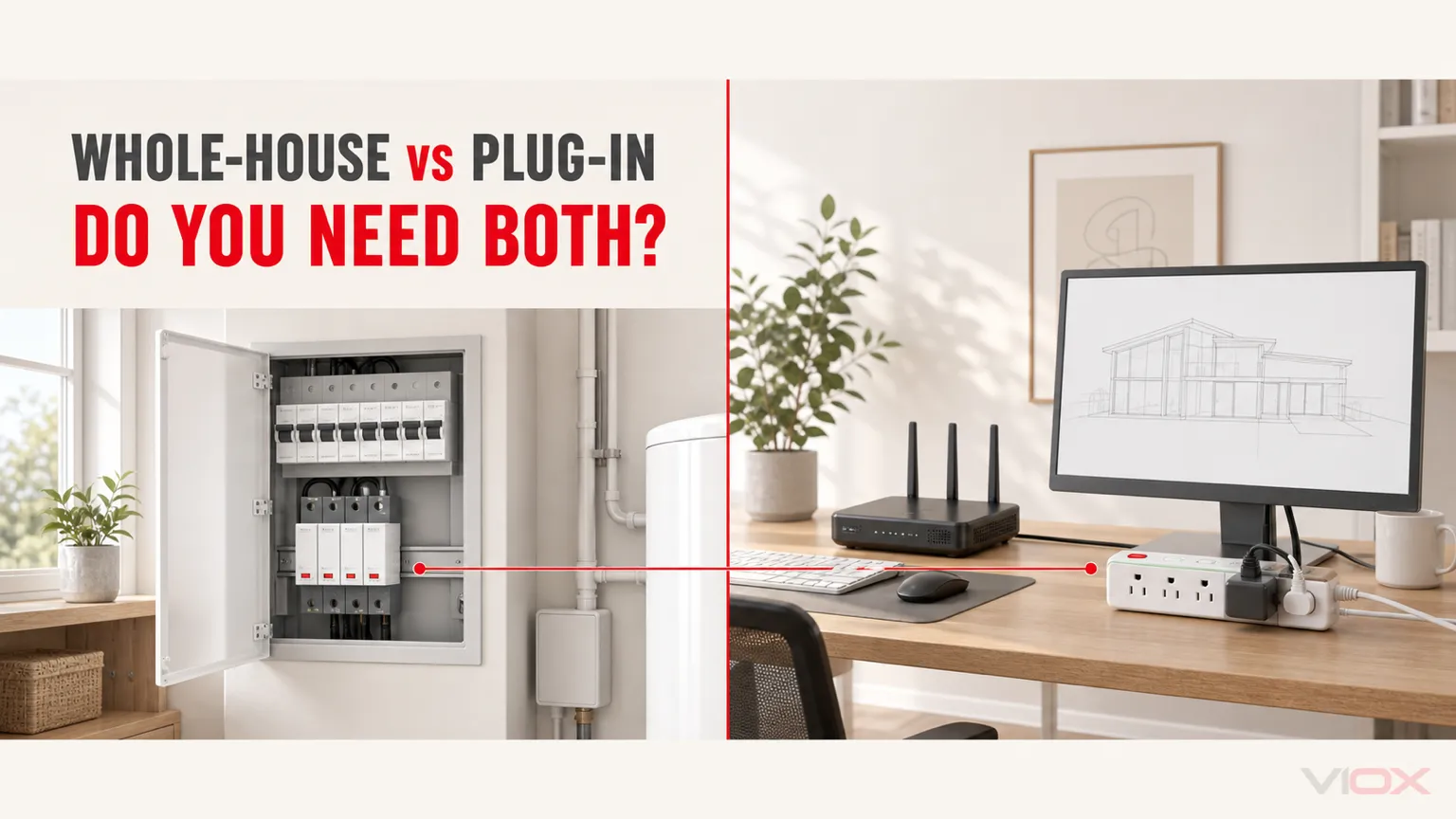
Ein Überspannungsschutzgerät (SPD) für das ganze Haus und ein steckbarer Überspannungsschutz schützen unterschiedliche Bereiche und sind daher kein direkter Ersatz füreinander. Ein im Verteilerschrank montiertes SPD bietet einen umfassenden Schutz für nachgeschaltete Stromkreise und festverdrahtete Verbraucher. Ein steckbares SPD schützt nur die daran angeschlossenen Geräte und kann einen zusätzlichen Schutz in unmittelbarer Nähe empfindlicher Elektronik bieten.
Viele selbstgenutzte Eigenheime profitieren von beiden Schutzebenen. Ein SPD im Verteiler hat meist Vorrang, wenn das Haus elektronische HVAC-Steuerungen, Wärmepumpen, Brunnenpumpen, intelligente Haushaltsgeräte, ein EV-Ladegerät oder andere festverdrahtete Geräte enthält. Steckbare SPDs bleiben für Computer, Netzwerkgeräte, Fernsehgeräte und andere empfindliche Verbraucher nützlich. Mieter oder Bewohner ohne Zugang zum Verteilerschrank müssen möglicherweise mit einem steckbaren Überspannungsschutz beginnen.
Eine einfache Steckdosenleiste ist etwas anderes: Sie bietet möglicherweise zusätzliche Steckdosen und einen Überlastschutz, ohne jedoch einen Überspannungsschutz zu gewährleisten. Wenn diese Unterscheidung Ihre Hauptfrage ist, lesen Sie unseren Leitfaden zum Unterschied zwischen Steckdosenleiste und Überspannungsschutz.
SPD für das ganze Haus vs. steckbares SPD: Schneller Vergleich
| Entscheidungsfaktor | SPD für das ganze Haus oder den Verteiler | Steckbares SPD |
|---|---|---|
| Installationspunkt | Service-Equipment, Hauptschalttafel oder Verteiler, abhängig vom Produkt und den geltenden Vorschriften | Steckdose in der Nähe des Geräts; kann kabelgebunden, als Direktstecker oder in die Steckdose integriert sein |
| Schutzumfang | Bietet einen Schutzpfad für nachgeschaltete Stromkreise, Steckdosen und fest verdrahtete Geräte | Schützt nur Geräte, die über dieses Gerät angeschlossen sind |
| Hauptstärke | Umfassender Schutz auf der Ebene der Stromverteilung | Zusätzlicher Schutz in der Nähe ausgewählter empfindlicher Geräte |
| Hauptbeschränkung | Schützt nicht automatisch Koaxial-, Telefon-, Ethernet-, Antennen- oder andere Nicht-Strom-Eingangspfade | Kann keine anderen Steckdosen, Stromkreise oder fest verdrahteten Geräte schützen |
| Einrichtung | Erfordert normalerweise einen qualifizierten Elektriker sowie Zugang zur Wartungs- oder Schaltschrankausrüstung | Vom Benutzer anschließbar, wenn genau wie gekennzeichnet und angewiesen verwendet |
| Produktüberprüfung | Systemspannung, Erdungsanordnung, Schutzmodi, Typ, Spannungsschutz-Nennwert oder -pegel, Ableitstrom-Nennwerte, Kurzschlusskoordination und Statusanzeige | Systemspannung, Produktzertifizierung für den Markt, Spannungsschutzleistung, Lastnennwert, Schutzstatusanzeige und Herstelleranweisungen |
| Beste unmittelbare Verwendung | Häuser mit Zugang zum Schaltschrank, mehreren Stromkreisen und wichtigen fest verdrahteten elektronischen Lasten | Mieter, einzelne empfindliche Lasten oder eine zusätzliche Schutzstufe am Einsatzort |
| Kann er den anderen ersetzen? | Nicht in jeder Anwendung | Nicht in jeder Anwendung |
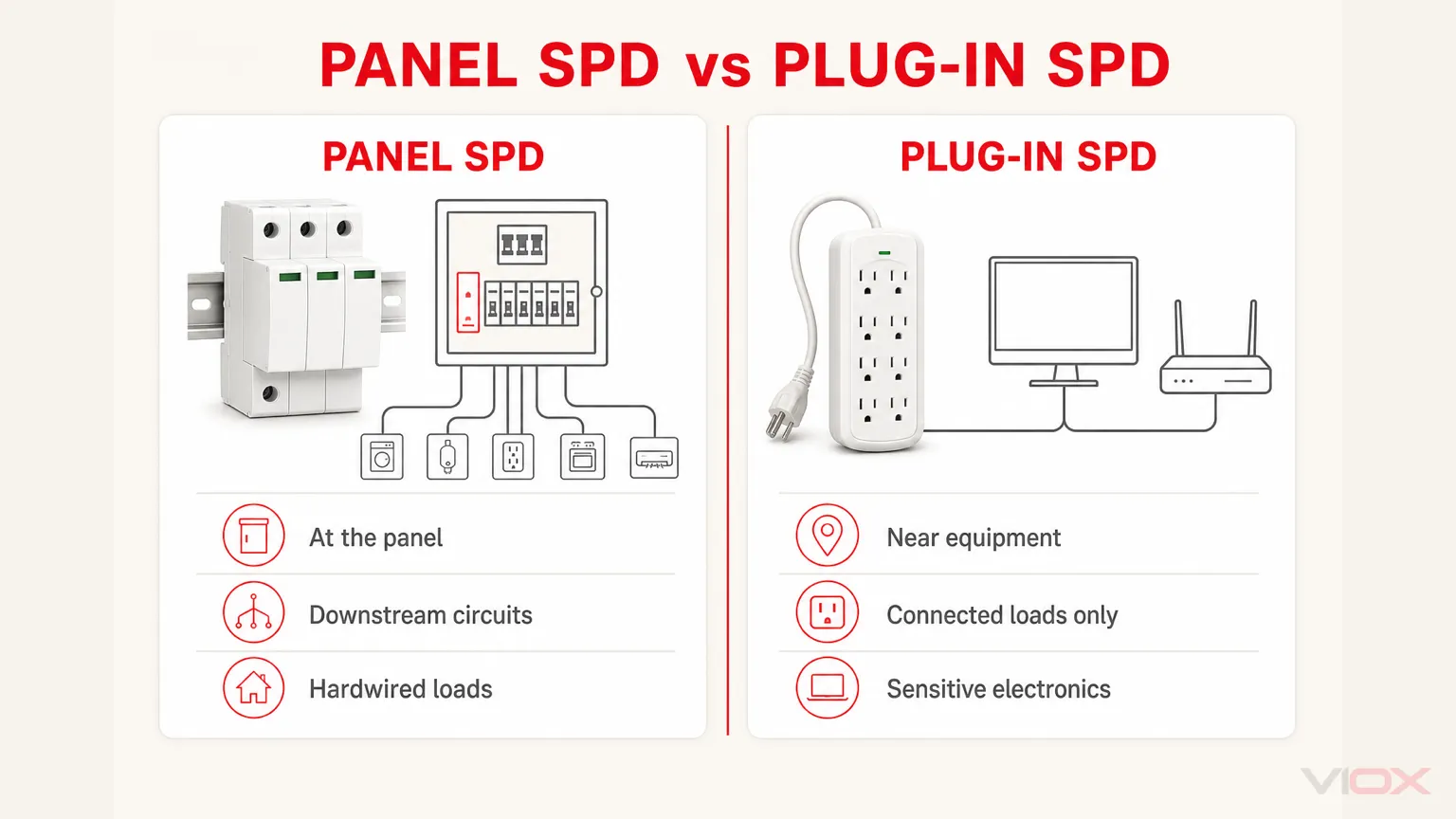
Ein SPD begrenzt transiente Überspannungen; es regelt keine Spannungsversorgung, die dauerhaft zu hoch oder zu niedrig bleibt. Für das Funktionsprinzip und die funktionalen Grenzen beginnen Sie mit der Wirkungsweise eines Überspannungsschutzgeräts.
Schnellentscheidungsmatrix: Schaltschrank, Steckbar, Beides oder Keines von beidem?
Verwenden Sie diese Matrix, bevor Sie Produktnennwerte vergleichen.
| Ihre Situation | Höchste Priorität | 为什么 | Was noch zu prüfen ist |
|---|---|---|---|
| Sie sind Eigentümer des Hauses, können den Schaltschrank modifizieren und verfügen über wichtige festverdrahtete elektronische Geräte | SPD für das ganze Haus oder den Verteiler | Ein Steckgerät kann keine Geräte schützen, die nicht darüber angeschlossen sind | Empfindliche Stecklasten, Signal-/Dateneingangspfade und Produktkompatibilität |
| Sie wohnen zur Miete oder haben keinen Zugang zur Unterverteilung | Steckbarer SPD an ausgewählten Geräten | Es bietet eine verfügbare Schutzebene direkt am Einsatzort ohne Arbeiten an der Verteilung | Ob das Gebäude bereits über einen vorgeschalteten Schutz verfügt und ob auch Daten-/Koaxialleitungen geschützt werden müssen |
| Sie haben sowohl fest verdrahtete elektronische Lasten als auch empfindliche Steckgeräte | Beide | Die Geräte schützen unterschiedliche Standorte und können eine gestufte Schutzstrategie bilden | Koordinierung, Installationsanweisungen und andere leitfähige Eintrittspfade |
| Ihr Hauptproblem ist dauerhaft hohe Spannung, niedrige Spannung, wiederholtes Dimmen oder eine instabile Stromversorgung | Nicht als Komplettlösung | SPD schützen vor kurzzeitigen Transienten, nicht vor jedem Zustand der Spannungsqualität | Spannungsüberwachung, Versorgungsdiagnose, Verdrahtungsfehler und die geeignete Spannungsschutzfunktion |
| Das Gebäude verfügt über ein externes Blitzschutzsystem oder ist einer hohen Blitzbelastung ausgesetzt | Koordinierte Auslegung, oft unter Einbeziehung mehrerer SPD-Standorte | Blitzschutz umfasst Potenzialausgleich, Stromkreise, Signalkreise und Installationsgrenzen | Risikobewertung und Auslegung gemäß den geltenden lokalen Blitzschutz- und Installationsvorschriften |
| Das Gerät empfängt Strom sowie Koaxial-, Antennen-, Ethernet-, Telefon- oder Steuerkabel | Netz-SPD sowie geeigneter Schutz für die anderen Schnittstellen | Ein Überspannungsimpuls kann das Gerät über jeden angeschlossenen leitfähigen Pfad erreichen | Schnittstellenspannung, Bandbreite, Erdung, Schirmung und Potenzialausgleich |
Die Entscheidung lautet daher nicht “Welches Gerät ist besser?”, sondern “Welche Schutzpfade benötigt dieses Haus?”
Was ein hausweiter SPD schützt
Ein hausweiter SPD wird am oder in der Nähe des Anschlussschranks oder der Verteilung installiert. Während des Normalbetriebs verbleiben seine Schutzelemente im Standby-Zustand. Wenn eine transiente Überspannung die Spannung über einem geschützten Modus anhebt, stellt der SPD einen kontrollierten Pfad für den Stoßstrom bereit und begrenzt die Spannungsbelastung, die auf nachgeschaltete Geräte einwirkt.
Der praktische Vorteil liegt in der Abdeckung. Ein korrekt ausgewähltes und installiertes SPD im Schaltschrank kann zum Schutz beitragen für:
- Abzweigstromkreise im gesamten Haus;
- fest verdrahtete HLK-Steuerungen und Wärmepumpen;
- fest installierte Pumpen, Garagenausstattung, Lichtsteuerungen und Sicherheitssysteme;
- Steckdosenstromkreise und die daran angeschlossenen Geräte;
- nachgeschaltete Verteiler, abhängig vom Systemaufbau und der Koordination.
Das bedeutet nicht, dass jedes angeschlossene Gerät bei einer Überspannung die gleiche Spannung erfährt. Die tatsächliche Leistung hängt von den deklarierten Eigenschaften des SPD, dem Überspannungspfad, dem Schutzmodus, der Leitungsführung, der Erdung, der Schrankkonfiguration und der Impedanz der Anschlüsse ab. Lange oder in Schleifen verlegte Anschlussleitungen können bei einem schnellen Stoßstrom die Spannung erhöhen, selbst wenn das SPD selbst einen geeigneten Laborbemessungswert aufweist.
Was “ganzes Haus” nicht bedeutet
Ein SPD in einer Verteilung bildet keinen undurchdringlichen Schutzschild um das Gebäude. Insbesondere leistet es für sich allein nicht:
- die Garantie, dass die Ausrüstung bei jedem Blitzereignis unversehrt bleibt;
- den Ersatz eines externen Blitzschutzsystems, wo ein solches erforderlich ist;
- die Korrektur einer mangelhaften Erdung oder eines unzureichenden Potenzialausgleichs;
- den Schutz eines ungeschützten Koaxial-, Telefon-, Ethernet-, Antennen- oder Steuerkabels;
- die Regulierung von andauernder Überspannung oder Unterspannung;
- den Ersatz von Überstromschutzeinrichtungen, Erdschlussschutz oder anderen erforderlichen Sicherheitseinrichtungen.
Leser, die die Blitzgefährdung bewerten, sollten separat prüfen was ein SPD gegen Blitzeinschläge leisten kann und was nicht.
Was ein steckbarer Überspannungsschutz schützt
Ein steckbares SPD wird an der Verbrauchsstelle installiert. In der nordamerikanischen Terminologie, identifiziert UL Solutions kabelgebundene, direkt steckbare und steckdosenartige Produkte im Kontext von Typ 3 SPD. Die genaue Kennzeichnung und die Installationsbedingungen müssen dennoch am Produkt überprüft werden.
Ein steckbares SPD kann eine lokale Schutzstufe für Geräte bieten wie:
- Desktop-Computer und Bildschirme;
- Router, Switches und andere Netzwerkgeräte;
- Fernseher und audiovisuelle Systeme;
- Heimbürogeräte;
- andere steckerfertige Elektronik innerhalb der Lastnennwerte und Anweisungen des Geräts.
Der Wirkungsbereich ist ebenso wichtig: Er schützt nur die daran angeschlossenen Lasten. Er kann keine HLK-Steuerplatine, keine fest verdrahtete Wärmepumpe, keinen anderen Raum und keinen separaten Abzweigstromkreis schützen.
Eine Steckdosenleiste ist nicht automatisch ein Überspannungsschutz
Eine einfache Steckdosenleiste dient primär zur Bereitstellung zusätzlicher Steckdosen. Sie kann einen Schalter und ein Überstromschutzelement enthalten, ohne über ein SPD zu verfügen. ESFI warnt ebenfalls davor, dass nicht alle Steckdosenleisten einen Überspannungsschutz bieten. Achten Sie auf Produktkennzeichnungen, die das Gerät als Überspannungsschutzgerät oder SPD gemäß dem in Ihrem Markt verwendeten Zertifizierungssystem ausweisen. Eine allgemeine “Power”-, “On”- oder “Grounded”-Anzeige ist nicht notwendigerweise eine Statusanzeige für den Schutz.
Bewerten Sie bei steckbaren Produkten die vollständige Deklaration anstelle einer einzelnen Marketingnummer. Eine Joule-Angabe kann herstellerspezifische Informationen zur Energieabsorption liefern, ersetzt jedoch nicht die Prüfung auf Spannungskompatibilität, Schutzleistung, Zertifizierung, Statusanzeige und sichere Lastnutzung. Die Grenzen dieser Kennzahl werden behandelt im Leitfaden für Joule-Angaben bei Überspannungsschutzgeräten.
Benötigen Sie nach der Installation eines SPD für das gesamte Haus weiterhin steckbare Überspannungsschutzgeräte?
Oft ja – aber nicht als allgemeingültige Regel für jede Steckdose.
Die Leitfaden für Wohngebäude des National Institute of Standards and Technology (NIST) beschreibt Architekturen, die ein Schutzgerät an der Hauptverteilung vorsehen, wobei steckbare Schutzgeräte in der Nähe besonders empfindlicher Geräte beibehalten werden. Das vorgeschaltete Gerät deckt den breiteren Pfad der elektrischen Energieverteilung ab; das nachgeschaltete Gerät ergänzt den Schutz an ausgewählten Lasten.
Steckbare SPD sind nach einem SPD im Hauptverteiler am ehesten zu rechtfertigen, wenn:
- die Ausrüstung empfindlich, wertvoll oder schwer zu ersetzen ist;
- mehrere zusammengehörige Geräte teilen sich einen Standort, wie etwa ein Heimbüro oder einen Netzwerkschrank;
- der Produkthersteller empfiehlt einen koordinierten vorgeschalteten Schutz;
- der Stromkreis ist nur eine von mehreren Schnittstellen, die an diesem Gerät geschützt werden;
- die Anlage wurde dahingehend bewertet, dass ein mehrstufiger Schutz erforderlich ist.
Sie sind nicht automatisch für jede Lampe, jedes Ladegerät oder jedes Gerät erforderlich. Das Hinzufügen von Geräten ohne Prüfung ihrer Kennzeichnungen, Lastgrenzen, ihres Zustands und ihrer Koordination führt nicht zu einem besseren Schutz.
Wie mehrstufiger Überspannungsschutz funktioniert
Beim mehrstufigen Schutz werden SPDs an verschiedenen Schnittstellen des elektrischen Systems platziert. Ein SPD in der Verteilung schafft einen vorgeschalteten Pfad für den Stoßstrom. Ein steckbares SPD kann eine weitere Schutzstufe in der Nähe ausgewählter Geräte bieten. Zusätzliche SPDs können an nachgeschalteten Verteilern oder an anderen Schnittstellen eingesetzt werden, wenn die Systemarchitektur dies erfordert.
Das technische Prinzip ist einfach, aber die Strom- und Spannungsaufteilung ist nicht universell. Sie hängt ab von:
- die Spannungs-Strom-Kennlinien jedes SPD;
- die bereitgestellten Schutzmodi;
- die Leiterimpedanz zwischen den Stufen;
- die Stoßwellenform und die Quelle;
- die Erdungs- und Potenzialausgleichsanordnung;
- die nachgeschalteten Betriebsmittel und deren angeschlossene Schnittstellen;
- die Koordinations- und Installationsanforderungen des Herstellers.
Aus diesem Grund ist es technisch nicht fundiert zu behaupten, dass ein Schaltschrank-SPD einen bestimmten Stoßstrom immer auf einen festen Fehlerstrom reduziert oder dass ein steckbares SPD dem Betriebsmittel immer eine exakte Spannung bereitstellt. Diese Werte erfordern einen definierten Prüfkreis, Produkte, Modi, Wellenformen und Messpunkte.
Die relevante praktische Regel lautet:
Verwenden Sie einen vorgeschalteten SPD, der für die jeweilige Position in der Einspeisung oder Verteilung geeignet ist, und fügen Sie dann einen Schutz am Einsatzort hinzu, wenn die geschützte Last, die Exponierung und die Produktanweisungen dies rechtfertigen. Gehen Sie nicht davon aus, dass zwei unabhängige Produkte koordiniert sind, nur weil beide als “Überspannungsschutz” gekennzeichnet sind.”
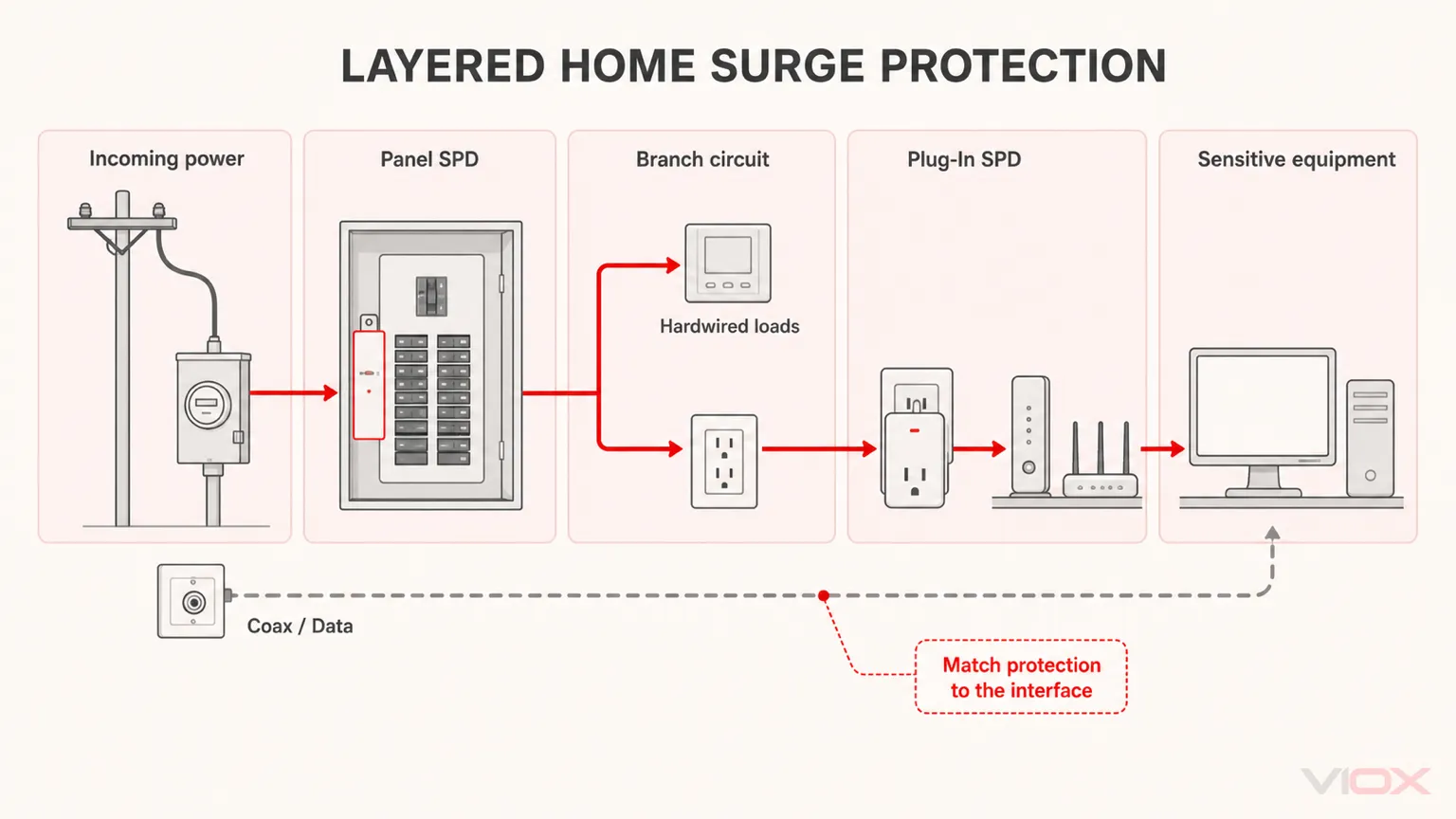
Für einen tiefergehenden Vergleich der geprüften SPD-Positionen siehe Typ 1 vs. Typ 2 vs. Typ 3 SPD.
Schutzpfade, die beide Geräte übersehen können
Die meisten Vergleiche im Wohnbereich enden bei den Stromleitern. Das lässt die wichtigste Systemgrenze unerklärt.
Koaxial-, Ethernet-, Telefon-, Antennen- und Steuerleitungen
Geräte können an mehr als ein leitfähiges Netzwerk angeschlossen sein. Ein Fernseher kann Strom und ein Koaxialkabel empfangen. Ein Router kann AC-Strom und eine Ethernet-Verbindung für den Außenbereich empfangen. Eine Sicherheitssteuerung kann an Stromversorgung, Sensoren und Kommunikationsleitungen angeschlossen sein.
Ein SPD für die Stromversorgung begrenzt nicht automatisch einen transienten Vorgang, der über diese anderen Leiter ankommt. Wenn zusätzliche Schnittstellen Schutz erfordern, muss der gewählte Signal-SPD auf die Schnittstellenspannung, die Signalisierungsmethode, die Bandbreite, den Stecker, die Schirmungsanordnung, die Erdung und die Installationsumgebung abgestimmt sein. Betrachten Sie dies als separate Aufgabe zur Schnittstellenauswahl, anstatt einen Signalschutz basierend auf dem kA-Nennwert des Stromversorgungs-SPD auszuwählen.
Anhaltende Überspannung und Unterspannung
Ein SPD ist für transiente Überspannung vorgesehen. Es ist nicht die vollständige Abhilfe für eine Versorgung, die dauerhaft über oder unter ihrem normalen Bereich liegt, bei wiederholten Spannungseinbrüchen, einem fehlenden Neutralleiter, falscher Verdrahtung oder anderen anhaltenden Fehlern der Spannungsqualität. Diese Bedingungen erfordern eine Diagnose und möglicherweise eine Spannungsüberwachungs- oder Abschaltfunktion. Der Unterschied wird erklärt in Spannungsschutz vs. Überspannungsschutz.
Direkter Blitzschutz und baulicher Schutz
Weder ein Steckdosenprodukt noch ein SPD für die Verteilung sollten als Garantie gegen einen direkten Blitzeinschlag dargestellt werden. Eine vollständige Blitzschutzstrategie kann den Abfang des Einschlags, Ableitungen, Potentialausgleich, Erdung, SPD für die Stromversorgung sowie den Schutz für eingehende Signaldienste umfassen. Die Anforderungen hängen vom Gebäude, der Exposition und den örtlichen Vorschriften ab.
Welche Strategie passt zu Ihrem Zuhause?
Hausbesitzer mit HLK-Elektronik und mehreren empfindlichen steckbaren Verbrauchern
Priorisieren Sie ein SPD für die Verteilung, da wichtige Geräte fest verdrahtet sind und sich über mehrere Stromkreise verteilen. Ergänzen Sie steckbare SPDs an konzentrierten empfindlichen Lasten wie im Heimbüro, an Netzwerkgeräten oder an audiovisuellen Systemen, wo eine zusätzliche Schutzstufe am Einsatzort gerechtfertigt ist.
Entscheidung: Beides.
Mieter ohne Zugang zu Service- oder Schalttafelausrüstung
Verwenden Sie entsprechend zertifizierte Steckdosen-SPDs an ausgewählten Geräten. Fragen Sie den Gebäudemanager, ob das Gebäude bereits über einen vorgeschalteten Überspannungsschutz verfügt. Öffnen oder modifizieren Sie keine allgemeinen elektrischen Anlagen.
Entscheidung: Steckdosen-Schutz zuerst.
Zuhause mit hauptsächlich fest verdrahteten Geräten und wenigen empfindlichen Steckdosen-Geräten
Ein Schalttafel-SPD bietet einen größeren Nutzen als der Kauf mehrerer Steckdosen-Einheiten, die die fest verdrahteten Lasten nicht schützen können. Ein Schutz am Einsatzort kann selektiv statt automatisch hinzugefügt werden.
Entscheidung: Schalttafel-Schutz zuerst; fügen Sie bei Bedarf Steckdosen-SPDs hinzu.
Zuhause mit langen Perioden hoher Spannung oder wiederholtem Flackern der Beleuchtung
Betrachten Sie dies nicht als ein einfaches Problem beim Kauf von Überspannungsschutzgeräten. Lassen Sie die Stromversorgung, den Neutralleiter, die Anschlüsse, die Last und das Spannungsverhalten überprüfen. Ein SPD kann Teil des Transienten-Schutzsystems bleiben, löst jedoch nicht das zugrunde liegende anhaltende Problem.
Entscheidung: Zuerst die Diagnose; keine der beiden SPD-Typen ist die Komplettlösung.
Haus mit Dachantennen, Außen-Datenkabeln oder mehreren Einspeisungen
Der Schutz des Stromkreises allein lässt andere Pfade offen. Das elektrische System benötigt möglicherweise einen koordinierten Schutz für Strom und Signale zusammen mit einem korrekten Potenzialausgleich an den Eintrittspunkten.
Entscheidung: Koordinierter Mehrwegeschutz, nicht einfach nur mehr Steckdosenleisten.
Was vor dem Vergleich von Produkten zu prüfen ist
Der Vergleich bestimmt den Schutzort. Er schließt die Produktauswahl nicht ab.
Überprüfung des SPD am Schaltschrank
- AC-Systemspannung und -konfiguration;
- Erdungskonzept und erforderliche Schutzarten;
- zulässige Einbaulage und SPD-Typ gemäß dem geltenden Rahmenwerk;
- Bemessungsspannung für den Dauerbetrieb;
- deklarierter Spannungsschutzpegel oder Spannungsschutzbemessungswert;
- Ableitstrom-Bemessungswerte unter ihren angegebenen Testwellenformen;
- verfügbarer Fehlerstrom und erforderliche Kurzschluss-/Backupschutz-Koordination;
- Leitungsführung und Herstellerangaben zur Leitungslänge;
- Schutzstatusanzeige und, falls erforderlich, Fernsignalisierung;
- vom Projekt oder der Zuständigkeit geforderter Zertifizierungsnachweis.
Überprüfung des steckbaren SPD
- geeignete Versorgungsspannung und Stecker-/Steckdosensystem;
- für den Markt angemessene Zertifizierung oder Zulassung;
- deklarierte Spannungsschutzleistung gemäß der anwendbaren Prüfmethode;
- Beschränkungen für Laststrom und angeschlossene Last;
- eine dedizierte Anzeige des Schutzstatus oder Trennverhalten;
- Herstellerbeschränkungen für die Installation, Verlängerungskabel, Steckdosenleisten und angeschlossene Geräte;
- Schutz für Nicht-Leistungsschnittstellen, sofern diese vorhanden sind.
Vergleichen Sie den IEC Up-Wert eines SPD für Schalttafeln nicht direkt mit dem UL Voltage Protection Rating (VPR) eines Steckprodukts, als wären es identische Messgrößen. Vergleichen Sie Imax, In, SCCR, Isccr und Joule nicht als austauschbare Messwerte. Jede Deklaration beantwortet eine andere Frage innerhalb eines festgelegten Prüfrahmens. Verwenden Sie Wie man ein Datenblatt für Überspannungsschutzgeräte liest beim Übergang von der Schutzstrategie zur tatsächlichen Spezifikation.
Grenzen der Normen: UL/NEC und IEC sind kein einheitliches Klassifizierungssystem
Die Begriffe Typ 1, Typ 2 und Typ 3 kommen in mehr als einer Normenumgebung vor, aber die Definitionen, Prüfungen, Nennwerte und Installationsregeln müssen innerhalb des jeweils anwendbaren Rahmens interpretiert werden.
| Kontext | Was ist zu überprüfen? | Wichtige Abgrenzung |
|---|---|---|
| Nordamerikanische Produktbewertung | Anwendbarer UL 1449 Typ, Produktzulassung, MCOV, VPR, In, SCCR, Schutzmodi und Installationsanweisungen | UL Solutions umfasst fest angeschlossene Typen 1–3 sowie kabelgebundene, direkt steckbare und Typ 3-Produkte für Steckdosen; verwenden Sie die exakte Kennzeichnung des Produkts |
| Installationsvorschriften der Vereinigten Staaten | Angewandte Ausgabe des National Electrical Code, lokale Ergänzungen, Anforderungen an Hausanschluss/Zuleitung sowie zuständige Behörde | NEC-Anforderungen sind nicht überall automatisch Gesetz; Einführung und Änderungen variieren |
| IEC AC-Niederspannungs-SPD | IEC 61643-11 zusammen mit IEC 61643-01, angegebener Typ, Uc, Up, In, Imax oder Iimp, wo zutreffend, Schutzmodi und Kurzschlussangaben | IEC-Begriffe und Testergebnisse sollten nicht durch eine einfache Eins-zu-eins-Tabelle in UL-Werte umgerechnet werden |
In den Vereinigten Staaten, NEC 230.67 befasst sich mit gelisteten Typ 1 oder Typ 2 SPDs für Versorgungen, die bestimmte Gebäude versorgen, einschließlich Wohneinheiten. Wenden Sie die Anforderung gemäß der NEC-Ausgabe und den von der lokalen Behörde verabschiedeten Änderungen an. Machen Sie aus der Existenz einer NEC-Anforderung keine globale Aussage, dass jedes bestehende Haus in jeder Gerichtsbarkeit auf die gleiche Weise nachgerüstet werden muss.
Für IEC-Märkte, IEC 61643-11:2025 deckt AC-Niederspannungs-SPD ab und ist dazu gedacht, zusammen mit der neuesten Ausgabe der IEC 61643-01 gelesen zu werden. Produktanforderungen müssen weiterhin mit nationalen Installationsvorschriften und dem tatsächlichen elektrischen System kombiniert werden.
Grenzen für Installation und Wartung
Die Installation von Schaltschrank-SPD umfasst Versorgungs- oder Verteilungsausrüstung und sollte von einer qualifizierten Person gemäß den geltenden lokalen Vorschriften durchgeführt werden. Der Installateur muss den Stromkreis, die Produktanweisungen, die Anschlussmodi, die Anforderungen an Überstrom- oder Backup-Schutz, den verfügbaren Fehlerstrom, die Leitungsführung und das Verfahren zur sicheren Trennung überprüfen.
Die Installationsqualität ist Teil der Überspannungsleistung. Das Vermeiden unnötiger Leitungslängen, Schleifen und gemeinsamer Impedanz kann genauso wichtig sein wie die Auswahl einer geeigneten Nennleistung. Siehe Installationsfehler bei SPD in Bezug auf Leitungslänge, Erdung, Verdrahtungskonfiguration und Statusanzeige.
Nach der Installation:
- identifizieren Sie, welche Anzeige spezifisch den Schutzstatus angibt;
- verwechseln Sie nicht eine Betriebsanzeige mit einer Anzeige für den Schutzstatus;
- befolgen Sie die Inspektions- und Austauschhinweise des Herstellers;
- überprüfen Sie das Schutzsystem nach einem bekannten schwerwiegenden Ereignis, wenn die Anweisungen oder das Standortverfahren dies erfordern;
- ersetzen Sie ein ausgefallenes oder abgetrenntes Modul/Gerät durch ein kompatibles Produkt;
- wenden Sie kein allgemeines Austauschalter auf jeden Schaltschrank und jeden steckbaren SPD an.
Ob ein schaltbarer steckbarer SPD bei ausgeschaltetem Schalter weiterhin Schutz bietet, hängt von seiner internen Schaltung und dem Produktdesign ab. Leiten Sie die Antwort nicht allein aus der Schalterstellung ab. Wenn eine vollständige Trennung erforderlich ist und dies sicher möglich ist, trennen Sie das Gerät von der Stromversorgung und denken Sie daran, dass andere leitfähige Verbindungen weiterhin bestehen können.
Für Hinweise zum zustandsbasierten Austausch siehe Wie bestimmt man, wann ein Überspannungsschutzgerät das Ende seiner Lebensdauer erreicht hat?.
Entscheidungsregel
Wählen Sie einen zuerst SPD für das gesamte Haus oder den Verteiler wenn das Hauptziel ein umfassender Schutz für nachgeschaltete Stromkreise und fest verdrahtete elektronische Geräte ist.
Wählen zuerst steckbare SPD wenn kein Zugang zum Verteiler besteht oder wenn ausgewählte steckbare Elektronik eine unmittelbare Schutzebene direkt am Einsatzort benötigt.
Wählen beide wenn das Haus wichtige fest verdrahtete Lasten und empfindliche steckbare Geräte besitzt, vorausgesetzt, die Produkte sind für ihre Einsatzorte geeignet und werden gemäß den geltenden Anweisungen verwendet.
Wählen keines von beidem als vollständige Lösung wenn das eigentliche Problem eine anhaltende Spannungsabweichung, ein Verdrahtungsfehler, ein fehlender Potentialausgleich, ein ungeschützter Daten-/Signalpfad oder eine Blitzschutzanforderung ist, die ein umfassenderes Systemdesign erfordert.
Die beste Strategie ist nicht die mit dem höchsten kA- oder Joule-Wert. Es ist diejenige, die die relevanten Überspannungspfade mit korrekt ausgewählten, installierten und wartungsfähigen Geräten schließt. Um nach der Definition der Schutzstrategie die verfügbaren Optionen für den Schaltschrankeinbau zu bewerten, prüfen Sie das VIOX SPD-Produktfamilie und fordern Sie modellspezifische Leistungsdaten und Zertifizierungsunterlagen für den Zielmarkt an.
Geprüfte Quellen
- NIST Special Publication 960-6 — Surges Happen! How to Protect the Appliances in Your Home
- NIST Surge Protection Anthology — Coordination of Cascaded Surge-Protective Devices
- Electrical Safety Foundation International — Surge Protection: Keeping Your Electronics and Home Safe
- UL Solutions — Surge Protection Device Testing and Certification Services
- NFPA code-development material for NEC 230.67
- IEC 61643-11:2025 — Überspannungsschutzgeräte für den Einsatz in AC-Niederspannungsnetzen
- IECEE TRF 61643-111D:2026 — IEC 61643-11:2025 in Verbindung mit IEC 61643-01:2024